Design and Development of a Novel Method to
Secure Vehicular Cloud Computing
Environment
Navya.B.R1, Swamy.L.N2, Shobha.S3, Madhu Chandra.G4
M. Tech Student, Department of CSE, VTU-CPGSB, Muddenahalli, Karnataka, India1
Assistant Professor, Department of MCA, VTU-CPGSB, Muddenahalli, Chickballapur, Karnataka, India2
Technical Assistant, Department of CS&E, GITAM School of Technology, Bengaluru, Karnataka, India3
Assistant Professor, Department of ECE, RLJIT, Doddaballapur, Karnataka, India4
ABSTRACT: In recent period of modern wireless communication and technology permits Vehicular Ad-hoc Networks
(VANETs), which has been conceptualized and emerged to offers a capable, intelligent transport management. Vehicular Ad hoc networks (VANETs) are measured to have a collision on efficient statement to avoid traffic congestion problems in the present situation. Though, it is one of the major researched regions for its superior impact on enhancing the road traffic safety submissions for both passengers as well as drivers, but extremely less consideration is given to the security distinctiveness. The main purpose of the paper is to plan a scalable and safe cloud-based vehicular ad-hoc network to optimize the security disputes and data privacy problems in vehicular infrastructure.
KEYWORDS: Application Unit; Cloud Computing; VANET.
I. INTRODUCTION
VANET stands for Vehicle Adhoc Networks (VANETs). It is particular form of MANET and its present’s vehicle-to-vehicle communication and also illustrates vehicle-to-infrastructure communications. Utilizes prepared vehicles as the network nodes. Nodes move at will relative to every another but within the restraints of the road communications. A characteristic Vehicle Adhoc Networks (VANETs) network indication is highlighted below [1-3].
Types of Vehicular Adhoc Networks (VANET)
Basically there are two different types of VANET network scenario may be prepared and interpreted, initially one of the Vehicular Adhoc Network (VANET) topology structures included with dynamic topology configuration which leads to make sure an illustrious wireless ad-hoc network situation and vehicular statement, which doesn’t require any sustain of infrastructure. Secondly, Vehicular Area Network (VANET) which sustains vehicle to infrastructures [4].
a. Vehicle to Vehicle Communication
The nodes connected with Vehicular Area Networks (VANETs) communications typically moves at extremely quick rate. Therefore, a communication situation has been included considering wireless medium for exchanging data (Control Messages) between one vehicle to another vehicle [5].
b. Vehicle to Infrastructure Communication
Vehicle to communications sustains enables statement in between the vehicle and the roadside unit, supplementary exactly a fixed communications operated for radio incidence signal transmission. In vehicular communication, every vehicle is prepared with two dissimilar kinds of units which are On Board Unit (OBU) and Application Units (AU) correspondingly.
c. Applications of Vehicular Adhoc Networks (VANET)
The use of Vehicle Adhoc Network (VANET) in genuine time profitable submissions plays a important role to reduce various challenges throughout the vehicular traffic overcrowding, and an impact and accident prevention.
d. Challenges Associated with Vehicular Adhoc Networks (VANET)
Yet, the major of the study and their future extent towards capable Vehicle Adhoc Network transactions with different technical problems such as management of network, collision control strategies and congestion except very few of them illustrated on security Problems. As the transmitted data packets in Vehicle Ad Hoc Networks (VANETs) hold extremely dangerous information therefore security related messages should not be obtain modified and transported with 100 ms broadcast holdup.
Section I briefly describes overview of Virtual Adhoc Networks (VANETs) techniques. Section II pacts with prior study work, which explicates about the previous work done. Section III describes the proposed system as well as proposes system architecture. Result & Analysis has been described in Section IV. Finally, an Overall conclusion from this document and futuristic work is illustrated in Section V.
vehicular network has increased reputation payable to its numerous applications like suitable management of traffic, consistency of road security. Vehicular cloud (VCs). The challenges include the authentication, complexity, scalability issues among the short range communication. The review study out forms that the executed algorithm assists in civilizing the security systems scalability. Zeadallyet al. [11] has reviewed the recent attempts towards the Vehicle Adhoc Networks (VANETs). In this paper author also demonstrated his review study in statement and distribution towards the Quality of service (QoS).Also, Author have demonstrated the Vehicle Adhoc Networks (VANETs) connected wireless standards (IEEE 802.11.c) and accessed the disadvantage and important of those review studies. The review study has proposed the phase for the future Vehicle Adhoc Networks (VANETs) investigate. The paper has been proposed by Kumar et al. [12] on the conversation towards the dissimilar routing protocols import ants and disadvantages in Vehicle Adhoc Networks (VANETs). In this paper author also stated that the Vehicle Adhoc Networks are the section of Mobile Adhoc Networks (MANETs), which may be accepted for intelligent transport by mitigating or preserves the correct traffic instruments.
III.PROPOSED ALGORITHM
The main principle of the proposed system is to present security with admiration to vehicular data amassed in cloud stands server database. In this examination an encryption and decryption method is executed for the data demonstrate in the cloud sever. In my paper there are three main modules are designed
a. The initial module is the data broadcasting module where the map or district is produced where the vehicles (referred to as nodes) are organized. This is also known as the directed graph formulation which creates vertices and edges beside the measured district. The vertices and edges created from the directed graph formulation are additional sent to vehicular node replica where the model creates a source node and a destination node. The outcome of the source node and the destination nodes are additional sent to the communication module for the reason of broadcast.
b. In the second module engage three common blocks which presents signature design, adversary and customized
message along with an input pair.
Table.1 Input Parameters with their Values
Fig.3. Map Loaded into the Network
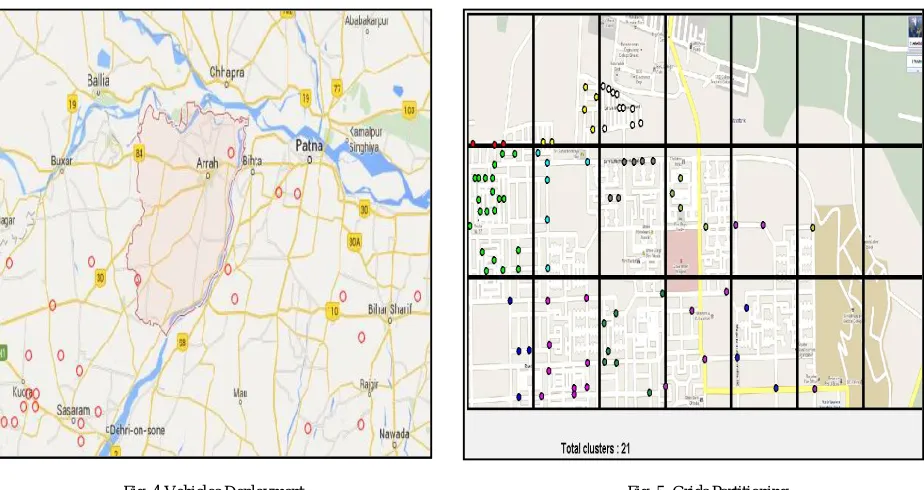
The exploitation of fifty vehicles is been presented in Fig.4, which are pointed by little red circles. The partition of channels into different 21 parts is been represented in Fig.5, which makes a cluster. The cluster head (CD) is indicated with green color which gathers the data from each sensor nodes. In later case the collected / gathered data from the sensors are transferred to the next CD.
Fig. 4.Vehicles Deployment Fig. 5. Grids Partitioning
The Fig.6 shows how the virtual cloud servers (VMs) Deployment in Each Grids of 24 clusters. The Fig.7 shows how the Cloud Environment Simulation with cluster head (CD) is indicated with green color which gathers the data from each sensor nodes.
Input Parameters Values
Vehicles 50
Grid partition 100
Channel capacity 25
Fig.6.VMs Deployment in Each Grids Fig.7. Cloud Environment Simulation
The Fig.8 gives an idea about Network Analysis with cluster head (CD) is indicated with green color which gathers the data from each sensor nodes. The Fig.9 Shows the Node Communication at Round in Grids with the Cluster head (CD) are communicated with the other cluster head.
The Fig.10 is illustrating the Various Channel capacity (grid size vs. call drop), in the graph the pink, red and black color line indicate that the channel capacity= 15, 10 and 5 respectively. The channel capacity is increase, the call drop is decrease.
Fig. 10. Various Channel Capacity (grid size vs. call drop)
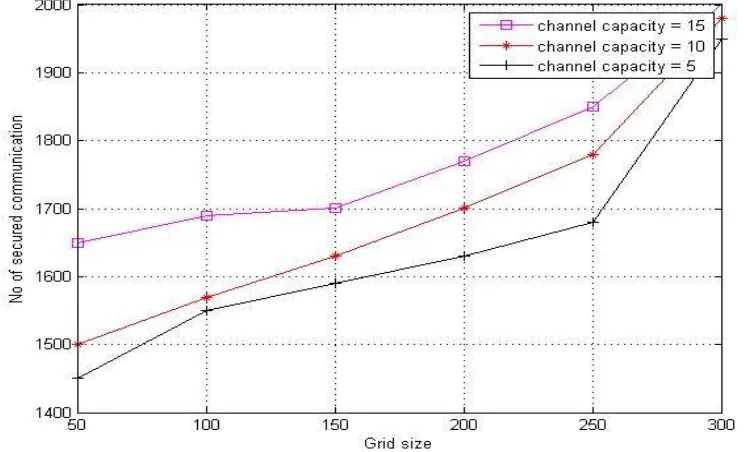
The Fig.11 shows the Various Channel capacity (grid size vs. no of secured communication), in the graph the pink, red and black color line indicate that the channel capacity= 15, 10 and 5 respectively. The channel capacity is increase; the number of secured communication is increase.
V. CONCLUSION AND FUTURE WORK
Nowadays, the term vehicular ad hoc network (VANET) is the new attractive and helpful in wireless communication stands traffic organization. As previous little decades the Vehicle Adhoc Networks (VANETs) has got greatly concentration and is been measured as capable, secure communication model while the apprehension is that only rare amount of the research products have been obtained the market. The safety is the main problem till date for the Vehicle Ad Hoc Networks (VANETs) which is also appropriate for Mobile Adhoc Networks (MANETs) too. Therefore, the report illustrated a method, which has implemented the graph hypothesis for Vehicle Adhoc Networks (VANETs) safety capacities. The proposed system has accepted the data redundancy for displace the predictable node and digital signature is been accepted for the message encryption amongst the nodes. In this paper work, the proposed system may be executed where the additional systematic, synthetic and intelligent transportation is needed with all the security and privacy apprehension. As well the proposed technique may present the possible and solid solutions for the prospect vehicular cloud, computing systems.
REFERENCES
1. S. Arif, S. Olariu, J. Wang, G. Yan, W. Yang, and I. Khalil, “Datacenter at the airport: Reasoning about time-dependent parking lot occupancy,” IEEE Trans. Parallel Distrib. Syst., 2012, [Online]. Available: https:// csdl2.computer.org/csdl/trans/td/preprint/ttd2012990021-abs.html, to be published.
2. S. Olariu, M. Eltoweissy, and M. Younis, “Toward autonomous vehicular clouds,” ICST Trans. Mobile Commun.Comput., vol. 11, no. 7–9, pp. 1– 11, Jul.–Sep. 2011.
3. S. Olariu, I. Khalil, and M. Abuelela, “Taking VANET to the clouds,” Int. J. Pervasive Comput.Commun., vol. 7, no. 1, pp. 7–21, 2011. 4. L. Li, J. Song, F.-Y. Wang, W. Niehsen, and N. Zheng, “IVS 05: New developments and research trends for intelligent vehicles,” IEEE Intell.
Syst., vol. 20, no. 4, pp. 10–14, Jul./Aug. 2005.
5. G. Yan and S. Olariu, “A probabilistic analysis of link duration in vehicular ad hoc networks,” IEEE Trans. Intell. Transp. Syst., vol. 12, no. 4, pp. 1227–1236, Dec. 2011.
6. G. Yan, D. B. Rawat and B. B. Bista, "Towards Secure Vehicular Clouds," Complex, Intelligent and Software Intensive Systems (CISIS), 2012 Sixth International Conference on, Palermo, 2012, pp. 370-375.
7. Yasmeen, M. R., and M. Ramya Devi. "SAAS–A Gateway to Cost Effective Secure Vehicular Clouds." (2014): 275-283.
8. Nkenyereye Lewis and Kyung Hyune Rhee." Towards Secure Virtual Machine Migration in Vehicular Cloud Environment" Advanced Science and Technology Letters (Networking and Communication.) Vol.66, pp.85-89, 2014.
9. Khaza N. Muhammad, MujdatSoyturk, Muhammed N. Avcil, BurakKantarci, Jeanna Matthews. "From Vehicular Networks to Vehicular Clouds in Smart Cities, CHAPTER 8: From vehicular networks to vehicular clouds in smart cities.
10. Whaiduzzaman, Md, et al. "A survey on vehicular cloud computing." Journal of Network and Computer Applications 40 (2014): 325-344. 11. Zeadally, Sherali, et al. "Vehicular ad hoc networks (VANETS): status, results, and challenges." Telecommunication Systems 50.4 (2012):
217-241.
Visvesvaraya Technological University, India. Her research interests are Software Engineering, Data Warehouse and Data Mining, Algorithms.
Mr. Madhu Chandra.G received his B.E degree in ECE from RLJIT, Visvesvaraya Technological University (VTU)