ABSTRACT
POOYA, PEGAH. An Optimization Framework To Improve Patient Safety In The Radiation Therapy Process . (Under the direction of Julie Ivy and Osman Ozaltin.)
Radiation therapy (RT) is an important part of cancer treatment with approximately 50% of cancer patients undergoing RT during the course of their treatment. The risk of error and the concern for patient safety is high in RT as the treatment planning and delivery include complex processes that involve numerous hand-offs among healthcare providers. Despite the use of quality assurance procedures in radiation oncology clinics, errors still occur and sometimes result in devastating consequences including fatal injuries. It is estimated that RT errors occur for up to 5% of patients and the rate of lethal errors is about 1/10,000 patients in the U.S. These numbers highlight the need for adopting a systematic approach to improve patient safety in the RT.
The use of safety barriers (SB) in RT is widely recognized for detecting potential human and non-human errors before they reach the patient. Despite the critical role of SBs in ensuring patient safety, very little research effort has been focused on the potential impact, cost or optimal implementation of SBs. While it may seem desirable to have as many safety barriers as possible to improve patient safety and process reliability, performing too many SBs prolongs the overall treatment time and cause extra workload that lead to additional errors.
©Copyright 2017 by Pegah Pooya
An Optimization Framework To Improve Patient Safety In The Radiation Therapy Process
by Pegah Pooya
A dissertation submitted to the Graduate Faculty of North Carolina State University
in final fulfillment of the requirements for the Degree of
Doctor of Philosophy
Industrial Engineering
Raleigh, North Carolina 2017
APPROVED BY:
Julie Ivy
Co-chair of Advisory Committee
Osman Ozaltin
Co-chair of Advisory Committee
Maria Mayorga Yahya Fathi
DEDICATION
To my loving parents,Saeed and Shahnaz, To my dearest brother, Navid,
and
BIOGRAPHY
ACKNOWLEDGEMENTS
First and foremost, I wish to thank my advisors Dr. Julie S. Ivy and Dr. Osman Ozaltin for all their support and guidance throughout my graduate studies. I am truly grateful to have you as my advisors. You have always been generous in sharing your valuable knowledge and wisdom which helped me learn and grow in many ways.
I also wish to thank the other members of my committee, Dr. Maria Mayorga, Dr. Yahya Fathi, and Dr. Lukasz Mazur for providing thoughtful suggestions on my research work and dissertation.
I would like to thank our collaborators, Dr. Lukasz Mazur, Dr. Lawrence Marks, Dr. Bhisham Chera, Kathy Burkhardt, Dr. Prithima Mosaly and Gregg Tracton from the Department of Radiation Oncology at University of North Carolina (UNC) Lineberger Comprehensive Cancer Center for their support and invaluable input to this research. Without their support, it would not have been possible to conduct this research. In particular, I am grateful to Dr. Lukasz Mazur for being a great mentor and for his constant enthusiasm and encouragement.
I would like to thank my friends and fellow graduate students at North Carolina State University for their support and friendship. I am so lucky to have known you.
TABLE OF CONTENTS
LIST OF TABLES . . . vii
LIST OF FIGURES . . . ix
Chapter 1 Introduction . . . 1
1.1 Patient Safety in Healthcare . . . 1
1.2 Patient Safety in Radiation Therapy . . . 2
1.3 Classification of Errors . . . 4
1.4 Quality Assurance (QA) System in Radiation Therapy . . . 5
1.5 Safety Barrier (SB) . . . 6
1.6 Error Reporting System . . . 8
1.7 Research Objective . . . 8
1.8 Challenge 1: Conflicting Objectives . . . 9
1.9 Challenge 2: Quantifying The Performance of SBs . . . 9
1.10 Challenge 3: Complexity of RT Process . . . 10
1.11 Challenge 4: Uncertainties in RT Process . . . 10
1.12 Research Goals . . . 10
Chapter 2 Literature Review . . . 13
2.1 Literature Review on Inspection Allocation Problems . . . 13
2.2 Literature Review on Reliable Facility Location Problems . . . 21
2.3 Contribution of This Work . . . 27
Chapter 3 Simulation Modeling . . . 28
3.1 Literature Review . . . 28
3.2 Case Study . . . 30
3.2.1 Safety Barriers . . . 33
3.3 Model Development . . . 35
3.3.1 Input Data and Model Assumptions . . . 36
3.4 Model Verification . . . 40
3.5 Sensitivity Analysis and Model Validation . . . 42
3.5.1 SB Failure Probability . . . 42
3.5.2 Error Probability . . . 46
3.6 What-if Analysis . . . 48
3.7 Conclusion . . . 51
Chapter 4 Deterministic Models . . . 53
4.1 Problem Description . . . 53
4.2 Mixed Integer Programming (MIP) Model for Reliable Radiation Therapy Problem (RRTP) . . . 55
4.3 Literature Review . . . 58
4.4 RRTP - Special Case . . . 61
4.5 A Solution Approach for RRTP . . . 66
4.5.1 A Lower Bound for RRTP . . . 67
4.5.2 An Upper Bound for RRTP . . . 67
4.6 Computational Results . . . 70
4.6.1 Instance Generation . . . 70
4.6.2 Performance Evaluation . . . 74
4.6.3 Policy Insights . . . 78
4.7 Conclusion and Future Work . . . 87
Chapter 5 A Two-Stage Stochastic Programming Model . . . 89
5.1 Stochastic Programming . . . 89
5.2 A Two Stage Stochastic Programming Model for RRTP . . . 91
5.2.1 Mean-risk Function . . . 94
5.3 Sample Average Approximation (SAA) Method . . . 96
5.3.1 Lower Bound . . . 98
5.3.2 Upper Bound . . . 99
5.3.3 Estimating the Gap . . . 100
5.4 Computational Results . . . 101
5.4.1 Sensitivity Analysis . . . 105
5.4.2 Risk Measures . . . 107
5.5 Conclusion and Future Work . . . 113
Chapter 6 Conclusion and Future Work . . . .115
6.1 Future Work . . . 117
References. . . .118
Appendix . . . .133
Appendix A Computational Results . . . 134
A.1 Effect of increasing error probability and checking cost on SnC algorithm performance . . . 134
LIST OF TABLES
Table 2.1 Comparing reliable radiation therapy problem to inspection allocation problem 14
Table 2.2 Summary of Literature on Inspection Allocation Problems . . . 20
Table 2.3 Comparing reliable radiation therapy problem to reliable facility location problem . . . 22
Table 2.4 Summary of Literature on Reliable Facility Location Problems . . . 26
Table 3.1 Examples of Patient Element . . . 34
Table 3.2 SBs in UNC Department of Radiation Oncology . . . 35
Table 3.3 Arrival Rate . . . 38
Table 3.4 Error probabilities in UNC RT process . . . 40
Table 3.5 E[REP] for element iwith error probability = 0.002 . . . 41
Table 3.6 E[REP] for element iwith error probability = 0.01 . . . 41
Table 3.7 E[REP] for element (i) with error probability = 0.05 . . . 42
Table 3.8 Effect of element workload on SB failure probability . . . 43
Table 3.9 Performance Measures . . . 43
Table 3.10 Sensitivity analysis on SB failure probabilities (non-uniform case) . . . 44
Table 3.11 Sensitivity analysis on SB failure probabilities (uniform case) . . . 45
Table 3.12 Sensitivity analysis on error probabilities . . . 46
Table 3.13 What-if analysis - Case 1: additional SB with all elements . . . 48
Table 3.14 Elements with maximum E[N EP] . . . 50
Table 3.15 What-if analysis - Case 2: additional SB with top six elements . . . 50
Table 4.1 Summary of Notation . . . 56
Table 4.2 Comparing reliable radiation therapy problem to the reliable facility location problem . . . 59
Table 4.3 Error probabilities by stage and step and the percentage of elements generated per step . . . 71
Table 4.4 Probability distribution for element workload . . . 72
Table 4.5 Checking cost and failure probability for each element workload . . . 73
Table 4.6 Duration of each step by stage . . . 73
Table 4.7 Size of the RRTP as a function of elements and available SBs . . . 74
Table 4.8 Parameters for SnC algorithm . . . 74
Table 4.9 SnC algorithm performance - Base Case . . . 75
Table 4.10 SnC algorithm performance - increasing the penalty for an error reaching the patient by 25% . . . 76
Table 4.11 SnC algorithm performance - increasing failure probabilities by 25% . . . 76
Table 4.12 Comparison between SnC Algorithm and total enumeration technique . . . 78
Table 4.13 Objective function value - cost elements . . . 79
Table 4.14 Optimal policy - checking time . . . 80
Table 4.15 Optimal policy - number of checks . . . 81
Table 4.16 Comparison between UNC SB design and our solution . . . 86
Table 5.1 Summary of Notation . . . 93
Table 5.2 Size of the SAA Problem . . . 102
Table 5.3 Computational Time for the SAA Problem . . . 103
Table 5.5 Computational Results - Modification 1,λ= 0 . . . 105
Table 5.6 Computational Results - Modification 2,λ= 0 . . . 106
Table 5.7 sensitivity analysis - increasing checking costs . . . 106
Table 5.8 sensitivity analysis - increasing error probabilities . . . 106
Table 5.9 sensitivity analysis - increasing the penalty for an error reaching the patient . 107 Table 5.10 sensitivity analysis - increasing failure probabilities . . . 107
Table 5.11 n=25, b=10, central semi-deviation - impact of λon SAA performance . . . . 108
Table 5.12 n=25, b=10, central semi-deviation - cost elements . . . 108
Table 5.13 n=25, b=10, T=240, semi-deviation from a target - impact of λ on SAA performance . . . 109
Table 5.14 n=25, b=10, T=240, semi-deviation from a target - cost elements . . . 109
Table 5.15 n=25, b=10, λ = 5, semi-deviation from a target - impact of T on SAA performance . . . 111
Table 5.16 n=25, b=10, λ= 5, semi-deviation from a target - cost elements . . . 111
Table A.1 SnC algorithm performance - increasing the error probabilities by 25% . . . . 134
Table A.2 SnC algorithm performance - increasing the checking costs by 25% . . . 135
Table A.3 Objective function value - cost elements . . . 136
Table A.4 Optimal policy - checking time . . . 137
LIST OF FIGURES
Figure 1.1 Classification of Errors - adapted from Kessels et al. [60] . . . 5
Figure 1.2 Swiss Cheese Model . . . 7
Figure 2.1 Inspection station in a multi-stage manufacturing process- adapted from Mandroli et al. [78] . . . 16
Figure 3.1 Stages of Radiation Therapy Process . . . 32
Figure 3.2 Healthcare providers involved in RT process . . . 33
Figure 3.3 Process steps and SBs in the first two stages of UNC RT Process . . . 35
Figure 3.4 Configuration of SBs in UNC RT Process . . . 36
Figure 3.5 Patient Flow . . . 37
Figure 3.6 Error Reporting System . . . 39
Figure 3.7 E[N EP] as a function of SB failure probability . . . 44
Figure 3.8 E[N EP] as a function of error probability . . . 47
Figure 3.9 Flow Time as a function of error probability . . . 47
Figure 3.10 E[N EP] box plot - Case 1: additional SB with all elements . . . 49
Figure 3.11 E[N EP] histogram by element . . . 50
Figure 3.12 E[N EP] box plot - Case 2: additional SB with top six elements . . . 51
Figure 4.1 In this sample care path example, process step 1 generates elements A,B,C; process step 2 generates element D; and process step 3 generates elements E,F. A SB can be placed after each process step. Each SB checks one or more elements generated in previous process steps. An element may be checked multiple times in different SBs. The patient is considered to be the last SB in the RT process that checks all elements. . . 55
Figure 4.2 CPU Time - Solution Quality . . . 77
Figure 4.3 The effect of changingb (number of available SBs) on optimal policy . . . 82
Figure 4.4 Sensitivity Analysis - Total Cost . . . 83
Figure 4.5 Sensitivity Analysis - Rework Cost . . . 83
Figure 4.6 Sensitivity Analysis - Checking Cost . . . 84
Figure 4.7 The effect of varying different parameters on optimal policy . . . 85
Figure 5.1 Effect of risk parameterλon expected cost- central semi-deviation . . . 109
Figure 5.2 Effect of λon solution policy - central semi-deviation . . . 110
Figure 5.3 Effect of λon solution policy - semi-deviation from a target . . . 110
Figure 5.4 Effect of target mean T on expected cost . . . 112
Chapter 1
Introduction
1.1
Patient Safety in Healthcare
Patient safety and the quality of care have become major concerns for healthcare providers in United States. The landmark report published by the Institute of Medicine (IOM) in 1999, “To Err is Human: Building a Safer Health System”, revealed that each year between 44,000 to 98,000 people die in the U.S. because of preventable medical errors which is equivalent to a large airplane crash every day in a year [22, 32, 65]. The IOM report highlighted the need to acknowledge the epidemic of medical errors as a national health problem that has to be managed in a manner similar to other epidemics like heart disease, diabetes and obesity [93]. This need is further emphasized by a recent study which estimated that medical errors kill more than 250,000 Americans every year [77]- surpassing the CDC’s (Centers for Disease Control and Prevention) stated third-leading cause of death in the U.S. (i.e. respiratory diseases) [26].
indirect cost associated with medical errors includes but is not limited to the cost of patient and provider dissatisfaction with the healthcare system. While patients suffer from physical or mental health consequences, health professionals may struggle with feelings of frustration and demoralization associated with being unable to provide patients with safe and efficient care [65].
A variety of factors have been shown to contribute to medical errors and affect the quality of care [69, 45]. For example, scientific and technological advances bring with them challenges associated with translating these advances into practice. According to Lee and Mongan [69] advances in medical science and medical technologies are major contributors to the current chaos in today’s health care system. The increasing number of diagnostic procedures and treatment options have increased the risk of medical errors and thus many patients do not receive optimal care [45].
New diagnostic and treatment procedures require the involvement of multiple physicians and healthcare professionals. However, the healthcare delivery system does not always facilitate effective communication and teamwork among healthcare providers [69]. Physicians often work in isolation while “coordinated care” for their patients should require them to interact with their colleagues. It is more likely that errors occur when patients see multiple providers and none of them are able to access the patient’s complete health information [65].
Although human errors are unavoidable, the majority of medical errors are attributable to flawed systems and processes, not to individuals [65]. The frequency and consequences of medical errors can be mitigated by designing safer healthcare systems. In particular, the quality/safety assurance procedures followed during treatment delivery can be optimally designed via data-driven models that are informed by past errors [45]. Such computer-based models will help reduce risks associated with actual implementations, e.g., trials leading to errors and harm, by providing a virtual environment for experimenting with quality assurance alternatives.
1.2
Patient Safety in Radiation Therapy
in the U.S. per year) undergoing radiation therapy during the course of their treatment [53]. RT professionals design and deliver high-energy photon beams to cancer targets while minimizing risk to adjacent healthy tissue. The importance of patient safety and quality assurance has long been recognized in RT as it involves high-risk complex medical procedures [10, 55, 128]. However, the continuous adoption of rapidly-evolving health information technologies (health IT), increasing workloads on providers, and the lack of effective care coordination have recently caused increased quality/safety concerns in RT [32, 48, 128, 107].
In the past several years, there has been negative media coverage of RT errors. A front page New York Times article in 2010 spotlighted RT errors with the potential to harm patients and raised concerns about patient safety in the RT process [38]. The investigation by the New York Times involved 621 cases of RT errors that occurred in New York state from 2001 to 2009. The authors suggested that there may be a substantial bias towards the underestimation of the actual number of errors, because the research was mostly based on the errors significant enough to be reported to the New York State Department of Health [38]. The actual error rate and the seriousness of patient safety issues in RT are not clear due to lack of information on errors that have occurred. Because of legal concerns, often, only the people who were directly involved with an error have information about it and as a result many errors go undocumented [40, 37]. Ford and Terezakis [38] estimated an error rate of 1 in 600 patients while a study by Arnold et al. [10] reported error rates ranging from 0.06 percent to 4.66 percent depending on the error rate calculation method.
need to be addressed to improve safety in RT [65]. This concern is also echoed by recent con-gressional hearings [117], and a public meeting sponsored by the Food and Drug Administration focusing on safety issues in RT [6]. The overarching goal of this research is to improve patient safety in radiation therapy by optimizing quality assurance in pre-treatment steps.
1.3
Classification of Errors
There is a lack of consistency in the definitions of the commonly used terms in patient safety such as error, incident and near miss and some terms are used interchangeably in literature. To ensure consistency, we introduce the following terms and classifications that will be used throughout this document: error and near miss. An error is defined as “an unwanted or unexpected change from normal system behavior which causes or has the potential to cause an adverse effect to persons or equipment” [37]. Reviewing literature, two factors distinguish different error types: “patient reached” and “patient harmed” [60]. Based on these factors, errors are classified into three groups that are shown in Figure 1.1 :
Type 1 :“Errors that did not reach the patient”
Type 2 :“Errors that reached the patient but did not cause harm” Type 3 :“Errors that reached the patient and caused harm”
In the case of “near misses” or “close calls” in healthcare settings, the negative consequences for patients are prevented. Some researchers [16, 57] use the term near-miss only for a type 1 error, i.e., when the error did not reach the patient as a result of timely intervention and correction, while others [13, 44] classify ”near misses” as errors that did not harm patients regardless of the reason (type 1 and 2). The second definition includes both cases where (i) the error was caught before reaching the patient and serious harm did not occur as a result of effective corrective action and (ii) cases where potential harm was prevented either by chance or the patient’s robustness. [60]. In this document, we use the first definition and only refer to error type 1 as a “near-miss”.
regard-Figure 1.1: Classification of Errors - adapted from Kessels et al. [60]
ing reporting and analyzing near- misses. First, the frequency of occurrence of near misses is relatively high allowing for more near miss data to be collected over a shorter period of time. Second, near misses and errors that harm patients can share the same underlying causes. There-fore, investigating near-misses and eliminating their causes will help one prevent the occurrence of similar errors. Third, since near-misses did not cause serious harm to patients, employees are less fearful of legal actions and therefore are more likely to report near-misses [60, 14, 120]. However the lack of consensus regarding the definition of near-misses is likely to cause issues with understanding them. If providers are not educated about the definition of near-misses, they may not identify them correctly and consequently many near misses may go unreported and uninvestigated [35]. Kessels-Habraken et al. [60] argued that the optimal definition from a practical standpoint is subject to the context in which the organization is operating and even the standardized definitions may be interpreted differently in various organizational settings [60]. Hence the interpretation and analysis of errors and near-misses must consider the enviromental and organizational context.
1.4
Quality Assurance (QA) System in Radiation Therapy
and the American Association of Physicists in Medicine (AAPM) have developed comprehensive guidelines for QA in RT [66]. Implementation of a comprehensive QA program has proven to be beneficial for preventing and detecting errors and improving the quality of care for patients who receive RT. A QA program is a “quality plan” which establishes the specific quality practices, resources, and activities associated with care delivery. Implementing a QA program requires a team of care providers that is committed to a policy of quality throughout for all activities it performs [66]. A QA program can improve safety performance as well as the safety culture through vertical-oriented interventions (“aimed at a specific process, technology or related er-rors”) and horizontal-oriented interventions (“aimed at improving the culture or environment to reduce the number of human errors”) [32].
In the next two sections we discuss key components of quality assurance programs: 1) safety barriers and 2) error reporting systems.
1.5
Safety Barrier (SB)
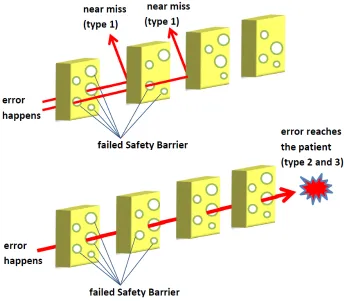
One of the widely recognized methods used to minimize the chance of error in the RT delivery is the use of safety barriers. A safety barrier (SB) is a quality assurance step that is formally embedded in the RT process to prevent an error from occurring or propagating [37]. Figure 1.2 (based on [102]) presents a schematic illustration of how errors are caught by safety barriers or missed by SBs and reach the patient based on the Swiss Cheese model of accident causation [101]. According to this metaphor, in a complex system, propagation of errors are prevented by a series of safety barriers. Each cheese slice corresponds to a SB. The holes in the slices represent the fact that SBs may fail to detect errors as they are largely dependent on individual performance. An error is classified as a near-miss if it is caught by one of the SBs before reaching the patient. Rework is expected after a near-miss, but there is no adverse consequence to the patient. If the holes in the cheese slices align, i.e., all SBs fail to catch the error, the patient may suffer devastating consequences.Although, the holes may not align frequently, when they do, the potential consequences are serious [20, 40].
Figure 1.2: Swiss Cheese Model
element is related to a task completed or an outcome generated at a step in RT process. For example, “total dose” and “fractional dose” are two elements that are generated in “dose calculation” step. The elements are verified by SBs to make sure they are accurate and meet safety requirements before patient proceeds to the next step. For example, “dosimetry plan review” is a SB that checks the accuracy of total dose and fractional dose to make sure the correct amount of dose will be delivered to the patient.
1.6
Error Reporting System
As a part of a QA program an internal system of error reporting must be established aimed at: (i) reporting and documenting errors, (ii) analayzing errors and evaluating their impact on patients, and (iii) assessing the checking procedures (e.g. SBs) in a QA program [128]. Detailed analysis of data from error reporting systems provides valuable insights in preventing future errors. Several studies on error data demonstrate the benefits of SBs in improving patient safety [128, 25, 47, 10, 41]. Yeung et.al. [128] analyzed the data from 13,385 cancer patients that were treated at Northeastern Ontario Regional Cancer Centre (NEORCC) between November 1992 and December 2002. They showed that 58.7 % of errors related to “documentation” and “treatment planning” were detected by SBs before treatment delivery and no patient was harmed. Overall 97.9 % of errors resulted in a dose error of less than 5 % mainly because SBs improved early detection of errors and significantly reduced the number of high dose errors. Arnold et al. [10] analyzed three years (May 2004- 2007) of data from a radiation oncology department in Australia. Of the total errors reported, 22.5 % were errors that reached patients and 77.5 % were near misses. Most of the near-misses (65%) were detected in SBs before treatment delivery demonstrating the impact of SBs on preventing harm.
1.7
Research Objective
Despite the adoption of SBs, serious RT errors still occur and cause irreparable damage to patients [64]. While it may seem desirable to use as many SBs as possible to prevent errors from reaching the patient, unnecessary checks distract RT providers when performing critical procedures and cause extra workload that can lead to additional errors [128, 67, 82]. In the literature, there is little research on the potential impact, cost or optimal implementation of SBs [39]. Most of the research addressing safety challenges in RT focuses on the technical aspects of advanced RT technologies to optimize dose delivery [110, 23, 27, 28]. However, finding technical solutions alone, is not enough to achieve a desirable level of patient safety and other factors such as the implementation of SBs and other QA procedures should be studied and improved as well [80].
where the effectiveness of a SB is defined as the percentage of errors that it can detect. They evaluated commonly used SBs in RT at two radiation oncology clinics and showed that the effectiveness of SBs largely depends on which SBs are being used and in which configuration. Ford et al. [39] assumed that SBs are 100% reliable, but in reality no SB is perfectly reliable.
We develop an optimization framework to identify reliable SB configurations to maximize patient safety. Specifically, we develop models to determine the optimal location and composi-tion of SBs taking into account SB reliability and cost (i.e., time to perform the checks in SBs). The goal is to reduce the likelihood of harming patients due to medical errors during RT. We reduce the chance of errors reaching the patient by incorporating the penalty cost associated with errors in our objective function. In the following we discuss several challenges of our work and explain how they are addressed.
1.8
Challenge 1: Conflicting Objectives
The main challenge of our work is that it involves two conflicting objectives : 1) maximizing patient safety and 2) minimizing the cost of implementing SBs. As mentioned above, adding too many SBs to the RT process can be potentially harmful because unnecessary checks cause unnecessary delays, interruptions and extra workload which result in more errors [82]. We explicitly incorporate this trade-off in our mathematical and simulation models by incorporating the time-based costs associated with SBs as well as the patient safety implications such as expected cost/number of errors that reach patients.
1.9
Challenge 2: Quantifying The Performance of SBs
Another major challenge is to identify appropriate measures for evaluating the cost and effec-tiveness of SBs. In the analytical models proposed in Chapter 4, we quantify the performance of SBs in terms of cost measured in time. The cost has three elements:
Checking cost (hour) : cost that is incurred when checking is performed at a SB.
We use the checking cost to take into account the amount of time that is spent on performing SBs to catch potential errors. Each time an error is detected by a SB, rework is necessary to correct the error. We assume the earlier an error is detected, the lower the rework cost associated with correcting it, will be. There is also a penalty cost for an error that reaches a patient. It is often challenging to estimate the penalty for an error reaching a patient especially without knowing whether it harmed the patient. An alternative way to evaluate the effectiveness of SBs is to measure the expected number or ratio of errors that reach patients in a given period of time. We used these measures in the simulation model proposed in Chapter 3.
1.10
Challenge 3: Complexity of RT Process
The RT care delivery process is complex with multiple steps, dependencies and constraints that makes modeling the process challenging and adds to the computational complexity of the analytical model. We address these complexity challenges in two ways: First, by our use of computer simulation models which will allow us to capture many of the complexities inherent in the real life RT process and second, we have developed time-efficient solution methods to reduce the computational complexity and achieve near-optimal solutions.
1.11
Challenge 4: Uncertainties in RT Process
The RT process is subject to various sources of uncertainty that complicates parameter estima-tion for our problem. To address this issue, we use stochastic programming which is commonly used for modeling uncertainty in the parameters of optimization models. In Chapter 5, we pro-pose a two-stage stochastic programming framework to captures uncertainties in RT process.
1.12
Research Goals
Considering the above research question, the relevant research goals are:
To quantitatively measure the cost and effectiveness of SBs and capture the trade-off between them
To utilize the data from error reporting systems to estimate the input parameters for our models
To develop efficient solution methods to address the computational complexity issues To incorporate the uncertainties in model parameters (stochastic optimization)
The overall goal is to develop analytical model to help with the cost-effective design of SBs that results in early detection of errors and reduces the chance of harm to patients. In the proposed models, we take into account the penalty cost associated with errors that reach the patient to reduce the harm to patients.
Chapter 2
Literature Review
In this chapter we review the literature related to our study. The modeling approach and solution techniques that we propose for our problem are inspired by the literature in two areas: (i) inspection allocation problems and (ii) reliable facility location problems. In Section 2.1 we present a discussion of the literature focused on inspection allocation problems and in Section 2.2 we review the preceding work in the area of reliable facility location problems. We conclude each section by discussing the differences of our work from the related literature.
2.1
Literature Review on Inspection Allocation Problems
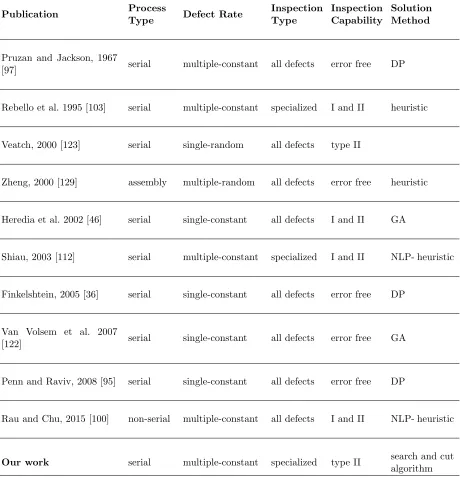
inspection in producing defect-free products. The same considerations should be taken into account regarding the cost of SBs and their impact on patient safety. These similarities moti-vated us to review the inspection allocation literature in order to gain a better understanding of our problem. Table 2.1, shows the relation between different elements of our problem and the inspection allocation problem.
Table 2.1: Comparing reliable radiation therapy problem to inspection allocation problem Reliable Radiation Therapy Problem Inspection Allocation Problem
Patient Element Production Unit
Error Type Defect Type
Error Probability Defect Probability
Safety Barrier Inspection Station
SB Failure Probability Probability of Accepting a Defective Item
Checking Cost Inspection Cost
Rework Cost Internal Failure Cost
Penalty of Errors that Reach Patients External Failure Cost
Inspection planning for production systems is a popular research domain and there are many studies focused on inspection allocation problems. Examples of studies in this area in-clude determining the number and locations of inspection stations, defining inspection plans (full inspection or sampling), deciding the best action (e.g., rework, repair or scrap) to take when finding defective units, incorporating different constraints (e.g., inspection time, average outgoing quality required or budget limit) and modeling different kinds of production systems [50].
process is a challenging decision that requires exploring the trade-off between multiple objectives [78].
According to Mandroli et al. [78] the relevant inspection literature can be classified into two groups: i) inspection-oriented QA strategies and ii) diagnosis-oriented sensor-distribution strategies. An inspection oriented strategy determines an optimal level of inspection efforts by balancing the cost factors with respect to inspection, rework, repair and penalty in cases where a defective product is delivered to a customer. These types of strategies aim to produce a final defect-free product for customers, but since they do not improve the underlying manufacturing process, the “overall product quality” does not change.
On the other hand, diagnosis-oriented strategies also known as sensor-distribution strategies focus on identifying the major defect-causing sources. For these strategies, the assumption is that there is a set of unknown variables that cause quality issues but they are not directly observable. Any change in the status of these variables should be tracked using sensors to diag-nose the variables that are causing defects [115]. The research on sensor distribution strategies is relatively new and is still in its early stages [78]. Our work on SBs in RT can be associated with the first group of studies that focuses on developing cost-effective inspection plans instead of root-cause diagnosis, therefore we primarily focus on the publications on inspection-oriented strategies.
The major decision in inspection-allocation problems is whether to inspect or not inspect a product after each manufacturing step. If it is decided to perform inspection, the next step is to determine the inspection threshold or specification limits to distinguish conforming and nonconforming products. If units are processed in batches, another decision is whether to inspect all items or a fraction of them. Upon completion of an inspection, the conforming units move to the next operation and the action for non-conforming units will be one of the following: 1) replacing with a conforming unit, 2) reworking or repairing, or 3) scrapping [111, 78]. Figure 2.1 shows inspection at a multi-stage manufacturing process.
Figure 2.1: Inspection station in a multi-stage manufacturing process- adapted from Mandroli et al. [78]
[78]. In the following we explain some important aspects of inspection allocation problems that can be used to characterize a manufacturing process [78] and also discuss which category our problem falls into :
Process Configurations : There are three types of process configurations in a production facility: i) serial system, ii) assembly system, and iii) nonserial system. In a serial system, there is only one sequential flow path as opposed to nonserial systems which have multiple flow paths for input material. An assembly system is a nonserial system where each workstation has ex-actly one successor node and can have many predecessor workstations. A system that is neither serial nor assembly will be classified as a nonserial system [43, 129]. Our problem falls into the category of a serial system. We assume all patients pass through a single sequential path to complete their treatment.
single type variable, iii) multiple types constant, and iv) multiple types variable [78]. We can use the same criteria to classify RT errors. Different types of errors each associated with a specific patient element may occur in RT process, so we have multiple error types. In our determin-istic model we have assumed constant error probabilities (the third combination) and in our stochastic programming model we considered error probabilities as random variables following a uniform distribution (fourth combination).
Inspection Capability : Ideally, an inspection station should detect all non-conforming units and accept all conforming ones. However, this is not the case in real world and inspec-tion stainspec-tions may not perform as expected due to various reasons such as human error. Two types of errors may occur when an performing inspection: i) Type I error which occurs when a conforming unit is rejected incorrectly and ii) Type II error when a non-conforming unit is falsely accepted. Some authors have considered both types of errors [46, 112, 100] and some have assumed only one type of error or an error-free inspection [97, 95, 36]. We consider type II errors given that SBs are not 100% reliable and may fail to detect all the errors associated with the elements they check. We assume the probability of false positive (type I) error is negligible and there is no false alarm if no error has occurred.
Inspection Type : We define the inspection type as the ability to detect different types of defects. Most studies have assumed that inspection stations are versatile meaning they can detect all types of defects produced by previous workstations [97, 46]. A few studies have considered specialized inspection stations that can only detect defects generated at certain workstations [103, 112]. We assume SBs belong to the second category (specialized) as each SB can verify certain elements and therefore can only detect certain errors.
used a quasi-concave function or a general non-linear function [78]. The internal failure cost includes the cost of repairing, replacing or scrapping a defective item that is detected before it is shipped to the customer. The external failure costs are incurred after the defective products are delivered to a customer. This cost include the cost of repair, replacement of defective parts and quality loss. External failure cost may depend on the defect type [123] or could be inde-pendent of it [112]. In some studies each type of cost is considered [112] while in others only a subset of them are considered [54]. According to a survey by Shetwan et al. [111] on allocation of inspection stations, most papers have not considered all elements of the external failure cost and instead assumed an aggregated penalty cost representing the cost of detective units being delivered to the customer. We define the cost components for our problem in a similar manner: we consider the cost of performing SBs (checking cost), the rework cost for those errors that are caught before reaching patients and the cost of errors that reach patients. We do not con-sider any fixed cost associated with investing in and setting up SBs and only assume a variable checking cost that is incurred each time a patient element is checked at a SB.
Objective function : Most papers that studied inspection allocation problems, seek to minimize the total cost consisting of manufacturing cost, inspection cost and quality failure costs, but there are a few papers that consider other objective functions such as maximizing the throughput or production capacity [99, 88]. Shetwan et al. [111] argued that this usually happens when an inspection allocation problem and a scheduling problem are considered si-multaneously. In the case of cost minimization, the common objectives are: total expected cost and expected unit cost, but the studies may differ in how the number of units is counted [78]. For our problem, we minimize the total expected cost to evaluate and optimize the design of SBs.
Solution Methods : According to the surveys conducted by Mandroli et al. [78] and Shetwan et al. [111], dynamic programming (DP) is the most commonly used method for solv-ing inspection allocation problems. Shetwan et al. [111] stated that what makes DP a desir-able choice is probably the multistage structure of a manufacturing process. However some researchers [113, 114] have pointed out that DP becomes impractical when the problem size grows and developed heuristics to solve the problem. The second popular approach is nonlinear programming (NLP). Almost all papers deal with a non-linear total cost function with some integer variables (such as whether to inspect or not, the number of inspection stations, etc.), therefore almost every problem is a NLP with many also being integer programming prob-lems. The computational efficiency of NLP drops substantially for large-sized probprob-lems. As a result, heuristic and meta-heuristic methods including simulated annealing (SA) and genetic algorithms (GA) are used to find efficient solutions for larger problems. In addition to numerical optimization techniques, several authors have used simulation techniques such as Monte Carlo simulation [111].
Table 2.2: Summary of Literature on Inspection Allocation Problems
Publication Process
Type Defect Rate
Inspection Type
Inspection Capability
Solution Method
Pruzan and Jackson, 1967
[97] serial multiple-constant all defects error free DP
Rebello et al. 1995 [103] serial multiple-constant specialized I and II heuristic
Veatch, 2000 [123] serial single-random all defects type II
Zheng, 2000 [129] assembly multiple-random all defects error free heuristic
Heredia et al. 2002 [46] serial single-constant all defects I and II GA
Shiau, 2003 [112] serial multiple-constant specialized I and II NLP- heuristic
Finkelshtein, 2005 [36] serial single-constant all defects error free DP
Van Volsem et al. 2007
[122] serial single-constant all defects error free GA
Penn and Raviv, 2008 [95] serial single-constant all defects error free DP
Rau and Chu, 2015 [100] non-serial multiple-constant all defects I and II NLP- heuristic
Our work serial multiple-constant specialized type II search and cut
2.2
Literature Review on Reliable Facility Location Problems
This section provides an overview of the literature on reliable facility location problems. We discuss how our model is comparable to reliable facility location model and also describe the unique features of our problem. In this section we review some of the relevant work in this area, and explain how different characteristics of reliable facility location problems can be translated into the RT setting.
Facility location models are well studied in the literature. These models aim to locate one or more facilities among a set of candidates and to assign customers to the facilities with the objective of minimizing cost or maximizing total profit [109, 30]. Most models in the literature assume facilities never fail [109], but in reality facilities may become unavailable for various reasons such as adverse weather, natural disasters or terrorist attacks [29]. Reliable facility location problems focus on supply chains with facilities that are susceptible to unexpected failures and disruptions [1]. In such supply networks, in the case of failures, customers have to be served by facilities other than the primary facility to which they were assigned [1]. To hedge against the unexpected failures and to diminish the impact of transportation and penalty costs that occur in the case of failures, each customer is assigned to multiple facilities that serve as backup [1]. The facilities are classified into “levels” and customers are assigned to facilities in the order of levels. A“level-k” assignment is one for which there are k closer failable facilities that are open [116]. Each demand point is served by the lowest-level facility that is available. So, a higher level facility will only serve a customer if the facility is operational and all the lower level facilities have failed [109, 1]. The objective is to find a cost-efficient solution to minimize the operating and transportation costs under both normal and emergency conditions [29].
penalty costs of errors that reach patients. The goal is to find a safe and cost-efficient SB design to minimize the total cost associated with errors and performing SB checks. Table 4.2 shows how different components of our problem can be mapped to similar concepts in the reliable facility location problem.
Table 2.3: Comparing reliable radiation therapy problem to reliable facility location problem Reliable Radiation Therapy Problem Reliable Facility Location Problem
Patient Element Customer
Error Probability Demand
Safety Barrier Facility
SB Failure Probability Facility Failure Probability Rework and Checking Cost Transportation Cost
The reliability issues in a supply chain network have attracted increased attention among researchers [29]. Snyder et al. [116] introduced the concept of reliability in facility location prob-lems. They proposed reliability models based on two facility location problems: the P-median Location Problem (PMP) and the Uncapacitated Fixed-charge Location Problem (UFLP) as-suming facilities have equal failure probabilities. In the case of the Reliable P-median Location Problem (RPMP), the objective function is the weighted sum of the operating costs under normal conditions and the failure costs (i.e., the expected transportation cost where facilities fail). In Reliable Uncapacitated Fixed-charge Location Problem (RUFLP) the cost of building facilities is included in the objective function. The authors developed Lagrangian-based solu-tions for both models and showed that reliability of a supply chain network can be significantly improved with a relatively small increase in operating costs [116].
and analyzed a pattern called “co-location” which is defined as locating more than a single facility at one location. According to their analysis, increasing failure probabilities results in an increased“co-location” effect as well as facilities becoming more centralized. They also devel-oped several exact and heuristic approaches for both uniform and nonuniform MPUFs. Qi and Shen [98] considered a three-level supply chain network consisting of one supplier, multiple fa-cilities and retailers where fafa-cilities distribute products provided by a 100% reliable supplier to retailers. They considered non-uniform failure probabilities as well as the cost of inventory and proposed a nonlinear optimization model [98]. Cui et al. [29] also assumed facility-dependent failure probabilities, and proposed a Lagrangian algorithm for mid-sized reliable uncapacitated fixed-charge location problems (RUFLP) and a Continuum Approximation (CA) model to find an efficient solution for large-scale RUFLP.
A scenario-based stochastic programming (SP) formulation for RUFLP was proposed by Shen et al. [109]. They assumed that in the first stage it is unknown which facilities are going to be operational and the decision is to determine which facilities should be open. In the second stage, when the operational facilities are revealed, each customer is assigned to an open and operational facility if the cost of assignment is lower than the penalty cost associated with failing to satisfy customer demand, otherwise penalty costs is incurred. The authors mentioned that the number of scenarios will be very large when assuming site-dependant failure probabilities and proposed a non-linear integer programming (NLIP) formulation for the case of independent failure probabilities. They evaluated the performance of two greedy heuristics for RUFLP-NLIP and a sample average approximation to solve RUFLP-SP. For a special case of the problem with equal failure probabilities, they developed a four approximation algorithm.
argued that the performance of the search and cut method is not very sensitive to the maximum assignment level for each customer but can be significantly affected by the failure probabilities. Maximum assignment level refers to the maximum number of facilities that a customer can be assigned to. In our problem we define maximum assignment level as the maximum number of times that we can check an element.
Most studies on reliable facility location problems have assumed facility disruptions occur independently meaning there is zero correlation between the failures that occur at different facilities. Recently a few studies [71, 7, 75] have incorporated disruption correlations arguing that in practice disruptions tend to be strongly correlated. One reason to model disruption correlation is that natural disasters and severe weather conditions often affect large geographical areas in a relatively short period of time [75]. According to the results of the study by Lu et al. [75] ignoring disruption correlation can lead to significant losses.
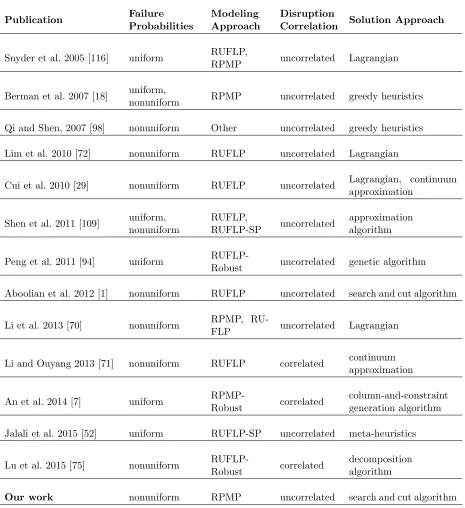
Based on our review of the literature, we have identified a set of main characteristics that can be used to classify reliable facility location problems. In the following, we go over these criteria and then we use them to categorize the literature.
Facility Failure Probability: Facilities may have uniform or non-uniform failure prob-abilities. In the uniform case, all facilities have the same failure probability whereas in the non-uniform case the failure probabilities are facility-dependant. Some studies have studied both cases [18, 109]. In our model, we assume failure probabilities that are associated with elements and SBs.
Modeling Approach: Several modeling approaches are used in reliable facility location problems. We focus on classical models that are commonly found in literature: (i) Reliability P-median Problem (RPMP) and (ii) Reliable Fixed-charge Location Problem (RFLP) [30]. In RPMP, exactlyP facilities have to be located whereas in RFLP the constraint on the number of facilities is relaxed but there is a fixed cost for opening facility. We formulate our problem as a RPMP assuming there is a constraint on the number of available SBs.
studies [71, 7]. In the real world, there is usually a strong correlation between facility disrup-tions mainly because closer facilities are more likely to be affected by similar events. Positive correlations cause neighboring facilities to fail simultaneously, while under negative correlations, customers are more likely to be served by neighboring facilities to avoid excessive transporta-tion costs [71]. We assume SB failure probabilities are independent meaning that there is zero correlation between them.
Solution Methods: Various solution methods have been developed to solve reliable facility location problems. Some common methods are Lagrangian relaxation-based methods, greedy heuristics and approximation algorithms. We present the solution method for our problem in Chapter 4. The proposed heuristic method is based on continuous improvements of lower and upper bounds on objective function.
Table 2.4: Summary of Literature on Reliable Facility Location Problems
Publication Failure
Probabilities
Modeling Approach
Disruption
Correlation Solution Approach
Snyder et al. 2005 [116] uniform RUFLP,
RPMP uncorrelated Lagrangian
Berman et al. 2007 [18] uniform,
nonuniform RPMP uncorrelated greedy heuristics
Qi and Shen, 2007 [98] nonuniform Other uncorrelated greedy heuristics
Lim et al. 2010 [72] nonuniform RUFLP uncorrelated Lagrangian
Cui et al. 2010 [29] nonuniform RUFLP uncorrelated Lagrangian, continuum
approximation
Shen et al. 2011 [109] uniform,
nonuniform
RUFLP,
RUFLP-SP uncorrelated
approximation algorithm
Peng et al. 2011 [94] uniform
RUFLP-Robust uncorrelated genetic algorithm
Aboolian et al. 2012 [1] nonuniform RUFLP uncorrelated search and cut algorithm
Li et al. 2013 [70] nonuniform RPMP,
RU-FLP uncorrelated Lagrangian
Li and Ouyang 2013 [71] nonuniform RUFLP correlated continuum
approximation
An et al. 2014 [7] uniform
RPMP-Robust correlated
column-and-constraint generation algorithm
Jalali et al. 2015 [52] uniform RUFLP-SP uncorrelated meta-heuristics
Lu et al. 2015 [75] nonuniform
RUFLP-Robust correlated
decomposition algorithm
an element is still incurred even when a SB fails to detect an error related to that element.
2.3
Contribution of This Work
Chapter 3
Simulation Modeling
In this chapter we present a discrete event simulation (DES) model of the radiation therapy (RT) process with the goal of assessing process reliability and patient safety. Patient safety is the primary concern in RT and safety considerations should be incorporated into all aspects of treatment planning and delivery. We develop a detailed DES model of the RT process at the Department of Radiation Oncology of University of North Carolina (UNC) Lineberger Comprehensive Cancer Center. We evaluate the performance of safety barriers (SB) and measure their effectiveness in reducing errors and preventing harm to patients. This chapter is structured as follows: first, we present a general overview of literature in Section 3.1 and then we describe the RT process and SBs used at UNC Department of Radiation Oncoloy in Section 3.2. We describe the DES model in Section 3.3 and we discuss the model verification in Section 3.4 followed by sensitivity analysis and model validation in Section 3.5. We present the results of what-if analysis in Section 3.6 and conclude and discuss future work in Section 3.7.
3.1
Literature Review
Several applications of the simulation techniques have been addressed in this review includ-ing health risk assessment [31, 74, 8], prognostic and transmission models of health interven-tions, [79, 62, 51], planning of healthcare systems [49, 118, 108], public health policy evaluation [11, 3, 2], and modeling health systems disruptions [24, 68, 9].
To the best of our knowledge, this is the first simulation study that addresses the patient safety in RT process. We used DES which is recognized as an effective and flexible technique for modeling and analyzing health systems and processes [59]. According to Katsaliaki et al. [59] applications of DES in healthcare can be classified into the following groups: planning for healthcare services, health economics models and modeling contagious disease interventions. The first category refers to the application of DES to evaluate and improve the performance of delivery systems by exploring the relationships between components in a complex system such as hospitals and emergency departments [59, 85, 19, 15]. The DES model that we develop falls in this category as we also model the RT process to improve patient safety and process reliability. DES allows decision makers to predict the effect and results of implementing a new policy or changes in an existing policy or strategy [87, 59]. This is advantageous for our problem since modifying a process or policy can potentially be very costly and have significant impacts on patient-related outcomes. Therefore it would be helpful to test proposed changes in a risk-free simulation environment.
3.2
Case Study
In this section, we describe a case study undertaken at the UNC Department of Radiation On-cology, a part of the UNC Lineberger Comprehensive Cancer Center. The UNC Cancer Center opened in September 2009 and currently serves patients from every county in North Carolina with more than 135,000 patient visits each year. The UNC department of Radiation Oncology offers the following services: 1) external beam radiation therapy (EBRT) 2) intensity-modulated and image-guided radiation therapy 3) Tomo-therapy 4) CyberKnife robotic radiosurgery and 5) Brachytherapy. We focused on the EBRT which is the most common form of RT used for cancer treatment at UNC Department of Radiation Oncology.
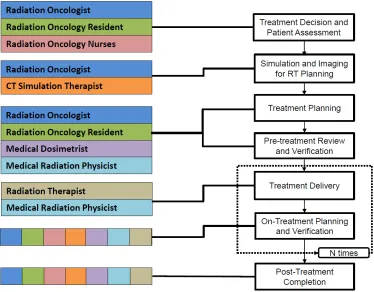
Patient decision and patient assessment: In the first step, radiation oncologist examines the patient to determine if RT is an appropriate treatment; if so, a tentative prescription is generated. RT may be used alone or in combination with surgery, chemotherapy or both.
Simulation and imaging for RT planning: The ideal treatment position is determined and immobilization tools are applied and then computed tomography scans of the patient are taken in the treatment position.
Treatment planning: RT professionals (i.e., oncologist, physicist, and dosimetrists) design radiation beams based on the scans, electronic medical records, and diagnostic images. Pre-treatment review and verification: Treatment instructions are reviewed to ensure that
they are correct and in accordance with physician’s directive. The final treatment plan is entered into a software that controls the radiation delivery machine.
Treatment delivery: Radiation therapists position the patient as planned on the treatment couch, images are obtained for accuracy, and RT is delivered. Depending on the cancer type and the patient characteristics, a course of treatment is usually delivered in five sessions per week for several weeks.
On-treatment Planning and Verification: The oncologist reviews treatment progress and makes changes as needed.
Post-treatment completion: The treatment course and patient outcomes are evaluated.
Figure 3.1: Stages of Radiation Therapy Process
Figure 3.2: Healthcare providers involved in RT process
3.2.1 Safety Barriers
As a part of the quality assurance (QA) program, safety barriers (SB) are used throughout the process to prevent, control, or mitigate undesired errors. Each stage of the RT process consists of multiple steps which are either process steps or SBs. Each process step generates a set of patient elements. A patient element is defined as any information specific to a patient. For example, dose calculation is a process step that generates the following elements: (i) total dose (ii) fractional dose. Each SB checks one or more elements which means the tasks or outcomes associated with the elements are verified by the SB to ensure that the elements are accurate and they meet safety standards before the patient proceeds to the next process step. For example ”dosimetry plan review” is a SB that checks the accuracy of total and fractional dose to make sure no mistake was made in the dose calculation step and the right amount of dose will be delivered to the patient.
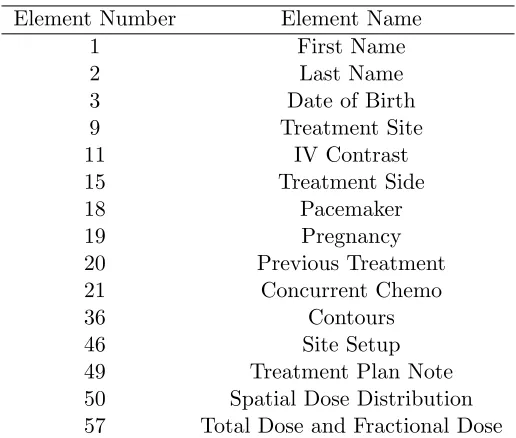
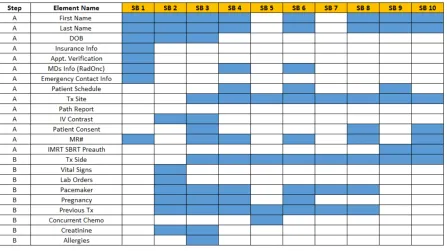
name of the first 15 elements are shown in Table 3.1. While each element is linked to a single process step, a process step may be associated with one or multiple elements. The 65 elements are checked by 10 safety barriers in the ”pre-treatment” phase as shown in Table 3.2. The first two columns in Table 3.2 show the stages in the process and the process steps completed at each stage. The patient elements produced at each step are shown in the third column of Table 3.2 and the fourth column represents the SB performed at the end of each step. The person who is responsible for performing the SB is shown in the last column of Table 3.2. Figure 3.3 illustrates the position of SBs in the first two stages of UNC RT process. The box on the left shows that “treatment decision and patient assessment” consists of two process steps A and B and two safety barriers SB1 and SB2. Similarly, the box on the right shows that there are two process steps C and D and one safety barrier SB 3 in “simulation and imaging for RT planning”. A SB can only check elements generated at previous process steps. For example, SB 2 can check elements produced at step A and step B while SB3 can check elements from steps A, B, C and D. Figure 3.4 shows examples of elements checked at each SB.
Table 3.1: Examples of Patient Element Element Number Element Name
1 First Name
2 Last Name
3 Date of Birth
9 Treatment Site
11 IV Contrast
15 Treatment Side
18 Pacemaker
19 Pregnancy
20 Previous Treatment
21 Concurrent Chemo
36 Contours
46 Site Setup
49 Treatment Plan Note
Table 3.2: SBs in UNC Department of Radiation Oncology
Stage Step Elements Safety Bariers(SB) Person
Treatment Decision and
Patient Assessment A 1-14 SB1 Nurse
B 15-25 SB2 Nurse/Phyisican
Simulation and Imaging
for RT Planning C 26-29 -
-D 30-34 SB3 Therapist
Treatment Planning E 35-51 SB4 Dosimetrist
F - SB5 Sim Review
G 52-57 SB6 Dosimetrist
H 58-59 SB7 Physician
I - -
-J 60-64 SB8 Physicist
K - SB9 Therapist
Pre-Treatment Review
and Verification L 65 SB10 Therapist
Figure 3.3: Process steps and SBs in the first two stages of UNC RT Process
3.3
Model Development
Figure 3.4: Configuration of SBs in UNC RT Process
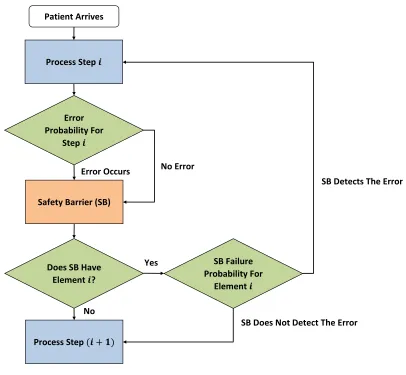
purposes we assume only one error occurs at a time. When the patient passes through a SB that checks the element, the SB may detect the error according to the some probability, i.e., (1-SB failure probability). Upon the detection of the error, the patient will repeat the step that generated the error. If the error was not detected, the patient proceeds to the next process step. We assume there is a SB failure probability associated with element iwhich is the probability that a SB fails to catch an error in element i. For the simulation model, we assume that SB failure probabilities only depend on elements, meaning that the SB failure probability for a given element is equal at all SBs.
3.3.1 Input Data and Model Assumptions
No
Error Occurs Patient Arrives
Process Step 𝒊
Does SB Have Element 𝒊?
Error Probability For
Step 𝒊
SB Failure Probability For
Element 𝒊
Process Step (𝒊 + 𝟏) Safety Barrier (SB)
No Error
Yes
SB Does Not Detect The Error
SB Detects The Error
Figure 3.5: Patient Flow
Arrival Process
Historical data indicates that on average 10 new patients arrive each day according to a non-homogeneous Poisson process. It is assumed that 2 patients arrive every hour from 7:00 am to 10:00 am and 1 patient arrive every hour from 10:00 am to 14:00 am. Table 3.3 shows the arrival rates.
Error Probability
er-Table 3.3: Arrival Rate
Time Interval Patient Arrival Rate
07:00 am- 08:00 am 2
08:00 am- 09:00 am 2
09:00 am- 10:00 am 2
10:00 am- 11:00 am 1
11:00 am- 12:00 pm 1
12:00 pm- 01:00 pm 1
01:00 pm- 02:00 pm 1
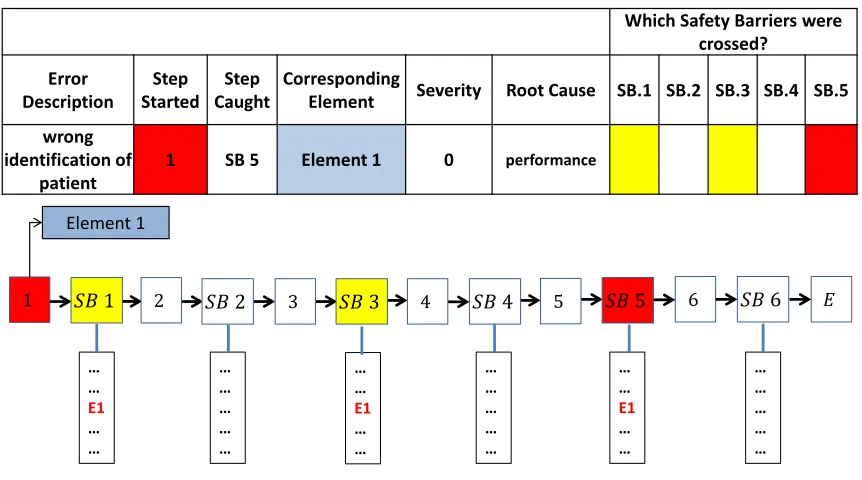
rors that had or could potentially have a negative impact on patient safety and the care delivery process. Staff members are encouraged to report errors that reached patients and near-misses detected at different stages of the RT process. During monthly meetings, the staff review and investigate the reported errors. The investigation involves asking a series of key questions such as when the error occurred, when it was caught, which SBs failed to catch it and what factors caused the error. Answers to these questions help identify ineffective SBs and causes of errors so similar errors can be prevented in the future. Figure 3.6 shows an example of error analysis. The step where the error was initiated and the SB that caught the error are highlighted in red where the yellow cells show the SBs that failed to catch the error.
To estimate the error probabilities we analyzed the error data over a two year period: May 2012 - May 2014. Since the patient level error sample sizes were small, aggregate error probability for each step in the RT process were calculated. We assumed the error probability was uniformly distributed across the elements within that step, so we divided the error probability of each step by the number of elements that are generated at that step, to obtain the error probability at the element level. Table 3.4 shows the estimated error probabilities.
SB Failure Probability
1
Pegah Pooya INFORMS Healthcare Conference 2015
Near-misses and incidents reported over a two-year period: June 2012- June 2014
The data was used to estimate the incident probability for all elements.
Incident Learning System
Which Safety Barriers were crossed? Error Description Step Started Step Caught Corresponding
Element Severity Root Cause SB.1 SB.2 SB.3 SB.4 SB.5
wrong identification of
patient
1 SB 5 Element 1 0 performance
1 𝑆𝐵 1
Element 1
𝑆𝐵 2 𝑆𝐵 3 𝑆𝐵 4 𝑆𝐵 5 𝑆𝐵 6
2 3 4 5 6 𝐸
… … E1 … … … … E1 … … … … … … … … … … … … … … … … … … … E1 … …
1 Pegah Pooya
Figure 3.6: Error Reporting System
workload score for each element. We classified the elements into three groups of low, medium and high workload and assumed the elements with higher workload also have a higher failure probabilities. Based on these assumptions, we estimated the failure probability for each element type. In Section 3.5 we will describe the calculation of failure probabilities in more detail.
Other Assumptions
Additionally, based on the data, the following assumptions are made to build the model: Error reporting rate is uniform throughout the year, therefore the estimated error
prob-abilities are constant throughout the year.
Error probability is the same for all the elements initiated at a given step Only one error at a time may occur for a patient
Duration of each step follows a uniform distribution (we conducted a time study to esti-mate the times)
For a given element, the failure probabilities are equal for all SBs.
Table 3.4: Error probabilities in UNC RT process
stage
steps that initiate elements
error probability at this step
number of elements
error probability for
each element Treatment Decision and
Patient Assessment A 0.40% 14 0.03%
B 1.10% 11 0.01%
Simulation and Imaging for
RT Planning C 0.77% 4 0.19%
D 1.14% 5 0.22%
Treatment Planning E 1.13% 17 0.06%
G 1.56% 6 0.26%
H 0.15% 2 0.08%
J 1.23% 5 0.25%
Pre-treatment Review and
Verification L 0.39% 1 0.39%
3.4
Model Verification
To ensure that the model is implemented correctly and works as intended, we checked the model components after each step in model development and made the necessary adjustments. Furthermore, we analyzed several scenarios considering a single patient element. For each sce-nario, we ran the model for 20 replications with a run length of 6 months. In each scesce-nario, we measured the expected rate of errors that reach patients (E[REP]) for an element with a given
error probability.E[REP] was calculated by dividing the total expected number of errors that
reach patients (E[N EP]) by the total number of patients who complete treatment planning.
We compared E[REP] across the three scenarios with error probabilities of 0.002, 0.01 and
0.05. In each scenario we also varied the SB failure probability from 0% to 100% using 10% increments and examined the impact on E[REP]. Tables 3.5, 3.6, and 3.7 provide the results
for three scenarios. The results indicate that adding an element to additional SBs or decreasing SB failure probabilities, results in lower E[REP]. Moreover, if we compare the E[REP] across
Table 3.5: E[REP] for elementiwith error probability = 0.002
SB failure
probability Number of safety barriers for a given element i
1 2 3 4 5 6 7 8 9
0% 0 0 0 0 0 0 0 0 0
10% 0.02% 0 0 0 0 0 0 0 0
20% 0.05% 0.01% 0 0 0 0 0 0 0
30% 0.06% 0.02% 0.01% 0 0 0 0 0 0
40% 0.08% 0.03% 0.02% 0.01% 0 0 0 0 0
50% 0.10% 0.05% 0.03% 0.01% 0.01% 0 0 0 0
60% 0.13% 0.08% 0.05% 0.03% 0.02% 0.01% 0 0 0
70% 0.14% 0.10% 0.07% 0.05% 0.04% 0.03% 0.02% 0.01% 0.01% 80% 0.16% 0.13% 0.12% 0.08% 0.07% 0.06% 0.04% 0.03% 0.03% 90% 0.18% 0.18% 0.14% 0.13% 0.12% 0.10% 0.11% 0.09% 0.08% 100% 0.20% 0.21% 0.20% 0.20% 0.19% 0.19% 0.20% 0.20% 0.20%
Table 3.6: E[REP] for elementiwith error probability = 0.01
SB failure
probability Number of safety barriers for a given element i
1 2 3 4 5 6 7 8 9
0% 0 0 0 0 0 0 0 0 0
10% 0.10% 0.01% 0 0 0 0 0 0 0
20% 0.24% 0.04% 0.01% 0 0 0 0 0 0
30% 0.32% 0.10% 0.04% 0.01% 0 0 0 0 0
40% 0.42% 0.16% 0.08% 0.04% 0.01% 0 0 0 0
50% 0.52% 0.26% 0.14% 0.06% 0.04% 0.02% 0.01% 0 0
60% 0.64% 0.38% 0.26% 0.14% 0.10% 0.06% 0.02% 0.01% 0
70% 0.72% 0.50% 0.34% 0.26% 0.18% 0.14% 0.08% 0.04% 0.03% 80% 0.80% 0.66% 0.58% 0.38% 0.34% 0.28% 0.20% 0.16% 0.14% 90% 0.92% 0.88% 0.72% 0.66% 0.62% 0.52% 0.54% 0.46% 0.42%
Table 3.7: E[REP] for element (i) with error probability = 0.05
SB failure
probability Number of safety barriers for a given element i
1 2 3 4 5 6 7 8 9
0% 0 0 0 0 0 0 0 0 0
10% 0.50% 0.06% 0 0 0 0 0 0 0
20% 1.20% 0.20% 0.04% 0 0 0 0 0 0
30% 1.60% 0.50% 0.20% 0.06% 0.02% 0.01% 0 0 0
40% 2.10% 0.80% 0.40% 0.20% 0.06% 0.02% 0.01% 0 0
50% 2.60% 1.30% 0.70% 0.30% 0.20% 0.08% 0.07% 0.02% 0
60% 3.20% 1.90% 1.30% 0.70% 0.50% 0.30% 0.09% 0.07% 0
70% 3.60% 2.50% 1.70% 1.30% 0.90% 0.70% 0.40% 0.20% 0.18% 80% 4.00% 3.30% 2.90% 1.90% 1.70% 1.40% 1.00% 0.80% 0.70% 90% 4.60% 4.40% 3.60% 3.30% 3.10% 2.60% 2.70% 2.30% 2.10% 100% 5.00% 5.20% 5.10% 5.10% 4.80% 4.80% 4.90% 5.00% 5.10%
3.5
Sensitivity Analysis and Model Validation
In this section we present the sensitivity analysis results on some of the model inputs. First, we focused on SB failure probabilities and examined the performance measures to determine the failure probability for each element. Using the probabilities from the analysis of failure probabilities, we validated the model and then conducted the sensitivity analysis on the error probabilities.
3.5.1 SB Failure Probability
Table 3.8: Effect of element workload on SB failure probability Element Workload Failure Probability
low workload (e.g., patient’s name) low failure probability (base case) medium workload (e.g., treatment site) low failure probability + 15%
high workload (e.g., dose distribution) medium failure probability + 15%
workload elements accordingly. The failure probabilities associated with each scenario are listed in Table 3.10. For each scenario, we measured patient throughput, the total expected number of errors that occurred (E[N E]), the total expected number of errors that reached patients (E[N EP]) and the expected ratio of errors that reached patients (E[REP]). The summary of
performance measures is provided in Table 3.9. We can see that some measures such as E[N E] and patient throughput were nearly unchanged across different scenarios. Comparing E[N E] and throughput with historical data on patient volume and errors, shows the numbers are within acceptable ranges. Performance measuresE[REP] andE[N EP] are largely driven by the failure
probabilities. Figure 3.7 illustrates the E[N EP] associated with the seven scenarios in a box
plot. We conservatively choose the first scenario as the base case for our model. Based on similar rates reported by other researchers [10, 128], the E[N EP] for the first scenario can be viewed
as a lower bound for actual E[N EP]. In addition, the failure probabilities and performance
measures associated with this scenario are verified by UNC clinical staff as reasonable.
Table 3.9: Performance Measures
performance measure definition
E[N E] expected number o