Weaknesses in a Recently Proposed RFID
Authentication Protocol
Mete Akg¨un1, and M. Ufuk C¸ aˇglayan2 1T¨ubitak UEKAE, 41470, Kocaeli, Turkey
2Computer Engineering Department, Boˇgazi¸ci University ˙Istanbul, Turkey
Abstract. Many RFID authentication protocols have been proposed to provide desired security and privacy level for RFID systems. Almost all of these protocols are based symmetric cryptography because of the lim-ited resources of RFID tags. Recently Cheng et. al have been proposed an RFID security protocol based on chaotic maps. In this paper, we analyze the security of this protocol and discover its vulnerabilities. We firstly present a de-synchronization attack in which a passive adversary makes the shared secrets out-of-synchronization by eavesdropping just one pro-tocol session. We secondly present a secret disclosure attack in which a passive adversary extracts secrets of a tag by eavesdropping just one protocol session. An adversary having the secrets of the tag can launch some other attacks.
Key words:RFID, Authentication, Security, Privacy
1
Introduction
Radio Frequency Identification (RFID) technology utilizes radio frequency in order to remotely identify people or objects. RFID systems typically consists of three elements: tags, readers and a back-end server. Many people in the world are aware of the benefits of this technology. However, these people have concerns about security and privacy problems of this technology. In the past, many au-thentication protocols have been proposed in order to provide adequate security and privacy level. However, many studies showed that authentication protocols that are suitable for low-cost RFID tags have serious security and privacy vul-nerabilities.
Recently, an RFID authentication protocol has been proposed by Cheng et al. [2]. It is claimed that the proposed protocol provides almost all security properties in the literature. Nevertheless we show that their proposal has security weakness against de-synchronization attacks. We also present an attack that can disclose the secrets of a tag. An adversary can launch some other attacks by using these extracted secrets. The success probabilities of the proposed attacks are significant and their complexities are polynomial.
The rest of this paper is organized as follows. In Section 2, we review the related work. Some preliminaries are introduced in Section 3. We describe Cheng et al.’s authentication protocol in Section 4 and analyze its vulnerabilities in Section 5. At last, we conclude the paper.
2
Preliminaries
In this section, we give the definition and properties of a Chebyshev chaotic map. The fundamental introduction was proposed by Wang and Zhao [3].
Definition 1 (Chebyshev polynomials [2]). Let n be an integer, and x can be defined as a variable value over the interval [1,1]. Chebyshev polynomial maps
Tn:R→R of degree n is derived from the following recurrent function:
Tn(x) = 2xTn−1(x)−Tn−2(x) (1)
where the integer n≥2,T0(x) = 1,andT1(x) =x.
Remark 1. The Chebyshev polynomial should be restricted to the interval [-1,1] so that the action of the mapTn :Tn([−1,1])→ [−1,1] is is characteristic for all n > 1. It satisfies a unique, absolutely continuous, invariant measure with positive Lyapunov exponent (lnn) and the Chebyshev map reduces to the feature logistic map forn >2.
Definition 2. Let n be an integer, and x can be defined as a variable value over the interval [1,1]. The Chebyshev polynomial Tn(x) : [−1,1]→[−1,1]is defined
as:
Tn(x) =cos(n.arccos(x)) (2)
Definition 3 (Semi-group property). The Chebyshev polynomial exhibits a well-known property, so-called the semi-group property, which presents that
Tr(Ts(x)) =Tr.s(x) (3)
Definition 4. Commute under composition. An immediate consequence of the semi-group property is that Chebyshev polynomials commute under composition:
Definition 5 (Enhanced Chebyshev polynomials). The enhanced Cheby-shev polynomials establish that
Tn(x) = (2xTn−1(x)−Tn−2(x)) modN (5)
where the integer n ≥2, x ∈ (−∞,+∞), and N is a large prime number. It absolutely derives the following relation:
Tr.s=Tr(Ts(x)) =Ts(Tt(x)) (6)
Thus, the semi-group property still can be achieved, and the enhanced Chebyshev polynomials also commute under composition.
3
Cheng et al.’s Protocol
In 2013, Cheng et al. proposed an RFID mutual authentication protocol based on chaotic maps [2]. They utilized enhanced Chebyshev polynomials in the proposed protocol (Definition 5). The proposed protocol needs seven exclusive-or and two chaotic cryptographic operations on the tag side. The authors presented the authentication proof of the proposed protocol based on Burrows-Abadi-Needham logic [1]. They also claim that their protocol provides the following security requirements: resistance to replay attacks, resistance to impersonation attacks, resistance to denial-of-service attacks, location privacy and forward secrecy.
3.1 Protocol Description
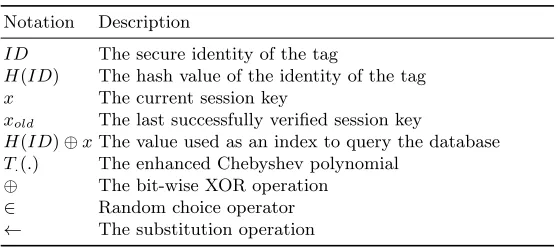
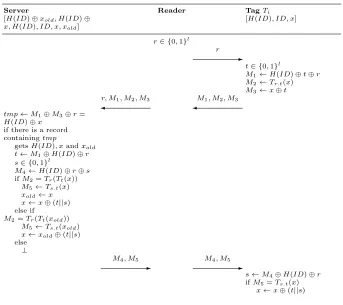
We give the overview of Cheng et al. protocol in Figure 1 and notations are listed in Table 1.
Table 1.Notations for Cheng et al.’s Protocol
Notation Description
ID The secure identity of the tag
H(ID) The hash value of the identity of the tag x The current session key
xold The last successfully verified session key
H(ID)⊕xThe value used as an index to query the database T.(.) The enhanced Chebyshev polynomial
⊕ The bit-wise XOR operation
∈ Random choice operator
← The substitution operation
For each tag T, the back-end server stores the following entry: [H(ID)⊕
Server Reader TagTi [H(ID)⊕xold, H(ID)⊕
x, H(ID), ID, x, xold]
[H(ID), ID, x] r∈ {0,1}l
r
-t∈ {0,1}l
M1←H(ID)⊕t⊕r M2←Tr.t(x) M3←x⊕t r, M1, M2, M3 M1, M2, M3
tmp←M1⊕M3⊕r= H(ID)⊕x
if there is a record containingtmp
getsH(ID), xandxold t←M1⊕H(ID)⊕r s∈ {0,1}l
M4←H(ID)⊕r⊕s ifM2=Tr(Tt(x))
M5←Ts.t(x) xold←x x←x⊕(t||s) else if
M2=Tr(Tt(xold)) M5←Ts.t(xold) x←xold⊕(t||s) else
⊥
M4, M5 M4, M5
-
-s←M4⊕H(ID)⊕r ifM5=Ts.t(x)
x←x⊕(t||s)
Fig. 1.Cheng et al.’s Protocol
x, the secure identityID and the hashed value of secure identity H(ID). It is assumed that xold = x initially. A step by step description of Cheng et al.’s Protocol is given below
1. The reader generates a random numberr and sends it to the tag.
2. Upon receiving the random number r, the tag generates a random number
t and computes M1 ← H(ID)⊕t⊕r ,M2 ← Tr(Tt(x)) and M3 ←x⊕t. Then, the tag sendsM1, M2 andM3 to the reader.
3. After receiving the messages from the tag, the reader forwards them with the random numberrto the back-end server.
4. After receiving the messages from the reader, the back-end server computes
H(ID)⊕x=M1⊕M3⊕r. The back-end server checks if there is a record matching with the indexH(ID)⊕x. If it finds a record, it gets H(ID),x
andxold. Then, it computest←M1⊕H(ID)⊕rand checks the validity of
M5 =Ts(Tt(x)) and replaces xandxold withx⊕(t||s) andxrespectively. IfM2=Tr(Tt(xold)), the server computesM5=Ts(Tt(xold)) and replacesx withxold⊕(t||s). The server sendsM4 andM5 to the reader.
5. After receiving the messages from the back-end server, the reader forwards them to the tag.
6. After receiving the messages from the reader, the tag computes s←M4⊕
H(ID)⊕rand checks the validity ofM5 by computingTs(Tt(x)). IfM5 is valid, it replacesxwithx⊕(t||s).
3.2 Security Properties
Cheng et al.’s protocol is asserted to have a list of security properties. These properties provided in [2] are summarized below.
– Mutual Authentication:Mutual authentication is proved by using Burrows-Abadi-Needham (BAN) logic proof [1].
– Secrecy protection:Any secret data cannot be retrieved by any attacker from the communications between the tag and the back-end server. The secret valuexis well protected by the enhanced Chebyshev polynomial.
– Resistance to impersonation attack:Without knowing the random value
tselected by the legal tag and the secret valuexstored in the memory of the tag, an attacker cannot pass the authentication in the server side. Only the valid server can compute the correct valuesM4andM5with its own selected random number so the attacker cannot pass the tag’s authentication.
– Resistance to replay attackIt is impossible to intercept messages with the intention of replaying them, since any message or information sent from the three components (tag, reader, and server) can always be changed by using random numberst,r, and s. The random numberst andsare transmitted securely by using the enhanced Chebyshev polynomials.
– Resistance to denial-of-service attack Although the synchronous up-dating is thus interrupted, the tag’s original secret value still can matchxold to pass the authentication, such thatM2=Tr(Tt(xold)).
– Location privacy Random values t and s that are randomly selected by the tag and the server, respectively, are used to generate the essential data
M2 andM5 and are used to update the secret constantly.r,t, andsvalues make the communication messages unpredictable for attackers.
– Forward secrecyEven if the attacker has the ability to compromise current session negotiations and retrieve the secret value, he or she still cannot use the compromised data to derive details of previous communications. This is because each session has a different secret x, and the shared key is always updated after individual tag reading.
4
Attacks
4.1 De-synchronization Attack
back-end server performs key-updating but the tag does not. Therefore, the synchronization of the session key between the tag and the back-end server is broken. The details of this attack are given below:
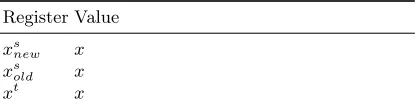
We know that the back-end server has two registers forxvalues corresponding to the attacked tag namely:xsoldandxsnew. The tags has a register for the current value ofxnamely:xt. At the beginning of the attack, the content of the registers are shown in Table 2.
Table 2.The content of the registers at the begin-ning of the attack.
Register Value
xs
new x
xsold x
xt x
Phase 1:
1. An adversary queries a tagT with a numberr1= 1. 2. After receiving the number r1, the tagT computesM1
1 ←H(ID)⊕t1⊕r1 ,M1
2 ←Tr1(Tt1(x)) andM31←x⊕t1 and sends them to the adversary. 3. The adversary computes H(ID)⊕t1 ← M1
1 ⊕r1. She knows M21 equals
Tt1(x) becauser1equals to 1 (Definition 1).
At the end of the Phase 1, neither the tag nor the back-end server performs key-updating. The content of the registers are shown in Table 2.
Phase 2:
1. The reader initiates a valid session by querying tags with a random number
r2.
2. After receiving the random numberr2, the tagT computesM2
1 ←H(ID)⊕
t2⊕r2 ,M2
2 ←Tr2(Tt2(x)) andM32←x⊕t2 and sends them to the reader. 3. The reader forwards r2,M12,M22 andM32to the back-end server.
4. The server identifies the tag T. It computes M2
4 ← H(ID)⊕r2⊕s2 and
M2
5 ←Ts2.t2(x) and sends them to the reader. 5. The reader forwards M2
4 andM52to the tag.
6. At the end of this valid session, the tag and the back-end server perform key-updating.
At the end of the Phase 2, the content of the registers are as shown in Table 3.
Phase 3:
1. The reader initiates a valid session by querying tags with a random number
Table 3.The content of the registers at the end of Phase 2.
Register Value
xs
new x⊕(t2||s2)
xsold x
xt x⊕(t2||s2)
2. After receiving the random number r3, the adversary has to create valid messages in order to pass the check by the back-end server. She obtained
H(ID)⊕t1, T
t1(x) and x⊕t1 in the Phase 1. She will use the values to create validM3
1,M23 andM33. She computesM13←H(ID)⊕t1⊕r3,M23←
Tr3(Tt1(x)) andM33←x⊕t3and sends them to the adversary. 3. The reader forwards r3,M13,M23 andM33to the back-end server. 4. The back-end server computes H(ID)⊕x = M3
1 ⊕M33⊕r3. The back-end server getsH(ID) and xsold from the record matching with the index
H(ID)⊕x. We know that the content of the register xsold equals x. The back-end server computest1←M13⊕H(ID)⊕r3. It checks the validity of
M23by computingTr3(Tt1(x)). The adversary passes this check because she createsM3
2 with the valid r3 and t1 values. After that the back-end server generates a random numbers3and replacesxs
newandxsoldwithx⊕(t 1||s3) andxrespectively.
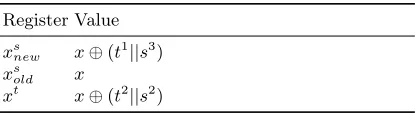
At the end of the Phase 3, the content of the registers are as shown in Table 4. In the above attack, the adversary is authenticated by the back-end database as a legitimate tag with a success probability of 1. The given attack makes the shared secrets out-of-synchronization in which only one legal protocol session is required.
Table 4.The content of the registers at the end of Phase 2.
Register Value
xsnew x⊕(t1||s3)
xs
old x
xt x⊕(t2||s2)
4.2 Secret Disclosure Attack
weakness in key-updating mechanism. She can disclose all secret parameters by eavesdropping one session of the protocol as follows:
1. An adversary eavesdrops a transcript of one protocol session between the tagT and the reader. She stores r,M1,M2andM3.
2. The adversary queries the tag T with the random numberr0.
3. After receiving r0, the tag T computesM10, M20 and M30 and sends them to the adversary.
4. The adversary computes (M10⊕M30⊕r0)⊕(M1⊕M3⊕r) = (H(ID)⊕x0)⊕ (H(ID)⊕x) =x0⊕x=x⊕(t||s)⊕x= (t||s). The adversary gets the values oftands. She computesM1⊕r⊕t=H(ID) andM3⊕t=x. The adversary gets the values ofH(ID) andx. Finally, she computesx⊕(t||s) =x0. An adversary knowing the secret values H(ID) and x0 can easily perform
traceability, tag impersonation, reader impersonation and de-synchronization attacks with a success probability 1.
5
Conclusion
In this paper, we show that Cheng et al.’s protocol [2] suffers from semi-group property of Chebyshev polynomials and its weak key-updating mechanism. We discover that this protocol is vulnerable to de-synchronization attack and secret disclosure attack. The cost of our attacks is the eavesdropping of one protocol session. The proposed secret disclosure attack shows that no security or privacy properties are achieved by this protocol.
References
1. Burrows, M., Abadi, M., Needham, R.: A Logic of Authentication. ACM Trans. Comput. Syst.8(1990) 18–36
2. Cheng, Z.Y., Liu, Y., Chang, C.C., Chang, S.C.: Authenticated RFID security mechanism based on chaotic maps. Security and Communication Networks6(2013) 247–256