Range Conservation
HORACE L. LEITHEAD
District Conservationist
,
Soil Conservation Service, Marja, TexasT
HE energy with which a farmer or rancher applies his range conservation program is likely to be in direct relation to his understanding of it. And his under- standing, likewise, is apt to depend more on what he has seen than on what he has been told. Methods used to give a man this understanding through “seeing” are usually called visual aids.The rancher naturally wants to know immediately what he can do to get his range in higher condition.
“But what can I do without rain?” he asks. “It hasn’t rained enough to make my grass head out.”
The grass, it is usually safe to say, did not head out because the range was too depleted to make use of the rain that fell. The landowner wants to know why the amount of grass his land produces is not in proportion to the rain he gets. It is easy to point out that the grass produced may be due to the condition of the range, and to the ease with which the soil can absorb moisture and make it available to plants. Soil texture and soil moisture have a bearing on the amount of moisture the soil can take up and hold. The depth of the soil is important, too. But it is easier to show this than to tell it. Take a “sharp- shooter” spade and dig around in several spots to see what the soils are like.
In a valley the soil is deep. Feel the texture-see how fine it is. Soil moisture is held as a film around these tiny par- ticles. It takes two to three inches of water to wet soil like this as much as a foot in depth. On the other hand, a coarse soil requires less than an inch of moisture to wet it a foot down. The finer the soil
the greater the holding surface for the film of moisture.
Select a plot where the range is excellent. Usually the soil here is darker in color than it is on poor condition ranges. That means there is more litter and organic matter-the living and dead plant matter, animal life and humus. The decay of grass roots, leaves, and the for- mation of humus improves the fertility, the physical condition and the water- holding capacity of the soil. The rate of water intake and storage capacity of any soil type can vary with the amount of organic material in the soil.
For any range site, it is recognized that certain combinations of plants largely de- termine range condition. It is only when a range is managed in such a way as to build up plant vigor and to return organic matter to the soil that we can expect the combination of plants known as climax vegetation or range in excellent condition to become established.
Just after a rain is a splendid time to show how range condition makes a big difference in moisture infiltration. Where a fence divides different range condition classes is a good place to show this. Use the sharpshooter spade again. Dig holes to show the depth of moisture penetra- tion.
In May of 1948, after a two-inch rain at Marfa, Texas, Soil Conservation Service range men and a group of ranchmen checked a site where a fence divided range in good and fair condition. They found that on the range in good condition the soil was wet to a depth of 30 inches. Across the fence that same amount of
96 HORACE L. LEITHEAD
rain had penetrated the soil only two inches. Three weeks later the grasses were starting to head out on the range in good condition, while on the other side of the fence, the grass had grown up about two inches and had burned up for the lack of moisture.
If a range technician is working with a rancher or a group and there is no rain to permit this demonstration of soil-moisture
I/S * “00s s- LONS AN0 AoUstAsLC.
‘d
FOR o.LI,R.IIO* 7 ss4 CU. MC”LI 0” It,., co L0Ul.S .I INO” I” lo 1°C” “MS.
VIEW W PARTS ARRANGED FOR USE
FIG. 1. Concentric rings for making soil in- filtration rate determinations.
relationship, there is another demonstra- tion that can be used. Infiltration rings, as shown in Figure 1, will demonstrate how fast different soils can absorb mois- ture.
These iron rings of 10 or 12 gauge black iron can be driven into the ground two or three inches so that water cannot seep out from under them. A board with two nails in it may be laid across the rings so that one nail is in the middle of the center ring and the other halfway between the
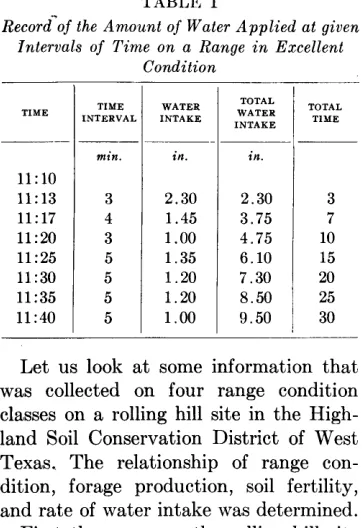
inner and outer rings. The nails should be adjusted so that the points are two inches above the ground. From a one-gallon glass jar or similar vessel calibrated in tenths of inches with the size of the inner ring, water is applied to the inner ring. The vessel should hold two inches of water, the initial application. At given intervals water is added to both rings to bring the water level up to the points of the nails. Time and amount of water applied to the inner ring are recorded, with the time interval between applications. Water is applied to the outer ring to compensate for the lateral movement of moisture in the soil, but no measurement of this is necessary.
Single rings may be used on field tours to show trends in infiltration rate. Double rings are more accurate because lateral penetration of moisture is avoided.
Those who see this test can readily understand the meaning of Table 1.
TABLE I
Record-of the Amount of Water Applied at given Intervals of Time on a Range in Excellent
Condition
TIME
11:lO 11:13 11:17 11:20 11:25 11:30 11:35 11:40
TIME WATER INTERVAL INTAKE
min.
3 4 3 5 5 5 5
in.
2.30 2.30 3 1.45 3.75 7 1.00 4.75 10 1.35 6.10 15 1.20 7.30 20 1.20 8.50 25 1.00 9.50 30
TOTAL WATER INTAKE
in.
TOTAL TIME
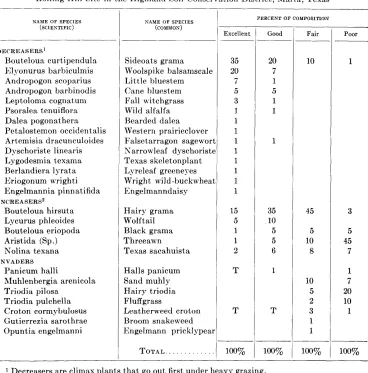
Let us look at some information that was collected on four range condition classes on a rolling hill site in the High- land Soil Conservation District of West Texas. The relationship of range con- dition, forage production, soil fertility, and rate of water intake was determined.
TABLE 2 Range Condition
Rolling Hill Site in the Highland Soil Conservation District, Marfa, Texas
NAME OF SPECIES NAME OF SPECIES
(SCIEKTIFIC) (COMMON)
DECREASERS’
Bouteloua curtipendula Elyonurus barbiculmis Andropogon scoparius Andropogon barbinodis Leptoloma cognatum Psoralea tenuiflora Dalea pogonathera Petalostemon occidentalis Artemisia dracunculoides Dyschoriste linearis Lygodesmia texama Berlandiera lyrata Eriogonum wrighti Engelmannia pinnatifida INCREASERS~
Bouteloua hirsuta Lycurus phleoides Bouteloua eriopoda Aristida (Sp.) Nolina texana INVADERS
Panicum halli
Muhlenbergia arenicola Triodia pilosa
Triodia pulchella Croton cormybulosus Gutierrezia sarothrae Opuntia engelmanni
Sideoats grama Woolspike balsamscale Little bluestem Cane bluestem Fall witchgrass Wild alfalfa Bearded dalea Western prairieclover Falsetarragon sagewori Karrowleaf dyschoristc Texas skeletonplant Lyreleaf greeneyes Wright wild-buckwheat Engelmanndaisy
Hairy grama Wolftail Black grama Threeawn Texas sacahuista
Halls panicum Sand muhly Hairy triodia Fluff grass
Leatherweed croton Broom snakeweed Engelmann prickIypear
TOTAL. . .
Excellent Good Fair Poor
35 20 7 5 3 1 1 1 1 1 1 1 1 1 15 5 1 1 2 T T 100% 20 7 1 5 1 1
10 1
1 35 10 5 5 6 1 45 5 10 8 T __--- 100% 10 5 2 3 1 1 3 5 45 7 1 7 20 10 1
100% 100%
PERCENT OF COMPOSITION
1 Decreasers are climax plants that go out first under heavy grazing.
2 Increasers are climax plants that increase temporarily and later decrease under heavy gran- ing.
was divided into four range condition classes (Table 2) based largely on the kinds of plants making up the forage cover. The most valuable plants occurred on range in excellent condition, whereas the least valuable plants occurred in abundance on the range in poor condition.
Analyses of these soils give the percent of organic matter for each range condition class as :
Excellent Condition ...
Good Condition ...
Fair Condition ...
Poor Condition. ...
4.6 3.8 3.6 2.1
98 HORACE L. LEITHEAD
on these four range condition classes in August, 1947, with an
perature of 90” were:
atmosphere tem-
Excellent Condition. ... 104”
Good Condition ... 110”
Fair Condition ... 114”
Poor Condition ... 120”
A soil thermometer helps to show how range condition affects soil temperatures. Moisture lost through evaporation in- creases as soil temperatures increase, thus reducing the amount of moisture available for plant growth.
The relation of the amount of surface litter and other vegetation to the rate at which moisture soaks into the ground is extremely important. This cover breaks the force of falling rain. It increases pene- tration, thereby reducing runoff. The in- creased penetration pays off in higher plant and animal production.
Water was applied by using infiltration
5 IO 15 20 25 30
Minutes
FIG. 2. Rate of range condition.
water intake as influenced bY
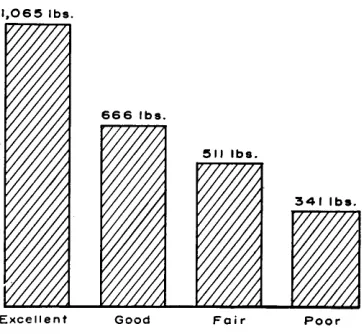
*To check forage production on each range condition class a two-foot quadrat can be laid out. The vegetation inside the quadrat is clipped and weighed. Results of one such comparison are shown in
Figure 3. Litter in this same quadrat was collected and weighed to find out how much was being returned to the soil to decay and be incorporated as humus. These weights (Fig. 4) reflect an accumu- lated amount of litter and not the exact amount being returned in any one year.
1,065 Ibs.
341 Ibr.
Excellent Good Fair Poor
FIG. 3. Pounds of air dried vegetation pro- duced per acre on rolling hill site according to range condition class.
726 Ibs.
Excellent Good
FIG. 4. Pounds of litter per acre on hill site according to range condition.
Fair Poor
rolling
Grass production can be increased sev- eral times by properly managing a range to bring it back to excellent condition.
condition. Simple methods can be used to for detail planning on a large number of help everyone understand conservation individual ranches. This results in more problems and treatment. These methods, conservation plans developed and applied, of course, can be used more effectively with the same manpower. Ranch planning with groups than with individuals. Work- requires time and hard work, and the ing with groups means spreading informa- planner, as well as the ranchman and the tion more quickly, thereby allowing time public, wants results.
PRESIDENT TRUMAN SPEAKS ON SOIL CONSERVATION
In his address to the Congress on the State of the Union, on January 4,1950, President Truman said, in part:
“If we are to achieve a better life for all, the natural resources of the country must be regarded as a public trust. We must use our precious assets of soil, water, forest, and grassland in such a way that they become constantly more productive and more valu- able.”