Article
Exploring The Magnetic Field Configuration Close To
The Central Engines Using GMVA
B. Rani1,2,†*, T. P. Krichbaum2, J. Hodgson3,, S. Koyama2, A. Zensus2, L. Fuhrmann2, A. P. Marscher4and S. G. Jorstad4
1 NASA Goddard Space Flight Center, Greenbelt, MD 20771, USA
2 Max-Planck-Institut für Radioastronomie, Auf dem Hügel 69, 53121, Bonn, Germany
3 Korea Astronomy and Space Institute, 776 Daedeokdae-ro, Yuseong-gu, Daejeon 34055, Korea
4 Institute for Astrophysical Research, Boston University, 725 Commonwealth Avenue, Boston, MA 02215,
USA
* Correspondence: [email protected]; Tel.: +1-301-286-2531 † NASA Postdoctoral Program (NPP) Fellow
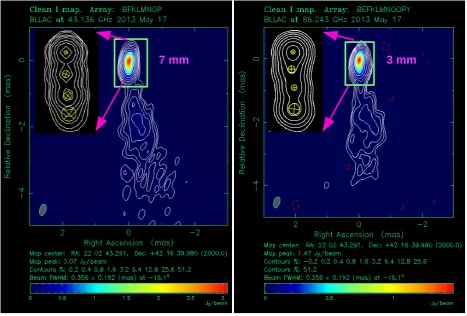
Abstract: The high radio frequency polarization imaging of non-thermal emission from active galactic nuclei (AGN) is a direct way to probe the magnetic field strength and structure in the immediate vicinity of supermassive black holes (SMBHs) and is crucial in testing the jet-launching scenario. To explore the the magnetic field configuration at the base of jets in blazars, we took advantage of the full polarization capabilities of the Global Millimeter VLBI Array (GMVA). With an angular resolution of ∼50 micro-arcseconds (µas) at 86 GHz, one could reach scales down to ∼900 Schwarzschild radii (for a 109solar mass black hole). We present here the preliminary results of our study on the blazar BL Lac. Our results imply that on sub-mas scales the core and the central jet of BL Lac are significantly polarized with two distinct regions of polarized intensity. We also noted a great morphological similarity between the 7mm/3mm VLBI images at very similar angular resolution.
Keywords: active galaxies; BL Lacertae object: BL Lac; jets; GMVA: high-resolution VLBI; magnetic field; polarization
1. High-frequency and high-resolution VLBI
Polarization study of non-thermal emission from AGN is a direct way to probe the magnetic field strength and structure in the immediate vicinity of a black hole, i.e., in a region where plasma is being injected and accelerated into the main jet stream. The current GMVA observations offer an angular resolution of 50µas, which scales down up to∼900 Schwarzschild radii for a 109M
BH. In
addition to that, Faraday depolarization effects become negligible at millimeter and sub-millimeter radio bands. Therefore, high-frequency polarimetric observations are essential in order to have a better understanding of the role of magnetic field in AGN accretion and jet production.
High-resolution observations have also been proven to be quite important in pinpointing the radiation processes responsible for theγ-ray emission in blazars [1–5]. Magnetic fields appear to plan an important role in particle acceleration; either particles are accelerated in high-magnetized environments [via relativistic magnetic reconnection and/or magnetoluminescence6,7], or in low magnetized environments via relativistic shocks [8]. Understanding magnetic-field configurations is therefore essential for probing the high-energy radiation processes.
31 32
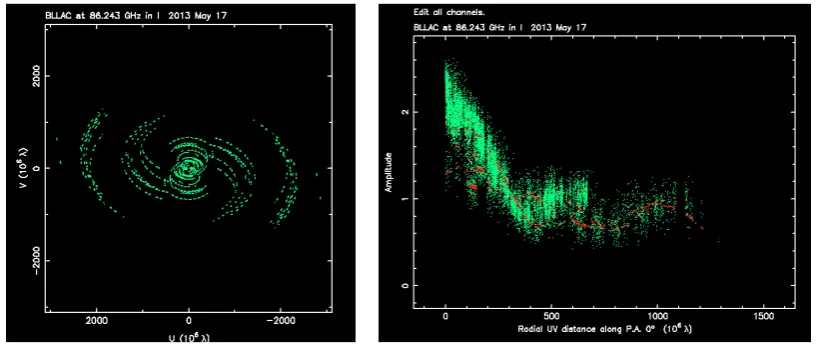
Figure 1. Left: UV-plot for BL Lac at 86 GHz in May 2013. Right: Correlated flux versus projected baseline.
solution of the problem. For a recent flare in 2006, a combination of high-resolution images with the associated broadband flux and optical polarization measurements of the source provided evidence for a helical magnetic field, well within the jet acceleration zone. There are also growing evidences that the observed gamma-ray emission is produced in this region, possibly by the interaction of moving with stationary shock(s) [5]. Therefore, BL Lac is an excellent candidate to study the relation between jet formation, gamma-ray emission, shock propagation and polarization variability.
2. Global 3 mm VLBI observations
The VLBI observations of the source were taken during an unprecedented broadband outburst. The source was detected at itshistoric high brightnessin cm and mm radio bands [11,12], at X-ray [13] and in the far-infrared bands in December 2012. On November 2012, the source flux had risen to ∼14.6 Jy at 1.3 mm - the highest measured since SMA (sub-millimeter array) observations began in 2002. On December 5, 2012, BL Lac experienced an X-ray flare several orders of magnitude brighter than any previous flare, accompanied by bright optical and ultraviolet emission. The source also experienced its brightest gamma-ray flare measured by the Fermi-LAT (Large Area Telescope) [Photon Flux at E>100 MeV ∼ 2×10−06 ph cm−2 s−1, 14]. We took advantage of this unique opportunity to search for related structural variations in the core region and on scales of a few ten micro-arcseconds.
To achieve the necessary high resolution and image fidelity, we conducted immediate VLBI observations in dual polarization mode at 22, 43, and 86 GHz radio frequencies in 2013. Bright blazars S5 0716+714, 1749+096, 3C 454.3, and 3C 345 were used as calibrators. In addition to the VLBA, we had participation of Pico Veleta and Effelsberg (both LCP/RCP) and Yebes (LCP). As a result, we had a factor of two increase in angular resolution and a factor of three gain in the sensitivity. Data calibration and imaging were performed using the standard tasks in AIPS and difmap. Figure1(left) shows the UV-coverage of BL Lac for the 3 mm data taken in May 2013. The correlated flux versus baseline length plot for the same is shown in the right panel.
3 of 6
29
7 mm
30
3 mm
Figure 2.Total intensity maps of BL Lac at 7 mm (left) and 3 mm (right) radio bands. For comparison purposes the 3 mm map is resolved with the 7 mm beam. A zoomed version (resolved with a beam size of 0.1 mas) of the central region is shown in the upper left corner for each case; the yellow circles are the fitted circular Gaussian components.
the source; to do so, we compare the EVPA orientation of the super-resolved map (especially of the optically thin region) with the close-in-time single EVPA measurements. The difference between the two is then applied to the final image. A detailed overview of polarization calibration and imaging can be found in Martí-Vidalet al.[15]. In the following section, we present the preliminary results of our study.
3. Results
Center at RA 22 02 43.29137088 DEC 42 16 39.9798699
ICONT:BLLAC IPOL 86242.928 MHz GR034 86 I.FITS.1
Grey scale flux range= 15.00 60.00 MilliJY/BEAM
Cont peak flux = 1.0360E+00 JY/BEAM
Levs = 1.000E-02 * (-0.700, 0.700, 1.400, 2.800,
5.600, 11.20, 22.40, 44.80, 89.60, 179.2, 358.4,
716.8)
Pol line 1 milli arcsec = 1.6667E-01 JY/BEAM
Pol. line rotated by -2.4 degrees
10
20
30
40
50
MilliArc seconds
MilliArc seconds
0.4
0.3
0.2
0.1
0.0
-0.1
-0.2
-0.3
-0.4
0.4
0.2
0.0
-0.2
-0.4
-0.6
preliminary
Region A
Region B
5 of 6
will provide observational constraints on the magnetic field strength and configuration close to the super-massive black holes.
In Fig.3 we show as an example the 86 GHz polarization map of BL Lac convolved with its natural beam. The color scale represents the polarized intensity which is plotted over the total intensity contours (I-map), and the solid lines mark the EVPA direction. Two regions of polarized intensity are of particular interest here; we mark these regions as Region A and Region B. Region A is a bright polarized region elongated from the core up to a distance of∼0.2 mas. The EVPA in this region is roughly inclined by 40-50◦to the jet axis. In region B we noticed an almost 90◦change in the EVPA direction in comparison to region A. Region B roughly extends from a distance of 0.2 to 0.5 mas and it is even more brighter than region A. The polarized intensity scale roughly follows the total intensity contours in the two regions. The change in the EVPA direction could either be due to the presence of helical magnetic field, which is a natural consequence of rotation of the central accretion disk and outflow, or it could simply be due to the presence of multiple oblique shocks. A comparison of multi-epoch polarization maps will allow us to resolve this question.
4. Summary and outlook
Understanding the physical processes happening close to the central engines and their connection to the jet activity and to the broadband flaring activity in blazars are the key challenges in active galactic nuclei physics. Ultra-high angular resolution mm-VLBI observations are the most feasible ways to answer these questions. We demonstrated the high-frequency and high-resolution polarization imaging capabilities of GMVA. In the very near future, ALMA will participate in the observations at 3 mm and 1.3 mm. This will significantly enhance the imaging and polarization capabilities of global mm-VLBI observations.
Acknowledgments:This research was supported by an appointment to the NASA Postdoctoral Program at the Goddard Space Flight Center, administered by Universities Space Research Association through a contract with NASA. BR acknowledges the help of Dave Thompson for his comments on the manuscript.
Author Contributions: BR, TK, AM, SJ, AZ, and JH proposed and conducted the observations. BR and SK analyzed the data. The manuscript is written by BR.
Conflicts of Interest:The authors declare no conflict of interest.
Bibliography
1. Hodgson, J.A.; Krichbaum, T.P.; Marscher, A.P.; Jorstad, S.G.; Rani, B.; Marti-Vidal, I.; Bach, U.; Sanchez, S.; Bremer, M.; Lindqvist, M.; Uunila, M.; Kallunki, J.; Vicente, P.; Fuhrmann, L.; Angelakis, E.; Karamanavis, V.; Myserlis, I.; Nestoras, I.; Chidiac, C.; Sievers, A.; Gurwell, M.; Zensus, J.A. Location of Gamma-ray emission and magnetic field strengths in OJ 287. ArXiv e-prints 2016, [arXiv:astro-ph.HE/1607.00725].
2. Karamanavis, V.; Fuhrmann, L.; Krichbaum, T.P.; Angelakis, E.; Hodgson, J.; Nestoras, I.; Myserlis, I.; Zensus, J.A.; Sievers, A.; Ciprini, S. PKS 1502+106: A high-redshift Fermi blazar at extreme angular resolution. Structural dynamics with VLBI imaging up to 86 GHz. A&A2016, 586, A60, [arXiv:astro-ph.HE/1511.01085].
3. Rani, B.; Krichbaum, T.P.; Marscher, A.P.; Jorstad, S.G.; Hodgson, J.A.; Fuhrmann, L.; Zensus, J.A. Jet outflow and gamma-ray emission correlations in S5 0716+714. A&A 2014, 571, L2, [arXiv:astro-ph.HE/1410.0196].
4. Rani, B.; Krichbaum, T.P.; Marscher, A.P.; Hodgson, J.A.; Fuhrmann, L.; Angelakis, E.; Britzen, S.; Zensus, J.A. Connection between inner jet kinematics and broadband flux variability in the BL Lacertae object S5 0716+714.A&A2015,578, A123,[arXiv:astro-ph.HE/1503.04218].
Miller, H.R.; Ryle, W.T. The inner jet of an active galactic nucleus as revealed by a radio-to-γ-ray outburst. Nature2008,452, 966–969.
6. Kagan, D.; Sironi, L.; Cerutti, B.; Giannios, D. Relativistic Magnetic Reconnection in Pair Plasmas and Its Astrophysical Applications.Space Science Reviews2015,191, 545–573,[arXiv:astro-ph.HE/1412.2451]. 7. Blandford, R.; East, W.; Nalewajko, K.; Yuan, Y.; Zrake, J. Active Galactic Nuclei: The TeV Challenge.
ArXiv e-prints2015,[arXiv:astro-ph.HE/1511.07515].
8. Marscher, A.P.; Gear, W.K. Models for high-frequency radio outbursts in extragalactic sources, with application to the early 1983 millimeter-to-infrared flare of 3C 273.ApJ1985,298, 114–127.
9. Jorstad, S.G.; Marscher, A.P.; Lister, M.L.; Stirling, A.M.; Cawthorne, T.V.; Gear, W.K.; Gómez, J.L.; Stevens, J.A.; Smith, P.S.; Forster, J.R.; Robson, E.I. Polarimetric Observations of 15 Active Galactic Nuclei at High Frequencies: Jet Kinematics from Bimonthly Monitoring with the Very Long Baseline Array. AJ 2005,130, 1418–1465,[astro-ph/0502501].
10. Mutel, R.L.; Denn, G.R. Is the Radio Core of BL Lacertae Precessing? ApJ 2005, 623, 79–84, [astro-ph/0412496].
11. Karamanavis, V.; Myserlis, I.; Fuhrmann, L.; Angelakis, E.; Nestoras, I.; Krichbaum, T.P.; Zensus, J.A.; Ungerechts, H.; Sievers, A.; Riquelme, D. Gamma-ray blazar BL Lacertae: the highest recorded cm/mm radio flux over the past 30 years.The Astronomer’s Telegram2012,4349.
12. Wehrle, A.E.; Grupe, D.; Gurwell, M.; Jorstad, S.; Marscher, A. Gamma-Ray Blazar BL Lacertae at historic high brightness in millimeter, X-ray and far-infrared bands. The Astronomer’s Telegram2012,4557. 13. Grupe, D.; Wehrle, A.E. Swift detects BL Lacertae in an historic high state in X-rays. The Astronomer’s
Telegram2012,4627.
14. Cutini, S. Fermi-LAT detection of increasing of gamma-ray activity of BL Lacertae. The Astronomer’s Telegram2012,4028.
15. Martí-Vidal, I.; Krichbaum, T.P.; Marscher, A.; Alef, W.; Bertarini, A.; Bach, U.; Schinzel, F.K.; Rottmann, H.; Anderson, J.M.; Zensus, J.A.; Bremer, M.; Sanchez, S.; Lindqvist, M.; Mujunen, A. On the calibration of full-polarization 86 GHz global VLBI observations. A&A2012,542, A107,[arXiv:astro-ph.IM/1203.1424]. 16. Tchekhovskoy, A.; Narayan, R.; McKinney, J.C. Efficient generation of jets from magnetically arrested accretion on a rapidly spinning black hole. MNRAS2011,418, L79–L83,[arXiv:astro-ph.HE/1108.0412].
c