
A preliminary version of this paper appears in the proceedings of ESORICS 2014. This is the full version.
Even more practical secure logging:
Tree-based Seekable Sequential Key Generators
Giorgia Azzurra Marson1 and Bertram Poettering2 1
CASED & TU Darmstadt 2
Information Security Group at Royal Holloway, University of London
Abstract. Computer log files constitute a precious resource for system administrators for discov-ering and comprehending security breaches. A prerequisite of any meaningful log analysis is that attempts of intruders to cover their traces by modifying log entries are thwarted by storing them in a tamper-resistant manner. Some solutions employ cryptographic authentication when storing log entries locally, and let the authentication scheme’s property offorward securityensure that the cryptographic keys in place at the time of intrusion cannot be used to manipulate past log entries without detection. This strong notion of security is typically achieved through frequent updates of the authentication keys via hash chains. However, as security demands that key updates take place rather often (ideally, at a resolution of milliseconds), in many settings this method quickly reaches the limits of practicality. Indeed, a log auditor aiming at verifying a specific log record might have to compute millions of hash iterations before recovering the correct verification key. This problem was addressed only recently by the introduction ofseekable sequential key genera-tors (SSKG). Every instance of this cryptographic primitive produces a forward-secure sequence of symmetric (authentication) keys, but also offers an explicit fast-forward functionality. The only currently known SSKG construction replaces traditional hash chains by the iterated evaluation of ashortcut one-way permutation, a factoring-based and hence in practice not too efficient building block. In this paper we revisit the challenge of marrying forward-secure key generation with seek-ability and show that symmetric primitives like PRGs, block ciphers, and hash functions suffice for obtaining secure SSKGs. Our scheme is not only considerably more efficient than the prior number-theoretic construction, but also extends the seeking functionality in a way that we believe is important in practice. Our construction is provably (forward-)secure in the standard model.
1
Introduction
Computer log files can be configured to record a large variety of system events that occur on network hosts and communication systems, including users logging on or off, memory resources reaching their capacity, malfunctioning of disk drives, etc. Therefore, log files represent one of the most essential sources of information that support system administrators in understanding the activity of systems and keeping them fully functional. Not less important is the role that log files play in computer forensics: events like login failures and software crashes serve as standard indicators for (attempted) intrusions. Unfortunately, as log files are often recorded locally (i.e., on the monitored machine itself), in many practical cases intruders can a posteriori manipulate the log entries related to their attacks.
Forward-secure cryptography for log file protection. A solution for tamper-resistant log-entry storage that does not require a remote log sink but offers integrity protection via cryptographic means issecured local logging. Here, each log entry is stored together with a specific authentication tag that is generated and verified using a secret key. Note that regular message authentication codes (MACs) by themselves seem not to constitute a secure solution, as corresponding tags will be forgeable by intruders that succeed in extracting the secret key from the attacked device. Rather, the forward-secure variant of a MAC is required, as elaborated next.
In a nutshell, a cryptosystem providesforward security(FS) if it continues to give meaningful security guarantees after the adversary got a copy of the used keys. A standard example is key exchange: here, all recent security models require established session keys to remain safe when the adversary obtains access to the involved long-term private keys [19,7]. Likely less known is that the notion of forward security also extends to non-interactive primitives. For instance, in forward-secure public key encryption [6] messages are encrypted in respect to a combination (pk, t), where pk is a public key andt∈Nidentifies one out
of a set of consecutive time epochs; for each such epocht, knowledge of a specific decryption key skt is
necessary for decrypting corresponding ciphertexts. In addition, while by design it is efficiently possible to perform updatesskt7→skt+1, forward security requires that the reverse mapping be inefficient, i.e., it
shall be infeasible to ‘go backwards in time’. More precisely, forward security guarantees that plaintexts encrypted for ‘expired’ epochs remain confidential even if the decryption keys of all later epochs are revealed.
Analogously to the described setting, signatures and authentication tags of the forward-secure variants of signature schemes and MACs, respectively, remain unforgeable for past epochs if only current and future keys are disclosed to the adversary [3,5]. One possible way to obtain such a MAC is to combine a (forward-secure)sequential key generator(SKG) with a regular MAC [12,5], where the former can be seen as a statefulpseudorandom generator (PRG) that, once initialized with a random seed, deterministically outputs a pseudorandom sequence of fixed-length keys. These keys are then used together with a MAC to ensure unforgeability of messages within the epochs.
The challenge of seekability. Forward-secure SKGs are typically constructed by deterministically evolving an initially random state using a hash chain, i.e., by regularly replacing a ‘current’ keyKt byKt+1 = H(Kt), where H is a cryptographic hash function [12,5]. Although hash chains, in principle, lead to
(forward-)secure local logging, they also come with an efficiency penalty on the side of the log auditor: the latter, in order to verify a log record of a certain epocht, first needs to recover the corresponding keyKt; however, as a high level of security requires a high key update rate, this might involve millions
of hash function evaluations. This problem was addressed only recently: in [16], efficient forward-secure local logging is achieved via aseekable sequential key generator (SSKG).
We give a rough overview over the ideas in [16]. Essentially, the authors propose a generic construc-tion of an SSKG from a shortcut one-way permutation (SCP), a primitive that implements a one-way permutationπ:D→D, for a domainD, with a dedicated shortcut algorithm allowing the computation of the k-fold composition πk in sublinear time. The concrete SCP considered in [16] is given by the
squaring operation modulo a Blum integer N, where applying the shortcut corresponds to reducing a certain exponent modulo ϕ(N). Given an SCP, an SSKG can be obtained by letting its state consist of a single element in D, performing state updates by applying π to this element, and deriving keys by hashing it (more precisely, by applying a random oracle). While it is instructive to observe how the forward security of the SSKG corresponds with the one-wayness of the SCP, and how its seekability is based on the SCP’s shortcut property, a notable technical artifact of the squaring-based SCP is that seekability requires knowledge of ϕ(N) while forward security requires this value to be unknown. This dilemma is side-stepped in [16] by giving only the owners of a seeking key the ability to fast-forward through the SSKG output sequence.
1.1 Contributions and organization
getting rid of the discussed seeking limitations of [16], our scheme allowseveryuser to efficiently advance any state by an arbitrary number of epochs. Our SSKG is supported by a security proof in the standard model.
This paper is organized as follows. After starting with preliminaries in Section2, we formally specify the functionality, syntax, and security requirements of SSKGs in Section 3; this includes both a com-parison with the (different) formalizations in [16] and a concrete proposal on how SSKGs can be used to protect audit logs in practice. In Section4 we describe our new PRG-based SSKG, including its gen-eralized seekability notion and some possible time-memory trade-offs. Finally, in Section 5, we discuss implementational aspects and efficiency results from our implementation.
1.2 Related work
The first published work that highlights the importance ofseekability as a desirable property of sequen-tial key generators in the context of secured local logging is [16,17]. An extensive comparison of the corresponding results with the ones of the current paper can be found in the preceding paragraphs and in Section3. In the following we discuss further publications and proposed protocols targeting the top-ics of sequential key generation and cryptographic audit log protection. We observe that all considered protocols either are forward-secure or offer seekability, but not both simultaneously.
An early approach towards secured local logging originates from Bellare and Yee [4]; they study the role of forward security in authentication, develop the security notion offorward integrity, and realize a corresponding primitive via a PRF chain. Later, the same authors provide the first systematic analysis of forward security in the symmetric setting [5], covering forward-secure variants of pseudorandom gen-erators, symmetric encryption, and message authentication codes, and also providing constructions and formal proofs of security for these primitives.
Shortly after [4], an independent cryptographic scheme specifically targeted at protecting log files was described by Kelsey and Schneier [12,13,18]. Their scheme draws its (forward) security from frequent key updates via iterated hashing, but is unfortunately not supported by a formal security analysis. A couple of implementations exist, notably the one by Chong, Peng, and Hartel in tamper-resistant hardware [8], the construction of Stathopoulos, Kotzanikolaou, and Magkos [20], who investigate the role of secure logging in public communication networks, and the logcrypt system by Holt [10]. The latter improves on [12] by paving the way towards provable security, but also adds new functionality and concepts. Most notable is the suggestion to embed regular metronome entries into log files to thwarttruncation attacks where the adversary cuts off the most recent set of log entries. Similar work is due to Accorsi [1] who presentsBBox, a hash-chain-based framework for protecting the integrity and confidentiality of log files in distributed systems.
Ma and Tsudik consider the concept offorward-secure sequential aggregate authentication for protect-ing the integrity of system logs [14,15]. Their constructions build on compact constant-size authenticators with all-or-nothing security (i.e., adversarial deletion of any single log message is detected), naturally defend against truncation attacks, and enjoy provable security.
The proposals by Yavuz and Ning [21], and Yavuz, Ning, and Reiter [22], specifically aim at secured logging on constraint devices and support a shift of computation workload from the monitored host to the log auditor. Notably, their key update procedure and the computation of authentication tags takes only a few hash function evaluations and finite field multiplications. In common with the schemes discussed above, their authentication systems are not seekable.
Kelsey, Callas, and Clemm [11] introduced secured logging into the standardization process at IETF. However, their proposal ofsigned syslog messages focuses on remote logging instead of on local logging. Precisely, their extension to the standard UNIX syslog facility authenticates log entries via signatures before sending them to a log sink over the network. While this proposal naturally offers seekability, it is bound to the full-time availability of an online log sink. Indeed, periods where the latter is not reachable are not securely covered, as the scheme is not forward-secure.
2
Preliminaries
We recall basic notions and facts from cryptography, graph theory, and data structures that we require in the course of this paper. Notably, in the section on trees, we define what we understand by the ‘co-path’ of a node. If not explicitly specified differently, all logarithms are understood to be taken to base 2.
2.1 Pseudorandom generators
Apseudorandom generator (PRG) is a function that maps a random string (‘seed’) to a longer ‘random-looking’ string. The security property of pseudorandomness requires that it be infeasible to distinguish the output of a PRG from random:
Definition 1 (Pseudorandom generator). For security parameter λand a polynomialc:N→N≥1,
an efficiently computable function G: {0,1}λ → {0,1}λ+c(λ) is a pseudorandom generator if for all efficient distinguishersDthe following advantage function is negligible, where the probabilities are taken over the random choices ofsandy, and overD’s randomness:
AdvPRGG,D(λ) = Pr
D(G(s)) = 1 : s←R{0,1}λ
−PrhD(y) = 1 : y←R{0,1}λ+c(λ)
i
.
As we discuss in Section5, in practice PRGs can be obtained from appropriate block ciphers, stream ciphers, or hash functions.
2.2 Binary and d-ary trees
A tree is a simple, undirected, connected graph without cycles. We particularly consider rooted trees, i.e., trees with a distinguished root node. The nodes adjacent to the root node are called itschildren; each child can be considered, in turn, the root of a subtree. Thelevel Lof a node indicates its distance to the root, where we assign levelL= 1 to the latter. Children of the same node aresiblings of each other. We will assume that the children of each node are ordered, i.e., can be identified by a number 1≤i≤d, where dis the number of children. For two siblings with indices i andj, respectively, in case i < j we say that nodeiisleft of nodej and that nodej is right of nodei. In binary trees we may also refer to the children as left and right directly. Nodes that have no children are calledleaves, all other nodes are calledinternal. A tree isd-regular (ord-ary, orbinary in case d= 2) if every internal node has exactly dchildren.
In this paper we focus on d-ary trees of constant height H, i.e., where all leaves have the same levelL=H. Ifµd(L) denotes the number of nodes at levelL, then for such trees we haveµd(1) = 1 and
µd(L) =d·µd(L−1) =dL−1 for allL >1. For the total number of nodes νd(H) we hence obtain
νd(H) = H
X
L=1
µd(L) = H
X
L=1
dL−1= (dH−1)/(d−1) ,
by the geometric summation formula. As a special case, for binary trees the total number of nodes is ν2(H) = 2H−1.
We finally define the notion ofco-pathof a node. Letvdenote an arbitrary node of a tree. Intuitively speaking, the (right) co-path of v is the list of the right siblings of the nodes on the (unique) path connecting the root node with v; if for individual nodes on this path there are multiple right siblings, all of them appear in the co-path. For a formal definition, let L denote the level of v = vL and let
(v1, . . . , vL) denote the path that connects the root (denoted here withv1) withvL. For each 1≤i≤L
letVi→be the list of right siblings of nodevi, in left-to-right order (some of these lists might be empty,
and particularly V1→ always is). We define the co-path of vL to be the listVL→k. . .kV1→ obtained by combining these lists into a single one using concatenation.
2.3 Stacks and their operations
procedures can be used to operate on stacks for storing, reading, and deleting elements. By Init(S) we denote the initialization of a fresh and empty stack S. To add an element x ‘on top of’ stack S, operation Push(S, x) is used. We write x ← Pop(S) for reading and removing the top element of stack S. Finally, with x ← Peekk(S) the k-th element of stack S can be read without deleting it;
here, elements are counted from the top, i.e.,Peek1(S) reads the top-most element. When using these notations, operationsInit,Push, andPop are understood to modify their argumentS in place, while Peekk leaves it unchanged.
3
Seekable sequential key generators
The main contribution of this paper is a new construction of aseekable sequential key generator (SSKG). This cryptographic primitive can be seen as a stateful PRG that outputs a sequence of fixed-length keys—one per invocation. The specific property ofseekabilityensures that it is possible to jump directly to any position in the output sequence. At the same time, the security goal of forward security ensures that keys remain indistinguishable from random even upon corruption of the primitive’s state. We next recall the syntactical definition and security properties, (mainly) following the notation from [16]. We defer the exposition of our new scheme to Section4.
3.1 Functionality and syntax
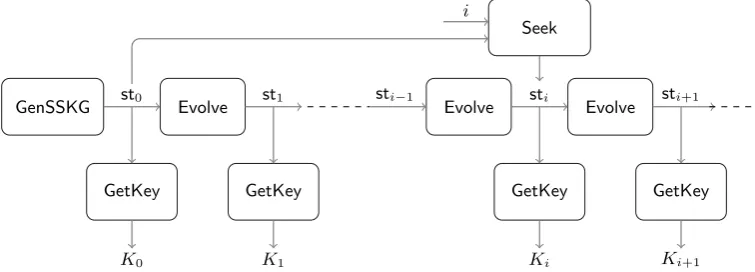
Generally speaking, a seekable sequential key generator consists of four algorithms:GenSSKGgenerates an initial statest0, the update procedureEvolvemaps each statesti to its successor statesti+1,GetKey
derives from any statestia corresponding (symmetric) keyKi, andSeekpermits to compute any statesti
directly from initial statest0and indexi. We consider each state associated with a specific period of time, called epoch, where the switch from epoch to epoch is carried out precisely with the Evolve algorithm. This setting is illustrated in Figure1 and formalized in Definition2.
GetKey GetKey GetKey GetKey GenSSKG Evolve Evolve Evolve
Seek
st0 st1 sti−1 sti sti+1
K0 K1 Ki Ki+1
i
Fig. 1:Illustration of the interplay of the different SSKG algorithms.
Definition 2 (Syntax of SSKG).Let `:N→Nbe a polynomial. Aseekable sequential key generator with key length `is a tuple SSKG={GenSSKG,Evolve,GetKey,Seek} of efficient algorithms as follows:
– GenSSKG. On input of security parameter 1λ and total number N ∈
N of supported epochs, this
probabilistic algorithm outputs an initial state st0.
– Evolve. On input of a statesti, this deterministic algorithm outputs the ‘next’ statesti+1. For conve-nience, fork∈N, byEvolvek we denote the k-fold composition ofEvolve, i.e.,Evolvek(sti) =sti+k.
– GetKey. On input of statesti, this deterministic algorithm outputs a key Ki∈ {0,1}`(λ). For k∈N,
we write GetKeyk(sti)forGetKey(Evolvek(sti)).
Implicit in Definition 2 is the following natural consistency requirement on the interplay of Evolve andSeekalgorithms:
Definition 3 (Correctness of SSKG).A seekable sequential key generatorSSKGis correctif, for all security parametersλ, allN ∈N, allst0←RGenSSKG(1λ, N), and allk∈Nwe have
0≤k < N =⇒ Evolvek(st0) =Seek(st0, k) .
Remark 1 (Epochs outside of supported range).Note that the correctness requirement leaves unspecified the effect of Evolve and Seek algorithms when invoked in the context of unsupported epoch numbers k ≥N. Clearly, if the application demands it, an SSKG can always be implemented such that Evolve, Seek, andGetKey output an error symbol for such epochs, simply by including an epoch counter in the state. We abstain from formally requiring such a behavior as our construction in Section4in many cases does guarantee security for a larger number of epochs than requested and there seems to be no reason to generally disregard systems that offer this extra service.
Remark 2 (Comparison with the definition from [16]). The syntax specified in Definition2does slightly deviate from the one in [16, Definition 3]: firstly, the SSKG setup routine of [16] has a secret ‘seeking key’ as additional output; it is required as auxiliary input for theSeekalgorithm. The necessity of this extra key should be considered an artifact of the number-theory-based construction from [16] (see Section3.4 for details): the seeking key contains the factorization of the RSA modulus underlying the scheme. As the proposedEvolve algorithm is one-way only if this factorization is not known, the Seekalgorithm is available exclusively to those who know the seeking key as a ‘trapdoor’. In contrast to that, our syntax for Seekis not only more natural, we also alloweverybodyto use theSeekalgorithm to fast-forward efficiently to future epochs. Secondly, in [16] the number of supported epochs does not have to be specified at the time of SSKG initialization; instead, an infinite number of epochs is supported by every instance. We had to introduce this restriction for technical reasons that become clear in Section4; however, we believe that the requirement of specifying the number of epochs in advance does not constrain the practical usability of our scheme too much: indeed, regarding our scheme from Section4, instantiations with, say, N = 230 supported epochs are perfectly practical.
3.2 Security requirements
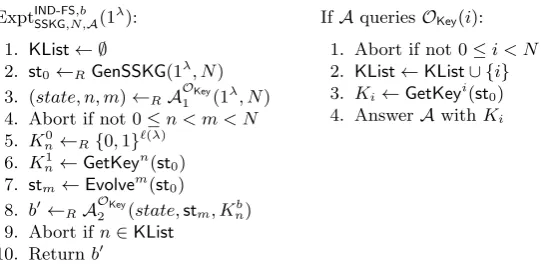
As the security property of SSKGs we demand indistinguishability of generated keys from random strings of the same length. This is modeled in [16] via an experiment involving an adversary Awho first gets adaptive access to a set of (real) keysKi of her choosing, and is then challenged with a stringKnb that
is either the real keyKn or a random string of the same length; the adversary has to distinguish these
two cases. This shall model the intuition that keysKn ‘look random’ even if the adversary is given (all)
other keysKi, fori6=n. Below we formalize a stronger security notion that also incorporates forward
security, i.e., additionally lets the adversary corrupt any state that comes after the challenged epoch. Definition 4 (IND-FS security of SSKG [16]). A seekable sequential key generator SSKG is indis-tinguishable with forward security against adaptive adversaries (IND-FS)if, for all efficient adversaries A = (A1,A2) that interact in experiments ExptIND-FS,b from Figure 2 and all N ∈ N bounded by a
polynomial inλ, the following advantage function is negligible, where the probabilities are taken over the random coins of the experiment (including overA’s randomness):
AdvINDSSKG-FS,N,A(λ) = Pr
h
ExptINDSSKG-FS,N,,1A(1λ) = 1i−PrhExptINDSSKG-FS,N,,0A(1λ) = 1i
.
3.3 Application of SSKGs: protecting locally stored log files
Given the definitions from Sections 3.1 and 3.2, the role of SSKGs in the context of secure logging is now immediate: in every epochi, corresponding keyKi is used to instantiate a message authentication
ExptIND-FSSSKG,N,,bA(1λ):
1. KList← ∅
2. st0←RGenSSKG(1λ, N) 3. (state, n, m)←RAOKey
1 (1
λ , N) 4. Abort if not 0≤n < m < N
5. Kn0 ←R{0,1}`(λ)
6. K1
n←GetKeyn(st0)
7. stm←Evolvem(st0) 8. b0←RAOKey
2 (state,stm, K
b n)
9. Abort ifn∈KList
10. Returnb0
IfAqueriesOKey(i): 1. Abort if not 0≤i < N
2. KList←KList∪ {i}
3. Ki←GetKeyi(st
0) 4. AnswerAwithKi
Fig. 2:Security experiments for indistinguishability with forward security. The abort operation lets the experi-ment return 0, disregarding any output of the adversary.
3.4 Prior SSKG constructions
While general sequential key generators have been considered in a variety of publications [12,18,5,10], the importance of seekability to obtain practical secure logging was only identified very recently [16]. By consequence, we are aware of only a single SSKG that precedes our current work.
Intuitively speaking, the SSKG construction from [16] follows the permute-then-hash paradigm. In more detail, the authors consider so-called shortcut one-way permutations π: D → D that allow the evaluation of thek-fold compositionπk in less thanO(k) time. Given such a primitive, statest
0consists of a random elementx0∈ D, and keysKiare computed asKi=H(πi(x0)), whereH is a hash function modeled as a random oracle. The authors propose a number-theory-based shortcut permutation where π implements precisely the squaring operation modulo a Blum integer N; in this case, πi(x) = x2i = x2imodϕ(N)
can be evaluated quite efficiently if the factorization ofN is known.
4
SSKGs from pseudorandom generators
We propose a novel construction of a seekable sequential key generator that assumes only symmetric building blocks. Unlike the scheme in [16] which draws security from shortcut one-way permutations in the random oracle model, our new SSKG assumes just the existence of PRGs, i.e., it relies on a minimal cryptographic assumption. In a nutshell, similarly to the works in [3] and [6] that achieve forward-secure signing and forward-secure public key encryption, respectively, we identify time epochs with the nodes of specially formed trees and let the progression of time correspond to a pre-order visit of these nodes. We will start with the exposition of our scheme in the case of binary trees, and then extend the results to the more general case.
4.1 Sequential key generators from binary trees
From Section2.2we know that for any fixedH ∈N≥1 the binary tree of constant heightH has exactly N =ν2(H) = 2H−1 nodes. In our SSKG we identify time epochs with the nodes of such a tree. More
precisely, given the pre-order depth-first enumeration w0, . . . , wN−1 of the nodes (first visit the root, then recursively the left subtree, then recursively the right subtree; cf. Figure3), we let time epochiand nodewi correspond.
The idea is to assign to each nodewia (secret) seedsi∈ {0,1}λfrom which the corresponding epoch’s
keyKiand the seeds of all subordinate nodes can be deterministically derived via PRG invocations. Here,
exclusively the secret of the root node is assigned at random. Intuitively, the pseudorandomness of the PRG ensures that all keys and seeds look random to the adversary.
We proceed with specifying which information the states associated with the epochs shall record. Recall that from each statesti, 0 ≤i < N, two pieces of information have to be derivable: the
0
1 8
2 5 9 12
3 4 6 7 10 11 13 14
Fig. 3: A binary tree with height H = 4 and
N = 24−1 = 15 nodes. The latter are num-bered according to a pre-order depth-first search, as partially indicated by the arrow from the root nodew0to nodew6.
for all 4≤i < N the keysKicould be computed from this state. Inspired by this observation, our SSKG
stores in each statestia collection of seeds, namely the seeds of the roots of the ‘remaining subtrees’. The
latter set of nodes is precisely what we called in Section2.2theco-path of nodewi. Intuitively speaking,
this construction is forward-secure as each state stores only the minimal information required to compute all succeeding states. In particular, as each node precedes all vertices on its co-path (in the sense of a pre-order visit of the tree), the corresponding key remains secure even if any subsequent epoch’s seed is leaked to the adversary.
4.2 Our SSKG construction
We present next the algorithms of our SSKG construction. Particularly interesting, we believe, are the details on how the required pre-order depth-first search is implicitly performed by help of a stack data structure.
Construction 1 (TreeSSKG) Fix a polynomial`:N→N and a PRG G:{0,1}λ → {0,1}2λ+`(λ). For alls∈ {0,1}λ writeG(s)as
G(s) =GL(s)kGR(s)kGK(s) where GL(s), GR(s)∈ {0,1}λ andGK(s)∈ {0,1}`(λ) .
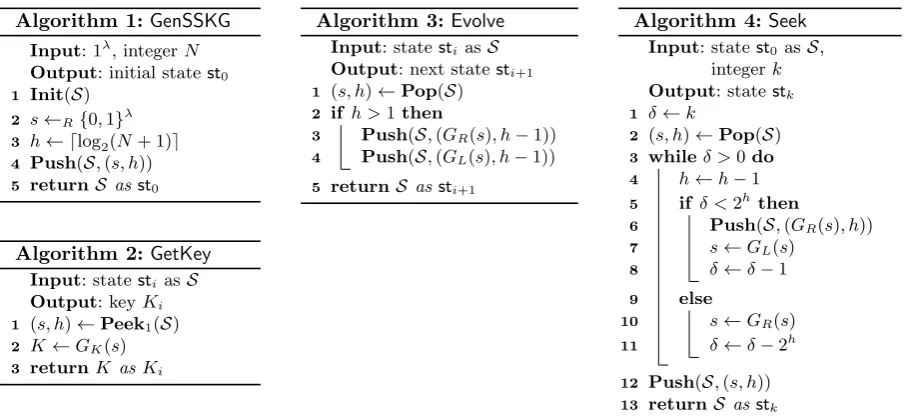
Assuming the notation for stacks from Section 2.3, the algorithms TreeSSKG = {GenSSKG,Evolve, GetKey,Seek}of our SSKG are defined by Algorithms 1–4in Figure4.
Algorithm 1:GenSSKG
Input: 1λ, integerN
Output: initial statest0
1 Init(S)
2 s←R{0,1}λ
3 h← dlog2(N+ 1)e
4 Push(S,(s, h))
5 returnS asst0
Algorithm 2: GetKey Input: statestiasS
Output: keyKi
1 (s, h)←Peek1(S)
2 K←GK(s)
3 returnK asKi
Algorithm 3:Evolve Input: statestiasS
Output: next statesti+1
1 (s, h)←Pop(S)
2 if h >1then
3 Push(S,(GR(s), h−1))
4 Push(S,(GL(s), h−1))
5 returnS assti+1
Algorithm 4:Seek Input: statest0 asS,
integerk
Output: statestk
1 δ←k
2 (s, h)←Pop(S)
3 whileδ >0do
4 h←h−1
5 if δ <2hthen
6 Push(S,(GR(s), h))
7 s←GL(s)
8 δ←δ−1
9 else
10 s←GR(s)
11 δ←δ−2h
12 Push(S,(s, h))
13 returnS asstk
Fig. 4:Algorithms ofTreeSSKGfor binary trees. As building blocks we assume a PRG and a stack (cf. Section2). For the meaning of symbols GL, GR, GK see Construction1. Observe that the number of supported epochs is potentially greater thanN due to the rounding operation in line3ofGenSSKG.
GenSSKG. Besides picking a random seeds=s0for the root node, Algorithm1 computes the minimum numberh∈Nsuch that the binary tree of constant heighthconsists of at leastNnodes (cf. Section2.2).
Observe that this tree might have more than N nodes, i.e., more epochs are supported than required. The algorithm stores in statest0a stackS that contains only a single element: the pair (s, h). Here and in the following such pairs should be understood as ‘seedsshall generate a subtree of heighth’.
Evolve. The stackS stored in state sti generally contains two types of information: the top element is
a pair (s, h) associated with the current node wi, and the remaining elements are associated with the
corresponding pairs of the nodes on wi’s co-path. After taking the current entry (s, h) off the stack, in
order to implement the depth-first search idea from Section 4.1, Algorithm 3 distinguishes two cases: if nodewi is an internal node (i.e., h >1), the update step computes the seeds of its two child nodes
using PRGG, starting with the right seed as it needs to be prepended to the current co-path. The new seeds GL(s) and GR(s) can be considered roots of subtrees of one level less than wi; they are hence
pushed onto the stack with decreased h-value. In the second case, if the current node wi is a leaf (i.e.,
h= 1), no further action has to be taken: the next required seed is the ‘left-most’ node onwi’s co-path,
which resides on the stack’s top position already.
GetKey. Algorithm 2 is particularly simple as it requires only a single evaluation of PRG G. Observe that thePeek1 operation leaves its argument unchanged.
Seek. Deriving state stk from the initial state st0 via iteratively evoking k times the Evolve procedure is equivalent to visiting all nodes of the tree according to a pre-order traversal until reaching node wk.
However, there is an appealing way to obtain seed sk more directly, without passing through all the
intermediate vertices. The idea is to just walk down the path connecting the root node withwk. Taking
this shortcut decreases the seeking cost to only O(logN), as opposed to O(N). This is the intuition behind the design of our algorithmSeekfrom Figure4.
0
1 8
2 5 9 12
3 4 6 7 10 11 13 14
target
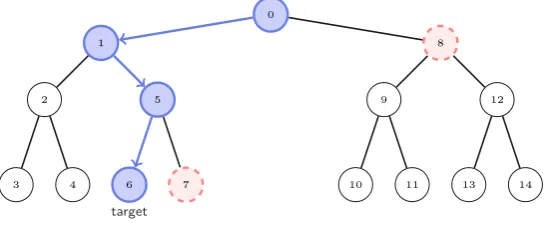
Fig. 5:A visualization of the procedureSeekwhen computing statest6. As indicated by the arrows, the algorithm walks down the path from the root nodew0to the target nodew6 (blue, thick nodes); simultaneously, it records the nodes ofw6’s co-path, i.e., (w7, w8) (red, dashed nodes).
Recall thatSeekis required to output the whole statestk, and not just seedsk. In other words, the
execution of the algorithm needs to comprehend the construction of the co-path of nodewk. We provide
details on how Algorithm 4 fulfills this task. Our strategy, illustrated in Figure5, is to walk down the path from the root to nodewk, recording the right siblings of the visited nodes on a stack. During this
process, with a variable δ we keep track of the remaining number of epochs that needs to be skipped. This counter is particularly helpful for deciding whether, in the path towards wk, the left or the right
child node have to be taken. Indeed, the number of nodes covered by the left and right subtrees is 2h−1
each; ifδ≤2h−1 then the left child is the next to consider, but the right child has to be recorded for
the co-path. On the other hand, ifδ≥2h, then the left child can be ignored, the co-path doesn’t have to be extended, and the walk towardswk is continued via the right child. The procedure terminates when
Security of tree-based SSKGs. We next formally assess the security of Construction1. For better legibility, in the following theorem we restrict attention to the settingN = 2H−1, i.e., where log(N + 1) is an integer; the extension to the general case is straightforward. We will also shorten the notation for some of the concepts from Definitions2 and4(e.g., we denote`(λ) simply by `, etc.).
Theorem 1 (Security of TreeSSKG). Assuming a secure PRG is used, our tree-based SSKG from Construction 1 provides indistinguishability with forward security (IND-FS). More precisely, for any efficient adversary A against the TreeSSKG scheme there exist efficient distinguishers Di against the
underlying PRG such that
AdvINDN,A-FS≤2(N−1)
log(N+1)
X
i=1
AdvPRGDi .
Proof. The security argument for our scheme reflects the intuition that every SSKG key Ki, for being
(part of) the output of a PRG invocation, looks like a random string to any efficient adversary as long as the seed used to compute it remains hidden. In the IND-FS experiment, in addition to state stm,
the adversary gets a challenge Kb
n, which is the real key Kn in case b = 1, or is a random string of
length`otherwise; here,nandmare adversarially chosen conditioned onn < m. The statestm reveals
seed sm and possibly some subsequent seeds. However, by construction, from these seeds none of the
preceding states can be computed. Thus, corrupting state stmshould be of no help to the adversary in
distinguishing keys prior to epochm. In particular, keyKn can be expected to stay secure. We formalize
this intuition in the following.
We make use of game hops which progressively transform the IND-FS experiment, denoted here by G0,b, into one for which every adversary has advantage exactly zero. The first hop changes the experiment
in that we let the challenger guess the epoch n corresponding to the challenge key Kb
n and abort the
simulation if the guess is wrong. More precisely, experiment G1,b is like G0,b but, before running A1,
the challenger also chooses a random integer n? such that 0≤n? < N −1. Then, whenA1 discloses
(state, n, m), the challenger checks whether its guess was correct: if it was, i.e., ifn?=n, it proceeds as
inG0,b; otherwise, it returns 0 and halts. We obtain
PrhGN,1,bA(1λ) = 1i= Prhn?=n ∧ GN,0,bA(1λ) = 1i= 1 N−1·Pr
h
ExptINDN,A-FS,b(1λ) = 1i ,
or, equivalently,
AdvINDN,A-FS(λ) = (N−1)· Pr
h
GN,1,1A(1λ) = 1i−PrhGN,1,0A(1λ) = 1i
. (1)
Regarding the analysis of game G1,b, observe that key K1
n is not just computed as the output of a
PRG on input a random seed; rather, it is computed by iterating a PRG up to log(N+ 1) times, where only the first input (seeds0) is truly random. We hence proceed via a hybrid argument, by considering intermediate experimentsH0,b,H1,b, . . . ,HL,b, where we setH0,b=G1,b and letL≤log(N+ 1) denote
the level of challenge node wn in the tree. The idea is to let each transition Hi−1,b → Hi,b replace the
output of the PRG associated with thei-th node on the path from the root node w0 to node wn by a
random value. Then, inHL,b the challenge keyKb
n will be random independently of bitb: in case b= 1
due to the argument just given, and in caseb= 0 by the definition of ExptIND-FS,0. In particular, every adversaryAplaying inHL,b will have zero advantage.
More precisely, let L be the level of node wn and let (v1, . . . , vL) denote the path from the root
v1 = w0 to node vL = wn. For every i = 1, . . . , L, derive Hi,b from Hi−1,b by replacing the output
ofG(sk) by a random string in{0,1}2λ+`, where kis the epoch number corresponding to nodevi.
Observe that, except forH0,b, as we follow the path top-to-bottom, seeds
k was replaced by a random
value in the hybrid before, i.e., in Hi−1,b. By consequence, for everyA there exists a distinguisherD i
that allows bounding the difference betweenHi−1,b andHi,b as follows:
Pr
h
HN,i−1A,b(1λ) = 1i−PrhHN,i,bA(1λ) = 1i
≤Adv
PRG
Di (λ) . (2)
As already stated, the challenge keyKb
n in hybridHL,b is uniformly random, independently of bitb. In
other words,HL,0andHL,1are the very same experiment, and we have, even for unbounded distinguish-ers,
Pr
h
HL,N,1A(1λ) = 1i−PrhHL,N,0A(1λ) = 1i
Using an induction argument and the triangle inequality, we can combine (2) and (3) into
Pr
h
GN,1,1A(1λ) = 1i−PrhGN,1,0A(1λ) = 1i ≤2
L
X
i=1
AdvPRGD
i (λ) . (4)
By combining equations (1) and (4) we obtain the bound indicated in the theorem statement. ut
4.3 Extending our scheme towards d-ary trees
We show how to extend our binary-tree-based construction towards the general case ofd-ary trees, for arbitrary d ≥ 2. Recall that a d-ary tree of constant height H hasνd(H) = (dH−1)/(d−1) nodes.
The intuition behind our design is mainly the same as in the binary case: we consider an enumeration w0, . . . , wN−1 of the tree’s nodes according to a pre-order depth-first search (first visit the root, then, from left to right, recursively the subtrees) and associate with every nodewia seedsifrom which epoch’s
keyKiand, where applicable, the seeds of its children are derived using a PRG. It is clear that this PRG
must have a larger expansion than in Section4.2: every PRG invocation has to yield one (sub)string of length`(λ) for the key, andd-many (sub)strings of lengthλfor the subordinate seeds. We construct the corresponding algorithms as follows.
Construction 2 (TreeSSKGfor d-ary trees) Fix a polynomial `:N→N, an integer d∈N≥2, and a
PRG G:{0,1}λ→ {0,1}dλ+`(λ). For alls∈ {0,1}λ writeG(s)as
G(s) =G1(s)k. . .kGd(s)kGK(s) where ∀j:Gj(s)∈ {0,1}λ andGK(s)∈ {0,1}`(λ) .
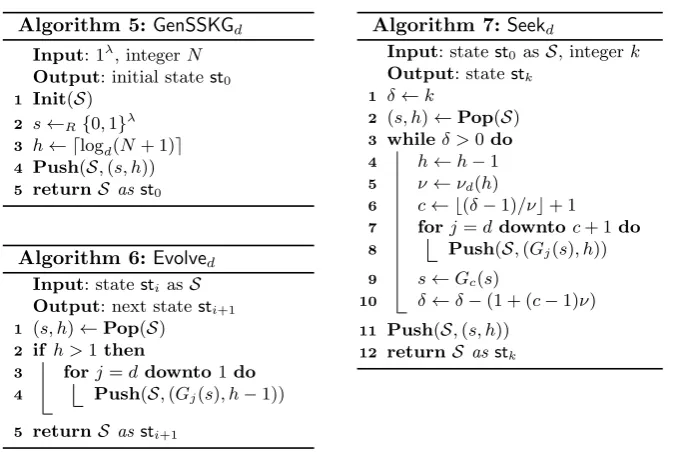
Assuming the notation for stacks from Section 2.3, our SSKG based on d-ary trees TreeSSKGd =
{GenSSKGd,Evolved,GetKey,Seekd} is defined by Algorithm 2 in Figure 4, and Algorithms 5, 6, and 7
in Figure6.
Algorithm 5:GenSSKGd
Input: 1λ, integerN
Output: initial statest0
1 Init(S) 2 s←R{0,1}λ
3 h← dlogd(N+ 1)e
4 Push(S,(s, h))
5 returnS asst0
Algorithm 6:Evolved
Input: statesti asS
Output: next statesti+1
1 (s, h)←Pop(S) 2 if h >1then
3 forj=ddownto1do
4 Push(S,(Gj(s), h−1))
5 returnS assti+1
Algorithm 7:Seekd
Input: statest0 asS, integerk Output: statestk
1 δ←k
2 (s, h)←Pop(S)
3 whileδ >0do
4 h←h−1
5 ν←νd(h)
6 c← b(δ−1)/νc+ 1
7 forj=ddowntoc+ 1do
8 Push(S,(Gj(s), h))
9 s←Gc(s)
10 δ←δ−(1 + (c−1)ν)
11 Push(S,(s, h))
12 returnS asstk
Fig. 6:Algorithms ofTreeSSKGd(ford-ary trees). As building blocks we assume a PRG and a stack (cf. Section2).
For the meaning of symbolGjsee Construction 2. Observe that the number of supported epochs is potentially greater thanN due to the rounding operation in line3ofGenSSKGd.
interesting is the new Evolved algorithm. Here, whenever an internal node needs to be expanded, alld
direct successor seeds are computed; the left-most seed will be associated with the next state (i.e.,sti+1),
and its right siblings become part of the new co-path, i.e., are pushed in the correct order onto the stack. We point out two differences in theSeekd algorithm. Firstly, in line6, withc we calculate the number
1 ≤ c ≤d of current node’s child that is on the path from the root to target node wk (consequently,
only the siblings with numbersc+ 1, . . . , dneed to be recorded for the co-path). Secondly, in line10, the numberδ of epochs that still need to be skipped is decreased by (c−1)ν in one shot, whereν indicates the number of nodes of the subtree generated by the respectively considered seeds.
We give the following security statement for our generalized construction. The proof is essentially identical with the one for Theorem1.
Theorem 2 (Security of TreeSSKGd). Assuming a secure PRG is used, our generalized tree-based
SSKG from Construction 2 provides IND-FS security. More precisely, for any efficient adversary A against the TreeSSKGd scheme there exist efficient distinguishers Di against the underlying PRG such
that
AdvINDN,A-FS≤2(N−1)
logd(N+1)
X
i=1
AdvPRGDi .
Remark 3 (Degenerate trees).In the above definitions we insisted on fixingdsuch thatd≥2. This choice guarantees that the time it takes to seek to an arbitrary target node isO(logN). Observe however, that also ford= 1 our scheme is correct and secure, but falls back to linear seeking time. It is interesting to observe that this degenerate case corresponds exactly with the hash chain approach of early SKGs (e.g., from [12,18,5]).
4.4 An enhanced seeking procedure
As required by Definition2, ourSeekalgorithm allows computing any statestkgiven the initial statest0.
Observe, however, that in many applications this initial state might not be accessible; indeed, forward security can be attained only if states of expired epochs are securely erased. From a practical perspective it is hence appealing to generalize the functionality ofSeekto allow efficient computation of sti+k from
any state sti, and not just fromst0.3 We correspondingly extend the notion of SSKG by introducing a
new algorithm, SuperSeek, which realizes the Evolvek functionality for arbitrary starting points; when invoked on inputst0, the new procedure behaves exactly asSeek.
Definition 5 (SSKG with SuperSeek). A seekable sequential key generatorSSKGsupportsSuperSeek if it has an auxiliary algorithm as follows:
– SuperSeek. On input of a state sti andk∈N, this deterministic algorithm returns statesti+k.
For correctness we require that for all N ∈ N, all st0 ←R GenSSKG(1λ, N), all i, k ∈ N, and sti =
Evolvei(st0)we have
0≤i≤i+k < N =⇒ Evolvek(sti) =SuperSeek(sti, k) .
Assume a TreeSSKGinstance is in state sti and an application requests it to seek to position sti+k,
for arbitrary 0 ≤ i ≤ i+k < N. Recall from the discussions in Sections 4.1 and 4.2 that state sti
encodes both the seedsi and the co-path of node wi. Recall also that, as a property of the employed
pre-order visit of the tree, for each statestj,j > i, the co-path of nodewicontains an ancestorwofwj.
Following these observations, ourSuperSeekconstruction consists of two consecutive phases. For seeking to statesti+k, in the first phase the algorithm considers all nodes on the co-path ofwi until it finds the
ancestorwofwi+k. The second phase is then a descent from that node to node wi+k, similarly to what
we had in the regularSeek algorithms. In both phases care has to be taken that the co-path of target node wi+k is correctly assembled as part ofsti+k. The working principle of our new seeking method is
also illustrated in Figure7.
3 Our reason to require in Definition2thatst
0
1 8
2 5 9 12
3 4 6 7 10 11 13 14
start target
Fig. 7:A visualization of the procedureSuperSeekjumping from epoch 3 to 11. As indicated by the arrows, the algorithm first finds the intersection, herew8, between the co-path of nodew3 (red, dashed nodes) and the path that connects the root with the target nodew11(blue, thick nodes); from there it proceeds downwards until it reaches target nodew11.
We present explicit instructions for implementing SuperSeek in Figure8, separately for the binary and d-ary case. In both cases the first while loop identifies the ancestor wof target node wi+k onwi’s
co-path by comparingδ(i.e., the remaining number of epochs to be skipped) with the number of nodes ν(h) in the subtree where w is the root. The second loop is equivalent to the one from Algorithms 4 and7.
Algorithm 8:SuperSeek Input: statestiasS, integerk
Output: statesti+k
1 δ←k
2 (s, h)←Pop(S)
3 whileδ≥2h−1do
4 δ←δ−(2h−1)
5 (s, h)←Pop(S)
6 whileδ >0do
7 h←h−1
8 if δ <2hthen
9 Push(S,(GR(s), h))
10 s←GL(s)
11 δ←δ−1
12 else
13 s←GR(s)
14 δ←δ−2h
15 Push(S,(s, h))
16 returnS assti+k
Algorithm 9:SuperSeekd Input: statesti asS, integerk
Output: statesti+k
1 δ←k
2 (s, h)←Pop(S)
3 ν←νd(h)
4 whileδ≥νdo
5 δ←δ−ν
6 (s, h)←Pop(S)
7 ν←νd(h)
8 whileδ >0do
9 h←h−1
10 ν←νd(h)
11 c← b(δ−1)/νc+ 1
12 forj=ddowntoc+ 1do
13 Push(S,(Gj(s), h))
14 s←Gc(s)
15 δ←δ−(1 + (c−1)ν)
16 Push(S,(s, h))
17 returnS assti+k
Fig. 8: AlgorithmSuperSeekfor binary andd-ary trees.
4.5 Evolving beyond the supported number of epochs
To achieve a certain level of graceful degradation, we propose, possibly as an amendment to Remark1, two ways to deal with the a posteriori increase of the number of required epochs. Firstly, the algorithms from Figures 4, 6, and 8 could be adapted such that when the bound N is reached they switch to computing and outputting keys according to a simple hash chain (or, even better, a PRG chain; see also Section 1). This modification would yield a sound SSKG with an unlimited number of supported epochs—however with only linear seeking time for the retroactively added epochs. Alternatively, in fact as a generalization of the first approach, the key KN−1 computed for the last ‘regular’ epoch could be used as initial seed for an otherwise independent TreeSSKG instance. Note that this would imply a somewhat non-uniform average seeking time, but the latter would nevertheless remain in the logarithmic domain.
5
Practical aspects
In the preceding sections we left open how PRGs can be instantiated in practice; indeed, the well-known recommendations and standards related to symmetric key cryptography exclusively consider block ciphers, stream ciphers, and hash functions. Fortunately, secure PRG instantiations can be boot-strapped from all three named primitives. For instance, a block cipher operated in counter mode can be seen as a PRG where the block cipher’s key acts as the PRG’s seed4. Similar counter-based constructions derived from hash functions or PRFs (e.g., HMAC) are possible.
A specific property of PRGs that are constructed by combining a symmetric primitive with a counter is particularly advantageous for efficiently implementing ourTreeSSKG schemes. Recall that the PRGs used in Constructions 1 and 2 are effectively evaluated in a blockwise fashion. More precisely, while the PRGs are formally defined to output strings of length dλ+`(λ), in our TreeSSKG algorithms it is sufficient to compute only a considerably shorter substring per invocation. This property is perfectly matched by the ‘iterated PRGs’ proposed above, as the latter allow exactly this kind of evaluation very efficiently.
Implementational details. We implemented ourTreeSSKGscheme both in the setting of binary trees and ofd-ary trees. In particular we have C code for Algorithms1–9, and we claim that the level of optimization is sufficient for practical deployment. Our code relies on the OpenSSL library [23] for random number generation and the required cryptographic primitives. We consider a total of four PRG instantiations, using the AES128 and AES256 block ciphers and the MD55 and SHA256 hash functions as described. That is, we have two instantiations at theλ= 128 security level, and two at theλ= 256 level.
We experimentally evaluated the performance of our implementation, using the following setup. We generated SSKG instances with parameters (d, H) = (2,20), i.e., instances that supportN = 220−1≈106 epochs. We iterated through all epochs in linear order, determining both the average and the worst-case time consumed by theEvolvealgorithm. Similarly we measured the average and worst-case time it takes for theSeekalgorithm to recover statesstk, ranging over all valuesk∈[0, N−1]. ConcerningSuperSeek,
we picked random pairsi, j∈[0, N−1],i < j, and measured the time required by the algorithm to jump from sti tostj. Finally, we performed analogous measurements forGenSSKGandGetKey (here, average
and worst-case coincide). The results of our analysis are summarized in Table1.
For comparison we also include the corresponding timing values of our competitor, the (factoring-based) SSKG from [16]6, for security levels roughly equivalent to ours. We point out that the analogue ofGenSSKG from [16] in fact consists of two separate algorithms: one that produces public parameters and an associated ‘seeking key’, and one that generates the actual initial SSKG state. As any fixed combination of public parameters and corresponding seeking key can be used for many SSKG instances 4 Observe that in this construction only very few enciphering operations need to be performed per key. By consequence, block ciphers with high key agility seem to be the preferable choice over ciphers with expensive key setup, as the latter cannot be amortized over time.
5 We considered MD5 in our tests because it is fast and ubiquitously available; the well-known attacks against its collision resistance do no seem to affect the hash function’s strength in the PRG context. Nevertheless, our choice was made for reasons of comparability and should not be misunderstood as a suggestion to use an MD5-based PRG in practice.
without security compromises, for fairness we decided not to count the generation costs of the former when indicating theGenSSKGperformance in Table1. Instead, we report the results of our timing analysis here as follows: for the costs of parameters and seeking key generation with 2048 bit and 3072 bit RSA moduli we measured 400msand 2300ms, respectively.
It might be instructive to also study the required state sizes for both our TreeSSKGscheme and the scheme from [16]. In our implementation, for fixed parameterd, the (maximum) state size scales roughly linearly in both H and the seed length of the used PRG. Concretely, for (d, H) = (2,20) and 128 bit keys (e.g., for AES128- and MD5-based PRGs) the state requires 350 bytes, while for 256 bit security a total of 670 bytes of storage are necessary. In the scheme from [16] the space in the state variable is taken by an RSA modulusN, a valuex∈Z×N, a 64 bit epoch counter, and a small header. Precisely, for
2048 and 3072 bit RSA moduli this results in 522 and 778 bytes of state, respectively.
AES128 MD5 [16]/2048 bit AES256 SHA256 [16]/3072 bit
[average] [max] [average] [max] [average] [max] [average] [max]
GenSSKG 22µs 22µs 27µs 22µs 22µs 38µs
Evolve 0.2µs 0.5µs 0.2µs 0.4µs 8µs 0.5µs 1µs 0.4µs 0.8µs 13µs
Seek 7µs 9µs 6µs 7µs 4.9ms 14µs 18µs 11µs 15µs 12.6ms
SuperSeek 6µs 9µs 5µs 7µs – 13µs 18µs 8µs 15µs –
GetKey 0.2µs 0.2µs 12µs 0.4µs 0.4µs 13µs
Table 1:Results of efficiency measurements of ourTreeSSKGalgorithms when instantiated with different PRGs, and a comparison with the algorithms from [16]. All experiments were performed on an Intel Core i7-3517U CPU clocked at 1.90GHz. We used OpenSSL version 0.9.8 for the implementation of ourTreeSSKGroutines, while for the compilation of the reference code from [16] we used the gcrypt library in version 1.5.0.
Results and discussion. We discuss the results from Table 1 as follows, beginning with those of our tree-based SSKG (i.e., columns AES128, MD5, AES256, and SHA256). Our first observation is that the GenSSKG time is independent of the respectively used PRG. This is not surprising as the former algorithm never invokes the latter, but spends its time with memory allocation and requesting the random starting seed from OpenSSL’s core routines. The timings for Evolveindicate that, as expected, 128-bit cryptographic primitives are faster than 256-bit primitives, and that for a fixed security level the hash-function-based constructions are (slightly) preferable. The hypothesis that the time spent by the individual algorithms is dominated by the internal PRG executions is supported by the observation that the running time of Evolve (on average) and GetKey coincide, and that the worst-case running time ofEvolve is twice that value; to see this, recall thatEvolve executions perform either two internal PRG invocations or none, and that the average number of invocations is one. We understand that the SuperSeektimings are generally better than theSeekvalues as the firstwhile loop in Algorithm8does not comprise a PRG invocation, whereas the secondwhile loop requires less iterations on average than the corresponding loop in Algorithm4.
The routines from [16] are clearly outperformed by the ones from our SSKG. Firstly, for the Evolve algorithm our timing values are about 30 times better than those for [16] (recall that the latter’s state update involves a modular squaring operation). Similar results show our tree-based GetKey algorithm to be faster, by a factor between 30 and 60, depending on the considered security level. This might be surprising at first sight, as the algorithm from [16] consists of just hashing the corresponding state variable, but presumably the explication for this difference is that [16] operates with considerably larger state sizes than we do. Finally, the superiority of our tree-based construction in terms of efficiency is made even more evident by studying the performance of the seekSeekalgorithms, where we can report our routines to be 700–1000 times faster than those from [16], again depending on the security level.
Conclusion
prior constructions of this primitive require specific number-theoretic building blocks, we show that symmetric tools like block ciphers or hash functions suffice for obtaining secure SSKGs; this leads to impressive performance improvements in practice, by factors of 30–1000, depending on the considered algorithms. In addition to the performance gain, our scheme enhances the functionality of SSKGs by generalizing the notion of seekability, making it more natural and concise, an improvement that we believe is very relevant for applications. Our scheme enjoys provable security in the standard model.
Acknowledgments
The authors thank all anonymous reviewers for their valuable comments. Giorgia Azzurra Marson was supported by CASED and Bertram Poettering by EPSRC Leadership Fellowship EP/H005455/1.
References
1. R. Accorsi. BBox: A distributed secure log architecture. In J. Camenisch and C. Lambrinoudakis, editors, EuroPKI, volume 6711 ofLecture Notes in Computer Science, pages 109–124. Springer, 2010.
2. M. Backes, C. Cachin, and A. Oprea. Secure key-updating for lazy revocation. In D. Gollmann, J. Meier, and A. Sabelfeld, editors,ESORICS 2006, volume 4189 ofLNCS, pages 327–346, Hamburg, Germany, Sept. 18–20, 2006. Springer, Berlin, Germany.
3. M. Bellare and S. K. Miner. A forward-secure digital signature scheme. In M. J. Wiener, editor,CRYPTO’99, volume 1666 ofLNCS, pages 431–448, Santa Barbara, CA, USA, Aug. 15–19, 1999. Springer, Berlin, Germany. 4. M. Bellare and B. S. Yee. Forward integrity for secure audit logs. Technical report, Department of Computer
Science and Engineering, University of California at San Diego, 1997.
5. M. Bellare and B. S. Yee. Forward-security in private-key cryptography. In M. Joye, editor,CT-RSA 2003, volume 2612 ofLNCS, pages 1–18, San Francisco, CA, USA, Apr. 13–17, 2003. Springer, Berlin, Germany. 6. R. Canetti, S. Halevi, and J. Katz. A forward-secure public-key encryption scheme. Journal of Cryptology,
20(3):265–294, July 2007.
7. R. Canetti and H. Krawczyk. Analysis of key-exchange protocols and their use for building secure channels. In B. Pfitzmann, editor, EUROCRYPT 2001, volume 2045 of LNCS, pages 453–474, Innsbruck, Austria, May 6–10, 2001. Springer, Berlin, Germany.
8. C. N. Chong, Z. Peng, and P. H. Hartel. Secure audit logging with tamper-resistant hardware. In D. Gritzalis, S. D. C. di Vimercati, P. Samarati, and S. K. Katsikas, editors, SEC, volume 250 of IFIP Conference Proceedings, pages 73–84. Kluwer, 2003.
9. P. Gutmann. Secure deletion of data from magnetic and solid-state memory. In Proceedings of the Sixth USENIX Security Symposium, San Jose, CA, volume 14, 1996.
10. J. E. Holt. Logcrypt: forward security and public verification for secure audit logs. In R. Buyya, T. Ma, R. Safavi-Naini, C. Steketee, and W. Susilo, editors,ACSW Frontiers, volume 54 ofCRPIT, pages 203–211. Australian Computer Society, 2006.
11. J. Kelsey, J. Callas, and A. Clemm. Signed Syslog Messages. RFC 5848 (Proposed Standard), May 2010. 12. J. Kelsey and B. Schneier. Cryptographic support for secure logs on untrusted machines. InProceedings of
the 7th USENIX Security Symposium, 1998.
13. J. Kelsey and B. Schneier. Minimizing bandwidth for remote access to cryptographically protected audit logs. InRecent Advances in Intrusion Detection, 1999.
14. D. Ma and G. Tsudik. Extended abstract: Forward-secure sequential aggregate authentication. In 2007 IEEE Symposium on Security and Privacy, pages 86–91, Oakland, California, USA, May 20–23, 2007. IEEE Computer Society Press.
15. D. Ma and G. Tsudik. A new approach to secure logging. Trans. Storage, 5(1):2:1–2:21, Mar. 2009. 16. G. A. Marson and B. Poettering. Practical secure logging: Seekable sequential key generators. In J. Crampton,
S. Jajodia, and K. Mayes, editors, ESORICS 2013, volume 8134 of LNCS, pages 111–128, Egham, UK, Sept. 9–13, 2013. Springer, Berlin, Germany.
17. G. A. Marson and B. Poettering. Practical secure logging: Seekable sequential key generators. Cryptology ePrint Archive, Report 2013/397, 2013. http://eprint.iacr.org/2013/397.
18. B. Schneier and J. Kelsey. Secure audit logs to support computer forensics. ACM Trans. Inf. Syst. Secur., 2(2):159–176, 1999.
19. V. Shoup. On formal models for secure key exchange. Technical Report RZ 3120, IBM, 1999.
21. A. A. Yavuz and P. Ning. BAF: An efficient publicly verifiable secure audit logging scheme for distributed systems. InACSAC, pages 219–228. IEEE Computer Society, 2009.

![Table 1: Results of efficiency measurements of our TreeSSKG algorithms when instantiated with different PRGs,and a comparison with the algorithms from [16]](https://thumb-us.123doks.com/thumbv2/123dok_us/7913571.1313968/15.595.97.493.227.314/eciency-measurements-treesskg-algorithms-instantiated-dierent-comparison-algorithms.webp)
