EPJ Web of Conferences 214, 02024 (2019) https://doi.org/10.1051/epjconf/201921402024 CHEP 2018
A fully parametric option in the LHCb simulation framework
Benedetto GianlucaSiddi1,∗
1INFN Sezione di Ferrara, Via G. Saragat 1, 44122 Ferrara, ITALY
Abstract.Faster alternatives to a detailed, GEANT4-based simulation are be-ing pursued within the LHCb experiment. In this context the integration of the Delphes toolkit in the LHCb simulation framework is intended to provide a fully parameterized option. Delphes is a modular software designed for general-purpose experiments such as ATLAS and CMS to quickly propagate stable par-ticles using a parametric approach and to provide reconstructed physical objects as output. It includes propagation inside a magnetic field and parameterized re-sponse for tracking and muon systems as well as calorimeters. Particle energies are computed by smearing the initial visible particles momenta according to detector resolution. The present contribution illustrates the current status of the Delphes toolkit in Gauss, the LHCb simulation framework. In this integra-tion the particle transport performed by GEANT4 and subsequent mimicking of detector response and reconstruction has been replaced with a parametric response of the various detector elements. The implementation required sig-nificant changes to Delphes itself to constrain the particle transport inside the detector acceptance and to match the LHCb dipole magnetic field. The config-uration of various parametrisations of resolution and efficiency is also a major
aspect of the work to provide a fully functional simulation. The output of the re-sulting fast simulation is formatted in such a way that can be used in the LHCb physics analysis framework.
1 Introduction
Monte Carlo simulations play an important role in High Energy Physics experiments to mimic the detector response and to extract experimental conditions and performances. Moreover, they allow us to extract information and perform sanity checks that cannot be accomplished on data. Clearly, such studies requires a high level of accuracy. In the LHCb experiment [1] [2], the interaction of particles with the detector elements is simulated in detail with Geant4 [3] and requires significant amount of computing resources. In addition, for the LHCb up-grade, more complex events and larger samples will need to be simulated. The projection of available computing resources will not be enough. The simulation time is dominated by the transport of particles inside the detector (O95% - 99%). For this reason increased CPU re-sources and also new faster Geant versions will not be sufficient and dedicated fast simulation
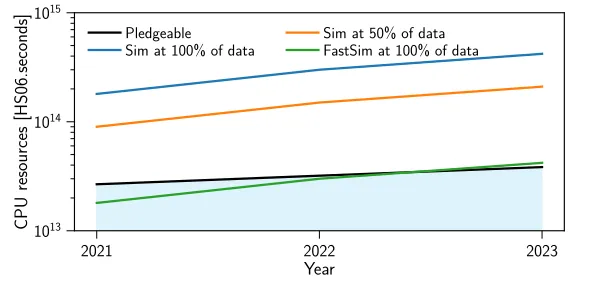
options will be necessary. Figure 1 shows the upgrade scenario in terms of needed CPU re-sources. The blue line represents the required resources when 100% of the data is simulated using Geant4, the black line represents the pledgeable resources coming from the funding agencies.In the case where detailed simulation of the detector is performed, the amount of
EPJ Web of Conferences 214, 02024 (2019) https://doi.org/10.1051/epjconf/201921402024 CHEP 2018
2021 2022 2023
Year
1013
1014
1015
CP
U
re
sou
rc
es
[HS06.se
con
ds] Pledgeable
Sim at 100% of data Sim at 50% of dataFastSim at 100% of data
Figure 1.Possible upgrade scenario in terms of CPU resources. The black line represents the pledge-able resources coming from the funding agencies, the blue line shows the requirement in the case the 100% of the data is simulated. Orange line shows the CPU resources in the case of 50% of the data is fully simulated. The green line represent the case in which the 100% of data is simulated using fast simulation option assuming 1/10th of CPU consumption with respect to the full detailed simulation.
the necessary CPU will not be enough and other options need to be provided. The green line represent the case when the 100% of the data collected is simulated using a fast simulation option, assuming a consumption rate of 1/10th of the detailed simulation. In this scenario the available CPU resources will be sufficient. Currently, some fast simulation options are
al-ready available in the LHCb framework and used for production. One of them consists in the exclusion of particular sub-detectors used in the simulation, allowing a time reduction of (O) 40% - 90%. Another possibility is to simulate just the decay of interest without including the rest of the event, with a time reduction of (O) 95% - 99%, or to simulate the rest of the event once and let the signal part redecay a defined number of times. Other fast simulation options are currently under development and will be deployed in the LHCb simulation framework, Gauss [4]. In this proceeding, the status of the integration of the parametric simulation tool Delphes [5] in LHCb is given.
2 Delphes
Delphes [5] is a modular framework for fast parametric simulations. It is written in C++and
is available as a library. Delphes has been written originally for the ATLAS and the CMS experiments at the LHC collider and is used to parametrize not only the detector but also the reconstruction effects. Its parametric simulation includes: a tracking system embedded
into a constant magnetic field, calorimeters with electromagnetic and hadronic sections, a muon system and a very forward detectors arranged along the beam-line. Delphes performs the propagation of stable particles and simulates theris interactin with the detector using a parametric approach to efficiency and resolution convolution.
3 Delphes in LHCb
3.1 Output for physics analysis
EPJ Web of Conferences 214, 02024 (2019) https://doi.org/10.1051/epjconf/201921402024 CHEP 2018
2021 2022 2023
Year 1013
1014
1015
CP
U
re
sou
rc
es
[HS06.se
con
ds] Pledgeable
Sim at 100% of data Sim at 50% of dataFastSim at 100% of data
Figure 1.Possible upgrade scenario in terms of CPU resources. The black line represents the pledge-able resources coming from the funding agencies, the blue line shows the requirement in the case the 100% of the data is simulated. Orange line shows the CPU resources in the case of 50% of the data is fully simulated. The green line represent the case in which the 100% of data is simulated using fast simulation option assuming 1/10th of CPU consumption with respect to the full detailed simulation.
the necessary CPU will not be enough and other options need to be provided. The green line represent the case when the 100% of the data collected is simulated using a fast simulation option, assuming a consumption rate of 1/10th of the detailed simulation. In this scenario the available CPU resources will be sufficient. Currently, some fast simulation options are
al-ready available in the LHCb framework and used for production. One of them consists in the exclusion of particular sub-detectors used in the simulation, allowing a time reduction of (O) 40% - 90%. Another possibility is to simulate just the decay of interest without including the rest of the event, with a time reduction of (O) 95% - 99%, or to simulate the rest of the event once and let the signal part redecay a defined number of times. Other fast simulation options are currently under development and will be deployed in the LHCb simulation framework, Gauss [4]. In this proceeding, the status of the integration of the parametric simulation tool Delphes [5] in LHCb is given.
2 Delphes
Delphes [5] is a modular framework for fast parametric simulations. It is written in C++and
is available as a library. Delphes has been written originally for the ATLAS and the CMS experiments at the LHC collider and is used to parametrize not only the detector but also the reconstruction effects. Its parametric simulation includes: a tracking system embedded
into a constant magnetic field, calorimeters with electromagnetic and hadronic sections, a muon system and a very forward detectors arranged along the beam-line. Delphes performs the propagation of stable particles and simulates theris interactin with the detector using a parametric approach to efficiency and resolution convolution.
3 Delphes in LHCb
3.1 Output for physics analysis
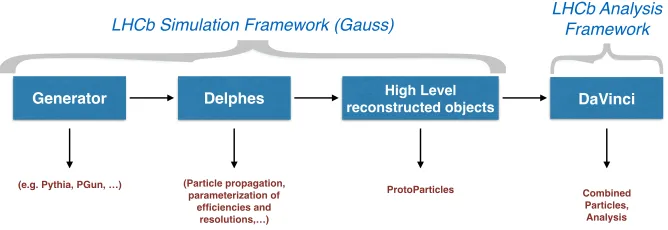
In the context of the LHCb simulation framework, Delphes will substitute the detailed sim-ulation performed by Geant4, and will give as output only high level reconstructed objects.
In Figure 2 a schematic view of the chain from generation to analysis in LHCb is given. Of-fline analyses in LHCb are performed using the DaVinci software package [6]. The DaVinci application combines basic reconstructed particles (e.g. K,π,µ) and compute the relative
kinematic quantities of the combined particles (e.g. D,B,Λ), such as invariant masses and
their distance of flight. It takes as an input reconstructed basic particles and it is possible to create the combined ones and to perform candidate selection. Since the hits in the detector cannot be performed, reconstruction cannot be run and therefore output from Delphes has to directly provide objects expected by the analysis tool DaVinci. The output of Delphes is a high level reconstructed object termed “protoparticle“ and containes following information on a particle:
• Links with tracks;
• At least one particle ID information;
• Link to calorimeter objects;
• Link to particle ID hypothesis objects.
B. Siddi
INFN Ferrara A fully parametric option in the LHCb simulation framework 6
• Delphes + modifications for LHCb, has been integrated in LHCb simulation framework
Gauss.
• It takes in input particles generated from the generator part of Gauss,
• It writes as output objects in the format necessary for LHCb analysis framework.
Delphes
Generator Delphes reconstructed objectsHigh Level DaVinci
(e.g. Pythia, PGun, …) (Particle propagation,
parameterization of efficiencies and
resolutions,…)
ProtoParticles Combined
Particles, Analysis
LHCb Simulation Framework (Gauss) LHCb Analysis Framework
Figure 2.Schematic view of the chain from generation to analysis in LHCb.
3.2 Tracking parametrisation
The original Delphes particle propagator module has been written for a solenoidal magnetic field embedded in a cylindrical acceptance and magnetic field. It has therefore been neces-sary to modify the functionality to match the LHCb acceptance. The particles are transported by applying a shift to the transverse momentum corresponding to the mean value of a simple dipole field termed pT −kick. Tracking resolutions and efficiencies are obtained from the
LHCb detailed simulation. To include these in Delphes, two dedicated modules have been developed in order to use parametrized histograms as inputs. Efficiencies are those for
recon-structed tracks in the tracker acceptance. The resolution is defined as the root mean square of differences between reconstructed Monte Carlo tracks and the Monte Carlo truth. The
kine-matic variables adopted to fill both histograms are the track slopesTx = px/pz,Ty = py/pz and the inverse of the particle momentum 1/p. Figure 3 shows the comparison between Delphes and detailed simulation output for theTxvariable used for the parametrisation. A specific parametrisation for each data taking period and detector conditions is provided. Co-variance error matrix associated to the track is also parametrized. This has been done with a lookup table in which each matrix element has been averaged as function of 1./p. A very
EPJ Web of Conferences 214, 02024 (2019) https://doi.org/10.1051/epjconf/201921402024 CHEP 2018
B. Siddi
INFN Ferrara
A fully parametric option in the LHCb simulation framework
9
Status of the Tracking parameterisation
•
Comparison between Delphes and full simulation output for the variables used
for parameterization
•
Slope dp
x
/dp
z
•
Slope dp
y
/dp
z
•
1./p
•
Parameterisation specific for each data taking period and detector conditions
0.4− −0.3 −0.2 −0.1 0 0.1 0.2 0.3 0.4
Tx 0
2000 4000 6000 8000 10000 12000 14000 16000
0.3
− −0.2 −0.1 0 0.1 0.2 0.3
Ty 0
1000 2000 3000 4000 5000 6000
0 0.0001 0.0002 0.0003 0.0004 0.0005 0.0006 0.0007 0.0008 0.0009 0.001 ] -1 1/p [(MeV/c) 0
100 200 300 400 500 600 700 800
Z = EndVelo (770 mm) LHCb simulation preliminary Z = EndVelo (770 mm) LHCb simulation preliminary Z = EndVelo (770 mm) LHCb simulation preliminary
Arbitrary units
Arbitrary units
Delphes
Standard Simulation DelphesStandard Simulation DelphesStandard Simulation
Figure 3.Track slopeTx=px/pzat thez=770 mm corresponding to the end of the vertex locator of
the LHCb detector.
and the standard LHCb analysis tools can be used proving the feasibility of the chain from the parametric simulation to analysis. Figure 4 shows the invariant mass of two reconstructed pi-ons through Delphes, obtained with standard LHCb analysis framework. The next step in the
B. Siddi
INFN Ferrara
A fully parametric option in the LHCb simulation framework 10Status of the Tracking parameterisation
•
It is possible then to provide final reconstructed objects and process them
with standard LHCb analysis framework
5240 5250 5260 5270 5280 5290 5300 5310 5320 5330 5340 ] 2 c ) [MeV/ -π + π M( 0
20 40 60 80 100 120 140
)
2c
Events (2 MeV/
LHCb simulation preliminary Preliminary parameterisation. Plot obtained with LHCb Analysis tool
Figure 4.Invariant mass ofπ+π−combination obtained providing final reconstructed objects to LHCb analysis framework DaVinci.
EPJ Web of Conferences 214, 02024 (2019) https://doi.org/10.1051/epjconf/201921402024 CHEP 2018
B. Siddi
INFN Ferrara
A fully parametric option in the LHCb simulation framework
9
Status of the Tracking parameterisation
•
Comparison between Delphes and full simulation output for the variables used
for parameterization
•
Slope dp
x
/dp
z
•
Slope dp
y
/dp
z
•
1./p
•
Parameterisation specific for each data taking period and detector conditions
0.4− −0.3 −0.2 −0.1 0 0.1 0.2 0.3 0.4
Tx 0 2000 4000 6000 8000 10000 12000 14000 16000 0.3
− −0.2 −0.1 0 0.1 0.2 0.3
Ty 0 1000 2000 3000 4000 5000 6000
0 0.0001 0.0002 0.0003 0.0004 0.0005 0.0006 0.0007 0.0008 0.0009 0.001 ] -1 1/p [(MeV/c) 0 100 200 300 400 500 600 700 800
Z = EndVelo (770 mm) LHCb simulation preliminary Z = EndVelo (770 mm) LHCb simulation preliminary Z = EndVelo (770 mm) LHCb simulation preliminary
Arbitrary units
Arbitrary units
Delphes
Standard Simulation DelphesStandard Simulation DelphesStandard Simulation
Figure 3.Track slopeTx=px/pzat thez=770 mm corresponding to the end of the vertex locator of
the LHCb detector.
and the standard LHCb analysis tools can be used proving the feasibility of the chain from the parametric simulation to analysis. Figure 4 shows the invariant mass of two reconstructed pi-ons through Delphes, obtained with standard LHCb analysis framework. The next step in the
B. Siddi
INFN Ferrara
A fully parametric option in the LHCb simulation framework 10Status of the Tracking parameterisation
•
It is possible then to provide final reconstructed objects and process them
with standard LHCb analysis framework
5240 5250 5260 5270 5280 5290 5300 5310 5320 5330 5340 ] 2 c ) [MeV/ -π + π M( 0 20 40 60 80 100 120 140 ) 2c
Events (2 MeV/
LHCb simulation preliminary Preliminary parameterisation. Plot obtained with LHCb Analysis tool
Figure 4.Invariant mass ofπ+π−combination obtained providing final reconstructed objects to LHCb analysis framework DaVinci.
parametrisation of the LHCb tracking system is to include at least one particle identification hypothesis information.
3.3 Electromagnetic calorimeter parametrisation
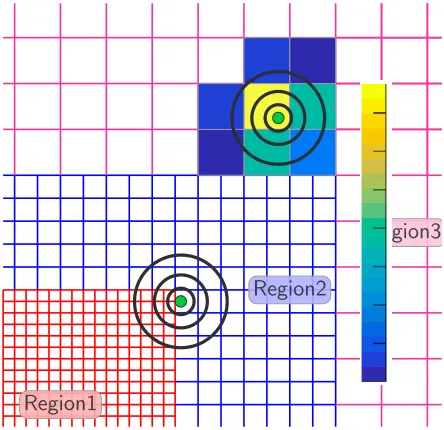
The electromagnetic calorimeter parametrisation in Delphes has been done for neutral parti-cles. This has been achieved using a custom geometry based on simple loops and is divided in 3 regions corresponding to the current LHCb calorimeter configuration. Figure 5 shows the three regions and the different granularity. The energy of each particle is obtained performing
B. Siddi
INFN Ferrara
A fully parametric option in the LHCb simulation framework
Status of the Calorimeter parameterisation
•
Calorimeter parameterisation in Delphes almost complete for neutrals
•
Customizable geometry based on simple loops within Delphes
•Gives the 3 regions of the current LHCb Calorimeter
•
As output reconstructed ProtoParticles
•
Clusterization in Delphes in order to get the particles energy:
•Take individual MC hits
(*)and get calorimeter response
from Delphes
•
Draw circles of 1, 2 and 3.5 R
Mto get 90, 95 and 99% of
the energy
An introduction to clusterization
�
First, take individual MC hits, get
calorimeter response from Delphes
�Draw circles of 1,2 and 3.5
R
Mto get
90,95 and 99% of the energy
�Take area intersection of area of
cluster with a circle vs total area of
circle of the fraction of energy
(e.g. this cell has
∼
95% of the energy
in 1
R
M,
∼
60% in 2
R
Mthen
A
cell�(
⇡
(
3
.
5
R
m)
2)
in the remaining
4%)
Region1
Region2
Region3
A. Davis
Update of ECal Clusterization using Delphes 2 / 8
*particles crossing the calorimeter face
11
Figure 5. Schematic view of the three calorimeter regions of the LHCb detector and the different
granularities.
a simple clusterization in Delphes:
• Obtain the smeared response from a Delphes module for the individual particles crossing the calorimeter surface;
• Draw circles centered in the position of the maximum energy deposit with different Molière
radius,RM=1, 2, 3.5, in order to get the 90%, 95% and 99% of the associated energy. As an output a neutral protoparticle is made. The necessary elements needed to construct the neutral protoparticles are:
• Covariance matrix of the calotimeter cluster (Energy,x,ycoordinates);
• Thezposition of the calorimeter cluster;
• Calorimeter cell IDs for every tower (built from the position);
• CaloDigits (cell ID and energy of the cell);
• Calorimeter cluster, corresponding to the collection of digits and thezposition of the clus-ter;
• At least one particle identification hypothesis.
EPJ Web of Conferences 214, 02024 (2019) https://doi.org/10.1051/epjconf/201921402024 CHEP 2018
B. Siddi
INFN Ferrara A fully parametric option in the LHCb simulation framework 13
Status of the Calorimeter parameterisation
•
Using the standard Analysis tools of the LHCb it is possible to reconstruct the π
0peak from the
𝛾𝛾
invariant mass
) [MeV]
γ
γ
M(
100
150
200
Events/ (2 MeV)
0
20
40
60
80
100
120
140
160
LHCb simulation preliminaryPreliminary parameterisation. Plot obtained with LHCb Analysis tool
Figure 6. Schematic view of the three calorimeter regions of the LHCb detector and the different
granularity.
The next steps in the calorimeter parametrisation are the generalization of the Molière radius to an ellipse and the inclusion of the parametrisation of the response of the calorimeter system for charged particles.
4 Conclusion
Fast simulation is crucial in LHC experiments to cope with the large amount of Monte Carlo statistics needed in the future. Delphes has been integrated within the LHCb simulation framework Gauss and extended for LHCb with a simple propagator for propagating particles inside the LHCb acceptance and a dipole magnetic field along with a parametric calorimeter response for neutral particles. Tools and algorithms have been developed in order to include tracking efficiencies and resolutions according to LHCb detailed simulation. A complete
user analysis chain has been tested to prove that Delphes output can be used for physics anal-ysis. Future steps will be to include the particle identification response and the calorimeter parametrisation for charged particles. The aim is to be about 100 times faster than the detailed simulation based on Geant4.
References
[1] LHCb collaboration, A. A. Alves Jr. et al., The LHCb detector at the LHC, JINST 3 (2008) S08005.
[2] LHCb collaboration, R. Aaij et al.,LHCb detector performance, Int. J. Mod. Phys. A30 (2015) 1530022, arXiv:1412.6352.
[3] S. Agostinelli et al. (Geant4 collaboration), GEANT4: A Simulation toolkit, Nucl. In-strum. Meth. A506, 250 (2003);
EPJ Web of Conferences 214, 02024 (2019) https://doi.org/10.1051/epjconf/201921402024 CHEP 2018
B. Siddi
INFN Ferrara A fully parametric option in the LHCb simulation framework 13
Status of the Calorimeter parameterisation
•
Using the standard Analysis tools of the LHCb it is possible to reconstruct the π
0peak from the
𝛾𝛾
invariant mass
) [MeV]
γ
γ
M(
100
150
200
Events/ (2 MeV)
0
20
40
60
80
100
120
140
160
LHCb simulation preliminaryPreliminary parameterisation. Plot obtained with LHCb Analysis tool
Figure 6. Schematic view of the three calorimeter regions of the LHCb detector and the different
granularity.
The next steps in the calorimeter parametrisation are the generalization of the Molière radius to an ellipse and the inclusion of the parametrisation of the response of the calorimeter system for charged particles.
4 Conclusion
Fast simulation is crucial in LHC experiments to cope with the large amount of Monte Carlo statistics needed in the future. Delphes has been integrated within the LHCb simulation framework Gauss and extended for LHCb with a simple propagator for propagating particles inside the LHCb acceptance and a dipole magnetic field along with a parametric calorimeter response for neutral particles. Tools and algorithms have been developed in order to include tracking efficiencies and resolutions according to LHCb detailed simulation. A complete
user analysis chain has been tested to prove that Delphes output can be used for physics anal-ysis. Future steps will be to include the particle identification response and the calorimeter parametrisation for charged particles. The aim is to be about 100 times faster than the detailed simulation based on Geant4.
References
[1] LHCb collaboration, A. A. Alves Jr. et al., The LHCb detector at the LHC, JINST 3 (2008) S08005.
[2] LHCb collaboration, R. Aaij et al.,LHCb detector performance, Int. J. Mod. Phys. A30 (2015) 1530022, arXiv:1412.6352.
[3] S. Agostinelli et al. (Geant4 collaboration), GEANT4: A Simulation toolkit, Nucl. In-strum. Meth. A506, 250 (2003);
[4] M. Clemencic et al.,The LHCb Simulation Application, Gauss: Design, Evolution and Experience, J. Phys. Conf. Ser. 331, 032023 (2011)
[5] de Favereau, J., et al.,DELPHES 3: a modular framework for fast simulation of a generic collider experiment, JHEP, 2(57), 2014
[6] The DaVinci project - http://lhcb-release-area.web.cern.ch/
lhcb-release-area/doc/davinci/.