An Efficient Key Mismatch Attack on the NIST
Second Round Candidate Kyber
Yue Qin, Chi Cheng,
Member, IEEE
, and Jintai Ding
Abstract—Kyber is a KEM based their security on the Modular Learning with Errors problem and was selected in the second round of NIST Post-quantum standardization process. Before we put Kyber into practical application, it is very important to assess its security in hard practical conditions especially when the Fujisaki-Okamoto transformations are neglected. In this paper, we propose an efficient key mismatch attacks on Kyber, which can recover one participant’s secret key if the public key is reused. We first define the oracles in which the adversary is able to launch the attacks. Then, we show that by accessing the oracle multiple times, the adversary is able to recover the coefficients in the secret key. Furthermore, we propose two strategies to reduce the queries and time in recovering the secret key. It turns out that it is actually much easier to use key mismatch attacks to break Kyber than NewHope, another NIST second round candidate, due to their different design structures. Our implementations have demonstrated the efficiency of the proposed attacks and verified our findings. Another interesting observation from the attack is that in the most powerful Kyber-1024, it is easier to recover each coefficient compared with that in Kyber-512 and Kyber-768. Specifically, for Kyber-512 on average we recover each coefficient with2.7queries, while in Kyber-1024 and 768, we only need2.4queries. This demonstrates further that implementations of LWE based schemes in practice is very delicate.
Index Terms—Modular-LWE, Kyber, key reuse attacks, secu-rity analysis;
I. INTRODUCTION
Public key cryptographic algorithms such as public key encryption (PKE), signatures and key exchange schemes have played fundamental roles in securing communications over the Internet. However, these widely used building blocks base their security on difficult problems like big integer factorization and discrete logarithms problems, which could be broken if there come the quantum computers. With recently reported rapid progresses in quantum technology [1], the transition from the currently used public key cryptographic blocks to their post-quantum counterparts has become urgent.
Since 2016 [2], the National Institute of Standards and Technology (NIST) has began collecting post-quantum crypto-graphic algorithms from all over the world. As pointed out in their 2016 report (NISTIR 8015 [3]), the goal of post-quantum cryptography is to establish cryptographic systems that are secure against both quantum and classical computers, inte-grating with existing communication protocols and networks. On December 20, 2017, 69 algorithms were accepted as the
Yue Qin and Chi Cheng are with the School of Computer Sci-ence, China University of Geosciences, Wuhan, 430074, China. E-mail:
{chengchi,qy52hz}@cug.edu.cn.
Jintai Ding is with Department of Mathematical Sciences, University of Cincinnati, Cincinnati, 45219, USA. E-mail:[email protected].
first-round candidates, which also marked the beginning of the NIST post-quantum cryptography standardization process. On January 30, 2019, in the report (NISTIR 8240 [4]) NIST announced the second round of candidates. In the past August NIST hosted the second NIST PQC standardization confer-ence.
The Key Encapsulation Mechanisms (KEMs), which allow the communicating parties to obtain a shared key by using a public key mechanism, have gained significant attention in the competition. Among these 26 PKE/KEM candidates in the second round of the NIST standardization process, 12 of them are based on lattice [4]. The advantages of lattice-based constructions include strong security guarantees lattice-based on worst-case hardness, as well as its high efficiency in implementations. The main difficulty in constructing a lattice-based Diffie-Hellman-like key exchange protocol is how to effectively reconcile errors in order to negotiate a consistent shared key. In [5], Ding, Xie, and Lin first proposed a “robust extractor” to reconcile the errors, and one of the participants needs to send an additional signal message to the other party, so that the two participants can agree on a shared key. Ding, Xie, and Lin’s schemes base their security on the Learning with Errors (LWE) problem or Ring Learning with Errors (R-LWE) problem. The latter can be seen as the polynomial version of the former. On NIST’s second-round list, there are LWE-based KEM Frodo, and R-LWE-based KEM NewHope. Kyber is another candidate, whose security is based on the Module Learning with Errors (M-LWE) problem. The M-LWE problem can be viewed as the combination of the LWE and R-LWE problems.
However, before we put these lattice-based KEMs into prac-tical application, it is of great importance to assess their secu-rity in hard practical conditions. From history we know that it happens frequently that the important secure transformations such as the Fujisaki-Okamoto transformation are neglected in the implementation, either for the reason of efficiency or being lazy to avoid the additional work. Therefore, in these cases we should keep in mind how to deal with the key reuse attacks against them. In PQCrypto 2019 [6], NIST defined the safety targets of the PKE/KEM schemes, which require that these schemes need to thwart the key reuse attacks. Reusing the key may cause the leakage of private keys, but in some situations the key must be reused, such as that in TLS 1.3 [7]. The 0-RTT (Zero Round Trip Time) mode is a major innovation in TLS 1.3 that saves one round trip time for connections during the handshake phase. This requires both the client and the server to maintain a long-term public key.
A-gency (NSA) announced that there may exist key reuse attacks against the lattice-based post-quantum key exchange protocol, without giving any details [8]. Later, Fluhrer showed in [9] that if the public key of the R-LWE-based key exchange is reused, then this protocol could be broken. In [10], Ding, Alsayigh and Saraswathy first applied the signal leakage attack to the key exchange protocol in [5] by using the leaked information about the secret key from the signal messages. Then, Liu, Zheng and Zou proposed another signal leakage attack [11] against the reconciliation-based NewHope-Usenix key exchange protocol [12]. Zhao and Gong proposed a small field attack for R-LWE-Based one-pass authenticated key exchange using the algebraic structure in R-LWE [13].
The idea of key mismatch attack was first proposed by Ding, Fluhrer and Saraswathy [14], which is proposed against a one pass case of the protocol in [5]. In a key mismatch attack, a participant’s public key is reused and its private key is recovered by comparing whether the shared keys between two participants match or not. In [15], Bauer et al. proposed a key mismatch attack against NewHope KEM [16]. Unfortunately, there are some problems with the attack which cannot recover all the private keys ranging from−6to4as they wish. In [17], Qin, Cheng and Ding proposed an improved and complete key mismatch attack to recover all private keys ranging from −8 to8in NewHope KEM [16] with extremely high accuracy and efficiency. In EUROCRYPT 2019, B˘aetu et al. gave a bound on the queries needed in the key mismatch attack on the chosen plaintext attack (CPA) versions of a number of postquantum cyrptosystem, as well as a attack on the chosen ciphertext attack (CCA) versions when they have quantum access to the decryption oracle [18]. But they did not analysis the security of Kyber under key mismatch attacks. Since Kyber is designed in a different algebraic structure, it is appealing to assess Kyber’s security when the public key is reused.
Contributions. In this paper, we propose an efficient key
reuse attack on the Kyber KEM. The main contributions of this paper include:
1) We precisely define the security oracle in which our proposed attack succeeds;
2) We propose key mismatch attacks on the Kyber-KEM with three security levels, i.e., the Kyber-512, Kyber-768, and Kyber-1024. Furthermore, we propose two strategies, to significantly reduce the needed queries and time in the original attack.
3) The implementations have demonstrate the efficiency of the proposed attacks. Our best record is that we can recover one coefficient in the secret key in only2queries. An interesting observation from the implementations is that in the most powerful Kyber-1024, it is easier to recover each coefficient compared with that in Kyber-512 and Kyber 768. Specifically, in Kyber-512 on average we recover each coefficient in 2.7 queries, while in Kyber-768 and 1024, we only need 2.4 queries.
Differences of key mismatch attacks on NewHope and
Kyber. We find that it is much easier to use key mismatch
attacks to break Kyber than that on NewHope, due to the different design structures of Kyber and Newhope. First, both
Compress and Decompress functions are used in Kyber and NewHope. But the additional Encode and Decode functions used in NewHope, which process four coefficients at the same time, bring challenges to the key mismatch attacks on NewHope. Second, the ranges of coefficients in Kyber’s secret key is from−2 to 2, while in NewHope it is from −8 to8. The smaller ranges of Kyber result in less queries to launch the attack. Specifically, on average we only need 2,475 queries to recover all the coefficients in Kyber-1024. While in Newhope-1024, which achieves the same security as that in Kyber-1024, on average we need 882,794 queries. From another perspective, in Kyber-1024 on average we need 2.4 queries to recover each coefficient, while in Newhope-1024, 862.1 queries are needed.
Organization of this paper. In Section II, we introduce
the basic notations and the underlying hard problems, as well as the Kyber KEM. Security analysis of Kyber with three security levels are given in Section III, IV, and V, respectively. In Section VI we go on proposing two improved attacks that effectively reduce the needed time and queries in the original attacks. The experiments in Section VII demonstrate the efficiency of our proposed attacks, and the conclusion is given in Section VIII.
II. PRELIMINARIES
A. Notations
Set Zq the ring with all elements are integers modulo q,
andZq[x] the polynomial ring, where all the polynomials in Zq[x]are with coefficients selected fromZq. Then, we further
define the polynomial ringRq=Zq[x]/(xn+ 1), in which for
every polynomial f(x) =a0+a1x+· · ·+an−1xn−1 ∈Rq,
each coefficient ai∈Zq (0≤i≤n−1) and the polynomial
additions and multiplications are operated moduloxn+ 1. All polynomials are in bold-lower case, and we treat a polynomial c ∈ Rq the same with its vector form (c[0],· · ·,c[n−1]),
here c[i] (0 ≤i ≤ n−1) represents the i-th coefficient of the polynomial c. By default, all the vectors will be column vectors. Bold upper-case letters represent matrices. For a ma-trixA∈Rk×k
q , we denoteAT ∈Rkq×k as its transpose. The
operation bxcrepresents the maximum integer not exceeding x, anddxcis the rounding function, i.e.dxc=bx+12c.
B. LWE & R-LWE & M-LWE
In the groundbreaking work of Ajtai in 1996 [19], he point-ed out that we can use lattice to build cryptosystems. In 2005, Regev introduced the LWE problems [20] and a reduction from solving the worst case problem in lattices to solving LWE problem in the average case. But the matrices used in the LWE problem incur heavy computation and communication costs. In order to solve this problem, Lyubashesky, Peikert and Regev in 2010 proposed the R-LWE problem, which is to use the polynomials in the ring [21]. The hardness of R-LWE is similar to R-LWE, which is based on a reduction from solving the worst case problem in idea lattices to solving R-LWE problem in the average case.
enjoys the advantages of easy scalability in LWE problem and the high efficiency in R-LWE problem. To be specific, for a matrix A ∈ Rk×k
q , s,e ∈ Bkη (Here Bη is a centered
binomial distribution), the M-LWE problem is to distinguish (A,B = As+e) ∈ Rk×k
q ×Rqk from uniformly selected (A,B) ∈ Rk×k
q ×Rkq. Kyber can change security levels by
simply changing the value ofk, and the lattice used in Kyber has less algebraic structure than that in Ring-LWE.
C. The Kyber KEM
TABLE I
PARAMETER CHOICES INKYBER
n k q dPB dvB Security
Kyber-512 256 2 3329 10 3 1 (AES-128)
Kyber-768 256 3 3329 10 4 3 (AES-192) Kyber-1024 256 4 3329 11 5 5 (AES-256)
Kyber is an IND-CCA2-secure KEM, which is a part of the Cryptographic Suite for Algebraic Cipher Suite (CRYSTALS) [22–24]. Kyber’s security is based on the hardness of solving the M-LWE problem, which makes Kyber different from NewHope [16]. In Kyber, there is a public matrix A of size k×k, and its elements are polynomials selected fromRq. The
secret key sand the errors e are k-dimensional vectors with elements selecting from Bη. Here Bη is a centered binomial
distribution with η= 2, which can be simply calculated from 2
P
i=1
(bi−b0i), herebiandb0iare randomly selected from{0,1}.
Specifically, the coefficients of the secretsare integers in the range[−2,2]. This has the advantage that the security level of Kyber can be shifted by simply modifyingk. More specifically, there are three security levels in Kyber: Kyber-512, Kyber-768 and Kyber-1024, corresponding to k= 2 ,k= 3, andk= 4, respectively. Table I lists the parameters choices for different security levels of Kyber. The parameternis always set as256 andq is always3329.
In the following, we first give the definition of two func-tions: Compressq(x, d)andDecompressq(x, d).
Definition 1: The Compression function:Zq →Z2d:
Compress(x, d)q =
2d q ·x
(mod 2d). (1)
Definition 2: The Decompression function:Z2d→Zq:
Decompress(x, d)q=
l q
2d ·x
k
. (2)
In the two functions, their inputxis selected fromZq. When
the input is a polynomial, it means we will operate coefficients of the polynomial one by one. Both equations (1) and (2) can be extended to the polynomialf =f0+f1x+· · ·+fn−1xn−1 as follows:
Compress(f, d)q =
2d q ·f0
(mod 2d),
2d
q ·f1
(mod 2d),· · · , 2d
q ·fn−1
(mod 2d) ), (3)
Decompress(f, d)q =
lq
2d ·f0
k ,l q
2d ·f1
k ,
· · ·,lq
2d ·fn−1c
.
(4)
Similarly, if the input is a matrix, we deal with each
column one by one. For matrix MT ∈ Rkq×k =
(m0,m1,· · · ,mk−1)T, equations (1) and (2) can be extended to:
Compress(MT, d)q= (Compress(m0, d)q,
Compress(m1, d)q,· · · ,Compress(mk−1, d)q ),
(5)
and
Decompress(MT, d)q = (Decompress(m0, d)q,
Decompress(m1, d)q,· · · ,Decompress(mk−1, d)q).
(6) The value of d is set as dPB or dvB in different security
levels of Kyber in Table I.
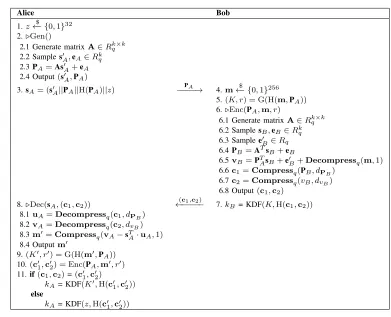
In Table II, we describe the details of the Kyber IND-CCA2-secure KEM. To simplify the security analysis, we remove the number theory transformation (NTT) that has nothing to do with security and is only used to accelerate polynomial multiplication in Table II. The three different functionsG(·), H(·) andKDF(·) in Table II use SHA3-256, SHA3-512 and SHAKE-256, respectively. The Kyber KEM consists of three parts:
(1) Alice first randomly chooses a32-bitzand callGen()to generate its key pair. In Step 2 of Table II, Alice first generates a matrixA∈Rk×k
q , then she will selects0AandeAuniformly
at random from Bη to compute the public key PA=As0A+
eA. The resultedsA is computed as(s0A||PA||H(PA)||z). The
output(sA,PA)is the key pair andPA will be sent to Bob.t
(2) After receivingPAsent by Alice, Bob will first generate
m ←− {$ 0,1}256 and (K, r) = G(H(P
A),m). Then he will
use PA,m and r as input to call Enc(). In Step 6 of Table
II, we can see that, Bob will generate a matrix A ∈ Rkq×k first. Subsequently, he will selectsB,eB ande0B uniformly at
random, and compute a public keyPB =ATsB+eB as well
asvB=PTAsB+e0B+Decompressq(m,1). After this, Bob
will compressPB,vB toc1,c2, respectively. In the end, he will send PB and(c1,c2) to Alice, and compute the shared keykB.
(3) When Alice receives PB and (c1,c2) sent by Bob, she will generate z←− {$ 0,1}256 first. Then, she will use her secret keysA and(c1,c2) as inputs to callDec() to get m0. According to Step 9 of Table II, Alice can obtain uA and
vAby decompressingc1andc2, respectively. With the output m0 = Compressq(vA −sTA ·uA,1), Alice will use it to
generate(K0, r0). She then usesPA,(K0, r0)as input to call
Enc() and get the returned (c01,c02). Finally, Alice calculates her shared keykAafter checking that(c1,c2)and(c01,c02)are equal.
In the following, we will use the key mismatch attack to assess the security of the Kyber KEM when the public key
PA is reused. Due to the different security parameters in the
TABLE II
KYBERIND-CCA2-SECUREKEM
Alice Bob
1.z←− {$ 0,1}32 2..Gen()
2.1 Generate matrixA∈Rqk×k
2.2 Samples0A,eA∈Rkq
2.3PA=As0A+eA
2.4 Output(s0
A,PA)
3.sA= (s0A||PA||H(PA)||z)
PA
−−−−→ 4.m←− {$ 0,1}256 5.(K, r) = G(H(m,PA))
6..Enc(PA,m, r)
6.1 Generate matrixA∈Rqk×k
6.2 SamplesB,eB∈Rkq
6.3 Samplee0B∈Rq
6.4PB=ATsB+eB
6.5vB=PTAsB+e0B+Decompressq(m,1)
6.6c1=Compressq(PB, dPB)
6.7c2=Compressq(vB, dvB)
6.8 Output(c1,c2)
8..Dec(sA,(c1,c2))
(c1,c2)
←−−−−− 7.kB = KDF(K,H(c1,c2)) 8.1uA=Decompressq(c1, dPB)
8.2vA=Decompressq(c2, dvB)
8.3m0=Compress
q(vA−sTA·uA,1)
8.4 Outputm0
9.(K0, r0) = G(H(m0,P
A))
10.(c01,c20) = Enc(PA,m0, r0)
11.if(c1,c2)=(c01,c02)
kA= KDF(K0,H(c01,c02))
else
kA= KDF(z,H(c01,c02))
Algorithm 1: The OracleO
Input:(c1,c2)
Output: 1 or 0
1 z←− {$ 0,1}256;
2 uA=Decompressq(c1, dPB);
3 vA=Decompressq(c2, dvB);
4 m0=Compressq(vA−sTA·uA,1); 5 (K0, r0) =G(H(PA),m0);
6 (c01,c02) = Enc(PA,m0, r0);
7 if(c1,c2)=(c01,c
0
2)then
8 kA= KDF(K0,H(c01,c02));
9 Return1;
10 else
11 kA= KDF(z,H(c01,c02));
12 Return0;
13 end
III. THEKEYMISMATCHATTACK ONKYBER-1024
In this section, we will propose the key mismatch attack on Kyber-1024. According to Table I, we have (dPB, dvB) =
(11,5)in Kyber-1024. We will first introduce how to build key mismatch Oracles and then describe the parameters choice of the adversary.
A. Key Mismatch Oracles
We build an oracle O that simulates Alice in Table II. In Algorithm 1 we describe how the oracle Oworks. The input ofOis(c1,c2)and its output is1or0. To be specific, first,O chooses a randomly selected256-bit secretz. By receiving the
inputs(c1,c2),Owill usec1 andc2to calculateuA andvA,
separately. ThenOuses these two values to calculate m0 and (K0, r0). Subsequently, it calls Enc() with inputs PA, m0, r0
to get (c01,c02), if (c1,c2) = (c01,c02) holds. If O outputs 1, the shared keyskA andkB match, otherwise the shared keys
mismatch.
Algorithm 2: The Oracle Om
Input:(c1,c2), m
Output: 1 or 0
1 uA=Decompressq(c1, dPB);
2 vA=Decompressq(c2, dvB);
3 m0=Compressq(vA−sT A·uA,1); 4 ifm0=mthen
5 Return1;
6 else
7 Return0;
8 end
According to Algorithm 1 , since (K, r) = G(H(PA),m)
and (K0, r0) = G(H(PA),m0), if m = m0, then r = r0.
Notice that(c1,c2)and(c01,c02)are both generated byEnc(), and their inputs are PA,m0, r0 and PA,m, r, respectively. It
is easy to verify that ifm=m0,kA=kB, and the output of Ois 1. To propose our attack, we need to modify the Oracle
O in Algorithm 1. We refer to this Oracle as Om and the
main process is shown in Algorithm 2. The main difference between the two oracles is that for the received m0, theOm
directly check whether m0 andm are equal or not. If so, O
B. Parameter choices of the adversary
We assume that Alice’s public key PA is reused, and the
adversary A’s goal is to recover Alice’s secret key sA by
accessing Oracle Om multiple times. Therefore, the most
important thing forAis to properly select the input parameters (c1,c2) and m in Om in a way such that these parameters
can be associated with the secret key sA and helpA recover
it successfully.
First of all, A will select a 256-bit m as (1,0,· · ·,0) rather than choose it uniformly at random. In this case, except m[0] = 1all the other m[i] = 0 (i= 1,2, . . . ,255).
Then,Awill directly setc2=h, and the range ofhis from 0 to 31. This is because in Kyber-1024 dvB = 5 and c2 =
Compressq(vB, dvB) = Compress(vB,5)q = l
32 q ·vB
k
(mod 32).
Suppose that A wants to recover the k-th position in sT A
and k is an integer in [0,255]. A will choose PB carefully
rather than calculating it as PB = ATsB +eB. First he let
PB=0, then in casek= 0, he setPB[0] =32q , otherwise
he let PB[256−k] = −32q. Next, A will calculate c1 = Compressq(PB, dPB).
In the following we briefly explain why A setsPB in this
way. We have already known that when Om outputs 1 only
if m0 =m, that is m0[0] = m[0] = 1. Therefore, we only need to consider the first position inm0. By calculatinguA=
Decompressq(c1, dPB),Om will get uA =PB andvA[0]
can be calculated as
vA[0] =Decompressq(c2[0], dvB)
=Decompressq(h, dvB)
=lq 25h
k
=lq 32h
k .
Next we discuss the results of m0[0] in cases k = 0 and k6= 0, respectively.
1) Ifk= 0andPB[0] =
q 32
, we have
m0[0] =Compressq((vA−sTAuA)[0],1)
=Compressq(vA[0]−(sTAuA)[0],1)
=
2
q vA[0]−(s
T AuA)[0]
mod 2.
(7)
Since (sT
AuA)[0] =sTA[0]uA[0] =sTA[0]
q 32
,
m0[0] =
2
q
lq
32h
k
−sTA[0]lq 32
k
mod 2. (8)
Whenhranges from0to15, according to equation (8) we can deduce that
m0[0] =
2 q
l q
32
k
(h−sTA[0])
mod 2. (9)
2) If k = 1,2,· · · ,255 and PB[256−k] = −32q, then
the constant term insT AuA is
sTA[k]xkuA[256−k]x256−k= sTA[k]
−lq
32
k x256
= sTA[k]lq 32
k ,
(10)
the last equation holds since x256=−1 inR q.
Then we have
m0[0] =
2 q
l q
32h
k
−sTA[k]
l q
32
k
mod 2. (11)
Whenhranges from0to15, according to equation (11) we can conclude that
m0[0] =
2
q l q
32
k
(h−sTA[k])
mod 2. (12)
Since equations (9) and (12) are the same, in this way the adversary A successfully associates his deliberately chosen parametersm,c1andc2withm0inOm. ThenAaccessesOm
multiple times and get useful information from the feedbacks to recoversA. It is worth noting that whenhranges from 16
to 31, equations (9) and (12) do not hold, but this will not affect the recovery of the secret key.
C. The Proposed Attack
Algorithm 3: Key-recovery-Kyber-1024
Output:s0
1 Setm={1,0,· · ·,0}256;
2 fori:= 0to3do
3 fork:= 0to255do
4 PB=0;
5 ifk= 0then
6 PB[0] =32q
;
7 else
8 PB[256−k] =−32q
; 9 c1=Compressq(PB, dPB);
10 forh:= 0to31do
11 c2=0exceptc2[0] =h;
12 t=Oraclem((c1,c2), m);
13 if t= 1then
14 break;
15 end
16 s0[i∗256 +k] =Check(h);
17 end
18 end
19 Returns0
To launch the attack, the adversaryAdeliberately selects the parametersm,c1andc2as aforementioned. In the following, we will briefly introduce our method to recover the exact value of sA in an efficient way. The key mismatch attack includes
four steps:
Step 1: As we know, in Kyber-1024,sTA ∈ Rq4 consists of
four 256-bit polynomials, and each polynomial is with 256 coefficients.t In this step, the adversaryAchooses one of the 4 polynomials as the target. As shown in line2 of Algorithm 3,i represents thei-thpolynomial chosen by A.
Step 2: In this step, the adversaryAalso chooses a position
in the i-th polynomial of sTA, and he tries to recover the value of the secret key corresponding to this position. More specifically, k represents the coefficient in each polynomial, which is shown in line3 of Algorithm 3.
Step 3: In this step, the adversary A tries to find a proper
hby accessing the OracleOmmultiple times to help recover
the secret key.
Before accessing theOm,Achooses the parametersm,c1 andc2 as described previously. ThenA sets PB[0] =0first,
if k = 0, PB[0] =
q 32
, otherwise PB[256−k] = −
q 32
WhenAaccessesOm, it will return0 or1. The adversary Astarts from settingh= 0toh= 31. Whenh= 0, according to equation (9) we have
m0[0] =
2 q
lq
32
k
(h−sTA[0])
mod 2
=
2
q lq
32
k
(−sTA[0])
mod 2.
(13)
Since 2q 32q ≈0.0624812, regardless of the value of sTA[0], m0[0]is always0. Sincem[0] = 1, in the beginning the output ofOmis always0. Ashincreases, the output may become1at
some point. The adversaryArecords the value ofhwhen the output ofOmchanges from0to1. Later,Auses the recorded
hto recover the secret key.
The main process in this step is shown between lines4 to 15 in the Algorithm 3.
Step 4: In this step, the adversary Awants to get the exact
value of the secret key based onhand Table III. In Table III, sk represents the possible value of the coefficient in sT
A[0].
TABLE III
THE RELATIONSHIP BETWEENskANDhINKYBER-1024
sk 0 1 -1 2 -2
h 9 10 8 11 7
With the recorded h in Step 3, A is able to recover sk corresponding tohin Table III. The process of looking up the table according to the value ofhis the Check(h)in the line 16 of Algorithm 3. For example, ifh= 9, then the operation of Check(h)is to find its correspondingsk= 0 according to Table III.
In the following we show why we can recover the secret key in this way.
According to equation (9) we have
m0[0] =
2 q
l q
32
k
(h−sTA[0])
mod 2.
We set f = 2
q
q 32
(h−sT
A[0]), then the above equation
becomes
m0[0] =dfcmod 2.
Since 2q32q≈0.0624812, we further have
f = 0.0624812(h−sTA[0]) (14)
and
m0[0] =0.0624812(h−sTA[0])
mod 2. (15)
1) If the element in sT
A we want to recover is0, according
to equations (14) and (15), we have
f = 0.0624812·h, (16)
and
m0[0] =dfcmod 2 =d0.0624812·hcmod 2. (17)
At the beginning, h= 0, so f = 0 andm0[0] = 0. Ash increases, the value of m0[0] turns to 1. From equation (16), we can check that whenh= 9,f = 0.0624812·9 = 0.56233 andm0[0]becomes1.
Therefore, ifh= 9, we can recover the coefficient to be 0.
2) Suppose the coefficient insT
A we want to recover is ±1, ±2,±3or ±4. Since they are similar, we only consider the case when the coefficient insT
A is±1.
(1) If the the coefficient insT
Ais1, according to equations
(14) and (15), we have
f = 0.0624812(h−1), (18)
and
m0[0] =dfcmod 2 =d0.0624812(h−1)cmod 2. (19) Whenh= 0, we can get f =−0.0624812andm0[0] = 0. As h increases, the value ofm0[0] also changes to 1 when f ≥0.5. To be specific, whenh= 10in equation (18), we can check that f = 0.0624812(10 −1) = 0.0624812·9 = 0.56233andm0[0]equals to1.
So, if the recorded h = 10 we can determine that the coefficient is1.
(2) Suppose the coefficient in sTA is −1, according to equations (14) and (15), we have
f = 0.0624812(h+ 1), (20)
and
m0[0] =dfcmod 2 =d0.0624812(h+ 1)cmod 2. (21) Whenh= 0, we can getf = 0.0624812 andm0[0] = 0. Ashincreases, iff ≥0.5the value ofm0[0]will change to 1. When h = 8 in equation (20), we can have f = 0.0624812(8 + 1) = 0.0624812·9 = 0.56233andm0[0] truns to1.
Therefore, if h = 8, we conduce that the coefficient in the secret key is−1.
IV. THEKEYMISMATCHATTACK ONKYBER-768 In this section, we will analyze the security of the Kyber-768 and introduce the key mismatch attack if the public keyPA is
reused. The main difference between 768 and Kyber-1024 is that their parameter choice is different. According to Table I, we know that (dPB, dvB) = (10,4) in
Kyber-768. Specifically, this will change the range of c1 and c2, so the adversary needs to reconsider the choice of these two parameters, and theCheck(h)also needs to be changed.
A. Parameters choices
We still use the same Oracle Om in Algorithm 1. At first, A still selects m as {1,0,· · · ,0} rather than choosing it uniformly at random. In this case, except m[0] = 1 all the otherm[i] = 0(i= 1,2, . . . ,255).
Since dvB = 4 in Kyber-768, we have c2 =
Compressq(vB, dvB) = Compress (vB,4)q = l
16 q ·vB
k
(mod 16). So, Adirectly sets c2 as h, which ranges from 0 to15.
Similarly, A directly sets PB = 0 first, then if k = 0,
PB[0] =
q 16
, otherwise PB[0] =−
q 16
c1=Compressq(PB, dPB). Next, we also only analyze the
casek= 0.
By calculatinguA=Decompressq(c1, dPB), theOmhas
uA=PB, and the resultedvA[0]is
vA[0] =Decompressq(c2[0], dvB)
=Decompressq(h, dvB)
=lq 24h
k
=lq 16h
k .
We further have
m0[0] =Compressq((vA−sTAuA)[0],1)
=Compressq(vA[0]−(sTAuA)[0],1)
=
2
q vA[0]−(s
T AuA)[0]
mod 2
=
2
q
lq
16h
k
−sTA[0]lq 16
k
mod 2.
(22)
Whenhranges from0to7, according to equation (22) we can deduce
m0[0] =
2 q
l q
16
k
(h−sTA[0])
mod 2. (23)
We also note that whenhranges from8to15, the equation (23) is not true. However, this has little impact on the recovery of the secret key, which we will explain in the next subsection.
B. The Proposed Attack
Algorithm 4: Key-recovery-Kyber-768
Output:s0
1 Setm={1,0,· · ·,0}256;
2 fori:= 0to2do
3 fork:= 0to255do
4 PB=0;
5 ifk= 0then
6 PB[0] =16q
; 7 else
8 PB[256−k] =−16q
;
9 c1=Compressq(PB, dPB);
10 forh:= 0to31do
11 c2=0exceptc2[0] =h;
12 t=Oraclem((c1,c2), m);
13 if t= 1then
14 break;
15 end
16 s0[i∗Kyber N +k] =Check(h); 17 end
18 end
19 Returns0
The key mismatch attack on Kyber-768 is similar to that on Kyber-1024, which also consists of four steps. Therefore, we only present Step 3 andStep 4.
Step 3: In this step, the adversaryArecord the value ofhby
accessing the Oracle Om multiple times to help him recover
the secret key.
BeforeAaccessesOm he will chose the parametersm,c1 and c2 as previously described. That is, if k = 0, A sets
PB[0] =
q 16
, otherwiseA setsPB[256−k] =−
q 16
.
The adversary A also starts from h = 0, according to equation (23), it holds that
m0[0] =
2 q
l q
16
k
(h−sTA[0])
mod 2
=
2
q l q
16
k
(−sTA[0])
mod 2.
(24)
Since 2q16q ≈ 0.1249625, regardless the value of sT A[0],
m0[0] is always 0. Similarly, A increases h from 0 to 15, and record the value of h when the output of Om changes
from0 to1.
The main process of this step is shown between line4 to line 15in Algorithm 4.
Step 4: In this step, the adversary A wants to recover the
coefficient of the secret key based onhand Table IV.
TABLE IV
THE RELATIONSHIP BETWEENskANDhINKYBER-768
sk 0 1 -1 2 -2
h 5 6 4 7 3
In Table IV, we demonstrate the relationship between sk andh. By looking up the Table IV, we can efficiently recover all the coefficients in the secret key.
V. THEKEYMISMATCHATTACK ONKYBER-512 In this section, we assess the security of the Kyber-512 under the key mismatch attack. According to Table I, we know (dPB, dvB) = (10,3). The Oracle we use in this section is still
Om in Algorithm 1. Since the theoretical analysis is similar
as that in Kyber-768 and Kyber-1024, the rest of this section only introducesA’s choice of parametersPB andc2, as well as thecheck(h)in Algorithm 5.
A. Parameters choices
Similarly,Afirst selects a256-bitmas{1,0,· · ·,0}. Then
A directly sets c2 =h. Here the range of h is from0 to7, since dvB = 3 in Kyber-512. Subsequently, A directly set PB = 0 first, then if k = 0, PB[0] =
q 8
and PB[256−
k] =−q 8
otherwise. The resultedc1can be caclulated using c1=Compressq(PB, dPB).
With the above parameters, Om needs to calculate uA =
Decompressq(c1, dPB) and the result isuA =PB. Next,
Omgoes on computing
vA[0] =Decompressq(c2[0], dvB)
=Decompressq(h, dvB)
=lq 23h
k
=lq 8h
k .
And this will result in
m0[0] =Compressq((vA−sTAuA)[0],1)
=Compressq(vA[0]−(sTAuA)[0],1)
=
2
q vA[0]−(s
T
AuA)[0]
mod 2
=
2
q
lq
8h
k
−sTA[0]lq 8
k
mod 2.
When h changes from 0 to 7, according to equation (25) we can deduce that
m0[0] =
2
q lq
8
k
(h−sTA[0])
mod 2. (26)
We could note that when hchanges from 4 to7, equation (26) does not hold any more, which could affect the recovery of the secret key.
B. The Proposed Attack
Algorithm 5: Key-recovery-Kyber-512
Output:s0
1 Setm={1,0,· · ·,0}256;
2 fori:= 0to1do
3 fork:= 0to255do
4 PB=0;
5 ifk= 0then
6 PB[0] =q8
; 7 else
8 PB[256−k] =−q8;
9 c1=Compressq(PB, dPB);
10 forh:= 0to7do
11 c2=0exceptc2[0] =h;
12 t=Oraclem((c1,c2), m);
13 if t= 1then
14 break;
15 end
16 s0[i∗Kyber N +k] =Check(h); 17 end
18 end
The same as before, the key mismatch attack on Kyber-512 consists of four steps. We only briefly describe the changes in
Step 3 and Step 4, and explain how to deal with values of
Check(h)in the line16of Algorithm 5.
Step 3:In this step, the adversaryAwants to find a valuehby
accessing the Oracle Om multiple times to help him recover
the secret key, and he will choose the parameters m,c1 and c2 as described previously.
When A accesses Om with h = 0, from (26) we further
have
m0[0] =
2
q lq
8
k
(h−sTA[0])
mod 2
=
2
q lq
8
k
(−sTA[0])
mod 2 = 0
(27)
since 2qq8≈0.249924. Therefore, when the output of Om
becomes 1,A uses the recordedhto recover the coefficient. The main process in this step is shown in the Algorithm 5.
Step 4: In this step, the adversary A also recovers the
coefficients by simply looking uphinTable V.
TABLE V
THE RELATIONSHIP BETWEENskANDh,h1ONKYBER-512
sk 0 -1 -2 1 2
h 3 2 1 4 4 5
h1 2 1 1
But there there are special cases we have to pay attention to. When the integer his in the interval [4,7], the equation (26) does not hold. So, we need additional information to further decide the exact sk.
We first letPB[0] =
−q 8
, ifk= 0, andPB[256−k] =
q 8
otherwise. Then we repeat the processes from lines 9 to 15 in Algorithm 5 until the value of h1 is obtained. And next, we can determine the exact value ofskbased onhandh1 in Table V. For example, ifh= 4andh1= 2, we can determine sk= 1, otherwise ifh1= 1, the value ofsk is2.
In sum, in this step, ifh= 1,2or3, we can directly recover skaccording to Table V. Otherwise, we will recover the value of skbased on handh1 in Table V.
VI. THEIMPROVEDKEYMISMATCHATTACK
In this Section, we propose our improved attack to reduce the number of queries and improve efficiency in the previous attacks.
In the previous sections we introduce the key mismatch attacks on three security levels of Kyber. Our key observation is that in the above three attacks all the hs start from h= 0, which is not efficient. By analysing Tables III, IV and V, we find that h is fixed within a certain range. Specifically, in Kyber-1024 the recorded hranges from 7 to11, while in Kyber-768 and Kyber-512,h ranges from3 to 7 and1 to5, respectively.
Therefore, in the improved attack we limit the range ofh, that is, hstarts from 7 in Kyber-1024 and the range of h is [7,11]. We only need to modify the line 10 in Algorithm 3. Similarly, in Kyber-768, we lethin Algorithm 4 in the range [3,7]. And the range of hin Kyber-512 is[1,5]. We refer to the improved attack as the Improved attack v1.
Can we further reduce the needed queries? In the following, we introduce ourImproved attack v2. Our key idea here is to use the information about the distribution of the coefficients in the secret key. As we know, the coefficients in the secret key obey the centered binomial distribution. That is, the probability of the occurrence of0inskis the largest, followed by±1,±2. So when recovering sk, we first determine if it is 0, if not we go on verifying whether it is ±1 or ±2. The specific key mismatch attacks are shown in Algorithms 6, 7 and 8, respectively.
A. The Improved attackv2 on Kyber-1024
In this subsection, we takesk= 0andsk=−1as examples to explain our idea. The specific details of this attack are shown in Table VI and Algorithm VI.
TABLE VI
THE RELATIONSHIP BETWEENsk&h&OmINKYBER-1024
sk 0 -1 -2 1 2
h 9 8 9 8 7 9 8 7 6 9 10 9 11 10
Om 1 0 1 0 1 0 1 1 0
According to Table III we can see that, if sk = 0, when h increase to 9, the output of the Oracle becomes 1, but if h= 8, Oracle’s output is still0. Therefore, we can determine sk= 0 using only2 queries:
Algorithm 6: Key-recovery-Kyber-1024-v2
Output:s0
1 Setm={1,0,· · ·,0}256;
2 fori:= 0to3do
3 fork:= 0to255do
4 PB=0;
5 ifk= 0then
6 PB[0] =32q
; 7 else
8 PB[256−k] =−32q
;
9 c1=Compressq(PB, dPB);c2=0;
10 if c2[0] = 9andOm((c1,c2), m) = 1then
11 if c2[0] = 8andOm((c1,c2), m) = 0then
12 s0[i∗256 +k] = 0;
13 else if c2[0] = 7andOm((c1,c2), m) = 0then
14 s0[i∗256 +k] =−1;
15 else
16 s0[i∗256 +k] =−2;
17 else if c2[0] = 9andOm((c1,c2), m) = 0then
18 if c2[0] = 10andOm((c1,c2), m) = 1then
19 s0[i∗256 +k] = 1;
20 else
21 s0[i∗256 +k] = 2;
22 end
23 end
24 end
The purpose of the second query is to confirm that the output of the Oracle becomes1 whenh= 9 instead ofh= 8.
Similarly, if we want to determine sk =−1, then only 3 queries are needed:
1) We set h= 9and the output of the Oracle is1;
2) If 1) holds, then we set h = 8 and the output of the Oracle is still1;
3) If 2) holds, then we go on setting h= 7and the Oracle returns 0.
B. The Improved attack v2 on Kyber-768
The improved key mismatch attack v2 on Kyber-768 is the same as that in Kyber-1024, except the relationship betweenh andsk. The specificskrecovery process is shown in Appendix 7. And the relationship between sk and h, Om is given in
Algorithm VII.
TABLE VII
THE RELATIONSHIP BETWEENsk&h&OmINKYBER-768
sk 0 -1 -2 1 2
h 5 4 5 4 3 5 4 3 2 5 6 5 6 7
Om 1 0 1 0 1 0 0 1 0 1
C. The Improved attackv2 on Kyber-512
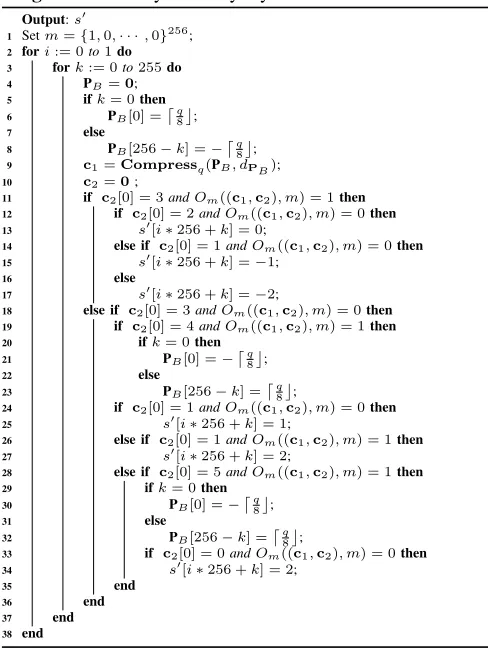
The improved attackv2on Kyber-512, in which we need to use anotherh1to collect enough information, differs from the attacks against Kyber-1024 and Kyber-768. Specifically, in the improved attackv2 on Kyber-512, we can recoversk= 0,−1 and−2withh, butsk= 1and2withhandh1. If theskwe want to recover is2, we can determine it through4queries:
1) We set h= 3and the output of the Oracle is0;
2) If 1) holds, then we set h = 4 and the output of the Oracle is 0;
3) If 2) holds, then we leth= 5 and Oracle will return1;
4) If 3) holds, we will reset PB and h1 = 0, the Oracle returns 0.
TABLE VIII
THE RELATIONSHIP BETWEENsk&h&h1&OmINKYBER-512
sk 0 -1 -2 1 2 2
h 3 2 3 2 1 3 2 1 0 3 4 3 4 5 3 4
Om 1 0 1 0 1 0 0 1 0 1 0 1
h1 1 0 1
Om 0 0 1
Similarly, we can determinesk= 2as follows: 1) We seth= 3 and the output of the Oracle is0;
2) If 1) holds, then we set h = 4 and the output of the Oracle becomes1;
3) If 2) holds, we reset PB and let h1 = 1, the Oracle returns 1.
Algorithm 7: Key-recovery-Kyber-768-v2
Output:s0
1 Setm={1,0,· · ·,0}256; 2 fori:= 0to2do 3 fork:= 0to255do 4 PB=0; 5 ifk= 0then 6 PB[0] =16q;
7 else
8 PB[256−k] =−16q; 9 c1=Compressq(PB, dPB);
10 c2=0;
11 if c2[0] = 5andOm((c1,c2), m) = 1then 12 if c2[0] = 4andOm((c1,c2), m) = 0then 13 s0[i∗256 +k] = 0;
14 else if c2[0] = 3andOm((c1,c2), m) = 0then 15 s0[i∗256 +k] =−1;
16 else
17 s0[i∗256 +k] =−2;
18 else if c2[0] = 5andOm((c1,c2), m) = 0then 19 if c2[0] = 6andOm((c1,c2), m) = 1then 20 s0[i∗256 +k] = 1;
21 else
22 s0[i∗256 +k] = 2;
23 end
24 end 25 end
The relationship between sk and h, h1 is shown in Table VIII and the specific sk recovery process is shown in Algo-rithm 8.
VII. EXPERIMENTS
TABLE IX AVERAGEQUERIES& TIME
Kyber-512 Kyber-768 Kyber-1024
Original Improved Improved Original Improved Improved Original Improved Improved Attack Attackv1 Attackv2 Attack Attackv1 Attackv2 Attack Attackv1 Attackv2
Average 2,596 2,086 1,401 4,654 2,351 1,855 10,303 3,132 2,475
Queries
Average 4.5 3.61 2.2 11.7 5.88 4.3 31.3 9.51 7.5
Time(s)
Algorithm 8: Key-recovery-Kyber-512-v2
Output:s0
1 Setm={1,0,· · ·,0}256;
2 fori:= 0to1do
3 fork:= 0to255do
4 PB=0;
5 ifk= 0then
6 PB[0] =q8
; 7 else
8 PB[256−k] =−q8;
9 c1=Compressq(PB, dPB);
10 c2=0;
11 if c2[0] = 3andOm((c1,c2), m) = 1then
12 if c2[0] = 2andOm((c1,c2), m) = 0then
13 s0[i∗256 +k] = 0;
14 else if c2[0] = 1andOm((c1,c2), m) = 0then
15 s0[i∗256 +k] =−1;
16 else
17 s0[i∗256 +k] =−2;
18 else if c2[0] = 3andOm((c1,c2), m) = 0then
19 if c2[0] = 4andOm((c1,c2), m) = 1then
20 ifk= 0then
21 PB[0] =−q8
;
22 else
23 PB[256−k] =q8;
24 if c2[0] = 1andOm((c1,c2), m) = 0then
25 s0[i∗256 +k] = 1;
26 else if c2[0] = 1andOm((c1,c2), m) = 1then
27 s0[i∗256 +k] = 2;
28 else if c2[0] = 5andOm((c1,c2), m) = 1then
29 ifk= 0then
30 PB[0] =−q8
;
31 else
32 PB[256−k] =q8
;
33 if c2[0] = 0andOm((c1,c2), m) = 0then
34 s0[i∗256 +k] = 2;
35 end
36 end
37 end 38 end
Fig. 1. The Average Time (s)
1 2 3 4 5 6 7 8 9 10 11 12 13 14 15 16 17 18 19 20 21 22 23 24 25 26 27 28 29 30 31 32
Kyber-512 Kyber-768 Kyber-1024
Average Time (s)
Kyber’s security level Original attack
Improved attack v1 Improved attack v2
Fig. 2. The Average Number of Queries
1200 1500 1800 2100 2400 2700 3000 3300 3600 3900 4200 4500 4800 5100 5400 5700 6000 6300 6600 6900 7200 7500 7800 8100 8400 8700 9000 9300 9600 9900 10200 10500
Kyber-512 Kyber-768 Kyber-1024
Average Queries
Kyber’s security level Original attack
Improved attack v1 Improved attack v2
of experiments. The first set is the original attack described in Sections III, IV, and V. The second is theImproved attack v1 introduced in Section VI. The difference between the Original Attack and the Improved attack v1 is that in the Original Attack h starts from h = 0. The third set corresponds to Algorithms 6, 7 and 8 in theImproved attack v2 described in Section VI. In this attack, we redesign the recovery strategy, applying information on distribution probability of coefficients in the secret key.
In our experiments, we first use Kyber’s source code to generate100secret keys. We evaluate the performance of these three attacks on both queries and time. Whenever the adversary accesses Oracle once, the number of quires increases by one. The number of average queries is reported by counting the number of queries the adversary needs to recover a whole secret key. For example, in the attack on Kyber-1024, we count the number of queries the adversary needs to recover 1024 coefficients in each secret key. Each attack is repeated 100 times and then the number is averaged.
The reported time in the experiments starts from the initial generation of the secret key sA by Alice, to the recovery of
the whole secret key by accessing the Oracle multiple times. The average time refers to recording the whole time required for the adversary to recovering a complete sA 100 times and
twice as fast as that in the Original Attack.
The comparison of the queries of the three sets of experi-ments is shown in Figure 2. We can see that the average num-ber of queries is significantly reduced inImproved attack v1 and Improved attack v2, compared with that in the O-riginal Attack. For example, in the Improved attack v1, the average number of queries on Kyber-1024 is reduced to 30% of the Original Attack. Comparing the results of the Improved attack v2 and the Original Attack, the average number of queries in Kyber-512 is reduced by a half, and the queries in Kyber-768 and Kyber-1024 occupy only 40% and a quarter of that in the Original Attack, respectively.
In Table IX, we illustrate the queries and time needed in recovering the whole key. From the experiments, an interesting observation is that as Kyber’s security level increases, the key mismatch attack becomes even simpler. Specifically, in Kyber-512 on average we recover each coefficient in 2.7 queries, while in Kyber-1024 and 768, we only need 2.4 queries. The reason is that in Kyber-1024 and Kyber-768, all the coefficients can be recovered directly using h. But in Kyber-512 the key mismatch attacks require calculating bothhandh1, and then recover sk with the recordedhandh1.
In [17], we propose our key mismatch attacks on another NIST second-round candidate NewHope. Comparing these two attacks, we conclude that it is much easier to use key mismatch attacks to break Kyber than that on NewHope. To be specific, in Kyber-1024, we need an average of 2,475queries to recover all the coefficients in a key. While in NewHope-1024 we need 882,794 queries. The number of queries for NewHope-1024 is356.7times larger than that of Kyber-1024. From another perspective, in Kyber-1024 on average we need 2.4 queries to recover each coefficient, while in Newhope-1024,862.1 queries are needed.
The main reason of the differences of key mismatch attacks on NewHope and Kyber comes from their different design structures. First, in Kyber only Compress and Decompress functions are used to process coefficients one by one. But in NewHope, additional Encode and Decode functions are used, which operate on a quadruple of coefficients at a time, and this makes the attack on NewHope particularly complicated. Second, the ranges of coefficients in Kyber are much smaller than that in NewHope. To be specific, in NewHope the parameter η of the centered binomial distribution Bη is set
as 8, while in Kyber η = 2. Equivalently, the coefficients of the secret key in NewHope ranges from−8 to8, while in Kyber the range is from−2to2. The smaller ranges of Kyber result in less queries to launch the attack. In addition, while recovering the secret key in NewHope, we need to find 50 favorable cases, which also incurs a lot of additional queries.
VIII. CONCLUSION
In this paper, we have proposed key mismatch attacks on the Kyber KEM with three security levels. We need to emphasize that the CCA2-secure Kyber KEM is still secure, but if we implement it in a wrong way, here comes the attacks. To show the efficiency of the proposed attacks, we have implemented them using Kyber’s source code. From
the experiments, an interesting observation is that as Kyber’s security level increases, the key mismatch attack becomes even simpler. We hope that our proposed attack may help in assessing the security of Kyber, reminding us not to implement Kyber in the wrong way.
REFERENCES
[1] L. Gyongyosi and S. Imre, “A survey on quantum com-puting technology,” Computer Science Review, vol. 31, pp. 51–71, 2019.
[2] D. Moody,Post Quantum Cryptography Standardization:
Announcement and outline of NIST’s Call for
Submissions. PQCrypto 2016, Fukuoka, Japan,
2016, https://csrc.nist.gov/Presentations/2016/ Announcement-and-outline-of-NIST-s-Call-for-Submis. Last accessed 11 July 2019.
[3] L. Chen, S. Jordan, Y.-K. Liu, D. Moody, R. Peralta, R. Perlner, and D. Smith-Tone,Report on post-quantum
cryptography. US Department of Commerce, National
Institute of Standards and Technology, 2016.
[4] G. Alagic, G. Alagic, J. Alperin-Sheriff, D. Apon, D. Cooper, Q. Dang, Y.-K. Liu, C. Miller, D. Moody, R. Peraltaet al.,Status Report on the First Round of the NIST Post-Quantum Cryptography Standardization Pro-cess. US Department of Commerce, National Institute of Standards and Technology, 2019, https://nvlpubs.nist. gov/nistpubs/ir/2019/NIST.IR.8240.pdf. Last accessed 26 February 2019.
[5] J. Ding, X. Xie, and X. Lin, “A simple provably secure key exchange scheme based on the learning with errors problem.”IACR Cryptology EPrint Archive, 2012, https: //eprint.iacr.org/2012/688.pdf. Last accessed 26 February 2019.
[6] D. Moody, “Round 2 of the nist pqc “competition” - what was nist thinking?” 2019.
[7] E. Rescorla, “The transport layer security (tls) protocol version 1.3,” Tech. Rep., 2018, http://www.rfc-editor.org/ info/rfc8446. Last accessed 26 February 2019.
[8] D. Kirkwood, B. C. Lackey, J. McVey, M. Motley, J. A. Solinas, and D. Tuller, “Failure is not an option: standardization issues for post-quantum key agreement,”
in Workshop on Cybersecurity in a Post-Quantum
World, 2015, https://csrc.nist.gov/csrc/media/events/
workshop-on-cybersecurity-in-a-post-quantum-world/ documents/presentations/session7-motley-mark.pdf. Last accessed 12 July 2019.
[9] S. R. Fluhrer, “Cryptanalysis of ring-lwe based key exchange with key share reuse.”IACR Cryptology ePrint
Archive, 2016, http://eprint.iacr.org/2016/085. Last
ac-cessed 18 February 2019.
[10] J. Ding, S. Alsayigh, R. Saraswathy, S. Fluhrer, and X. Lin, “Leakage of signal function with reused keys in rlwe key exchange,” in 2017 IEEE International
Conference on Communications (ICC). IEEE, 2017,
pp. 1–6.
Conference on Information Security and Cryptology. Springer, 2018, pp. 163–176.
[12] E. Alkim, L. Ducas, T. P¨oppelmann, and P. Schwabe, “Post-quantum key exchangeła new hope,” in 25th
USENIX Security Symposium (USENIX Security 16),
2016, pp. 327–343.
[13] B. Gong and Y. Zhao, “Cryptanalysis of rlwe-based one-pass authenticated key exchange,” in International
Workshop on Post-Quantum Cryptography. Springer,
2017, pp. 163–183.
[14] J. Ding, S. Fluhrer, and S. Rv, “Complete attack on rlwe key exchange with reused keys, without signal leakage,”
inAustralasian Conference on Information Security and
Privacy. Springer, 2018, pp. 467–486.
[15] A. Bauer, H. Gilbert, G. Renault, and M. Rossi, “As-sessment of the key-reuse resilience of newhope,” in
Cryptographers Track at the RSA Conference. Springer,
2019, pp. 272–292.
[16] E. Alkim, R. Avanzi, J. Bos, L. Ducas, A. de la Piedra, T. P¨oppelmann, P. Schwabe, and D. Stebila, “Newhope: Algorithm specification and supporting documentation - version 1.03,” 2019, https://newhopecrypto.org/data/ NewHope 2019 07 10.pdf. Last accessed 12 July 2019. [17] Y. Qin, C. Cheng, and J. Ding, “A complete and opti-mized key mismatch attack on nist candidate newhope.”
in European Symposium on Research in Computer
Se-curity, accepted. Springer, 2019, https://eprint.iacr.org/
2019/435.pdf. Last accessed 12 July 2019.
[18] C. B˘aetu, F. B. Durak, L. Huguenin-Dumittan, A. Talay-han, and S. Vaudenay, “Misuse attacks on post-quantum cryptosystems,” in Advances in Cryptology –
EURO-CRYPT 2019, Y. Ishai and V. Rijmen, Eds. Cham:
Springer International Publishing, 2019, pp. 747–776. [19] M. Ajtai, “Generating hard instances of lattice problems,”
inProceedings of the twenty-eighth annual ACM
sympo-sium on Theory of computing. ACM, 1996, pp. 99–108.
[20] O. Regev, “On lattices, learning with errors, random linear codes, and cryptography,” in Proceedings of the Thirty-seventh Annual ACM Symposium on Theory
of Computing. ACM, 2005, pp. 84–93. [Online].
Available: http://doi.acm.org/10.1145/1060590.1060603 [21] V. Lyubashevsky, C. Peikert, and O. Regev, “On ideal
lattices and learning with errors over rings,” in Annual International Conference on the Theory and Applications
of Cryptographic Techniques. Springer, 2010, pp. 1–23.
[22] R. Avanzi, J. Bos, L. Ducas, E. Kiltz, T. Lepoint, V. Lyubashevsky, J. M. Schanck, P. Schwabe, G. Seiler, and D. Stehl´e, “Crystalsckyber: Algorithm specification and supporting documentation,”Submission to the NIST
post-quantum project (2017), 2017, https://pq-crystals.
org/kyber. Last accessed 24 June 2019.
[23] J. Bos, L. Ducas, E. Kiltz, T. Lepoint, V. Lyubashevsky, J. M. Schanck, P. Schwabe, G. Seiler, and D. Stehl´e, “Crystals-kyber: a cca-secure module-lattice-based kem,”
in 2018 IEEE European Symposium on Security and
Privacy (EuroS&P). IEEE, 2018, pp. 353–367, https:
//eprint.iacr.org/2017/634. Last accessed 24 June 2019. [24] R. Avanzi, J. Bos, L. Ducas, E. Kiltz, T. Lepoint,