Jihye Kim1, Seunghwa Lee1, Jiwon Lee2, and Hyunok Oh2( )
1
Kookmin University, Seoul, Korea, {jihyek,ttyhgo}@kookmin.ac.kr
2
Hanyang University, Seoul, Korea, {jiwonlee,hoh}@hanyang.ac.kr
Abstract. Wildcard identity-based encryption (WIBE) allows a sender to simultaneously encrypt messages to a group of users matching a cer-tain pattern, defined as a sequence of identifiers and wildcards. We propose a novel scalable wildcarded identity-based encryption, called SWIBE, which reduces the ciphertext size to be constant. To the best of our knowledge, SWIBE is the first wildcard identity-based encryption scheme that generates a constant size ciphertext regardless of the depth of the identities with fast decryption. The proposed scheme improves the decryption time. According to our experiment results, decryption of the SWIBE scheme is 3, 10, and 650 times faster than existing WIBE, WW-IBE, and CCP-ABE schemes. The SWIBE scheme also subsumes the generalized key derivation naturally by allowing wildcards in the key delegation process. We prove CPA security of the proposed scheme, ex-tend it to be CCA secure, and propose a fully secure scheme to overcome selective-ID CPA.
Keywords: wildcard identity based encryption, constant ciphertext, key dele-gation, pattern
1
Introduction
The advanced information technology has increased the popularity and diversity of embedded systems (or IoT devices) in a variety of applications such as smart city, transport, smart grid, production control, medical, military, and so on. In these distributed settings, messages often need to be securely delivered to a specific group of devices or users for communication and management. Some examples are as follows:
– The official commands or monitoring messages from a commander or sen-sors deployed to jointly monitor malicious activity for city security must be securely communicated to a specific group or user determined by its region, role, class, function, etc.
?This paper is a full version of the conference paper with the same title that was
– Secure firmware updates in many systems including vehicles are crucial to improve performance and provide fixes for defective software that can lead to costly product recalls. The firmware, the intellectual property of a company, must be distributed securely to a distinct group specified by the brand, model, year, device type, version, etc.
– In the military, tactical communications such as real-time video and target-ing data need to be securely transmitted accordtarget-ing to the access structure determined by the receiver’s class, mission, location, etc.
Related Works.Identity-based encryption (IBE) is one of most powerful build-ing blocks to provide data confidentiality which can encrypt a message with-out retrieving and verifying the public key separated from the identity. The IBE scheme proposed by Shamir [Sha84] uses an actual user identity (e.g., [email protected]) as a public key for encryption. The first practical IBE scheme construction was presented by using bilinear maps [BF01, Wat05]. It has ad-vanced to a hierarchical identity-based encryption (HIBE) scheme in [BBG05] where an identity is defined by multiple identity strings in a hierarchy such that keys for each identity string can be generated in a hierarchically distributed way: users at levellcan derive keys for their children at levell+ 1. The advantage of HIBE is to reduce the burden of a trusted key distribution center by distributing key derivation and solving a bottleneck problem. The technical intuition of the key delegation in the HIBE system has been adapted to other various crypto-graphic constructions, such as broadcast encryption [BGW05, LLWQ14, BH08]. Motivated by the fact that many email addresses correspond to groups of users rather than single individuals, Abdalla et al. [ACD+06] extended HIBE
to wildcarded identity-based encryption (WIBE) by combining a concept called wildcard (∗), which can be replaced by any identity string in a sequence of identity strings. A pattern (or an identity) defined as a sequence of multiple identity strings and wildcards efficiently determines a group of identities as well as a single identity. WIBE engages a pattern as a public key for encryption, meaning that a single ciphertext encrypted on a pattern (edu, univ, cs, ∗)
(corresponding to∗@cs.univ.edu) can be simultaneously delivered to the mul-tiple users with identities such [email protected]@cs.univ.edu. Abdalla et al. proposed three different WIBE constructions by extending the previous HIBE schemes; however, all constructions suffer from comparatively larger ciphertext size which is at least O(L) where L denotes the maximum depth of a pattern (i.e, the maximum number of identity strings). Later, Bir-kett et al. [BDNS07] presented compilation techniques that convert any L-level CPA-secure WIBE scheme into L-level CCA-secure identity-based key encap-sulation mechanisms with wildcards (WIB-KEM). They constructed more effi-cient CCA-secure WIBE variants by applying their compilation techniques to the CPA-secure WIBE schemes from [ACD+06]. However, the ciphertext size
the distributed setting, the non-scalable ciphertext size in [ACP12] has not been improved and remained an obstacle so far.
There are attribute-based encryption schemes (ABE) that allow more ex-pressive policies than WIBE. Ciphertext-policy attribute-based encryption (CP-ABE) in [BSW07] associates to each ciphertext an access structure consisting of a logical combination of attribute values using AND and OR gates. A decryption key is given for a set of attributes and can only decrypt a ciphertext whose ac-cess structure is satisfied by the set of its attributes. WIBE schemes are a special case of CP-ABE schemes by mapping the identity vector(*, Tesla, *, Model S) to the access structure (2||Tesla ∧ 4||Model S). The device with a set of attributes (2018, Tesla, Powertrain, Model S)can decrypt the ciphertext. However, its ciphertext size grows linearly with the number of attributes in the access structure. The authors in [EMN+09] proposed a CP-ABE scheme with
constant ciphertext size, but, without supporting wildcards in its access policy. Later, the ABE scheme was upgraded to support wildcards in [ZH10], however, only with binary identities. When it is converted into the string-based identity version, the number of attributes grows exponentially to cover all possible iden-tities in a binary notation, which results in an exponential number of public parameters. Otherwise, each attribute should be denoted in a binary format, which increases the the maximum depth of a pattern by the binary string length times.
Ciphertext Size.In general, the ciphertext size is an important issue because the ciphertext is the actual payload that is transmitted via network in real applications. However, the existing WIBE scheme [ACD+06] produces a
non-constant size ciphertext linearly increasing by the maximum depth of a pattern. It is mainly because the ciphertext should include additional information for each wildcard such that wildcards in a pattern can be transformed for every matching key element in WIBE scheme. With the approach that the ciphertext contains all information required to conversion, it is not clear how to construct a WIBE with constant size ciphertext.
Using a generic construction described in [ACD+06], WIBE with a constant
size ciphertext can be constructed from a hierarchical identity based encryption scheme (HIBE) with a constant sized ciphertext. However, this WIBE scheme has a secret key size that is exponential in the depth of the pattern. Briefly, a user stores secret keys for every possible matching pattern such that the user directly decrypts a ciphertext with a suitable key. For example, given an identity pattern (ID1, ID2), a user stores keys for all four matching patterns: (ID1, ID2), (∗,
ID2), (ID1, ∗), (∗, ∗). Thus, the secret key size is exploded up to 2L which is
impractical to be used in small embedded devices.
Intuitions.Our construction is based on the variant of the BBG-HIBE [BBG05]. The BBG-HIBE scheme has the advantage of constant-sized ciphertexts and our WIBE scheme keeps this advantage while allowing wildcards in a pattern in encryption. The WIBE scheme by Abdalla et al. [ACD+06] also modifies a
wildcard. This extra data is used for each user to convert the ciphertext to match their specific identity pattern. However, this approach seems to be difficult to avoid the message overhead required for each wildcard. In the WIBE scheme [ACD+06], a pattern withwwildcards leads to a ciphertext withw+ 3 group
el-ements. Our approach reverses the method of Abdalla et al.’s: each user converts the identity pattern of the secret key to match the ciphertext. In this method, each user must store an extra data for each non-wildcard identity in order to replace the identity by a wildcard. A pattern withlspecific identity strings leads to a secret key withl additional elements. The benefit of this approach is that the extra values for each wildcard do not have to be separately delivered as in [ACD+06] because they are not used for conversion of each corresponding iden-tity string any more. From this observation, our WIBE scheme reduces the extra data values for each wildcard in the ciphertext as a single element. The resulting scheme is secure under the same cryptographic assumption as the BBG-HIBE scheme. The details of the construction are described in section 4.
Contributions.In this paper, we propose a new WIBE scheme with constant size ciphertext and with polynomial overhead in every parameter. Our main contributions are summarized as follows:
– We propose a novel scalable wildcarded identity based encryption scheme called SWIBE. To the best of our knowledge, the proposed scheme is the first WIBE scheme that generates a constant size ciphertext regardless of the depth, i.e., the maximum number of attributes; the ciphertext consists of just four group elements, which is comparable even to the HIBE scheme [BBG05] that contains three group elements for its ciphertext.
– The proposed SWIBE also improves decryption performance of WIBE. Much of the decryption overhead in the existing WIBE is in the conversion operation of wildcards in a ciphertext into identity strings of a user’s secret key. While the WIBE [ACD+06] converts a ciphertext to another
cipher-text for a specific matching identity strings, the proposed SWIBE replaces any identity string by a wildcard; this method reduces point multiplications (i.e., exponentiations) required in the previous WIBE and speeds up the decryption.
– The proposed SWIBE allows wildcards in the key delegation process as well as in the encryption procedure, naturally subsuming the generalized key derivation of wicked-IBE [AKN07] and distributing the key management overhead.
– We formally prove the selective CPA-security of the proposed SWIBE scheme under the L-BDHE assumption. We also extend it to be a CCA secure SWIBE scheme.
Table 1 compares the HIBE scheme [BBG05] (that does not support wild-cards as identities), the WIBE scheme [ACD+06], HIBE with the generalized key
Table 1: Comparison of HIBE, WIBE, wicked-IBE, WW-IBE, CCP-ABE, and proposed SWIBE schemes.cf. e= time of scalar multiplication,p= time of pairing, andL= hierarchy depth, IDi is represented using aq-bit string, size
indicates group elements, Enc = Encryption, and Der = Key derivation.
HIBE[BBG05] WIBE[ACD+06] wicked-IBE[AKN07] WW-IBE[ACP12] CCP-ABE[ZH10] SWIBE
pp size L+ 4 L+ 4 L+ 2 2L+ 2 2L2q+ 1 L+ 4
SK size L+ 2 L+ 2 L+ 2 L+ 1 3L2q+ 1 2L+ 3
CT size 3 L+ 3 3 3L+ 2 2 4 Enc time (L+ 3)e+p (L+ 3)e+p (L+ 1)e+p (3L+ 2)e 2L2qe+p (L+ 3)e+p
Dec time 2p Le+ 2p Le+ 2p Le+ (2L+ 1)p 2L2qe+ 4L2qp Le+ 3p
Wildcard use None Enc Der Enc&Der Enc Enc&Der
identities as well as the generalized key delegation. The table shows the public parameter size (pp size), the user secret key size (SK size), the ciphertext size, the encryption time (Enc time), and the decryption time (Dec time) according to the maximum depth of the pattern (L) whereeandpdenote the numbers of scalar multiplications and pairings, respectively. It is assumed that each ID is represented using a q-bit string maximally. For the wildcard use, the table spec-ifies whether wildcards are used in an encryption (Enc) algorithm or in an key derivation (Der) algorithm. Note that the SWIBE scheme hasO(L) size of the secret key, while it produces a constant-size ciphertext with allowing wildcards in a ciphertext pattern. Note that if each bit in ID representation is regarded as an attribute in CCP-ABE then pp size, SK size, the encryption, and the decryption time are 2Lq+ 1, 3Lq+ 1, 2Lqe+p, and 2Lqe+ 4Lqp, respectively. In WW-IBE and CCP-ABE, the decryption time is a major hurdle to be used in practical applications since the decryption requires pairing operations of which number is proportional to the maximum depth level L. Especially, in CCP-ABE, the number of pairing operations is dependent on the length of a bit string in each ID, in addition. In experiment, the decryption time overheads in WW-IBE and CCP-ABE are 10 times and 650 times compared with the proposed approach.
This paper is organized as follows: section 2 introduces the basic defini-tions and complexity assumpdefini-tions. In section 3, we formally define the wildcard identity-based encryption as a universal primitive. In section 4 we explain the main idea of the proposed scheme and how to construct it in details, along with the security proof. Section 5 extends it to be CCA secure, and section 6 proposes a new version of our scheme in composite order to obtain full security instead of selective security. In section 7, we show the experimental results and in section 8, we conclude.
2
Background
2.1 Identity-based Encryption
wishes to become part of the system, the trusted authority generates a user
decryption key dID
$
← KeyDer(msk, ID), and sends this key over a secure and
authenticated channel to the user. To send an encrypted messagemto the user
with identityID, the sender computes the ciphertextC←$ Enc(pp, ID,m), which can be decrypted by the user asm←Dec(dID, C). We refer to [BF03] for details
on the security definitions for IBE schemes.
2.2 Hierarchical IBE
In a hierarchical IBE (HIBE) scheme, users are organized in a tree of depth L, with the root being the master trusted authority. The identity of a user at level 0≤l≤Lin the tree is given by a vectorID= (P1, . . . , Pl)∈({0,1}q)l. A HIBE
scheme is a tuple of algorithmsHIBE= (Setup,KeyDer,Enc,Dec) providing the same functionality as in an IBE scheme, except that a userID= (P1, . . . , Pl) at
levellcan use its own secret keyskIDto generate a secret key for any of its
chil-dren ID0 = (P1, . . . , Pl, . . . , PL) via skID0
$
← KeyDer(skID, ID0). Note that by
interactively applying the KeyDeralgorithm, userID can derive secret keys for any of its descendantsID0= (P1, . . . , Pl+δ),δ≥0. We use the overloaded
nota-tionskID0
$
←KeyDer(skID,(Pl+1, . . . , PL+1)) to denote this process. The secret
key of the root identity at level 0 issk=msk. Encryption and decryption are
the same as for IBE, but with vectors of bit strings as identities instead of ordi-nary bit strings. We use the notation P|l−1 to denote vector (P1, . . . , Pl−1).We
refer to [BBG05] for details on the security definitions for HIBE schemes.
2.3 Bilinear Groups and Pairings
We briefly review the necessary facts about bilinear maps and bilinear map groups. We use the following standard notation [Jou04, BF03].
1. GandG1 are two (multiplicative) cyclic groups of prime order p.
2. gis a generator ofG.
3. e:G×G→G1 is a bilinear map.
LetGandG1be two groups as above. A bilinear map is a mape:G×G→G1
with the following properties:
1. Bilinear: for all u, v∈Gand a, b∈Z, we havee(ua, vb) =e(u, v)ab 2. Non-degenerate:e(g, g)6= 1.
We say thatGis a bilinear group if the group action inGcan be computed efficiently and there exist a groupG1and an efficiently computable bilinear map
2.4 Computational Complexity Assumptions
Security of our system is based on a complexity assumption called the bilinear Diffie-Hellman Exponent assumption (BDHE) used in [BBG05], which is a nat-ural extension of bilinear-DHI assumption previously used in [BB11]. LetGbe a bilinear group of prime orderp. TheL-BDHE problem inGis stated as follows: given a vector of 2L+ 1 elements
(h, g, gα, g(α2), . . . , g(αL), g(αL+2), . . . , g(α2L)∈G2L+1)
as input, output e(g, h)αL+1
∈ G1. As shorthand, once g and α are specified,
we useyi to denote yi =gα i
∈ G. An algorithm A has advantage in solving L-BDHE inGif
P r[A(h, g, y1, . . . , yL, yL+2, . . . , y2L) =e(yL+1, h)]≥
where the probability is over the random choice of generators g, h in G, the random choice of α in Zp, and the random bits used by A. The decisional
version of the L-BDHE problem in G is defined analogously. Let yg,α,L =
(y1, . . . , yL, yL+2, . . . , y2L). An algorithm B that outputs b ∈ {0,1} has
advan-tage in solving decisionalL-BDHE inGif
|P r[B(g, h,yg,α,L,e(yL+1, h)) = 0]
−P r[B(g, h,yg,α,L, T) = 0]| ≥
where the probability is over the random choice of generators g, h in G, the random choice of αin Zp, the random choice ofT ∈G1, and the random bits
consumed byB.
Definition 1. We say that the (decisional) (t, , L)-BDHE assumption holds in
G if no t-time algorithm has advantage at least in solving the (decisional) L-BDHE problem inG.
Occasionally we omit the tand, and refer to the (decisional)L-BDHE inG.
3
Model
A scalable wildcarded identity based scheme (SWIBE) allows general key del-egation and encryption to a group that is denoted by multiple identity strings and wildcards. To make the further description simple and clear, we define the following notations similarly to [ACD+06].
Definition 2. A patternP is a vector(P1, . . . , PL)∈(Z∗p∪ {∗})L , where∗is a
special wildcard symbol,pis a q-bit prime number, and Lis the maximal depth of the SWIBE scheme.3
3
We denote pattern P as in (Z∗p∪ {∗})Linstead of ({0,1}q∪ {∗})L, since{0,1}q can
Definition 3. A pattern P0 = (P10, . . . , PL0) belongs to P, denoted P0 ∈∗ P, if
and only if∀i∈ {1, . . . , L},(Pi0=Pi) ∨(Pi=∗).
Definition 4. A pattern P0= (P10, . . . , PL0)matchesP, denotedP0≈P, if and only if∀i∈ {1, . . . , L},(Pi0=Pi)∨(Pi=∗)∨(Pi0=∗).
Notice that a set of matching patterns ofPis a super set of belonging patterns of P. For a pattern P = (P1, . . . , PL), we define W(P) is the set containing
all wildcard indices in P, i.e. the indices 1 ≤ i ≤ L such that Pi = ∗, and
W(P) is the complementary set containing all non-wildcard indices. Clearly, W(P)∩W(P) =∅andW(P)∪W(P) ={1, . . . , L}.
Definition 5. W(P)is the set containing all wildcard indices in a patternP.
Definition 6. W(P) is the complementary set containing all non-wildcard in-dices in a patternP.
A scalable wildcarded identity-based encryption SWIBE consists of four algorithms:
Setup(L) takes as input the maximal hierarchy depth L. It outputs a public
parameterppand master secret keymsk.
KeyDer(skP, Pnew) takes as input a user secret key skP for a pattern P =
(P1, . . . , PL) and can derive a secret key for any pattern Pnew ∈∗ P. The
secret key of the root identity ismsk=sk(∗,...,∗).
Encrypt(pp, P, m) takes as input patternP = (P1, . . . , PL), messagem∈ {0,1}∗
and public parameterpp. It outputs ciphertextC for patternP.
Decrypt(skP, C, P0) takes as input user secret keyskPfor patternP= (P1, . . . , PL)
and ciphertextCfor patternP0. Any user in possession of the secret key for a patternP that matchesP0 can decrypt the ciphertext usingskP, and the
algorithm outputs messagem.
Correctness requires that for all key pairs (pp, msk) output by Setup, all messages m ∈ Z∗
p, and all patterns P, P0 ∈ (Z∗p ∪ {∗})L such that P ≈ P0, Decrypt(KeyDer(msk, P),Encrypt(pp, P0, m), P0) =m.
SECURITY. We define the security of a scalable wildcarded identity based
en-cryption scheme similar to [ACD+06], but additionally considering the key
del-egation property. An adversary is allowed to choose an arbitrary pattern and query secret keys corresponding to the pattern. The adversary is not allowed to query the key derivation oracle for any pattern matching with a challenge pattern. The security is defined by an adversary A and a challenger C via the following game. BothC andAare given the hierarchy depthLand the identity bit-lengthqas input.
Setup: Challenger C runs Setup(L) to obtain public parameter pp and master
Key derivation queries:1: AdversaryAissues key derivation queriesqK1, . . . , qKm
in which a key derivation query consists of a patternP0∈(Z∗p∪ {∗})L, and
challengerCresponds with skP0 ←$ KeyDer(skP, P0).
Query phase1: AdversaryA issues decryption queries qD1, . . . , qDn in which a
decryption query consists of a patternP0 ∈(Zp∗∪ {∗})L and ciphertextC,
next challengerC responds with a messageM ←$ Decrypt(C, P0).
Challenge: A outputs two equal-length challenge messagesm∗0, m∗1 ∈ Z∗p and a
challenge identityP∗= (P1∗, . . . , PL∗∗) s.t.P∗6≈P0for all queriedP0.Cruns algorithmC∗←Encrypt(pp, P∗, mb∗) for random bitb and givesC∗ toA.
Key derivation queries:2: Attacker A continues to issue key derivation queries qKm+1, . . . , qqK same as Key derivation queries:1 where query pattern P
0 6≈
P∗.C responds as in key derivation query 1.
Query phase2: Attacker A continues to issue decryption queriesqDn+1, . . . , qqD
same asQuery phase1. It should be satisfied that queried ciphertextC6=C∗.
Cresponds as in query phase 1.
Guess: Aoutputs its guessb0∈ {0,1} forband wins the game ifb=b0.
Definition 7. A SWIBE is (t, qK, qD, , L) IND-ID-CCA-secure if all t-time
adversaries making at mostqK queries to the key derivation oracle and at most
qDqueries to the decryption oracle have at most advantagein the IND-ID-CCA
game described above.
We also define IND-ID-CPA-secure similar as IND-ID-CCA game except for-bidden all decryption queries.
Definition 8. ASWIBE is(t, qK,0, , L)IND-ID-CPA-secure if allt-time
ad-versaries making at most qK queries to the key derivation oracle have at most
advantagein the IND-ID-CPA game described above.
SELECTIVE-IDENTITY SECURITY. A weaker selective-identity (sID) security
notion IND-sID-CPA is defined analogously to the IND-ID-CPA one: every pro-cedure is the same except that the adversary has to commit to the challenge identity at the beginning of the game, before the public parameter is made available.
4
The Proposed Scheme
4.1 Overview: BBG-HIBE and our idea
The BBG-HIBE scheme [BBG05] is described as follows:
Setup(L): L indicates the maximum hierarchy depth. Select a random integer
α ∈ Z∗p, and O(L) random group elements g, g2, g3, h1, h2, . . . , hL ∈ G, and computeg1=gα.
The public parameters and the master secret key are given by
pp= (g, g1, g2, g3, h1, h2, . . . , hL), msk=gα2.
KeyDer(skP|l−1,P):To compute the secret keyskPfor an identityP = (P1, . . . , Pl)∈
(Z∗p)lwherel≤Lfrom the master secret key, a randomr←$
Z∗p is chosen, then
secret key skP = (a1, a2, bl+1,· · · , bL) forP is constructed as
a1=gα2(g3·
Y
i∈[1,···,l]
hPi i )
r, a
2=gr,{bi=hri}i∈[l+1,···,L]
The private key forP can be generated incrementally, given a private key for the parent identityP|l−1= (P1, . . . , Pl−1)∈(Z∗p)l−1. LetskP|l−1 = (a
0
1, a02, b0l,· · ·, b0L)
be the private key forP|l−1. To generateskP, pick a randomt∈Z∗p and output
a1=a01·(b0l) Pl·(g
3·
Y
i∈[1,···,l]
hPi i )
t
, a2=a02·g
t
,
{bi=b0i·h t
i}i∈[l+1,···,L]
Encrypt(pp, P, M):To encrypt a message m∈G1 to patternP = (P1, . . . , Pl),
choose s←$ Z∗p, and compute
C= (gs, (g3·
Y
i∈[1,···,l]
hPi i )
s, M ·e(g
1, g2)s)
Decrypt(skP, C):Consider an identity pattern P = (P1,· · ·, Pl). To decrypt a
given ciphertext C= (C1, C2, C3) with private keyskP = (a1, a2, bl+1,· · ·, bL),
output
C3·
e(a2, C2)
e(C1, a1)
=M
The BBG-HIBE scheme [BBG05] has the advantage of constant-sized cipher-texts. The ciphertext consists of only three elements: (gs,(g
3·hP11· · ·h
Pl l )
s, M(g, g
2)sα).
The secret key is composed of two types of keys for its purposes: decryption and key delegation. To decrypt a ciphertext, two elements in the secret key are in-volved with: (gα
2(g3·hP11· · ·h
Pl l )
r, gr). A pattern P = (P
1,· · ·, Pl) is combined
as a single element in the secret key. We observe that each identity string of a pattern in the secret key can be replaced by another identity by multiplication because it can be canceled by multiplying its inverse. For instance, it is possible to computegα
2(g3h
P10
1 · · ·h
Pl l )
r by multiplyingh(P10−P1)r
1 tog2α(g3·hP11· · ·h
Pl l )
Assume that a wildcard∗is mapped to some elementw∈Z∗
p. In order to
al-low a pattern to include a wildcard, we consider a way to includeci= (hwi/h Pi i )
r
for every identity stringPiin a secret key. Then each identity part (hPii)
rcan be
substituted by (hwi)r. The method, however, is not secure. From this extra secret key ci and the valuesw and Pi, it is possible to computehri =ci
1/(w−Pi); this
leads to extract the top level secret key g2αg3r from gα2(g3hP11· · ·h
Pl l )
r because
(hP1
1 · · ·h
Pl l )
r can be generated fromhr
1,· · ·, hrl.
To solve the problem, we randomize the wildcard part using an independent random value t ∈ Zp. Thus, the extra key value is revised as ci = hwti /h
Pir i
and gt is additionally appended so that they can be canceled out correctly in decryption. For example, the keygα
2(g3·hP11h
P2
2 h
P3
3 )
rfor (P
1, P2, P3) is changed to
gα
2(g3·hP22)r·(hw1hw3)tfor (∗, P2,∗) by multiplyingc1c3. The encryption needs
to be slightly changed to be compatible with this modification. To encrypt a message to (∗, P2,∗), the pattern must be divided into non-wildcard and wildcard
identity groups so that they can be treated as follows: the encryption for the non-wildcard identities (·, P2,·) is the same as the BBG-HIBE which generates three
elements: (gs,(g
3·hP22)s, M·e(g1, g2)s). The encryption for the wildcard identities
(∗,·,∗) is computed as (hw
1hw3)s. This additional element is used to cancel out the
wildcard part of the user’s secret key in decryption. As a result, the ciphertext size increases by a single group element to support wildcards in the proposed scheme. The key size increases linearly to the number of identity strings, which is still polynomial to the maximum depth of a pattern.
The key delegation is orthogonal to the wildcard support for encryption and our scheme follows the key delegation method of BBG-HIBE. Only difference is that our key delegation is more flexible because it does not have to follow the hierarchical order as in BBG-HIBE.
The complete scheme is described in the following section 4.2 withw = 1 and we prove the security of the proposed scheme in section 4.3.
4.2 SWIBE Construction
We present the SWIBE scheme with constant size ciphertexts and O(L) size keys.
Setup(L):Lindicates the maximum hierarchy depth. The generation of a random initial set of keys proceeds as follows. Select a random integerα∈Z∗p, andO(L)
random group elementsg, g2, g3, h1, h2, . . . , hL∈G, and computeg1=gα.
The public parameter is given by
pp←(g, g1, g2, g3, h1, h2, . . . , hL).
A master secret key is defined asmsk=gα
2.
KeyDer(pp,skP,P0):To compute the secret keyskP0for a patternP0= (P10, . . . , PL0)∈
(Z∗p∪ {∗})Lfrom the master secret key, first two randoms r, t
$
then secret keyskP0 = (a01, a02, a03, b0, c0, d0) forP0 is constructed as
a01=msk(g3·
Y
i∈W(P0) hP
0
i i )
r, a0
2=g
r, a0 3=g
t
b0={b0i=hri}i∈W(P0) c0 ={c0i=hit}i∈W(P0)
d0={d0i=hti/hP 0
ir
i }i∈W(P0)
In order to generate secret keyskP0 for a patternP0 from secret keyskP = (a1, a2, a3, b, c) for a patternP such thatP0 ∈∗ P, simply choose two randoms
r0, t0←$ Z∗
q and outputskP0 = (a01, a20, a03, b0, c0, d0), where
a01=a1·(
Y
i∈W(P0)∩W(P) bP
0
i i )·(g3
Y
i∈W(P0) hP 0 i i ) r0 ,
a02=a2·gr
0
, a03=a3·gt
0
b0 ={b0i =bi·hr
0
i }i∈W(P0), c0={c0i=ci·ht
0
i}i∈W(P0)
d0 ={d0i=di·
ht0 i
hPi0r0 i
}i∈W(P0)∩W(P)
∪ {d0i =
ci
bPi0 i
· h
t0 i
hPi0r0 i
}i∈W(P0)∩W(P)
Encrypt(pp, P,m): To encrypt a messagem∈G1 to patternP = (P1, . . . , PL)
under pp, chooses←$ Z∗p, and computeC= (C1, C2, C3, C4)
C1=gs, C2= (g3·
Y
i∈W(P)
hPi i )
s
C3=m·e(g1, g2)s, C4= (
Y
i∈W(P)
hi)s
Decrypt(skP, C, P0): Consider patterns P and P0 ∈ (Zp∗ ∪ {∗})
L, where P is
a key pattern and P0 is a ciphertext pattern. To decrypt a given ciphertext C = (C1, C2, C3, C4) with private key skP = (a1, a2, a3, b, c, d), compute a01 =
a1·Qi∈W(P0)∩W(P)b
Pi0 i ·
Q
i∈W(P0)∩W(P)ci·Qi∈W(P0)∩W(P)di and output
C3·
e(a2, C2)·e(a3, C4)
e(C1, a01)
=m
The fact that decryption works can be seen as follows. We denoteWP0P = W(P0)∩W(P),WP0
P =W(P
0)∩W(P),W
Sincea1=g2α(g3Qi∈W(P)hPii)r,bi=hri,ci=hti, anddi= h t i hPiri ,
a01=a1·
Y
i∈WP0P bP
0
i i ·
Y
i∈WP0P ci·
Y
i∈WP0P di
=g2α(g3·
Y
i∈W(P)
hPi i )
r· Y
i∈WP0P hP
0
ir
i ·
Y
i∈WP0P
hti· Y i∈WP0P
ht i
hPir i
=g2α(g3·
Y
i∈W(P)
hPi i ·
Y
i∈WP0P hP
0
i i ·
Y
i∈WP0P h−Pi
i )
r
· Y
i∈WP0P
hti· Y i∈WP0P
hti.
SinceWP0P ∪WP0
P=W(P) andWP0P∩WP0
P=∅, Q
i∈W(P)h
Pi i ·
Q
i∈WP0Ph
−Pi i
=Q
i∈WP0Ph
Pi
i . Similarly, sinceWP0P ∪W
P0P =W(P0) andWP0P ∩W
P0P =∅,
Q
i∈WP0Ph
t i·
Q
i∈WP0Ph
t i =
Q
i∈W(P0)hti. Therefore,
a01=g2α(g3·
Y
i∈WP0P hPi
i · Y
i∈WP0P hP
0
i i )
r· Y
i∈W(P0) hti.
SinceP≈P0,Pi=Pi0 fori∈WP0P.
a01=gα2(g3·
Y
i∈WP0P hP
0
i i ·
Y
i∈WP0P hP
0
i i )
r· Y
i∈W(P0) hti.
SinceWP0
P ∪WP0P=W(P
0) andW
P0P∩WP0P=∅, Q
i∈WP0Ph
Pi0 i ·
Q
i∈WP0Ph
Pi0 i
=Q
i∈W(P0)h
Pi0 i .
a01=g2α(g3·
Y
i∈W(P0) hP
0
i i )
r· Y
i∈W(P0) hti.
e(a2, C2)·e(a3, C4)
e(C1, a01)
= e(g
r,(g
3·Qi∈W(P0)h
P0
i i )
s)·e(gt,(Q
i∈W(P0)hi)s)
e(gs, gα
2(g3·Qi∈W(P0)h
P0
i i )r·
Q
i∈W(P0)hti)
= 1
e(g, g2)sα
= 1
e(g1, g2)s
.
4.3 Security Proof
Theorem 1. LetGbe a bilinear group of prime order p. Suppose the decisional
(t, , L)-BDHE assumption holds inG. Then our SWIBE is(t0, qK,0, , L)
sID-CPA secure for arbitraryL, and t0< t−O(Le+p), whereeis a time of scalar multiplication and pis a time of pairing inG.
Proof. Suppose A has advantage in attacking the SWIBE scheme. Using A, we build an algorithmBthat solves the (decisional) L-BDHE problem inG.
For a generatorg∈Gandα∈Z∗p, let yi=gα i
∈G. AlgorithmBis given as input a random tuple (g, h, y1, . . . , yL, yL+2, . . . , y2L, T) that is either sampled
from PBDHE (where T = e(g, h)(α L+1)
) or from RBDHE (where T is uniform
and independent inG1). AlgorithmB’s goal is to output 1 when the input tuple
is sampled fromPBDHE and 0 otherwise. AlgorithmBworks by interacting with Ain a selective subset game as follows:
Init:The game begins withAfirst outputting an identity vectorP∗= (P∗
1, . . . , PL∗) ∈∗(Z∗p∪ {∗})L.
Setup: To generate a public parameter, algorithm B picks a random γ in Zp
and sets g1 = y1 = gα and g2 = yLgγ = gγ+(α L)
. Next, B picks random γi ∈ Z∗p for i = 1, . . . , L, and sets hi = gγi/yL−i+1 for i∈W(P∗) and hi =
gγi for i∈W(P∗). Algorithm B also picks a random δ in
Z∗p and sets g3 =
gδQL
i∈W(P∗)y
Pi∗ L−i+1.
Key derivation queries: Suppose adversary B makes a key derivation query for
pattern P = (P1, . . . , PL) ∈∗ (Z∗p ∪ {∗})L. By the definition of the security
experiment, we know that P∗6∈∗P. That means that there exists an indexk∈
W(P) such thatPk6=Pk∗. We definekto be the smallest one among all possible
indices.Bpicks two random ˜r,˜t∈Z∗
p and (implicitly) setsr← − α k
P∗
k−Pk+ ˜rand
t←r·P∗
k + ˜t. Secret keyskP = (a1, a2, a3, b, c, d) forP is constructed as
a1=g2α·(g3
Y
i∈W(P)hPii
)r;a2=gr;a3=gt
b={bi=hri}i∈W(P)
c={ci=hti}i∈W(P)
d= (di=hti/h Pi∗r i )i∈W(P)
We have
(g3
Y
i∈W(P)
hPi i )
r= (gδ Y
i∈W(P)
yP ∗
i L−i+1
Y
i∈W(P)
gγiPiy−Pi L−i+1)
r
=(gδ+Pi∈W(P)Piγi· Y
i∈W(P)\{k}
yP ∗
i−Pi L−i+1·y
Pk∗−Pk L−k+1·
Y
i∈W(P)
yP ∗
i L−i+1)
We split this term up into two factors A·Z, where A = (yP ∗
k−Pk L−k+1)
r is the
third product only. It can be checked that Z can be computed by A, i.e. the termsyi only appear with indicesi∈ {1, . . . , L}. TermAcan be expressed as
A=gα
L−k+1(P∗
k−Pk)(−Pk∗αk−Pk+˜r)=y−1 L+1·y
(Pk∗−Pk)˜r L−k+1
Hence,
a1=g2α·A·Z=yL+1yγ1·y −1
L+1y
(Pk∗−Pk)˜r L−k+1 ·Z
=y1γ·y(P ∗
k−Pk)˜r L−k+1 ·Z
can be computed byA. Furthermore,
gr=g−
αk
Pk∗−Pk+˜r=y− 1
Pk∗−Pk
k ·g
˜
r
and for eachi∈W(P),
hri = (gγi/y L−i+1)
− αk Pk∗−Pk+˜r
=y
−P∗γi
k−Pk
k y
1
Pk∗−Pk
L+k−i+1·g
γi˜r·y−˜r L−i+1
hti= (hi)r·P
∗
k+˜t=hP
∗
kr
i ·h
˜ t i =y − γiP ∗ k Pk∗−Pk
k y
Pk∗ Pk∗−Pk L+k−i+1·g
γi(˜rPk∗+˜t)·y−(˜rP
∗
k+˜t) L−i+1
can be computed sincek6∈W(P). And for eachi∈W(P),
hti/h Pi∗r
i =h
rPk∗+˜t
i /h
Pi∗r
i =h
(Pk∗−Pi∗)r+˜t i
=(gγi/y L−i+1)
(P∗
k−Pi∗)(−Pk∗αk−Pk+˜r)+˜t
=(y
−P∗γi
k−Pk
k y
1
Pk∗−Pk
L+k−i+1·g
γir˜·y−˜r L−i+1)
(Pk∗−Pi∗)
·(gγi/y L−i+1)
˜
t.
Ifi=k,Pk∗−Pi∗= 0. So Acan compute it. Otherwise alsoAcan compute it sincei6=kandyL+1does not appear in the equation.
Challenge:To generate a challenge,BcomputesC1,C2, andC4as h,
hδ+Pi∈W(P∗)(γiPi∗), and h P
i∈W(P∗)γi, respectively. It then randomly chooses a
bit b ∈ {0,1} and sets C3 =mb·T ·e(y1, h)γ. It gives C = (C1, C2, C3, C4) as
a challenge to A. We claim that when T =e(g, h)(αL+1)(i.e. the input to B is
an L-BDHE tuple) then (C1, C2, C3, C4) is a valid challenge to A as in a real
attack. To see this, writeh=gc for some (unknown)c∈
hδ+Pi∈W(P∗)(γiPi∗)= (gδ+ P
i∈W(P∗)(γiPi∗))c
=(gδ· Y
i∈W(P∗) yPi∗
L−i+1
Y
i∈W(P∗) ( g
γi
yL−i+1
)Pi∗)c
=(g3
Y
i∈W(P∗) hP
∗
i i )
c,
hPi∈W(P∗)γi= (gPi∈W(P∗)γi)c = ( Y
i∈W(P∗) gγi)c
and
e(g, h)(αL+1)·e(y1, h)γ
=e(y1, yL)c·e(y1, g)γ·c=e(y1, yLgγ)c =e(g1, g2)c.
Therefore, by definition, e(yL+1, g)c = e(g, h)(α L+1)
= T and hence C = (C1, C2, C3, C4) is a valid challenge toA. On the other hand, whenT is random
inG1(i.e. the input toBis a random tuple) thenC3is just a random independent
element inG1 toA.
Guess: Finally, A outputs a guess b0 ∈ {0,1}. Algorithm B concludes its own game by outputting a guess as follows. If b = b0 then B outputs 1 meaning T =e(g, h)(αL+1). Otherwise, it outputs 0 meaningT is random in
G1.
When the input tuple is sampled from PBDHE (where T = e(g, h)(α L+1)
) then A’s view is identical to its view in a real attack game and therefore A
satisfies |P r[b=b0]−1/2| ≥. When the input tuple is sampled from RBDHE
(whereT is uniform inG1) thenP r[b=b0] = 1/2. Therefore, withg, huniform
in G,αuniform inZp, and T uniform inG1 we have that
|P r[B(g, h,yg,α,L, e(g, h)(α L+1)
) = 0]
−P r[B(g, h,yg,α,L, T) = 0]| ≥ |(1/2 +)−1/2|=
as required, which completes the proof of the theorem.
5
Extension to CCA Security
We extend the semantically secure SWIBE scheme using the similar technique in [CHK04] to obtain chosen ciphertext security. Given a strong one-time sig-nature scheme (SigKeygen, Sign, V erif y) with a verification key which is a q-bit string, we enable construction of an L-level wildcard identity-based en-cryption with constant size ciphertext Π = (Setup, KeyDer, Encrypt, Decrypt) secure against chosen-ciphertext attacks using the (L+ 1)-level Π0 = (Setup0, KeyDer0 Encrypt0, Decrypt0) semantically secure SWIBE. The intuition is that P = (P1,· · ·, PL) ∈ {Z∗p ∪ {∗}}L in Π is mapped to P0 = (P1, · · · , PL, ∗) ∈ {Z∗
p ∪ {∗}}L+1 in Π0. Thus, the secret key skP for P in Π is the secret
of node P0. When encrypting a message mto PC = (PC1,· · ·, PCL) in Π, the
sender generates a q-bit verification keyVsig ∈Z∗p and then encrypts mto the
PC0 = (PC1,· · ·, PCL, Vsig) usingΠ
0.L-levelΠ is constructed using (L+ 1)-level
Π0 and a one-time signature scheme as follows:
Setup(L)runsSetup0(L+ 1) to obtain (pp0, msk0). Givenpp0 ←(g, g1, g2, g3, h1, · · · , hL+1) andmsk0, the public parameter ispp←(g, g1, g2, g3, h1,· · · , hL) and
the master secret key ismsk←msk0.
KeyDer(pp, skP,Pnew)is the same as theKeyDer0 algorithm.
Encrypt(pp, P, m)runsSigKeyGen(1L) algorithm to obtain a signature signing key Ksig and a verification key Vsig. For a given pattern P = (P1,· · · , PL),
encode P to P0 = (P1,· · · , PL, Vsig), compute C ← Encrypt0(pp0, P0, m) and
σ←Sign(Ksig, C), and outputCT = (C, σ, Vsig)
Decrypt(skP, CT, PC):LetCT = (C, σ, Vsig).
1. Verify thatσis the valid signature ofCunder the keyVsig. If invalid, output ⊥.
2. Otherwise, check P ≈ PC, generate skP0 ← KeyDer0(skP, P0) for P0 = (P1,· · · , PL, Vsig), and run Decrypt0 (skP0, C, PC) to extract the message.
Theorem 2. Let G be a bilinear group of prime order p. The above SWIBE Π is (t, qK, qD, 1 + 2, L) CCA-secure assuming the SWIBE Π0 is (t0, q0K,
0,1, L+ 1)semantically secure inG and signature scheme is(t00,2)strongly
existentially unforgeable with qK < q0K, t < t
0−(Le+ 3p)q
D−ts, where e is
exponential time, p is pairing time, and ts is sum of SigKeyGen, Sign and
V erif y computation time.
Proof. Suppose there exists at-time adversary,A, such that|AdvBrA,Π−1/2|>
1+2. We build an algorithmB, that has advantage |AdvBrB,Π0−1/2|> 1 in G. AlgorithmBproceeds as follows.
Setup: B gets the public parameterppof Π0 and also gets secret keys skP0 0 for P06≈S∗∗ from challengerC.
SinceΠ0 can generate secret keys in a compressed way using∗, wlog,P0can be categorized into the following two formats:
1. P0 = (P1,· · · , PL,∗) forP 6∈∗P∗
2. P0 = (P1,· · · , PL, Vsig) forP∈∗P∗ andVsig6=Vsig∗ .
Bresponds withppand secret keyssk0P0 of the first type ofP0. (Recall that the secret key skP =skP00 whereP0 = (P1,· · ·, PL,∗.) The secret keys skP0 0 of the second type of P0 are used to respond to the decryption queries of A as described in the below.
Query phase1:AlgorithmAissues decryption queries. Let (P, CT) be a decryp-tion query whereP∈∗P∗andP ≈PC wherePC is a pattern of ciphertext. Let
1. Run V erif yto check the signature σ on (C1, C2, C3, C4) using verification
keyVsig. If the signature is invalidBresponds with⊥.
2. If Vsig = Vsig∗ , a forge event happens, algorithm B outputs a random bit
b← {$ 0,1}, and aborts the simulation.
3. Otherwise,Bdecrypts the ciphertextCTusing the second type of secret keys. SinceVsig6=Vsig∗ ,Bcan query the key generation query forP0 = (P1,· · · , PL,
Vsig) which is second type pattern. UsingskP0,Bcan decryptm←Decrypt0( skP0, (C1, C2, C3, C4), P0
C) wherePC0 = (P1,· · · , PL,Vsig) since P0=PC0.
Challenge: Agives the challenge (m0, m1) toB.B gives the challenge (m0, m1)
toCand gets the challenge (CTb) fromC. To generate challenge forA, algorithm BcomputesC∗ as follows:
σ∗←Sign(CTb, Ksig∗ )
C∗←(CTb, σ∗, Vsig∗ )
BrepliesC∗ toA.
Query phase2:Same as in query phase1 except can not decrypt query for C*.
Guess:TheAoutputs a guessb∈ {0,1}. Boutputsb.
We see that algorithmBcan simulate all queries to runA.B’s success prob-ability as follows:
|AdvBrB,Π0 − 1
2| ≥ |AdvBrA,Π− 1
2| −P r[forge]>(1+2)−P r[forge]
To conclude the proof of Theorem 2 it remains to bound the probability that Baborts the simulation as a result offorge. We claim thatP r[forge]< 2.
Otherwise one can useAto forge signatures with probability at least2. Briefly,
we can construct another simulator that knows the private key, but receivesKsig∗ as a challenge in an existential forgery game.
In the above experiment,Acauses an abort by submitting a query that in-cludes an existential forgery under K∗
sig on some ciphertexts. Our simulator is
able to use this forgery to win the existential forgery game. Note that during the game the adversary makes only one chosen message query to generate the sig-nature needed for the challenge ciphertext. Thus,P r[forge]< 2. It now follows
that B’s advantage is at least1as required.
6
Fully Secure Scheme
single group. In this case, if the challenge pattern is not committed before the game, the reduction algorithm cannot simulate secret keys (without knowing the secret factor α) for key queries from the adversary. To resolve this issue, we now construct the scheme with parameters from multiple subgroups similar to [ACP12], using the fact that it is difficult to determine from which group the element came from. When using the subgroup assumptions, for each pattern, the reduction can both simulate the secret key in one subgroup and embed the prob-lem in another subgroup. Therefore, the full security can be achieved. We first introduce the definition and features of composite order bilinear groups. Then we show the decisional subgroup assumptions from Lewko and Waters (LW.1-LW.3), and present our composite order (fully-secure) SWIBE which also has a constant-size ciphertext. Finally, we prove the full security of our composite order SWIBE based on LW assumptions.
6.1 Composite Order Bilinear Groups
We describe the composite order bilinear groups as in [ACP12]. We use groups whose order is a product of three primes and a generatorGwhich takes as input security parameter λ and outputs a description G = (N = p1p2p3,G,GT, e)
wherep1, p2, p3 are distinct primes ofΘ(λ) bits,GandGT are cyclic groups of
orderN. Fora, b, c∈ {1, p1, p2, p3}, we denote byGabcthe subgroup of orderabc.
From the fact that the group is cyclic, it is simple to verify that if g andhare group elements of different order (and thus belonging to different subgroups), thene(g, h) = 1.
6.2 Complexity Assumptions
We first restate the complexity assumptions we use, which was originally intro-duced by Lewko and Waters in [LW10] and used in [ACP12]. All these assump-tions can be seen as variants of the decisional subgroup assumption.
Assumption LW.1:For a generatorGof bilinear settings, first pick a bilinear
setting G ←$ G(1λ) and then pick g1, T1 $
← Gp1, g3
$
← Gp3, T2
$
← Gp1p2 and set D = (G, g1, g3). We define the advantage of an algorithm A in breaking
Assumption 1 to be:AdvALW.1(λ) =|P r[A(D, T1) = 1]−P r[A(D, T2) = 1]|.
Assumption LW.2: For a generator G of bilinear settings, first pick a
bilin-ear setting G ←$ G(1λ) and then pick g1, X1 $
← Gp1, X2, Y2
$
← Gp2, g3, X3
$ ←
Gp3, T1
$
←Gp1p3, T2
$
←Gp1p2p3 and setD = (G, g1, g3, X1X2, Y2X3). We define the advantage of an algorithmAin breaking Assumption 2 to be:AdvALW.2(λ) =
|P r[A(D, T1) = 1]−P r[A(D, T2) = 1]|.
Assumption LW.3:For a generatorGof bilinear settings, first pick a bilinear
settingG←$ G(1λ) and then pick α, δ, s←$
ZN, g1 $
← Gp1, g2, X2, Y2
$
← Gp2, g3
$
← Gp3, T2
$
and D = (G, g1, g2, g3, g1αX2, gδ1, gs1Y2). We define the advantage of an
algo-rithm A in breaking Assumption 3 to be: AdvALW.1(λ) = |P r[A(D, T1) = 1]−
P r[A(D, T2) = 1]|.
6.3 Fully-Secure SWIBE Construction
We present the fully-secure SWIBE with constant size ciphertexts andO(L) size keys, which is based on the composite order bilinear group (N =p1p2p3). Note
that W from subgroup Gp3 is only a blinding factor, to be eliminated when computed in a pairing operation (due to the orthogonal property of composite order bilinear groups).
Setup(L):Lindicates the maximum hierarchy depth. Choose a description of a
bilinear groupG←$ G(1λ) with known factorization andg1, k1 $
←Gp1, g3
$ ←Gp3.
Chooseα←$ ZN and{hi
$
←Gp1}i∈[L], and computeγ=g
α
1.
The public parameter is given by
pp←(N, g1, γ, k1, g3, h1, h2, . . . , hL).
A master secret key is defined asmsk=kα
1.
KeyDer(pp,skP,P0):To compute the secret keyskP0for a patternP0= (P10, . . . , PL0)∈
(Z∗p∪ {∗})L from the master secret key, first two randoms r, t ←$
ZN are
cho-sen. Then random blinding factors from different subgroupW1, W2, W3 $ ←Gp3,
{Wa,i, Wd,i
$
← Gp3}i∈W(P), and {Wb,i, Wc,i
$
← Gp3}i∈W(P) are chosen. Secret keyskP0 = (a01, a02, a03, b0, c0, d0) forP0 is constructed as
a01=msk· Y
i∈W(P0) (hP
0
i
i ·Wa,i)r·W1
a02=gr1·W2
a03=gt1·W3
b0 ={b0i=h r
i ·Wb,i}i∈W(P0)
c0 ={c0i=h t
i·Wc,i}i∈W(P0)
d0 ={d0i=hti/h Pi0r
i ·Wd,i}i∈W(P0)
In order to generate secret keyskP0 for a patternP0 from secret keyskP = (a1, a2, a3, b, c) for a patternP such thatP0 ∈∗ P, simply choose two randoms
r0, t0←$ ZN, and blinding randomsW10, W20, W30 $
←Gp3,{W
0
a,i, Wd,i0 }i∈W(P0), and
a01=a1·(
Y
i∈W(P0)∩W(P) bP
0
i i )·
Y
i∈W(P0) (hP
0
i i ·W
0
a,i)r
0 ,
a02=a2·gr
0
1
a03=a3·gt
0
1
b0={b0i=bi·hr
0
i ·Wb,i0 }i∈W(P0)
c0={c0i=ci·ht
0
i ·W
0
c,i}i∈W(P0)
d0={d0i=di·
hti0
hPi0r0 i
·Wd,i0 }i∈W(P0)∩W(P)
∪ {d0i= ci bPi0
i
· h
t0
i
hPi0r0 i
·Wd,i0 }i∈W(P0)∩W(P)
Encrypt(pp, P, m): To encrypt a message m∈ G to pattern P = (P1, . . . , PL)
under pp, chooses←$ Z∗p, and computeC= (C1, C2, C3, C4)
C1=g1s, C2= (
Y
i∈W(P)
hPi i )
s
C3=m·e(γ, k1)s, C4= (
Y
i∈W(P)
hi)s
Decrypt(skP,C,P0):The decryption is similar to the decryption in section 4.2,
since the elements inGp1will work in an equivalent way compared to the original SWIBE construction. Consider patterns P and P0 ∈(Zp∗ ∪ {∗})L, where P is
a key pattern and P0 is a ciphertext pattern. To decrypt a given ciphertext C = (C1, C2, C3, C4) with private key skP = (a1, a2, a3, b, c, d), compute a01 =
a1·Qi∈W(P0)∩W(P)b
P0
i i ·
Q
i∈W(P0)∩W(P)ci·Qi∈W(P0)∩W(P)di and output
C3·
e(a2, C2)·e(a3, C4)
e(C1, a01)
=m
The fact that decryption works is similar to the decryption of original SWIBE construction in section 4.2. Note that the blinding factorsW from subgroupGp3 make no difference, since they will be eliminated in the pairing operations due to the orthogonal property in 6.1.
6.4 Security Proof
In this section, we prove that our fully-secure SWIBE scheme in 6.3 is IND-ID-CPA-secure under the Lewko and Waters assumptions (LW.1-LW.3) in 6.2. The security proof is based on the hybrid games.
Semi-Functional (SF) Ciphertext.Letg2denote a generator ofGp2. An SF ciphertext is created as follows: first, we use the encryption algorithm to form a
normal ciphertextC0←[C0
1, C20, C30, C40]. We choose random exponentsx $
←ZN
and zc2, zc4 $
←ZN. Then we set:C1=C10 ·gx2, C2=C20 ·g
x·zc2
2 , C3 =C30, C4=
C0 4·g
x·zc4
2 .
Semi-Functional (SF) Keys.To create a SF key, a normal secret key (a01, a02, a03, b0, c0, d0) is first created, using the key derivation algorithm with pp, msk, and pattern
P. Then randoms are chosen:y, zk1, zk2, zk3 $
←ZN, (zkb,i, zkc,i
$
←ZN)i∈W(P),
and (zkd,i
$
←ZN)i∈W(P). Then the SF secret key is constructed as follows.
a1=a01·g
y·zk1
2 , b={bi=b0i·g y·zkb,i
2 }i∈W(P)
a2=a02·g
y·zk2
2 , c={ci=c0i·g y·zkc,i
2 }i∈W(P)
a3=a03·g
y·zk3
2 , d={di=d0i·g y·zkd,i
2 }i∈W(P)
Notice that SF ciphertexts can still be decrypted by normal secret keys and SF secret keys can still be used to decrypt normal ciphertext. But an SF cipher-text, for patternP0, and an SF secret key, for patternP, lead to a random de-cryption with high probability. In fact the dede-cryption algorithm will compute the blinding factor multiplied by the additional terme(g2, g2)xy·(zk2·zc2+zk3·zc4−zk1).
If zk2·zc2+zk3·zc4 = zk1, decryption will still work. Such ciphertexts and
secret keys are defined asnominallySF. This concept is used during the security proofs, and the nominality is hidden even to an unbounded adversary under the constraints of the security game.
Theorem 3. If Assumptions LW.1, LW.2, and LW.3 hold, then our fully-secure SWIBE scheme is IND-ID-CPA (or IND-WWID-CPA [ACP12]) secure.
Proof. We prove the security via sets of hybrid games, and by showing that two games are computationally indistinguishable in each step. For the sketch of our proof, we first define the series of games. Let us assume PPT adversaryAwithq key queries. Then we defineq+ 5 games betweenAand a challengerCas follows.
– Gamereal: It is the real IND-ID-CPA (or IND-WWID-CPA [ACP12]) se-curity game.
– Gamegen: This game is same as Gamereal, except the fact that all key
queries from the adversary is answered by fresh key generation algorithm. In the security proof, we use the termkey generation for the key delegation frommsk, which is equivalent.
– Gamepre: It is a same game asGamegen, except the fact that the adversary
cannot query for keys if the pattern is aprefix of the challenge pattern mod p2. We say that the patternP is a prefix of P∗ modp2 if there existsis.t.
Pi6=Pi∗ modN andPi =Pi∗ modp2.
– Game0: It is a same game as Gamepre, except the fact that the challenge
– Game1∼q: Forkfrom 1 toq,Gamek is same asGame0except the fact that
the firstk keys are given as SF keys. The other keys are given as normal keys from the key generation algorithm.
– Gamerand: This game is same as Gameq, but where C3 of challenge
ci-phertext has a random element inGT. SinceC3 is distorted with a random
element, the ciphertext is now independent from the message and the adver-sary can have no advantage.
With the defined games above, we now introduce the outline of our hybrid games as follows.
1. Gamereal=Gamegen. Since the key generation algorithm has an
identi-cal distribution, it is exactly the same to identi-call key delegation or fresh key generation from the adversary’s view.
2. Gamegen≈Gamepre.We require that the adversary cannot obtain the key for prefix pattern of challenge ciphertext, to prevent the adversary to find the nominality in SF randoms. We prove the hybrid game by showing that prefix query itself can break the Assumption LW.2.
3. Gamepre≈Game0. We construct algorithm B which breaks Assumption LW.1 with a help of SWIBE CPA distinguisherA. The nature of the chal-lenge ciphertext (normal or SF) is decided byT given from the Assumption LW.1, which indicates that two games are indistinguishable from the adver-sary’s view.
4. Gamek−1≈Gamek. We construct algorithmB which breaks Assumption
LW.2 with a help of SWIBE CPA distinguisherA. The nature of the k-th key (normal or SF) is decided byT given from the Assumption LW.2, which indicates that two games are indistinguishable from the adversary’s view. 5. Gameq≈Gamerand.We construct algorithmBwhich breaks Assumption
LW.3 with a help of SWIBE CPA distinguisher A. The nature of the ci-phertext (SF or random) is decided byT given from the Assumption LW.3, which indicates that two games are indistinguishable from the adversary’s view. This concludes the proof, since the adversary can have no advantage in the final game.
We now give formal proofs for each hybrid game stated above.
1)Gamereal =Gamegen.
The delegated key from the key delegation algorithm has an identical distribution as the freshly generated key from the key generation algorithm. Therefore, it is straightforward that it is exactly the same whether to provide the key with delegating the previous key or to provide the key from a fresh call to the key generation algorithm.
2)Gamegen ≈Gamepre.
We define that patternP = (P1,· · ·, Pk) is a prefix of patternP∗= (P1∗,· · · , Pj∗)
modulo p2, if there exists Pi and Pi∗ such that Pi 6= Pi∗ mod N and Pi =Pi∗
nontrivial factor ofN. Sincep2dividesa, let us setb=N/a. There are two cases:
(1)bis inord(g1), or (2)bis not inord(g1) but inord(g3). Suppose that case 1
has probability of at least/2. We describe algorithmBthat breaks Assumption LW.2. B receives (G, g1, g3, X1X2, Y2X3) andT and constructs ppand msk by
choosing α, δ ←$ ZN and ηi
$
←ZN i∈[L], and setting pp ←(N, g1, γ =g1α, k1 =
g1δ, g3,{hi = g1ηi}i∈[L]) and msk ← kα1. Then B runs A on input pp and uses
knowledge of msk to answer A’s queries. At the end of the game, Bcomputes a =gcd(Pi−Pi∗, N), for all Ps which are patterns for the key queries that A
has asked, and forP∗which is the challenge pattern. Ife((X
1X2)a, Y2X3) is the
identity element ofGT,Btests ife(Tb, X1x2) is also the identity element ofGT.
When the second test is successful,BdeclaresT ∈Gp1p3. Otherwise,Bdeclares T ∈Gp1p2p3. It is from the simple fact thatp2dividesaandp1=ord(g1) divides b. For case 2,Bcan break Assumption LW.2 in the same way by exchanging the roles ofGp1 andGp3, i.e.,p1and p3.
3)Gamepre ≈Game0.
We construct algorithmBthat breaks Assumption LW.1 with the help of SWIBE CPA distinguisherA.Bfirst receives (G, g1, g3) andT from LW.1. ThenBstarts
the IND-ID-CPA game withAand simulatesGamepreorGame0 depending on
the nature ofT.
Setup: B chooses α, δ ←$ ZN, (ηi
$
←ZN)i∈[L], then set pp← (g1, γ =gα1, k1 =
gδ
1, g3,{hi=gη1i}i∈[L]) andmsk←k1α.
Key derivation queries: B can answer all key generation queries fromAsince B
knowsmsk.
Challenge:AsendsBchallenge messagem0, m1∈ {0,1}∗and a challenge pattern
P = (P1,· · ·, Pl) where 0≤l ≤L. Bflips a coinζ ← {0,1} and computes the
challenge ciphertext Cas follows:
C1=T, C2=
Y
i∈W(P)
Tηi·Pi
C3=m·e(γ, Tδ), C4=
Y
i∈W(P)
Tηi
Notice that if T ∈ Gp1, then T can be written as g
s
1 and C is a normal
ciphertext with randomnesss. Instead, ifT ∈Gp1p2, thenT can be written as gs
1g2xandC is SF with randomnesss, x, zc2=ηi·Pi, zc4=ηi.
4)Gamek−1≈Gamek.
We construct algorithmBthat breaks Assumption LW.2 with the help of SWIBE CPA distinguisherA.B first receives (G, g1, g3, X1X2, Y2X3) andT from LW.2.
ThenBstarts the IND-ID-CPA game withAand simulatesGamek−1orGamek
depending on the nature ofT.
Setup: B chooses α, δ ←$ ZN, (ηi
$
←ZN)i∈[L], then set pp← (g1, γ =g1α, k1 =
gδ
Key derivation queries:There are three cases for thei-th key query with pattern P.
i) case 1:i < k.Choose SF randomszk1, zk2, zk3 $
←ZN, and (zkb,i, zkc,i
$ ←
ZN)i∈W(P), and (zkd,i
$
←ZN)i∈W(P). Then choose randomr, t $
←ZN,W1, W2, W3 $ ←
Gp3,{Wa,i, Wd,i
$
←Gp3}i∈W(P), and{Wb,i, Wc,i
$
←Gp3}i∈W(P). Then we set the skP as follows:
a1=msk·
Y
i∈W(P0) (hPi
i ·Wa,i)r·(Y2X3)zk1·W1
a2=g1r·(Y2X3)zk2·W2
a3=g1t·(Y2X3)zk3·W3
b={bi=hri ·(Y2X3)zkb,i·Wb,i}i∈W(P)
c={ci=hti·(Y2X3)zkc,i·Wc,i}i∈W(P)
d={di=hti/h Pi0r
i ·(Y2X3)zkd,i·Wd,i}i∈W(P)
By writingY2as gy2, we have that this is a properly distributed SF key with
randomnessy,zk1∼3,zkb∼d.
ii) case 2:i > k.Bruns key generation algorithm usingmsk.
iii) case 3: i = k. To answer the k-th key query, B chooses r0, t0 ←$ ZN,
W1, W2, W3 $
←Gp3, {Wa,i, Wd,i
$
←Gp3}i∈W(P), and {Wb,i, Wc,i $
←Gp3}i∈W(P). Then theskP is constructed as follows:
a1=msk·
Y
i∈W(P0)
(Tηi·Pi·W a,i)r
0
·W1
a2=Tr
0
·W2
a3=Tt
0
·W3
b={bi =Tηi·r
0
·Wb,i}i∈W(P)
c={ci =Tηi·t
0
·Wc,i}i∈W(P)
d={di=Tηi(t
0−P
ir0)·W
d,i}i∈W(P)
Notice that, ifT ∈Gp1p3,T can be written asg
r
1g3w and thek-th secret key
is a normal key with randomness rr0, rt0. Otherwise, if T ∈Gp1p2p3, T can be written asgr
1g
y
2gw3 and thek-th secret key is SF with randomnessrr0, rt0, y, zk1=
P
i∈W(P)ηiPi, zk2=r0, zk3=t0, zkb,i=ηir0, zkc,i=ηit0, zkd,i=ηi(t0−Pir0).
Challenge:AsendsBchallenge messagem0, m1∈ {0,1}∗and a challenge pattern
P = (P1,· · ·, Pl) where 0≤l ≤L. Bflips a coinζ ← {0,1} and computes the
C1=X1X2, C2=
Y
i∈W(P)
(X1X2)ηi·Pi
C3=m·e(γ,(X1X2)δ), C4=
Y
i∈W(P)
(X1X2)ηi
Notice thatT can be written asg1s, and therefore this is a proper SF cipher-text with randomnesss, x, zc2=Pi∈W(P)xηiPi, zc4=Pi∈W(P)xηi.
Since thek-th secret key pattern is not a prefix of the challenge pattern mod p2, we have that zk set and zc set are independent and randomly distributed.
IfB attempts to test whether thek-th key is SF by using the above procedure (to create an SF ciphertext fork-th secret key pattern), then we will havezk2·
zc2+zk3·zc4=zk1, which is nominally SF, and thus decryption always works
(independently ofT).
5)Gameq ≈Gamerand.
We construct algorithmBthat breaks Assumption LW.3 with the help of SWIBE CPA distinguisher A. B first receives (G, g1, g2, g3, g1αX2, g1δ, g1sY2) and T from
LW.3. Then B starts the IND-ID-CPA game withA and simulates Gameq or
Gamerand depending on the nature ofT.
Setup:Bchooses (ηi
$
←ZN)i∈[L], then setpp←(g1, γ =gα1X2, k1=gδ1, g3,{hi=
gηi 1 }i∈[L]).
Key derivation queries:For patternP = (P1,· · · , Pl) where 0≤l≤L,B chooses
zk01, zk20, zk30 ←$ ZN, and (zkb,i0 , zk
0
c,i
$
← ZN)i∈W(P), and (zk0d,i
$
← ZN)i∈W(P).
Next it chooses r, t←$ ZN,W1, W2, W3 $
←Gp3, {Wa,i, Wd,i
$
←Gp3}i∈W(P), and
{Wb,i, Wc,i
$
←Gp3}i∈W(P). Then it creates a SF secret key by setting:
a1= (gα1X2)·
Y
i∈W(P)
(hPi
i ·Wa,i)r·g zk01
2 ·W1
a2=g1r·g
zk02
2 ·W2
a3=g1t·g
zk0 3
2 ·W3
b={bi=hri ·g zk0b,i
2 ·Wb,i}i∈W(P)
c={ci=hti·g zk0c,i
2 ·Wc,i}i∈W(P)
d={di=hti/h Pi0r i ·g
zk0d,i
2 ·Wd,i}i∈W(P)
Challenge:AsendsBchallenge messagem0, m1∈ {0,1}∗and a challenge pattern
P = (P1,· · ·, Pl) where 0≤l ≤L. Bflips a coinζ ← {0,1} and computes the
C1=g1sY2, C2=
Y
i∈W(P)
(g1sY2)ηi·Pi
C3=m·T, C4=
Y
i∈W(P)
(g1sY2)ηi
This sets zc2 =Pi∈W(P)ηiPi, zc4 =Pi∈W(P)ηi. We note that g1ηi are
el-ements of Gp1, so when ηi are randomly chosen from ZN, their value mod p1 and mod p2 are random and independent. We observe that, ifT =e(g1, gδ1)αs,
then the challenge ciphertext is a properly distributed SF with message mζ.
Otherwise, ifT ←$ GT, then the ciphertext is an SF with a random message.
Since the adversary has no advantage inGamerand(whereζ is
information-theoretically hidden), and by hybrid gameGamerand is indistinguishable from
GameReal, we conclude that the adversary inGameRealhas a negligible
advan-tage.
7
Experiment
In this section, we measure the execution times of encryption and decryption of the proposed SWIBE, WIBE [ACD+06], wicked-IBE [AKN07], WW-IBE
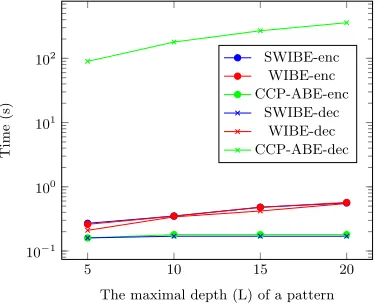
[ACP12], and CCP-ABE [ZH10]. We have implemented the algorithms based on the PBC (pairing based cryptography) librarya param and executed them on Intel Edison with a 32-bit Atom processor 500 MHz and ublinux 3.10.17.
5 10 15 20
10−1
100
101
102
The maximal depth (L) of a pattern
Time
(s)
SWIBE-enc WIBE-enc CCP-ABE-enc
SWIBE-dec WIBE-dec CCP-ABE-dec
Fig. 1: Encryption and decryption time in SWIBE, WIBE, and CCP-ABE
proposed SWIBE allows wildcards in both key and ciphertext. While WIBE performs point multiplications to convert a ciphertext to another ciphertext for a specific matching ID, SWIBE computes point additions to replace any ID by a wildcard. In CCP-ABE, each bit in an ID is regarded as an attribute where each pattern (ID) is 32 bit. Since the decryption requires pairing operations of which number is proportional to the number of attributes in CCP-ABE, the decryption is very slow. On the other hand, since point additions is negligible compared with a pairing operation, decryption time of SWIBE remains as constant. SWIBE improves decryption performance by up to 3 times and 650 times compared with WIBE and CCP-ABE.
5 10 15 20
0.2 0.4 0.6 0.8 1
The maximal depth (L) of a pattern
Time
(s)
SWIBE-enc wicked-IBE-enc
SWIBE-dec wicked-IBE-dec
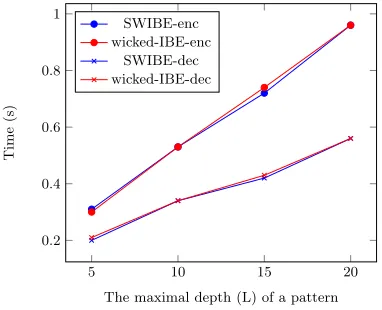
Fig. 2: Encryption and decryption time in SWIBE and wicked-IBE
Figure 2 compares encryption and decryption performance between SWIBE and wicked-IBE. In this case, a private key may include wildcards but no wild-card is allowed in a ciphertext in wicked-IBE. Since a point multiplication is required to decrypt a ciphertext in both SWIBE and wicked-IBE, both schemes show similar encryption and decryption performance even though SWIBE allows wildcards in a ciphertext which is prohibited in wicked-IBE.
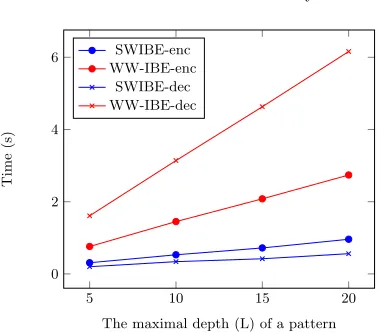
Figure 3 compares encryption and decryption performance between SWIBE and WW-IBE. Both SWIBE and WW-IBE allow wildcards in a key and a cipher-text. While a point multiplication is required to decrypt a ciphertext in SWIBE, 2L number of pairing operations are required in WW-IBE. SWIBE improves decryption performance by 10 times compared with WW-IBE.