R E S E A R C H
Open Access
Selection of optimal transmit power in
multi-hop underlay cognitive full-duplex relay
networks
Poornima S.
*and Babu A. V.
Abstract
This paper investigates optimization of underlay multi-hop cognitive full-duplex relay (CogFDR) networks in independent non-identically distributed Rayleigh fading channels. First of all, analytical expressions for the outage probability experienced in the secondary network is formulated, taking into account (i) residual self-interference (RSI) arising due to full-duplex operation, (ii) inter-relay interference (IRI) arising due to frequency re-use, and (iii)
interference generated by the primary transmitter on the secondary network. Optimal power allocation (OPA) that either minimizes the end-to-end outage probability or maximizes the end-to-end instantaneous rate is investigated with constraints on total available power in the secondary network and tolerable interference power at the primary receiver. The OPA vector for the outage minimization problem is obtained by solving an equivalent geometric programming problem (GPP) and that for the rate maximization problem is obtained by applying the rate balancing criterion for each hop. Extensive performance evaluations conducted with the help of Monte Carlo simulations show that transmit power optimization can improve the end-to-end rate and outage probability performance of multi-hop CogFDR network in comparison to equal power allocation on average (EPA).
Keywords: Full-duplex, Multi-hop, Cognitive, Underlay, Power allocation, Geometric programming
1 Introduction
Cognitive radio (CR) networks improve the spectrum utilization efficiency by allowing secondary (unlicensed) users to make use of the primary (licensed) user spec-trum without degrading the communication performance of the primary network [1,2]. In general, a CR network can operate either in the overlay or in the underlay mode. In the former, the secondary users are allowed to access the spectrum occupied by the primary if the primary user is inactive. In the underlay mode, the secondary users can coexist with the primary user by sharing its frequency band, provided the interference caused by the secondary node transmissions on the primary network, lies within a predefined threshold value. However, this leads to serious constraints on maximum transmit power that the sec-ondary nodes can choose for their operation. To improve the coverage and capacity performance of the secondary
*Correspondence:[email protected]
Department of Electronics & Communication Engineering, National Institute of Technology Calicut, Calicut, India
network, relay nodes can be deployed to assist the sec-ondary transmitter (ST) in relaying information to the secondary receiver (SR). Such networks that combine the features of cooperative relaying and cognitive radio are known as cognitive relay networks (CRNs) [3].
In CRNs, the relay nodes can operate either in half-duplex (HD) or in full-half-duplex (FD) mode. In half-half-duplex relaying (HDR), two orthogonal time or frequency chan-nels are allotted for the relay transmission and reception. Whereas, full-duplex relaying (FDR) allows concurrent reception and retransmission using the same frequency band. Even though FDR leads to two-fold improvement in spectral efficiency, it causes self-interference (SI) because of the coupling between the relay node’s transmitter and receiver circuits [4]. Recently several proposals for cancel-lation of SI have appeared in the literature [5,6]. However, even with advanced SI cancellation methods, a level of residual self-interference (RSI) remains that significantly deteriorates the performance of FD systems [7–9]. In a FD-based CRN, the relay nodes in the secondary net-work operate in the FD mode [10]. The CRN based on FD
would differ in performance in comparison to that of con-ventional HD network, due to the presence of RSI. This paper considers a cognitive FD relay (CogFDR) network in underlay mode, with a multi-hop secondary network, i.e., the secondary network comprises of a secondary trans-mitter (ST), a secondary receiver (SR), and N FD relay nodes connecting ST and SR. In underlay CRNs, even though the secondary users are allowed to coexist by shar-ing the spectrum allotted to the primary, they need to choose the transmission powers such that the interference induced at the primary receiver (PR) does not go beyond the maximum tolerable limit. This significantly affects the outage and rate performance of the secondary user in the CogFDR network. Further, the performance is affected by the amount of RSI as well, which is related to the transmis-sion power of the relay nodes and the power gain of the corresponding channel. The major objective of this paper is to develop a model for finding the secondary users’ outage probability in a multi-hop CogFDR system and to investigate transmit power optimization for improving the secondary users’ rate and outage probability performance.
1.1 Related work
Extensive research has been reported in the literature on the performance evaluation and optimization of CRNs operating in half-duplex mode (i.e., CogHDR networks), e.g., [11–15]. The authors in [11] have considered relay selection for the secondary network in underlay CogHDR with secondary nodes selecting fixed transmit powers for their operation. The outage probability of an under-lay decode-and-forward (DF) CogHDR network has been analyzed in [12], while one-dimensional relay location optimization problem has been addressed in [13]. Opti-mal relay placement in the secondary network of a CogHDR network has been addressed in [14] assum-ing Nakagami-m fadassum-ing channels, while the work in [15] has considered transmit power optimization to maximize the achievable ergodic capacity of CogHDR network. In addition to these, many authors have attempted to ana-lyze and improve the performance of wireless networks, see, e.g., [16–19] and references therein. Resource allo-cation is very crucial in wireless systems. The authors in [16] have considered joint optimization of computa-tion and communicacomputa-tion power in multi-user massive MIMO system, which improves the energy efficiency. In [17], the authors have studied the performance of a cooperative multi-relay system where the relays harvest energy from RF signals of the source. The authors in [18] have analyzed the performance of a dual-hop FD system with multiple relays, which provide spectral effi-ciency and diversity gains respectively. In [19], the authors have proposed a virtual FD relaying scheme for a coop-erative multi-path relay channel (MPRC) with multiple half-duplex relays.
Recently, the performance analysis and optimization of dual-hop CogFDR network has been carried out exten-sively by many researchers [20–29]. In [20], the authors have presented an analytical model to evaluate the out-age probability of secondary user in dual-hop CogFDR network by considering a joint decoding scheme at the SR in which the signals arriving at the SR from ST and the relay are utilized together for the decoding purpose. Two-way FD relay spectrum sharing protocol for a dual-hop CogFDR network has been proposed in [21], and the outage probability of the network has been evaluated under the proposed protocol. The outage performance of both primary and secondary users in a CogFDR net-work has been analyzed in [22]. Optimal power allocation algorithms for amplify-and-forward (AF)-based CogFDR network has been analyzed in [23] assuming Rayleigh fad-ing. Two relay selection schemes, i.e., partial relay selec-tion and optimal relay selecselec-tion, have been proposed in [24], and the outage performance of CogFDR network has been carried out assuming the availability of multi-ple relay nodes. Joint power control and relay selection algorithms that maximize the transmission rate of the sec-ondary network has been addressed in [25] for a dual-hop CogFDR framework. In [26], the authors have investi-gated transmit power optimization problem in the context of dual-hop CogFDR network. In [27], the authors have proposed an analytical model for evaluating the outage probability of a dual-hop CogFDR network by consider-ing various locations for the relay node, while neglectconsider-ing the impact of direct transmission link from ST to SR. In [28], the authors have derived a closed form expression for the outage probability of an OFDM-based CRN with relay selection considering a dual-hop secondary network. In [29], authors have considered optimal power allocation for maximizing the transmission rate in AF-based dual-hop CogFDR network.
all the above mentioned papers [30–35] consider the relay nodes to use HDR while the focus of the current work is on multi-hop CogFDR networks. Even though FDR has been employed in the secondary network of CRNs [20–29], majority of them consider dual-hop secondary network for their analysis of outage and other perfor-mance metrics. Finding the transmit power allocation that optimizes the performance of secondary network in multi-hop CogFDR network remains as an open problem.
1.2 Major objectives and contributions
In this paper, we focus on the outage probability and instantaneous transmission rate analysis of a multi-hop CogFDR/HDR network. We develop an analytical model for finding the outage probability of the secondary user considering the effects of both RSI and inter-relay interfer-ence (IRI), i.e., interferinterfer-ence caused by simultaneous trans-missions from neighboring nodes that operate in the same frequency band. The interference generated by the pri-mary transmitter on the secondary network is also taken into account for the analysis. We then investigate opti-mal power allocation for the secondary nodes that either minimizes the end-to-end outage probability or maxi-mizes the instantaneous rate subject to two constraints: (i) constraint imposed on the secondary node’s transmit power by the tolerable interference power threshold at PR and (ii) constraint on total transmit power available in the secondary network. We make an extensive study on the end-to-end rate and outage performance of the CogFDR network under optimal power allocation (OPA). For comparison, we report the results for CogHDR net-work as well. Numerical and simulation results establish
that OPA can lead to significant improvement in end-to-end rate and outage probability performance of the sec-ondary network in CogFDR system. The analytical results are validated by simulation results.
Remainder of the paper is arranged as follows. Section2 describes the methods used in this work. Section3gives a detailed description of the system model for the under-lay CogFDR network. In Section4, the derivation of the outage probabilities are given. Section 5 describes the transmit power optimization by ignoring the effect of PT, while Section6considers the impact of PT for OPA determination. The simulation and analytical results are discussed in Section7. Finally, the paper is concluded in Section8.
2 Methods
In this paper, we consider a multi-hop underlay cogni-tive relay network withN DF relays placed between the secondary transmitter and receiver. The outage probabil-ity of the secondary network is derived considering the effect of RSI, IRI, and interference from the primary net-work. The outage probability minimization problem is formulated as a geometric programming problem. The transmit power allocation which maximizes end-to-end rate is determined by equating the rates over each hop. Monte Carlo simulations are done to validate the analyti-cal results.
3 System model
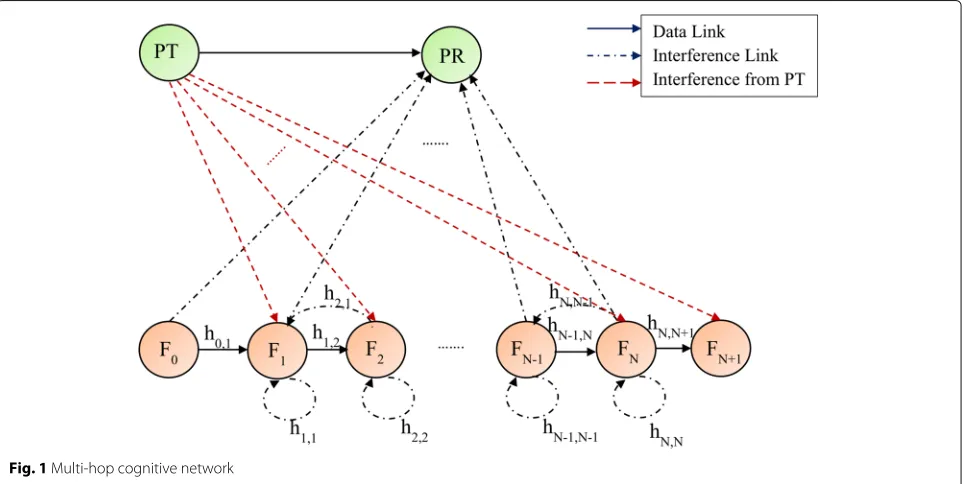
The multi-hop CogFDR network that operates in the underlay mode is shown in Fig.1. Here, the secondary net-work consists of a secondary transmitter (F0), secondary
receiver (FN+1), andN FD relay nodes (F1,. . .,FN) that
use DF relaying strategy. The primary network consists of a primary transmitter (PT) and a primary receiver (PR). Since the relay nodes in the secondary network operates in FD mode, they suffer from RSI. To further improve the spectral efficiency, multi-hop relay networks employs frequency re-use in which adjacent nodes operate in the same frequency band. Due to simultaneous transmis-sion and reception at the relay nodes, all the receiving nodes in the network suffer from inter-relay interference (IRI) as well. Let uj andvj denote the signals
transmit-ted and received by the relay node Fj respectively. Now, vj is composed of the desired signal fromFj−1; the RSI factor atFj; and the IRI components arising due to
simul-taneous transmissions from the remaining relay nodes
Fi,i = 0, 1, ...N,∀i = j−1,j. The path loss exponent is
assumed to be relatively higher for the links in the net-work. The path loss exponent can be very large in certain scenarios such as obstructed in-building environment. Since the signal is attenuated significantly as the path loss exponent becomes larger, we assume that the IRI at the relay nodeFjconsists of interference from one hop
neigh-bor alone (i.e., from relay node Fj+1 alone), i.e., the IRI components arriving at the relayFjfrom all the other links
are assumed to be negligible as shown in Fig.1. Further, we assume thatFj does not employ any diversity technique;
thus, the signal that arrives at FjfromFj+1is treated as interference All the links in the network undergo indepen-dent non-iindepen-dentically distributed frequency flat Rayleigh fading.
A block fading model has been assumed where fading is assumed to be constant over one block but changes independently from one block to another [36]. Further-more, we assume that all the FD relays employ two direc-tional antennas, solely for transmission and reception, respectively. Directional antennas isolate the transmit-ter and receiver circuits of each FDR node, so that the effect of loop interference can be reduced. Further, direc-tional antennas can reduce the line-of-sight (LOS) com-ponents of SI as well [7]. As reported in many papers, e.g., [4–10,20–27], we model the RSI channel of every relay node as a Rayleigh fading channel. Let the channel gain between relay nodesFiandFjbehi,j,i,j{0, 1, ....N+1},
and lethj,j be the channel coefficient of the RSI channel
at the relay node Fj,j = {1, 2, ....N}. With Rayleigh
fad-ing assumption,|hi,j|2are exponential, having mean values λi,j. Furthermore, we consider hi,PR and hPT,j to
repre-sent the channel coefficient corresponding to the links connecting secondary nodesFi,i = {0, 1, ...N}to PR and
PT to Fj,j = {1, ...N + 1}, respectively. With Rayleigh
fading assumption, the power gains |hPT,j|2 and |hi,PR|2
are exponential with mean valuesλPT,jandλi,PR,
respec-tively. The average channel power gainsλi,j,i,j{0, 1, ....N}
are related to the length of the corresponding links as
λi,j = GD−ni,j where n is the path loss exponent;Di,j is
the distance betweenFiandFj, andGis the propagation
constant [36]. The mean channel gains for the link con-necting PT to a node in the secondary network is given byλPT,j =GD−nPT,j,j= {1, 2, ...N+1}and that for the link
from secondary nodes to PR is given byλi,PR=GD−ni,PR,i=
{0, 1, ...N}, where DPT,j andDi,PR denotes the respective
distances from PT toFjand fromFi to PR, respectively.
The mean RSI, denoted byλj,j,j = {1, 2, ...N}, is assumed
as equal for all the FD relays. Some reduction in IRI is also attained by the usage of antennas that are directional in nature, at the FDR nodes. Hence, the amount of IRI atFj
from its successor nodeFj+1can be assumed to be com-paratively less. Accordingly, the mean IRI atFjis modeled
asλj+1,j=δGD−nj+1,j, where 0< δ <1 denotes the fraction of IRI reduction due to the use of directional antennas. Apart from this, we model the noise as white Gaussian noise with zero mean and varianceN0. The received signal
at relay nodeFjduring a given time instance is given by
vj=hj−1,juj−1+hjjuj+hj+1,juj+1+nj (1)
where nj denotes the additive white Gaussian noise at Fj. In addition to this,uj−1, uj, and uj+1 are the signals
transmitted byFj−1,Fj, andFj+1, respectively, during the
specified time instance.
4 Derivation of outage probability of the secondary user
In this section, we derive analytical expressions for the secondary user’s outage probability for the following cases: (i) by ignoring interference from PT and (ii) by con-sidering the effect of interference from PT. We derive the outage probability expression for the CogHDR network as well.
4.1 Outage probability derivation ignoring interference
from primary transmitter
In this section, we assume the PT to be located far away from the secondary network so that primary transmission does not cause any interference to the secondary network. Here, we derive the outage probability expressions for the multi-hop CogFDR and CogHDR networks.
4.1.1 Multi-hop CogFDR network
DefinePi,i= {0, 1, ...N}as the transmission power vector
for the secondary nodes of the CogFDR network in Fig.1. Further, letj,FDR(0) be the signal-to-interference plus noise ratio (SINR) at the relay nodeFj,j= {1, 2, ...N−1}, which
is computed as follows:
(0) j,FDR=
Pj−1hj−1,j2
N0+Pjhj,j2+Pj+1hj+1,j2
Furthermore, the SINR at the relay nodes FN andFN+1
The outage probability of a multi-hop CogFDR network with DF relaying is the probability for at least one of the links along the multi-hop path to experience outage. Assuming the fading over the links to be independent, the probability of outage is computed by,
P(out,FDR0) =1−
where T is the threshold SINR required for
accept-able performance over link j,j = 1, 2, ...N+1. Letr(bits/sec/Hz) be the target data rate for communi-cation over linkjconnecting nodesFj−1 andFj. Now,r
andT are related as follows:T = 2r−1 [7]. Now, for
value λi,j, Xi,j is also exponential with the mean value βi,j = λNi,jP0i. The probability density function (PDF) ofXi,j
Since hi,j’s are assumed to be independent random
variables, the PDF ofZjcan be determined as the
convo-lution of the PDFs ofXj,jandXj+1,jand is given by, can be determined as follows (details given in AppendixA):
threshold at PR. Now,Pj,j= {0, 1, ...N}have to be chosen
such that the following conditions are satisfied:
N
To satisfy the above constraints, the transmit powers for the secondary nodes are chosen as:
Pj=min
Selection of Pj according to (13) is known as equal
power allocation on average (EPA) [26]. Notice that EPA does not optimize the system performance. In Section5, we consider OPA for minimizing the outage probability.
4.1.2 Multi-hop CogHDR network
We consider a CogHDR network with multi-hop sec-ondary system consisting of N relay nodes Fi, i =
1, 2, ...N, a source node F0 and a destination node FN+1 as in the CogFDR case. However, we consider a multi-phase relaying system where N + 1 non over-lapping time slots are allocated for transmission within the secondary network. As a result, the spectral effi-ciency is degraded significantly; however, the IRI is zero. Further, HDR networks do not suffer from RSI [7]. Accordingly, the received SNR at the relay node Fj is
given by,
As in the CogFDR case outlined earlier, the outage prob-ability experienced by a secondary user is represented as follows:
whereγT is the SINR threshold for the CogHDR system.
For a fair comparison, we setγT = 2r(N+1)−1
assum-ing that each node in the secondary network of CogHDR system consumes
1 N+1
th fraction of the total resources
available [7]. Since j,HDR(0) = Xj−1,j which is
exponen-tial with the mean value βj−1,j = λj−1,jPj−1 N0 , P
(0) out,HDR is
represented by the following equation
P(out,HDR0) =1−
N+1 j=1
exp−γT/βj−1,j (16) Since the relay nodes operate in HD mode, Pj,j =
{0, 1, ...N}have to satisfy the following constraints:
Pjλj,PR≤Iavg,j= {0, 1, ...N} (17a)
network is given by,
Pj=min
4.2 Outage probability of secondary user under the effect
of interference from the primary transmitter
In this section, we find the outage probability of the secondary network for CogFDR and CogHDR scenarios by taking into account the effect of interference from PT on the secondary network performance. Assume that PT transmits a signalxpto PR with fixed powerPPT and data
rateRp. The secondary nodes re-use this time resource to
transmit their signals.
4.2.1 Multi-hop CogFDR network
With the primary interference induced on the secondary network, the instantaneous SINR at the node Fj,j =
{1, 2, ...N−1}can be written as follows:
Similar to Section4.1.1, we can rewrite (19) as follows:
(1)
the secondary network for this scenario is defined as,
P(out,FDR1) =1−
Assuming independent, non-identically distributed Rayleigh fading links, (22) can be evaluated as follows (details given in AppendixB):
wheremandβare defined as:
4.2.2 Multi-hop CogHDR network
Considering the effect of interference from PT, the SINR at the relay nodeFj,j,HDR(1) is given by,
The outage probability P(out,HDR1) is then computed as follows (details given in AppendixC):
P(out,HDR1) =1−
5 Optimal power allocation (OPA) for the secondary nodes in CogFDR network ignoring primary interference
In this section, we consider optimizing the performance of CogFDR secondary network ignoring the influence of the interference from the primary network. We consider two optimization problems for the secondary network: (i) determine the OPA to minimize the end-to-end outage probability and (ii) determine the OPA to maximize the end-to-end instantaneous rate.
5.1 Outage probability minimization in multi-hop
CogFDR network
Here, we determine the OPA for the secondary network which minimizes the outage probability of a CogFDR system with average interference constraint at PR. The optimization problem is formulated as follows:
Min resents the average interference constraint at PR, which limits the average interference caused by the nodes in the secondary network at PR. Let us defineP =[Pj] ,j = reformulate the optimization problem in (28) as follows:
Min
F(P)= −ln
we assume that directional antennas are used by the FD relays to reduce the loop interference and other degrad-ing effects, we consider thatλj+1,j< λj−1,j(i.e., we assume that mean power gain of the IRI link atFj(λj+1,j) is less
than the mean power gain of the desired link atFj(λj−1,j)). Similarly, the mean power gain of the RSI link is assumed to be less than the mean channel gain of the desired link atFj, i.e.,λj,j < λj−1,j. The objective function can there-fore be simplified using the approximation,ln(1+x) ≈ x,x<<1, and the optimization problem can be re-casted as follows:
Now, (31) is in the standard form of a geometric program-ming problem (GPP) [38]; a GPP in the standard form is represented as follows:
Min f0(x) (32a)
s.t. fi(x)≤1,i=1, 2...m (32b) hi(x)=1,i=1, 2...p (32c)
wheref0,f1, ...fmare posynomials andh1,h2...hpare
mono-mials. From (31), notice that the objective function is in posynomial form. The inequality constraints also have a posynomial form in the left hand side and a monomial form on the right hand side. Hence, (31) is a standard GPP which can be solved using standard convex optimiza-tion software tools [39]. Notice that average channel gains (i.e., statistical channel state information-SCSI) alone is needed for finding the OPA for problem (31). The numer-ical and simulation results for the outage probability are presented in Section7.
5.2 Instantaneous rate maximization in multi-hop
CogFDR network
Here, we investigate OPA to maximize the end-to-end instantaneous rate under a sum power constraint. Under the assumption that the inputs are complex Gaussian of unit bandwidth, with the secondary nodes employing a continuous rate scheme, we express the instantaneous transmission rate of the link betweenFj−1andFjas [40], withPN+1=PN+2= 0. The end-to-end instantaneous rate
of the DF-based secondary network is expressed by the minimum of instantaneous rates of theN+1 links as [40],
R(P)=Min
j Rj(P), j=1, 2, ...N+1 (34)
Since the instantaneous rate is a function of instantaneous channel gains, the knowledge of instantaneous channel state information (ICSI) is required for solving the rate maximization problem. Along with this, we consider a peak interference constraint for the PR. Accordingly, the rate maximization problem is defined as follows:
Max
Here, (35c) represents the peak interference power thresh-old for PR.
Lemma 1 In DF relaying under a total power constraint, maximizing the minimum of rates corresponding to the N+1links in the system is equivalent to a condition where the instantaneous received SINRs over all the links become equal, i.e.,j,FDR(0) (P)=,∀j=1, 2, ...N+1.
Proof The maximum achievable rateRmax(P)in a multi-hop relay network strictly increases with increase in total transmission powerPof the network. Let us assume that
P∗j,j = {0, 1, 2, ..N} is the optimal power allocation for achieving a maximum rate of Rmax(P). In contradiction to this statement, consider an arbitrary hop k connect-ing nodesFk−1andFk having an instantaneous rate over
this link, i.e., Rk satisfying Rk > Rmax(P). Since Rk is
an increasing function of Pk−1; let us slightly decrease
Pk−1such thatRk ≥ Rmax(P)is still unaffected. AsP k−1
which improves the received SINR atFk−2, which in turn increases the rateRk−2. To compensate for the increase in
Rk−2, we can slightly reducePk−3, which in turn increases
Rk−4 and so on. Therefore, with this new power alloca-tion (i.e., with total power less than P), Rk ≥ Rmax(P)
still holds. This contradicts the original property that
Rmax(P)is a strictly increasing function ofP. This proves that the optimal rate over any given hop Fj cannot be
greater thanRmax, so the optimum power allocation cor-responds to the condition for which the hop rates are equal, i.e.,Rk =Rmax(P). Since rate is given by the
expres-sion,Rj(P) = log2(1+ j,FDR(0) (P)), where log2(x) is a
monotonically increasing function of x, we can say that optimal power allocation which maximizes the minimum of rates is achieved by equating the rates, or equivalently, by equating the SINRs of all the links in the network.
To solve (35), we adopt the approach used in [40–42]. Therefore, the criteria for finding OPA which maximizes the end-to-end instantaneous rate of the sec-ondary network, is given by,
(0)
j,FDR= ∀j=1, 2, ...N+1 (36)
Recall that the SINR atFN+1is given by (3b). Notice that
FN+1does not suffer from RSI and IRI as is evident from (3b). The relay node FN does not suffer from IRI since
its successor nodeFN+1 being the destination does not transmit. However, FN suffers from RSI and hence the
SINR at FN is given by (3a). The SINR at the
remain-ing relay nodesFj, j = 0, 1, ...N−1 are given by (2) in
Section3of this paper. Combining (2) and (3) with (36), we get the following set of equations for the optimal trans-mit power Pj,FDR∗ in terms of (i.e., the SINR per hop value of the transmission power atFj,Pj,FDR∗ can be
recur-sively expressed as a function of, i.e., P∗j,FDR = gj().
Since the objective function given by (35a) is maximized when the constraints hold with equality [40], we can write the following equations for the constraints:
N
Notice that (38a) and (38b) are polynomial equations of order N +1, which needs to be solved to get . Even though it is tough to determine the closed form solu-tions forfrom the above equations, we can use efficient numerical algorithms to find the solution [43]. Let1and 2respectively be the solution forobtained from (38a)
and (38b). Now, (i.e., SINR corresponding to the opti-mal powers) is chosen as = min(1,2). Once is
known, the optimal power valuesPj,FDR∗ ,j= 0, 1, ...Ncan be determined as follows: First of all, we findPN,FDR∗ using (37a). After that, we findP∗j,FDR,j=0, 1, ...N−1 using the recursive relations given by (37c). Further, notice that the complexity involved in the calculation of optimal trans-mit power is equivalent to that of finding the real roots of two polynomial equations of orderN+1. Algorithm 1 illustrates the steps involved in determining the optimal transmit powers.
5.2.1 Three-hop CogFDR network : a case study
The end-to-end rate optimization problem for the three-hop CogFDR network is expressed as follows:
Algorithm 1Procedure for power allocation : Multi-hop CogFDR system
4: Finding optimal powers:
6: Substitute P∗j,FDR = gj() values obtained from
Steps2-5in the constraints (38a) and (38b)
7: Solve (38a) and (38b) independently to get1and2 8: Set=min(1,2)
9: SubstituteinSteps2-5to obtain the optimal powers
Max
to-end rate is maximized when the hop SINRs are equal (under total power constraint), we have,
(0)
From (41), we get the optimal power values as:
P2,FDR∗ =N0 following pair of cubic equations are obtained:
3N
Substituting in (42a)–(42c), we can find the optimal powersP∗i,FDR,{i=0, 1, 2}.
6 Optimal power allocation (OPA) for the secondary network with primary interference In this section, we determine the OPA that either mini-mizes the end-to-end outage probability or maximini-mizes the end-to-end instantaneous rate of the secondary network under the influence of interference from PT.
6.1 Outage probability minimization in multi-hop
CogFDR network with primary interference
Here, we follow the approach adopted in Section5.1. To minimize P(out,FDR1) derived in Section4.1.2, we consider
the function F1(P) = −ln tively. The objective functionF1(P)is not in the standard
posynomial form of a GPP. We can convert the function in (45) in the standard form by using the approximation
λPT,j. Intuitively,βj−1,j > β, and thus, we can
approxi-mateln1+Tβ/βj−1,j
≈Tβ/βj−1,j. Therefore, we can
further simplifyF1(P)as follows:
F1(P)=
Now, the objective function F1(P) is in the standard
posynomial form. The optimization problem under the influence of interference from PT is given by,
Min
Now, (47) is a standard GPP, which can be solved using Convex optimization software tools [39].
6.2 Rate maximization in multi-hop CogFDR network
with primary interference
By following the approach detailed in Section5.2, the OPA problem for instantaneous rate maximization is formu-lated as follows:
As detailed in Section5.2, for solving (48), we adopt the approach in [40–42], where the criterion for instanta-neous rate maximization is that the instantainstanta-neous SINRs over each hop must be made equal.
(1)
The knowledge of0and ICSI will enable us to findPj,FDR∗
using (50).
7 Results and discussion
Here, we present the theoretical and simulation results for the outage and rate performance of multi-hop CogFDR/HDR networks considering the proposed OPA and the conventional EPA strategies. We consider a three-hop secondary network where the secondary nodes Fj, j = 0, 1, 2, 3 are assumed to be located on a straight line at (−1.5,0), (−0.5,0), (0.5,0), and (1.5,0), respectively. The positions of PT and PR are assumed to be at (−1.5,1) and (−0.5,1), respectively. The RSI at the secondary relays are assumed as equal to−40 dB (unless otherwise specified). We select the path loss exponent(n)to be equal to four for all the links in the network. The channel gains are defined asλi,j = GD−ni,j ; here,G = 1 and the distancesDi,j are
analytical plots are identified by lines and simulation plots by markers. We consider the EPA scheme as well, for which the transmit powers Pj,j = 1, 2, ...N
correspond-ing to the secondary nodes in CogFDR network are set as given by (13).
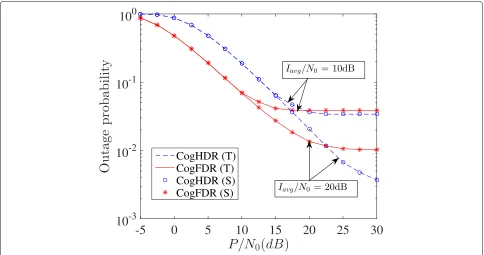
Figure2 depicts the outage probability comparison of a three-hop CogFDR and CogHDR network under EPA againstP/N0which is the ratio of total transmit
power-to-noise power. Here, we consider distinct values forIavg/N0,
the ratio of tolerable average interference-to-noise power ratio. In the low transmit power region, CogFDR performs better than CogHDR networks because the target data rate requirement for CogHDR is higher than that of CogFDR. However, asP/N0increases, CogHDR networks
show improved performance as compared to CogFDR networks due to the fact that higher transmit power increases the RSI and IRI in the case of FDR networks. Both CogHDR and CogFDR networks suffer from an out-age floor behavior at high transmit powers, as seen in Fig.2. In the case of CogHDR and CogFDR networks, the outage floor occurs owing to the fact that the transmit power depends on the tolerable interference threshold at the PR and the total transmit power according to (13). As a result, for a given Iavg, if we continue to increase the
transmit power, proportional change in outage will not be observed. Apart from this, CogFDR networks suffer from degradation in outage performance at higher transmit powers due to the presence of RSI and IRI. Due to this, the outage floor in CogFDR networks occur for comparatively
lower values ofP/N0as can be seen in Fig.2. When the
tolerable interference power (Iavg) at the PR increases, it is
observed that the outage decreases because the nodes can transmit at higher power; however, the rate of decrease is very small due to the proportional increase in RSI and IRI.
Figure3presents the impact of RSI on outage probabil-ity of CogFDR network under EPA. Here, we assume the mean RSI power at the secondary nodesF0,F1, andF2to
be equal and denote it as λrr. When RSI decreases, the
outage probability of CogFDR network decreases. With
P/N0 = 20 dB, the outage probability reduces by almost
74% when the RSI decreases from −5 dB to −35 dB. In other words, the range of transmit power values over which the outage probability of CogFDR network is lower than that of CogHDR network, decreases as RSI becomes higher.
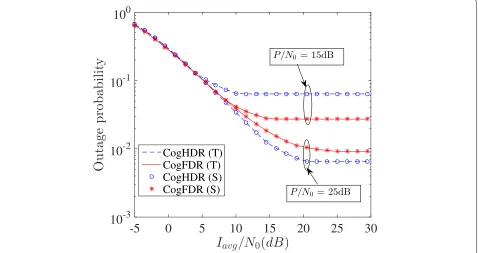
Figure 4 plots outage probability versus Iavg/N0, for
n values ofP/N0. WhenP/N0 =15 dB, CogFDR
outper-forms CogHDR for all values ofIavg/N0considered. How
ever, whenP/N0is increased to 25 dB, CogFDR outage
probability is higher than that of CogHDR network due to the severe effects of RSI and IRI in the high transmit power region.
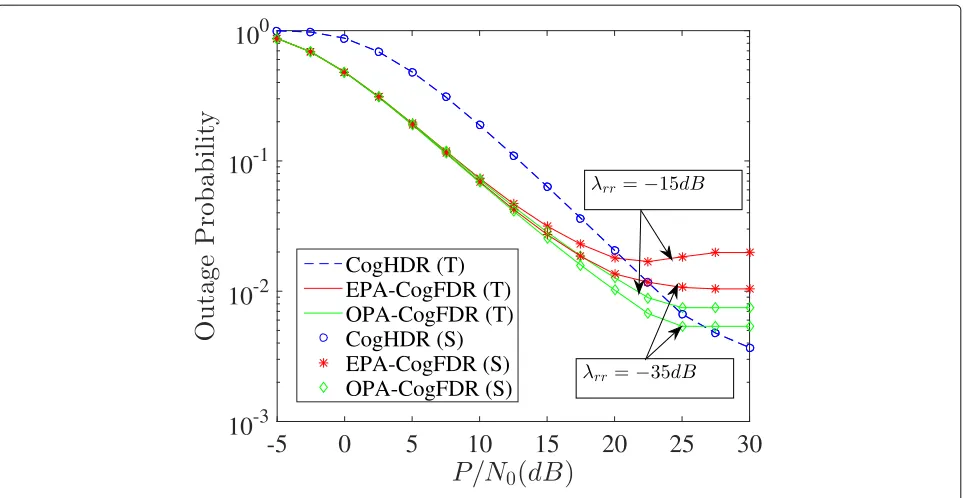
Figures 5,6, 7, and8show the outage probability per-formance of CogFDR networks under OPA and EPA. In Fig. 5, the outage probability is drawn against P/N0.
From the graph, it is clear that OPA leads to improve-ment in the outage performance of CogFDR networks in
Fig. 3Outage probability vs.P/N0;Iavg/N0=20 dB (λrr= −40 dB)
comparison to that of EPA. In the high transmit power region, CogHDR network continues to show better per-formance than CogFDR-OPA. In Fig.5, we can observe that the range over which CogFDR-OPA performs bet-ter than CogHDR-EPA is increased by 5 dB, in the high
transmit power region, as compared to CogFDR-EPA. WithP/N0 =25 dB, OPA reduces the outage probability
of CogFDR system by almost 50% as compared to EPA. For CogFDR, the OPA distributes the available trans-mit power among the secondary nodes of the CogFDR
Fig. 5Outage probability comparison with varying interference threshold power;P/N0=20 dB (λrr=−40 dB)
network such that the effects of RSI and IRI are reduced. Even though the outage floor still exists in the high trans-mit power region, the benefit of OPA is that the value of
P/N0at which the floor occurs is extended, as can be seen
in Fig.5. The results in Fig.6show that the range ofP/N0
values over which CogFDR performs better than CogHDR improves when the mean RSI power is reduced.
Figure7depicts the outage probability comparison plots with respect to target rate variations. With increasing target rate, the outage performance is badly affected,
Fig. 7Outage probability vs.R;P/N0= 20 dB;Iavg/N0= 20 dB
since the SINR threshold is also increased. However, OPA leads to performance improvement in outage. At
P/N0 = 20 dB, the performance improvement in outage
of CogFDR system is 21.6% as compared to the equivalent EPA case.
Table1shows the OPA vector, i.e.,P∗j,FDR/N0,j=0, 1, 2,
the normalized transmit powers, for two distinct values of
P/N0underδ =−3 dB,−5 dB, and−7 dB, respectively.
Here,δ represents the level of isolation provided by the directional antennas, for reducing the effect of IRI. Notice
Table 1Comparison of power allocation schemes for various levels of IRIδand total transmit powerP/N0 δ P∗j,FDR/N0,j= {0, 1, 2}
P/N0=10 dB P/N0=20 dB
CogFDR-EPA CogFDR-OPA CogFDR-EPA CogFDR-OPA
−3 dB 3.33, 3.33, 3.33 4.62, 3.18, 2.19 33.33, 33.33, 33.33 64.06, 25.66, 10.27
−5 dB 3.33, 3.33, 3.33 4.32, 3.24, 2.43 33.33, 33.33, 33.33 60.56, 27.21, 12.22
−7dB 3.33, 3.33, 3.33 4.07, 3.28, 2.64 33.33, 33.33, 33.33 56.98, 28.63, 14.38
that for EPA scheme, the total available transmit power is divided equally among the nodes. The OPA for the CogFDR network is such that the power is allocated in the descending order for nodesF0,F1, andF2. SinceF3is the
destination node, it does not transmit and does not have RSI either. So the transmit power forF2is comparatively
lower. However,F2suffers from RSI and contributes to IRI
forF1, which is taken care by allocating more power toF1.
Due to this, the RSI atF1 increases, the effect of which
is compensated by allocating higher power toF0. This is
clearly depicted in Table 1. As the IRI channel gain is reduced byδ=−7 dB, the interference caused byR2onR1
is reduced. Hence,P∗2,FDR/N0can be increased in order to
improve the SINR ofR2−R3link causing a small
interfer-ence effect atR1. This small increase in interference atR1
is compensated by slightly increasing the powerP1,FDR∗ /N0
as well.
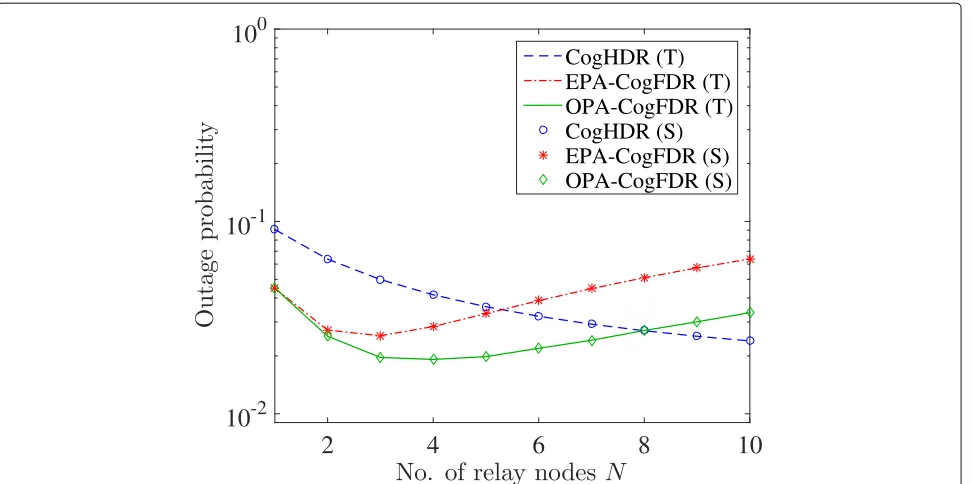
Figure 8 shows the outage probabilities of CogFDR network under EPA and OPA versus the number of relays. The RSI level at all the nodes has been assumed as equal to −40 dB. The separation between F0 and FN+1 is assumed to be constant. Accordingly, the num-ber of hops significantly affects the outage performance of the secondary network. Initially for CogFDR, whenN
increases, the outage decreases owing to the reduced link distance. However, when N becomes larger, each node introduce additional RSI and IRI into the system so that the outage performance degradation happens. Notice that with increase in number of relays, the outage probability decreases monotonically in CogHDR due to reduced path
loss between relay links. Further CogFDR-OPA outper-forms CogFDR-EPA.
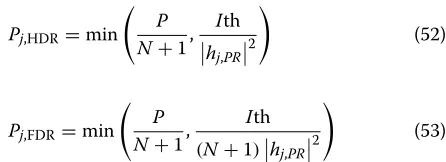
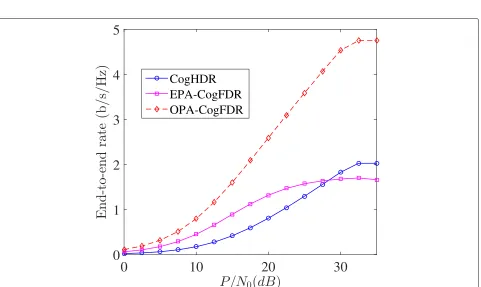
Figure9shows the maximum instantaneous end-to-end rate for the three-hop secondary network of CogFDR sys-tem under EPA/OPA schemes. Here, we choose the EPA powers for CogHDR and CogFDR as follows:
Pj,HDR=min
P N+1,
Ith
hj,PR2
(52)
Pj,FDR=min
P N+1,
Ith (N+1)hj,PR2
(53)
The results show that OPA improves the instantaneous end-to-end rate of FDR system. WhenP/N0= 30 dB, the
improvement in instantaneous rate is found to be 135% as compared to EPA. Further, it can be seen that, when
P/N0is lower, instantaneous rate increases; however, for
larger P/N0, the rate is found to be almost saturating.
For CogHDR and CogFDR-EPA, this saturation behav-ior is due to the transmit power limitation imposed by the condition given in (52) and (53) respectively. As the normalized transmit power P/N0 becomes very large,
the instantaneous transmit power becomes a function of
Ith, which is fixed as a constant. Hence, the rate is no longer a function of P, and therefore, saturation occurs. For CogFDR-EPA system, saturation happens for lower
P/N0as compared to CogHDR-EPA, due to the presence
of RSI and IRI in the FDR system. In the case of CogFDR-OPA, the optimal distribution of transmit power among the nodes leads to significant improvement in the date rate. To determine the instantaneous rate corresponding to OPA/EPA, the following channel coefficient matrix has been assumed.
H=
⎡
⎣0.3661 00.0032 1.2156 00 0.1579 0.0037 0.3567
⎤ ⎦
In this case, each elementhi,j2,i= {0, 1, 2},j= {1, 2, 3}
is obtained by generating exponential random variables of a given mean value, which depends on the distance
Di,j and path loss exponent n (assumed to be equal to
4). Further, the channel coefficients for the secondary network to PR links have been assumed as,
HPR=[0.0430 1 0.0410]
where the elements denotehj,PR2,j = {0, 1, 2}, which
are also generated from exponential random variables. The OPA vector and the corresponding instantaneous rate have been determined by following the method described in Section5.2.
Figure10presents the plot for end-to-end instantaneous rate versus Ith/N0when P/N0 = 25 dB. It can be seen
from the graph that OPA improves the instantaneous rate of CogFDR network as compared to EPA. Further, we can observe that saturation behavior happens whenIth/N0is
Fig. 11Outage probability comparison with effect of interference from PT;PPT/N0=10 dB
larger. This is because, whenIth/N0is larger, the
instanta-neous transmit power is no longer a function ofIth, rather
it depends onPas can be seen in (53). SincePis set as a constant, the rate also remains as a constant in this region. In the next set of figures, we consider the effect of primary interference on the secondary network.
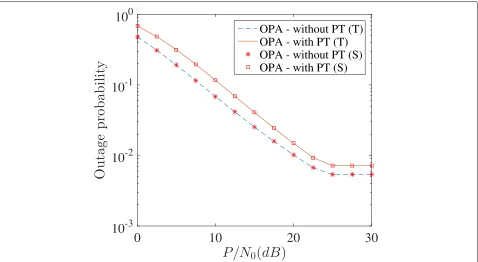
Figures11,12and13show the outage probability results under the influence of primary interference. The results establish that the outage probability increases in the pres-ence of PT. In CogFDR/HDR networks, the outage floor which is seen to occur in the high transmit power region, happens for lower values ofP/N0when the effect of PT is
Fig. 13Outage probability comparison for variousy-coordinate locations of PT-PR pair;PPT/N0=10 dB
Fig. 15End-to-end instantaneous rate comparison with and without interference from PT;PPT/N0=10 dB
considered. Further, the results show that the outage prob-ability increases by 46% forP/N0=20 dB andPPT/N0=
10 dB. Figure13shows the impact ofy-coordinate location of PT and PR on outage of secondary network. Notice that the outage probability decreases by 40% as thePT−PR
pair moves fromyPT =yPR=1 toyPT =yPR=3.
Figures 14and15show the end-to-end instantaneous rate taking the interference from PT into consideration. The instantaneous value of channel gain from PT to the secondary nodesF1,F2, andF3is given as follows:
HPT =[0.1807 0.0825 0.0195] (54)
where the elements denote|hPT,j|2,j = {1, 2, 3}, which
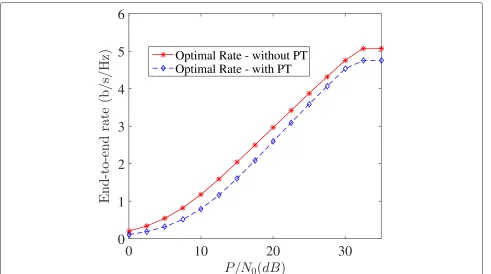
are also generated from exponential random variables. Figure 14shows the comparison of optimal end-to-end instantaneous rate of CogFDR against that of CogHDR and CogFDR-EPA. The end-to-end rate outperforms all the other cases, under OPA. Figure15shows that the end-to-end rate obtained under the effect of PT is 14% less than that obtained without PT (at P/N0 = 20 dB and PPT/N0=10 dB).
Overall, the results demonstrate that transmit power optimization can cause notable enhancement in the instantaneous rate and outage probability performance of CogFDR systems with respect to CogFDR-EPA and CogHDR systems. However, the interference from PT reduces the instantaneous rate and increases the outage
probability, and the proposed OPA scheme ensures that even under the effect of interference from PT, we obtain good outage and rate performance. The power allocation schemes can be implemented in a centralized manner. The secondary nodes must have the ICSI/SCSI of the sec-ondary transmission links, the links from PT toFjand the
links from Fj to PR. The ICSI can be obtained with the
help of ICSI feedback or pilot-aided channel estimation. Each node, after learning the channel to every other node, have to communicate the acquired information to the cen-tralized controller, which has to run the algorithm and compute the OPA vector and distribute the power values among the nodes.
8 Conclusion
would minimize the outage probability of the secondary network subject to constraints on total power available in the secondary network and also the tolerable interfer-ence power at the primary receiver. In order to maximize the end-to-end rate, a power allocation method based on SINR balancing was formulated. Monte Carlo sim-ulations were carried out to substantiate the analytical results. The transmission rate and outage probability of the multi-hop CogFDR network improved significantly when transmit power optimization was employed, in com-parison to equal power allocation method.
Appendix A: Derivation of (9):
Pr(0)
Appendix B: Derivation of (23a):
Let us define the variableWj=Xj,j+Xj+1,j+XPT,j. Using
Welch-Satterthwaite approximation [44] for the PDF of the sum of exponential random variables, we have,
fWj(w)=
Appendix C: Derivation of (27): To findPrj,HDR(1) ≥γT
, we make use of (26). Thus, we have the following equations:
Pr(j,HDR1) ≥γT
AF: Amplify-and-forward; CogFDR: Cognitive-based FDR; CogHDR: Cognitive-based HDR; CR: Cognitive radio; CRN: Cognitive relay network; DF: Decode-and-forward; EPA: Equal power allocation on average; OPA: Optimal power allocation; FD: Full-duplex; FDR: Full-duplex relaying; HD: Half-duplex; HDR: Half-duplex relaying; ICSI: Instantaneous channel state information; IRI: Inter-relay interference; PR: Primary receiver; PT: Primary transmitter; RSI: Residual self-interference; SCSI: Statistical channel state information; SR; Secondary receiver; ST: Secondary transmitter
Acknowledgements
Not applicable.
Funding
Not applicable.
Availability of data and materials
Not applicable.
Authors’ information
Not applicable.
Authors’ contributions
All authors have contributed to this research work. Both authors have read and approved the final manuscript.
Competing interests
The authors declare that they have no competing interests.
Publisher’s Note
Received: 17 August 2018 Accepted: 12 November 2018
References
1. S. Haykin, Cognitive radio: brain-empowered wireless communications. IEEE J. Sel. Areas Commun.23(2), 201–220 (2005)
2. B. Wang, K. R. Liu, Advances in cognitive radio networks: a survey. IEEE J. Sel. Top. Signal Process.5(1), 5–23 (2011)
3. K. B. Letaief, W. Zhang, Cooperative communications for cognitive radio networks. Proc. IEEE.97(5), 878–893 (2009)
4. M. Duarte, C. Dick, A. Sabharwal, Experiment-driven characterization of full-duplex wireless systems. IEEE Trans. Wirel. Commun.11(12), 4296–4307 (2012)
5. Z. Zhang, X. Chai, K. Long, A. V. Vasilakos, L. Hanzo, Full-duplex techniques for 5G networks: self-interference cancellation, protocol design, and relay selection. IEEE Commun. Mag.53(5), 128–137 (2015) 6. E. Everett, D. Dash, C. Dick, A. Sabharwal, in2011 IEEE 49th Annual Allerton
Conference on Communication, Control, and Computing. Self-interference cancellation in multi-hop full-duplex networks via structured signaling (IEEE, Allerton, 2011), pp. 1619–1626
7. T. Kwon, S. Lim, S. Choi, D. Hong, Optimal duplex mode for df relay in terms of the outage probability. IEEE Trans. Veh. Technol.59(7), 3628–3634 (2010)
8. G. Liu, F. R. Yu, H. Ji, V. C. Leung, X. Li, In-band full-duplex relaying: a survey, research issues and challenges. IEEE Commun. Surv. Tutor.17(2), 500–524 (2015)
9. T. Riihonen, S. Werner, R. Wichman, in2009 IEEE Wireless Communications and Networking Conference. Comparison of full-duplex and half-duplex modes with a fixed amplify-and-forward relay (IEEE, Budapest, 2009), pp. 1–5
10. Y. Liao, L. Song, Z. Han, Y. Li, Full-duplex cognitive radio: a new design paradigm for enhancing spectrum usage. IEEE Commun. Mag.53(5), 138–145 (2015)
11. S. I. Hussain, M. M. Abdallah, M.-S. Alouini, K. Qaraqe, M. Hasna, Relay selection in underlay cognitive networks with fixed transmission power nodes. Trans. Emerg. Telecommun. Technol.24(7-8), 734–747 (2013) 12. W. Lin, Y. Wang, F. Y. Li, in2015 IEEE 81st Vehicular Technology Conference
(VTC Spring). A multi-phase decode-and-forward transmission protocol in cognitive relay networks: outage analysis and relay power allocation (IEEE, Glasgow, 2015), pp. 1–5
13. J. Zhu, J. Huang, W. Zhang, inInternational Conference on Wireless Communications and Signal Processing (WCSP). Optimal one-dimensional relay placement in cognitive radio networks, vol. 2010 (IEEE, Suzhou, 2010), pp. 1–6
14. T.-T. Tran, V. N. Q. Bao, V. D. Thanh, T. Q. Duong, in2013 International Conference on Computing, Management and Telecommunications (ComManTel). Performance analysis and optimal relay position of cognitive spectrum-sharing dual-hop decode-and-forward networks (IEEE, Ho Chi Minh City, 2013), pp. 269–273
15. Z. Shu, W. Chen, in2010 IEEE International Conference on Wireless Communications, Networking and Information Security (WCNIS). Optimal power allocation in cognitive relay networks under different power constraints (IEEE, Beijing, 2010), pp. 647–652
16. X. Ge, Y. Sun, H. Gharavi, J. Thompson, Joint optimization of computation and communication power in multi-user massive MIMO systems. IEEE Trans. Wirel. Commun.17(6), 4051–4063 (2018) 17. Q. Li, S. Feng, A. Pandharipande, X. Ge, Q. Ni, J. Zhang, Wireless-powered
cooperative multi-relay systems with relay selection. IEEE Access.5, 19058–19071 (2017)
18. Q. Li, S. Feng, X. Ge, G. Mao, L. Hanzo, On the performance of full-duplex multi-relay channels with DF relays. IEEE Trans. Veh. Technol.66(10), 9550–9554 (2017)
19. Q. Li, M. Yu, A. Pandharipande, X. Ge, J. Zhang, J. Zhang, Performance of virtual full-duplex relaying on cooperative multi-path relay channels. IEEE Trans. Wirel. Commun.15(5), 3628–3642 (2016)
20. S. B. Mafra, H. Alves, D. B. Costa, R. D. Souza, E. M. G. Fernandez, M. Latva-aho, On the performance of cognitive full-duplex relaying under spectrum sharing constraints. EURASIP J. Wirel. Commun. Netw.2015(1), 1–13 (2015)
21. N. Li, Y. Li, T. Wang, M. Peng, W. Wang, in2015 IEEE 26th Annual International Symposium on Personal, Indoor, and Mobile Radio Communications (PIMRC). Full-duplex based spectrum sharing in cognitive two-way relay networks (IEEE, Hong Kong, 2015), pp. 997–1001
22. H. Chen, S. Tan, F. Zhao, Outage performance of relay-assisted transmissions in cognitive full-duplex relay networks. EURASIP J. Wirel. Commun. Netw.2015(1), 1–11 (2015)
23. Y. Shi, L. Zhang, Z. Chen, Y. Gong, G. Wu, in2013 IEEE Globecom Workshops (GC Wkshps). Optimal power allocation for AF full-duplex relay in cognitive radio networks (IEEE, Atlanta, 2013), pp. 322–327 24. X.-T. Doan, N.-P. Nguyen, C. Yin, D. B. Da Costa, T. Q. Duong, Cognitive
full-duplex relay networks under the peak interference power constraint of multiple primary users. EURASIP J. Wirel. Commun. Netw.2017(1), 1–10 (2017)
25. L. T. Tan, L. Ying, D. W. Bliss, in51st Annual Conference on Information Sciences and Systems (CISS). Power control and relay selection in full-duplex cognitive relay networks: coherent versus non-coherent scenarios (IEEE, Baltimore, 2017), pp. 1–6
26. H. Kim, S. Lim, H. Wang, D. Hong, Optimal power allocation and outage analysis for cognitive full-duplex relay systems. IEEE Trans. Wirel. Communun.11(10), 3754–3765 (2012)
27. C. Yin, T. X. Doan, N.-P. Nguyen, T. Mai, L. D. Nguyen, inInternational Conference on Recent Advances in Signal Processing, Telecommunications & Computing (SigTelCom). Outage probability of full-duplex cognitive relay networks with partial relay selection (IEEE, Da Nang, 2017), pp. 115–118 28. S. Rajkumar, J. S. Thiruvengadam, Outage analysis of OFDM based
cognitive radio network with full-duplex relay selection. IET Signal Proc.
10(8), 865–872 (2016)
29. Y. Shi, L. Zhang, Z. Chen, Y. Gong, G. Wu, in2013 IEEE Globecom Workshops (GC Wkshps). Optimal power allocation for AF full-duplex relay in cognitive radio networks (IEEE, Atlanta, 2013), pp. 322–327 30. M. A. Girnyk, M. Xiao, L. K. Rasmussen, in2012 Swedish Communication
Technologies Workshop (Swe-CTW). Power allocation for multi-hop decode-and-forward cognitive radio networks with line topology (IEEE, Lund, 2012), pp. 7–12
31. N. T. Van, T. T. Duy, T. Hanh, V. N. Q. Bao, in2017 International Symposium on Antennas and Propagation (ISAP). Outage analysis of
energy-harvesting based multihop cognitive relay networks with multiple primary receivers and multiple power beacons (IEEE, Phuket, 2017), pp. 1–2
32. S. Mondal, S. D. Roy, S. Kundu, Primary behaviour-based energy harvesting multihop cognitive radio network. IET Commun.11(16), 2466–2475 (2017)
33. H. K. Boddapati, S. Prakriya, M. R. Bhatnagar, in2016 IEEE 83rd Vehicular Technology Conference (VTC Spring). Outage analysis of cluster-based multi-hop cognitive radio networks (IEEE, Nanjing, 2016), pp. 1–5 34. S. Mondal, S. Dhar Roy, S. Kundu, Energy harvesting based multihop
relaying in cognitive radio network. Wirel. Pers. Commun.97(4), 6325–6342 (2017)
35. K. Ho-Van, Influence of channel information imperfection on outage probability of cooperative cognitive networks with partial relay selection. Wirel. Pers. Commun.94(4), 3285–3302 (2017)
36. A. Goldsmith,Wireless communications. (Cambridge university press, 2005) 37. M. Xia, S. Aissa, Cooperative AF relaying in spectrum-sharing systems:
performance analysis under average interference power constraints and Nakagami-m fading. IEEE Trans. Commun.60(6), 1523–1533 (2012) 38. S. P. Boyd, L. Vandenberghe,Convex optimization (pdf). (Np: Cambridge
UP, 2004)
39. M. Grant, S. Boyd, CVX: Matlab software for disciplined convex programming (web page and software) (2009). http://stanford.edu/-boyd/cvx
40. M. Sikora, J. N. Laneman, M. Haenggi, D. J. Costello, T. E. Fuja,
Bandwidth-and power-efficient routing in linear wireless networks. IEEE Trans. Inf. Theory.52(6), 2624–2633 (2006)
41. H. Jeong, J. H. Lee, inIEEE 68th Vehicular Technology Conference, 2008. VTC 2008-Fall. Adaptive relay selection for regenerative OFDMA relay networks with fairness constraints (IEEE, Calgary, 2008), pp. 1–5 42. D. Bharadia, G. Bansal, P. Kaligineedi, V. K. Bhargava, Relay and power
allocation schemes for OFDM-based cognitive radio systems. IEEE Trans. Wirel. Commun.10(9), 2812–2817 (2011)
43. R. J. Schilling, S. L. Harris,Applied numerical methods for engineers using MATLAB and C. (Brooks/cole, Pacific Grove, 2000)