ISSN 2286-4822 www.euacademic.org
Impact Factor: 3.1 (UIF) DRJI Value: 5.9 (B+)
Food Security Issues and Challenges:
A Case Study of Potohar
SAQIB SHAKEEL ABBASI NISAR KHAN MARWAT SOBIA NAHEED SAQIB SIDDIQUI Scientific Officers Social Sciences Research Institute National Agricultural Research Center Park Road, Islamabad Pakistan
Abstract:
Food security is one of the biggest challenges being currently faced by Pakistan. There is no second opinion that it is the responsibility of the state to ensure food for its citizens, however due to different reasons food for all is yet to be achieved in Pakistan. Food security issues are high in KPK and FATA, although Punjab is considered to be one of the most secure region with respect to Pakistan. However, this proposed study highlights Potohar, northern region in Punjab as one of the upcoming threats of food insecurity region.12% of Potohar districts population is food insecure, and another 38% at the border line is a threatening indicator for the country. The rate of growth has been increasing since 1951 in Potohar region as compared to the growth rate of rest of country. The study concludes that initiatives for promotion of small scale farming are mandatory for achieving the sustainable living at the study area as well as ensuring food security. In the end certain policy measures are mentioned that can be helpful in achieving food security in the similar area.
1. Introduction
The study is based on the fact that food security is the biggest challenge for our present and future generation. There was a dire need to address this issue at micro level that how different factors all together are effecting the food insecurity. The study was focused on addressing the issues of food insecurity in marginal areas of Potohar region of Punjab, Pakistan. Food security in Pakistan has been under risk during the last few years. The countries overall poor performance in the long run areas like energy and water is one of the biggest reason for it. Along with this, the weak government policies, law and order situation, natural hazards resulting into disasters are few of the many reason of food security for an agricultural state. It is no doubt responsibility of the state to ensure sufficient food to the people to meet their dietary as well as nutritious requirements. Article 38 of the Constitution of Pakistan explicitly says
The State shall: provide basic necessities of life, such as food, clothing, housing, education and medical relief, for all such citizens, irrespective of sex, caste, creed or race.
“Food security has four main components; availability,
accessibility, nutrition and stability” (FAO, 2009).
Unfortunately we are not fulfilling any single aspect as yet. Furthermore, the right to food for all is also set out in Universal Declaration of Human Rights (UDHR) and International Convent on Economics, Social and Cultural Rights (ICESCR) is the sole responsibility of state to ensure.
along with poor women within their household level. This will also include the basis access to available technologies for production, product development and distribution food items.
One of the reasons for the issue under discussion is the lack of participation of the marginal areas of the country in overall food production. The possible reason for this lack of involvement is the high input cost of agriculture produce, like seeds, fertilizers and pesticides, small farm size, changing weather patterns and rapid urbanization as discussed earlier. Along with that, rise in oil prices resulting in extra expenditure for the small farmers to cultivate, harvest and even distribute the produce. The study has highlighted some of the major factors such as trends of area and production of crops in Potohar, average rainfall trend, population and available farm size.
2. Major Reasons for Emerging Food Security Issues
Population Increase
Total population of the country is around 183 Million (GOP, 2012). The rate of population increase has noticeably been slow, from over 3% in 1980s to 2.05% in 2010. It will increase to nearly 230 million by 2020 and is very much expected to be doubled by 2050 – making Pakistan 4th most populated state of the world from its current status of 6th most populated country (GOP, 2010). On the other hand, the total cultivated area has increased only by 40% during past six decades. The current rate of urbanization is also expected to increase rapidly as there will be a 50:50 rural-urban population ratio by 2050, indicating tremendous pressure on land and a need of urgent efforts to narrow food demand-supply gaps.
Massive Urbanization
creating more problems as the local employment is almost nine at the village level. This also includes the lack of opportunities that are available to the poor sector of the economy at rural areas. Ultimately they have to shift towards the cities. This shift from rural to urban is also creating issues for feeding large sector of the population in the cities. The food supplies tended to reach the households living in the city area from the near villages which have now been replaced by the city expansion. Thus the shortage of supply is causing the food security issues to emerge as supply had to reach from the far areas now.
Lack of Innovations
The food security issues in Pakistan are directly linked with low yield per acre of land. The major reason to that is lack of innovations and technologies. Public and private sector is not taking keen interest in developing the small farmer’s abilities to produce more. Again the farm level technologies like better water management and cheap solution to grow are lacking. New innovations and technologies in agriculture can result in better performance of this sector. Waste lands can be cultivated and variety of crops can be increased.
Land issues
cost has been increasing as the land size starting to decrease. So he has no option left but to find other source of income and let go with the land.
Input Inaccessibility
Around 93% of the farmer community is relying on 60% of the land while rest belongs to the 7% land lords. The small farmers needs water, seed, fertilizer, machinery, market structures and other inputs that will incourage them to do farming. Unfortunately lack of basic infrastructure for the availability of good quality and efficient inputs is lacking.
3. Rationale of the Study
Food security in Pakistan has been under risk during the last few years. The countries overall poor performance in the long run areas like energy and water is one of the biggest reason for it. Along with this, the weak government policies, law and order situation, natural hazards resulting into disasters are few of the many reason of food security for an agricultural state. It is no doubt responsibility of the state to ensure sufficient food to the people to meet their dietary as well as nutritious requirements. Rationale of the study is to highlight key issues and challenges on the important component of food security (food availability) in the selected area
4. Aim of the Study
5. Research Objective
Objective of the study is to highlight the issues and challenges of food security that are faced by the area under study. Lot of research, studies has been conducted on the issue of food security at macro level. However, there was an information gap to address the food security issue at micro level. Furthermore, the study will identify the remedial measures to cope with these challenges in the selected area
6. Research Questions
What are the factors that contribute to increasing food insecurity in Potohar region?
7. Delimitations of the Study
Following will be the delimitations of the study: Secondary data will be used.
Study will be based upon the available data in Potohar region only for Attock, Jehlum, Chakwal and Rawalpindi districts.
8. Literature Review
The existing literature on food security highlights that countries whether they are underdeveloped, developing or in developing phase are facing the issues related to the food security. India the second most populous country in the world is already considered as global economic power. However in last two decades the level of poverty has only increased and the macro benefits of the economy haven’t really trickled down to the less deprived areas of the society. According to Timmer (Timmer, 2004); “Food security and economic growth mutually
interact and reinforce each other in the development process.”
opinionated that “A country unable to produce the needed food and has no resources or afford to buy food from the international market to meet demand-supply gap, is not food
sovereign state” (Pinstrup-Andersen, 2009).
Food security describes the situation when “all people, at all times, have physical, social and economic access to sufficient,
safe and nutritious food” (World Food Summit, 1996).
Considerable level of unrest is created in the society in the absence of the food particularly of the daily use food items. Recent example can be taken from the last couple of years of the rule of the General Pervez Musharraf, where unrest/havoc in the society was created due to the shortage of the flour and other routine consumable items. The event became a national issue and played a part in shaping the future of the country, as the food issue becomes the common point of discussion of the masses. Work has been done by the social science practitioner, through which the food security is linked to the national security of the country. In this regard, Fullbrook commented that “Food security is thus fundamental to national security,
which is generally ignored” (Fullbrook, 2010).
From small farmers to the urban masses and IDPs, millions of Pakistanis are affected by the food insecurity— particularly the 77 million going hungry and the 36 percent of the population that Islamabad believes are afflicted by poverty (GOP Economic Survey 2008-09).
In February 2010, according to figures from the UN Food and Agriculture Organization (FAO), the prices of wheat and rice—Pakistan’s two chief staple crops—were 30 to 50 percent higher than before the global food crisis, and on the increase. Meanwhile, Pakistan is burdened by devastating water shortages. The country’s per capita water availability ranks among Asia’s lowest, and is lower than that of many African nations. At least 90 percent of Pakistan’s dwindling water supplies are allocated to agriculture, yet inefficient irrigation and poor drainage have produced epidemics of water logging and soil salinity across the countryside. As a result, “vast expanses” of farmland fail to produce successful harvests. The government policies are also a reason for the urging food security in the country, 1Altaf harshly criticizes the poor governance in Pakistan’s agricultural sector. He describes how powerful farmers “hog” water that should be going to smallholders; how “a lack of knowledge of equity” translates to rampant resource misallocations; and how industry “mafias” forestall economic liberalization by monopolizing new products and demanding government subsidies (Woodrow Wilson International Center for Scholars, 2009)
The food security issue increases the possibility of conflicts among masses. Suleri2 believes “it is an established fact” that food insecurity sparks violence and conflict. Echoing Roshan Malik3, he notes that Pakistan’s most volatile and conflict-torn areas are also the most food-insecure. He refers to
1 Dr. Zafar Altaf is the former Chairman of Pakistan Agricultural Research Council
2Abid Qaiyum Suleri is an executive director at Sustainable Development Policy Institute (SDPI) in Islamabad.
the Waziristan’s and other parts of FATA and NWFP, but also to Baluchistan’s Dera Bugti—the second-most food-insecure district in Pakistan, and home to an anti-Islamabad insurgency fuelled by grievances about resource misallocations. Clearly, Suleri concludes, “fighting hunger is not merely charity work.” There is a dire need to address the issue as early as possible. The more the food security in the country, the more it will be violence.
There is strong need to engage the neglected agricultural areas in the country. Pakistan has 13 ecological and 27 sub-ecological regions, making it a very moving field for experiments in agriculture sector. Pakistan, therefore, offers a great variety of environments that can be used to eradicate poverty and secure food. The small farmer is the focus area to address. Need is to facilitate the small farmer so that the agricultural productivity can be increased.
9. Aims & Objectives
Aims & objective of the study is to highlight the issues and challenges of food security that are faced by the area under study. Furthermore, the study will identify the remedial measures to cope with these challenges in the selected area.
10. Methodology
11. Analysis
The study is based on the present literature with additional secondary data through reports of government institutes. The area of Potohar is approx. 22,253 sq km out of total area of Punjab which is approximately 205,344 Sq km. According to the district census report of 1998, Potohar region is from East to West about 257.3 km in concave shape; with Murree Hills at highest point on the north east with approx. 2400 meters height. Margalla region on the north comes next with average height of around 731.5 meters. On the other side towards, haripur and hazara district and up to Attock; it ranges from 457 meters to 610 meters. The region thus has variety of geographic distinctiveness including weather-beaten land, up and down plains and dissected water channels and rivers. Furthermore, the area is hot in summers and cold during the winter period. The annual rainfall of the area ranges from 450 mm in southwest to 1750 mm in northeast with highest of about 70% rainfall received by the area in the area during monsoon spell in summers between July and August
Demographic Situation
The demographic outlook of the Potohar region which comprises of following major areas is presented in table below:
Description Potohar
Area (sq.kms) 22253
Population 1981 census 4432729
Population (Persons) 1998 census 6659528
Sex Ratio/100female 98.975
Population Density/ sq.km 312.425
Rural 4209141
Average Household Size 6.15
L R (10+) 60.08%
Source: District census reports, Rawalpindi, Attock, Jehlum and Chakwal
Food Security Situation
The situation of food insecurity in Potohar is not as severe as in case of some other parts of the country. According to SDPI report 2009-2010, across the country, 48.6 % of the population is food insecure. 22.4 % are extremely food insecure in the country. Fig.1 shows the situation of food insecurity in major areas of the country (see figure on next page).
Fig. 1 Food insecurity in Pakistan
Source: Food Insecurity in Pakistan 2009
province of Punjab; which does not have any issues as highlighted above for FATA, Baluchistan and KPK. It’s worth mentioning that Punjab itself is the food basket for the whole country as it is the biggest contributor in providing food to all parts of the country for domestic use. The food insecurity in Potohar can be seen through Fig.2 as shown below
Fig.2 Food insecurity situation in Potohar
Source: Food Insecurity in Pakistan 2009
Rawalpindi has lowest number of food insecure population, 28.7% as compared to other parts. Attock is highest with 41.9%; Chakwal follows Attock with 41.7% which is being followed by Jehlum, with around 34% food insecure population. The area has the problems with food security and the increasing situation in the country will add more into it.
Population
census period of 1981 and 1998 and estimated population till 2021 in these districts. With the current growth rate of 2.7 percent the population of Potohar will be 11 million (fig.4) with half the population in Rawalpindi district only (fig.3).
Source: DCR, Rawalpindi, Attock, Jehlum and Chakwal
Source: District census reports, Rawalpindi, Attock, Jehlum and Chakwal
agriculture with an average of 3.8%. However, in the 1998 census report the growth rate of Potohar, Punjab and Pakistan is at par on 2.7% growth rate. This reflects an increase in growth as compare to overall trend in Punjab and in the rest of the country. This increasing population growth trend in the area is a threatening indicator for meeting the food requirements. The requirement of food can be met by providing the food from other parts but again with the current situation in the country, it is difficult to predict that supplying food from other parts of the country is a sustainable way for the people of Potohar region.
Fig. 5 Population growth rate of Potohar from 1951 to 1998
Source: District census reports, Rawalpindi, Attock, Jehlum and Chakwal
Agriculture
Like many other parts of the world, in Pakistan also, crops have been cultivated for centuries or millennia by small holders, for subsistence production. Most of the resources used for this purpose including the seeds, fertilizers, sowing and cultivating tools were either home/area grown/made. The practice has been followed by the people living in the region for years.
living style of the people, the trend has diminished considerably. The rapid decline of the same trend in the marginal rural areas of Potohar is simply shocking.
But since last few years, on and off, due to increase in demand the supply side has been tested and to which they have failed most of the time. Now, when this happened the cost of the products have grown up and with poor economic conditions coupled with poor governance, the mechanism for bringing the rate down is totally absent.
The root cause of this can be termed as the mass production and absence of medium or small scale production, in which the production and supply chain is controlled but very few. With no alternatives available, people who can afford to pay the higher prices are surviving, while the rest were either waiting for prices to get lowered or switched to little or no quantity for the particularly product. Unlike cars, TVs, computers etc, the agricultural products don’t necessarily require a large industrial/manufacturing setup for their production. Even a small portion of land, with adequate resources can be turned into a crop production facility. This creates the gap where the available land in Potohar is not used up to its potential for agricultural purposes.
As mentioned already, this has been part and parcel of the routine life of the individuals of this country. However, the trend has declined mostly due to the change in the social behaviors as people don’t like to work as their ancestors used to. All this eventually, will result in creating massive food security problems for the people living in the rural areas of Potohar.
Source: Agriculture statistics of Punjab
Source: Agriculture statistics of Punjab
Similarly, percentage of farmers working in small lands has also increased over the same period of time. If we look at the Fig. 8 below, it is clear that almost 22% of the farmers had land size measuring in range of One to 2.5 acres in 1980’s as compared to year 2000, when the percentage of small farms in the area have increased up to 58% due to land division amongst families. From this it could be implied that by improving the small farms can be helpful in solving the food insecurity in the area.
Source: Agriculture statistics of Punjab
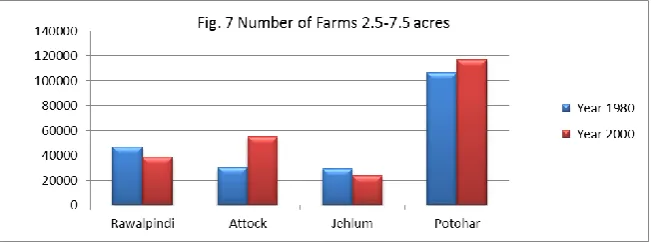
The Fig. below shows a similar trend in the percentage of farmers having farm size of 2.5 to 7.5 acres. In 1980’s there were around 33% farmers with land size of 2.5 to 7.5 acres which have slightly reduced to 31% in twenty years, showing the people mostly have small farm sizes.
Source: Agriculture statistics of Punjab
During the period of 1981 the crop area for wheat was measured around more than 500, 000 hectares that has come down to around 450,000 hectare during 2008-09 (Fig. 10). The area for other crops cultivated throughout the year has not changed as much as the crop area of wheat.
Source: Pakistan Bureau of Statistics 1981-82-2008-09
Production
Source: Pakistan Bureau of Statistics 1981-82-2008-09, Agriculture Statistics of Pakistan 1981-82-2008-09
Rainfall
The average rainfall has decreased over the years in Potohar as its averages around 329.7 mm during 1995 which have come down to 249mm on average per year by 2011. Drought is dangerous for growth of crop and its development. We can also say that, drought is the less availability of water. Heisey and Edmeades (1999) have said that, the drought pressure or stress is the reason for damage to the grain yield especially as it happens at reproductive phase of crop’s life. Muchow (1989) had further elaborated the point through analyzing the growth and development phase of the crop leaves, the period when the leaves are growing and require water for its growth. The unavailability of water at that time can reduce the growth of the plant and ultimately effects the growth as well as the yield. Grant et al. (1989) further discussed that it is also critical as most of the times at the crucial stage, stress on crop due to water deficiency is seen, especially in maize crop at the time of
Year Murree Rawalpindi Jehlum Potohar
1995 1702.9 1615.2 989.1 329.7
2002 1264.4 885.4 682.2 227.4
2003 1520.5 1503.3 885.3 295.1
2004 1485.1 1026.3 879.8 293.2667
2005 1596.2 979 620.7 206.9
2006 1691.3 1598 1528.5 509.5
2007 1520.2 1621.9 823.1 274.3667
2008 1498.4 1384.2 826.1 275.3667
2009 1270.6 401 542 180.6667
2010 1681.6 849 771 257
flowering. The yield and size of grain is decreased due to water deficiency. The size of grain increases almost up to three folds if the water is made available at that stage, i.e. ten to fifteen days of before and after the flowering. Ahmad et al. (1990) explains the type of soil in the area that is generally medium in texture and goes to loamy clay type. Natural fertility of soil is very low, with deficiency of, Phosphorus, Nitrogen and organic matter; however, level of potassium is sufficient.
Conclusion and Recommendations
An analysis of the production tendency, cropping pattern, rainfall and population in the study area establishes the fact that the food security is not as much a factor as yet for Potohar region but can emerge as it is almost at the border line. Supplies of food items is accessible for the people at the moment and having some purchasing power with them is making it convenient for them to fulfill the food requirements but the key problem which still continue to emerge in near future is related to the limit on access to food and continuing shortfall of household income to purchase food as the population level increases along with demand for food in other parts of the country. This will also follow the possibility of further hike in food items. The basic causes of the high incidence of chronic under-nutrition and food insecurity in the area are assigned to:
Low production in agriculture that is associated with government policy and institutional constraints
Lack of interest of the local people in utilizing the land area for maximum production
Lack of off- farm employment opportunities and
REFERENCES
Ahmad, S., M. Khan and M. Zaheer-ul-Ikram. 1990. “Soil and water conservation and integrated land use in Pothwar, Pakistan.” In Soil Physics-Application under stress
environments. Barani Agricultural Research and
Development Project (BARD), PARC, Islamabad.
Altaf, Zafar. 2009. “Food Security in Pluralistic Pakistan.” Washington, DC: Woodrow Wilson International Center for Scholars.
Food and Agriculture Organization (FAO). “Crop Prospects and Food Situation,” February 2010, No. 1, http://www.fao.org/docrep/012/ak343e/ak343e00.pdf. Fullbrook, D. 2010. “Food as Security.” Food Security 2:5–20. GOP 1951-98. Census Report of Pakistan, Population Census
Organization, Islamabad.
GOP 1951-98. District Census Report of Attock, Chakwal, Jhelum and Rawalpindi, Table-1, Population Census Organization, Islamabad.
Government of Pakistan. 2009. “Pakistan Economic Survey 2008-09.” Islamabad: Finance Division, Economic Adviser’s Wing. (The government generated this figure by calculating the “headcount ratio” in Pakistan—the proportion of the national population whose incomes fall below the poverty line established by Islamabad.)
Grant, F.R., Jackson B. S., Kiniry, J.R., and Arkin G.F 1989. “Water deficit timing effects on yield components in maize.” Agronomy Journal 81: 61-65.
Heisey, P.W. and Edmeades, G.O 1999. “Maize production in drought-stressed environments: technical options and research resource allocation.” World Maize Facts and
Trends 1997/1998.
for Scholars. http://www.wilsoncenter.org/topics/pubs/ASIA_090422_R unning%20on%20Empty_web.pdf.
Muchow, R. C. 1989. “Comparative productivity of maize, sorghum and pearl millet in a semi-arid tropical environment. II Effects of water deficits.” Field Crops
Research 20: 207-219.
“Pakistan’s Food Crisis to Worsen on Rising Fertilizer Cost.”
The Earth Times, June 19, 2008,
http://www.earthtimes.org/articles/show/213492,analysis -pakistans-food-crisis-to-worsen-on-rising-fertilizer-cost.html
Pinstrup-Andersen, Per. 2009. “Food Security: Definition and Measurement.” Food Security 1:5–7 DOI 10.1007/s12571-008-0002-y.
Timmer, C.P. 2004. “Food Security and Economic Growth: Asian Perspective.” Asia-Pacific Economic Literature, November.
World Food Program (WFP). 2009 “Food Security Market Price
Monitoring.” Bulletin 10.