CSEIT11831379 | Received : 11 Feb 2018 | Accepted : 22 Feb 2018 | January-February-2018 [(3) 1 : 1457-1461 ]
International Journal of Scientific Research in Computer Science, Engineering and Information Technology © 2018 IJSRCSEIT | Volume 3 | Issue 1 | ISSN : 2456-3307
1457
Raspberry Pi Based Intelligent Autonomous Campus Mobility
Services
V. K. Arthikeyani1, N. Kirubhasudha1, S. Kiruthika1, T. Monisha1, Dr. B. Sivasankari2
1UG, Department of Electronics and Communication, SNS College of Technology, Coimbatore, Tamil Nadu,
India
2Associate Professor, Department of Electronics and Communication, SNS College of Technology,
Tamil Nadu, India
ABSTRACT
This paper represent driverless car is an unmanned vehicle capable of sensing its environment and navigating without human input. The technology plays an important role in our life. Trending methods in transportation is emerging in order to put the people in comfort zone. By using driverless car, the presence of private automobiles on campuses due to teaching and research disturbances, visual degradation from parking provision, environmental pollution and negative health effects can be reduced. Conventional shuttle systems suffer from first and last mile problem. A bicycle and pedestrian friendly policy is not a generalizable solution for all geographic locations and campus layout. A driverless taxi service as an alternative point-to-point shared mobility system for campuses. In the existing system, the GPS is used for tracking and laser sensor used for identifying moving obstacles. In the proposed system, RFID technology is implemented for tracking the locations instead of GPS and Pi camera for pre identifying the destination path and to identify the obstacles Keywords: Raspberry pi, Pi camera, RFID technology, GPS
I.
INTRODUCTION
The main purpose of the Raspberry pi based intelligent autonomous campus mobility services is to reduce the number of private automobiles inside the campus. College campuses have unique transportation requirements in terms of layout, population, and spatio-temporal mobility patterns. Commuting by private automobiles must be reduced due to teaching and research disturbances, pollution of the natural environment, visual degradation caused by parking provision, and negative health effects on staff and students. Bicycle and pedestrian friendly policies are not a generalizable solution, especially in large, sloped, or rural campuses. Alternatively, this service provides point-to-point mobility while increasing car-utilization and reaping the benefits of reducing private automobile
commuting. The autonomous mobility services consist of IR sensor which detects the objects in order to avoid accidents in the campus. This approach reduces human resources, consumes less fuel and also cost for designing the system is low.
II.
LITERATRURE SURVEY
2.1 Embedded Driver-Assistance System Using Multiple Sensors for Safe Overtaking Maneuver A driver-assistance system that uses a low-cost embedded digital signal processor, with the overall system installed in a commercial vehicle. Based on driving information supplied by multiple sensors, such as a real-time vision system, a vehicle-to-vehicle communication system, and in-vehicle-to-vehicle sensors, the proposed system can facilitate decision making and the performing of driving tasks while executing overtaking maneuvers. This paper developed a data fusion stage based on a collision warning algorithm in which the overtaken vehicle and other vehicles in the neighbouring lane are accounted for to avoid collisions. The system employs fuzzy control in the steering and speed automation to emulate the driving tasks performed by humans.
2.2 Research on vision based intelligent vehicle safety inspection and visual surveillance
Computer vision and intelligent transportation technologies are led into the safety inspections and surveillances according to these critical defects. Line scanned and area scanned CCD cameras are trigged by the vehicle detection apparatus to grab images of the vehicles’ bottom and license plates respectively. These images will be processed by the industrial computers real-timely. Sounded alarms can remind the workers there are existing doubtable foreign goods under the bottom. The experimental results indicate preliminarily that the proposed method not only have good performances on detection rate and low false alarm rate, also can improve the reliability effectively. three steps, namely, data acquisition, data processing,
and road modelling. GPS trajectory data are unsuitable for direct roadway map use by autonomous cars due to signal interruptions and multipath; therefore, motion information from the on-board sensors is applied to refine the GPS trajectory data. A fixed-interval optimal smoothing theory is used for a refinement algorithm that can improve the accuracy, continuity, and reliability of road geometry data. Refined road geometry data are represented into the B-spline road model. A gradual correction algorithm is proposed to accurately represent road geometry with a reduced amount of control parameters. The developed map generation algorithm is verified and evaluated through experimental studies under various road geometry conditions.
2.4 The Impact of Cooperative Perception on Decision Making and Planning of Autonomous Vehicles
ooperative perception started with the use of mobile or robotic sensor networks such as environmental surveillance or monitoring. Recently, cooperative perception has been considered as one of the essential technologies for safety improvement and traffic flow efficiency on the road. The trend has been accelerated with the advent of intra-vehicle and inter-vehicle communication technologies. From the perspective of human drivers, the extended spatial information can be directly used for driving assistance purpose as a part of Advanced Driving Assistance Systems such as cooperative collision warning, or overtaking assistance.
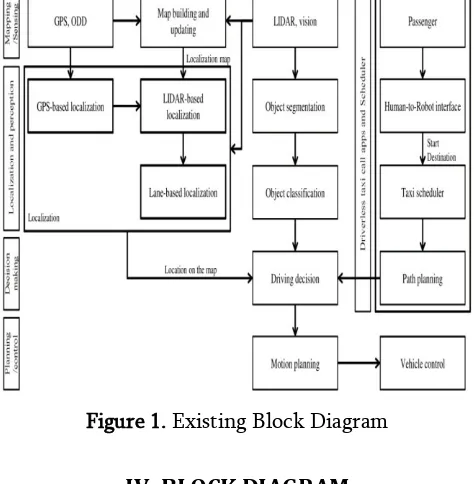
III. EXISTING SYSTEM
Module is used for sending the messages to the user which tends to increase the cost.
Figure 1. Existing Block Diagram
IV. BLOCK DIAGRAM
Figure 2
The block diagram indicating the main parts of the Autonomous campus mobility services. Here the RFID, IR sensor, Pi camera and Matrix keypad are interfaced with Raspberry Pi. The RFID uses electromagnetic field to identify and track tags attached to the object. The Pi camera is interfaced with Raspberry pi which can be used to take high detection videos and images.
V.
RASPBEERY PI
This project is built using Rasperry pi 0W Module which has the 65mm*30mm*5mm dimensions. It has an Soc of Broadcom BCM 2835. TE CPU which has
the ARM11 running 1GHz.The RAM storage is about only 512 MB. It is an wireless connection which has the 2.4GHz 802.11n wireless LAN. It also has an Bluetooth classic 4.1 and Bluetooth LE. This has an power supply of 5v via micro USB connector. The storage is under MicroSDcard. The output is with Micro USB.
VI. RFID TAG :
The tag contains electronically stored information. RFID is not a replacement for a barcoding, but a complement for distance reading of codes. This technology is used for automatically identifying a person, a package or an item. To do this it relies on RFID tags. There are small transponders that will transmit identity information over a short distance.
6.1 TYPES OF RFID TAG USED: 1. Passive RFID Tag
2. Active RFID Tag
Passive RFID devices have no power supply built in. Electrical current transmitted by the RFID reader inductively powers the device, which allows it to transmit its information back. Since the tag has a limited power supply, its transmission is much more limited than an active tag, typically no more than simply an ID number. Similarly, passive devices have a limited range of broadcast, requiring the reader be significantly closer than an active one would.
Figure 3. Passive Tag
feature that most active tags have and most passive tags do not is the ability to store data received from a transceiver. The battery life potential has greatly increased over the years, currently having an upper bound of several years.
Active tags are ideal in environments with electromagnetic interference since they have a stronger signal broadcast and in situations that require a greater distance between the tag and the transmitter.
Figure 4. Active Tag
VII.
TYPES OF TAG
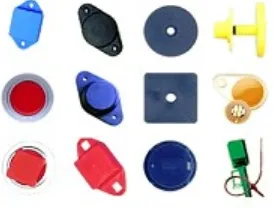
Passive tags are those energized by the reader itself, they contain no power source, typically have very long lifetimes (near indefinite) a drawback over active tags is the read range, typically 2cm (1in) to 1.5m (4.5 ft), a strong positive is individual tag cost. RFID Passive tag is composed of a integrated electronic chip and a antenna coil that includes basic modulation circuitry and non-volatile memory.
Figure 3. Different types of Tags
For most general applications passive tags are usually the most cost effective. These are made in a wide variety of sizes and materials: there are durable plastic tags for discouraging retail theft, wafer thin
tags for use within "smart" paper labels, tiny tracking tags which are inserted beneath an animal's skin and credit card sized tags for access control. In most cases the amount of data storage on a passive tag is fairly limited - capacity often being measured in bits as opposed to bytes.
However for most applications only a relatively small amount of data usually needs to be codified and stored on the tag, so the limited capacity does not normally pose a major limitation. Most tags also carry an unalterable unique electronic serial number, which makes RFID tags potentially very useful in applications where item tracking is needed or where security aspects are important.
VIII.
IR SENSOR
An infrared sensor is an electronic device that emits in order to sense some aspects of the surroundings. An IR sensor can measure the heat of an object as well as detects the motion. These types of sensors measures only infrared radiation, rather than emitting it that is called as a passive IR sensor. Usually in the infrared spectrum, all the objects radiate some form of thermal radiations. These types of radiations are invisible to our eyes that can be detected by an infrared sensor. The emitter is simply an IR LED (Light Emitting Diode) and the detector is simply an IR photodiode which is sensitive to IR light of the same wavelength as that emitted by the IR LED. When IR light falls on the photodiode. The resistances and these output voltages, change in proportion to the magnitude of the IR light received.
IX. CONCLUSION
This vehicle navigates the road primarily using RFID based localization and perception, and obstacles sensing by IR sensor. It has become clear that visual guides would be very helpful for users, because there is no driver present to explain various situations. It is expected that more passengers will eventually be carried on each trip. It is to be believed that autonomous campus mobility services are important for the potential application of collaborative driving.The augmented perception and situation awareness capability can contribute to better autonomous driving in terms of decision making and planning. Here, Raspberry Pi is used for efficient data transformation and accuracy will be high. Pi Camera which is interfaced with Raspberry Pi produces high resolution images and by using this, the correct destination can be reached by the user.
X.
REFERENCES
[1].W. Kim and W. Liu, "Cooperative autonomous driving: A mirror neuron inspired intention awareness and cooperative perception approach," IEEE Intell. Transp. Syst. Mag., vol. 8, no. 3, pp. 23–32, Jul. 2016.
[2].S.W. Kim, W. Liu, M. H. Ang, E. Frazzoli, and D. Rus, "The impact of cooperative perception on decision making and planning of autonomous vehicles," IEEE Intell. Transp. Syst. Mag., vol. 7, no. 3, pp. 39–50, Jul. 2015.
[3].M. Furuhata, M. Dessouky, F. Ordonez, M.-E. Brunet, X. Wang, and S. Koenig, "Ridesharing: The state-of-the-art and future directions," Transp. Res. B, Methodol., vol. 57, pp. 28–46, Nov. 2013.