Rule-based Reordering Space in Statistical Machine Translation
Nicolas P´echeux, Alexandre Allauzen, Franc¸ois Yvon
LIMSI/CNRS, B.P. 133, 91403 Orsay, France Universit´e Paris-Sud, 91403 Orsay, France {pecheux,allauzen,yvon}@limsi.fr
Abstract
In Statistical Machine Translation (SMT), the constraints on word reorderings have a great impact on the set of potential translations that are explored. Notwithstanding computationnal issues, the reordering space of a SMT system needs to be designed with great care: if a larger search space is likely to yield better translations, it may also lead to more decoding errors, because of the added ambiguity and the interaction with the pruning strategy. In this paper, we study this trade-off using a state-of-the art translation system, where all reorderings are represented in a word lattice prior to decoding. This allows us to directly explore and compare different reordering spaces. We study in detail a rule-based preordering system, varying the length or number of rules, the tagset used, as well as contrasting with oracle settings and purely combinatorial subsets of permutations. We focus on two language pairs: English-French, a close language pair and English-German, known to be a more challenging reordering pair.
Keywords:Reordering Contraints, Empirical Analysis, Statistical Machine Translation
1.
Introduction
Reordering is still a critical issue for statistical machine translation, and the reordering complexity for a language pair can be considered as a relevant indicator of the difficulty to automatically translate from one into the other (Birch et al., 2008). Reordering is problematic since the factorial space of permutations cannot be fully explored. Moreover, even if we could, this space would contain too much ambiguity and permutations that are linguistically meaningless. Therefore we must rely on methods that can restrict the space of possible reorderings. Various con-straints on admissible permutations have been proposed in the past including IBM (Berger et al., 1996), MJ (Kumar and Byrne, 2005) or ITG (Wu, 1997). Those constraints have been compared in terms of performance (Zens and Ney, 2003; Zens et al., 2004) or in oracle settings (Dreyer et al., 2007; Wisniewski and Yvon, 2013). Other ap-proaches include linguistically motivated rules that are au-tomatically learned (Crego and Mari˜no, 2006; Niehues and Kolss, 2009; Popovic and Ney, 2006). To the best of our knowledge, these two families of approaches have not been compared yet.
In the phrase-based approach, sentences are first segmented into variable length segments or phrases, then reordered. Word reorderings can be divided in two tighly intertwined parts: local reorderings that take place within phrases; and longer reorderings of those phrases. Moreover, a recent trend has been to consider preordering methods, where source sentences are reordered in a pre-processing step to match the target word order and then fed into the standard Phrase-Based pipeline (Xia and McCord, 2004; Collins et al., 2005; Tromble and Eisner, 2009). This further com-plexifies the analysis of the word reorderings that are actu-ally considered in translation. Finactu-ally, because of the prun-ing strategy, only a restricted part of the search space is effectively explored.
In this paper, we use a state-of-the-art n-gram SMT sys-tem (Crego et al., 2011), described in Section 2., that splits
reordering and decoding into two separate steps. Reorder-ings of the source sentence are compactly encoded in a per-mutation lattice, the reordering space, that is then trans-lated in a monotonic fashion. This allows us to study the reordering space that is explored and then to assess its im-pact on the whole translation process. Indeed, in addition to computationnal issues, there is a tradeoff when building the reordering space of a machine translation system. On the one hand, a larger space is more likely to contain a per-mutation that can yield a relevant translation. On the other hand, it may also cause more decoding errors, because of both the ambiguity of natural languages and the necessary pruning of the search space.
The main contribution of this work is to evaluate the impact of the reordering space on translation performance by ex-ploring various experimental conditions (Section 3.). We study different methods to generate the reordering space by varying the word classes that are used by the reorder-ing rules. Evaluation is carried out on two language pairs (French-English and German-English in both directions) that greatly differ by the range of the involved reorderings. The results in Section 4. show that our SMT system is not able to fully benefit from an accurate reordering space.
2.
The
n
-gram Based Approach for SMT
For all our experiments, we use NCODE, an open source n-gram SMT toolkit1, which achieved state-of-the-art per-formance in recent WMT evaluations (Callison-Burch et al., 2012; Bojar et al., 2013). NCODE implements the bilingualn-gram approach to SMT (Casacuberta and Vidal, 2004; Mari˜no et al., 2006; Crego and Mari˜no, 2006) that is closely related to the standard phrase-based approach. However, in this framework, the translation is divided into two steps: a source reordering step and a (monotonic) trans-lation step. Since the transtrans-lation step is monotonic, the translation model relies on the n-gram assumption to(s) : the meeting was announced by the president’s spokesman Radim Ochvat .
(r) : c’ est le porte-parole pr´esidentiel Radim Ochvat qui a inform´e de la r´eunion . (m) : la r´eunion a ´et´e annonc´ee par le pr´esident porte-parole Radim Ochvat .
(l) : la r´eunion a ´et´e annonc´ee par le porte-parole du pr´esident Radim Ochvat . (u) : le porte-parole du pr´esident Radim a ´et´e annonc´ee par la r´eunion Ochvat .
(o) : de la r´eunion a inform´e de la c’ est le porte-parole pr´esidentiel Radim Ochvat qui
Figure 2:Translations of a source sentence(s)fromnewstest2010, along with the reference translation(r), contrasting monotone(m)lattice based(l)and unfolded reordering(u)constraints, as well as oracle decoding(o)in the lattice reordering space.
• Brown classes(classes): Statistical word classes were found to be a good approximation for Part-of-Speech tags when a POS tagger is not available. In (Ra-manathan and Visweswariah, 2012), word clusters perform worse than POS, but still reasonably well, in a preordering setting. In this work, we compute the statistical word classes using the methods of Brown et al. (1992).
3.4. MJ-i
In principle, one can design any kind of permutation con-straints and encode them in a lattice. In practice, the num-ber of nodes in the lattice must remain reasonable (polyno-mial) in the number of words in the sentence.
To assess whether constraining the reorderings to those ob-served in the data is appropriate, we contrast rule-based approaches with MaxJump (MJ) constraints (Kumar and Byrne, 2005). In MJ-i, a word move cannot exceedi po-sitions. This is equivalent to using a rule-based system, where all possible rules up to sizei+ 1are considered.
3.5. Metrics and Unfolded Reorderings
Given our assumptions, the reordering space should con-tain the unfolded reordering as defined in Section 2. For un-seen data, this oracle can be derived from forced alignments between source sentences and their associated references. Therefore, as a quality measure on reordering constraints, we define thecoverageon some test set as the number of time the reordering space contains the reference reorder-ing. We also compute the sizeof the reordering space as the number of paths2and edges in the reordering lattice.3 In that sense, the best reordering constraints should be the ones that generate lattices containing the unfolded reorder-ing as only alternative. We refer to this oracle-like con-straint asunfolded reorderingconstraint.
4.
Experimental Results
4.1. Data and System DescriptionWe considered two different tasks: 1) the French-English Basic Traveling Expression Corpus (BTEC) (Paul et al., 2010), using train10, devel03 and test09 for training, tuning and testing, respectively; 2) The English-French and English-German training data of NEWSCOMMENTARY
provided by organizers of WMT’12 (Callison-Burch et al.,
2Computed efficiently using the counting semiring.
3The number of edges closely relates to the decoding
complex-ity.
2012), withnewstest2009andnewstest2010for tuning and for testing, respectively.
All data is preprocessed as described in (Allauzen et al., 2013). For each task, a 4-gram language model is esti-mated using the target side of the training data and50word classes4derived usingMKCLS.5 We used NCODEwith the
default setting and an additional a POS-POS bilingual fac-tor model.6 Beam size was set to25during the tuning step
and to 50 when decoding, as this showed some gains in previous experiments. Oracles are computed using lattice minumum Bayes-risk decoding with linear corpus BLEU as described in Tromble et al. (2008) using unigram preci-sion and recall values of 0.8. All results are averaged over 5 runs of MERT to control for optimizer instability (Clark et al., 2011). Approximate randomization tests for multi-ple optimizer sammulti-ples to assess statistical significance are carried out usingMULTEVAL.7
4.2. From monotone to Oracle Reorderings
Table 1 shows BLEU scores on test data for the BTEC and NEWSCOMMENTARYtask, for three different reorder-ing spaces of increasreorder-ing “quality”. The first reorderreorder-ing space only considers the original source sentence order (monotone). The second uses our rule-based approach to create the reordering lattice. The last and most specific one considers exactly the reordering that match the target order (forced unfolded reordering). An example of sen-tence translation for those configurations is shown in Fig-ure 2. Monotone translation does not succeed in inverting
president’sandspokesman, thus resulting in a
mis-translation (meaning “by the president, spokesman, Radim Ochvat”).
We can observe BLEU improvement from monotone to lat-tice reordering, as one would expect. For French-English, the increase may be as high as 3BLEU points. However for English-German, the gain is much lower, especially for en → dedirection (only about a half BLEU point). This could suggest that our reordering system does not succeed in predicting German word order.
Although direct comparison of BLEU scores on different corpora is unfair, scores for en → deare always worst, indicating a more challenging language direction. German is a morphologically rich language that exhibits long range
4
Out-of-vocabulary are mapped to class1.
5
http://code.google.com/p/giza-pp/ 6
Note that this is independent of the choice of tags used in the reordering rules.
BTEC task NEWSCOMMENTARYtask
tun. dec. en→fr fr→en en→fr fr→en en→de de→en
(m) (m) 43.4±0.4 46.8±0.4 20.3±0.1 20.9±0.1 12.7±0.0 17.4±0.1 ncode (l) (l) 46.8±0.2 49.1±0.4 23.3±0.1 23.0±0.1 13.2±0.1 18.5±0.1 (u) (u) 48.7±0.3 51.6±0.6 25.4±0.1 27.0±0.1 15.9±0.0 22.3±0.0
(m) 88.6 86.4 70.3 70.5 55.7 64.0
oracle (l) 96.4 95.2 84.3 84.3 64.6 74.0
(u) 98.8 99.7 92.7 94.7 81.9 92.7
ncode (u) (l) 43.4±5.6 45.8±2.7 23.1±0.3 21.7±1.5 13.0±0.0 18.1±0.2 (l) (u) 48.7±0.2 52.2±0.5 25.4±0.1 26.9±0.1 15.9±0.0 22.3±0.1
Table 1: BLEU scores on test data obtained by NCODEsystem and oracle decoding, when no reorderings are allowed (monotone (m)), using our lattice reordering space (l) and when given exactly the unfolded reordering (u), during tuning phase on development data (tun.) and when decoding the test (dec.). Reported BLEU scores are averages across 5 runs of MERT along with standart deviation across runs shown in script size.
maxcost BLEU ncode BLEU oracle #rules size coverage (%)
en→f r
0 19.6∗
±0.1 70.3 0 27 / 1 19
2 22.6∗
±0.1 81.3 20k 34 /40 40
4 22.8±0.1 84.6 30k 49 /104 50
8 22.3∗±
0.2 87.9 42k 217 /1021 62
f r→en
0 20.2∗
±0.1 70.5 0 30 / 1 16
2 21.9∗
±0.0 77.2 19k 35 / 11 25
4 22.5±0.1 84.4 31k 69 /107 40
8 22.2∗
±0.1 89.6 49k 397 /1034 60
en→de
0 12.7∗
±0.1 55.7 0 27 / 1 16
2 12.7∗
±0.1 57.0 61k 30 /2.1 17
4 13.1±0.1 64.6 83k 65 /104 25
8 12.9∗
±0.1 70.0 99k 250 /1021 33
de→en
0 17.6∗±
0.1 64.1 0 28 / 1 15
2 17.9∗±
0.1 66.3 63k 33 / 3.5 17
4 18.7±0.1 74.1 86k 67 /106 25
8 18.7±0.1 79.8 103k 264 /1034 33
Table 2: Impact of rule filtering strategy (maxcost) inNEWSCOMMENTARYtask on: BLEU scores obtained byNCODE
system and oracle decoding; the number of reordering rules (#rules); the size of the lattice reordering space (averaged number of arcs / average number of paths); and on the coverage (see section 3.5.). Reported BLEU scores are averages across 3 runs of MERT along with standart deviation ac ross runs shown in script size. A statistical significance (p <0.005) difference from themaxcost= 4baseline is indicated by * symbol.
reorderings when translating from English.
All language directions also benefit from being given the unfolded reordering. Note however that a better BLEU does not always result in a better translation. In the example in Figure 2, the lattice translation is perfectly valid although different from the reference. However, the translation in the unfolded reordering condition is mistranslated as the ini-tial sentence is in the passive voice (the translated sentence means “President Radim’s spokesman has been announced by the Ochvat meeting”). This example shows that artificial reorderings may sometimes lead to poor translations. Yet, an improvement up to 4 BLEU points when translating to-ward English shows that there is a room for improvement. However the improvement foren→deis not so clear. In
other words, “solving” the reordering problem at decoding time has only a slight effect on performance for this lan-guage direction. Therefore the reordering constraints might currently not be the main limitation for our system. It is worth noticing that the reordering length is limitless in the unfolded reordering case, hence the lack of long range re-orderings in our model can not be the main explanation.
op-en→f r f r→en en→de de→en
BLEU size BLEU size BLEU size BLEU size
maxlen=2 22.4±0.1 34 /102 21.9±0.0 40 /103 12.8±0.0 34 /102 17.6±0.1 34 / 30 MJ-1 22.1∗
±0.1 74 /1014 21.9±0.0 84 /1017 12.8±0.0 74 /1014 17.8∗±0.2 19 /1019
maxlen=3 22.6±0.0 40 /103 22.2±0.0 47 /105 12.9±0.1 42 /103 18.0±0.1 41 /103 MJ-2 22.3∗
±0.1 209 /1023 22.2±0.1 239 /1028 12.9±0.1 209 /1023 18.0±0.1 223 /1031
maxlen=4 22.9±0.2 43 /104 22.3±0.1 56 /106 13.0±0.1 50 /104 18.3±0.1 50 /104 MJ-3 22.4∗±
0.1 715 /1030 22.1∗±0.1 824 /1036 12.8∗±0.0 715 /1030 17.8∗±0.2 768 /1040
Table 3:Comparison between rule-based reordering with a length rule limit (maxlen) and purely combinatorial MaxJump constraints (MJ-i) forNEWSCOMMENTARYtask. Reported BLEU scores are averages across 3 runs of MERT along with standart deviation across runs shown in script size. A statistical significance (p <0.005) difference betweenmaxlen=i
and MJ-(i−1)is indicated by * symbol.
timistic and a large part of the gain may result from over-fitting the BLEU metric. An illustration is provided in Fig-ure 2 with the mumbo-jumbo oracle translation.
We also explored the importance of the reordering space during the tuning step. Table 1 shows that when tuning with unfolded reorderings instead of a lattice, we observe a small drop for all directions when decoding on a lattice along with a dramatic increase in the optimizer variance. This means that the reordering features do benefit to see the whole reordering space during tuning.
4.3. Reordering Space Trade-off
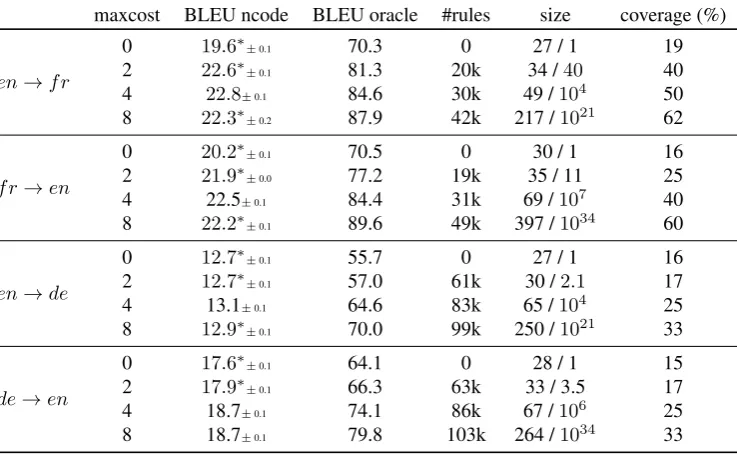
Table 2 shows reordering space size, coverage, oracle and decoding scores for various constraints (results for the BTEC task are omitted for brievty). We observe that while the number of rules is almost twice foren→ dethan for en→f r, the generated reordering spaces are comparable in sizes, but with a much lower coverage foren→de. By relaxing the rules pruning, we see large increases in re-ordering space size, in coverage and in oracle BLEU. How-ever, in regular test condition, we observe a degradation of the BLEU scores, when the size of the reordering space drastically increases. This shows the importance of the trade-off regarding the design of the reordering space.
4.4. Alternative Tagsets
en→fr fr→en en→de de→en
baseline 22.8±0.1 22.5±0.1 13.1±0.1 18.7±0.1 spos 22.7±0.1 22.5±0.2 13.1±0.0 18.7±0.1 e50pos 22.8±0.1 22.5±0.1 13.1±0.1 18.3∗±0.1 classes 22.8±0.1 22.6±0.1 12.9∗±0.1 18.2∗±0.2
Table 4: Comparison of different tagsets for NEWSCOM
-MENTARY task. Reported BLEU scores are averages across 5 runs of MERT along with standart deviation across runs shown in script size. A statistical significance (p < 0.005) difference from the baseline is indicated by * sym-bol.
From Table 4 we observe that the tagset has limited in-fluence on BLEU scores. Oracle scores, spaces size, and
coverage were also very similar. Moreover, the competi-tive results obtained with the coarse grained tagset and the automatic word classes show that they can be used as a workaround for under resourced language.
4.5. Comparison with MJ-i
Table 3 provides a head to head comparison between MJ-i constraints and the rule based approach. The MJ reorder-ing spaces are several orders of magnitude larger than their ruled-based counterpart but yield to significanlty lower re-sults. This justifies the use of linguistically motivated rules, instead of allowing all local permutations and corroborate the trade-off discussed earlier. Training time is also an issue here: foren→ f r, the tuning step with MJ-3constraints takes four times as long thanmaxlen= 4.
5.
Conclusions
In this work, we have compared the reordering space gener-ated by different reordering rules as well as local permuta-tion constraints. We use an-gram SMT tool that separates reordering and decoding, but our approach is more general as soon as the reordering space may be encoded in a lat-tice prior to decoding. We compare the different reordering constraints from an oracle point of view, but also taking into account the trade-off between expressivity and size, explor-ing the interaction with a pruned decodexplor-ing.
6.
Acknowledgements
We would like to thank Thomas Lavergne and Guillaume Wisniewski for their helpful feedback and for having pro-vided the oracle and semiring frameworks used in this work. We would also like to thank to our anonymous re-viewers for their comments and suggestions.
7.
References
Alexandre Allauzen, Nicolas P´echeux, Quoc Khanh Do, Marco Dinarelli, Thomas Lavergne, Aur´elien Max, Hai-Son Le, and Franc¸ois Yvon. 2013. LIMSI @ WMT13. In Proceedings of the Eighth Workshop on Statistical Machine Translation, pages 62–69, Sofia, Bulgaria. Adam L. Berger, Peter F. Brown, Stephen A. Della Pietra,
mars and bilingual parsing of parallel corpora. Compu-tational Linguistics, 23(3):377–403.
Fei Xia and Michael McCord. 2004. Improving a statis-tical mt system with automastatis-tically learned rewrite pat-terns. In Proceedings of the 20th International Con-ference on Computational Linguistics, pages 508–514, Geneva, Switzerland.
Richard Zens and Hermann Ney. 2003. A comparative study on reordering constraints in statistical machine translation. InACL, pages 144–151.