Connecting Text Mining and Pathways using the PathText Resource
Sætre, Kemper, Oda, Okazaki
a, Matsuoka
b, Kikuchi
c, Kitano
d, Tsuruoka, Ananiadou, Tsujii
eaComputer Science, University of Tokyo, Hongo 7-3-1, Bunkyo-ku, Tokyo 113-0033 Japan,
bThe Systems Biology Institute, 6-31-15 Jingumae M31 6A, Shibuya-ku, Tokyo 150-0001 Japan,
cMitsui Knowledge Industry Co., Ltd., 2-7-14 Higashinakano, Nakano-Ku, Tokyo 164-8555 Japan,
dOkinawa Institute of Science and Technology, 7542 Onna, Onna-Son, Kunigami, Okinawa 904-0411 Japan,
eNational Centre for Text Mining (NaCTeM) 131 Princess Street, Manchester M1 7DN United Kingdom
a[email protected],b[email protected],
c[email protected],d[email protected],e[email protected]
Abstract
Many systems have been developed in the past few years to assist researchers in the discovery of knowledge published as English text, for example in the PubMed database. At the same time, higher level collective knowledge is often published using a graphical notation representing all the entities in a pathway and their interactions. We believe that these pathway visualizations could serve as an effective user interface for knowledge discovery if they can be linked to the text in publications. Since the graphical elements in a Pathway are of a very different nature than their corresponding descriptions in English text, we developed a prototype system called PathText. The goal of PathText is to serve as a bridge between these two different representations. In this paper, we first describe the overall architecture and the interfaces of the PathText system, and then provide some details about the core Text Mining components.
1.
Introduction
One of the main challenges in biomedical Text Mining (TM) is the identification of terminology, which is a key factor for accessing and integrating the information stored in literature. Several approaches have been suggested to automatically integrate and map between resources, but the problems of extensive variability of lexical representations and ambiguity have been revealed (Nenadic et al., 2006). After the entities (proteins, genes, lipids, ions, carbohy-drates, etc.) have been discovered, the natural next step is to find out what relationships exist between the entities. One type of such relationships is Protein-Protein Interac-tion (PPI), and it has received a lot of attenInterac-tion lately, for example in the Second BioCreative Challenge Evaluation Workshop (Krallinger, 2007). A related field, which has not received as much attention, is the creation of Pathways or
diagrams. These Pathways capture the interaction between
all the entities involved in a specific biological process. For example, a PPI usually involves more entities than just two proteins, and this creates new challenges for biomedical TM. In this paper we present a new system, PathText, and show how it can be used to browse a corpus of text that describes the entities in the graph.
2.
PathText
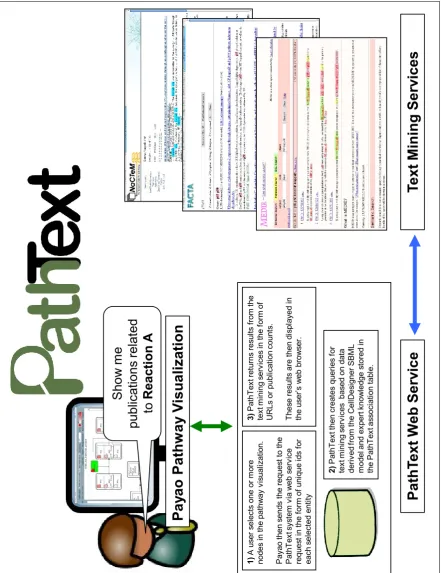
PathText is a new system developed to connect Natural Language Processing (NLP) technology to the graphs and diagrams that are so often used by biologists. It uses the graphical interface of Payao (described below), to let the user quickly find related text snippets and articles related to the different parts of the Pathway. Figure 1 shows the overall structure of the PathText system. There are two in-teracting user interfaces: Payao (in the top-left corner), is used to show biologically meaningful diagrams to the user, and the PathText interface (bottom-left corner) connects to the corresponding language resources shown on the right
side: KLEIO (Nobata et al., 2008), FACTA (Tsuruoka et al., 2008) and MEDIE (2008). In the rest of this paper, we first introduce the biological interface and modules, and then the information extraction and language processing modules.
2.1. Payao (“Pa-ya-o”)
Payao is a Web 2.0 community tagging system for biologi-cal networks, enabling a community to work online on the same models simultaneously. It provides an interface for users to add tags and comments to the models, and an Ap-plication Programming Interface (API) that lets our Text Mining (TM) tools automatically add more information to the models (Kitano et al., 2007b). The API provides a list of all the entities and interactions in the model, and the TM tool searches the existing or newly published literature for texts that describe these entities in the context of the given reactions. Automatically generated comments are added to the entities and reactions in the model, and they contain clickable links that take the users back to the PathText web page to show a highlighted version of the corresponding text, and more information about the selected entity or in-teraction. Payao relies on several other enabling technolo-gies like the Systems Biology Markup Language, SBML (Hucka and et al., 2003), and Graphical Notation, SBGN (Kitano et al., 2007a), and it builds on the CellDesigner pro-gram (Funahashi et al., 2007) to show the graphical models.
2.2. Systems Biology Graphical Notation (SBGN)
tein name recognition. Journal of Biomedical
Informat-ics, 37(6):461–470.
Yoshimasa Tsuruoka, John McNaught, Jun’ichi Tsujii, and Sophia Ananiadou. 2007. Learning string similarity measures for gene/protein name dictionary look-up using logistic regression. Bioinformatics. doi: 10.1093/bioin-formatics/btm393.
Yoshimasa Tsuruoka, Chikashi Nobata, Philip Baker, Dou-glas Kell, and S. Ananiadou. 2008. Facta: a web-based text mining system for finding associations be-tween biomedical concepts. In Genomes to Systems
2008, Manchester, UK, March. The Consortium for