Centering Theory for Evaluation of Coherence in Computer-Aided Summaries
Laura Hasler
Research Institute in Information and Language Processing University of Wolverhampton, Stafford St., Wolverhampton, WV1 1SB, UK
Abstract
This paper investigates a new evaluation method for assessing the coherence of computer-aided summaries, justified by the inappropriacy of existing evaluation methods for this task. It develops a metric for Centering Theory (CT), a theory of local coherence and salience, to measure coherence in pairs of extracts and abstracts produced in a computer-aided summarisation environment. 100 news text summaries (50 pairs of extracts and their corresponding abstracts) are analysed using CT and the metric is applied to obtain a score for each summary; the summary with the higher score out of a pair is considered more coherent. Human judgement is also obtained to allow a comparison with the CT evaluation to assess the validity of the development of CT as a useful evaluation metric in computer-aided summarisation.
1. Introduction
Computer-aided summarisation (CAS) is an alternative to fully automatic summarisation which accounts for the fact that fully automatic summaries are not always of a high standard of quality (Orasan et al., 2003). CAS combines methods from the fields of both human and automatic sum-marisation, allowing users of a system to access the output and post-edit it to improve the summary. Guidelines, which aim to consistently improve the coherence and readability of extracts produced by CAS systems, have been developed to help users of such systems (Hasler, 2007). Summaries produced using these guidelines need to be evaluated to prove that such a resource is indeed useful. However, be-cause the final summaries are produced via a mixture of ex-traction and human post-editing, existing evaluation meth-ods used to assess quality are unsuitable.
This paper investigates a new evaluation method for assess-ing the coherence of computer-aided summaries. The aim is to take a step in the right direction to find a more objec-tive evaluation method for coherence than those currently available for this task. A metric is developed for Center-ing Theory (CT) (Grosz et al., 1995), a discourse theory of local coherence and salience, to measure the coherence of pairs of extracts and the abstracts created from them us-ing summary production guidelines. 50 pairs of news text summaries are analysed using CT and the metric is applied to obtain a score for each summary; the summary with the higher score out of a pair is considered more coherent. Hu-man judgement is also obtained, which allows a compari-son between human and CT evaluations of the same texts to assess the validity of the development of CT as a useful evaluation metric in computer-aided summarisation. The remainder of this paper is structured as follows. Sec-tion 2. introduces current evaluaSec-tion methods for informa-tiveness and quality in summarisation. Centering Theory is described in Section 3., and more specifically for its appli-cation to evaluate coherence in computer-aided summaries in Section 4. The results of an evaluation of computer-aided summaries are discussed in Section 5. and a comparison with human judgement is given in Section 6.
2. Evaluation in Summarisation
Evaluation is a vital issue in the field of automatic summari-sation (AS). If summaries produced by automatic systems are not evaluated, there is no way of knowing how well they perform and consequently how useful they are. To date, the majority of evaluation in automatic summarisation has fo-cused on the information content of summaries. This re-flects the current preference for automatic extraction as op-posed to abstraction, with relatively little consideration for issues of coherence and readability. Evaluation in AS can be split into two main strands: informativeness and qual-ity (Hirschman and Mani, 2003).1 Sections 2.1. and 2.2.below briefly describe existing evaluation methods in the field of automatic summarisation and explain why they are not wholly suitable for assessing coherence in computer-aided summaries.
The human summarisation literature does not address eval-uation in the same way as the automatic summarisation lit-erature does. Instead, the focus is on the checking and edit-ing of abstracts to ensure they adhere to the conventions and specifications of the organisation or publication for which they are produced. Hasler (2007) established that it is not desirable to assess abstracts solely in terms of guidance for professional summarisers. This is too restrictive and would result in abstracts being negatively evaluated when they are considered acceptable to a human judge and a human sum-mariser working with guidelines. A corpus analysis proved that conventions regarding, for example, tense and voice, are not always strictly adhered to because texts have id-iosyncracies in the ways they realise information.
2.1. Evaluation of Informativeness in AS
Although not directly relevant to the evaluation discussed in the rest of this paper, it is important to mention established methods for the evaluation of informativeness in AS, as these have recently received most attention from the AS re-search community. Evaluation of informativeness assesses the information content of a summary in comparison with a reference text, either the source text or an ideal summary
1The evaluation literature also distinguishesintrinsicand
created by a human. It can involve human judgements on how well the units in a summary cover the content of the source or an ideal summary. Relevance assessment, read-ing comprehension and the usefulness of the summary in completing other tasks are other common means of evalu-ation.2 Automatic evaluation has recently become popular,
with methods such as ROUGE (Lin, 2004) and the Pyra-mid method (Nenkova and Passonneau, 2004; Harnly et al., 2005) being incorporated in the Document Understand-ing Conferences (DUC: http://duc.nist.gov/). Systems can also be automatically compared against annotated corpora used as a gold standard, or against source texts using mea-sures such as precision, recall and f-measure, and the cosine similarity (see Donaway et al. (2000) for a comparison of recall- and content-based evaluation measures). However, all of these evaluation methods are concerned with infor-mativeness and therefore it is unfair to employ them in the assessment of the coherence of summaries.
2.2. Evaluation of Quality in AS
Quality evaluates how well a summary reads, by taking into consideration style via phenomena such as dangling anaphors and connectives, discourse ruptures and grammat-icality (e.g. Minel et al. (1997)). Saggion and Lapalme (2000) use criteria such as good spelling and grammar, im-personal style, clear indication of the topic of the source document, and conciseness, as criteria for human judges to grade summaries. The SEE tool (Lin, 2001) allows humans to manually assess extracts for a variety of quality and in-formativeness phenomena, including coverage, complete-ness and grammatical fluency. Because the texts used in the evaluation experiment in this paper comprise abstracts as well as extracts (see Section 4.2.), it is assumed that the abstract which was produced by human post-editing of an extract will fulfil these quality criteria due to the effect of guidelines used in the process. Therefore, it is inappropriate to use evaluation methods such as these which will almost always score the abstracts very well because the criteria are very similar to the guidelines used to produce them. Standard readability measures such as the Gunning-fog in-dex (Gunning, 1988) and the Flesch-Kincaid inin-dex (Kin-caid et al., 1975), which assess ease of reading based on average word and sentence length, can also be used to eval-uate the quality of summaries. However, these have been criticised as extremely coarse methods due to their simplic-ity (Mani, 2001): word and sentence length do not deter-mine a ’good’ summary, and do not give many insights into how or why one summary is of a higher quality than an-other. Indeed, in the texts used for this evaluation, there were many instances ofmerging, where sentences in an ab-stract were made longer than their corresponding ones in the extract so that the text did not seem as ’choppy’. Sen-tences were also lengthened to shorten the abstract overall by incorporating one sentence into another.
Post-edit measures based on the number of corrections nec-essary to transform the output of a system into an accept-able state are another option. Whilst these measures may seem suitable for the evaluation of changes made when
2See Mani (2001) for an overview.
transforming an extract into an abstract, they are imprac-tical due to the complexity of the operations applied dur-ing the process. Edit distance between sentences was tried, but because there were so many complex changes between extracts and abstracts, especially due to the merging and reordering of information, this proved unsuitable.
3. Centering Theory
As Centering Theory attempts to explain local coherence and salience within a discourse, it is a prime candidate with which to evaluate summaries, where both coherence and salience are issues and the text is short and usually only about one (or two) main topic(s). CT is a parametric the-ory which deals with coherence by examining repetitions of entities across consecutive utterances, and the relation-ship between these repetitions. The main concepts and assumptions introduced in the earliest versions of Center-ing Theory (Brennan et al., 1987; Grosz et al., 1995) are presented in this section. Whilst the most popular applica-tion in the past has been anaphora resoluapplica-tion, the suitability of CT variations for other tasks has been shown in recent years by its application in natural language generation (e.g. Karamanis (2003)) and automatic summarisation (Orasan, 2006). Hasler (2004) and Lapata and Barzilay (2005) also prove CT’s usefulness in evaluation.
3.1. Centers
As CT is a theory oflocalcoherence, only two consecutive utterances are considered at any one time (Un andUn+1).
Each utterance in a text introduces a number of forward looking centers(Cfs), which are noun phrases (NPs) refer-ring to an entity. TheseCfs must be realised explicitly in the utterance. In addition, each utterance except the first has precisely onebackward looking center(theCb), which is the link between one utterance and the previous utterance in the text. A weaker version of this is also offered, assert-ing that each utterance has at most one Cb (e.g. Walker et al. (1998)). TheCbof any current utterance (Un+1) is
the most highly rankedCf of the previous utterance (Un)
which is realised in the current utterance (Un+1).
TheCfs are ranked, usually according to grammatical func-tion (see Secfunc-tion 3.4.). The more highly ranked aCf, the more likely it is, in a ’coherent’ text, to be theCb of the next utterance. The most highly rankedCf of an utterance is thepreferred center(Cp), so the theory predicts that the Cp ofUn is most likely to be theCb ofUn+1. If an
en-tity within an utterance is pronominalised, it is most likely to be the Cb. Table 1 summarises these basic notions of Centering Theory.
3.2. Transitions
The relationships between Cfs and Cbs of utterances re-sult in transitions between utterances, which have a defi-nite order of preference; texts demonstrating certain transi-tions are considered to be more coherent than those demon-strating others. In the original formulation of the theory, three types of transition are described: CONTINUE, RE
-TAIN, SHIFT. However, following Brennan et al. (1987)
Constraint 1 Each utterance has precisely 1Cb(Weak version: each utterance has at most 1Cb) Constraint 2 Every element ofCf(Un)must be realised inUn
Constraint 3 Cb(Un+1)is the highest-ranked element ofCf(Un)which is realised inUn+1 Rule 1 If some element ofCf(Un)is realised as a pronoun inUn, then so isCb(Un+1)
(Strong version: ifCb(Un+1)=Cb(Un), a pronoun should be used)
Rule 2 In transitions,CONTINUEis preferred overRETAIN, which is preferred overSMOOTH SHIFT,
which is preferred overROUGH SHIFT
Table 1: Centering Theory Constraints and Rules
andROUGH SHIFT. CONTINUE is preferred overRETAIN,
which is preferred over SMOOTH SHIFT, which is in turn preferred overROUGH SHIFT. The ordering of transitions reflects the idea that it is preferable for consecutive utter-ances to have the sameCb, i.e., for the same entity to pro-vide the link between two utterances, and also for the most salient entity (theCp) in one utterance to be theCbof the next utterance. Table 2 presents CT’s transitions in terms of the relationship betweenCbs andCps.
3.3. Coherence
The interaction and positioning of entities (Cbs andCfs) in consecutive utterances, which is encoded by the transi-tions in the table above, helps to create the impression that a text is about the same entity (in terms of summarisation, the ’main topic’). Consider the following examples taken from Grosz et al. (1995), who argue that the same information is present in both, but that (1) is more coherent because it sug-gests that the discourse is about the same thing (John). The changes in the subject (or ranking) of each sentence in (2) make it difficult for the reader to decide whether this par-ticular example is about John or the store. Examples such as these help to validate arguments for the ranking of theCf list and of transitions. In terms of a CT analysis adhering to the weak version of Constraint 1, (1) displays CONTINUE
transitions, because the subject of the first utterance is kept as theCpthroughout and is also theCbin the subsequent utterances. (2), on the other hand, displays aRETAIN
fol-lowed by aCONTINUE, followed by aRETAIN, due to the
fact that theCbis the same throughout the utterances, but it is not the same entity as theCp.
(1)John[Cp] went to his favorite music store to buy a pi-ano.He[Cp], [Cb] had frequented the store for many years. He[Cp],[Cb] was excited that he could finally buy a piano. He[Cp], [Cb] arrived just as the store was closing for the day.
(2)John[Cp] went to his favorite music store to buy a pi-ano.It[Cp] was a storeJohn[Cb] had frequented for many years.He[Cp], [Cb] was excited that he could finally buy a piano.It[Cp] was closing just asJohn[Cb] arrived.
3.4. Parameters
Centering Theory is a notoriously underspecified theory, and this underspecification has prompted a substantial body of research into optimal parameters depending on text type, language and tasks (see Poesio et al. (2004) for a com-prehensive overview). There are a wide variety of possible instantiations of CT, and parameters need to be specified before the theory can be used. In earlier work (Grosz et al.,
1995), even the most basic notion ofutterance is not de-fined, although an utterance is often considered to be a sen-tence because it is the simplest option. This view has been criticised by some researchers, and using different types of clauses as utterances has been proposed as an alternative (e.g., Kameyama (1998)), although this too has its critics. Realisationis another parameter. It is possible to have di-rect or indirect realisations ofCfs,Cps andCbs. Direct realisations must be coreferential, whilst indirect realisa-tions encompass other relarealisa-tionships between entities, such as part-whole and set-membership. Direct realisation is easier to employ due to the high number of possibilities of indirect realisations of an entity.Rankingof theCf list is a third parameter to be specified. This is traditionally taken to be a grammatical/linear preference order: subject>object > others, which is sometimes further split to distinguish direct and indirect objects: subject>direct object> indi-rect object>others. However, it has been argued that this is inappropriate because the ’topic’ of an utterance is not always the subject. Strube and Hahn (1999) propose func-tional centering where information structure is taken into account and ranking is based on hearer-old and hearer-new information.
4. Centering Theory for Evaluation in CAS
This section discusses the instantiation of CT used for the evaluation of coherence in computer-aided summaries. A metric is formulated using CT to score summary coherence in 50 pairs of news text summaries.4.1. Parameters for Summarisation
Section 3.4. discussed the parameters of CT that need to be specified before the theory can be applied. The specifica-tion of parameters adhered to in this paper is that which is most appropriate for summary evaluation. Due to the num-ber of possible instantiations, it is best to start simply, ad-dressing issues as and when they arise; there is no point in making the evaluation more complicated than necessary.3
The first parameter to be specified in the current instantia-tion is utterance. An utterance is considered to be a sen-tence, as that is the unit used to create the extracts analysed here so it would not be practical to equate an utterance with certain types of clause, for example. In addition, this en-hances the generality of the evaluation method because it can be applied to summaries produced by a variety of meth-ods and systems, which mainly operate at sentence level. It
3However, this is not to say that these parameters are the most
Cb(Un+1)=Cb(Un)orCb(Un)undefined Cb(Un+1)6=Cb(Un)
Cb(Un+1)=Cp(Un+1) CONTINUE SMOOTH SHIFT
Cb(Un+1)6=Cp(Un+1) RETAIN ROUGH SHIFT
Table 2: Centering Theory Transitions
is not feasible at this stage to use full indirectrealisation be-tween aCband aCf as it is not easy to define what exactly indirect realisation could encompass. In addition, it is not desirable to branch too far from the ’main topic’ of the text. However, the summaries used in this evaluation display a particular use of possessive pronouns. An entity such as a country, government or other ’organisation’ is introduced in the first sentence, and then throughout the summary posses-sive pronouns are used to discuss slightly different aspects of this entity, but the entity itself could still be considered as the main topic, or very closely related to it. Therefore, direct realisation between entities, plus indirect realisation where possessive pronouns are involved, is used to identify theCbof an utterance.
The grammatical/linearrankingof theCf list for each ut-terance is employed: the subject of the sentence is most preferable, followed by the direct object, indirect object, and finally any other noun phrases in the sentence. Because sentences can be complex and do not always comprise only one clause, where there is a main and subordinate clause, the grammatical classes in the main clause appear higher in theCf list, with those in the subordinate clause coming later. This reflects the assumption that the most important information in a sentence tends to be presented in its main clause. In a summary, the most important information from the source text is retained; a corpus analysis showed that there are fewer instances of main clause deletion than the deletion of subordinate clauses when post-editing extracts. This suggests that the most relevant information does in-deed appear in main clauses. Where there is more than one clause of the same type in a sentence, theCf list ranking reflects the linear organisation of the sentence.
The weak version of Constraint 1 (each utterance has at most oneCb) is used, which allows two utterances to dis-play aNO TRANSITIONbetween them, in cases where there
is noCb. The instances of NO TRANSITIONare split into
two groups: NO TRANSITION (NO Cb), where there is no
entity at all in common with a consecutive utterance, and
NO TRANSITION (INDIRECT), which are due to the
indi-rect realisation of an entity. Although NO CBis cited as a
common transition, representing on average 20% of transi-tions found in various corpora (Karamanis et al., 2004), in terms of summaries it is the most damaging transition. In this type of short text, which should have one or perhaps two main topics over an average of 6 sentences, for even one pair of utterances to not have an entity in common has a negative effect in terms of coherence and readability.
4.2. Texts for CT Evaluation
The CT evaluation uses summaries produced both by hu-mans and automatically. Twenty two human-produced ex-tracts of news texts were taken from the CAST corpus (Hasler et al., 2003). A further 3 texts from New Scientist
which had previously been annotated for summarisation in another project were added to make 25 in total. The source texts of the 25 human-produced extracts were fed into the CAST system (Orasan et al., 2003), which produced 30% automatic extracts of them using theterm weighting method. Previous experiments showed that a professional summariser using CAST selected this method to produce extracts for post-editing (Orasan and Hasler, 2006). This means that the automatic extracts used in the evaluation are more likely to be similar to those which a user of a CAS system would work with. These extracts were then trans-formed into abstracts by a human summariser using a set of guidelines. All extracts adhere to a 30% compression rate, and all abstracts to 20%, based on experiments with a professional summariser (Orasan and Hasler, 2006). As a result, 100 summaries in total were analysed using Center-ing Theory: 25 human-produced extracts, 25 abstracts cor-responding to these human-produced extracts, 25 automat-ically produced extracts, and 25 abstracts corresponding to these automatically produced extracts.
Using the parameters discussed in Section 4.1., these 100 summaries were analysed using Centering Theory. In or-der to perform a CT analysis, first of all, a summary was split into its constituent utterances andCfs of the utterances identified. Based on grammatical ranking, theCpof each utterance was marked and theCbfor each utterance (where present) was established. Transitions between consecutive utterances were assigned based on the relationship between theCbandCp. To illustrate the task, the following abstract from the evaluation texts is analysed using CT. Utterances are marked with{curly brackets},Cfs with (normal brack-ets), andCps andCbs are indicated by [square brackets] and are highlighted inbold. The transition holding between two utterances is indicated in between each pair.
U1: {(Everybody)[Cp] should be ready for ((Monday)’s
national championship game), despite (casualties in ((Sat-urday night)’s NCAA semifinal battles)).}
NO TRANSITION(INDIRECT)
U2:{(Jason Terry of (Arizona))[Cp], [Cb] was injured.} RETAIN
U3:{”(We)[Cp] were going to put(him)[Cb] in late in (the
game),” said (Arizona coach (Lute Olson)).}
ROUGH SHIFT
U4: {”(He)[Cp] had played a lot before (that), of course,
but when (we)’re protecting (a lead),(we)[Cb] like getting (four perimeter guys) in there and that gives (us) (another ball handler), gives (us) (another free throw shooter).”}
RETAIN
U5: {(Kentucky coach (Rick Pitino))[Cp] predicted that
4.3. Evaluation Metric
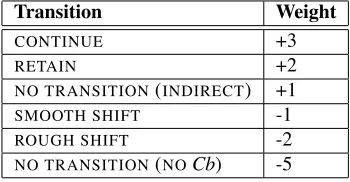
For the evaluation to accurately reflect the relation between Centering Theory transitions and coherence and summari-sation, a metric needs to be formulated which represents the positive and negative effects of the presence of certain transitions in summaries. This idea of formulating a metric for CT is not novel, but the development of a summary-motivated CT metric is. To reward those transitions which add to the coherence of a summary and to penalise those which negatively affect it, weights are assigned to each type of transition. The traditional order of preference for transi-tions is kept in this evaluation, althoughNO TRANSITIONs are treated differently (see Section 4.1.).
Although the presence of a NO CBin other text types can
indicate a new discourse segment and therefore not be con-sidered damaging for coherence, summaries are necessarily shorter than full texts. Due to the nature of a summary, sum-mary sentences should generally be about the same topic. A sentence which does not contain even an indirect men-tion of an entity which has been repeated in other utter-ances throughout is detrimental to the flow of the text as the reader has to stop and work out why that particular sen-tence is included. In such a short text, the presence of even one or two utterances which do not have an entity in com-mon is noticeable and affects coherence negatively. A pre-liminary investigation of the evaluation texts indicated that parts of extracts which are viewed intuitively as less coher-ent can be attributed to the presence of aNO TRANSITION
(NOCb). Therefore, in terms of summarisation,NO TRAN
-SITION(NOCb) is the most damaging to coherence and is weighted accordingly. NO TRANSITION(INDIRECT) does not damage a summary’s coherence to the same extent be-cause the reader can easily infer that there is some kind of relationship between two entities.
To obtain the average transition score per summary, the weights for each transition identified are added, and then divided by the number of transitions, which is the total number of utterances-1. Table 3 shows the scores assigned to each transition, based on their relation to coherence. It should be noted that the numbers themselves assigned to the transitions are subjective. The most important part of the metric is the difference between the scores for each tran-sition because that represents how positive or negative the effect of a particular transition is on a summary.
Transition Weight
CONTINUE +3
RETAIN +2
NO TRANSITION(INDIRECT) +1
SMOOTH SHIFT -1
ROUGH SHIFT -2
NO TRANSITION(NOCb) -5
Table 3: Transition Weights for Summary Evaluation
According to this metric, the abstract used in the exam-ple above (Section 4.2.) would receive an average transi-tion score of 0.8, based on the scores for its transitransi-tions (1
NO TRANSITION(INDIRECT), 2RETAIN, 1ROUGH SHIFT)
and the number of transitions present (4). This score would then need to be compared to that of its corresponding ex-tract to allow a meaningful interpretation.
5. CT Evaluation of Summary Coherence
This section discusses the results of the CT evaluation carried out using the texts, parameters and metric de-scribed above (Section 4.). The evaluation maintains the distinction between human-based summaries (set 1) and automatically-basedsummaries (set 2).5.1. Results
In total, CT evaluated 78% of abstracts as more coherent than the extracts from which they were produced. 2% (1 instance) of pairs were considered to be of equal coher-ence, leaving 20% of extracts evaluated as more coherent than the human post-edited abstracts. If only set 1 is ex-amined, the abstracts are judged as better in 84% of cases, and the extracts in 16%. For set 2, extracts are considered more coherent than their corresponding abstracts 24% of the time, and 4% are evaluated as demonstrating equal co-herence, leaving 72% of abstracts classed as more coherent than their extracts. Table 4 displays the normalised tran-sition scores for all summaries. The next section provides some explanations for this performance of CT in evaluating coherence in computer-aided summaries.
Set 1 Set 2
Text Extract Abstract Extract Abstract
475968 2.4 2.5 0.6 1
475997 0.1 -2 -0.1 0.8
476016 -0.2 0.8 0.1 1
476032 -1 1.7 0.6 1
476038 -0.3 1.7 1 2
476040 -0.9 2.3 1 2.3
476052 -1.5 -2 0.7 2
476056 -0.7 2 0 0.3
476057 -0.6 1.7 0.8 1.3
476058 0.3 1 0.2 1.3
476059 0 0.8 -1 1.3
476062 0.2 1.5 1.3 1
476074 1.3 2 0 2
476086 0.9 2.3 0.3 0.6
476093 -0.8 0.2 0.2 0
476097 -1.4 2.7 3 3
476143 2.8 2.5 1.8 0
476183 2.2 2 0.7 1.5
476316 -0.7 0.3 1 0.7
476501 -1.1 0.8 0.2 1
476208 -0.3 2.8 0.5 0.3
476520 -1.7 -0.3 -0.3 1.5
sci01 -0.1 0 -0.7 -0.3
sci03 -0.2 3 -0.2 0
sci37 0.6 1.7 1.5 1.3
Total 0 1.3 0.5 1.1
score
5.2. Discussion
There are several reasons for the set 2 abstracts results in comparison with set 1. First of all, CT considers represen-tations of the same information (an entity in consecutive utterances). The sentences extracted from source texts au-tomatically are more likely to be repetitive, i.e., to focus on exactly the same aspects of the same topic, due to the way that term-based summarisation works. Such automatic methods are not concerned with the way sentences fit to-gether, or the ways in which they repeat information. If repetitive sentences are presented to a human summariser, they are very likely to change them to make them more readable, which will involve some modification of the in-formation or sentences to try to avoid repetition, as advised in their guidelines. However, the resulting abstract is con-sidered less coherent by CT when such changes affect the ranking of elements within the sentences, or delete some of these altogether. If the same sentence is taken as the starting point in the extract and in the abstract, it will mean that the abstract is less coherent because the links in subse-quent sentences to the initial ordering are disrupted. This illustrates the fact that information content cannot be com-pletely divorced from issues of readability and coherence, which is emphasised by discussions with a human judge who evaluated the coherence and readability of the sum-maries using intuitive judgement (see Section 6.).
Related to these repetitive sentences is the presence of a ’headline’ in automatically produced extracts. This head-line can be repeated, once with a location and once without, for example:
RUSSIA: Threats get Russians to pay tax - but not much. Threats get Russians to pay tax - but not much.
This would be analysed by CT as displaying the transition
CONTINUE, although it is obviously not desirable to have such repetition in any kind of summary. This increased the number ofCONTINUEandRETAINtransitions in automatic
extracts (allowed because of the weak version of Constraint 1). If the same sentence is repeated immediately after its first instance, the utterances will be deemed optimally co-herent due to the fact that the same entities are mentioned in exactly the same position. Because the transition weights in the evaluation metric reward the more coherent transi-tions, the average transition score is higher than it might have been had one of these headlines not been included. This should be taken into account in future uses of CT in evaluation of automatically produced summaries.
The third reason for these results is that the transformation of automatic extracts into abstracts was not as simple as that of human-produced extracts. Where human annotators have the option to indicate sentences which contain infor-mation vital to the full understanding of a sentence, such as the antecedent of a pronoun, this is not the case with extracts produced automatically. During the transforma-tions of automatic extracts into abstracts, the source was accessed on a number of occasions in order to resolve a pronoun and replace it with the full NP to make the text understandable. However, improvements such as these are not reflected in the CT evaluation, because it does not con-sider that such operations may have to be applied, being developed for whole discourses rather than ones which are
produced from parts of a whole. Issues such as whether a pronoun has an antecedent or not, and whether this has to be remedied to make the text coherent from the point of view of a human reader, are simply not addressed by the theory because it was not designed to deal with such issues. In these cases, the same transition will hold between ut-terances regardless of whether the entity was originally an unresolved pronoun or a full NP mention.
6. CT Evaluation vs Human Judgement
Because the evaluation using CT is a new method, not having been used in this form for this task before, human judgements about the summaries’ coherence and readabil-ity are also obtained in an attempt to validate the evaluation method. Human readers are the ultimate users of computer-aided summaries which have been created by post-editing automatically produced extracts and so their judgement matters. In addition, being based on entity repetition, CT does not take into account aspects of extracts and abstracts such as the use of connectives to signal relations between units or the restructuring of NPs to avoid repetition. Other limitations of CT for the evaluation of summary coherence were discussed in Section 5.2. The human judge was asked to intuitively select the more readable and coherent sum-mary out of an extract/abstract pair, but was not told which text was which.
6.1. Results of Human Judgement
In total, 82% of abstracts were judged to be more read-able/coherent than the extracts from which they were pro-duced. The human judge expressed complete uncertainty about one pair (2%), leaving 16% of extracts evaluated as more coherent than their corresponding abstracts. Similar to the CT evaluation of coherence, examining the two sets separately demonstrates a better evaluation of set 1 than set 2. Set 1 abstracts are judged as better in more cases: 92% of the time. Only 2 human-produced extracts (8%) were judged as more readable/coherent than the abstracts created by post-editing them. Automatic extracts are evaluated as better than their corresponding abstracts in 24% of cases, and there is one case of complete uncertainty (4%), mean-ing that 72% of the set 2 abstracts are considered to be more readable/coherent.
6.2. Agreement between CT and Human Judge In terms of agreement between the CT evaluation and the evaluation by the human judge, their total agreement was 70%, and total disagreement was 26%. Two cases (4%) were unable to be compared because in one case the hu-man judge could not select the better text, and in the other case, CT evaluated the abstract and the extract as exactly the same in terms of coherence. As with the other results, the evaluation of set 1 was better on the whole than that of set 2. The human judge and CT agreed in 76% of cases in set 1, and disagreed in 24%. The summaries which could not be compared belong to the automatic group, constitut-ing 8% of cases. However, in the instance of the CT evalu-ation of equal coherence, the human judge commented that it was extremely difficult to decide on a better summary be-cause they were so similar, which is in keeping with the CT evaluation. For set 2, the human judge and CT agreed in 64% of cases and disagreed 28% of the time.
To establish whether the disagreement between the human judge and Centering Theory indicates a problem with the reliability of CT as an evaluation method, chi-square was calculated. Chi-square is normally calculated between a set of expected results and a set of observed results, to see whether there is a statistically significant difference. In the case of this particular evaluation, the expected result was that the human would agree with the CT evaluation on all pairs of extracts and abstracts. The number of agree-ments and disagreeagree-ments on pairs between CT and the hu-man judge is the observed result. Chi-square revealed that there is no statistically significant difference between the CT and human evaluations of pairs, with a confidence level of p≤0.001. This means that CT can be used as a reliable way of evaluating coherence because there is no statistical difference between its evaluation of the better summary out of a pair and human judgement on the same pair.
6.3. Discussion
The disagreement between the human judge and CT illus-trates the fact that what a human considers to be a ’readable’ and coherent text is not necessarily the same as something which is judged more coherent in terms of an ’objective’ theory of local coherence. The comparison of the CT and human evaluations correlates with the findings of other re-searchers (Kibble, 2001; Poesio et al., 2004), who claim that CT alone is not always enough to account for the co-herence of a text. Indeed, a reader does not assess a text solely on whether an entity is mentioned in consecutive ut-terances, although this can be an important part of their as-sessment. They also look at aspects such as rephrasing, reordering and conciseness. However, CT is still consid-ered a useful tool in evaluating the local coherence of sum-maries (as chi-square proved), although at this stage in its development as an evaluation method it is wise to supple-ment it with other methods to take into account the wider variety of aspects of coherence and readability obvious to a human. Its appropriateness for the task was supported by discussions with the human judge. In most cases the judge found it very difficult to select the best summary out of a pair in terms of readability and coherence alone: the in-formation contained in the summary nearly always affected
their judgement. Therefore any assessment of coherence which is more objective than intuitive human judgement is useful for evaluation.
7. Conclusions
This paper presented an investigation into the use of Cen-tering Theory for the evaluation of coherence in pairs of extracts and abstracts produced in a computer-aided sum-marisation environment. Current means of evaluating qual-ity in automatic summaries, such as considering dangling anaphors, discourse ruptures, grammaticality, etc., are in-appropriate for this task due to the way computer-aided summaries are produced. Users of CAS systems should have access to guidelines describing how best to post-edit the automatically produced extract to transform it into a readable and coherent abstract. These guidelines cover aspects which are often used in the evaluation of coher-ence/readability, meaning that using the same criteria for evaluation is unfair.
CT is considered an appropriate option for development as an evaluation method because it is a theory of local coher-ence considering consecutive utterances, which are impor-tant in short texts comprising parts of a whole, such as sum-maries. The CT parameters most suited to summaries were specified (utterance = sentence; realisation = direct + indi-rect for possessive pronouns; ranking = grammatical/linear; constraint 1 = weak), and a metric was formulated to rep-resent the effect of CT transitions in summaries. The tra-ditional preference order for transitions was adopted, with some alterations regardingNO TRANSITIONs, and the most
damaging transition in a summary was found to be NO TRANSITION(NOCb):CONTINUE>RETAIN>NO TRAN
-SITION(INDIRECT)>SMOOTH SHIFT>ROUGH SHIFT>
NO TRANSITION (NO Cb). 100 news text summaries (50 extract/abstract pairs) were subject to evaluation using CT and the metric developed.
Of the 50 pairs, CT evaluated 78% of abstracts as more co-herent than the extracts from which they were produced. Human judgement was also obtained to validate the CT evaluation. The human judge considered 82% of abstracts as more coherent than the extracts from which they were produced. The CT evaluation and the human judge agreed in 70% of cases. Chi-square was calculated to assess whether their disagreement poses problems for the relia-bility of using CT in evaluation; it revealed that there is no statistically significant difference between the evaluations, with a confidence level of p≤0.001. This means that CT can be used as a reliable way of evaluating coherence in pairs of summaries.
than human intuition alone. However, it is wise to supple-ment the CT evaluation with other methods, to take into account the wider variety of aspects of coherence and read-ability obvious to readers of summaries. In future, it would be interesting to experiment further with different instanti-ations of the theory, especially as other researchers have found that different instantiations result in different fre-quencies of occurrence of NO CBtransitions, which were found to be the most damaging for summary coherence.
8. References
S. E. Brennan, M. A. Friedman, and C. J. Pollard. 1987. A Centering Approach to Pronouns. In Proceedings of the 25th Annual Meeting of the Association for Compu-tational Linguistics (ACL’87), pages 155–162.
R. Donaway, K. Drummey, and L. Mather. 2000. A Comparison of Rankings Produced by Summarization Evaluation Measures. In Proceedings of the NAACL-ANLP2000 Workshop on Automatic Summarization, pages 69–78.
B. J. Grosz, A. K. Joshi, and S. Weinstein. 1995. Center-ing: a Framework for Modelling the Local Coherence of Discourse. Computational Linguistics, 21(2):203–225. R. Gunning. 1988. The Technique of Clear Writing. New
York. McGraw-Hill.
A. Harnly, A. Nenkova, R. Passonneau, and O. Rambow. 2005. Automation of Summary Evaluation by the Pyra-mid Method. In Proceedings of Recent Advances in Natural Language Processing 2005 (RANLP’05), pages 226–232.
L. Hasler, C. Orasan, and R. Mitkov. 2003. Building Better Corpora for Summarisation. InProceedings of Corpus Linguistics 2003, pages 309–319.
L. Hasler. 2004. An Investigation into the Use of Centering Transitions for Summarisation. InProceedings of the 7th Annual Colloquium of the UK Special Interest Group in Computational Linguistics (CLUK’04), pages 100–107. L. Hasler. 2007. From Extracts to Abstracts: Human
mary Production Operations for Computer-Aided Sum-marisation.Ph.D. thesis, University of Wolverhampton. L. Hirschman and I. Mani. 2003. Evaluation. In R. Mitkov, editor,The Oxford Handbook of Computational Linguis-tics, pages 414–429. Oxford. Oxford University Press. M. Kameyama. 1998. Intrasentential Centering: A Case
Study. In M. A Walker, A. K. Joshi, and E. F. Prince, editors, Centering Theory in Discourse, pages 89–112. Oxford. Oxford University Press.
N. Karamanis, M. Poesio, C. Mellish, and J. Oberlander. 2004. Evaluating Centering-based Metrics of Coherence Using a Reliably Annotated Corpus. InProceedings of the 42nd Annual Meeting of the Association for Compu-tational Linguistics (ACL’04), pages 391–398.
N. Karamanis. 2003. Entity Coherence for Descriptive Text Structuring.Ph.D. thesis, University of Edinburgh. R. Kibble. 2001. A Reformulation of Rule 2 of Centering
Theory.Computational Linguistics, 27(4):579–587. J. P. Kincaid, R. P. Fishburne, R. L. Rogers, and B. S.
Chissom. 1975. Derivation of new readability formulas (automated readability index, Fog count and Flesch read-ing ease formula) for navy enlisted personnel. Research
Branch Report 8-75, Naval Air Station, Memphis, TN, USA.
M. Lapata and R. Barzilay. 2005. Automatic Evaluation of Text Coherence: Models and Representations. In Pro-ceedings of the 19th International Conference on Artifi-cial Intelligence (IJCAI’05), pages 1085–1090.
C.-Y. Lin. 2001. SEE - Summary Evaluation Environment. http://haydn.isi.edu/SEE/.
C.-Y. Lin. 2004. ROUGE: A Package for Automatic Eval-uation of Summaries. InProceedings of The ACL2004 Workshop Text Summarization Branches Out, pages 74– 81.
I. Mani. 2001. Automatic Summarization. Amster-dam/Philadelphia. John Benjamins.
J.-L. Minel, S. Nugier, and G. Piat. 1997. How to Appre-ciate the Quality of Automatic Text Summarization? Ex-amples of FAN and MLUCE Protocols and their Results on SERAPHIN. In Proceedings of the ACL/EACL’97 Workshop on Intelligent Scalable Text Summarization (ISTS’97), pages 25–31.
A. Nenkova and R. Passonneau. 2004. Evaluating Content Selection in Summarization: The Pyramid Method. In Proceedings of the Human Language Technology Con-ference/North American Chapter of the Association for Computational Linguistics (HLT/NAACL2004), pages 145–152.
C. Orasan and L. Hasler. 2006. Computer-aided Summari-sation: What the User Really Wants. InProceedings of the 5th International Conference on Language Resources and Evaluation (LREC2006), pages 1548–1551. C. Orasan, R. Mitkov, and L. Hasler. 2003. CAST: a
Computer-Aided Summarisation Tool. In Proceedings of the 11th Conference of The European Chapter of the Association for Computational Linguistics (EACL’03), pages 135–138.
C. Orasan. 2006. Comparative Evaluation of Modular Summarisation Systems Using CAST. Ph.D. thesis, Uni-versity of Wolverhampton.
M. Poesio, R. Stevenson, B. di Eugenio, and J. Hitzeman. 2004. Centering: A Parametric Theory and its Instantia-tions. NLE Technical Note TN-02-01/CS Technical Re-port CSM-369, University of Essex, UK.
H. Saggion and G. Lapalme. 2000. Concept Identification and Presentation in the Context of Technical Text Sum-marization. InProceedings of The NAACL-ANLP 2000 Workshop on Automatic Summarization, pages 1–10. M. Strube and U. Hahn. 1999. Functional Centering
-Grounding Referential Coherence in Information Struc-ture. Computational Linguistics, 25(3):309–344. M. A. Walker, A. K. Joshi, and E. F. Prince. 1998.