Attribute-Based Fully Homomorphic Encryption
with a Bounded Number of Inputs
Michael Clear
Georgetown University and George Mason University E-mail: [email protected]
Ciar´
an Mc Goldrick
School of Computer Science and Statistics,Trinity College Dublin, Ireland E-mail: [email protected]
Abstract: The only known way to achieve Attribute-based Fully Homomorphic Encryption (ABFHE) is through indistinguishability obfuscation. The best we can do at the moment without obfuscation is Attribute-Based Leveled FHE which allows circuits of an a priori bounded depth to be evaluated. This has been achieved from the Learning with Errors (LWE) assumption. However we know of no other way without obfuscation of constructing a scheme that can evaluate circuits of unbounded depth. In this paper, we present an ABFHE scheme that can evaluate circuits of unbounded depth but with one limitation: there is a boundN on the number of inputs that can be used in a circuit evaluation. The boundN could be thought of as a bound on the number of independent senders. Our scheme allowsN to be exponentially large so we can set the parameters so that there is no limitation on the number of inputs in practice. Our construction relies on multi-key FHE and leveled ABFHE, both of which have been realized from LWE, and therefore we obtain a concrete scheme that is secure under LWE.
Keywords:Attribute-Based Encryption; Fully Homomorphic Encryption;
Biographical notes: Michael Clear is a postdoctoral researcher at Georgetown University and George Mason University. He received his PhD from Trinity College Dublin in 2016.
Ciar´an Mc Goldrick is an Assistant Professor in the School of Computer Science & Statistics in Trinity College Dublin Ireland where he has been a faculty member since 1999. His research interests include constrained wireless networking, computer systems and security, renewable energy technologies and engineering education. He is a Senior Member of both the IEEE and ACM, and has been Visiting Professor in UCLA in 2015 and 2016.
1 Introduction
Attribute Based Encryption (ABE) is a cryptographic primitive that realizes the notion of cryptographic access control. ABE owes its roots to a simpler primitive called Identity Based Encryption (IBE), proposed in 1985 by Shamir (Shamir (1985)) and first realized in 2001 by Boneh and Franklin (Boneh and Franklin (2001)) and Cocks (Cocks (2001)). IBE is centered around the notion that a user’s public key can be efficiently derived from an identity string and a system-widepublic parameters.
The identity string may be a person’s email address, IP address or staff number, depending on the application. The public parameters along with a secret trapdoor (master secret key) are generated by a trusted third party referred to as the Trusted Authority (TA). The primary purpose of the TA is to issue a secret key to a user that corresponds to her identity string (we abbreviate this to identity) over a secure channel. The means by which the users authenticate to the TA or establish a secure channel are outside the scope of IBE.
The TA uses the master secret key to derive the secret keys for identities. It is assumed that all parties have a priori access to the public parameters. For instance, the public parameters may be hard-coded in the software used by the participants, or made available on a public website.
ABE was proposed in 2005 by Sahai and Waters (Sahai and Waters (2005)). ABE can be viewed as a generalization of IBE. In ABE, the TA generates secret keys instead for access policies (an access policy prescribes the types of data a user is authorized to access). An encryptor Alice can use the public parameters to encrypt data, and embed within the ciphertext a descriptor of her choice that suitably describes her data. The descriptor is referred to as an attribute. We caution the reader that although the term attribute is used here in its singular form, it may in fact incorporate a collection of descriptive elements (which we call “subattributes”). To illustrate this, an example of an attribute is {“CS”,“CRYPTO”}; it consists of the subattributes “CS” and “CRYPTO”. Let us assume
that this is the attribute chosen by Alice. Suppose the TA has issued a user Bob a secret key for his access policy. Keeping with the above example, suppose his access policy “accepts” an attribute if it contains both
the subattributes “CS” and “CRYPTO”. It follows that Alice’s chosen attribute satisfies Bob’s access policy. As such, Bob can use his secret key to decrypt Alice’s ciphertext. Notice that IBE is a special case of ABE. One way of looking at an IBE scheme is that each attribute corresponds to a unique identity string such as an email address or phone number. In IBE, there is a one-to-one mapping between attributes and access policies, so Alice is given a secret key for a policy that is singularly satisfied by her identity string.
We will return to identity/attribute-based encryption momentarily. First we need to introduce the notion of fully homomorphic encryption (FHE). An FHE scheme can evaluate all polynomial-time computable functions. Strikingly, it achieves this without expanding the ciphertext size. For many applications, we need only the capability to evaluate circuits of some limited depth. Leveled FHE is a relaxation of FHE that can evaluate circuits of depth at most some positive integerd.
FHE was first constructed in 2009 in a breakthrough work by Gentry (Gentry (2009)). Most work on FHE has focused on the public-key setting but there has been some work in recent years in achieving FHE in the identity/attribute-based setting. Gentry, Sahai and Waters (Sahai and Waters (2013)) constructed the first leveled Identity-Based Fully Homomorphic Encryption (IBFHE) scheme and the first leveled Attribute-Based Fully Homomorphic Encryption (ABFHE) scheme from the Learning with Errors (LWE) problem. Clear and Mc Goldrick (Clear and Mc Goldrick (2015)) extended the former to achieve “multi-identity” leveled IBFHE where evaluation can be performed on ciphertexts associated with different identities. These schemes are leveled; that is, they are not “pure” FHE schemes insofar as all circuits cannot be evaluated, only those of limited depth. The only known way to achieve “pure” ABFHE (i.e. where all circuits can be evaluated) is through indistinguishability obfuscation (Garg et al. (2013)), namely the construction in (Clear and Mc Goldrick (2014)). The best we can do at the moment without obfuscation is Attribute-Based Leveled FHE which allows circuits of an a priori bounded depth to be evaluated. However we know of no other way in the identity/attribute-based setting (without obfuscation) of constructing a scheme that can evaluate circuits of unbounded depth. This has particular significance in the attribute-based setting because the public parameters are generated once and the chosen bound on the circuit may not cater for all applications where deeper circuits are needed, and it would be unwieldy to generate new public parameters.
The technique of bootstrapping is currently the only known way to evaluate circuits of unbounded depth. Obtaining ABFHE for circuits of unbounded depth has been impeded by the fact that employing bootstrapping
in the attribute-based setting (non-interactively) is particularly challenging since bootstrapping requires encryptions of the secret key bits to be available as part of the public key. Even in the identity-based setting this is a difficult challenge because one has to non-interactively derive encryptions of the secret key bits for any identity string from the public parameters alone. The only known way of doing bootstrapping is via indistinguishability obfuscation (Clear and Mc Goldrick (2014)). Without obfuscation, we have not been able to achieve “pure” ABFHE.
In this work we construct an almost “pure” ABFHE with one catch, namely, there is a pre-established bound
N on the number of inputs to the circuits that can be evaluated where each input is a bitstring of arbitrary size. Another way of looking at it is that there is a limit on the number of independent senders who can contribute inputs to the circuit. Our construction allows
N to be exponentially large because the parameter sizes grow logarithmically in N so it can be set large enough to accommodate most reasonable applications. For example by setting N = 232, the parameter sizes do not grow much and over 4 billion inputs can be accommodated, which is more than one would expect in reasonable applications, since each input (contributed by an independent sender) can be of arbitrary size.
1.1 Our Construction
Our construction relies on multi-key FHE and leveled ABFHE. Our use of multi-key FHE is similar to that of (Clear and Mc Goldrick (2013)) which uses it to a achieve a non-compact form of ABFHE. If we have a leveled ABFHE with a class of access policiesF, then we get a (“pure”) ABFHE for the class of policiesFwith a
boundN on the number of inputs. The main idea behind our approach is that an encryptor generates a key-pair (pk,sk) for the multi-key FHE scheme and it encrypts the secret key skwith the leveled ABFHE scheme to obtain ciphertext ψ. Then the encryptor encrypts every bit of plaintext (say w bits) with the multi-key FHE scheme using pk to obtain ciphertext c1, . . . , cw. It sends the ciphertextCT:= (ψ, c1, . . . , cw). The evaluator evaluates the circuit on the multi-key FHE ciphertexts and obtains an encrypted resultc0. Then it evaluates with the leveled ABFHE scheme the decryption circuit of the multi-key FHE scheme on c0 together with the encrypted secret keys (the ψciphertexts). We obtain a ciphertext in the leveled ABFHE scheme that encrypts the result of the computation (i.e. what c0 encrypts). The size of the resulting ciphertext is independent of N and the size of the circuit. By using the multi-key FHE scheme of Clear and Mc Goldrick (Clear and Mc Goldrick (2015)), we only need the leveled ABFHE scheme to have L=
O(logN) levels whereN is the bound on the number of inputs.
ciphertexts with different attributes, we refer to the scheme as multi-attribute. Whether our construction is single-attribute or multi-attribute depends on the underlying leveled ABFHE scheme that is used. Single-attribute leveled ABFHE has been achieved from LWE as has identity leveled IBFHE. However multi-attribute leveled ABFHE is an open problem. Hence we cannot obtain “pure” multi-attribute ABFHE with a bounded number of inputs because there are no multi-attribute leveled schemes. The closest we have is multi-identity leveled IBFHE. The only known way of achieving “pure” multi-attribute ABFHE is via indistinguishability obfuscation.
1.2 Organization
This paper is organized as follows. In Section 2, we introduce definitions that we use throughout the paper including a definition of Attribute-Based Homomorphic Encryption. In Section 3, we provide security definitions and introduce a new security notion which we call
EVAL-SIM security. In Section 4, we present our construction of ABFHE with a bounded number of inputs. We prove security of the construction in Section 5. We review our main result and its corollaries in Section 6. In Section 7 we prove the sel-EVAL-SIM
security of the multi-attribute ABFHE scheme from (Clear and Mc Goldrick (2014)). Finally in Section 8 we present performance results for the multi-key FHE scheme of L´opez-Alt, Tromer and Vaikuntanathan (L´opez-Alt et al. (2012)).
2 Definitions
Let us briefly recall the definition of key-policy attribute based encryption (KP-ABE). A trusted authority (TA) generates public parameters and a master secret key. It uses its master secret key to generate secret keys for access policies. Alice encrypts her data, using the public parameters, under an “attribute” of her choice in some designated set of “attributes”. An “attribute” serves as a descriptor for the data she is encrypting. Suppose the TA issues a secret key for someaccess policyto Bob. This access policy essentially describes which attributes he is authorized to access. Bob can decrypt Alice’s ciphertext if its associated “attribute” satisfies hisaccess policy.
We refer to the result of an evaluation on a set of ciphertexts as anevaluated ciphertext.
2.1 Models of Access Control for Decryption
A model of access control for decryption specifies how decryption of an evaluated ciphertext is to be performed. Consider an evaluated ciphertext c0 associated with
d attributes a1, . . . , ad ∈A. There are two primary
models of decryption, each with different strengths and weaknesses. Both models will be considered in turn.
2.1.1 Atomic Access
The intended semantics of this model is that a user should only be able to decrypt an evaluated ciphertext
c0 if she has a secret key for a policy f that satisfies all d attributes a1, . . . , ad. In other words, policies are enforced in an “all or nothing” manner. So in order to decrypt a ciphertext c0, the decryptor needs a
secret key for a policy f with f(a1) =· · ·=f(ad) = 1. Furthermore, it captures the natural requirement that a decryptor be authorized completely to access data associated with a particular attribute.
2.1.2 Non-Atomic
Access
-
Collaborative
Decryption
The interpretation in this model is that a group of users can pool together their secret keys to decrypt a ciphertext c0. In other words, there may not be a single f ∈F that satisfies all d attributes (or no user
holds a secret key for such an f), but the users may share secret keys for a set of policies that “covers all”
d attributes. In other words, suppose the group of users have (between them) secret keys for policiesf1, . . . , fk ∈
F. In this model, they can decrypt c0 if and only if for
every i∈[d], there exists aj∈[k] such thatfj(ai) = 1. How is decryption performed? There are a few possible approaches:
1. Every user in the group shares their secret keys with each other, and all users can decrypt. However, this violates the principle of least privilegeand gives users in the group access to data they might not have been explicitly authorized to access.
2. Perform decryption collaboratively using a multi-party computation (MPC) protocol. This approach has been suggested in other works including (L´opez-Alt et al. (2012)). The advantage of this approach is that it does not leak any party’s secret key to the other parties.
3. It is possible that a user has been issued secret keys for several policies. For example: ABE for disjunctive policies can be achieved with an IBE scheme where the TA issues secret keys for different identities (treated as “attributes”) to the same user.
4. Collaborative decryption subsumes the
functionalityof the atomic model i.e. a user with a single policyf satisfying all d attributes can still decrypt on her own.
Our syntax for attribute based homomorphic
specifies the atomic model whereas the setting K =D
specifies the collaborative model. Note that this is only a syntactic rule, it does not pertain to enforcing the security property of either model. Our “default” model, assumed implicitly without further qualification, is the collaborative model. This is for several reasons, which we will enumerate now:
• In the identity-based setting, collaborative decryption is necessary. In this context, a single
f is satisfied by only one attribute (i.e. identity). Suppose an evaluation is performed on ciphertexts with different identities to yield an evaluated ciphertextc0. Clearly, there is no single secret key that is sufficient to decrypt c0, since each secret key corresponds to exactly one identity. Because IBE is a special case of ABE, and very important in its own right, we want to ensure we allow multi-identity evaluation.
• As noted above, the collaborative model subsumes the functionality of the atomic model. The greater flexibility of permitting multiple users to collaboratively decrypt (such as via MPC) invites more applications.
2.2 Definition of Attribute-Based Homomorphic
Encryption
Recall the definition of ABE from the introduction. An ABE scheme with message space M, attribute space A and class of supported access policies F is a tuple of probabilistic polynomial time (PPT) algorithms (Setup,KeyGen,Encrypt,Decrypt).
Degree of composition: Let c1, . . . , c` be input ciphertexts to an evaluation. Each ciphertext ci is associated with an attribute ai∈A. The degree of composition of the evaluation is the number of
distinctattributes among theai; that is, the cardinality of the set|{a1, . . . , a`}|.
We use the symbol d to denote the degree of
composition. When the context is unambiguous, the term is abbreviated to degree. We use the symbolD to denote the maximum degree of composition supported by a particular system.
Definition 2.2: A (Key-Policy) Attribute-Based Homomorphic Encryption (ABHE) scheme E(D,K) for
an integerD >0 and an integerK ∈[D] is defined with respect to a message space M, an attribute space A, a class of access policies F⊆A→ {0,1}, and a class of circuits C⊆ M∗→ M. An ABHE scheme is a tuple of
PPT algorithms (Setup,KeyGen,Encrypt,Decrypt,Eval) where Setup, KeyGen, Encrypt are defined equivalently to KP-ABE. We denote byC the ciphertext space. The decryption algorithm Decrypt and evaluation algorithm
Evalare defined as follows:
• Decrypt(hskf1, . . . ,skfki, c): On input a sequence of
k ≤K secret keys for policies f1, . . . , fk ∈Fand a
ciphertext c, output a plaintext µ0 ∈ M iff every attribute associated withc is satisfied by at least one of thefi; output⊥otherwise.
• Eval(PP, C, c1, . . . , c`): On input public parameters
PP, a circuitC∈Cand ciphertextsc1, . . . , c`∈ C, output anevaluated ciphertext c0∈ C.
More precisely, Evalis required to satisfy the following properties:
• Over all choices of (PP,MSK)←Setup(1λ),
C:M`→ M ∈
C, every d ≤D, a1, . . . , a`∈
As.t|{a1, . . . , a`}|=d, µ1, . . . , µ`∈ M, ci←
Encrypt(PP, ai, µi) for i∈[`], and c0←
Eval(PP, C, c1, . . . , c`):
– Correctness
Decrypt(hskf1, . . . ,skfki, c
0) =C(µ
1, . . . , µ`) iff∀i∈[d]∃j ∈[k] fj(ai) = 1
(2.1)
for any k ∈[K], any f1, . . . , fk ∈F, and any skfj ←KeyGen(MSK, fj) forj∈[k].
– Compactness There exists a fixed
polynomial s(·,·) for the scheme such that
|c0| ≤s(λ,d). (2.2)
The complexity of all algorithms may depend on D. Furthermore, the size of freshly encrypted ciphertexts, the size of the public parameters and the size of secret keys may depend onD. On the other hand, the size of the evaluated ciphertext c0 must remain independent of D
(along with the size of the circuitC), but it may depend on the actual number of distinct attributes, d, used in the evaluation. Note that single-attribute ABHE is the special case where D = 1 i.e. evaluation is correct only for ciphertexts associated with the same attribute. As mentioned earlier,K = 1 represents the atomic model of decryption whereas K =D represents the collaborative model. When the parameter K is omitted, it can be assumed that K =D; that is, the notation E(D) is
shorthand forE(D,D).
Definition 2.3: Multi-Attribute ABHE (MA-ABHE)
is a primitive with the same syntax as ABHE
except that its Setup algorithm takes an additional input D >0, which is the maximum degree of composition to support. An instance of MA-ABHE can be viewed as a family of ABHE schemes {E(D)=
(Setup,KeyGen,Encrypt,Decrypt,Eval)}D>0.
Remark 1: In the constructions considered in this work, A consists of attributes of fixed length. However
A concrete ABHE scheme is characterized by three facets: 1). its supported computations (i.e. the class of circuits C); 2). its supported access policies (the class
of access policies F); and 3). its supported composition
defined by its maximum degree of composition,D.
3 Security Definitions
3.1 Semantic Security
The semantic security definition for ABHE is the same as that for ABE, except that the adversary has access to the Eval algorithm as well. There are two definitions of semantic security for ABE: selective and adaptive security. In the selective security game, the adversary chooses the attribute to attack before receiving the public parameters whereas in the adaptive game, the adversary chooses its target attribute after receiving the public parameters. We denote the selective definition byIND-sel-CPAand the adaptive definition by
IND-AD-CPA.
3.2 Simulation Model of Evaluation
Let D and K ≤D be fixed parameters denoting the maximum degree of composition and the maximum number of keys passed to the decryption algorithm respectively. Consider ciphertexts c1, . . . , c` encrypted under attributesa1, . . . , a`respectively. We expect that a ciphertextc0resulting from an evaluation onc1, . . . , c`be decryptable by a set of policies{fi}i∈[k] withk ∈[K] if
the following two conditions are satisfied: (1). the degree of compositiond is less thanD(i.e.d :=|{a1, . . . , a`}| ≤
D) - for convenience we re-label thed distinctattributes as a1, . . . , ad; and (2). for every i∈[d], there exists a
j∈[k] withfj(ai) = 1.
Ideally a user who does not have keys for such a set of policies {fi}i∈[k] should not learn anything about c0
except that it is associated with the attributesa1, . . . , ad. This implies that such a user should not be able to efficiently decide whetherc0was produced fromc1, . . . , c` or an alternative sequence of ciphertextsd1, . . . , d`0 with
the same collection of distinct attributesa1, . . . , ad. We now give a definition of security that captures the fact that an adversary learns nothing from an evaluated ciphertext other than that it was generated from a particular circuit and is associated with the attributes
a1, . . . , ad.
EVAL-SIMSecurity: Let F ⊆F be a set of policies, and letA⊆Abe a set of attributes. For convenience, we define the predicate
compat(F, A) = (
1 if∃a∈A∀f ∈F f(a) = 0 0 otherwise.
Let E be an ABHE scheme with parameters D and
K. We define the following experiments for a pair of
PPT adversarial algorithms A= (A1,A2) and a PPT
algorithmS.
• ExpREALE,A (λ) (Real World): 1. (PP,MSK)← E.Setup(1λ). 2. (C,(a1, µ1), . . . ,(a`, µ`),st)←
AE1.KeyGen(MSK,·)(PP).
3. LetF be the set of policies queried byA1.
4. Let A:={a1, . . . ,ad} be the distinct attributes in the collectiona1, . . . , a`. 5. Assert d ≤D and compat(F, A) = 1;
otherwise output a random bit and abort. 6. cj← E.Encrypt(PP, aj, µj) forj∈[`]. 7. c0← E.Eval(PP, C, c
1, . . . , c`). 8. b← AO(2 MSK,·)(st, c0, c1, . . . , c`) 9. Output b.
• ExpIDEALE,A,S(λ)(Ideal World): 1. (PP,MSK)← E.Setup(1λ). 2. (C,(a1, µ1), . . . ,(a`, µ`),st)←
AE1.KeyGen(MSK,·)(PP).
3. LetF be the set of policies queried byA1.
4. Let A:={a1, . . . ,ad} be the distinct attributes in the collectiona1, . . . , a`. 5. Assert d ≤D and compat(F, A) = 1;
otherwise output a random bit and abort. 6. cj← E.Encrypt(PP, aj, µj) forj∈[`]. 7. c0← S(PP, C, A).
8. b← AO(2 MSK,·)(st, c0, c1, . . . , c`) 9. Output b.
whereO(MSK,·) is defined as: • O(MSK, f) :
1. If compat(F∪ {f}, A) = 1: set F ←F∪ {f} and output E.KeyGen(MSK, f).
2. Else output⊥.
Then E is said to be EVAL-SIM-secure if there exists a PPT simulator S such that for every pair of PPT algorithmsA:= (A1,A2), it holds that
|Pr[ExpREALE,A →1]−Pr[ExpIDEALE,A,S →1]|<negl(λ).
Note that the above definition relates to adaptive security. For selective security, the adversary must choose the attributes before receiving the public parameters. As a result, in the modified definition, A consists of three PPT algorithms (A1,A2,A3). Furthermore, A1
outputs a set of d ≤D attributes A:={a1, . . . ,ad}; A2 receives PP and outputs a circuit C along with a
sequence of ` pairs (µi, ai) for i∈[`] where µi∈ M and ai∈A. Finally,A3 is defined equivalently toA2 in
the above definition. We denote the selective variant by
4 Construction
4.1 Building Blocks
4.1.1 Multi-Key FHE
Multi-Key FHE allows multiple independently-generated keys to be used together in a homomorphic evaluation. The syntax of multi-key FHE imposes a limit N
on the number of such keys that can be supported. Furthermore, the size of the evaluated ciphertext does not depend on the size of the circuit (or number of inputs), but instead on the number of independent keys
Nthat is supported. In order to decrypt, the parties who have the corresponding secret keys must collaborate such as in an MPC protocol.
Based on Definition 2.1 in (L´opez-Alt et al. (2012)):
A multi-key C-homomorphic scheme family for a class of circuits Cand message space M is a family of PPT algorithms {E(N):= (Gen,Encrypt,Decrypt,Eval)}
N >0
whereE(N) is defined as follows:
• MKFHE.Gentakes as input the security parameter 1λ and outputs a tuple (pk,sk,vk) where pk is a public key,skis a secret key andvkis an evaluation key.
• MKFHE.Encrypttakes as input a public keypkand a message m∈ M, and outputs an encryption of
munder pk.
• MKFHE.Decrypt takes as input 1≤k≤N secret keyssk1, . . . ,skkand a ciphertextc, and outputs a message m0∈ M.
• MKFHE.Eval takes as input a circuit C∈C,
and ` pairs (c1,vk1), . . . ,(c`,vk`) and outputs a ciphertextc0.
Informally, evaluation is only required to be correct if at most N keys are used in MKFHE.Eval; that is, |{vk1, . . . ,vk`}| ≤N. Furthermore, the size of an evaluated ciphertextc0 must only depend polynomially on the security parameterλand the number of keys N, and not on the size of the circuit.
The IND-CPA security game for multi-key
homomorphic encryption is the same as that for standard public-key encryption; note that the adversary is given the evaluation keyvk.
There are two multi-key FHE schemes in the literature: the scheme of L´opez-Alt, Tromer and Vaikuntanathan (L´opez-Alt et al. (2012)) based on NTRU and the scheme of Clear and Mc Goldrick (Clear and Mc Goldrick (2015)) based on Learning wtih Errors (LWE). Although our construction can work with any multi-key FHE, we obtain better efficiency if we use the multi-key FHE scheme of Clear and Mc Goldrick, which we call CM. More precisely, the depth of the decryption circuit of CM is O(logN) (as opposed to O(log2N) in the case of the multi-key FHE from (L´opez-Alt et al.
(2012))) which results in fewer levels needed for the leveled ABFHE.
For the remainder of the paper, we will denote an instance of a multi-key FHE byEMKFHE.
4.1.2 Leveled ABFHE
Our approach uses a leveled ABFHE scheme in an essential way. A leveled ABFHE scheme allows one to evaluate a circuit of bounded depth. The bound on the depth L is chosen in advance of generating the public parameters. Gentry, Sahai and Waters (Sahai and Waters (2013)) presented the first leveled ABFHE where the class of access policies consists of bounded-depth circuits. They based security on LWE. A leveled Identity-Based FHE (IBFHE) scheme from LWE is also presented in (Sahai and Waters (2013)). Furthermore a leveled IBFHE that is multi-identity (supports evaluation on ciphertexts with different identities) was constructed in (Clear and Mc Goldrick (2015)) from LWE.
Any of the above schemes can be used to instantiate our construction and its properties are inherited by our construction. Therefore if we use an identity-based scheme, our resulting construction is identity-based etc. For the rest of the paper, we will denote a leveled ABFHE scheme byElABFHE with message spaceMElABFHE,
attribute spaceAElABFHE and class of predicatesFElABFHE.
4.2 Overview of Our Approach
The main idea behind our approach is to exploit multi-key FHE and leveled ABFHE to construct a new ABFHE scheme that can evaluate circuits with up toN
inputs, where N is chosen before generating the public parameters. Let EMKFHE be a multi-key FHE scheme whose decryption circuit has depth δ(λ, N) whereN is the number of independent keys tolerated and λis the security parameter. Let ElABFHE be a leveled ABFHE scheme as described in Section 4.1.2 that can compactly evaluate circuits of depth δ(λ, N).
Let wbe a positive integer. The supported message space of our scheme is M,{0,1}w. The supported attribute space is A,AElABFHE and the supported class
of access policies is F,FElABFHE. In other words, the
attribute space and class of access policies is the same as the underlying leveled ABFHE scheme. Finally, the class of supported circuits isC,MN → M.
Roughly speaking, to encrypt a message µ∈ M under attribute a∈A in our scheme, (1) a key triple
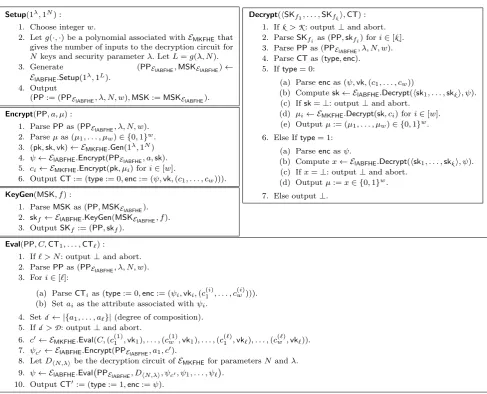
(pk,sk,vk) is generated for EMKFHE; (2) µ is encrypted with EMKFHE under pk; (3)sk is encrypted with ElABFHE under attribute a; (4) the two previous ciphertexts along withvkconstitute the ciphertext that is produced. Therefore, EMKFHE is used for hiding the message and for homomorphic computation, whereasElABFHEenforces access control by appropriately hiding the secret keys for EMKFHE.
It then homomorphically decrypts c0 with the leveled ABFHE scheme using the encryptions of the secret keys for EMKFHE. As a result we obtain a ciphertext whose length is independent of N and the circuit size, which satisfies our compactness condition.
In more concrete terms, we assume without loss of generality that the message space ofEMKFHEis{0,1}, and we encrypt a w-bit message µ= (µ1, . . . , µw)∈ {0,1}w one bit at a time using EMKFHE. Furthermore, let N be the maximum number of keys supported byEMKFHE. Our construction can therefore support the class of circuits
C={({0,1}w)N → {0,1}w}. We remind the reader that w can be arbitrarily large, and in practice, the length of plaintexts may be shorter than w. In practice, each sender’s input may be of arbitrary size. However, there is a limit,N, on the number of independent senders i.e. the number of inputs to the circuit where the inputs are taken from the domain{0,1}w.
4.3 Construction
We now present our construction, which we callbABFHE.
4.3.1 Setup
On input a security parameter λ and a bound N on the number of inputs to support, the following steps are performed:
1. Choose integerw.
2. Generate (PPElABFHE,MSKElABFHE)←
ElABFHE.Setup(1λ,1L) where L=O(logλ·N) is the depth of the decryption circuit of ElABFHE for parametersλandN.
3. Output (PP:= (PPElABFHE, λ, N, w),MSK:=
(PP,MSKElABFHE)).
4.3.2 Secret Key Generation
Given the master secret key MSK:= (PP,MSKElABFHE)
and a policyf ∈F, a secret key skf for f is generated as skf ← ElABFHE.KeyGen(MSKElABFHE, f). The secret key
SKf := (PP,skf) is issued to the user.
4.3.3 Encryption
On input public parameters PP:= (PPElABFHE, λ, N, w),
a binary string µ= (µ1, . . . , µw)∈ {0,1}w and an attribute a∈A: the sender first generates
a key triple for EMKFHE; that is, she computes (pk,sk,vk)← EMKFHE.Gen(1λ,1N). Then she runs
ψ← ElABFHE.Encrypt(PPElABFHE, a,sk). Subsequently
she uses pk to encrypt each bit µi ∈ {0,1} in turn using EMKFHE for i∈[w]; that is, she computes
ci← EMKFHE.Encrypt(pk, µi). Finally she outputs the ciphertextCT:= (type:= 0,enc:= (ψ,vk,(c1, . . . , cw))).
Remark 2: A ciphertext CT in our scheme has two components: the first is labeled withtypeand the second
is labeled with enc. The former has two valid values: 0 and 1; 0 indicates that the ciphertext is “fresh” while 1 indicates that the ciphertext is the result of an evaluation. The value of the type component specifies how theenccomponent is to be parsed.
4.3.4 Evaluation
On input public parametersPP:= (PPElABFHE, λ, N, w), a
circuit C∈C, and ciphertexts CT1, . . . ,CT` with `≤
N, the evaluator performs the following steps. Firstly, the ciphertexts are assumed to be “fresh” ciphertexts generated with the encryption algorithm. In other words, theirtypecomponents are all 0. Otherwise the evaluator outputs⊥. Consequently, the evaluator can parseCTi as (type:= 0,enc:= (ψi,vki,(c
(i) 1 , . . . , c
(i)
w ))) for every i∈ [`]. We denote by ai the attribute associated with the ElABFHE ciphertext ψi. The maximum degree of composition of our construction is inherited from that of the underlying leveled ABFHE scheme ElABFHE. We denote this as usual by D. The evaluator derives the degree of composition asd ← |{a1, . . . , a`}|, and outputs ⊥and aborts unlessd ≤D.
Next the evaluator computes
c0 ← EMKFHE.Eval(C,(c
(1)
1 ,vk1), . . . ,(c(1)w ,vk1), . . . ,(c(1`),vk`), . . . ,(c(w`),vk`))
and encrypts this ciphertext with the leveled
ABFHE scheme under any arbitrary ai, say
a1; that is, the evaluator computes ψc0 ←
ElABFHE.Encrypt(PPElABFHE, a1, c
0). The final step is to
evaluate usingElABFHE the decryption circuit DhN,λi1 of
EMKFHE:
ψ← ElABFHE.Eval PPElABFHE, DhN,λi, ψc0, ψ1, . . . , ψ`
.
The evaluator outputs the evaluated ciphertext CT0:= (type:= 1,enc:=ψ).
Remark 3: Observe that a “fresh” ciphertext has a different form to an evaluated ciphertext. Further evaluation with evaluated ciphertexts is not guaranteed by our construction. Hence it is a 1-hop homomorphic scheme using the terminology of Gentry, Halevi and Vaikuntanathan (Gentry et al. (2010)).
4.3.5 Decryption
To decrypt a ciphertext CT:= (type,enc) with a sequence of secret keys hSKf1:= (PP,skf1), . . . ,SKfk :=
(PP,skfk)i for respective policies f1, . . . , fk ∈F, a
decryptor performs the following steps.
If CT is a “fresh” ciphertext (i.e. type= 0), then
enc is parsed as (ψ,vk,(c1, . . . , cw)) and the decryptor computessk← ElABFHE.Decrypt(hsk1, . . . ,skki, ψ). Ifsk= ⊥, then the decryptor outputs⊥and aborts. Otherwise, she computes
Figure 1 Formal Description of schemebABFHE.
Setup(1λ,1N) :
1. Choose integerw.
2. Letg(·,·) be a polynomial associated withEMKFHEthat
gives the number of inputs to the decryption circuit for
N keys and security parameterλ. LetL=g(λ, N). 3. Generate (PPElABFHE,MSKElABFHE)←
ElABFHE.Setup(1λ,1L).
4. Output
(PP:= (PPElABFHE, λ, N, w),MSK:=MSKElABFHE).
Encrypt(PP, a, µ) :
1. ParsePPas (PPElABFHE, λ, N, w). 2. Parseµas (µ1, . . . , µw)∈ {0,1}w. 3. (pk,sk,vk)← EMKFHE.Gen(1λ,1N)
4. ψ← ElABFHE.Encrypt(PPElABFHE, a,sk). 5. ci← EMKFHE.Encrypt(pk, µi) fori∈[w].
6. OutputCT:= (type:= 0,enc:= (ψ,vk,(c1, . . . , cw))).
KeyGen(MSK, f) :
1. ParseMSKas (PP,MSKElABFHE). 2. skf ← ElABFHE.KeyGen(MSKElABFHE, f).
3. OutputSKf := (PP,skf).
Decrypt(hSKf1, . . . ,SKfki,CT) :
1. Ifk >K: output⊥and abort. 2. ParseSKfias (PP,skfi) fori∈[k].
3. ParsePPas (PPElABFHE, λ, N, w). 4. ParseCTas (type,enc). 5. Iftype= 0:
(a) Parseencas (ψ,vk,(c1, . . . , cw))
(b) Computesk← ElABFHE.Decrypt(hsk1, . . . ,skki, ψ).
(c) Ifsk=⊥: output⊥and abort. (d) µi← EMKFHE.Decrypt(sk, ci) fori∈[w].
(e) Outputµ:= (µ1, . . . , µw)∈ {0,1}w. 6. Else Iftype= 1:
(a) Parseencasψ.
(b) Computex← ElABFHE.Decrypt(hsk1, . . . ,skki, ψ).
(c) Ifx=⊥: output⊥and abort. (d) Outputµ:=x∈ {0,1}w. 7. Else output⊥.
Eval(PP, C,CT1, . . . ,CT`) :
1. If` > N: output⊥and abort. 2. ParsePPas (PPElABFHE, λ, N, w). 3. Fori∈[`]:
(a) ParseCTias (type:= 0,enc:= (ψi,vki,(c
(i) 1 , . . . , c
(i)
w))). (b) Setaias the attribute associated withψi.
4. Setd ← |{a1, . . . , a`}|(degree of composition). 5. Ifd >D: output⊥and abort.
6. c0← EMKFHE.Eval(C,(c
(1)
1 ,vk1), . . . ,(c (1)
w ,vk1), . . . ,(c1(`),vk`), . . . ,(c
(`)
w ,vk`)). 7. ψc0← ElABFHE.Encrypt(PPElABFHE, a1, c0).
8. LetDhN,λibe the decryption circuit ofEMKFHEfor parametersNandλ.
9. ψ← ElABFHE.Eval PPElABFHE, DhN,λi, ψc0, ψ1, . . . , ψ`
. 10. OutputCT0:= (type:= 1,enc:=ψ).
and outputs the plaintextµ:= (µ1, . . . , µw)∈ {0,1}w. If CT is an evaluated ciphertext (i.e. type= 1), then the decryptor parses enc as ψ and computes
x← ElABFHE.Decrypt(hsk1, . . . ,skki, ψ). If x=⊥ the decryptor outputs⊥and aborts; otherwise the plaintext
µ:=x∈ {0,1}w is outputted.
4.4 Formal Description
A formal description of the constructionbABFHEis given in Figure 1. As mentioned previously, the parameters
D (maximum degree of composition) andK (maximum number of decryption keys passed to Decrypt) are inherited directly from the underlying leveled ABFHE schemeElABFHE. Although circuits in the supported class send a sequence of elements in the message spaceM:= {0,1}w to another element in the message space M, we simplify the description here and assume that each circuit C outputs a single bit. A circuit ˆC in our supported class can then be modelled aswsuch circuits.
4.5 Correctness
In the evaluation algorithm, the desiredN-ary circuitC
whoseN inputs are over the domain{0,1}wis evaluated using the multi-key FHE scheme. Observe that C can be of arbitrary depth since the size of the resultant multi-key FHE ciphertext only depends on λ and N. We then encrypt this resulting ciphertext with ElABFHE in order to homomorphically evaluate the decryption circuit ofEMKFHE usingElABFHE. Consequently, we obtain a ciphertext whose size is independent ofN as required by the compactness condition for ABHE.
5 Security
5.1 Semantic Security
Without loss of generality we assume that the message spaceMElABFHEofElABFHEis big enough to represent secret
keys in EMKFHE and binary strings inM.
multi-key FHE scheme, then bABFHE is IND-X-CPA
whereX ∈ {sel,AD}.
Proof. We prove the lemma by means of a hybrid argument.
Hybrid 0IND-X-CPAgame forbABFHE.
Hybrid 1Same as Hybrid 0 except with one difference. Let a?∈
A be the target attribute chosen by the
adversary A. The challenger uses a modified Encrypt
algorithm to compute the leveled ABFHE ciphertext corresponding to a∗ by replacing Step 4 with ψ← ElABFHE.Encrypt(PPElABFHE, a
∗,0|sk|) where 0|sk| is a string
of zeros whose length is the same as the multi-key FHE secret key generated in Step 3 ofEncrypt. The algorithm is otherwise unchanged.
We claim that any poly-timeAthat can distinguish between Hybrid 0 and Hybrid 1 with a non-negligible advantage can break theIND-X-CPAsecurity ofElABFHE. An adversaryB that usesAproceeds as follows. When Achooses a target attributea?,Bgenerates a key-triple forEMKFHE i.e. it computes
(pk,sk,vk)← EMKFHE.Gen(1λ,1N).
Then it gives a∗ to its challenger along with two messages x0:=sk andx1:= 0|sk|. Note that we assume
for simplicity that both messages are in MElABFHE; if
multiple messages (say k) are required then the usual hybrid argument can be applied which loses a factor of
k. Subsequently,Bembeds the challenge leveled ABFHE ciphertext as the ψ component of its own challenge ciphertextCT∗. It computes the remaining components ofCT∗as in theEncryptalgorithm. Ifψencryptsx0, then B perfectly simulates Hybrid 0. Otherwise, B perfectly simulates Hybrid 1. Note that secret key queries made by A can be perfectly simulated by B. Thus, if A has a non-negligible advantage distinguishing between the hybrids, thenBhas a non-negligible advantage attacking theIND-X-CPAsecurity ofElABFHE.
Fori∈[w]:
Hybrid 1 + i Same as Hybrid 1 + (i−1) with the exception that the challenger does not encrypt message bit µ(0)i or µ(1)i (usingEMKFHE) chosen by A. Instead it encrypts some fixed message bitβ ∈ {0,1}.
We now show that if A can efficiently distinguish between Hybrid 1 +iand Hybrid 1 + (i−1), then there is a PPT algorithm G that can use A to attack the
IND-CPA security of EMKFHE. Let pk and vk be the public key and evaluation key that G receives from its challenger. When A chooses µ(0)∈ {0,1}w and µ(1)∈
{0,1}, G simply gives µi(b) and β to its IND-CPA
challenger where b is the bit it uniformly samples in its simulation of the IND-X-CPA challenger. Let c? be the challenge ciphertext it receives from the IND-CPA
challenger. It sets ci←c∗ in the challenge ciphertext
CT∗. Ifc?encryptsµ(ib), then the view ofAis identical to Hybrid 1 + (i−1). Otherwise, the view ofAis identical to Hybrid 1 +i. Therefore, a non-negligible advantage
obtained byA implies a non-negligible advantage forG in theIND-CPAgame, and thus contradicts theIND-CPA
security ofEMKFHE.
Finally observe that the adversary has a zero advantage in Hybrid 1 +w because the challenge
ciphertext contains no information about the
challenger’s bit.
5.2
EVAL
-
SIM
Security
Recall the simulation-based security definition from Section 3.2, which we called EVAL-SIM security. In the following lemma, we show that bABFHE inherits
EVAL-SIMsecurity from ElABFHE.
Lemma 2: Let EMKFHE be an IND-CPA secure multi-key FHE scheme. LetElABFHE be anX-EVAL-SIMsecure ABHE scheme with X∈ {sel,AD}. ThenbABFHEisX
-EVAL-SIMsecure.
Proof. By the hypothesized X-EVAL-SIM security of ElABFHE, there exists a PPT simulatorSElABFHE such that
for all PPT adversaries AElABFHE := (AElABFHE,1,AElABFHE,2)
we have
|Pr[ExpREALElABFHE,AElABFHE →1]−Pr[Exp
IDEAL
ElABFHE,AElABFHE,SElABFHE
→1]|<negl(λ).
(5.1)
Remark 4: Note that in this proof we use the definition for adaptive EVAL-SIM security, which is slightly different to that for sel-EVAL-SIM security, but the argument holds analogously for the latter.
A simulator S can be constructed using SElABFHE in
order to achieveX-EVAL-SIMsecurity forbABFHE. The simulatorS runs as follows:
• S(PP, C,{a1, . . . , ad}) with d ≤D, a1, . . . , ad ∈A
andC∈C:
1. ParsePPas (PPElABFHE, λ, N, w).
2. Let DhN,λi be the decryption circuit of
EMKFHE for parameters N andλ.
3. OutputSElABFHE(PPElABFHE, DhN,λi,{a1, . . . , ad}).
We claim that if there exists a PPT adversary A:= (A1,A2) with a non-negligible advantage distinguishing
the real distribution and ideal distribution for bABFHE
(with respect to S), then there exists a PPT adversary AElABFHE := (AElABFHE,1,AElABFHE,2) with a non-negligible
advantage distinguishing the real distribution and ideal distribution for ElABFHE (with respect to SElABFHE). If
this claim were to hold it would contradict the hypothesized X-EVAL-SIM security of ElABFHE, which seals the lemma. To prove the claim, we show how to construct (AElABFHE,1,AElABFHE,2) from (A1,A2). The
algorithm AElABFHE,1 is given as input the public
parameters PPElABFHE for ElABFHE. We denote its key
1. Set PP:= (PPElABFHE, λ, N, w) (the parameters N
andware fixed elsewhere).
2. Run (C,(a1, µ1), . . . ,(a`, µ`),st)← AO11(PP).
3. Fori∈[`]:
(a) Parse µi as (µ
(i) 1 , . . . , µ
(i)
w )∈ {0,1}w. (b) (pki,ski,vki)← EMKFHE.Gen(1λ,1N) (c) c(ji)← EMKFHE.Encrypt(pk, µ
(i)
j ) forj∈[w]. 4. Setd ← |{a1, . . . , a`}|(degree of composition). 5. c0← EMKFHE.Eval(C,(c
(1)
1 ,vk1), . . . ,(c (1)
w ,vk1), . . . ,(c (`) 1 ,vk`),
. . . ,(c(w`),vk`)).
6. LetDhN,λi be the decryption circuit ofEMKFHEfor parametersN andλ.
7. Setstate←(st,PP,(vk1,(c (1) 1 , . . . , c
(1)
w )), . . . ,(vk`,(c
(`) 1 , . . . , c(w`)))).
8. Output (DhN,λi,(a1, c0),(a1,sk1), . . . ,(a`,sk`),state).
The algorithm AElABFHE,2 is given as input the state
state (generated in AElABFHE,1), the evaluated ciphertext ψ0 along with the `+ 1 “input ciphertexts” (which we denote by ψc0, ψ1, . . . , ψ`) and attributes {a1, . . . , ad}.
We denote its key generation oracle by O2. It runs as
follows.
1. Parsestateas (st,PP,(vk1,(c (1) 1 , . . . , c
(1)
w )), . . . ,(vk`,(c
(`) 1 , . . . , c(w`)))).
2. ParsePPas (PPElABFHE, λ, N, w).
3. Generate bABFHE input ciphertext CTi←
(type:= 0,enc:= (ψi,vki,(c
(i) 1 , . . . , c
(i)
w))) for i∈ [`].
4. Generate bABFHE evaluated ciphertext CT0← (type:= 1,enc:=ψ0).
5. Runb← AO2 2 (st,CT
0,CT1, . . . ,CT
`). 6. Outputb.
If ψ0 is generated with ElABFHE.Eval (i.e. the real distribution) then CT0 is distributed identically to the output of bABFHE.Eval. On the other hand, if ψ0 is generated withSElABFHE (i.e. the ideal distribution), then
CT0 is distributed identically to S. Therefore, a non-negligible advantage against bABFHE implies a non-negligible advantage againstElABFHE.
6 Main Result
Theorem 3: Let N be a positive integer. Let w be a positive integer. Let λbe a security parameter. Suppose there exists an IND-CPA secure multi-key FHE scheme EMKFHE whose decryption circuit has depth δ(N, λ). Suppose there exists a leveled ABFHE scheme ElABFHE
that can compactly evaluate circuits of depth δ. Then there exists an ABHE scheme E (whose parameters D
and K are the same as ElABFHE) that can compactly evaluate all Boolean circuits in {({0,1}w)N → {0,1}w} i.e. the class of Boolean circuits of unbounded depth with
N inputs over the domain {0,1}w, such that
1. E is IND-X-CPA secure if ElABFHE is IND-X-CPA secure.
2. EisX-EVAL-SIMsecure ifElABFHEisX-EVAL-SIM secure.
forX ∈ {sel,AD}.
Proof. Instantiating our scheme bABFHE from Section 4.3 with the multi-key FHE scheme EMKFHE and the ABHE scheme ElABFHE, the theorem follows by appealing to Lemma 1 (IND-X-CPA security) and Lemma 2 (X-EVAL-SIMsecurity).
Corollary 6.1: LetN be a positive integer. Assuming the hardness of LWE, there exists aIND-sel-CPAsecure ABFHE that can compactly evaluate circuits with N
inputs.
Proof. We can instantiate the multi-key FHE scheme in our construction with the CM multi-key FHE from (Clear and Mc Goldrick (2015)), whose security is based on LWE. Furthermore we can instantiate the leveled ABFHE in our construction with the leveled ABFHE of Gentry, Sahai and Waters (Sahai and Waters (2013)), which is shown to be selectively secure under LWE.
6.1 Discussion
We could instantiate EMKFHE with the multi-key FHE scheme of L´opez-Alt, Tromer and Vaikuntanathan (L´opez-Alt et al. (2012)). However its decryption circuit has depth O(log2(N·λ)) as opposed to O(log (N·λ)) for CM, which means that the leveled ABFHE scheme must be set up to accommodate more levels, which in turn causes the parameters to blow up. Suppose we set
N to be a large value so as not to practically limit the number of inputs to a circuit. As a result, N dominates
λ. Therefore we need the leveled ABFHE to evaluate roughlyO(logN) levels. Concretely, suppose we were to pick a very large value ofN, sayN= 232, then we need
a leveled ABFHE that can evaluate on the order of 32 levels.
7
sel
-
EVAL
-
SIM
Security of ABFHE from
Obfuscation
we introduce a new assumption we need to make. Finally we give the proof.
7.1 MABFHE Construction
7.1.1 Building
Blocks:
Indistinguishability
Obfuscation
Indistinguishability Obfuscation: (Based on Definition 7 from (Goldwasser et al. (2013)) A uniform PPT machine iO is called an indistinguishability obfuscator for every circuit class {Cκ} if the following two conditions are met:
• Correctness: For everyκ∈N, for every C∈ Cκ, for everyxin the domain ofC, we have that
Pr[C0(x) =C(x) :C0←iO(C)] = 1.
• Indistinguishability: For every κ∈N, for all
pairs of circuits C0, C1∈ Cκ, if C0(x) =C1(x) for
all inputs x, then for all PPT adversaries A, we have:
|Pr[A(iO(C0)) = 1]| − |Pr[A(iO(C1)) = 1]| ≤negl(κ).
7.2 Building Blocks: Puncturable Pseudorandom
Function
A puncturable pseudorandom function (PRF) is a constrained PRF (Key,Eval) with an additional PPT algorithm Puncture. Let n(·) and m(·) be polynomials. Our definition here is based on (Goldwasser et al. (2013)) (Definition 3.2). A PRF key K is generated with the PPT algorithm Key which takes as input a security parameterκ. TheEvalalgorithm is deterministic, and on input a keyKand an input stringx∈ {0,1}n(κ), outputs
a stringy∈ {0,1}m(κ).
A puncturable PRF allows one to obtain a
“punctured” key K0 ←Puncture(K, S) with respect to a subset of input strings S⊂ {0,1}n(κ) with
|S|=poly(κ). It is required that Eval(K, x) =
Eval(K0, x) ∀x∈ {0,1}n(κ)\S, and for any
poly-bounded adversary (A1,A2) with S← A1(1κ)⊂
{0,1}n(κ) and|S|=poly(κ), any keyK←Key(1κ), any
K0 ←Puncture(K, S), and anyx∈S, it holds that
Pr[A2(K0, x,Eval(K, x)) = 1]−Pr[A2(K0, x, u) = 1]≤negl(κ)
where u←− {$ 0,1}m(κ). For more details, see (Bellare et
al. (2016)).
7.3 Construction
We need to define a programFMapPKthat is obfuscated as part of the public parameters. LetEMKFHEbe a multi-key FHE scheme. The programFMapPK takes an attributea and maps it to public keypkaand evaluation keyvkafor EMKFHE.
ProgramFMapPK(a) :
1. Computera←PRF.Eval(K,id).
2. Compute (pka,vka,ska)←
EMKFHE.Gen(1κ;ra). 3. Output(pka,vka)
We also need to define a family of programsFMapSKf with respect to polynomial-time predicates f: A→
{0,1} whereAis the set of attributes. ProgramFMapSKf(a) :
1. Iff(a) = 0,Output⊥. 2. Computera←PRF.Eval(K, a).
3. Compute (pka,vka,ska)←
EMKFHE.Gen(1κ;ra). 4. Outputska.
• MABFHE.Setup(1κ): ComputeK←PRF.Key(1κ), compute obfuscation H ←iO(FMapPK) of FMapPK with K embedded. Output (H, K) (note that
H constitutes the public parameters and K
constitutes the master secret key).
• MABFHE.KeyGen(K, f): Output skf ←
iO(FMapSKf).
• MABFHE.Encrypt(H, a, m): Compute (pka,vka)←
H(a) and c← EMKFHE.Encrypt(pka, m). Output
ψ:= (c,vka).
• MABFHE.Decrypt(skf, ψ): Get attributes A associated with ψ. For every ai∈A, Compute
ski←skf(ai). If ski=⊥, output⊥. Else Output EMKFHE.Decrypt(sk1, . . . ,sk|A|, d) where d is set to cifψis of the form (c,vk); otherwisedis set toψ.
• MABFHE.Eval(H, C,(c1,vka1), . . . ,(c`,vka`)):
Outputψ← EMKFHE.Eval(C,(c1,vka1), . . . ,(c`,vka`)).
7.4 Multi-Key Privacy
We need to make an additional assumption to prove
sel-EVAL-SIM security of MABFHE. We require the underlying multikey FHE scheme EMKFHE to satisfy a stronger notion than IND-CPA security that we call multikey privacy. Informally, this means that an attacker cannot distinguish which of two known sets of public keys was used to encrypt a given ciphertext provided both sets have the same cardinality and both sets contain at least one public key whose corresponding secret key is unknown to the attacker. The formal security game is captured in the following experiment.
Let O be an oracle that returns a key tuple (pk,sk,vk)←Gen(1λ) for the multikey FHE scheme EMKFHE when queried for an index i∈N. It returns
Similarly, let O0 be an oracle that returns a key
tuple (pk,vk) where (pk,sk,vk)←Gen(1λ). Both oracles generate fresh keys for EMKFHE with O providing both public and secret information associated with the key, andO0providing only public information. The adversary
A= (A1,A2) is a pair of PPT algorithms. Experiment MKPriv(A1,A2):
1. (state, C, m0,1, . . . , m0,`, m1,1, . . . , m1,`, v0,1, . . . , v0,`, v1,1, . . . , v1,`)← AO,O
0
1 (1λ).
2. Suppose A1 makes a total of Q=q+q0 queries.
Assume w.l.o.g. that A1 queries O on 1, . . . , q to
yield (pki,ski,vki) for 1≤i≤q, and it queries O0 onq+ 1, . . . , Qto yield (pki,ski) forq+ 1≤i≤Q. 3. Abort with a random bit unless the following
conditions are met fori∈ {0,1}: (a) vi,1, . . . , vi,`∈[Q].
(b) vi,j> q for some j (this implies that q0≥1 and at least one key to be used in evaluation came fromO0).
4. Generate a uniformly random bitb←− {$ 0,1}. 5. Computeci,j←Enc(pkvi,j, mi,j) fori∈ {0,1}and
j∈[`]. 6. Compute
c∗←Eval(C,(cb,1,vkvb,1), . . . ,(cb,`,vkvb,`)). 7. b0← A
2(state, c∗, c0,1, . . . , c0,`, c1,1, . . . , c1,`). 8. Output 1 ifb0=band output 0 otherwise.
A multikey FHE scheme is said to bemultikey-private if for any pair of PPT algorithms (A1,A2), it holds that
Pr[MKPriv(A1,A2)⇒1]−
1
2 <negl(λ).
Observe that this formulation of multikey FHE privacy requires Eval to be nondeterministic. Otherwise, it is trivial for an adversary to guess the challenger’s random coin by merely calling Eval with both sequences of ciphertexts.
Lemma 4: There exists a multikey FHE scheme from (L´opez-Alt et al. (2012)) that is multikey-private under the Decisional Small Polynomial Ratio (DSPR) and Ring Learning With Errors (R-LWE) assumptions.
Proof.Ciphertexts in this scheme are indistinguishable from uniform elements in a ring provided a party does not have secret keys for all keys used.
To help the reader follow the proof below, we first recall the definition ofsel-EVAL-SIMsecurity from Section 3.2. The goal is that there exists a simulatorS such that no adversarial triple of PPT algorithms B= (B1,B2,B3) can distinguish between the real distribution
(which uses the real system) and ideal distribution
(which uses S). To recap: the algorithm B1 outputs a
set of attributesA={a1, . . . ,ad} ⊆A; the algorithmB2
takes as input the public parameters PPand outputs a circuit C, a sequence of pairs (a1, µ1), . . . ,(a`, µ`) with
ai∈Aandµi∈ Mfori∈[`], and statest; the algorithm B3 takes as input statest, a challenge ciphertextc∗ and
a sequence of ciphertexts c1, . . . , c` - it outputs a guess bitb∈ {0,1}.
Theorem 5: MABFHE, instantiated with a multikey FHE that is multikey private, is sel-EVAL-SIMsecure.
Proof. We show sel-EVAL-SIM security with respect to the following simulator S. The simulator S, on input public parameters PP, circuit C and set of attributesA={a1, . . . ,ad}performs the steps: generate
d key triples for the multikey FHE: (pki,vki,ski)← EMKFHE.Gen(1λ) for i∈[d]; generate random bits bi
$
←− {0,1} for i∈[`]; choose v1, . . . , v`∈[d], encrypt ci← EMKFHE.Encrypt(pkvi, bi) for i∈[`] and output c
0←
EMKFHE.Eval(C,(c1,vkv1), . . . ,(c`,vkv`)).
Suppose there is an adversary B= (B1,B2,B3) that
attacks the sel-EVAL-SIM security of MABFHE. Then there is an adversary A= (A1,A2) that attacks the
multikey privacy of EMKFHE. The algorithm A1 runs as
follows:
• RunB1 to get attributesA={a1, . . . ,ad}. • Choose randomk←−$ [d].
• Query O for all i∈[d]\ {k} to get (pki,vki,ski). QueryO0 onkto get (pk
k,vkk).
• Run B2 to get (C,(a1, µ1), . . . ,(a`, µ`),st). B2’s
secret key queries are handled as follows:
– If f is queried with f(ak) = 1, abort with a random bit.
– An obfuscation of a modified version of
fMapSKf is returned. In the modified version, for each i∈[d]\ {k}. the secret key ski is hard-coded for input ai. Due to the indistinguishability property, B2’s view is
indistinguishable from the original view. • Letv0,ibe the index such thatai=av0,i fori∈[`].
• Choosev1,1, . . . , v1,`∈[d]. • Choose randomb1, . . . , b`
$
←− {0,1}.
• Output (C, µ1, . . . , µ`, b1, . . . , b`, v0,1. . . , v0,`, v1,1, . . . ,
v1,`,state:=st).
The probability thatA1does not abort is at least 1/d. To
see this, observe that there must be at least one attribute that satisfies no queried policy. The probability that this attribute isak is 1/d.
The algorithm A2 receives as input state:=st, a
challenge ciphertextc∗ and two sequences of ciphertexts
c0,1, . . . , c0,`andc1,1, . . . , c1,`. The algorithmA2 runs as
• It runsγ← B3(st, c∗, c0,1, . . . , c0,`). • It outputsB3’s guessγ∈ {0,1}.
Recall that the challenge c∗ is generated from (cb,1,vkvb,1). . . ,(cb,`,vkvb,`) for either b= 0 orb= 1. If
b= 0, thenc∗is generated as in the real system. Ifb= 1,
thenc∗generated in an identical manner to the simulator S. Therefore, if B3 has a non-negligible advantage
againstsel-EVAL-SIMsecurity, then this translates into a non-negligible advantage against multikey privacy.
8 Performance of Multi-Key FHE
We extended the implementation of Lepoint and Naehrig (Lepoint and Naehrig (2014)) to support multiple keys; in effect, this is an implementation of the multikey FHE scheme of L´opez-Alt, Tromer and Vaikuntanathan (L´opez-Alt et al. (2012)). The implementation uses the library FLINT (Hart (2013)) for arithmetic. We chose to evaluate a useful circuit, namely the circuit that gives the greater than comparison of 2 unsigned 8-bit integers. We homomorphically evaluated the circuit using our implementation of multi-key FHE. The parameters we chose were as follows: d= 512, log2q= 570. Furthermore, the standard deviation of the noise distribution was set to 8. The private keys were randomly sampled from {−1,0,+1}d. Empirically we determined that a maximum of 4 independent keys could be tolerated when evaluating the above circuit.
[image:13.595.360.509.100.201.2]The code was compiled with optimization flag ’-03’ along with OpenMP using g++ version 4.7.2. The experiments were executed on a laptop with 4 GB of RAM and an Intel Core i5-3340M CPU clocked at 2.70 GHz. In each experiment, a number was keys was chosen to be used in the range 1 to 4. In other words, in the k-th experiment for k∈[4], k keys were used. Each input plaintext was assigned to one of thekkeys. This was done in a round-robin fashion, where adjacent inputs were assigned to the next key in sequence. Each input plaintext was then encrypted with the key it was assigned to. This spreads the inputs among the keys. Each experiment involved evaluating the aforementioned circuit (i.e. the greater-than circuit) with the ciphertexts generated as described. We ran each experiment 10 times and obtained the mean run time for the evaluation along with the mean noise level in the resulting ciphertext. More precisely, we take the log of the noise level, which with our parameters takes on a value between 0 and log2q−1 = 569 bits. As we can see from Table 1, 4 keys is the most we can tolerate since the noise level is almost at the threshold, which is log2q−1 = 569. The table also tells us that the average run time for 4 keys is ≈ 2.74 times that for one key, which shows the overhead of additional keys. It must be noted that assigning the inputs to different keys in a round-robin manner (as we have done) results in the worst performance because the gates at every level involve multiple keys and are thus more costly to evaluate. In practice, one might expect
Table 1 Run times and noise levels (log2) for evaluation
of the 8-bit greater-than circuit with different keys.
Number of
keys Run time
-Mean (s) Noise level (log2)
1 129.08 274
2 207.85 380.2
3 285.01 560.9
4 354.06 566.5
inputs from different keys to be combined with each other at a later stage in the circuit, which would lead to better performance.
The implementation we extended of Lepoint and Naehrig (Lepoint and Naehrig (2014)) uses the library FLINT (Hart (2013)) for arithmetic, which exploits parallelization using OpenMP. To parallelize further, one could distribute work to different worker nodes.
9 Conclusion
This paper presents an ABFHE scheme that can evaluate circuits of any depth but with a bound on the number of inputs. The scheme uses multi-key FHE and leveled ABFHE to achieve this. We also present a new security notion calledEVAL-SIMsecurity (whose selective variant is sel-EVAL-SIM security) which captures the intuition that an adversary should not be able to learn anything about an evaluated ciphertext except that it is associated with some set of attributes and the result of some circuit, provided the adversary cannot decrypt the ciphertext. We show that our ABFHE construction is semantically secure and show that if the underlying leveled ABFHE scheme is EVAL-SIM-secure then our construction is
EVAL-SIM-secure. An open problem is to construct an EVAL-SIM-secure leveled ABFHE. We remark that the multi-identity leveled IBFHE from (Clear and Mc Goldrick (2015)) is notEVAL-SIM-secure. We also prove that the multi-attribute ABFHE scheme from (Garg et al. (2013)) based on indistinguishability obfuscation is sel-EVAL-SIM-secure. Finally we concluded with performance results for the multi-key FHE scheme of L´opez-Alt, Tromer and Vaikuntanathan (L´opez-Alt et al. (2012)).
References
Shamir, A.: Identity-based cryptosystems and signature schemes. Lecture Notes in Computer Science 196 (1985) 47–53
on Advances in Cryptology, London, UK, Springer-Verlag (2001) 213–229
Cocks, C.: An identity based encryption scheme based on quadratic residues. In: Proceedings of the 8th IMA International Conference on Cryptography and Coding, London, UK, Springer-Verlag (2001) 360–363
Sahai, A., Waters, B.: Fuzzy identity-based encryption. In: Proceedings of the 24th Annual International
Conference on Theory and Applications of
Cryptographic Techniques. EUROCRYPT’05, Berlin, Heidelberg, Springer-Verlag (2005) 457–473
Gentry, C.: Fully homomorphic encryption using ideal lattices. Proceedings of the 41st annual ACM Symposium on Theory of Computing STOC 09 (2009) 169
Gentry, C., Sahai, A., Waters, B.: Homomorphic encryption from learning with errors: Conceptually-simpler, asymptotically-faster, attribute-based. In Canetti, R., Garay, J.A., eds.: CRYPTO (2013). Volume 8042 of Lecture Notes in Computer Science., Springer (2013) 75–92
Clear, M., Mc Goldrick, C.: Multi-identity and multi-key leveled fhe from learning with errors. In Gennaro, R., Robshaw, M., eds.: CRYPTO (2). Volume 9216 of Lecture Notes in Computer Science., Springer (2015) 630–656
Garg, S., Gentry, C., Halevi, S., Raykova, M., Sahai, A., Waters, B.: Candidate indistinguishability obfuscation and functional encryption for all circuits. In: FOCS, IEEE Computer Society (2013) 40–49
Clear, M., Mc Goldrick, C.: Bootstrappable identity-based fully homomorphic encryption. In: Cryptology and Network Security - 13th International Conference, CANS 2014, Heraklion, Crete, Greece, October 22-24, 2014. Proceedings. (2014) 1–19
Clear, M., Mc Goldrick, C.: Policy-Based
Non-interactive Outsourcing of Computation using
multikey FHE and CP-ABE. Proceedings of the
10th International Conference on Security and Cryptography, SECRYPT 2013 (2013)
L´opez-Alt, A., Tromer, E., Vaikuntanathan, V.: On-the-fly multiparty computation on the cloud via multikey fully homomorphic encryption. In: Proceedings of the 44th symposium on Theory of Computing. STOC ’12, New York, NY, USA, ACM (2012) 1219–1234
Gentry, C., Halevi, S., Vaikuntanathan, V.: i-hop homomorphic encryption and rerandomizable yao circuits. In Rabin, T., ed.: CRYPTO. Volume 6223 of Lecture Notes in Computer Science., Springer (2010) 155–172
Goldwasser, S., Goyal, V., Jain, A., Sahai, A.: Multi-input functional encryption. Cryptology ePrint Archive, Report 2013/727 (2013) http://eprint. iacr.org/.
Lepoint, T., Naehrig, M.: A comparison of the
homomorphic encryption schemes FV and YASHE. In: Progress in Cryptology AFRICACRYPT 2014 -7th International Conference on Cryptology in Africa, Marrakesh, Morocco, May 28-30, 2014. Proceedings. (2014) 318–335
Hart, w. et al.: Fast library for number theory (version 2.4). http://www.flintlib.org(2013)
Clear, M., Tewari H., Mc Goldrick, C.:
Anonymous IBE from quadratic residuosity with improved performance. Progress in Cryptology AFRICACRYPT 2014,(2014) 377-397