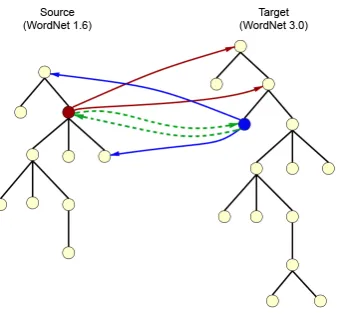
Figure 1: Example of a intersection when performing the mapping between two versions of WordNet.
Figure 2: Example of a multiple intersection in the mapping between two versions of WordNet.
For nouns, those synsets having multiple mappings from 1.6 to 3.0 were checked manually (Pociello et al., 2008). For verbs, adjectives and adverbs, for those synsets having multiple mappings, we took the intersection between the two mappings (from 1.6 to 3.0, and from 3.0 to 1.6). An example is shown in Figure 1, where the selected mapping between the two synsets is marked in green.
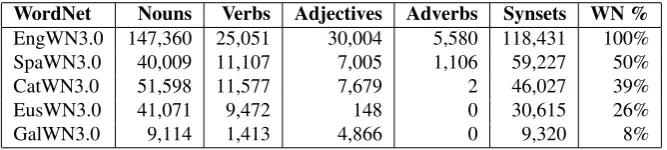
Upgrading WordNets: Finally, using the previous map-ping, we transported from ILI 1.6 to ILI 3.0 the Basque (Pociello et al., 2008) and Catalan (Ben´ıtez et al., 1998) wordnets. The English WordNet was uploaded directly from the source files while the Spanish (Fern´andez-Montraveta et al., 2008) and Galician (Xavier et al., 2011) wordnets were directly uploaded from their database dumps.
It is possible to have multiple intersections for a source synset. When multiple intersections colapsed into the same target synset, we decided to join the set of variants from the source synsets to the target synset.
Figure 2 shows an example of this particular case (the inter-sections are displayed as dot lines). Therefore, the variants of the synsets A, B and C of WordNet 1.6 will be placed together in the synset Z of WordNet 3.0.
Figure 3: Example of a multiple intersection in the mapping between two versions of WordNet.
Upgrading Base Concepts: We used Base Concepts di-rectly generated for WN 3.04(Izquierdo et al., 2007).
Upgrading SUMO: SUMO has been directly ported from version 1.6 using the mapping. Those unlabelled synsets have been filled through inheritance. The ontology of the previous version is a modified version of SUMO, trimmed and polished, to allow the use of first-order theorem provers (like E-prover or Vampire) for formal reasoning, called AdimenSUMO5. The next step is to update AdimenSUMO using the latest version of SUMO for WordNet 3.0 (avail-able on the website of SUMO6).
Upgrading WordNet Domains: As SUMO, what is cur-rently in the MCR has been transported directly from ver-sion 1.6 using the mapping. Again, those unlabelled synsets have been filled through inheritance.
Upgrading the Top Ontology: Similar to SUMO and WordNet Domains, what is currently available in the MCR has been transported directly from version 1.6 using the mapping. Once more, those unlabelled synsets have been filled through inheritance. It remains to check the incom-patibilities between labels following ( `Alvez et al., 2008). An example of how to perform the process of inheritance used for SUMO, WordNet Domains and Top Ontology is shown in Figure 3. The example is presented for domains, but it can be applied to the other two cases.
Figure 3 shows a sample hierarchy where each node rep-resents a synset. The domains are displayed on the sides. The inherited domain labels are highlighted using dot lines. In this specific example synset soccer playerinherits la-bels playandathletefrom its hypernymsplayerand ath-lete, respectively. Note that synsethockey playerdoes not inherit any label form its hypernyms because of it owns a domain (hockey). Similarly, synsetgoalkeeperdoes not inherit domains coming from the synsetsoccer player. Fi-nally, synsettitular goalkeeperinheritshockeydomain (but neitherplaynorathletedomains).
Thus, some of the current content of the MCR will require a future revision. Fortunately, by cross-checking its ontolog-ical knowledge most of these errors can be easily detected.
4
http://adimen.si.ehu.es/web/BLC
5
http://adimen.si.ehu.es/web/adimenSUMO
6
national conference on Language Resources and Evalu-ation, LREC’08.
Rigau, G., Magnini, B., Agirre, E., Vossen, P., and Car-roll, J. (2002). MEANING: A Roadmap to Knowledge Technologies. InProceedings of COLING Workshop A Roadmap for Computational Linguistics, Taipei, Taiwan. Vossen, P. (1998). EuroWordNet: A Multilingual Database with Lexical Semantic Networks. Kluwer Academic Publishers.
Xavier, G. G., Clemente, X. M. G., Pereira, A. G., and Lorenzo, V. T. (2011). Galnet: WordNet 3.0 do galego.
Linguam´atica, 3(1):61–67. `