154
Design of Smart Home Security System using
Fuzzy Logic based Internet of Things
P
1
P
Abhinav Kumar Shukla, P
2 P Neelam Sahu P 1 P
Department of IT, Scholar, Dr. C.V. Raman University, Bilaspur, India
P
2
P
Department of IT, Dr. C.V. Raman University, Bilaspur, India
Abstract
Secure home provide a sense of security to its owner. Home security has two aspects, inside and outside. Inside security covers the concept of securing home from threats like fire etc. whereas, outside security is meant to secure home against any burglar/intruder etc. This work is aimed to provide a solution for home security that takes decision dynamically using the pervasive devices. Also this solution has the feature to intimate security analysis results anywhere in the world using internet.
In the case of designing type-2 fuzzy controllers for particular applications, the use of bio-inspired optimization methods have helped in the complex task of finding the appropriate parameter values and structure of the fuzzy systems.
Interval type-2 fuzzy Smart home control system (IT2FSHCS) can be integrated into an existing home appliances to reduce the need for human intervention, increase security and energy efficiency. This paper reviews various topics on smart home technologies including control system, smart home network, smart home appliance and sensor technologies for smart home. In this research, the proposed prototype of home automation allows users to remotely switch on or off any household appliances based on Internet of Things (IoT) with the enhancement of solar charger. This prototype uses four types of sensors i.e. PIR sensor, temperature sensor, ultrasonic sensor and smoke gas sensor for automatic environmental control and intrusion detection. The hardware, software, and test field design will be discussed in this paper.
The increasing average age of the population in most industrialized countries imposes a necessity for developing advanced and practical services using state-of-the-art technologies, dedicated to personal living spaces. In this paper, we introduce a hierarchical distributed approach for home care systems based on a new paradigm known as Internet of Things (IoT). We examine the proposed model through a real case scenario of an early fire detection system using a distributed interval type-2 fuzzy logic approach.
Keywords:
155 1. Introduction
156
management, and service providing can be enabled through IoT, without the need for the users to recognize the technology behind it.
IoT is supposed that in future people will have an invisible and ubiquitous computing infrastructure to perform different activities both at work and home. Modern home requires easy to use and synergistic devices. A smart homecare system using smart phones, wireless sensors, web servers and IP webcams is proposed by Leijdekkers et al. Ghorbel et al have proposed the integration of networking and communication technologies in the smart homes concept. Popescu et al have proposed a security architecture allowing digital rights management in home networks consisting of consumer electronic devices. In the proposed model, devices are allowed to establish dynamic groups in an environment where legally acquired copyrighted content are seamlessly transmitted between devices. Popescu et al have claimed that connectivity between devices has a minimal reliance on public key cryptographic operations. Gao et al have suggested the concept of a self programming thermostat that without any human intervention creates a best possible setback schedule by sensing the possession statistics of a home.
Kim et al have proposed a Home Security system based on Sensor Network (HSSN) configured by sensor nodes including radio frequency (RF), ultrasonic, temperature, light and sound sensors. Proposed system has the capability to acknowledge security alarm events that are acquired by sensor nodes. Initially fuzzy logic control was introduced to model free control design approach but was criticized due lack of systematic stability analysis and controller design. G. Feng has shown the current improvement in the analysis and design of model based fuzzy control systems. Moreover, the proposed system should have easy-to-use GUI interface to control and monitor. The use of a web server is the best choice to overcome this problem as a single website can reach users across many different types of mobile devices, whereas native apps require a separate version to be developed for each type of device.
2. Home Automation System
2.1. Elements of Smart Home
157
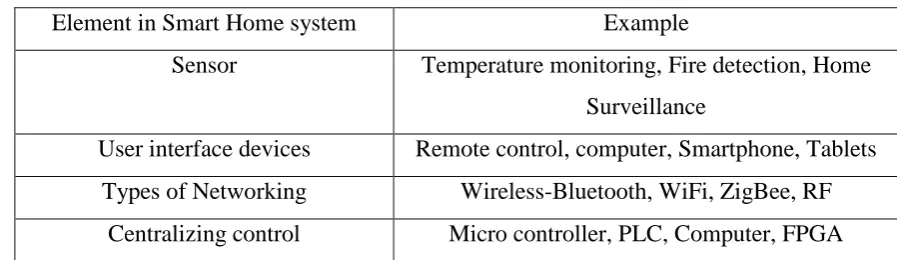
Table 1 Summary of elements in smart home Element in Smart Home system Example
Sensor Temperature monitoring, Fire detection, Home Surveillance
User interface devices Remote control, computer, Smartphone, Tablets Types of Networking Wireless-Bluetooth, WiFi, ZigBee, RF
Centralizing control Micro controller, PLC, Computer, FPGA
2.2 Internet of Things
In the communication domain for smart home, two requirements are needed. The first one is how to make possible the communication of the equipment inside the house. The second one is to connect the smart house to the outside internet world. Internet of Things refers to a network of objects, where all things are uniquely and universally addressable, identified and managed by computers. It is a collection of technologies that makes it possible to connect things like sensors and actuators to the Internet.
A formal definition of the IoT is the following: “The Internet of Things is an integrated part of the Future Internet and could be defined as a dynamic global network infrastructure with
self-configuring capabilities based on standard and interoperable communication protocols where
physical and virtual things have identities, physical attributes, and virtual personalities and use
intelligent interfaces, and are seamlessly integrated into the information network.” .
2.3 Related Works on Smart Home
From the invention of embedded smart home many decades ago until today, numerous researchers and developers envisioned, designed and developed ubiquitous applications, to transform physical environments into smart spaces. The purpose of smart home project includes HVAC (Heater, Ventilation, and Air Conditioning), lighting, energy monitor, and security. Many researchers used ZigBee and SAANet protocol to develop their smart home project. Meanwhile, the authors designed smart home by using OSGi technology as home network subsystem. OSGi technology is a set of specifications that defines a dynamic component system for Java.
3. Design of Smart Home Control System
158 3.1. Hardware Design
In the proposed design, the evolution process was based on mobile control system. The SHCS configuration consists of a website platform and an Ethernet based micro web-server. The SHCS configuration consists of the following components based on developed system as shown in the Figure 1.
Fig.1 Block Diagram of Smart Home Control System(SHCS)
3.2. Software Design
First, user need to configure the IP address of SHCS and key in the IP address at the web browser. For the SHCS prototype, it is connected to the university’s network router which is a dynamic and private IP address. Next, user need to key in the password to access the main page. The website is kept in idle mode and refreshed in every 1 second (configurable) so that it can be updated with the current sensor reading. Lastly, a command string is decoded if the user enters a command key. The command is interpreted in microcontroller and HIGH or LOW output is produced to the relay circuit. The relay circuit enables a low voltage Arduino to control the high voltage home appliances.
159
Fig.2 Test field of Smart Home Control System
Fig.3 The top view of test field
3.3 Devices employed in the control system
The devices used are embedded sensors, actuators, Interval type-2 fuzzy logic controller (ITF2FLC), WiFi Adapter, WiFi Access point, RFID reader, and a smart phone. The input given is different sensors and RFID card. The block diagram is shown below.
160 4. Interval Type-2 Fuzzy Logic Controller
The ITF2FLC is architecture machine based on type-2 fuzzy sets using rule base, where program and data are stored in separate physical memory systems that appear in different address spaces, but having the ability to read data items from program memory using special instructions.
SENSOR:
In the broadest definition, a sensor is an object whose purpose is to detect events or changes in its environment, and then provide a corresponding output. A sensor is a type of transducer; sensors may provide various types of output, but typically use electrical or optical signals.
ACTUATOR:
An actuator is a type of motor that is responsible for moving or controlling a mechanism or system. It is operated by a source of energy, typically electric current, hydraulic fluid pressure, or pneumatic pressure, and converts that energy into motion. These two are static and dynamic loads. Static load is the force capability of the actuator while not in motion. Conversely, the dynamic load of the actuator is the force capability while in motion.
WIFI:
Wi-Fi is a wireless networking technology that allows computers and other devices to communicate over a wireless signal. Wi-Fi is the standard way computers connect to wireless networks. Nearly all modern computers have built-in Wi-Fi chips that allow users to find and connect to wireless routers. When a device establishes a Wi-Fi connection with a router, it can communicate with the router and other devices on the network. However, the router must be connected to the Internet (via a DSL or cable modem) in order to provide Internet access to connected devices. Therefore, it is possible to have a Wi-Fi connection, but no Internet access.
RFID READER
Radio-frequency identification (RFID) is the wireless use of electromagnetic fields to transfer data, for the purposes of automatically identifying and tracking tags attached to objects. RFID tags and reader are used to provide access to the unique person. The tags contain electronically stored information. Some types collect energy from the interrogating radio waves and act as a passive transponder. Unlike a barcode, the tag does not necessarily need to be within line of sight of the reader and may be embedded in the tracked object. RFID is one method for Automatic Identification and Data Capture (AIDC).
5. Interval Type-2 Fuzzy logic controller design
161
Toolbox (Interval Type-2 Fuzzy Logic Systems) reused from the MATLAB® commercial Fuzzy Logic Toolbox.
The Interval Type-2 Fuzzy Inference Systems (IT2FIS) structure is the MATLAB object that contains all the interval type-2 fuzzy inference system information.
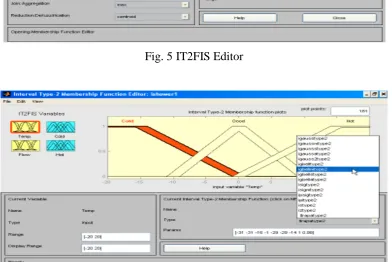
The implementation of the IT2FLS GUI is analogous to the GUI used for Type-1 FLS in the Matlab® Fuzzy Logic Toolbox, thus permitting the experienced user to adapt easily to the use of IT2FLS GUI. Figures 5 and 6 show the main viewport of the Interval Type-2 Fuzzy Inference Systems Structure Editor called IT2FIS (Interval Type-2 Fuzzy Inference Systems).
Fig. 5 IT2FIS Editor
Fig.6 Interval Type-2 MF’s Editor
162
element of this set is itself a fuzzy set in [0,1]. then the input will no longer have a single value for the MF. Instead, the MF takes on values wherever the vertical line intersects the area shaded in gray. Hence, input value will have primary membership values that lie in the interval [lower µ, upper µ].
Each point of this interval will have also a weight associated with it. Consequently, this will create an amplitude distribution in the third dimension to form what is called a secondary membership function, If the secondary membership function is equal to 1 for all the points in the primary membership and if this is true for ∀x∈X, we have the case of an Interval Type-2 fuzzy set (IT2FS). The MFs of type-2 fuzzy sets are three dimensional and include a Footprint of Uncertainty (FOU). A Type-2 fuzzy set 𝐴̃is characterized by a T2 MF μRA˜R(x, u) where x ∈ X and u ∈ JRxR ⊆ [0,
1], i.e.
𝐴̃ = ��(𝑥, 𝑢), 𝜇𝐴�(𝑥, 𝑢)�, ∀ 𝑥 ∈ 𝑋, ∀𝑢 ∈ 𝐽𝑥 ⊆ [0,1]� (1)
in which 0 ≤ μA˜(x, u) ≤ 1. 𝐴̃ can also be expressed as follows:
𝐴̃ = ∫𝑥∈𝑋∫𝑢∈𝐽𝑥𝜇𝐴�(𝑥, 𝑢)/(𝑥, 𝑢), 𝐽𝑥 ⊆ [0,1] (2)
Where ∫∫ denotes union over all admissible x and u. For example, when fRxR(u)=1, ∀u ∈ JRxR⊆
[0,1], then the secondary MFs are interval sets, and if this is true for ∀x∈X, we have the case of an
interval type-2 membership function, which characterizes the Interval Type-2 fuzzy sets (IT2FS) that will be used in this paper. Interval secondary MFs reflect a uniform uncertainty at the primary memberships of x. Since all the memberships in an interval set are unity, an interval set is represented just by its domain interval which can be represented by its left and right end-points as [l, r]. The two end-points are associated with two Type1 MFs that are referred to as Upper MF (UMF) and Lower MF (LMF). The UMF and LMF are bounds for the FOU (𝐴̃) (Fig.7) of an IT2 fuzzy set 𝐴̃. The UMF is associated with the upper bound of FOU (𝐴̃) and is denoted by 𝜇̅𝐴�(𝑥), ∀ x
∈ X. The LMF is associated with the lower bound of FOU�𝐴̃� and is denoted by 𝜇�(𝐴), ∀x ∈ X. The interval type-2 fuzzy set 𝐴̃ can be represented in terms of upper and lower membership functions as follows:
𝐴̃ = ∫𝑥∈𝑋�∫𝑢∈�𝜇
𝐴�(𝑥),𝐴�𝐴�(𝑥)�1 𝜇� � /𝑥 (3)
For discrete universes of discourse X and U, Mendel and Joh have shown that an IT2 fuzzy set 𝐴̃ can be represented as follows:
𝐴̃ = ∑𝑛𝑗=1𝐴𝑒𝑗 (4)
163 𝐴𝑒𝑗 =
∑ �1 𝑢𝑑𝑗 � �
𝑁 𝑑=1
𝑥𝑑 , 𝑢𝑑
𝑗𝜖𝐽
𝑥𝑑 ⊆ 𝑈 = [0,1]. (5)
For discrete universes of discourse X and U, an embeddedtype-1 set 𝐴𝑒𝑗 has N elements, as it contains exactly one element from JRx1R, JRx2R, ....JRxNR,namely uR1R,uR2R, . . . uRNR, i.e.
𝐴𝑗𝑒 = ∑𝑁𝑑=1𝑢𝑑𝑗/𝑥𝑑, 𝑢𝑑𝑗 ∈ 𝐽𝑥𝑑 ⊆ 𝑈 = [0,1] (6)
Fig.7FOU for Gaussian (primary) MF with uncertain mean
Following Fig.8 shows interval type2 fuzzy logic control scheme of smart home with input sensor nodes and output actuators.
Fig.8 IT2FLC Controller Input and Output Device Parameters
6. The proposed scheme
In this paper to detect the fire a type-2 fuzzy system is proposed. By the same token, the other vital parameter is weather, which has a great influence on traffic volume. To add to these, it should also be stated that the other affective parameter is population. In can be inferred that that the less populated areas have less traffic density. And last but not least, is age. Areas with younger
Interval Type2 Fuzzy
Logic Controller
Sensor Node1Sensor Node2
Sensor Node3
RFID Reader
Actuator1
Actuator2
Actuator3
WiFi
164
population have more traffic congestion since students have to go to schools and universities every day and adults have to attend their work as well.
The parameters mentioned above, have been considered as fuzzy system inputs. Each of them has some membership functions. Data has been gathered from experts working in Traffic Department of Kermanshah Province, Iran. That is why, the membership functions are in accordance with reality in this city. For instance, since the city has a moderate weather there are three membership functions, cold, hot and moderate for weather. Also, there are four membership functions for age input which includes: child, teenagers, adults and elderly. In the same way, for day two membership functions have considered, the first one belongs to weekends and the other is dedicated to working days. The output is the traffic volume and an estimate of the velocity a person can drive.
In order to achieve this goal, different membership functions have been used. Gaussian membership functions have been used for weather and age inputs, triangular functions have been applied in area input. Z-shaped and S-shaped membership functions have also used in day and population inputs.
As an example membership functions for temperature and population has demonstrated in Fig.9 and Fig.10 respectively.
Fig.9 Temperature membership function
165
Fig.11 COR2 Rconcentration membership function
7. Interval Type-2 Fuzzy Inference System Implementation
We used MATLAB to create interval type-2 fuzzy inference systems (IT2FIS). The toolbox does not limit the number of inputs or outputs allowed. For each of the four scenarios we performed eight tests with different input attributes and different inference methods. The parameters for these eight tests are shown in Table 1. We used four input variables: temperature (temp), temperature of the neighbouring nodes (tempN), and oxygen (OR2R) and carbon dioxide (COR2R) concentration. After
defining the variables, the next step is defining the membership functions (MF) for the input and output values. A membership function determines the certainty with which a crisp value is associated with a specific linguistic value. The membership functions can have different shapes. Some of the most frequently used shapes include triangular, trapezoidal, and Gaussian shapes. The rules were reduced manually. For example, the rule
If (temp is hot) and (tempN is freezing) then (fire Detection is no) is obtained by merging 4 rules:
If (temp is hot) and (tempN is freezing) and (O2 is low) and (CO2 is low) then (fireDetection is no)
If (temp is hot) and (tempN is freezing) and (O2 is low) and (CO2 is high) then (fireDetection is no)
If (temp is hot) and (tempN is freezing) and (O2 is high) and (CO2 is low) then (fireDetection is no)
If (temp is hot) and (tempN is freezing) and (O2 is high) and (CO2 is high) then (fireDetection is
no)
For more complex systems, there are different techniques that can be used for rules reduction.
8. Results and Discussion
166
whole system detects a fire. Using (1) and (2) we calculate precision (number of items correctly classified as being positive) and recall (number of correct positive items divided by the total number of items from the positive class), while we use (3) to calculate the 𝐹𝐹- measure (harmonic mean of precision and recall).
𝑃𝑟𝑒𝑐𝑖𝑠𝑖𝑜𝑛 =(𝑇𝑃 + 𝐹𝐹𝑃)𝑇𝑃
𝑅𝑒𝑐𝑎𝑙𝑙 =(𝑇𝑃 + 𝐹𝐹𝑁)𝑇𝑃
𝐹𝐹 = 2 ×(𝑃𝑟𝑒𝑐𝑖𝑠𝑖𝑜𝑛 + 𝑅𝑒𝑐𝑎𝑙𝑙)𝑃𝑟𝑒𝑐𝑖𝑠𝑖𝑜𝑛 × 𝑅𝑒𝑐𝑎𝑙𝑙
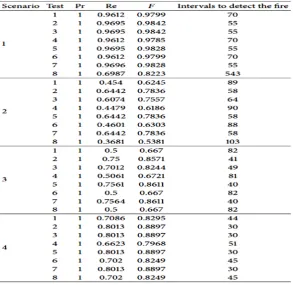
To achieve high accuracy in detection, the technique should have high precision and recall values. The results for the four scenarios and each test are given in Table 2.We can see that this system never detects false fire. This is concluded from the precision measure, because for all tests we have a value of one. The recall measure depends on the false negative value, which is important when we want to answer how fast the system will detect the fire. Scenario 1 has the best results, but this is a referential case, because we build the fuzzy model on the data from this scenario. So, if we eliminate this case, the best results are achieved for scenario 4. The 𝐹𝐹-measure is almost 90% for the best tests, and the worst value is 53%. The average 𝐹𝐹-measure for scenario 2 is 68.97%, for scenario 3 is 76.33%, and for scenario 4 is 85.43%. This means that the system should perform around these values worked perfectly when there is no fire to detect; that is, it does not produce false positives. When we analyze the different tests we performed, the best results we have are those from test 2. In this test we did not use the attribute temp N, which means that this attribute does not improve the performance of our system. The reason for this, is that when the closest node to the fire is making the decision, this attribute is always lower than the attribute temp, and because our systems detects fire when at least one node detects fire, temp N does not give any useful information to the system. Therefore, we can conclude from the results that the data acquired from only one sensor is sufficient for detecting fire. If we observe the results between test 3 and test 4 (where CO2 and O2 are excluded, resp.), we can see that O2 is more important when we make the decision, because when we use O2 the system detects the fire faster.
167
approach is 81.4%, while for Naıve Bayes classifier it is 71.78%. Both accuracy rates represent the best result among all scenarios.
Table 2: Results for precision, recall, 𝐹𝐹-measure, and number of time intervals to detect the fire
4. Conclusion
A fuzzy logic based home security system is proposed. It is observed that using this proposed concept, a better and flexible home security is provided. Proposed system inherits the properties of fuzzy logic and thus provides intermediary values as compare to Boolean logic bi-value outputs. This paper has presented the prototype design and implementation of smart home control systemThe prototype uses six lamps, one speed-controlled fan, one window blind, and one security gate. The actual implementation of a smart home web service was also presented. The home appliances are successfully integrated with the smart home control system through relays. Further research includes the performance evaluation of the developed prototype.
168 References
1. D. D. Spinellis, “The information furnace: consolidated home control,” Pers Ubiquit Comput, vol. (7), pp. 53–69, 2003.
2. P. Leijdekkers, V. Gay, and E. Lawrence, “Smart Homecare System for Health Tele-monitoring,” Proceedings of the First International Conference on the Digital Society (ICDS'07), IEEE Computer Society 2007.
3. M. Ghorbel, M. Segarra, J. Kerdreux, R. Keryell, A. Thepaut, and M. Mokhtari, “Networking and Communication in Smart Home for People with Disabilities,” Computers Helping People with Special Needs, Springer Berlin / Heidelberg, pp.624, 2004. 32TUhttp://dx.doi.org/10.1007/978-3-540-27817-7_138U32T
4. B. C. Popescu, B. Crispo, A. S. Tanenbaum, and F. L. A. J. Kamperman, “A DRM Security Architecture for Home Networks,” DRM’04, Proceedings of the 4th ACM workshop on Digital rights management, October 25, 2004, Washington, DC, USA.
5. G. Gao, and K. Whitehouse, “The Self-Programming Thermostat: Optimizing Setback Schedules based on Home Occupancy Patterns,” Proceedings of BuildSys’09, November 3, 2009, Berkeley, CA, USA.
6. Y. Tseng, Y. Wang, and K. Cheng, “An Integrated Mobile Surveillance and Wireless Sensor (iMouse) System and Its Detection Delay Analysis,” MSWiM’05, October 10–13, 2005, Montreal, Quebec, Canada.
7. Y. Kim, H. Kim, S. Lee, and K. Lee, “Ubiquitous Home Security Robot based on Sensor Network,” Proceedings of the IEEE/WIC/ACM International Conference on Intelligent Agent Technology (IAT'06), 2006
8. G. Feng, “A Survey on Analysis and Design of Model-Based Fuzzy Control Systems,” IEEE Transactions on Fuzzy Systems, vol. 14(5), pp. 676-697, October 2006.
9. N Gershenfeld, R Krikorian, D Cohen. Internet of Things. Scientific American. 2004
10.F Mattern, C Floerkemeier. From the Internet of Computers to the Internet of Things. From active data management to event-based systems and more. Springer. 2010: 242-259.
11.C Felix, IJ Raglend. Home automation using GSM. In Signal Processing, Communication,
Computing and Networking Technologies (ICSCCN), 2011 International Conference on. 2011:
15-19.
12.M. N. K. Boulos and N. M. Al-Shorbaji, “On the internet of things, smart cities and the WHO healthy cities,” InternationalJournal of Health Geographics, vol. 13, article10, 2014. 13.A. Whitmore, A. Agarwal, and L. Da Xu, “The Internet of Things—a survey of topics and
169
14.J. A. Stankovic, “Research directions for the internet of things,” IEEE Internet ofThings Journal, vol. 1, no. 1, pp. 3–9, 2014.
15.D. Meana-Llori´an, C. G. Garc´ıa, B. C. P. G-Bustelo, J. M. C. Lovelle, and N. Garcia-Fernandez, “IoFClime: the fuzzy logic and the Internet of Things to control indoor temperature regarding the outdoor ambient conditions,” Future Generation Computer Systems, 2016.
16.A. Hussain, R. Wenbi, Z. Xiaosong, W. Hongyang, and A. L. da Silva, “Personal home healthcare system for the cardiac patient of smart city using fuzzy logic,” Journal of Advances inInformation Technology, vol. 7, no. 1, pp. 58–64, 2016.
17.G. Yang, L. Xie, M. M¨antysalo et al., “A health-IoT platform based on the integration of intelligent packaging, unobtrusive bio-sensor, and intelligent medicine box,” IEEE Transactions on Industrial Informatics, vol. 10, no. 4, pp. 2180–2191, 2014.
18.K. Skala, D. Davidovic, E. Afgan, I. Sovic, and Z. Sojat, “Scalable distributed computing hierarchy: cloud, fog and dew computing,”Open Journal of Cloud Computing, vol. 2, no. 1, pp.16–24, 2015.
19.B. L. R. Stojkoska and K. V. Trivodaliev, “A review of Internet of Things for smart home: challenges and solutions,” Journal ofCleaner Production, vol. 140, pp. 1454–1464, 2017. 20.S. Kitanov, E. Monteiro, and T. Janevski, “5G and the Fog— survey of related technologies