ISSN (Print) : 2320 – 3765 ISSN (Online): 2278 – 8875
International Journal of Advanced Research in Electrical,
Electronics and Instrumentation Engineering
(A High Impact Factor, Monthly, Peer Reviewed Journal)
Website: www.ijareeie.com
Vol. 7, Issue 5, May 2018
Resource Management for Wireless Systems
under Assignment Methods and Optimization
Algorithms: Survey
Mundele Tshienda Serge1, Hassana Ganame2, Liu Yingzhuang3
Ph.D. Student, Dept. Elect. Inform. & Comm. Eng Wuhan/China1., Huazhong University of Science and Technology, Wuhan/China2
Professor, Huazhong University of Science and Technology/Wuhan Optoelectronic National Laboratory, Wuhan/China3
ABSTRACT: This article describes the different methods and rules for managing resources radio sources radio resource management (RRM). We wish by this present study to achieve a twofold objective to create an analytical model of the problem of optimization radio resources and highlight recommendations for the management of resources in terms of frequency and power of a transmission network based on one of the most used modulation techniques such as OFDM.
KEYWORDS: OFDM, OFDMA, Radio Resources, Random and Adaptive Allocation, Optimization Algorithms.
.
I. INTRODUCTION
In fact, it begins with a semantic interpretation of the term Radio Resource Management (RRM). The word resource management in a communication system has no bearing on the content or value of the management. It's all about allocating resources at the physical level, using frequency and power. Two categories of assignments are considered in this article paper. In the first part of this, we will introduce randomization methods that use one of the most promising access technologies for 4G access networks. (IEEE 802.11, WiMax, LTE) known as OFDMA. In the second part of this work, the details of the investigation of various methods of assignment of adaptive resources are presented.
II. RELATED WORK
In this section, we review the optimization based wireless network resource management techniques and discuss the open issues.
II.1 Network Resource Usage Optimization
ISSN (Print) : 2320 – 3765 ISSN (Online): 2278 – 8875
International Journal of Advanced Research in Electrical,
Electronics and Instrumentation Engineering
(A High Impact Factor, Monthly, Peer Reviewed Journal)
Website: www.ijareeie.com
Vol. 7, Issue 5, May 2018
techniques, like multi-objective optimization involving the user objective and operator objective, and game theorem based optimization [3] are also effective techniques in optimizing resource management.
In wireless resource optimization problems, the major difference from wire-line networks is the resource sharing mechanism, which is constrained by the interdependencies among wireless links: when one link is used, the links in the same channel and within the interference range of this link cannot be active. Therefore the formulations of wireless optimization problems usually rely on some interference models, for instance, the conflict graph [12].
II.2 Channel Assignment and Scheduling
Optimization algorithms on channel assignment and scheduling focus on improving the quality of service by controlling media access, like wireless link access [3, 12, 13, 14, 15, 16], channel usage [1], etc. A notable scheduling policy is the well-known throughput optimal scheduling [30]: Maximal Matching Scheduling, which is used by many existing works like [2, 7, 8] and [18]. The capacity of wireless networks can be greatly extended by using multi-channel multi-radio (MC-MR) interfaces. Each radio can switch between several orthogonal channels to avoid interference. The work of [1] proposes a robust resource provision channel assignment algorithm for MR-MC wireless networks. The solution provides guaranteed QoS under channel variability and external interference. The Max-Weight algorithm [17] is a popular scheduling strategy, which determines the transmission priority based on the product of queue length and current channel rate.Max-Weight involves both user demands and channel variation, and was considered to provide throughput optimality. However, the work in [19] proves that Max-Weight is not always throughput optimal under certain flow-level dynamics.
II.3 Routing
Generally, routing is a mechanism used to find the path(s) from a source to a destination in a network, which can also be formulated as optimization problems. The algorithms solving these problems usually claim analytical properties like resource utilization optimality and throughput fairness [5].
Optimal routing under conflict graph [11] is a throughput optimal routing strategy. It relies on a conflict graph model: the link dependencies in a wireless network can be modelled by a graph, in which the interference between two links is mapped to an edge of graph. A throughput optimal routing algorithm is derived from a multi-commodity flow problem, in which the graph model is used to formulate the constraint set.
Wireless networks are often constrained by the power of wireless clients. The power aware routing [4] aims at finding the most energy-efficient route. It employs energy opportunistic weighted minimum energy routing strategy based on the energy consumption model to maximize the total revenue of a network.
II.4 Congestion Control
Congestion control algorithms adapt the sending rates at the source nodes to avoid traffic congestion in networks. Since the seminal work by Kelly [6], congestion control problems have been investigated under the optimal resource allocation framework. Algorithms in this class explore how to maximize network utility under the constraint of network capacity by allocating sending rates and meanwhile maintain fairness among the competing flows, such as the max-min fairness and the proportional fairness. To this end, many existing works [9, 10, 20] adopt an optimization variable called price that reflects the demand-supply relationship between the available network resource and bandwidth utilization. Since the achievable capacity of wireless networks is not explicit, Xue et al. [10] use maximal clique to model the resource sharing of wireless nodes. In the contention graph of a wireless network, wireless links are mapped to the vertices and the interference between two links is mapped to an edge in the graph. In a maximal clique of the contention graph, any two vertices are connected, so only one link in the clique can be active at any time, thus the contention graph can be mapped to a set of cliques. Then each clique is associated with a shadow price: the charge for a unit flow to use a link in the clique.
II.5 Cross-Layer Optimization
ISSN (Print) : 2320 – 3765 ISSN (Online): 2278 – 8875
International Journal of Advanced Research in Electrical,
Electronics and Instrumentation Engineering
(A High Impact Factor, Monthly, Peer Reviewed Journal)
Website: www.ijareeie.com
Vol. 7, Issue 5, May 2018
II.6 Dynamic-Aware Network Resource Management
Resource management in wireless networks can be further complicated by external dynamics such as time-varying channel and feedback delay. Recently, providing dynamic-aware resource management has attracted a lot of research attention. Time delay problem is notoriously intricate in the area of networking: the out-dated feedback information could raise various problems such as inaccurate rate/scheduling adjustment, bandwidth under/over utilization and system instability. Therefore, investigating network performance under time delay has been a long lasting research focus, either within the context of wire-line networks [9, 21], or wireless networks [22, 23] and [24].
III. RESOURCE ALLOCATION
In the first part, the allocation of resources is considered at the level of the physical layer (frequency and power allocation). This article is devoted to the study of several OFDM resource allocation techniques that allow, depending on the quality of the requested service, to ensure optimal system performance, assuming that the information on the channels corresponding to the subsystems carriers are available. As a result, two alternatives are considered. The first deals with the problem from the point of view, while the second has an adaptive aspect. These last two will be the main focus of our study.
III.1 Random allocation method
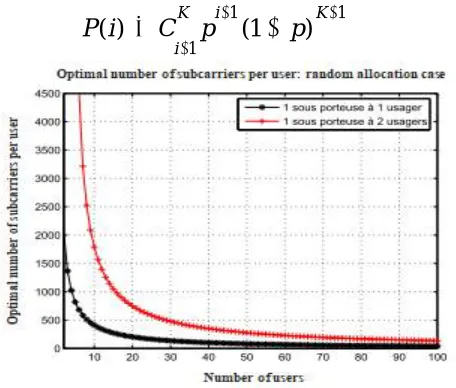
This is to describe how the optimal number of subcarriers has been affected. Each user is charged. To achieve this, we consider a number as a subcarrier common for all users. Namely, two hypotheses are considered: A subcarrier can be assigned only to a single user (hypothesis 1) or to two users (hypothesis 2). The probability P (i) that the users i select the same sub-carrier is given by the following expression [33]:
1 1
1
( )
K i(1
)
Ki
P i
C
p
p
(1)Fig.1: Optimal number of subcarriers per user
ISSN (Print) : 2320 – 3765 ISSN (Online): 2278 – 8875
International Journal of Advanced Research in Electrical,
Electronics and Instrumentation Engineering
(A High Impact Factor, Monthly, Peer Reviewed Journal)
Website: www.ijareeie.com
Vol. 7, Issue 5, May 2018
1
1 1
1
1
(1
)
K K
K
SIC k
k
n
n
u
n
K
K
N
n
(2)
Fig.2: Optimal number of subcarriers per user with or not SIC
From Figure 2 it can be seen that the number of a for the user using the SIC algorithm exceeds this number in the absence of SIC. This brings us to a higher user capacity and thus to a higher return important.
III.2 Adaptive assignment method
Different Types of Optimization Problems There are several types of optimization problems in the literature; we will not fully illustrate them but confine ourselves to the problem of the type Rate Adaptive (RA). The following figure summarizes the different types of optimization issues available in the literature.
- Optimization problem, says in Rate Adaptive (RA), - Optimization problem in Margin Adaptive (MA), - Problems of justice,
- Failure problem.
In our study, we limit ourselves to the first type of optimization rate adaptation (RA).
III.2.1 Problem formulation of the optimization in RA
In the second part of this paper, we will present a detailed study of the algorithms proposed in the single-cell context of the descending path for an RA problem, as shown in [28, 26, 29, 30]. The fact that this type of problem is best suited to the problems of high-speed networks [31, 32, 25]. The main objective of the RA optimization problem is to maximize overall user throughput with limitations on maximum transmitted power (fixed power budget) and possibly minimal individual riffs u, b for each user.
1 1
( )
,max
0
max
,
with
,
(1
), (1
)
( )
B Ub u
b
tr tr
ru b
P
P
u U
b B
and
r
r
ISSN (Print) : 2320 – 3765 ISSN (Online): 2278 – 8875
International Journal of Advanced Research in Electrical,
Electronics and Instrumentation Engineering
(A High Impact Factor, Monthly, Peer Reviewed Journal)
Website: www.ijareeie.com
Vol. 7, Issue 5, May 2018
IV. PROPOSED APPROACHES FOR OPTIMIZATION ALGORITHMS
Two main applications in the literature they have been proposed as "Approach 1" and "Approach 2", each of which, despite some similarities, allows its own principal both approaches. The basic principle of Approach 1 is to consider that subcarrier assignment (step 1) and power assignment (step 2) are two steps that take place in a different way. For approach 2 they are performed simultaneously joint [31, 30]. We will limit ourselves to approach 1 in our study. Main optimization algorithms Assignment of subcarriers in approach 1 Subcarrier assignment is a process that consists of two sub-steps. The first is to allocate the band and the second to allocate the subcarriers. These last two can be done in a nested (option 1) or different way (option 2).
IV.1 BABS (Bandwidth Allocation Based on SNR) Allocation Algorithm
This algorithm begins by assigning each user the minimum number of subcarriers that they need. If the total number of sub-carriers requested exceeds the total number of sub-carriers N available, users are eliminated to the minimum of allocated sub-carriers. If you come to a number of subcarriers that are lower than N, or if you have not gone through N, you will begin assigning the additional subcarriers to the subcarriers. Users who actually add an extra subcarrier [30, 34, 27].
IV.1.1 Modified BABS allocation algorithm
A modification of the BABAS algorithm proposed (BABS modified). We become the main goal of the latter and consider the difference between BABS and the modified BABS. The idea with this algorithm is to eliminate the user whose a necessary number of subcarriers is closest to the difference between the number of subcarriers required (higher or equal) by the system and the available number [31, 33].
V. SIMULATION AND RESULTS
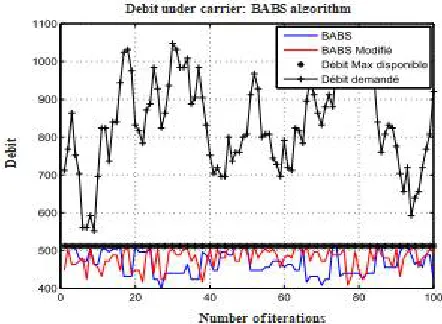
We consider in our simulations a mono-cellular context in which the users are evenly distributed. This cell consists of a base station (BS) and a U number of users. As far as the model of the considered channel is concerned, it is constituted N subcarrier. We have the same strategy as in [31]. That we led to the following simulation results.
Fig 3: Flow per carrier: Application of the BABS algorithm
VI. CONCLUSION
ISSN (Print) : 2320 – 3765 ISSN (Online): 2278 – 8875
International Journal of Advanced Research in Electrical,
Electronics and Instrumentation Engineering
(A High Impact Factor, Monthly, Peer Reviewed Journal)
Website: www.ijareeie.com
Vol. 7, Issue 5, May 2018
which improves the capacity and thus the load rate transmission. In calculating the number of subcarriers we have considered two approaches. The first is to think that the subcarrier can only be assigned to one user. While in the second, the subcarriers can be assigned by two users.
We will not limit ourselves to the different types of allocation In future studies, we will focus on other areas and approaches that will undoubtedly have advantages over the above methods. In contrast to the first type of assignment method, the second type is the adaptive allocation of radio resources.
In this second part of this article, we introduce the optimization problems that can occur when resource allocation is implemented in OFDMA, a promising access technique. It is mainly the subcarriers and the energy that is available to all users based on the so-called BABS optimization algorithm.
REFERENCES
[1] CunqingHua, Song Wei, and RongZheng. Robust channel assignment for linklevel resource provision in multi-radio multi-channel wireless networks. In IEEEInternational Conference on Network Protocols, ICNP 2008., pages 157–166, Oct.2008.
[2] Gaurav Sharma, Ravi R. Mazumdar, and Ness B. Shroff. On the complexity ofscheduling in wireless networks. In Proceedings of the 12th annual internationalconference on Mobile computing and networking, MobiCom ’06, pages 227–238,New York, NY, USA, 2006. ACM.
[3] I.-H. Hou, V. Borkar, and P.R. Kumar. A theory of qos for wireless. In Proceedings of the 28th IEEE International Conference on Computer Communications,INFOCOM 2009, pages 486 –494, April 2009.
[4] Longbi Lin, N.B. Shroff, and R. Srikant. Asymptotically optimal energy-awarerouting for multihop wireless networks with renewable energy sources. IEEE/ACMTransactions on Networking, 15(5):1021–1034, Oct.
[5] Liang Dai, Yuan Xue, Bin Chang, Yanchuan Cao, and Yi Cui. Optimal routingfor wireless mesh networks with dynamic traffic demand. Mobile Networks andApplications,13(1-2):97–116, April 2008.
[6] F. P. Kelly, A. K. Maulloo, and D. K. H. Tan. Rate control for communicationnetworks: Shadow prices, proportional fairness and stability. The Journal of theOperational Research Society, 49(3):pp. 237–252, 1998.
[7] L. Chen, S. H. Low, M. Chiang, and J. C. Doyle. Cross-layer congestion control,routing and scheduling design in ad hoc wireless networks. In Proceedings of the25th IEEE International Conference on Computer Communications, INFOCOM2006, pages 1 –13, April 2006.
[8] Xiaojun Lin and N.B. Shroff. The impact of imperfect scheduling on cross-layerrate control in wireless networks. In Proceedings of the 24th IEEE InternationalConference on Computer Communications, INFOCOM 2005, volume 3, pages1804 – 1814 vol. 3, March 2005.
[9] Steven H. Low and David E. Lapsley. Optimization flow control i: Basic algorithmand convergence. IEEE/ACM Transactions on Networking, 7(6):861–874, 1999.
[10] Yuan Xue, Baochun Li, and KlaraNahrstedt. Optimal resource allocation in wireless ad hoc networks: a price-based approach. IEEE Transactions on Mobile Computing,5(4):347 – 364, April 2006.
[11] Kamal Jain, JitendraPadhye, Venkata N. Padmanabhan, and LiliQiu. Impact ofinterference on multi-hop wireless network performance. In Proceedings of the 9thannual international conference on Mobile computing and networking, MobiCom’03, pages 66–80, New York, NY, USA,
2003. ACM.
[12] I-Hong Hou and P. R. Kumar. Utility-optimal scheduling in time-varying wirelessnetworks with delay constraints. In Proceedings of the eleventh ACM internationalsymposium on Mobile ad hoc networking and computing, MobiHoc ’10, pages 31-40, New York, NY, USA, 2010. ACM.
[13] Shihuan Liu, Lei Ying, and R. Srikant. Throughput-optimal opportunistic scheduling in the presence of flow-level dynamics. IEEE/ACM Transactions on Networking, 19(4):1057–1070, Aug. 2011.
[14] SujaySanghavi, Loc Bui, and R. Srikant. Distributed link scheduling with constantoverhead. In Proceedings of the 2007 ACM SIGMETRICS international conferenceon Measurement and modeling of computer systems, SIGMETRICS ’07, pages313–324, New York, NY, USA, 2007. ACM. [15] V. J. Venkataramanan and Xiaojun Lin. On wireless scheduling algorithms forminimizing the queue-overflow probability. IEEE/ACM Transactions on Networking, 18(3):788–801, June, 2007.
[16] ChangheeJoo, Xiaojun Lin, and N.B. Shroff. Understanding the capacity regionof the greedy maximal scheduling algorithm in multi-hop wireless networks. InProceedings of the 27th IEEE International Conference on Computer Communications, INFOCOM 2008, pages 1103–1111, 2008.
[17] L. Tassiulas and Anthony Ephremides. Stability properties of constrained queueingsystems and scheduling policies for maximum throughput in multihop radio networks. IEEE Transactions on Automatic Control, 37(12):1936–1948, Dec. 1992.
[18] Xinzhou Wu and R. Srikant. Regulated maximal matching: A distributed scheduling algorithm for multi-hop wireless networks with node-exclusive spectrum sharing. In Proceedings of 44th IEEE Conference on Decision and Control, and theEuropean Control Conference. CDC-ECC ’05., pages 5342–5347, Dec. 2005.
[19] P. van de Ven, S. Borst, and S. Shneer. Instability of maxweight scheduling algorithms. In Proceedings of the 28th IEEE International Conference on ComputerCommunications, INFOCOM 2009, pages 1701–1709, April 2009.
[20] SrisankarKunniyur and R. Srikant. End-to-end congestion control schemes: utilityfunctions, random losses and ecn marks. IEEE/ACM Transactions on Networking,11(5):689–702, Oct. 2003.
[21] RayadurgamSrikant. The Mathematics of Internet Congestion Control (Systemsand Control: Foundations and Applications). SpringerVerlag, 2004.
ISSN (Print) : 2320 – 3765 ISSN (Online): 2278 – 8875
International Journal of Advanced Research in Electrical,
Electronics and Instrumentation Engineering
(A High Impact Factor, Monthly, Peer Reviewed Journal)
Website: www.ijareeie.com
Vol. 7, Issue 5, May 2018
[23] Lei Ying, R. Srikant, A. Eryilmaz, and G.E. Dullerud. Distributed fair resourceallocation in cellular networks in the presence of heterogeneous delays. IEEETransactions on Automatic Control, 52(1):129–134, Jan. 2007.
[24] Guohua Zhang, Yiyu Wu, and Yonghe Liu. Stability and sensitivity for congestioncontrol in wireless mesh networks with time varying link capacities. Ad Hoc Netw.,5(6):769–785, Aug. 2007.
[25] Miguel. Acena and Stephan. Pfeltschinger. A spectrally e cient method for subcarrier and bit allocation in ofdma. IEEE 61th Vehicular Technology Conference, VTC-Spring, 3:1773–1777, 30 May-1 June 2005.
[26] Tommy K. Chee, Cheng-Chew. Lim, and Jinho. Choi. Sub-optimal power allocation for downlink ofdma systems. IEEE 60th VTC, pages 387– 390, 26-29 September 2004.
[27] S. Hammouda. Analyze and improve the management of third generation mobile resources, and vice versa. PhDs, ESC of Tunisia, 2007.
[28] Jiho. Jang and Kwang Bok. Lee. Transmit power adaptation for multiuser ofdma systems. IEEE Journal on selected areas in communications, 21 (2): 171–178, February 2003.
[29] Keunyoung. Kim, Hoon. Kim, and Youngnam. Han. Subcarrier and power allocation in ofdma systems. IEEE 60th Vehicular Technology Conference, VTC-Fall, 2:1058–1062, September 2004.
[30] D. Kivanc and H. Liu. Subcarrier allocation and power control for ofdma. Conference Record of the Thirty-Fourth Asilomar Conference on Signals, Systems, and Computers, pages 147–151, 2000.
[31] C. Lengoumbi. Multiple ofdma access for post 3g cellular systems: resource allocation and scheduling. PhD Thesis, ENST Paris, 2008.
[32] C. Lengoumbi, P. Godlewski, and P. Martins. An e ecient subcarrier assignment algorithm for downlink ofdma,. The 64th IEEE Semiannual Vehicular Technology Conference, Montreal, Canada, 2006.
[33] J. Naked. Allocation of radio resources in a wireless local area network (wlan) of the type ofdm. Advanced studies diploma, University of Libya, 2003.