Economic Load Dispatch Using Particle
Swarm Optimization
Kanika Raghu1, Vinit Kumar Vishwakarma2, Hemant Mahala3
M. Tech Student, Department of EEE, Oriental Institute of Science & Tech. Bhopal, Madhya Pradesh, India1
M. Tech Student, Department of EEE, Oriental Institute of Science & Tech. Bhopal, Madhya Pradesh, India2
Associate Professor, Department of EEE, Oriental Institute of Science & Tech. Bhopal, Madhya Pradesh, India 3
ABSTRACT: The paper presents a new approach to solve economic load dispatch problem using particle swarm optimization (PSO). ELD problems have objective functions with inequality and equality constraints that make it difficult to find the global optimum using any mathematical approaches. Normally, the fuel cost of generators can be
treated as a quadratic function of real power generation.In power system operation output power of generators should
be properly adjusted in economical approaches so as to reach till the load demand which changes every moment. Power always flows from generation side to load side. Transmitting the power at minimum cost and better efficiency is called Economic Load Dispatch. Economic Load Dispatch is the essential term in power system network for reducing the generation cost and giving optimum output. Particles swarm optimization algorithms inspired by behaviour of swarm has been applied successfully to find ELD problem. The results obtained from PSO are compared to those achieved from other approaches. These results prove that the proposed method is capable of getting higher quality solution including mathematical simplicity, fast convergence, and robustness to solve hard optimization problems.
KEYWORDS: Particle Swarm Optimization, Economic Load Dispatch etc.
I.INTRODUCTION
Electric energy is the most flexible form of energy which is used to operate various domestic appliances in households and the electrical equipment’s used in large factories. Electricity demand [4] is rising day by day following such a highly power dependent society [1]. These demands can be fulfilled either by utilizing electrical energy in a more efficient and way or by producing energy in most economical manner [2][5]. Generating the exact amount of power as demanded meeting all the losses is crucial and follows a complex procedure [6]. Economic load dispatch (ELD) can be utilized to figure and to schedule the required quantity of power to be generated among the various generating units in the system. The operation of the various generating systems in an economical manner is always considered an important factor in power industry while considering various diversified form of constraints regarding to power generation, power demand [4] and operational limits of the generating units.
Conventional methods have many draw back such as nonlinear programming has algorithmic complexity. Linear programming methods are reliable and fast but require linearization of the objective function as well as limitation with non-negative variables. Quadratic programming [3] which is a special form of nonlinear programming has some disadvantages associated with hybrid quadratic cost approximation [2]. Newton-based method has a drawback of the convergence characteristics that are subtle to initial conditions. The interior point method is computationally efficient but suffers from bad optimality criteria and initial termination.
II. LITERATURE REVIEW
Jaya Pediwal et al. [1] proposed two strategies depending upon inertia weight variation in PSO algorithm. e1 - PSO and e2 - PSO has been successfully applied to determine optimal generation. Two strategies of exponential decreasing inertia weight i.e. e1-PSO. & e2-PSO have been successfully applied to determine the optimal generation schedule of the six unit test system. Apart from solution quality e1-PSO. & e2-PSO are giving better dynamic convergence.
with its numerous variants that can be employed in different optimization problem. This showed that how PSO can be applied to solve various complicated problems which comes in power system during load dispatch.
K. Premalatha et. al.[3] suggested that a modified Tent map based Chaotic PSO (TCPSO) to solve the economic load dispatch problem .A dynamic inertial weight factor was incorporated with the modified hybrid TCPSO, which balances the global and local search better. For three test systems the hybrid methodology was successfully validated, which shows that the modified TCPSO algorithm has significant advantages both in convergence precision and global convergence.
Y. Del Valle et. al.[4] Proposed that PSO and Simulated Annealing (SA) are applied to find out the minimum cost for different power demand. When the results are compared with the traditional technique, PSO seems to give a better result with better convergence characteristic. All the methods are executed in MATLAB environment. The experiment showed encouraging results, suggesting that the proposed approach of computation is capable of efficiently determining higher quality solutions addressing economic dispatch problems.
III. ECONOMIC LOAD DISPATCH
The aim of electric supply utility is to provide electrical energy in smooth form to the consumers. While doing this, the generation of electric power with minimum cost should be ensured. The total demand should be shared appropriately among the units to achieve economic operation of the system [1][4]. By this the total generation cost will be minimized for the system with the maintained voltage level at the safe operating limits. The economic dispatch of power is one of the major issue in the power system [2]. With the passage of time, the load demand among consumers are increasing and day by day fuel costs are booming, so the system operating cost also enhances with time [7]. The maintenance costs and service costs are small and just a fixed proportion, so we can say that the operating costs are the fuel cost and here we have to minimize fuel cost. These problems can be solved by conventional and nonconventional optimization techniques.
Generator
Fuel Input
Boiler
T
ur
bi
n
e
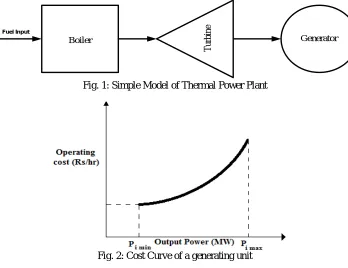
Fig. 1: Simple Model of Thermal Power Plant
Fig. 2: Cost Curve of a generating unit
IV.PARTICLE SWARM OPTIMIZATION (PSO)
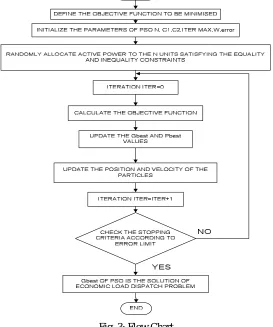
evolutionary computation techniques such as Genetic Algorithms (GA). Every particle in PSO is associated with some velocity. So the particles has a tendency that they can fly towards the better search area. The system is initialized with a population of random solutions and searches for optima by updating generations. However, unlike GA, PSO has no evolution operators such as crossover and mutation. The potential solutions in PSO, which are called as particles, fly through the problem space by following the current optimum particles [7]. The detailed information of PSO will be given in following sections. Compared to GA, the advantages of PSO is that it is easy to implement and there are few parameters to adjust [5][6]. As the complexities of the problem increase, especially with the introduction of uncertainties to the system, we have to use more complicated optimization techniques, such as stochastic programming or DP. However, these analytical methods are not easy to implement for most of the real-world problems. In fact, for many problems, the curse of dimensionality makes the approach unfeasible to implement. The above issues discussed are of some particular importance while solving optimization problems in a power system [2]. As a highly nonstationary, nonlinear system with noise and some uncertainties, a power network can have a large number of states and parameters. Implementing any of the classical analytical optimization might not be feasible in many cases. Whereas, PSO can be an alternative solution. It is a stochastic based search technique that has its roots in artificial life and social psychology, as well as in engineering and computer science [3]. It utilizes a “population,” which is known as particles, which flows through the problem hyperspace with given velocities; during each iteration, the velocities are randomly adjusted considering the previous best position of the particle itself and the position of neighbour (both of them are defined according to a fitness function which is predefined). Then, the movement of each particle naturally evolves to an optimal or near-optimal solution [3]. Particles of a swarm may benefit from the prior discoveries and experiences of all the members of a swarm when foraging. The fundamental point of development of PSO [7] is a hypothesis where the exchange of information among the creatures of same species offers some kind of evolutionary advantage [6][7]. Every particle is affected by three factors: its own velocity, the best location it has achieved so far called Pbest and the overall best location achieved by all particles called Gbest.
V. PSO: VARIANTS The different variants of PSO algorithm are described in this section.
Hybrid PSO:
Angeline (1998) produced one of the first particle swarms which were intentionally hybridized. In his model, selection was applied to the particle population; the particles which were “good” were reproduced with mutation, and “bad” ones were eliminated. Angeline’s results showed that PSO could benefit from this modification. As a result, hybrid versions of PSO have been created and tested in different applications [6]. The most common has hybrid of genetic algorithm and PSO (GA-PSO), hybrid of evolutionary programming and PSO (EPSO) and hybrid of differential evolution and PSO (DEPSO and C-PSO).
Adaptive PSO:
Other authors have suggested different adjustments to the parameters of the Particle Swarm Optimization algorithm: adding a random component to the inertia weight applying Fuzzy logic to it, using a secondary PSO to find the optimal parameters of a primary PSO, Q-learning, or adaptive critics. The adaptive strategies are: Adjust the swarm size, adjust the inertia weight, and adjust the neighbourhood size [6].
PSO in complex environment:
PSO in complex environment includes: Multi-objective particle swarm optimization (PSO), Constraints handling in PSO and Dynamic tracking in particle swarm optimization (PSO) [6].
Discrete PSO variants:
In direct approach the classical PSO algorithm is applied and the solutions are converted into bit strings using a hard decision decoding process [6].
VI. PROBLEM FORMULATION
The problem formulation of economic load dispatch problem is totally based on objective function and it depends upon the equality and inequality constraints. Transmission line losses plays an important role in Economic Load Dispatch Problem [1][2].
Objective Function
Min F=∑ Fi(Pgi) (1)
Subject to:
∑ Pgi = ∑ PDi +PL (2)
Pi min≤ Pi≤ Pi max (3)
Pi min is the lowest limit of power generation and Pi max is the upper limit of power generation.
Where Fi(Pgi) represents the cost function of generators and its formulated as:
Fi(Pgi) = ai(P2gi) + bi (Pgi) + ci (4)
Where ai, bi, ci are cost coefficients. Equation 2 is represent inequality constraints and equation 3 represent equality
constraints.
Pi min = Minimum Power
VII. RESULT AND DISCUSSION
Table 1:Parameters for Genetic Algorithm
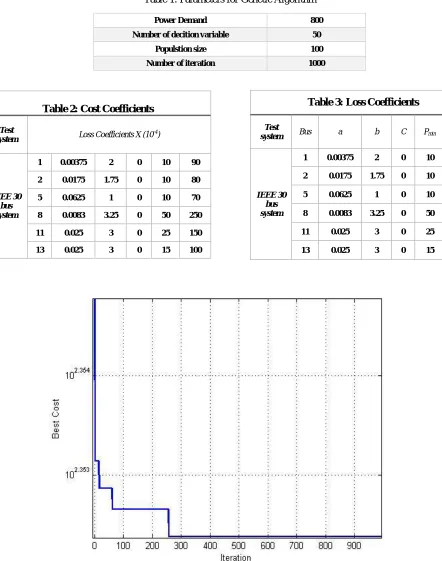
Fig. 4: Result after usingParticle Swarm Optimization technique
Power Demand 800
Number of decition variable 50
Populstion size 100
Number of iteration 1000
Table 2: Cost Coefficients
Test
system Loss Coefficients X (10
-4)
IEEE 30 bus system
1 0.00375 2 0 10 90
2 0.0175 1.75 0 10 80
5 0.0625 1 0 10 70
8 0.0083 3.25 0 50 250
11 0.025 3 0 25 150
13 0.025 3 0 15 100
Table 3:Loss Coefficients
Test
system Bus a b C Pmin Pmax
IEEE 30 bus system
1 0.00375 2 0 10 90
2 0.0175 1.75 0 10 80
5 0.0625 1 0 10 70
8 0.0083 3.25 0 50 250
11 0.025 3 0 25 150
By running the simulation of Economic Load Dispatch Problem using Particle Swarm Optimization technique, the minimum fuel cost is obtained which is 225.1043 Rs/hr. after 1000 iteration.
VIII.CONCLUSION
In this proposed work PSO approach is used for the solution of economic dispatch with constraints in power system. This method has been applied to IEEE30 bus test system. The analysis results have demonstrated that PSO outperforms the other methods in terms of a better optimal solution. However, the much improved speed of computation allows the additional searches to be made to increase the confidence in the solution. Overall, the PSO algorithms have been shown to be very helpful in studying optimization problems in power systems.
REFERENCES
[1] Jaya Pediwal, Dr. Amita Mahor, Navita Khatri, “Exponential Decreasing Inertia Weight Particle Swam Optimization in Economic Load Dispatch”. IJEIR VOL. 1, Issue 5, ISSN: 2277-5668 ©2012.
[2] Yamille valle, Ganesh kumar venayagamoorthy, Salman mohagheghi, Jean-Carlos Hernandez, Ronald G. Harley “PSO: Basic Concept, Variant and application in power system”. IEEE Transaction on evolutionary computation. Vol.12 No. 2 April, 2008: Page No. 176-178.
[3] K. Premalatha, A.M. Natrajan, “Hybrid PSO and GA for global maximization”. International J. Open Problems Compt. Math. Vol.2, No.4, Dec. 2009.
[4] V. Karthikeyan, S. Senthilkumar, V.J. Vijayalakshmi, “A New Approach to the Solution of Economic Dispatch Using Particle Swarm Optimization with Simulated Annealing”. International Journal on Computational Sciences & Applications (IJCSA) Vol.3, No.3, June 2013. [5] Ashish dhamanda, Arunesh dutt, Surya Prakash, A.k. bharadwaj. “A traditional Approach to solve economic load dispatch problem of thermal
generating unit using matlab programming”. IJERT: ISSN: 2278 - 0181 Vol. 2 issue 9, Septamber – 2013.
[6] Y. Del Valle, S. Mohagheghi, G. Venayagamoorthy, and R. Harley, “Training MLP neural networks for identification of a small power system: Comparison of PSO and backpropagation,” in Proc. 6th Int. Conf. Power Syst. Operation and Planning, May 2005, pp. 153–157.