Freestart collision for full SHA-1
]Marc Stevens1o, Pierre Karpman2,3,4f, and Thomas Peyrin4b
1 Centrum Wiskunde & Informatica, The Netherlands 2
Inria, France
3 Ecole polytechnique, France´ 4
Nanyang Technological University, Singapore
[email protected],[email protected],[email protected]
Abstract. This article presents an explicit freestart colliding pair for SHA-1, i.e. a colli-sion for its internal comprescolli-sion function. This is the first practical break of the fullSHA-1, reaching all 80 out of 80 steps. Only 10 days of computation on a 64-GPU cluster were necessary to perform this attack, for a cost of approximately 257.5 calls to the compression
function of SHA-1. This work builds on a continuous series of cryptanalytic advancements onSHA-1since the theoretical collision attack breakthrough of 2005. In particular, we reuse the recent work on 76-step SHA-1 of Karpman et al.from CRYPTO 2015 that introduced an efficient framework to implement (freestart) collisions on GPUs; we extend it by incorpo-rating more sophisticated acceleincorpo-rating techniques such as boomerangs. We also rely on the results of Stevens from EUROCRYPT 2013 to obtain optimal attack conditions; using these techniques required further refinements for this work.
Freestart collisions do not directly imply a collision for the full hash function. However, this work is an important milestone towards an actualSHA-1collision and it further shows how GPUs can be used very efficiently for this kind of attack. Based on the state-of-the-art collision attack onSHA-1by Stevens from EUROCRYPT 2013, we are able to present new projections on the computational and financial cost required for aSHA-1collision computa-tion. These projections are significantly lower than what was previously anticipated by the industry, due to the use of the more cost efficient GPUs compared to regular CPUs. We therefore recommend the industry, in particular Internet browser vendors and Certifica-tion Authorities, to retractSHA-1quickly. We hope the industry has learned from the events surrounding the cryptanalytic breaks ofMD5and will retractSHA-1before concrete attacks such as signature forgeries appear in the near future.
Keywords: SHA-1, hash function, cryptanalysis, freestart collision, GPU implementation.
1 Introduction
A cryptographic hash functionHis a function that takes an arbitrarily long messageM as input and outputs a fixed-length hash value of sizenbits. It is a versatile primitive useful in many applications, such as building digital signature schemes, message authentication codes or password hashing functions. One key security feature expected from a crypto-graphic hash function is collision resistance: it should not be feasible for an adversary to find two distinct messagesM, ˆM that hash to the same valueH(M) =H( ˆM) faster than with a generic algorithm,i.e.with significantly less than 2n2 calls to the hash function.
A widely used hash function construction is the Merkle-Damg˚ard paradigm [Mer89, Dam89]:His built by iterating a compression functionhthat updates a fixed-size internal state (also called chaining value) with fixed-size message blocks; the initial chaining value (IV) is a fixed constant of the hash function. This construction is useful in particular for the simple security reduction it allows to make: if the compression function is collision-resistant, then so is the corresponding hash function. This leads to defining variants of
]c IACR 2016. This is the version of the article sent by the authors to be included in the proceedings
of EUROCRYPT 2016.
o Supported by the Netherlands Organization for Scientific Research Veni Grant 2014
f Partially supported by the Direction G´en´erale de l’Armement and by the Singapore National Research
Foundation Fellowship 2012 (NRF-NRFF2012-06)
collision attacks which allow the attacker to choose the IV: afreestart collision is a pair of different message and IV (C, M), ( ˆC,Mˆ) such that HC(M) =HCˆ( ˆM); semi-freestart collisions are similar but impose C = ˆC. It is noteworthy that the Merkle-Damg˚ard se-curity reduction assumes that any type of collision (freestart or semi-freestart) must be intractable by the adversary. Thus, a collision attack on the compression function should be taken very seriously as it invalidates the security reduction coming from the operating mode of the hash function.
The most famous hash function family, basis for most hash function industry standards, is undoubtedly theMD-SHAfamily, which includes notable functions such asMD4,MD5,SHA-1 and SHA-2. This family first originated withMD4 [Riv90] and continued with MD5 [Riv92] (due to serious security weaknesses [dB91,Dob96] found onMD4soon after its publication). Even though collision attacks on the compression function were quickly identified [dB93], the industry widely deployed MD5 in applications where hash functions were required. Yet, in 2005, a team of researchers led by Wang [WY05] completely broke the collision resistance of MD5, which allowed to efficiently compute colliding messages for the full hash function. This groundbreaking work inspired much further research on the topic; in a major development, Stevens et al. [SLdW07] showed that a more powerful type of attack (the so-calledchosen-prefix collision attack) could be performed against MD5. This eventually led to the forgery of a Rogue Certification Authority that in principle completely undermined HTTPS security [SSA+09]. This past history of cryptanalysis on MD5 is yet
another argument for a very careful treatment of collision cryptanalysis progress: the industry should move away from weak cryptographic hash functions or hash functions built on weak inner components (compression functions that are not collision resistant) before the seemingly theoretic attacks prove to be a direct threat to security ( counter-cryptanalysis [Ste13a] could be used to mitigate some of the risks during the migration).
While lessons should be learned from the case ofMD5, it is interesting to observe that the industry is again facing a similar challenge.SHA-1 [NIS95], designed by the NSA and a NIST standard, is one of the main hash functions of today, and it is facing important at-tacks since 2005. Based on previous successful cryptanalysis works [CJ98,BC04,BCJ+05] on SHA-0 [NIS93] (SHA-1’s predecessor, that only differs by a single rotation in the mes-sage expansion function), a team led again by Wang et al. [WYY05a] showed in 2005 the very first theoretical collision attack on SHA-1. Unlike the case of MD5, this attack, while groundbreaking, remains mostly theoretical as its expected cost was evaluated to be equivalent to 269 calls to the SHA-1compression function.
Therefore, as a proof of concept, many teams considered generating real collisions for re-duced versions ofSHA-1: 64 steps [DR06] (with a cost of 235SHA-1calls), 70 steps [DMR07] (cost 244 SHA-1), 73 steps [Gre10] (cost 250.7 SHA-1) and the latest advances for the hash function reached 75 steps [GA11] (cost 257.7 SHA-1) using extensive GPU computation power.
In 2013, building on these advances and a novel rigorous framework for analyzing SHA-1, the current best collision attack on full SHA-1 was presented by Stevens [Ste13b] with an estimated cost of 261 calls to the SHA-1 compression function. Nevertheless, a publicly known collision still remains out of reach.
Very recently, collisions on the compression function ofSHA-1reduced to 76 steps (out of 80) were obtained by using a start-from-the-middle approach and a highly efficient GPU framework [KPS15]. This required only a reasonable amount of GPU computation power (less than a week on a single card, equivalent to about 250.3 calls toSHA-1on GPU, whereas the runtime cost equivalent on regular CPUs is about 249.1 SHA-1).
Because of these worrisome cryptanalysis advances on SHA-1, one is advised to use
beyond 2014 [NIS12] (by 2010 for governmental use), the industry actors only recently started to move away from SHA-1, about a decade after the first theoretical collision attacks. For example, Microsoft, Google and Mozilla have all announced that their respec-tive browsers will stop accepting SHA-1 SSL certificates by 2017 (and that SHA-1-based certificates should not be issued after 2015). These deadlines are motivated by a simple evaluation of the computational and financial cost required to generate a collision for SHA-1: in 2012, Bruce Schneier (using calculations by Jesse Walker based on a 261 attack cost [Ste13b], Amazon EC2 spot prices and Moore’s Law) estimated the cost of running oneSHA-1collision attack to be around 700,000 US$ in 2015, down to about 173,000 US$ in 2018, which he deemed to be within the resources of criminals [Sch12]. We observe that while a majority of industry actors already chose to migrate to more secure hashing algorithms, surveys show that in September 2015SHA-1 remained the hashing primitive for about 28.2% of certificate signatures [SSL15].
1.1 Our contributions
In this article, we give the first colliding pair for the fullSHA-1compression function (see Table 1-1), which amounts to a freestart collision for the full hash function. This was obtained at a GPU runtime cost approximately equivalent to 257.5 evaluations of SHA-1.1 The starting point for this attack is the start-from-the-middle approach and the GPU framework of CRYPTO 2015, which was used to compute freestart collisions on the 76-step reduced SHA-1 [KPS15]. We improve this by incorporating the auxiliary paths (or boomerangs) speed-up technique from Joux and Peyrin [JP07]. We also rely on the crypt-analytic techniques by Stevens [Ste13b] to obtain optimal attack conditions, which required further refinements for this work.
Table 1-1.A freestart collision for SHA-1. A test program for this colliding pair is available athttps: //sites.google.com/site/itstheshappening/tester.cpp
Message 1
IV1 50 6b 01 78 ff 6d 18 90 20 22 91 fd 3a de 38 71 b2 c6 65 ea
M1 9d 44 38 28 a5 ea 3d f0 86 ea a0 fa 77 83 a7 36
33 24 48 4d af 70 2a aa a3 da b6 79 d8 a6 9e 2d 54 38 20 ed a7 ff fb 52 d3 ff 49 3f c3 ff 55 1e fb ff d9 7f 55 fe ee f2 08 5a f3 12 08 86 88 a9
Compr(IV1,M1) f0 20 48 6f 07 1b f1 10 53 54 7a 86 f4 a7 15 3b 3c 95 0f 4b
Message 2
IV2 50 6b 01 78 ff 6d 18 91 a0 22 91 fd 3a de 38 71 b2 c6 65 ea
M2 3f 44 38 38 81 ea 3d ec a0 ea a0 ee 51 83 a7 2c 33 24 48 5d ab 70 2a b6 6f da b6 6d d4 a6 9e 2f 94 38 20 fd 13 ff fb 4e ef ff 49 3b 7f ff 55 04 db ff d9 6f 71 fe ee ee e4 5a f3 06 04 86 88 ab
Compr(IV2,M2) f0 20 48 6f 07 1b f1 10 53 54 7a 86 f4 a7 15 3b 3c 95 0f 4b
As was mentioned above, previous recommendations on retracting SHA-1 were based on estimations of the resources needed to findSHA-1 collisions. These consist both in the
1
time necessary to mount an attack, for a given computational power, as well as the cost of building and maintaining this capability, or of renting the equipment directly on a platform such as Amazon EC2 [Ser16]. In that respect, our freestart collision attack can be run in about 9 to 10 days on average on a cluster with 64 GeForce GTX970 GPUs, or by renting GPU time on Amazon EC2 for about 2K US$.2 Based on this experimental data and the 2013 state-of-the-art collision attack, we can project that a completeSHA-1collision would take between 49 and 78 days on a 512 GPU cluster, and renting the equivalent GPU time on EC2 would cost between 75K US$ and 120K US$ and would plausibly take at most a few months.
Although freestart collisions do not directly translate to collisions for the hash function, they directly invalidate the security reduction of the hash function to the one of the compression function. Hence, obtaining a concrete example of such a collision further highlights the weaknesses ofSHA-1and existing users should quickly stop using this hash function. In particular, we believe that our work shows that the industry’s plan to move away fromSHA-1 in 2017 might not be soon enough.
Outline. In Section2, we provide our analysis and recommendations regarding the time-line of migration from SHA-1 to a secure hash function. In Section 3 we give a short description of the SHA-1 hash function and our notations. In Section 4, we explain the structure of our cryptanalysis and the various techniques used from a high level point of view, and we later provide in Section5 all the details of our attack for the interested readers.
2 Recommendations for the swift removal of SHA-1
Our work allowed to generate a freestart collision for the fullSHA-1, but a collision for the entire hash algorithm is still unknown. There is no known generic and efficient algorithm that can turn a freestart collision into a plain collision for the hash function. However, the advances we have made do allow us to precisely estimate and update the computational and financial cost to generate such a collision with latest cryptanalysis advances [Ste13b] (the computational cost required to generate such a collision was actually a recurrent debate in the academic community since the first theoretical attack from Wanget al. [WYY05a]).
Schneier’s projections [Sch12] on the cost ofSHA-1collisions in 2012 (on EC2:≈700K US$ by 2015, ≈173K US$ by 2018 and ≈43K US$ by 2021) were based on (an early announcement of) [Ste13b]. As mentioned earlier, these projections have been used to establish the timeline of migrating away fromSHA-1-based signatures for secure Internet websites, resulting in a migration by January 2017 —one year before Schneier estimated that aSHA-1collision would be within the resources of criminal syndicates.
However, as remarked in [KPS15] and now further improved in this article thanks to the use of boomerang speed-up techniques [JP07], GPUs are much faster for this type of attacks (compared to CPUs) and we now precisely estimate that a full SHA-1 collision should not cost more than between 75K and 120K US$ by renting Amazon EC2 cloud over a few months at the time of writing, in early autumn 2015. Our new GPU-based projections are now more accurate and they are significantly below Schneier’s estimations. More worrying, they are theoretically already within Schneier’s estimated resources of criminal syndicates as of today, almost two years earlier than previously expected, and one year beforeSHA-1being marked as unsafe in modern Internet browsers. Therefore, we
2
believe that migration fromSHA-1 to the secure SHA-2 or SHA-3 hash algorithms should be done sooner than previously planned.
Note that it has previously been shown that a more advanced so-called chosen-prefix collision attack onMD5 allowed the creation of a rogue Certification Authority undermin-ing the security of all secure websites [SSA+09]. Collisions on SHA-1 can result in e.g.
signature forgeries, but do not directly undermine the security of the Internet at large. More advanced so-called chosen-prefix collisions [SSA+09] are significantly more
threat-ening, but currently much costlier to mount. Yet, given the lessons learned with the MD5 full collision break, it is not advisable to wait until these become practically possible.
At the time of the submission of this article in October 2015, we learned that in an ironic turn of events the CA/Browser Forum3 was planning to hold a ballot to decide whether to extend issuance ofSHA-1certificates through the year 2016 [For15a]. With our new cost projections in mind, we strongly recommended against this extension and the ballot was subsequently withdrawn [For15b]. Further action is also being considered by major browser providers such as Microsoft [Mic15] and Mozilla [Moz15] in speeding up the removal ofSHA-1 certificates.
3 Preliminaries
3.1 Description of SHA-1
We start this section with a brief description of theSHA-1 hash function. We refer to the NIST specification document [NIS95] for a more thorough presentation. SHA-1 is a hash function from the MD-SHA family which produces digests of 160 bits. It is based on the popular Merkle-Damg˚ard paradigm [Dam89,Mer89], where the (padded) message input to the function is divided intokblocks of a fixed size (512 bits in the case ofSHA-1). Each block is fed to a compression functionh which then updates a 160-bit chaining value cvi
using the message block mi+1, i.e. cvi+1 = h(cvi, mi+1). The initial value cv0 = IV is a predefined constant andcvk is the output of the hash function.
Similarly to other members of theMD-SHA family, the compression function h is built around anad hocblock cipherEused in a Davies-Meyer construction:cvi+1 =E(mi+1, cvi)+
cvi, where E(x, y) is the encryption of the plaintext y with the key x and “+” denotes
word-wise addition in Z/232Z. The block cipher itself is an 80-step (4 rounds of 20 steps each) five-branch generalized Feistel network using an Add-Rotate-Xor “ARX” step func-tion. The internal state consists in five 32-bit registers (Ai, Bi, Ci, Di, Ei); at each step, a
32-bit extended message wordWi is used to update the five registers:
Ai+1 = (Ai ≪5) +fi(Bi, Ci, Di) +Ei+Ki+Wi
Bi+1 =Ai
Ci+1 =Bi≫2
Di+1=Ci
Ei+1 =Di
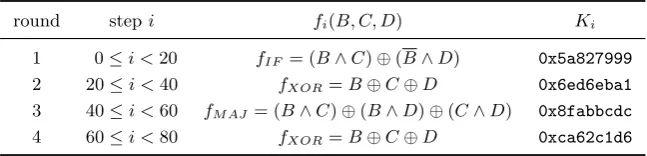
where Ki are predetermined constants and fi are Boolean functions (see Table 3-1 for
their specifications). As all updated registers butAi+1 are just rotated copies of another, it is possible to equivalently express the step function in a recursive way using only the registerA:
Ai+1 = (Ai≪5) +fi(Ai−1, Ai−2 ≫2, Ai−3 ≫2) + (Ai−4 ≫2) +Ki+Wi.
3
Table 3-1.Boolean functions and constants ofSHA-1
round stepi fi(B, C, D) Ki
1 0≤i <20 fIF= (B∧C)⊕(B∧D) 0x5a827999
2 20≤i <40 fXOR=B⊕C⊕D 0x6ed6eba1
3 40≤i <60 fM AJ = (B∧C)⊕(B∧D)⊕(C∧D) 0x8fabbcdc
4 60≤i <80 fXOR=B⊕C⊕D 0xca62c1d6
Finally, the extended message words Wi are computed from the 512-bit message block,
which is split into sixteen 32-bit words M0, . . . , M15. These sixteen words are then ex-panded linearly into the eighty 32-bit wordsWi as follows:
Wi=
(
Mi, for 0≤i≤15
(Wi−3⊕Wi−8⊕Wi−14⊕Wi−16)≪1, for 16≤i≤79
The step function and the message expansion can both easily be inverted.
3.2 Differential collision attacks on SHA-1
We now introduce the main notions used in a collision attack onSHA-1(and more generally on members of theMD-SHAfamily).
Background. In a differential collision attack on a (Merkle-Damg˚ard) hash function, the goal of the attacker is to find a high-probability differential path (the differences being on the message, and also on the IV in the case of a freestart attack) which entails a zero difference on the final state of the function (i.e. the hash value). A pair of messages (and optionally IVs) following such a path indeed leads to a collision.
In the case of SHA-1 (and more generally ARX primitives), the way of expressing differences between messages is less obvious than fore.g.bit or byte-oriented primitives. It is indeed natural to consider both “XOR differences” (overFn2) and “modular differences” (over Z/2nZ) as both operations are used in the function. In practice, the literature on SHA-1uses several hybrid representations of differences based onsigned XOR differences. In its most basic form, such a difference is similar to an XOR difference with the additional information of the value of the differing bits for each message (and also of some bits equal in the two messages), which is a “sign” for the difference. This is an important information when one works with modular addition as the sign impacts the (absence of) propagation of carries in the addition of two differences. Let us for instance consider the two pairs of words a = 11011000001b, ˆa = 11011000000b and b = 10100111000b, ˆb = 10100111001b;
the XOR differences (a⊕ˆa) and (b⊕ˆb) are both 00000000001b (which may be written
...x), meaning that (a⊕b) = (ˆa⊕ˆb). On the other hand, the signed XOR difference betweenaand ˆamay be written ...-to convey the fact that they are different on their lowest bit and that the value of this bit is 1 for a (and thence 0 for ˆ
consider relations between various bits of the (possibly rotated) state words; this allows to efficiently keep track of the propagation of differences through the step function. Such differences are for instance used by Stevens [Ste13b], and also in this work (seeFigure 5-2).
The structure of differential attacks on SHA-1 evolved to become quite specific. At a high level, they consist of: 1. a non-linear differential path of low probability; 2. a linear
differential path of high probability; 3. accelerating techniques.
The terms non-linear and linear refer to how the paths were obtained: the latter is derived from a linear (overF322 ) modelling of the step function. This kind of path is used in the probabilistic phase of the attack, where one simply tries many message pairs in order to find one that indeed “behaves” linearly. Computing the exact probability of this event is however not easy, although it is not too hard to find reasonable estimates. This probability is the main factor determining the final complexity of the attack.
The role of a non-linear path is to bootstrap the attack by bridging a state with no differences (the IV) with the start of the linear differential path4. In a nutshell, this is
necessary because these paths do not typically lie in the kernel of the linearized SHA-1; hence it is impossible to obtain a collision between two messages following a fully linear path. This remains true in the present case of a freestart attack, even if the non-linear path now connects the start of the linear path with an IV containing some differences. Unlike the linear path, the non-linear one has a very low probability of being followed by random messages. However, the attacker can fully choose the messages to guarantee that they do follow the path, as he is free to set the 512 bits of the message. Hence finding conforming message pairs for this path effectively costs nothing in the attack.
Finally, the role of accelerating techniques is to find efficient ways of using the freedom degrees remaining after a pair following the non-linear path has been found, in order to delay the effective moment where the probabilistic phase of the attack starts.
We conclude this section with a short discussion of how to construct these three main parts of a (freestart) collision attack onSHA-1.
Linear path; local collisions. The linear differential paths used in collision attacks are built around the concept of local collision, introduced by Chabaud and Joux in 1998 to attack SHA-0. The idea underlying a local collision is first to introduce a difference in one of the intermediate state words of the function, say Ai, through a difference in the
message word Wi−1. For an internal state made of j words (j = 5 in the case of SHA-0 or SHA-1), the attacker then uses subsequent differences in (possibly only some of) the message words Wi...i+(j−1) in order to cancel any contribution of the difference in Ai in
the computation of a new internal stateAi+1...i+j, which will therefore have no differences.
The positions of these “correcting” differences are dictated by the step function, and there may be different options depending on the used Boolean function, though originally (and in most subsequent cases) these were chosen according to a linearized model (overF322 ) of the step functions.
Local collisions are a fit basis to generate differential paths of good probability. The main obstacle to do this is that the attacker does not control all of the message words, as some are generated by the message expansion. Chabaud and Joux showed how this could be solved by chaining local collisions along adisturbance vector (DV) in such a way that the final state of the function contains no difference and that the pattern of the local
4
For the sake of simplicity, we ignore here the fact that a collision attack on SHA-1 usually uses two blocks, with the second one having differences in its chaining value. The general picture is actually the following: once a pair of messages following the linear pathP+
is found, the first block ends with a signed difference +∆; the sign of the linear path is then switched for the second block to becomeP−
collisions is compatible with the message expansion. The disturbance vector just consists of a sparse message (of sixteen 32-bit words) that has been expanded with the linear message expansion of SHA-1. Every “one” bit of this expanded message then marks the start of a local collision (and expanding all the local collisions thus produces a complete linear path).
Each local collision in the probabilistic phase of the attack (roughly corresponding to the last three rounds) increases the overall complexity of the attack, hence one should use disturbance vectors that are sparse over these rounds. Initially, the evaluation of the prob-ability of disturbance vector candidates was done mostly heuristically, usinge.g.the Ham-ming weight of the vector ([BC04,PRR05,RO05,MP05,JP05]), the sum of bit conditions for each local collision independently (not allowing carries) ([WYY05b,YIN+08]), and the product of independent local collision probabilities (allowing carries) ([MPRR06,Man11]). Manuel [Man08,Man11] noticed that all disturbance vectors used in the literature belong to two classes I(K, b) and II(K, b). Within each class all disturbance vectors are forward or backward shifts in the step index (controlled by K) and/or bitwise cyclic rotations (controlled by b) of the same expanded message. We will use this notation through the remainder of this article.
Manuel also showed that success probabilities of local collisions are not always indepen-dent, causing biases in the above mentioned heuristic cost functions. This was later resolved by Stevens using a technique called joint local-collision analysis (JLCA)[Ste13b, Ste12], which allows to analyze entire sets of differential paths over the last three rounds that conform to the (linear path entailed by the) disturbance vector. This is essentially an exhaustive analysis taking into account all local collisions together, using which one can determine the highest possible success probability. This analysis also produces a minimal set of sufficient conditions which, when all fulfilled, ensure that a pair of messages follows the linear path; the conditions are minimal in the sense that meeting all of them hap-pens with this highest probability that was computed by the analysis. Although a direct approach is clearly unfeasible (as it would require dealing with an exponentially growing amount of possible differential paths), JLCA can be done practically by exploiting the large amount of redundancy between all the differential paths to a very large extent.
Non-linear differential path. The construction of non-linear differential paths was
initially done by hand by Wang, Yin and Yu in their first attack on the full SHA-1 [WYY05a]. Efficient algorithmic construction of such differential paths was later proposed in 2006 by De Canni`ere and Rechberger, who introduced a guess-and-determine approach [DR06]. A different approach based on a meet-in-the-middle method was also proposed by Stevenset al. [Ste12,HC].
Accelerating techniques. For a given differential path, one can derive explicit conditions on state and message bits which are sufficient to ensure that a pair of messages follows the path. This lets the collision search to be entirely defined over a single compression function computation. Furthermore, they also allow detection of “bad” message pairs a few steps earlier compared to computing the state and verifying differences, allowing to abort computations earlier in this case.
An important contribution of Wang, Yin and Yu was the introduction of powerful
of a bit which does not invalidate nearby sufficient conditions with good probability). In essence, both techniques allow to amortize part of the computations, which effectively delays the beginning of the purely probabilistic phase of the attack.
Finally, Joux and Peyrin showed how to construct powerful neutral bits and message modifications by using auxiliary differential paths akin toboomerangs [JP07], which allow more efficient attacks. In a nutshell, a boomerang (in collision attacks) is a small set of bits that together form a local collision. Hence flipping these bits together ensures that the difference introduced by the first bit of the local collision does not propagate to the rest of the state; if the initial difference does not invalidate a sufficient condition, this local collision is indeed a neutral bit. Yet, because the boomerang uses a single (or sometimes a few) local collision, more differences will actually be introduced when it goes through the message expansion. The essence of boomerangs is thus to properly choose where to locate the local collisions so that no differences are introduced for the most steps possible.
4 Attack overview
In this section we provide an overview of how our attack was constructed. At a high level, it consists of the following steps:
1. Disturbance vector selection: We need to select the best disturbance vector for our attack. This choice is based on results provided by joint local collision analysis (JLCA), taking into account constraints on the number and position of sufficient conditions on the IV implied by the disturbance vector. We explain this in Section 4.1.
2. Finding optimal attack conditions: Having selected a disturbance vector, we need to determine a set of attack conditions over all steps consisting of sufficient conditions for state bits up to some step, augmented by message bit relations. We use non-linear differential path construction methods to determine conditions within the first round. Using JLCA we derive an optimal complete set of attack conditions that given the first round path leads to the highest possible success probability over all steps, yet minimizes the number of conditions within this model. We detail this in Section 4.2. 3. Finding and analyzing boomerangs and neutral bits: To speed up the freestart collision
attack, we exploit advanced message modification techniques such as (multiple) neutral bits and boomerangs. In order to find suitable candidates, we sample partial solutions fulfilling the above attack conditions up to an early step. The samples are used to test many potential boomerangs and neutral bits, and only ones of good quality and that do not introduce contradictions will be used. In particular, no boomerang or neutral bit may invalidate the attack conditions of the so-called base solution (see below, includes all message bit relations) with non-negligible probability. We also use sampling to estimate the probability of interaction between boomerang and neutral bits with particular sufficient conditions, in the forward and backward direction. Although we do not allow significant interaction in the backward direction, we use these probabilities to determine at which step the boomerang or neutral bit are used. This is explained inSection 4.3.
4. Base solution generation: Before we can apply neutral bits and boomerangs, we first need to compute a partial solution over 16 consecutive steps. Only this partial solution can then be extended to cover more steps by using neutral bits and boomerangs. We call such a solution abase solution; it consists of state wordsA−3, . . . , A17and message words W1, . . . , W16. The cost for generating base solutions is relatively low compared to the overall attack cost, therefore it is not heavily optimized and the search is run on regular CPUs. This is further explained inSection 4.4.
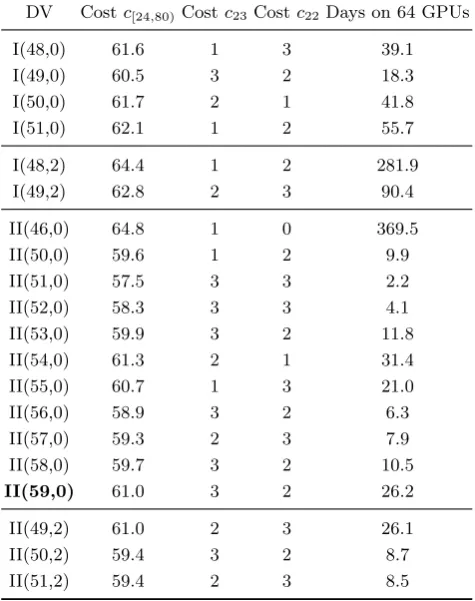
Table 4-1.Disturbance vector analysis. For each DV, underc[24,80), we list the negative log2of the success
probability over steps [24,80) assuming that all sufficient conditions up to A24 have been satisfied. The columnsc23and c22list the number of conditions onA24 (in step 23) andA23(in step 22), respectively. The final column represents an estimated runtime in days on a cluster consisting of 64 GTX970s based on
c[24,80).
DV Costc[24,80)Costc23Costc22Days on 64 GPUs
I(48,0) 61.6 1 3 39.1
I(49,0) 60.5 3 2 18.3
I(50,0) 61.7 2 1 41.8
I(51,0) 62.1 1 2 55.7
I(48,2) 64.4 1 2 281.9
I(49,2) 62.8 2 3 90.4
II(46,0) 64.8 1 0 369.5
II(50,0) 59.6 1 2 9.9
II(51,0) 57.5 3 3 2.2
II(52,0) 58.3 3 3 4.1
II(53,0) 59.9 3 2 11.8
II(54,0) 61.3 2 1 31.4
II(55,0) 60.7 1 3 21.0
II(56,0) 58.9 3 2 6.3
II(57,0) 59.3 2 3 7.9
II(58,0) 59.7 3 2 10.5
II(59,0) 61.0 3 2 26.2
II(49,2) 61.0 2 3 26.1
II(50,2) 59.4 3 2 8.7
II(51,2) 59.4 2 3 8.5
boomerangs and verifying sufficient conditions. Once all neutral bits and boomerangs have been exploited, the remainder of the steps have to be fulfilled probabilistically. This is computationally the most intensive part, and it is therefore implemented on GPUs that are significantly more cost-efficient than CPUs, using the highly efficient framework introduced by Karpman, Peyrin and Stevens [KPS15]. More details are provided inSection 4.5.
All these steps strongly build upon the continuous series of papers that have advanced the state-of-the-art inSHA-1cryptanalysis, yet there are still small adaptions and improve-ments used for this work. We now describe all these points in more details.
4.1 Disturbance vector selection
It is possible to compute exactly the highest success probability over the linear part by using joint-local collision analysis [Ste13b]. By further using the improvements described in [KPS15], one can restrict carries for the steps where sufficient conditions are used and obtain the sufficient conditions for those steps immediately.
all sufficient conditions up toA24 have been satisfied; we also include the number of con-ditions on A24 and A23. The final column represents an estimated runtime in days on a cluster consisting of 64 GTX970s based on c[24,80), by multiplying the runtime of the 76-step freestart GPU attack [KPS15] with the difference between the costsc[24,80)for the 76-step attack and the DVs in the table.
Considering Table 4-1, the obvious choice of DV to mount a full collision attack on SHA-1 would be II(51,0). However in the present case of a freestart attack additional constraints need to be taken into account. In particular the, choice of the DV determines the possible differences in the IV, as these have to cancel the differences of the final state (A80, B80, C80, D80, E80). This impacts the estimated runtime as follows: if there are sufficient conditions present onA0 then the estimated runtime in the last column should be multiplied by 2c23. Indeed, the 76-step freestart attack did not have any sufficient conditions onA0and could thus ignore step 0, leading to an offset of one in the probabilistic phase. Moreover, if the IV differences are denser or ill-located (compared to the 76-step attack), then more neutral bits and boomerangs are likely to interact badly with the sufficient conditions on the IV, when propagated backwards. If only few neutral bits and boomerangs can be used for a given DV, the cost of the attack would rise significantly. The number of conditionsc23 andc22for each DV allow to estimate how much more expensive a vector will be in the case where the probabilistic phase effectively starts sooner than in stepA25 as for the 76-step attack.
Taking the freestart setting into account, and with a preliminary analysis of available neutral bits and boomerangs, the best option eventually seemed to be II(59,0). This DV is actually a downward shift by four of II(55,0), which was used in the 76-step attack. Consequently, this choice leads to the same IV sufficient conditions as in the latter.
4.2 Finding optimal attack conditions
Using joint local collision analysis, we could obtain sufficient conditions for the beginning of the second round and IV differences that are optimal (i.e., with the highest probability of cancelling differences in the final state). What remains to do is to construct a non-linear differential path for the first round. For this, we used the meet-in-the-middle method using the public HashClash implementation [HC]. Although we tried both non-linear differen-tial path construction methods,i.e.guess-and-determine, using our own implementation, and the meet-in-the-middle method, we have found that the meet-in-the-middle approach generally resulted in fewer conditions. Furthermore, the control on the position of these conditions was greater with the meet-in-the-middle approach.
This differential path for the first round was then used as input for another run of joint local collision analysis. In this case the run was over all 80 steps, also replacing the differences assumed from the disturbance vector with the differences in the state words coming from the non-linear path of the first round; switching the sign of a difference was also allowed when it resulted in a sparser overall difference. In this manner joint local collision analysis is able to provide a complete set of attack conditions (i.e., sufficient conditions for the state words and linear relations on message bits) that is optimized for the highest success probability over the last three rounds, all the while minimizing the amount of conditions needed.
as extensions of attack conditions classes over steps [0, i−1], we only have to work with a very small number of class representatives at each step, making it very practical.
Note that we do not exploit this to obtain additional freedom for the attack yet, However, it allows us to automatically circumvent random unpredictable contradictions between the attack conditions in the densest part, by randomly sampling complete sets until a usable one is found. We previously used the guess-and-determine approach to resolve such contradictions by changing signs, however this still required some manual interaction.
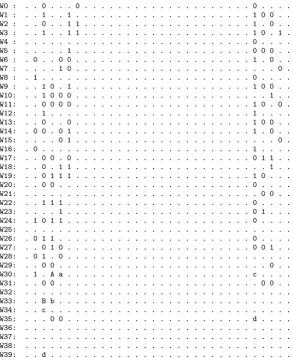
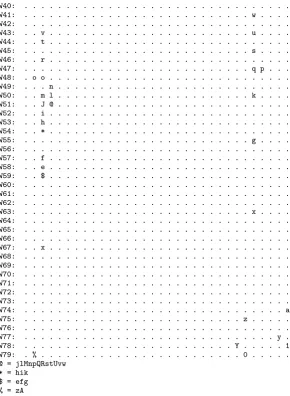
The resulting sufficient conditions on the state are given in the form of the differential path in Figure 5-1 (using the symbols of Figure 5-2) and the message bit relations are given inFigure 5-5 through Figure 5-7.
4.3 Finding and analyzing neutral bits and boomerangs
Generating and analyzing the boomerangs and neutral bits used in the attack was done entirely automatically as described below. This process depends on a parameter called the
main block offset (specific to a freestart attack) that determines the offset of the message freedom window used during the attack. We have selected a main block offset of 5 as this led to the best distribution of usable neutral bits and boomerangs. This means that all the neutral bits and boomerangs directly lead to changes in the state from steps 5 up to 20, and that these changes propagate to steps 4 down to 0 backwards and steps 21 up to 79 forwards.
Because the dense area of the attack conditions may implicitly force certain other bits to specific values (resulting in hidden conditions), we use more than 4000 sampled solutions for the given attack conditions (over steps 1 up to 16) in the analysis. The 16 steps fully determine the message block, and also verify the sufficient conditions in the IV and in the dense non-linear differential path of the first round. It should be noted that for this step it is important to generate every sample independently. Indeed using e.g.
message modification techniques to generate many samples from a single one would result in a biased distribution where many samples would only differ in the last few steps.
Boomerang analysis. We analyze potential boomerangs that flip a single state bit
together with 3 or more message bits. Each boomerang should be orthogonal to the attack conditions, i.e., the state bit should be free of sufficient conditions, while flipping the message bits should not break any of the message bit relations (either directly or through the message propagation). Lett∈[6,16], b∈[0,31] be such that the state bitAt[b] has no
sufficient condition.
First, we determine the best usable boomerang on At[b] as follows. For every sampled
solution, we flip that state bit and compute the signed bit differences between the resulting and the unaltered message wordsW5, . . . , W20. We verify that the boomerang is usable by checking that flipping its constituting bits breaks none of the message bit relations. We normalize these signed bit differences by negating them all when the state bit is flipped from 1 to 0. In this manner we obtain a set of usable boomerangs forAt[b]. We determine
the auxiliary conditions on message bits and state bits and only keep the best usable boomerang that has the fewest auxiliary conditions.
Secondly, we analyze the behaviour of the boomerang over the backwards steps. For every sampled solution, we simulate the application of the boomerang by flipping the bits of the boomerang. We then recompute steps 4 to 0 backwards and verify if any sufficient condition on these steps is broken. Any boomerang that breaks any sufficient conditions on the early steps with probability higher than 0.1 is dismissed.
bits. We then recompute steps 21 up to 79 forwards and keep track of any sufficient condition for the differential path that becomes violated. A boomerang will be used at step i in our attack if it does not break any sufficient condition up to step i−1 with probability more than 0.1.
Neutral bits analysis. The neutral bit analysis uses the same overall approach as the boomerangs, with the following changes. After boomerangs are determined, their con-ditions are added to the previous attack concon-ditions and used to generate a new set of solution samples. Usable neutral bits consist of a set of one or more message bits that are flipped simultaneously. However, unlike for boomerangs, the reason for flipping more than one bit is to preserve message bit relations, and not to control the propagation of a state difference. Let t ∈ [5,20], b ∈ [0,31] be a candidate neutral bit; flipping Wt[b] may
possibly break certain message bit relations. We express each message bit relation over W5, . . . , W20using linear algebra, and use Gaussian elimination to ensure that each of them has a unique last message bitWi[j] (i.e. where i∗32 +j is maximal). For each relation
involvingWt[b], letWi[j] be its last message bit. If (i, j) equals (t, b) then this neutral bit
is not usable (indeed, it would mean that its value is fully determined by earlier message bits). Otherwise we add bitWi[j] to be flipped together withWt[b] as part of the neutral
bit. Similarly to boomerangs, we dismiss any neutral bit that breaks sufficient conditions backwards with probability higher than 0.1. The stepiin which the neutral bit is used is determined in the same way as for the boomerangs.
The boomerangs we have selected are given in Figure 5-4 and the neutral bits are listed inFigure 5-3. In the case of the latter, only the first neutral bit is given and not the potential corrections for the message bit relations.
4.4 Base solution generation on CPU
We are now equipped with a set of attack conditions, including some that were added by the selected boomerangs and neutral bits. However, before these can be applied, we first need to compute partial solutions over 16 consecutive steps. Since the selected neutral bits and boomerangs cannot be used to correct the sufficient conditions on the IV, these have to be pre-satisfied as well. Therefore, we compute what we callbase solutionsover steps 1, . . . ,16 that fulfill all state conditions onA−4, . . . , A17and all message bit relations. A base solution itself consists of state words A−3, . . . , A17 and message wordsW1, . . . , W16 (although the implementation of the GPU step implies that the message words are translated to the equivalent message wordsW5, . . . , W20with the main block offset of 5).
The C++code generating base solutions is directly compiled from the attack and aux-iliary conditions. In this manner, all intermediate steps and condition tables can be hard-coded, and we can apply some static local optimizations eliminating unnecessary compu-tations where possible. However, we do not exploit more advanced message modification techniques within these first 16 steps yet.
Generating the base solutions only represents a small part of the cost of the overall attack, and it is run entirely on CPU. Although theoretically we need only a few thousand base solutions to be successful given the total success probability over the remaining steps and the remaining freedom degrees yet to be used, in practice we need to generate a small factor more to ensure that all GPUs have enough work.
4.5 Applying neutral bits and boomerangs on GPU
Nvidia GTX970 [NVI] GPUs that feature 1664 small cores operating at a clock speed of about 1.2GHz; each card cost about 350 US$ in 2015.5 In [KPS15], the authors evaluate a single GTX970 to be worth 322 CPU cores6 for rawSHA-1 operations, and about 140 cores for theirSHA-1attack.
We make use of the same efficient framework for Nvidia GPUs [KPS15]. This makes use of the CUDA toolkit that provides programming extensions to Cand C++for convenient programming. For each step ofSHA-1wherein we use neutral bits and boomerangs, there will be a separate GPU-specificC++function. Each function will load solutions up to that step from a global cyclic buffer; extend those solutions using the freedom for that step by triggering the available neutral bits or boomerangs; verify the sufficient conditions; and finally save the resulting partial solution extended by one step in the next global cyclic buffer. The smallest unit that can act independently on Nvidia GPUs is thewarp, which consists of 32 threads that can operate on different data, but should execute the same instruction for best performance. When threads within a warp diverge onto differ-ent execution paths, these paths are executed serially, not in parallel. In the framework, the threads within each warp will agree on which function (thus which step) to execute together, resulting in reads, computations, and conditional writes that are coherent be-tween all threads of the warp. We refer the reader to the original paper introducing this framework for a more detailed description [KPS15].
The exact details of which neutral bits and which boomerangs are used for each step are given inSection 5.
In the probabilistic phase, after all freedom degrees have been exhausted, we can verify internal state collisions that should happen after steps 39 and 59 (for a message pair that follows the differential path), as these are steps with no active differences in the disturbance vector. These checks are still done on the GPU. Solutions up toA60are passed back to the CPU for further verification to determine if a complete freestart collision has been found. We would like to note that in comparison with the attack on 76 steps, this work introduces boomerangs and has a slightly bigger count of neutral bits (60 v. 51). As a result, this required to use more intermediate buffers, and consequently a slightly more careful management of the memory. Additionally, in this work there is a relatively high proportion of the neutral bits that need additional message bits to be flipped to ensure no message bit relation is broken, whereas this only happens twice in the 76-step attack. These two factors result in an attack that is slightly more complex to implement, although neither point is a serious issue.
5 Attack details
5.1 Sufficient conditions
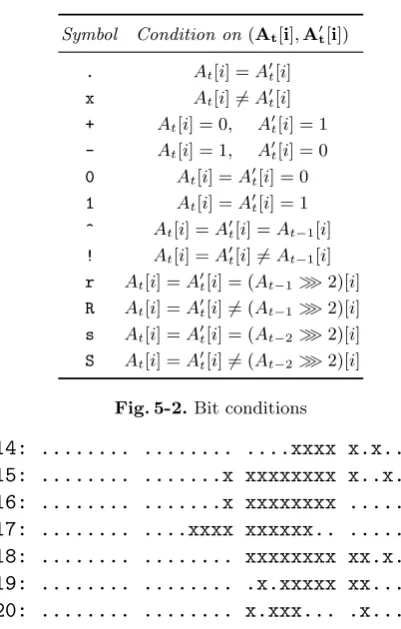
We give a graphical representation of the differential path used in our attack up to step 28 inFigure 5-1, consisting of sufficient conditions for the state, and the associated message signed bit differences. The meaning of the bit condition symbols are defined inFigure 5-2. Note that the signs of message bit differences are enforced through message bit relations. All message bit relations used in our attack are given in Figure 5-5 through Figure 5-7. The remainder of the path can easily be determined by linearization of the step function given the differences in the message.
5.2 The neutral bits
We give here the list of the neutral bits used in our attack. There are 60 of them over the 7 message wordsW14toW20, distributed as follows:
5
With the right motherboard one can place up to 4 such GPUs on a single machine.
A-4: ... ... ... ... A-3: ... ... ... ... A-2: ... ... ... ...^-. A-1: 1...1... ... ... .0...+
A0 : 01..0... ... ... .1... W0 : x.+...+. ... ... ...+.... A1 : 11+^..+. ... ....^... ...+.... W1 : ..-..-.. ... ... ...-++.. A2 : ..-11-1. 1...^ ...1+1 10.1.0.. W2 : ..+..--. ... ... ...-.+.. A3 : .0.0-001 1.^.10.. .+01.011 11^0.1.1 W3 : ..-..--. ... ... ...-+.-. A4 : .1.11+-1 +^^^+1^^ ^011^^.- +++++-.+ W4 : ... ... ... ...+.... A5 : .+.+.-++ ++++++++ ++++++++ .+0-1111 W5 : ...-.. ... ... ...+++.. A6 : .0.0.1.0 11.111.1 1110-010 0-1.10-+ W6 : x+..++.. ... ... ...-.+.. A7 : 1-.+.1.0 10100010 00000011 1+.-.0.+ W7 : ....-+.. ... ... ...+. A8 : 0+.0.0.. ... ...0. .+.-.0.1 W8 : x-... ... ... ...+.... A9 : .+.0.0.. ... ... .0.+...^ W9 : x.-+.-.. ... ... ...-++.. A10: .+... ... ... ...+.0.. W10: ..-+++.. ... ... ...-.. A11: ...-.... ... ... ... W11: x.++++.. ... ... ...-+.+. A12: ...0.1.. ... ... ...1.. W12: ..-... ... ... ...-.... A13: .1...0.. ... ... ...!^ W13: ..+..+.. ... ... ...-++.. A14: +-... ... ... ... W14: x++.+-.. ... ... ...-.+.. A15: 1.1-.... ... ... ...!. W15: ....+-.. ... ... ...+. A16: +.10.1.. ... ... ... W16: x+... ... ... ...-.... A17: 1.-..0.. ... ... ...^ W17: x.++.+.. ... ... ...+--.. A18: .+-.0... ... ... ...! W18: ..+.--.. ... ... ...-.. A19: .+.s.... ... ... ... W19: x.+---.. ... ... ...-+... A20: -...R... ... ... ... W20: x.++.... ... ... ...+.... A21: -.+R.... ... ... ... W21: ... ... ... ....++.. A22: -...S... ... ... ...^ W22: x.---... ... ... ...+.... A23: .-..R... ... ... ... W23: ....-... ... ... ...+-... A24: -.rs.... ... ... ... W24: .-+--... ... ... ...+.... A25: -.-r.... ... ... ... W25: ....+... ... ... ...+.+.. A26: -...s... ... ... ... W26: .+--.... ... ... ...+.... A27: -.-.r... ... ... ... W27: x.+-+... ... ... ...++-.. A28: ... ... ... ... W28: x+-.-... ... ... ... A29: ..-... ... ... ...
Fig. 5-1.The differential path used in the attack up to step 28. The meaning of the different symbols is given inFigure 5-2
– W14: 6 neutral bits at bit positions (starting with the least significant bit (LSB) at zero) 5,7,8,9,10,11
– W15: 11 neutral bits at positions 4,7,8,9,10,11,12,13,14,15,16
– W16: 9 neutral bits at positions 8,9,10,11,12,13,14,15,16
– W17: 10 neutral bits at positions 10,11,12,13,14,15,16,17,18,19
– W18: 11 neutral bits at positions 4,6,7,8,9,10,11,12,13,14,15
– W19: 8 neutral bits at positions 6,7,8,9,10,11,12,14
– W20: 5 neutral bits at positions 6,11,12,13,15
We give a graphical representation of the position of these neutral bits inFigure 5-3. Not all of the neutral bits of the same word (sayW14) are used at the same step during the attack. Their repartition in that respect is as follows
– Bits neutral up to step 18 (excluded): W14[8,9,10,11], W15[13,14,15,16]
– Bits neutral up to step 19 (excluded):W14[5,7],W15[8,9,10,11,12],W16[12,13,14,15,16]
– Bits neutral up to step 20 (excluded): W15[4,7,8,9], W16[8,9,10,11,12], W17[12,13,14, 15,16]
– Bits neutral up to step 21 (excluded): W17[10,11,12,13],W18[15]
– Bits neutral up to step 22 (excluded): W18[9,10,11,12,13,14], W19[10,14]
– Bits neutral up to step 23 (excluded): W18[4,6,7,8],W19[9,11,12],W20[15]
– Bits neutral up to step 24 (excluded): W19[6,7,8], W20[11,12,13]
– Bit neutral up to step 25 (excluded):W20[7]
Symbol Condition on(At[i],A0t[i])
. At[i] =A0t[i]
x At[i]6=A0t[i]
+ At[i] = 0, A0t[i] = 1
- At[i] = 1, A0t[i] = 0
0 At[i] =A0t[i] = 0
1 At[i] =A0t[i] = 1
^ At[i] =A0t[i] =At−1[i]
! At[i] =A0t[i]6=At−1[i]
r At[i] =A0t[i] = (At−1≫2)[i]
R At[i] =A0t[i]6= (At−1≫2)[i]
s At[i] =A0t[i] = (At−2≫2)[i]
S At[i] =A0t[i]6= (At−2≫2)[i]
Fig. 5-2.Bit conditions
W14: ... ... ....xxxx x.x... W15: ... ...x xxxxxxxx x..x.... W16: ... ...x xxxxxxxx ... W17: ... ....xxxx xxxxxx.. ... W18: ... ... xxxxxxxx xx.x.... W19: ... ... .x.xxxxx xx... W20: ... ... x.xxx... .x...
Fig. 5-3. The 60 neutral bits. An “x” represents the presence of a neutral bit, and a “.” the absence thereof. The LSB position is the rightmost one.
5.3 The boomerangs
We finally give the boomerangs used in the attack, which are regrouped in two sets of two. The first one first introduces a difference in the message on wordW10; as it does not significantly impact conditions up to step 27, it is used to increase the number of partial solutionsA28that are generated. The second set first introduces a difference on wordW11, and is used to generate partial solutions atA30. More precisely, the four boomerangs have their first differences at bits 7,8 ofW10and 8,9 of W11. InFigure 5-4, we give a graphical representation of the complete set of message bits to be flipped for each boomerang. One can see that these indeed follow the pattern of a local collisions.
W10: ... ... ...BA ... W11: ... ... .ba....D C... W12: ... ... ..dc.... ... W13: ... ... ... ... W14: ... ... ... .a... W15: ... ... ... ba... W16: ... ... ... .dc...
- W0[4] = 0 - W9[29] = 1 - W18[27] = 1 - W29[28] = 0 - W0[25] = 0 - W10[2] = 1 - W18[29] = 0 - W29[29] = 0
- W0[29] = 0 - W10[26] = 0 - W19[3] = 0 - W30[27] ^ W30[28] = 1 - W1[2] = 0 - W10[27] = 0 - W19[4] = 1 - W30[30] = 1
- W1[3] = 0 - W10[28] = 0 - W19[26] = 1 - W31[2] = 0 - W1[4] = 1 - W10[29] = 1 - W19[27] = 1 - W31[3] = 0 - W1[26] = 1 - W11[1] = 0 - W19[28] = 1 - W31[28] = 0 - W1[29] = 1 - W11[3] = 0 - W19[29] = 0 - W31[29] = 0
- W2[2] = 0 - W11[4] = 1 - W20[4] = 0 - W33[28] ^ W33[29] = 1 - W2[4] = 1 - W11[26] = 0 - W20[28] = 0 - W30[4] ^ W34[29] = 0 - W2[25] = 1 - W11[27] = 0 - W20[29] = 0 - W35[27] = 0
- W2[26] = 1 - W11[28] = 0 - W21[2] = 0 - W35[28] = 0
- W2[29] = 0 - W11[29] = 0 - W21[3] = 0 - W35[4] ^ W39[29] = 0 - W3[1] = 1 - W12[4] = 1 - W22[4] = 0 - W58[29] ^ W59[29] = 0 - W3[3] = 0 - W12[29] = 1 - W22[27] = 1 - W57[29] ^ W59[29] = 0 - W3[4] = 1 - W13[2] = 0 - W22[28] = 1 - W55[4] ^ W59[29] = 0 - W3[25] = 1 - W13[3] = 0 - W22[29] = 1 - W53[29] ^ W54[29] = 0 - W3[26] = 1 - W13[4] = 1 - W23[3] = 1 - W52[29] ^ W54[29] = 0 - W3[29] = 1 - W13[26] = 0 - W23[4] = 0 - W51[28] ^ W51[29] = 1 - W4[4] = 0 - W13[29] = 0 - W23[27] = 1 - W50[4] ^ W54[29] = 0 - W5[2] = 0 - W14[2] = 0 - W24[4] = 0 - W50[28] ^ W51[28] = 0 - W5[3] = 0 - W14[4] = 1 - W24[27] = 1 - W50[29] ^ W51[28] = 1 - W5[4] = 0 - W14[26] = 1 - W24[28] = 1 - W49[28] ^ W51[28] = 0 - W5[26] = 1 - W14[27] = 0 - W24[29] = 0 - W48[29] ^ W48[30] = 0 - W6[2] = 0 - W14[29] = 0 - W24[30] = 1 - W47[3] ^ W51[28] = 0 - W6[4] = 1 - W14[30] = 0 - W26[4] = 0 - W47[4] ^ W51[28] = 1 - W6[26] = 0 - W15[1] = 0 - W26[28] = 1 - W46[29] ^ W51[28] = 1 - W6[27] = 0 - W15[26] = 1 - W26[29] = 1 - W45[4] ^ W51[28] = 0 - W6[30] = 0 - W15[27] = 0 - W26[30] = 0 - W44[29] ^ W51[28] = 0 - W7[1] = 0 - W16[4] = 1 - W27[2] = 1 - W43[4] ^ W51[28] = 1 - W7[26] = 0 - W16[30] = 0 - W27[3] = 0 - W43[29] ^ W51[28] = 0 - W7[27] = 1 - W17[2] = 1 - W27[4] = 0 - W41[4] ^ W51[28] = 0 - W8[4] = 0 - W17[3] = 1 - W27[27] = 0 - W63[4] ^ W67[29] = 0 - W8[30] = 1 - W17[4] = 0 - W27[28] = 1 - W79[5] = 0
- W9[2] = 0 - W17[26] = 0 - W27[29] = 0 - W78[0] = 1
- W9[3] = 0 - W17[28] = 0 - W28[27] = 0 - W77[1] ^ W78[6] = 1 - W9[4] = 1 - W17[29] = 0 - W28[29] = 1 - W75[5] ^ W79[30] = 0 - W9[26] = 1 - W18[2] = 1 - W28[30] = 0 - W74[0] ^ W79[30] = 1 - W9[28] = 0 - W18[26] = 1 - W29[2] = 0
W0 : . . 0 . . . 0 . . . 0 . . . . W1 : . . 1 . . 1 . . . 1 0 0 . . W2 : . . 0 . . 1 1 . . . 1 . 0 . . W3 : . . 1 . . 1 1 . . . 1 0 . 1 . W4 : . . . 0 . . . . W5 : . . . 1 . . . 0 0 0 . . W6 : . 0 . . 0 0 . . . 1 . 0 . . W7 : . . . . 1 0 . . . 0 . W8 : . 1 . . . 0 . . . . W9 : . . 1 0 . 1 . . . 1 0 0 . . W10: . . 1 0 0 0 . . . 1 . . W11: . . 0 0 0 0 . . . 1 0 . 0 . W12: . . 1 . . . 1 . . . . W13: . . 0 . . 0 . . . 1 0 0 . . W14: . 0 0 . 0 1 . . . 1 . 0 . . W15: . . . . 0 1 . . . 0 . W16: . 0 . . . 1 . . . . W17: . . 0 0 . 0 . . . 0 1 1 . . W18: . . 0 . 1 1 . . . 1 . . W19: . . 0 1 1 1 . . . 1 0 . . . W20: . . 0 0 . . . 0 . . . . W21: . . . 0 0 . . W22: . . 1 1 1 . . . 0 . . . . W23: . . . . 1 . . . 0 1 . . . W24: . 1 0 1 1 . . . 0 . . . . W25: . . . . W26: . 0 1 1 . . . 0 . . . . W27: . . 0 1 0 . . . 0 0 1 . . W28: . 0 1 . 0 . . . . W29: . . 0 0 . . . 0 . . W30: . 1 . A a . . . c . . . . W31: . . 0 0 . . . 0 0 . . W32: . . . . W33: . . B b . . . . W34: . . c . . . . W35: . . . 0 0 . . . d . . . . W36: . . . . W37: . . . . W38: . . . . W39: . . d . . . .
W40: . . . . W41: . . . w . . . . W42: . . . . W43: . . v . . . u . . . . W44: . . t . . . . W45: . . . s . . . . W46: . . r . . . . W47: . . . q p . . . W48: . o o . . . . W49: . . . n . . . . W50: . . m l . . . k . . . . W51: . . J @ . . . . W52: . . i . . . . W53: . . h . . . . W54: . . * . . . . W55: . . . g . . . . W56: . . . . W57: . . f . . . . W58: . . e . . . . W59: . . $ . . . . W60: . . . . W61: . . . . W62: . . . . W63: . . . x . . . . W64: . . . . W65: . . . . W66: . . . . W67: . . x . . . . W68: . . . . W69: . . . . W70: . . . . W71: . . . . W72: . . . . W73: . . . . W74: . . . a W75: . . . z . . . . . W76: . . . . W77: . . . y . W78: . . . Y . . . 1 W79: . % . . . 0 . . . . . @ = jlMnpQRstUvw
* = hik $ = efg % = zA
Software disclosure policy
To allow verification and improve understanding of our new results, we intend to release our engineered freestart attack code for graphic cards at https://sites.google.com/
site/itstheshappening/.
However, this source code does not directly enable the engineering of a SHA-1 collision attack. Any cryptanalytic tools needed for engineering a full SHA-1 collision attack will be released independently in a responsible manner.
Acknowledgements
We would like to express our gratitude to Orr Dunkelman for the use of his cluster with NVidia Tesla K10 cards. We also thank the anonymous reviewers for their helpful com-ments.
References
[BC04] Eli Biham and Rafi Chen,Near-Collisions of SHA-0, CRYPTO (Matthew K. Franklin, ed.), Lecture Notes in Computer Science, vol. 3152, Springer, 2004, pp. 290–305.
[BCJ+05] Eli Biham, Rafi Chen, Antoine Joux, Patrick Carribault, Christophe Lemuet, and William Jalby,Collisions of SHA-0 and Reduced SHA-1, in Cramer [Cra05], pp. 36–57.
[Bra90] Gilles Brassard (ed.),CRYPTO, Lecture Notes in Computer Science, vol. 435, Springer, 1990. [CJ98] Florent Chabaud and Antoine Joux, Differential Collisions in SHA-0, CRYPTO (Hugo
Krawczyk, ed.), Lecture Notes in Computer Science, vol. 1462, Springer, 1998, pp. 56–71. [Cra05] Ronald Cramer (ed.),EUROCRYPT, Lecture Notes in Computer Science, vol. 3494, Springer,
2005.
[Dam89] Ivan Damg˚ard,A Design Principle for Hash Functions, in Brassard [Bra90], pp. 416–427. [dB91] Bert den Boer and Antoon Bosselaers,An Attack on the Last Two Rounds of MD4, CRYPTO
(Joan Feigenbaum, ed.), Lecture Notes in Computer Science, vol. 576, Springer, 1991, pp. 194– 203.
[dB93] Bert den Boer and Antoon Bosselaers, Collisions for the Compression Function of MD5, EUROCRYPT (Tor Helleseth, ed.), Lecture Notes in Computer Science, vol. 765, Springer, 1993, pp. 293–304.
[DMR07] Christophe De Canni`ere, Florian Mendel, and Christian Rechberger, Collisions for 70-Step SHA-1: On the Full Cost of Collision Search, SAC (Carlisle M. Adams, Ali Miri, and Michael J. Wiener, eds.), Lecture Notes in Computer Science, vol. 4876, Springer, 2007, pp. 56–73.
[Dob96] Hans Dobbertin,Cryptanalysis of MD4, FSE (Dieter Gollmann, ed.), Lecture Notes in Com-puter Science, vol. 1039, Springer, 1996, pp. 53–69.
[DR06] Christophe De Canni`ere and Christian Rechberger,Finding SHA-1 Characteristics: General Results and Applications, ASIACRYPT (Xuejia Lai and Kefei Chen, eds.), Lecture Notes in Computer Science, vol. 4284, Springer, 2006, pp. 1–20.
[For15a] CA/Browser Forum, Ballot 152 - Issuance of SHA-1 certificates through 2016, Cabforum mailing list, 2015.
[For15b] CA/Browser Forum, Ballot 152 - Issuance of SHA-1 certificates through 2016, Cabforum mailing list, 2015.
[GA11] Evgeny A. Grechnikov and Andrew V. Adinetz,Collision for 75-step SHA-1: Intensive Par-allelization with GPU, IACR Cryptology ePrint Archive2011(2011), 641.
[Gre10] Evgeny A. Grechnikov,Collisions for 72-step and 73-step SHA-1: Improvements in the Method of Characteristics, IACR Cryptology ePrint Archive2010(2010), 413.
[HC] HashClash project webpage,https://marc-stevens.nl/p/hashclash/.
[JP05] Charanjit S. Jutla and Anindya C. Patthak, A Matching Lower Bound on the Minimum Weight of SHA-1 Expansion Code, Cryptology ePrint Archive, Report 2005/266, 2005. [JP07] Antoine Joux and Thomas Peyrin, Hash Functions and the (Amplified) Boomerang Attack,
CRYPTO (Alfred Menezes, ed.), Lecture Notes in Computer Science, vol. 4622, Springer, 2007, pp. 244–263.
[KPS15] Pierre Karpman, Thomas Peyrin, and Marc Stevens, Practical Free-Start Collision Attacks on 76-step SHA-1, CRYPTO (Rosario Gennaro and Matthew Robshaw, eds.), Lecture Notes in Computer Science, vol. 9215, Springer, 2015, pp. 623–642.
[Man11] St´ephane Manuel, Classification and generation of disturbance vectors for collision attacks against SHA-1, Des. Codes Cryptography59(2011), no. 1-3, 247–263.
[Mer89] Ralph C. Merkle,One Way Hash Functions and DES, in Brassard [Bra90], pp. 428–446. [Mic15] Microsoft,SHA-1 Deprecation Update, Microsoft blog, 2015.
[Moz15] Mozilla,Continuing to Phase Out SHA-1 Certificates, Mozilla Security Blog, 2015.
[MP05] Krystian Matusiewicz and Josef Pieprzyk,Finding Good Differential Patterns for Attacks on SHA-1, Coding and Cryptography, International Workshop, WCC 2005 (Øyvind Ytrehus, ed.), Lecture Notes in Computer Science, vol. 3969, Springer, 2005, pp. 164–177.
[MPRR06] Florian Mendel, Norbert Pramstaller, Christian Rechberger, and Vincent Rijmen,The Impact of Carries on the Complexity of Collision Attacks on SHA-1, FSE (Matthew J. B. Robshaw, ed.), Lecture Notes in Computer Science, vol. 4047, Springer, 2006, pp. 278–292.
[NIS93] National Institute of Standards and Technology,FIPS 180: Secure Hash Standard, May 1993. [NIS95] National Institute of Standards and Technology, FIPS 180-1: Secure Hash Standard, April
1995.
[NIS02] National Institute of Standards and Technology,FIPS 180-2: Secure Hash Standard, August 2002.
[NIS12] National Institute of Standards and Technology,Special Publication 800-57 - Recommendation for Key Management Part 1: General (Revision 3), July 2012.
[NIS15] National Institute of Standards and Technology, FIPS 202: SHA-3 Standard: Permutation-Based Hash and Extendable-Output Functions, August 2015.
[NVI] Nvidia Corporation, Nvidia Geforce GTX 970 Specifications, http://www.geforce.com/ hardware/desktop-gpus/geforce-gtx-970/specifications.
[PRR05] Norbert Pramstaller, Christian Rechberger, and Vincent Rijmen, Exploiting Coding Theory for Collision Attacks on SHA-1, Cryptography and Coding, 10th IMA International Confer-ence (Nigel P. Smart, ed.), Lecture Notes in Computer SciConfer-ence, vol. 3796, Springer, 2005, pp. 78–95.
[Riv90] Ronald L. Rivest, The MD4 Message Digest Algorithm, CRYPTO (Alfred Menezes and Scott A. Vanstone, eds.), Lecture Notes in Computer Science, vol. 537, Springer, 1990, pp. 303– 311.
[Riv92] Ronald L. Rivest,RFC 1321: The MD5 Message-Digest Algorithm, April 1992.
[RO05] Vincent Rijmen and Elisabeth Oswald, Update on SHA-1, CT-RSA (Alfred Menezes, ed.), Lecture Notes in Computer Science, vol. 3376, Springer, 2005, pp. 58–71.
[Sch12] Bruce Schneier,When Will We See Collisions for SHA-1?, Schneier on Security, 2012. [Ser16] Amazon Web Services,Amazon EC2 – Virtual Server Hosting, aws.amazon.com, Retrieved
Jan. 2016.
[Sho05] Victor Shoup (ed.), Advances in Cryptology — CRYPTO 2005: 25th Annual International Cryptology Conference, Santa Barbara, California, USA, August 14-18, 2005, Proceedings, Lecture Notes in Computer Science, vol. 3621, Springer, 2005.
[SLdW07] Marc Stevens, Arjen K. Lenstra, and Benne de Weger,Chosen-Prefix Collisions for MD5 and Colliding X.509 Certificates for Different Identities, EUROCRYPT (Moni Naor, ed.), Lecture Notes in Computer Science, vol. 4515, Springer, 2007, pp. 1–22.
[SSA+09] Marc Stevens, Alexander Sotirov, Jacob Appelbaum, Arjen K. Lenstra, David Molnar,
Dag Arne Osvik, and Benne de Weger, Short Chosen-Prefix Collisions for MD5 and the Creation of a Rogue CA Certificate, CRYPTO (Shai Halevi, ed.), Lecture Notes in Computer Science, vol. 5677, Springer, 2009, pp. 55–69.
[SSL15] Survey of the SSL Implementation of the Most Popular Web Sites, TIM Trustworthy Internet Movement, 2015.
[Ste12] Marc Stevens,Attacks on Hash Functions and Applications, Ph.D. thesis, Leiden University, June 2012.
[Ste13a] Marc Stevens, Counter-Cryptanalysis, CRYPTO (Ran Canetti and Juan A. Garay, eds.), Lecture Notes in Computer Science, vol. 8042, Springer, 2013, pp. 129–146.
[Ste13b] Marc Stevens,New Collision Attacks on SHA-1 Based on Optimal Joint Local-Collision Anal-ysis, EUROCRYPT (Thomas Johansson and Phong Q. Nguyen, eds.), Lecture Notes in Com-puter Science, vol. 7881, Springer, 2013, pp. 245–261.
[WY05] Xiaoyun Wang and Hongbo Yu,How to Break MD5 and Other Hash Functions, in Cramer [Cra05], pp. 19–35.
[WYY05a] Xiaoyun Wang, Yiqun Lisa Yin, and Hongbo Yu,Finding Collisions in the Full SHA-1, in Shoup [Sho05], pp. 17–36.
[WYY05b] Xiaoyun Wang, Hongbo Yu, and Yiqun Lisa Yin,Efficient Collision Search Attacks on SHA-0, in Shoup [Sho05], pp. 1–16.
[YIN+08] Jun Yajima, Terutoshi Iwasaki, Yusuke Naito, Yu Sasaki, Takeshi Shimoyama, Noboru