An Enhanced Agent Based Simulation using
Selected Viewing Multi-Resolution Modeling
Vivek Sharma Department of CSE
BCET Gurdaspur, India
Anil Sagar Department of IT, BCET, Gurdaspur
BCET Gurdaspur, India
Abstract— Resolution modeling has been used for the display
of the real time information of a system hierarchy such as defence system, business management system and others. Many resolution models has been proposed such as variable resolution modeling, cross resolution modeling and multi resolution modeling in terms to enhance the quality of the real time information display. These resolution models are constructed along with agents who are meant to pass the information between the various levels of hierarchy. In this paper we propose a framework for designing an agent based modeling using selected viewing multi resolution modeling (MRM). It includes team behaviour and their representation for achieving the desired goal. It will help us for analysis, planning and decision making. While using this tactical behaviour in the battlefield they execute the plans from higher order to lower order. These are needed in complex battlefield for better decomposition of problems so that they can better show the hierarchy. So more detailed and flexible view is selected and minimizing the possibility of unwanted effects
.
Keywords— Agent software, Selected viewing, Java
programming, Aggregation. Multi-Resolution Modeling, Agent Based Simulation.
I. INTRODUCTION
Resolution modeling is a growing technology that allows the users to access the information at various levels of system hierarchy. It generally deals with two level of resolutions that are disaggregation level and aggregation level. A disaggregation level provides a high resolution detail about the entities of a level of hierarchy while an aggregation level provide low resolution detail regarding the entities. A model is said to be of high resolution if it deals with more fine grained entities and their attributes. A model with the same set of entities and attributes may have high resolution then other if it provides the information regarding the relationship between the attributes in more detail. Usually, people doing simulation think of higher resolution as associated with lower-level resolution. By taking the example of military we make the distinctions among different aspects of resolution. Entity resolution refers to the individual units rather than battalions. Attribute resolution explains the net weapon strength of each battalion at low level and number of various weapons held by each battalion at high level. Logical-dependency resolution that standard formation (sum of men in battalion) at low level is same as the circumstantial formation (number of men in the battalion) at high level. It includes the constraints on the attributes and their interrelationships. Process resolution allocates the attrition evenly among battalions on the front line at low level and computes the combat attrition at battalion level based on battle situation at high level resolution. Higher spatial and temporal resolution means using finer scales for space (miles for low level and feet for high level) and time (days for low level and minutes for high level). An agent based model consists of agents that interact with the
environment and programmed to react to the computation environment of the model. These agents can pass the informational messages to each other and act on the basis of what they learn from these messages. The interaction between the agents makes the agent based modeling different from the other computational models. The JACK intelligent agent framework by Agent Oriented Software brings the concept of intelligent agents into the main stream of commercial software engineering. JACK intelligent agent is a third generation agent framework designed as a set of light weight components with high performance and strong data typing. Figure-I represents the functions and attributes of the agents.
Figure-I represents the functions and attributes of the agents.
representing human decision making, including formalism for expressing team structures and behaviours necessary to model C3 (command, control and communications) [1]. The agents used in JACK are intelligent agents. They model reasoning behaviours according to the theoretical BDI (Belief, Desire, Intention) model of artificial intelligence [2] as shown in figure II. Applications range from modeling agent behaviour in supply chains and the stock market, in medicine to projecting the future needs of the healthcare system and in defence.
In this paper we are using agent based modeling approach to model the military C&C hierarchy battlefield entities tactical behaviours. We have two team blue and red. Red is the attacker team and blue is the enemy team. Red team has a hierarchy from company to soldiers in which a company consists of three platoons, a platoon consists of three sections and a section consists 8...10 soldiers. Red attacker has to stop the blue enemy. For this we are using the selected viewing (zoom in, zoom out) MRM (multi-resolution modeling) approach. In this we can see any view by selecting that particular area having different resolutions at different levels. At the base level we have soldiers or agents or actors those who act autonomously. They have their own belief so that while engagement, they use their own plan and self making decision mechanism. Agents propagate the information like morale, fatigue, position, and causalities to the company level via section and platoon level. According to their information commanding officer takes the decision and gives the new order to soldiers via same way as discussed above. In high level resolution model there is often a hierarchy of different types of agents that need to operate on different time scales. The agents that operate at the lower resolution often have to rely on agents that operate at the higher resolution for information. In this we have to assign a central location to an agent at the lower resolution level to gather all the information needed by agents and propagates that information to the upper level.
The rest of the paper is organized as follows. The section II presents the Multi-resolution modeling. The section III presents the selected viewing. Section IV presents the aggregation and disaggregation. Section V presents the agents, their BDI (belief, desire and intention) architecture and their working. Section VI presents the simulation analysis and results. Section VII presents the conclusion and future work. Section X presents the references.
II. MULTI-RESOLUTION MODELING (MRM)
Multi-Resolution Modeling (MRM) is one that conducts the simulation using precision and multi-level method. It takes the difference between interaction levels as principles, uses modeling methods of different precisions and different levels to describe each function to Control the System, in order to improve simulation fidelity and efficiency. The multi-resolution modeling methods had two focus problems, model’s consistency and cost effectiveness. One sufficient method to MRM should satisfy the following requirements. (1) Multi-resolution interactions. The simulation entities in different levels of
resolution could send and receive interactions to change some attributes concurrently. (2) Multi-representation consistency. Consistency means accuracy. The simulation models in different levels of resolution must maintain consistency. (3) Cost-effectiveness. In a good multi-resolution model, the cost of simulating multiple models and maintaining consistency among them should be comparatively lower [3]. The primary MRM methods are selective viewing, aggregation-disaggregation and multi-resolution entity. In these methods, aggregation-disaggregation was most widely used and was considered to be the most capable of manifesting the essence of MRM. In aggregation-disaggregation method, a simulation entity was built multi-resolution model which could dynamically change its level of resolution in simulation process. In general situation, the simulation entities were executing in low-resolution level. When simulation needed more model details, the model changed itself to high-resolution level. After that, the model could also change back to low-resolution level when those details were not needed any more. Multi-resolution modeling (MRM) is building a single model, a family of models, or both to describe the same phenomena at different levels of resolution [4]. It is independent of computational power. MRM sometimes called variable-resolution modeling but it is more consistent. It is also called model abstraction so that we get the important detail of any model. It is very useful for complex models. It is used in war-gaming and transformation. It is economical because not every time we are using the high resolution. It has good explanation power. Together, VRM and MRM methods are collectively referred to as MRM. In MRM, multiple models at different detail levels are executed jointly.
III.SELECTED VIEWING
IV.AGGREGATION-DISAGGREGATION
In order to reduce development costs, the real world of the single level resolution application was simplified[7].
Figure II- Aggregation & Disaggregation
In this we have aircrafts which are equipped with their own radar devices and anti-radar weapons. Then cooperation between the air defense system was not taken into account. Each ground unit is considered as being autonomous during the engagement. It detects aircraft's with its own radar devices and fires ground to air missiles independently from other ground entities[7].
At the aggregate level, a patrol of aircraft's has to attack a set of ground radar's. On entering the area of engagement, the patrol automatically disaggregates into its individual entities. The engagement is then managed. At the disaggregate level, a patrol of aircraft's has to attack a set of ground radar's. On entering the area of engagement, the patrol automatically disaggregates into its individual entities [8].
The above diagram(figure II) we have a combat scenario in which three aircrafts are firslty going into aggregated form but as soon as they caught by ground radar, they themselves disaggregates changes its current trajectory, following a randomly generated fly path with a higher speed. and attack the enemy with full strength. When the engagement will be over they again turn into the aggregated form. All the aircrafts fly through the air-defense system.
A Commander can view the battlefield
scenario/information at different view of model aggregation just by selecting any resolution at any time. In this approach high resolution model runs at the base level hierarchy with the detailed information.
Figure III Aggregated Detail from Lower to Above Level
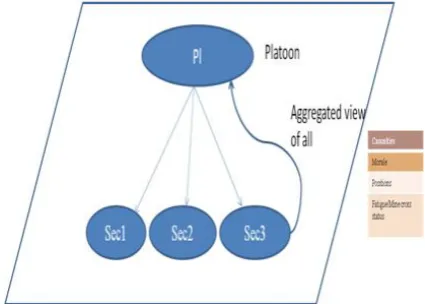
The effect of high level infantry section to section model is aggregated to the next higher level of resolution up to Coy. In this way the detail information will be given to commander at the chosen level at zoom scale. In the figure III we can see how the information is propagated to platoon level from section level and a aggregated view has been seen to the commanding officer.
V. AGENTS AND BDI ARCHITECTURE TEAM-ORIENTED
BEHAVIOUR OF AGENTS
Teamwork means a combine effort for achieving common goals effectively. So, a team-oriented modeling involves the formation of teams of battlefield entities. The BDI agents have beliefs, desires (goals) and intentions (plans). Extending this concept further, the team has joint beliefs, joint goals and joint plans, which lead individuals or sub-teams in the team those share (role) of the team activity. Hence, the individual team members will have individual beliefs, goals, plans, and intentions. It is mandatory for the others members team also. Team-oriented concepts are implemented through an agent-based team reasoning entity that encapsulates coordinated team behaviours. In this model, although team members act in coordination by being given goals according to the specification, they are individually responsible for determining how to satisfy those goals [9]. A very complex task is decomposed into smaller contended tasks. In team-oriented modeling, the entire agent still holds the tasks which are associated with roles. Role is a very important concept that constraints an individual or a sub-team to undertake certain activities in service of the joint intention. The team declaration specifies which roles the team itself may perform for other teams and which roles it offers to other sub-teams to perform. Different team members will perform different roles to fulfill the joint intention, or the team plan which leads to the steps directing each sub-team to achieve specific goals. The team specification determines what each member does, and it also handles failure of members to achieve their goals. Team members act in coordination by being given goals according to the specification, and they are themselves responsible for determining how to specify those goals [9].
COMMAND AGENT (CA)
Command agent is thehead of all levels. He makes the
Figure IV Command Agent Architecture
Figure V Message Passing Through Event Handler
VI. SIMULATION ANALYSIS &RESULTS
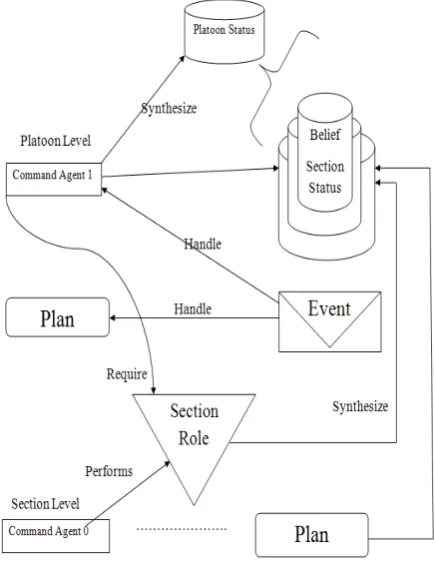
In this we replace the combat entities with command agent. Command agent coordinates and controls the activity of lower subordinates. Command agent takes the data from the lower level agent. Every lower level Command agent periodically propagates the information to the command agent at the upper level and this may change the belief of upper level Command agent. Each Command agent has behaviours and plan which are triggered by the events from the environment and from its own belief. In this below diagram we have the diagram of agent posting a message to an event handler and also using a plan as shown in figure V. According to this an agent will work suitably as in the below diagram. I have shown a demo of my work and that work will be implemented by this above Jack tool in which we will use the agents, events, plans, belief-set etc.
We have considered a combat scenario of battlefield. In this we take the hierarchy of military levels from Section to Platoon, Platoon to Company, Company to Battalion. At the base starting with high resolution to low resolution (section to battalion) the agents at the upper level periodically gather information from the designated party. At every level we have one active agent whose work is to gather information and send that information to the upper level time by time (figure VI).
The information is given to the commander at the chosen level of zoom scale. Concept of selected viewing is used over here. While engaging, we have so many types of scenario. This scenario must be known by the Commander and he wants every information about the war-field. If the Commander wants to see the full detail at the low level by selecting that area then he will use high resolution. At the upper level he wants only low resolution. In this thesis we are going to design a combat scenario in which at every level information will be propagated by agents to the Commander. Now Commander is aware of every level i.e. from battalion level to company level, company level to platoon level, and platoon level to section level. He can see any view by selecting that particular area by zoom in or zoom out. By this Commander can check out that how many casualties are there, what type of plans their soldiers are following, how many mine fields or any other obstacle are there in the battle field and how to survive from them. All types of strategies can be seen by the Commander at any time. He can view the full fledge combat scenario by zoom in or zoom out.
CA
Coy1 Coy2 Coy3
Pl1 Pl2 Pl3 Pl1 Pl2 Pl3 Pl1 Pl2 Pl3
s s s s s s s s s s s s s s s s s s s s s s s s s s s
1………..10
Command & Control
Soldiers S --- Sec1 Sec2 Sec3
Casualties
Morale
Positions
Fatigue/Mine cross status
Bn----Battalion Coy---Company Pl 1 ----Platoon 0
1
2
3
Belief Propagation from Section to Platoon
synthesizes
SectionPlan
SectionRole Applicable for
section_status Sectiopn Belief Data
Add
platoon_status
Section Team
/updates
Platoon Team
synthesizes
uses
startsection1 startsection1
handles
handles
ReadPlatoonStatus
handles
ReadPlatoonStatusPlan
handles
aggregates
private
retreive uses
#synthesizes teamdata PlatoonStatus platoon_status(sec1.section_status,sec2.section_status,sec3.section_status,plhqr.section_status);
.……
Soldiers(1…10)
Figure VII Belief Propagation From Section To Platoon
The above figure (figure VII) shows how the data is propagated from soldiers to section and to platoon. As from the figure we can clearly see how the soldiers belief is caught by section role, which synthesizes the section_status belief, where the section plan is applicable for the section role and update/add the data in section_status continuously. Section team uses the section plan and handle the startsection1 event. Now the platoon_status aggregates the data of three sections which is retrieved by an event readplatoonstatus which handles by a plan readplatoonstatusplan and used by platoon team. Similarly this data is further propagated to company team by platoon role. The code in the diagram express how the platoon_status belief synthesize the three section data after aggregating.
RESULTS
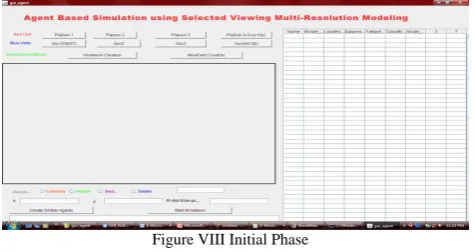
The figure VIII depicts the initial phase of the diagram.
Figure VIII Initial Phase
This figure IX depicts result when the creation of the soldiers has been done. the information about the movement of soldiers and their aggregated morale, fatigue, leadership, causalities as shown.
Figure IX Soldiers Information
This figure X shows the starting of simulation
Figure X Start of Simulation
This figure XI describes information about the movement of soldiers and their combined effect of morale, fatigue, leadership, causalities as shown. We can clearly see the soldiers are moving towards the mine field.
Figure XI Combined Effect and Movement of Soldiers
This figure XII gives us the information about the movement of section and their aggregated morale, fatigue, leadership, causalities as shown. We can clearly see the 9 sections are moving across the mine field.
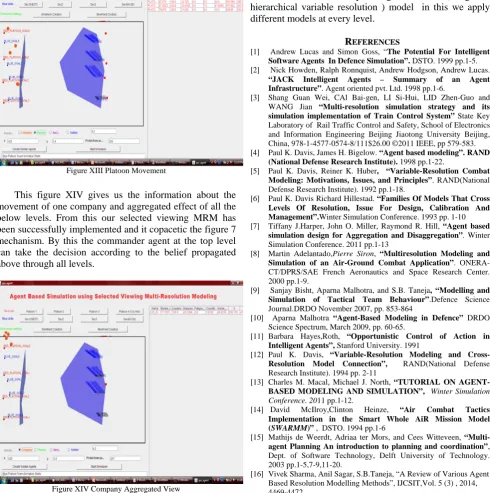
This figure XIII gives us the information about the movement of platoons and their aggregated morale, fatigue, leadership, causalities as shown. We can clearly see the 4 platoons (3 pl+1 HQr) are moving across the mine filed.
Figure XIII Platoon Movement
This figure XIV gives us the information about the movement of one company and aggregated effect of all the below levels. From this our selected viewing MRM has been successfully implemented and it copacetic the figure 7 mechanism. By this the commander agent at the top level can take the decision according to the belief propagated above through all levels.
Figure XIV Company Aggregated View
VII.CONCLUSION AND FUTURE WORK
By using selected viewing Multi resolution modellng approach we can get the desired view of choosen level. As the consistency of this model from switching from one level to another level is very high , Command Agent can do effective and accurate decision making based on the propogated beliefs of its sub teams. We can enhance this work to next level by using the IHVR(Integrated hierarchical variable resolution ) model in this we apply different models at every level.
REFERENCES
[1] Andrew Lucas and Simon Goss, “The Potential For Intelligent Software Agents In Defence Simulation”. DSTO. 1999 pp.1-5. [2] Nick Howden, Ralph Ronnquist, Andrew Hodgson, Andrew Lucas.
“JACK Intelligent Agents – Summary of an Agent Infrastructure”. Agent oriented pvt. Ltd. 1998 pp.1-6.
[3] Shang Guan Wei, CAl Bai-gen, LI Si-Hui, LID Zhen-Guo and WANG Jian “Multi-resolution simulation strategy and its simulation implementation of Train Control System” State Key Laboratory of Rail Traffic Control and Safety, School of Electronics and Information Engineering Beijing Jiaotong University Beijing, China, 978-1-4577-0574-8/111$26.00 ©2011 IEEE, pp 579-583. [4] Paul K. Davis, James H. Bigelow. “Agent based modeling”. RAND
(National Defense Research Institute). 1998 pp.1-22.
[5] Paul K. Davis, Reiner K. Huber, “Variable-Resolution Combat Modeling: Motivations, Issues, and Principles”. RAND(National Defense Research Institute). 1992 pp.1-18.
[6] Paul K. Davis Richard Hillestad. “Families Of Models That Cross Levels Of Resolution, Issue For Design, Calibration And Management”.Winter Simulation Conference. 1993 pp. 1-10 [7] Tiffany J.Harper, John O. Miller, Raymond R. Hill, “Agent based
simulation design for Aggregation and Disaggregation”. Winter Simulation Conference. 2011 pp.1-13
[8] Martin Adelantado,Pierre Siron, “Multiresolution Modeling and Simulation of an Air-Ground Combat Application”. ONERA-CT/DPRS/SAE French Aeronautics and Space Research Center. 2000 pp.1-9.
[9] Sanjay Bisht, Aparna Malhotra, and S.B. Taneja, “Modelling and Simulation of Tactical Team Behaviour”.Defence Science Journal.DRDO November 2007, pp. 853-864
[10] Aparna Malhotra “Agent-Based Modeling in Defence” DRDO Science Spectrum, March 2009, pp. 60-65.
[11] Barbara Hayes,Roth, “Opportunistic Control of Action in Intelligent Agents”, Stanford University. 1991
[12] Paul K. Davis, “Variable-Resolution Modeling and Cross-Resolution Model Connection”, RAND(National Defense Research Institute). 1994 pp. 2-11
[13] Charles M. Macal, Michael J. North, “TUTORIAL ON AGENT-BASED MODELING AND SIMULATION”, Winter Simulation
Conference. 2011pp.1-12.
[14] David McIlroy,Clinton Heinze, “Air Combat Tactics Implementation in the Smart Whole AiR Mission Model
(SWARMM)” , DSTO. 1994 pp.1-6
[15] Mathijs de Weerdt, Adriaa ter Mors, and Cees Witteveen, “Multi-agent Planning An introduction to planning and coordination”, Dept. of Software Technology, Delft University of Technology. 2003 pp.1-5,7-9,11-20.