University of South Carolina
Scholar Commons
Theses and Dissertations
2017
Implementing the Constructed Scaffold Model:
Hands-On Activity Units for Advanced Placement
Calculus
Susan Scott
University of South Carolina
Follow this and additional works at:https://scholarcommons.sc.edu/etd Part of theCurriculum and Instruction Commons
This Open Access Dissertation is brought to you by Scholar Commons. It has been accepted for inclusion in Theses and Dissertations by an authorized administrator of Scholar Commons. For more information, please [email protected].
Recommended Citation
IMPLEMENTING THE CONSTRUCTED SCAFFOLD MODEL:
HANDS-ON ACTIVITY UNITS FOR ADVANCED PLACEMENT CALCULUS
by
Susan Scott
Bachelor of Science
North Carolina State University, 1986
Master of Education Coastal Carolina University, 2002
_______________________________________________
Submitted in Partial Fulfillment of the Requirements
For the Degree of Doctor of Education in
Curriculum and Instruction
College of Education
University of South Carolina
2017
Accepted by:
Susan Schramm-Pate, Major Professor
Richard Lussier, Committee Member
Russell Conrath, Committee Member
Kenneth Vogler, Committee Member
ii
iii
DEDICATION
To my wonderful husband Willie and my incredible children Cassidy, Cameron,
and Caleb, I would like to thank each of you for all of the support, encouragement, and
love that you have given me as I have embarked on this journey. I really could not have
done this without the sacrifices that you made for me. I hope that my experiences will
serve as a reminder that you should always pursue your dreams and never let obstacles
stand in the way.
To the educators who work tirelessly to ensure that every student feels safe,
accepted, and is challenged to achieve, I commend you.
iv
ACKNOWLEDGMENTS
I would like to thank each of my committee members – Dr. Susan Schramm-Pate,
Dr. Richard Lussier, Dr. Russell Conrath, and Dr. Kenneth Vogler for your time and
advice as I worked to complete this Dissertation in Practice. I would like to acknowledge
my major professor, Dr. Susan Schramm-Pate for all of the help, feedback, and
encouragement that you gave as I worked on this dissertation. You have truly provided
leadership and direction throughout this process. I would like to thank Dr. Richard
Lussier for being a tireless advocate for social justice in schools. It is through your
guidance that I became much more aware of the difference that I can make in my
classroom so that all of my students are accepted and acknowledged. I would like to
acknowledge Dr. Kenneth Vogler for helping me determine my research method.
I would like to thank my school administration and school district for allowing me
to conduct this action research study in my classroom. I would like to thank the
student-participants in this study for maintaining positive attitudes and enthusiasm throughout the
process. I would like to acknowledge my colleagues Christine and Troy for helping me
with my statistical calculations. I would like to acknowledge all of the members of
Cohort B for their ideas, suggestions, and help as we journeyed down this path together.
Finally, I would like to thank Crystal for completing this program with me and for being
v
ABSTRACT
The purpose of the present action research study is to describe a hands-on activity model,
named the Constructed Scaffold Model (CSM), used in an Advanced Placement Calculus
class in a southeastern United States suburban high school. Data were collected over an
8-week period during the spring 2017 semester. The teacher-researcher developed a
pretest and posttest to describe the CSM’s impact on 10 student-participants in her
Advanced Placement classroom. Repeated measures t-tests were used to determine the
effect of the CSM on the student-participants’ test scores. Additional qualitative data
were collected from field notes, student surveys, a focus group, and student work samples
to determine student-participants’ perceptions of the CSM. Findings include the class
average score on the 20-question pretest was 1.5 questions correct, and the posttest
average score was 13.4 for a net gain of 11.9 points. Based on an analysis of the
qualitative data the following themes emerged: 1) developing conceptual understanding,
2) fostering interpersonal dynamics, and 3) improving model efficacy. The
teacher-researcher developed an action plan that included meeting with school leaders, district
leaders, and fellow teachers to share the results of this action research study and begin a
new cycle of the CSM in the fall of 2017.
Keywords: analytical representation, conceptual understanding, graphical representation,
hands-on activity, manipulative, mathematical modeling, process, numerical
vi
TABLE OF CONTENTS
DEDICATION ... iii
ACKNOWLEDGMENTS ... iv
ABSTRACT ...v
LIST OF TABLES ... ix
LIST OF FIGURES ...x
CHAPTER ONE: RESEARCH OVERVIEW ...1
Introduction ...1
Problem of Practice ...3
Research Question and Objectives ...7
Purpose of the Study ...8
Scholarly Literature ...8
Glossary of Keywords ...13
Potential Weaknesses ...16
The Significance of the Study ...17
Conclusion of Chapter One ...18
CHAPTER TWO: LITERATURE REVIEW ...22
Introduction ...22
Themes and Ideas ...23
Problem of Practice ...25
Points of View ...28
Summaries of Literature ...30
vii
Primary and Secondary Sources ...40
Methodologies ...44
Conclusion ...47
CHAPTER THREE: METHODOLOGY ...54
Introduction ...54
Action Research Method/Design ...59
Role of the Teacher-Researcher ...62
Sample ...63
The Setting ...65
Instrumentation and Materials ...66
Data Collection ...68
Data Analysis and Reflection ...69
Conclusion ...71
CHAPTER FOUR: FINDINGS AND IMPLICATIONS ...73
Introduction ...73
Findings of the Study ...75
Data Collection Strategy ...79
Ongoing Analysis and Reflection ...81
Reflective Stance ...83
Data Analysis ...84
Implications of the Findings ...87
Data Interpretation ...87
Answering the Research Question ...100
Conclusion ...102
CHAPTER FIVE: SUMMARY, CONCLUSIONS, AND ACTION PLAN ...106
Introduction ...106
viii
Action Researcher ...111
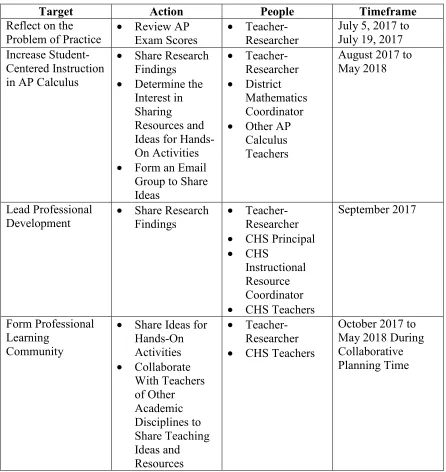
Developing an Action Plan ...115
Action Plan ...117
Facilitating Educational Change ...121
Summary of Research Findings ...124
Suggestions for Future Research ...124
Conclusion ...126
REFERENCES ...129
APPENDIX A: PRETEST/POSTTEST DATA COLLECTION INSTRUMENT REPLICA ...140
APPENDIX B: FIELD NOTES ...144
APPENDIX C: HANDS-ON ACTIVITY SURVEY ...145
APPENDIX D: STUDENTS’ PAST EXPERIENCES WITH HANDS-ON ACTIVITIES IN MATH ...147
APPENDIX E: FOCUS GROUP QUESTIONS ...148
APPENDIX F: CSM ACTIVITIES ...149
APPENDIX G: STUDENT ASSENT FORM ...151
APPENDIX H: PARENT CONSENT FORM ...152
ix
LIST OF TABLES
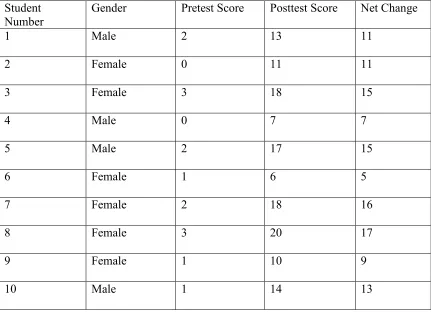
Table 4.1: Student Pretest and Posttest Scores ...76
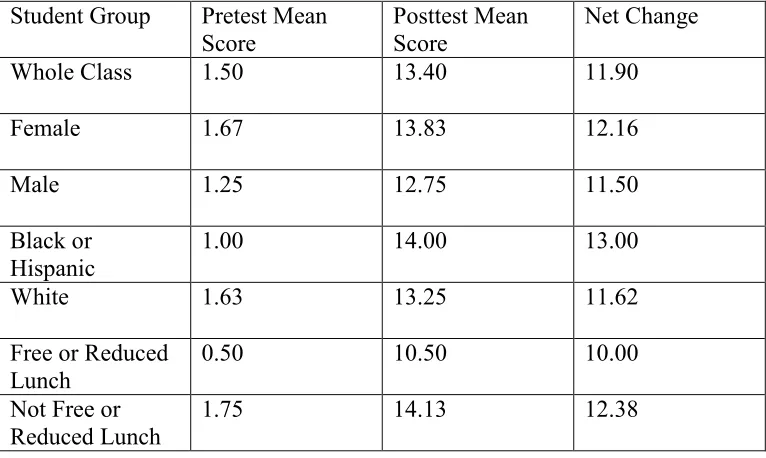
Table 4.2: Comparison of Pretest and Posttest Scores ...77
Table 4.3: T-tests of the Difference Between the Pretest and Posttest Means ...78
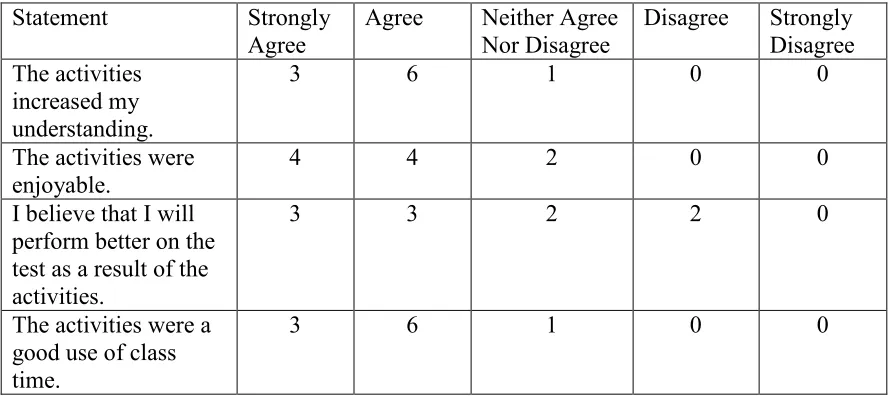
Table 4.4: Frequency Distribution of Student Survey Responses ...79
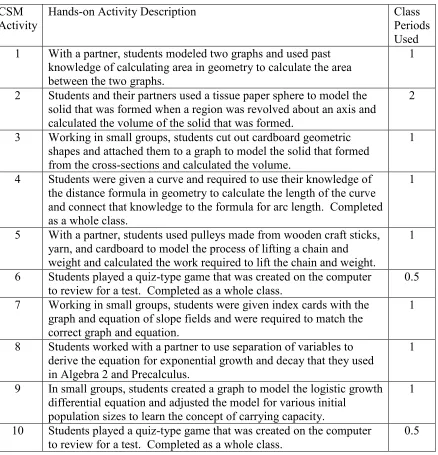
Table F.1: CSM Activities ...149
x
LIST OF FIGURES
Figure 1.1: Conceptual Diagram ...19
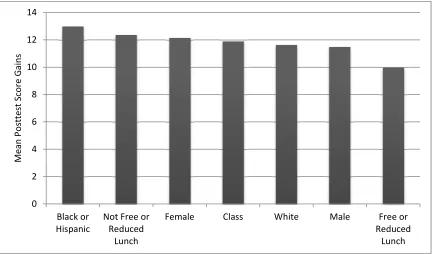
Figure 4.1: Mean Gain From Pretest to Posttest for the Class and Demographic
Groups ... 88
Figure 4.2: Percentage of Student-Participants Who Passed the Posttest ... 89
1
CHAPTER ONE: RESEARCH OVERVIEW
Introduction
The purpose of Chapter One is to introduce the present action research study,
which involved an Advanced Placement (AP) Calculus BC class offered through the
College Board (2016a) at County High School (pseudonym). County High School (CHS)
was a large, suburban high school located in the southeastern United States. After
studying other research that utilized hands-on activities in mathematics, the
teacher-researcher designed a hands-on activity model, named the Constructed Scaffold Model
(CSM), that was implemented during the 2017 spring semester with her AP Calculus
students (Couture, 2012; Cruse, 2012; Pfaff & Weinberg, 2009; Schunk, Pintrich, &
Meece, 2007). In an effort to enable student-participants at CHS to make critical
connections within the calculus content and foster enduring understandings, the
teacher-researcher designed the CSM. The teacher-teacher-researcher worked with the
student-participants to develop an action plan to improve the effectiveness and utility of the CSM
for future AP Calculus courses in order to continually and positively affect her students’
scholastic achievement.
Background of the Advanced Placement Calculus Program
The AP Mathematics program at CHS is offered through the College Board
2
a rigorous level. The College Board (2016a) offers two calculus courses, AP Calculus
AB which is one semester of calculus and AP Calculus BC which is two semesters of
calculus. AP Calculus BC provides the participant-researcher’s students the vehicle to
learn college-level calculus while still in high school with the added benefit of no cost to
the student. AP Calculus BC is the equivalent of Calculus 1 and Calculus 2 at many
college campuses and consequently the participant-researcher’s students who scored at
least 3 out of a possible 5 points on the AP Exam received up to eight credit hours before
their freshman year in college (College Board, 2016a). This is equal to approximately
$2,600 in tuition savings at the University of South Carolina (University of South
Carolina-Columbia, n.d.). The AP Calculus BC Exam is a demanding test that assesses
student comprehension of calculus content. The College Board (2016a) has indicated
that AP Calculus “is designed to develop mathematical knowledge conceptually, guiding
students to connect topics and representations throughout each course and to apply
strategies and techniques to accurately solve diverse types of problems” (p. 4).
Students needed to make connections within the course material and not simply
perform procedural calculations from memory to understand class concepts and be
successful in the course. Nao (2008) concluded that the goal for students enrolled in AP
classes was to pass the AP Exam and as a result AP teachers must present the curriculum
in a manner that prepared their students for the rigor of the AP Exam. Based on the
results of Nao’s (2008) research, the teacher-researcher in the present action research
study determined that for her student-participants enrolled in AP Calculus BC their
objectives were twofold: they had a desire to study calculus at a high level, and they
3
Calculus 2 before college. The research study by Nao (2008) indicated that most AP
teachers reviewed and reflected on the scores of their students in order to help their
students achieve the goal of passing the AP Exam. If the scores were not at an
appropriate level then the educator usually had a desire to modify classroom instruction
in an attempt to improve students’ AP Exam performance. Lamattina (2008) found that
70% of AP teachers who were participants in her research believed that “the rigors of the
AP curriculum call for learning new teaching methods and practices” (p. 85). Following
Nao (2008) and Lamattina (2008), the purpose of the present action research study was to
determine the impact of the CSM, a hands-on activity model, on calculus achievement of
AP Calculus BC students at CHS.
Problem of Practice
The Problem of Practice (PoP) for the present action research study was that
students at CHS were scoring below their global peers on the AP Calculus Exam and
struggling to build connections from basic mathematical operations to complex calculus
topics. This was especially a problem for CHS students from groups that have been
historically marginalized in advanced mathematics such as females, Blacks, and
Hispanics (Caviness, 2014). After reviewing the AP Calculus Exam scores of her former
students, the teacher-researcher found that her male students had the highest average
score followed by White students, students of color, and lastly female students. In 2017,
the AP Calculus Exam consisted of multiple-choice and free-response questions, which
required students to apply and synthesize multiple concepts (College Board, 2016a).
Based on a review of the previous AP Calculus BC Exam scores at CHS, the
4
free-response questions and had difficulty modeling mathematics. The teacher-researcher
believed that helping her student participants make connections and scaffold their prior
knowledge to new calculus content would increase the AP Calculus Exam scores of her
student-participants so that the individual scores met or exceeded the global mean score
of all examinees.
Background of the Problem of Practice
High school students in the United States performed worse than their counterparts
from around the world according to the Organisation for Economic Co-operation and
Development (OECD, 2012b), and the Programme for International Student Assessment
(PISA, 2012) that tested 510,000 students in developed nations in 2012. These
15-year-old students were assessed in reading, mathematics, and science (OECD, 2012b) with a
focus not on the recall of learned facts but the application of knowledge in real-world
situations. The OECD (2012a) provided a sample exam problem that was based on a
“real world” scenario. In this sample problem, students were given a map of a city and
required to find a location in which three people could meet in a place that would not
require any of them to travel for more than 15 minutes (OECD, 2012a). The results of
the 2012 assessment found that U.S. students ranked 27th out of the 34 OECD nations in
mathematics (OECD, 2012b). Students in the U.S. scored well when they were required
to make a single calculation or deduce simple explanations from charts and graphs but
struggled when they had to create a mathematical model to represent a problem or make
mathematical interpretations from various contexts (OECD, 2012b). Students were able
5
represent mathematics concepts in multiple contexts and struggled to create mathematical
models in order to solve problems.
The AP Calculus BC Exam results for CHS students indicated that they did not
perform as well as their global peers on questions that required them to model calculus
content. Educators must understand that their life experiences can be quite different from
those of their students and subsequently find ways to relate curriculum to students’ lived
experiences. Brazilian educator Freire believed that traditional schools were not meeting
the needs of the illiterate peasants (Ryan & Cooper, 1998). Freire (2013) noted, “one
cannot expect positive results from an educational or political action program which fails
to respect the particular view of the world held by the people” (p. 161). Based on the
ideas of Freire, educators must take the time to understand the lived experiences of their
students if they are going to be able to develop activities that will relate to students’ lives.
Hands-on activities can provide students with the opportunity to explore and learn from
new experiences.
Many educators have worked to bridge the gap so that students can scaffold from
prior knowledge when learning new material. For example, Dewey (1938/1997), a leader
of the progressive education movement, believed that students must understand not only
the finished product but also how this finished product was built or can be modified in
order to fully learn about the product, otherwise a disconnect in learning would exist.
Fowler (2010) noted the importance of connecting learning to the lived experiences of the
learner. The results of research by Cruse (2012) indicated that the utilization of a
hands-on activity model helped students form more chands-oncrete understanding of abstract ideas.
6
must have a purpose and need to be linked within the curriculum so that they enhance and
expand student understanding (Dewey, 1938/1997). A research study by White (2012)
emphasized that educators must be careful to avoid using hands-on activities to simply
entertain students, but should methodically select activities that provide learning
connections for students.
With the global economy and instant access to information, students must develop
skills to process and discern everything that is going on around them. Research by
Buoncristiani and Buoncristiani (2012) highlighted the role that globalization played in
the new ideas that have emerged on the way that people think and learn, and underscored
the importance of developing thinking skills. Based on this evidence the
teacher-researcher’s student-participants needed to develop problem-solving skills to be
competitive in the global economy, and rote memorization of mathematical procedures
would not adequately prepare them for the future. Furthermore, the results of the PISA
(OECD, 2012b) assessment showed that mathematics students in the U.S. were falling
behind students in other countries. Mathematics teachers cannot rely simply on the
lecture method of instruction in order to maximize student learning. Research by Schunk
et al. (2007) determined that learning for students might become meaningless when
teachers rely solely on the lecture method of instruction. Students had better
comprehension when they were actively involved in the learning process. Hands-on
activities provided students with the opportunity to be actively engaged in the learning
process, which led to deeper conceptual understanding (Cruse, 2012).
Based on the results of research studies by White (2012) and Cruse (2012),
7
knowledge to the current material within the course. Scholastic achievement in AP
Calculus BC requires students to develop a multirepresentational approach to problem
solving (College Board, 2016a), which is built through connections that are made within
the course. An occurrence that might be seen in some mathematics classes across the
U.S. is for teachers to be actively involved in demonstrating how to solve a particular
problem and the students passively following along. Schunk et al. (2007) concluded that
when teachers rely solely on the lecture method of instruction, students do not become
personally involved in the lesson and the learning becomes meaningless. A focus of the
present action research study was to explore the effect of the hands-on activity model in
an AP Calculus BC class, including students from groups that have been historically
marginalized in advanced mathematics such as females, Blacks, and Hispanics (Caviness,
2014).
Research Question and Objectives
The research question for the present action research study was, “What is the
impact of the hands-on activity model on secondary student achievement in Advanced
Placement Calculus?” The teacher-researcher’s primary objective was to establish a
continuous and positive impact on her students-participants’ scholastic achievement in
AP Calculus as a result of critical connections that were made within the course content
through implementation of the CSM. An additional objective was for the
teacher-researcher’s student-participants to increase their AP Calculus Exam scores after
8
Purpose of the Study
The primary purpose of the present action research study was to describe the
implementation of the CSM, a hands-on activity model (Couture, 2012; Cruse, 2012;
Pfaff & Weinberg, 2009; Schunk et al., 2007) designed by the teacher-researcher for an
AP Calculus class and used over an 8-week span. The teacher-researcher developed the
CSM in order to help her student-participants increase their AP Calculus Exam scores by
enabling them to build connections from basic mathematical operations to complex
calculus content. The secondary purpose of the present study was to design an action
plan in conjunction with the student-participants to improve the effectiveness and utility
of the hands-on activity model in providing critical connections and enduring
understanding within the course content for future AP Calculus students at CHS.
Scholarly Literature
Rationale
A more detailed literature review appears in Chapter Two of the present
Dissertation in Practice (DiP). A major justification for designing the CSM for the
present action research study involved improving the curriculum and pedagogy for an AP
Calculus BC class which was offered by the College Board (2016a) to provide CHS
students with the opportunity to take college-level Calculus 1 and Calculus 2 while still in
high school. This impacted the teacher-researcher’s action research study because upon
completion of her AP Calculus course, her student-participants were required to take the
teacher-9
researcher wanted her student-participants to earn AP Calculus Exam scores that met or
exceeded the global mean score of all examinees.
Description of the AP Calculus BC Exam
The AP Calculus BC Exam consists of 45 multiple-choice questions and six
free-response questions, all of which must be completed in 195 minutes (College Board,
2016a). The College Board (2016a) has developed a curriculum framework for each AP
course to ensure that rigorous standards are met and that the course content is consistent
all over the world. AP Calculus BC is designed to be challenging to students using the
premise identified by the College Board (2016a) that “building enduring mathematical
understanding requires students to understand the why and how of mathematics in
addition to mastering the necessary procedures and skills” (p. 4). It is the objective of the
College Board (2016a) to teach students how to apply the mathematical concepts that
have been learned and to not simply mimic operations that have been shown or rely on
rote memorization of facts. For students to be successful on the AP Calculus Exam they
must be able to understand the theoretical aspects of calculus as well as have the ability to
develop multirepresentational approaches to the content. Mathematics educators have
strived to help students become better problem solvers and become more comfortable
working through complex operations.
Additionally, the National Council of Teachers of Mathematics (2015),
commonly referred to as NCTM, has indicated that students need to gain proficiency in
the process standards of “problem solving, reasoning and proof, communication,
10
students are able to apply what they have learned to solve real-world problems and
develop a greater understanding of mathematics, the NCTM (2015) also notes that
proficiency in making connections allows students to “understand how mathematical
ideas interconnect and build on one another to produce a coherent whole” (p. 1) and
proficiency in representation indicates that students are able to use correct mathematical
representations for problem solving. Students needed to utilize each of these NCTM
(2015) process standards in order to pass the AP Calculus Exam. If a student received at
least 3 out of a possible 5 points on the AP Calculus BC Exam then they received credit
for Calculus 1 and Calculus 2 at most colleges and universities (College Board, 2016a).
Progressive Educational Theory
Progressive educational theory was used to create the CSM for the present action
research study. The early progressive education movement, led by John Dewey,
advocated for learning through hands-on activities so that students would gain more
understanding of concepts (Dewey, 1938/1997). Hands-on activities allow students to
actively engage and become responsible for their own learning, whereas relying on
lecture is a passive form of learning (Dewey, 1938/1997). Utilizing Dewey’s
(1938/1997) theories of learning, the teacher-researcher in the present action research
study believed that it was important for her AP course to incorporate components of a
variety of instructional methods to prepare students for the challenge of the AP Calculus
Exam. Additionally, the results of a study by Lamattina (2008) indicated that AP
teachers must develop new teaching methods in order to prepare students for the rigor of
11
study to implement the CSM to gain an understanding of the impact of hands-on
activities on students’ scholastic achievement in an AP Calculus BC class at a CHS.
Background Theories
As a mathematics instructor, the teacher-researcher initially believed in the
essentialist ideal that students would learn best through direct instruction of a
standards-driven curriculum (McNergney & Herbert, 1998). Furthermore, due to concern about her
students not performing as well in the area of mathematics as students from other
countries, the teacher-researcher leaned toward the ideas presented in A Nation at Risk
(U.S. National Commission on Excellence in Education, 1983) and the importance of
excellence in education. The U.S. National Commission on Excellence in Education
(1983) highlighted that “excellence characterizes a school or college that sets high
expectations and goals for all learners, then tries in every way possible to help students
reach them” (p. 12). As the teacher-researcher gained more experience in the classroom,
a better understanding of the needs of students as learners developed. Having high
expectations for students was crucial, but believing that every student learned the same
material using an identical method was not realistic and failed to differentiate the needs
of the individual.
The teacher-researcher began to understand the importance of the progressive
theory of education whereby students are, as McNergney and Herbert (1998) wrote,
“responsible for maximizing their own potential, with the teacher’s role being that of a
helper and guide” (p. 104). This corresponded to the ideas of Buoncristiani and
12
process of our own learning” (p. 5) and that students are better able to learn new material
when they are able to connect it to past experiences and understanding. The premise that
her students could become responsible for their own learning in a calculus classroom
became an intriguing prospect for the teacher-researcher. The goal of the present action
research study was to develop and implement the CSM within an AP Calculus BC
classroom in order to enable students to gain a better understanding of complex calculus
topics and increase their scholarly achievement on the AP Calculus Exam.
Research in the scholarly literature on the topic of hands-on activities such as
O’Shea, Heilbronner, and Reis (2010) indicated that high-achieving female students
prefer teachers who allow them to work collaboratively and provide academic challenge.
O’Shea et al. (2010) found “educators who model a passion for mathematics, who
provide challenging learning activities, and who occasionally enable their female students
to work cooperatively may encourage these students’ talents” (p. 262). Ladson-Billings
(1997), an advocate for mathematics achievement of African American students noted,
“prominent in the reform of mathematics education is the call for students not merely to
memorize formulas and rules and apply procedure but rather to engage in the processes
of mathematical thinking” (p. 697). After studying scholarly literature, the
teacher-researcher designed the CSM, which enabled her course to be constructed as a scaffold
where her student-participants’ prior mathematical knowledge built connections within
the AP course in order to impact her students’ scholarly achievement on the AP Calculus
13
Data Sources
The teacher-researcher collected the quantitative data from two sources. The first
was the pretest (see Appendix A) and second data source was the posttest administered
after implementation of the CSM in her AP Calculus BC classroom during the spring
2017 semester. The teacher-researcher used a pre- and posttest assessment to measure
growth in calculus ability and to answer the research question. Students took the pretest
prior to implementation of the CSM, which provided the teacher-researcher with data on
students’ knowledge of calculus. After the students completed the CSM they took a
posttest to measure their achievement in calculus. The results were disaggregated by
race, gender, and socioeconomic status. Using field notes, the teacher-researcher
recorded student engagement and interactions while completing the hands-on activities
(see Appendix B). Student surveys (see Appendices C and D) and student work samples
were also collected. These anecdotal data, as well as documents from the College Board
(2016a) and the high school where the teacher-researcher teaches, were used to
polyangulate (Mertler, 2014) the quantitative data. After the data were collected and the
student-participants completed the AP Calculus Exam, the teacher-researcher used a
focus group discussion (see Appendix E) to reflect on the data with her
student-participants in order to form an action plan designed to continually improve the CSM for
the AP Calculus BC classroom at CHS.
Glossary of Keywords
14
Action research: “any systematic inquiry conducted by educators for the purpose
of gathering information about how their particular schools operate, how they teach, and
how their students learn” (Mertler, 2014, p. 32).
Analytical (algebraic) representation: representing a function “by an equation in
two variables” (Larson, 2007, p. 40).
Conceptual understanding: “comprehension of mathematical concepts, operations
and relations” (Common Core State Standards Initiative, 2015b, p. 1).
Criterion-referenced test: an assessment that measures “a student’s performance
by comparing it to some clearly defined criterion for mastering a learning task or skill”
(McNergney & Herbert, 1998, p. 406).
Direct instruction: a teaching method that “consists of four stages: teacher
analysis and definition of goals, with selection of appropriate materials; teacher
instruction; teacher demonstration; and student practice” (Unger, 2007a, p. 350).
Graphical representation: representing a function “by points on a graph in a
coordinate plane in which the input values are represented by the horizontal axis and the
output values are represented by the vertical axis” (Larson, 2007, p. 40).
Hands-on activity: a “teaching method in which a student is an active rather than
passive participant” (Unger, 2007b, p. 530).
Likert scale: “statements provided on surveys or questionnaires to respondents
where individuals are asked to respond on an agree-disagree continuum” (Mertler, 2014,
15
Manipulative: “defined as any tangible object, tool, model, or mechanism that
may be used to clearly demonstrate a depth of understanding, while problem solving,
about a specified mathematical topic or topics” (Kelly, 2006, p. 184).
Mathematical modeling: the Common Core State Standards Initiative (2015a)
identifies modeling as “the process of choosing and using appropriate mathematics and
statistics to analyze empirical situations, to understand them better, and to improve
decisions” (p. 1).
(Mathematical) process: as defined in Webster’s New World College Dictionary
(Agnes, 2000) is “a particular method of doing something, generally involving a number
of steps or operations” (p. 1144).
Numerical representation: representing a function “by a table or a list of ordered
pairs that matches input values with output values” (Larson, 2007, p. 40).
Rote memorization: “the acquisition of essential information through the process
of memorization” (Unger, 2007c, p. 952).
Theoretical understanding (knowledge) of mathematics: according to Webster’s
New World College Dictionary (Agnes, 2000) is knowledge of mathematics that is
“limited to or based on theory; not practical or applied; hypothetical” (p. 1485).
Verbal representation: representing a function “by a sentence that describes how
16
Potential Weaknesses
During implementation of the CSM, the teacher-researcher made the assumption
that the student-participants would put forth their best effort in all of the activities as well
as on the pre- and posttest. This assumption was critical since the student-participants
completed most of the collected data. A second assumption that the teacher-researcher
made was that the student-participants would be honest and candid in their responses and
not feel compelled to provide responses that they believed that the teacher-researcher
wanted. The teacher-researcher continually reminded the student-participants to answer
questions openly and honestly without fear of repercussions, and the assumption was
made that the student-participants were candid in their responses.
The primary limitation of the study was the multiple-choice style of pre- and
posttest questions used for data collection. The teacher-researcher made the decision to
use a multiple-choice format because the AP Calculus Exam includes multiple-choice
sections. Student-participants could conceivably guess when answering a
multiple-choice question and get a correct answer for knowledge that they really do not have. On
the other hand, students could make a minor error and get a multiple-choice question
wrong when they actually had knowledge of the topic. Although the teacher-researcher
did not see evidence of the student-participants guessing on the pre- and posttest, there
was the possibility that they could have guessed on some of the questions if they were
experiencing difficulty with the topic.
The teacher-researcher delimited the study to include only AP Calculus BC
17
their AP Calculus Exam scores and make critical connections within the mathematical
content. While the teacher-researcher could have chosen student-participants from her
Precalculus Honors class since the majority of them enroll in her AP Calculus class the
following school year, she believed that using her AP Calculus class would be the most
impactful for the present action research study.
The Significance of the Study
The present action research study is significant and adds to the body of scholarly
literature because the purpose was for the student-participants to increase their academic
achievement on the AP Calculus Exam. All schools in the state in which CHS was
located receive a report card and rating based on the report card scores. Each high school
was required to report the percentage of the student body “Enrolled in AP/IB programs”
and “Successful in AP/IB programs” (South Carolina Department of Education, 2017).
Consequently, any educational research that can lead to improvement of the report card
scores for the school was important. Additionally, if the student-participants have
positive experiences when encountering the CSM then they might tell their peers about
the classroom activities and encourage them to enroll in AP Calculus. While improving
the report card scores was beneficial, researchers have also found that students who take
AP Calculus in high school have higher college retention rates than those who do not
(Mattern, Shaw, & Xiong, 2009). The teacher-researcher has used the
student-participants’ work samples that were created during the CSM to show other students the
18
This study is also significant because of the impact that the CSM had on groups
that have been historically marginalized in advanced mathematics such as female, Black,
and Hispanic students. Prior research studies have shown the benefits that female, Black,
and Hispanic students receive from engaging in hands-on activities in small groups
(Ladson-Billings, 1997; O’Shea et al., 2010). Other research has shown that high school
students who take AP courses are better prepared for the rigor of college work than
students who take other types of math courses (Mattern et al., 2009). The problem of
practice for the present action research study was the need for the student-participants to
increase their AP Calculus Exam scores as a result of critical connections that were made
from basic mathematical operations to complex calculus content. If the
student-participants earned a passing score on the AP Calculus BC Exam then they would receive
credit for Calculus 1 and Calculus 2 at all of the colleges and universities in their state.
This credit for two classes is a substantial financial benefit for the student-participants
and their families who have to pay their tuition or take out student loans. As a result, the
student-participants who encountered the CSM in AP Calculus have received numerous
benefits, which have a direct effect on their future college studies. Any study that can
positively impact students is significant for educators and the present action research
study is no exception.
Conclusion of Chapter One
As a result of what Mertler (2014) identified as the “cyclical, iterative process” (p.
xv) of action research, the teacher-researcher developed a conceptual framework for the
19
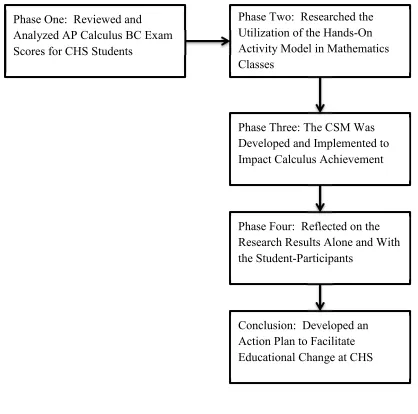
Figure 1.1. Conceptual diagram.
The teacher-researcher used quantitative data to answer the research question.
The student-participants took a pretest prior to implementation of the CSM and the same
assessment also served as the posttest that was given after 8 weeks. The
student-participants earned a mean score on the 20-question multiple-choice pretest of 1.5 correct
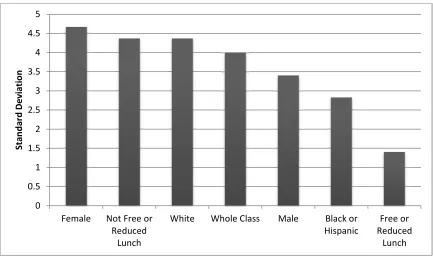
with a standard deviation (S.D.) of 1.02, and 13.4 correct with S.D. of 4.61 on the posttest
for a net mean gain of 11.9 correct. Every student-participant had a score increase from Phase Three: The CSM Was
Developed and Implemented to Impact Calculus Achievement Phase One: Reviewed and
Analyzed AP Calculus BC Exam Scores for CHS Students
Phase Two: Researched the Utilization of the Hands-On Activity Model in Mathematics Classes
Phase Four: Reflected on the Research Results Alone and With the Student-Participants
20
the pre- to posttest. Calculations from the t-tests indicated statistically significant growth
from the pretest mean score to the mean score of the posttest for these particular
student-participants. Qualitative data were used to polyangulate (Mertler, 2014) the quantitative
findings. The teacher-researcher transcribed the student-participants’ responses to a
survey and highlighted data that fit into specific themes. After studying the results, the
teacher-researcher determined that three themes emerged from the data. The themes
were: 1) developing conceptual understanding, 2) fostering interpersonal dynamics, and
3) improving model efficacy.
Dissertation Overview
This dissertation is composed of the following chapters:
1) CHAPTER ONE: RESEARCH OVERVIEW. This chapter introduces the
research by describing the problem of practice, the research question, the purpose
of the research, and an overview of the research design and methodology.
2) CHAPTER TWO: LITERATURE REVIEW. A thorough review of the literature
from both theoretical and historical contexts is presented.
3) CHAPTER THREE: METHODOLOGY. The research question, action research
design, and data collection strategies are included in this chapter.
4) CHAPTER FOUR: FINDINGS AND IMPLICATIONS. The results of the
research are provided in this chapter along with a discussion of their implications.
5) CHAPTER FIVE: SUMMARY, CONCLUSIONS, AND ACTION PLAN. This
21
of the results for continuous improvement in the teacher-researcher’s AP Calculus
22
CHAPTER TWO: LITERATURE REVIEW
Introduction
The purpose of Chapter Two is to present a detailed review of the related
literature on the current action research study of the impact of the Constructed Scaffold
Model (CSM), a hands-on activity model designed by the teacher-researcher, for use with
her AP Calculus BC class. This literature review provides a thorough overview of the
literature related to AP Calculus instruction as well as key information about prior
research on the use of manipulatives and hands-on activities in mathematics classes and
studies on participation in advanced mathematics courses based on race, gender, and
socioeconomic status. A review of literature on the historical background of hands-on
activities is included. The prior research in this area showed that implementing hands-on
activities in mathematics made classes more enjoyable for students, had an impact on
student confidence levels, and increased student understanding of the material by
allowing students to scaffold from previous learning to new content.
The related literature on the identified problem of practice for the present action
research study also gave the teacher-researcher a tremendous amount of information on
the guiding principles of the AP program and a better understanding of the desired
learning outcomes for the AP Calculus BC course. For example, a review of the use of
23
the problem of practice. By reviewing past literature, the teacher-researcher was able to
identify a problem of practice for the current study that built on the scholarly work that
has already been completed as well as to evaluate the quality and depth of work that
existed on the relationship between hands-on activities and mathematics achievement. In
order to conduct a review of the literature, the teacher-researcher searched through
scholarly literature of textbooks and peer-reviewed journals. While the
teacher-researcher found scholarly literature related to using manipulatives and hands-on
activities in mathematics, increasing equitable access to advanced mathematics, and
programs to increase calculus achievement, she did not find any studies on the use of
hands-on activities in AP Calculus classes. This literature review was important because
it provided broad knowledge of the research that has been done with educators using
hands-on activities in mathematics classes and the manner in which teachers worked to
build student learning and understanding of mathematics. A review of demographic
information on historically marginalized groups gave a context to the need for equity in
advanced mathematics classes. The theories and methodologies used in prior research
helped to guide the present action research study so that it added to the community of
scholarly work by providing data on the effectiveness of using the CSM in an AP
Calculus BC class.
Themes and Ideas
Definition of Hands-On Activities
Unger (2007b) described hands-on activities as a “teaching method in which a
24
students to construct their own understanding through the completion of a task rather than
passively listening to a lecture by the teacher. Hands-on activities include using
manipulative resources that serve as tools, which allow students to model or represent
abstract mathematical concepts. Algebra tiles, rulers, protractors, compasses, paper, and
scissors are all examples of manipulatives that provide students with the opportunity to
understand abstract mathematical concepts using tangible learning tools. Graphing
calculators are important technological tools because they give students the ability to see
visual models of algebraic expressions. In the mathematics classroom hands-on activities
can include using manipulatives and creating either graphical or physical models of
algebraic expressions. A research study by Pfaff and Weinberg (2009) developed the
following design guidelines for hands-on activities:
The activity should be motivated by a “natural” question and students should
explore the situation by gathering and interpreting data. The teacher should ask
scaffolding questions, solicit conjectures, and ask students to explain their
reasoning. Multiple representations (numerical descriptions, tables, and graphs)
and modes (kinesthetic, verbal, and written) should be integrated into the activity
and the teacher should facilitate making connections between the representations.
The context should build on students’ intuitions and experiences by using
situations with which students are familiar and asking questions that students see
as non-abstract. This should enable students to make predictions before engaging
in the activity. Students should be asked to reflect on their predictions after they
have collected data and again during a guided class discussion to articulate the
25
Each of these guidelines helped the teacher-researcher enable students to construct their
own understanding from the hands-on activities. In AP Calculus, a graphical or physical
model can be essential in providing students with the ability see a concrete representation
of an abstract concept.
Several studies have investigated the effectiveness of hands-on activities in
mathematics. A research study showed that utilizing paper as a manipulative tool in
which students used origami to fold the paper helped students understand the concept of
planes in geometry and thus develop a better sense of spatial reasoning (Sze, 2005). In
addition to the aforementioned learning tools, researcher Munley (2003) also identified
compasses, geoboards, tangrams, and other household items that can be used to model
mathematics as manipulatives. Educators do not need to invest in expensive props to
engage students, but can find any number of readily available items to provide students
with enriching learning experiences. Hands-on activities can be completed by an
individual, small group, or whole group based on the requirements of the lesson.
Mathematics educators have found many ways to provide active learning experiences for
their students.
Problem of Practice
Hands-On Activities Affect Student Understanding in Mathematics
Many students and teachers believe that rote memorization of facts is vital for
success in mathematics. A study was conducted by Tsao (2004) to compare the attitudes
toward mathematics between fifth graders in the United States and Taiwan. The results
26
place emphasis on understanding the concepts related to the procedures while Taiwanese
students placed more focus on the process of solving the problem to develop a deeper
level of understanding. The Taiwanese students believed that mathematical knowledge is
useful in life at a much higher rate than students from the United States (Tsao, 2004).
This study highlighted some of the problems that American students have in
understanding how to apply what they learn in mathematics classes to real-world problem
solving. Based on these results, it seems as if students in the United States do not see the
relevance of mathematics in their lives.
The mathematics classroom of today is much different from that of the past.
Students need to develop problem-solving skills to be competitive in the global economy
and rote memorization of mathematical procedures will not adequately prepare students
for the future job market. Mathematics teachers can no longer rely on simply lecturing
students if they want to maximize student understanding because students comprehend
more when they are actively involved in the learning process. Hands-on activities give
students the opportunity to apply what is learned for deeper conceptual understanding.
One of the ways in which hands-on activities help students understand
mathematical concepts was identified in a research study conducted by Kelly (2006) on
the effects of using manipulatives in cooperative learning groups in mathematics problem
solving. The study data revealed that when students used manipulatives in cooperative
learning groups they learned to use mathematical language, which helped to build a
27
The use of manipulatives helped students construct their own knowledge base and
showed that hands-on activities can be used in the mathematics classroom to enhance
instruction. In order to realize the benefits of hands-on activities, educators must make
class time available for students to engage in them. However, one study of the use of
hands-on activities in high school geometry classes did not provide definitive results
(Munley, 2003). In the study, one geometry teacher from eight different high schools
was selected to be interviewed on the use of hands-on instruction in his or her respective
class. Most of the teachers did not use manipulatives on a regular basis for various
reasons including not feeling comfortable using the manipulatives, fear that introducing
hands-on activities would take away valuable classroom time when there is already a
struggle to find time to finish teaching the standards, lack of available supplies, or
students not properly engaging in the activities.
University researchers Awang and Zakaria (2012) were asked to evaluate a
computer program that used hands-on activities to explore calculus topics. The purpose
of the hands-on activities was to allow students to gain a better understanding of the
calculus content while at the same time applying the concepts. The evaluators found that
the computer program was most effective when students were asked reflective questions
after the hands-on activities so that this would trigger their metacognitive awareness. The
reflection component of the activity offered students the opportunity to make the
connection between the hands-on activities and the mathematical content (Awang &
Zakaria, 2012).
In another study focused on the use of hands-on activities to enhance the
28
activities to help students get a better grasp of the content. Educators would agree that
most calculus students are able to perform the required mathematical processes but
struggle with conceptual understanding. The focus of the study was to determine if
hands-on activities were more beneficial for students before or after instruction on the
topic. When students were engaged in hands-on activities before formal instruction on a
topic, then the hands-on activities fostered mathematical thought; but when hands-on
activities were used after instruction this led to a deeper conceptual understanding (Yoon
et al., 2010). The previous research indicated that hands-on activities must be well
planned. Teachers cannot mindlessly assign hands-on activities but they must carefully
integrate them into course content to optimize student learning (Dewey 1938/1997).
These studies were related to the current research because the purpose was to determine
the impact of hands-on activities on AP Calculus BC Exam scores. Since the current
research focused on hands-on activities with high school AP Calculus BC students it
extends beyond previous studies conducted at the university level.
Points of View
Students in the United States
Students in the United States ranked 27th out of 34 nations in the area of
mathematics on the 2012 Programme for International Student Assessment (OECD,
2012b). If the U.S. wants to be a global leader in science and technology then students
must improve their knowledge and understanding of mathematics. Mathematics teachers
must find instructional methods that increase student achievement. Lamattina (2008)
29
rigorous course content. In order for students to develop enduring understanding of
mathematical content, educators must help students create critical connections to new
learning using prior knowledge.
In order for American students to be able to compete in the global economy, it has
become necessary for them to be proficient in the areas of mathematics and science.
Students must understand mathematics and science for many of the high-technology jobs
of today. Unfortunately, American students are falling behind students from other
countries in these subjects. Mathematics teachers must find instructional methods that
help students understand how to solve higher-level mathematics problems
(Ladson-Billings, 1997). Kent and Caron (2008) argued that:
[Before] the development of national standards for mathematics teaching and
learning, there was a tradition of keeping mathematics concepts and procedures
abstract and obscure so that only those who can “master” such ideas can succeed
and progress in the field. (p. 246)
They also noted that, similarly, when students were taught mathematical processes in
isolation, they were unable to see the relevance and importance of mathematics in their
lives although the study of higher-level mathematics is required for careers in engineering
and science. Mathematical competency is essential in helping students prepare for the
future job market.
Ladson-Billings (1997) underscored the idea that in American society while few
would admit that they struggle to read or write people readily claim that they do not
30
hated mathematics when they were students. Mathematical aptitude is often viewed as
“nerdy” and therefore leads many students away from the study of higher-level
mathematics (Ladson-Billings, 1997). As a result of these negative opinions, many
students have developed a dislike for mathematics and a lack of belief in their abilities to
be successful mathematics learners. In the 2002 National Science Foundation
Authorization Act (P.L. 107-368), congress mandated the funding for more laboratories
in U.S. schools to enhance instruction in mathematics and science (H. R. No. 107-488,
2002). Congress has placed emphasis on funding laboratories because results of prior
research have shown that hands-on experiences can help student understanding, allow
students to develop practical problem-solving skills, learn to work as a team, and help
students become more interested in mathematics and science. Additionally, a key focus
of research has been on identifying methodologies that change students’ attitudes about
mathematics and make mathematics more enjoyable and accessible for learners.
Summaries of Literature
The Development of the Hands-On Activity Model to Make Calculus More Enjoyable for High School Students
As previously noted, a significant amount of research has been conducted to
identify instructional methods that change learners’ outlooks about mathematics in order
to make mathematics more pleasurable and manageable for learners. Mukhopadhyay,
Resnick, and Schnauble (1990) conducted a research study to determine if there was a
difference in children’s ability to solve mathematics problems when presented within the
context of a story and when given as an algebraic equation. The investigation showed
31
narrative story with a great degree of fluency, but were unable to perform the same
calculations when they were in the form of an equation. These results pointed to the
importance of relevance in the study of mathematics.
A study of high school students by Mensah, Okyere, and Kuranchie (2013) was
designed to determine if a relationship existed between students’ attitudes about
mathematics and their achievement. Students were given a questionnaire to record their
attitudes about mathematics. At the end of the term the researchers reviewed the final
mathematics course grade for each participant. Using a Pearson Correlation coefficient,
researchers found a positive correlation between student attitude and achievement in
mathematics. If research showed that a positive attitude about mathematics increased
achievement then educators must utilize methods that help students find mathematics
more enjoyable.
In a previous study, Miller (2003) evaluated the use of cooperative learning
groups in two Algebra 2 classes. Students were put into cooperative groups in which
they had to create a daily group journal, work practice problems on a review carousel,
make a group presentation of practice work, and complete a cooperative review activity.
The classes engaged in cooperative learning activities at least three times over a 3-week
period. Students were surveyed prior to and at the conclusion of the 3-week period on
their views about mathematics and cooperative learning. The results showed a slight
increase in favorable attitudes towards mathematics at the conclusion of the 3-week
period, although the results were not statistically significant. Even though these results
were not statistically significant, any methodology that causes students to find
32
The outcome of a study of fourth-grade students revealed more positive results
(Couture, 2012). In that research, the teacher supplemented instruction on fractions with
math manipulative activities. Fractions usually are considered difficult and most
mathematics students would rather not have to perform arithmetic operations involving
fractions. Students often struggle to remember the rules that must be applied when
completing arithmetic operations on fractions. Finding instructional approaches that
make working with fractions a less daunting task for students can be instrumental in
changing students’ attitudes toward mathematics. After the hands-on activity, students
were given a Likert scale survey to record their views on the activity’s effectiveness. The
survey data revealed that 89.7% of students indicated that using math manipulatives
made learning fun. Additionally, the results identified an improvement in achievement.
The effectiveness of using hands-on activities in mathematics was shown in a
different study of fifth-grade students’ understanding and attitudes toward mathematics
before and after engaging in a hands-on activity. The students in that study had an
improved level of achievement, increased understanding, and a positive attitude toward
mathematics after taking part in a hands-on activity (Allen, 2007). The aforementioned
research study was important because creating positive attitudes toward mathematics so
that more students study mathematics and science was one of the goals of the
congressional mandate. Furthermore, it is critical for educators to make connections
within the content of mathematics so that students use prior knowledge to develop new
concepts. The results of these previous studies have proven to be beneficial for the
present action research because they provided a foundation for the study into the impact
33
Hands-On Activities Impact Student Confidence in Mathematics
Psychologist Albert Bandura has studied the concept of self-efficacy, which is a
person’s belief in his or her ability to be successful (Bandura, 1982). Consequently, a
student with a great deal of self-efficacy has more belief in him or herself and thus is
more confident in his or her ability. Teachers can help students feel more assured in their
abilities by giving students assignments that offer a challenge without being too difficult,
as well as assignments that have a real-world context. In a study of African American
and Latino college students, DeFreitas and Bravo, Jr. (2012) found a relationship between
self-efficacy and academic achievement. The researchers measured the students’
academic self-efficacy using the Self-Regulated Learning Scale of the Multidimensional
Scales of Perceived Self-Efficacy that was developed by Bandura in 1990. It was
determined that students with higher self-efficacy had better achievement academically
than those with less self-efficacy (DeFreitas & Bravo, Jr., 2012). This outcome leads to
the conclusion that confidence is a vital trait for students and therefore it is critical for
educators to find methods to help students gain confidence.
A study of university-level calculus and linear algebra students indicated that
when students felt more confident in their mathematical skill level then they developed a
positive attitude and were willing to work harder (Garcia-Santillan, Escalera-Chavez,
Lopez-Morales, & Rangel, 2014). The data for that research were collected using a
Likert scale survey. Additionally, a study by Jennison and Beswick (2010) was
conducted to determine if a focused intervention would help to build confidence in
students who suffered from math anxiety. The eight participants were eighth-grade
34
included mental computational materials, hands-on learning materials, and work in
collaborative groups. The results of a Likert scale survey showed that 50% of the
students were confident in their mathematical ability after the intervention. In interviews
the students indicated that the intervention taught them how to solve problems on their
own without relying on others for help (Jennison & Beswick, 2010). After reviewing the
literature, the results indicated that hands-on activities can help students build confidence
and increase proficiency in their mathematical abilities.
Equitable Access to Advanced Mathematics
In the AP Calculus AB and AP Calculus BC: Course and Exam Description,the
College Board (2016a) stated a commitment to equitable access in Advanced Placement
classes:
We encourage the elimination of barriers that restrict access to AP for students
from ethnic, racial, and socioeconomic groups that have been traditionally
underrepresented. Schools should make every effort to ensure their AP classes
reflect the diversity of their student population. (p. 2)
While this goal is admirable, research showed that minority students were not
represented in equal proportions in AP mathematics courses. Research by the National
Science Foundation (2014) determined that “Black students were particularly
underrepresented in the exam-taking population for AP exams in calculus BC” (para. 17).
AP Calculus BC has the second-lowest percentage of African American participants, with
only AP Physics C having a lower percentage of African American students (National
35
A report by Toppo (2013) found that only about one-third of African American
and Hispanic students who had Preliminary Scholastic Aptitude Test (PSAT) scores that
indicated readiness for AP mathematics classes actually enrolled in the courses. One
reason that enrollment in AP courses by qualified African American and Hispanic
students was lower than other races was because many of the schools in less affluent
areas do not offer as many AP classes (Smith, 2012). For schools that do offer a wide
variety of AP classes, educators need to make students more aware of the prerequisite
courses that prepare them for AP mathematics courses. For students to have the required
courses to enroll in AP Calculus BC at CHS, they have to take two mathematics classes
in at least one school year. If students and their parents are unaware of this need for
taking more than one mathematics class in a school year then the students will not be able
to enroll in AP Calculus BC.
Another issue that results in lowering the number of students taking AP courses is
that some schools restrict the courses to only the top students because of the pressure to
maintain a high rate of students passing their AP Exams. Although participation in AP
courses can help prepare high school students for the rigor of college, some schools do
not allow students to enroll in AP classes, even if the students have the prerequisite
coursework, if they believe that the student will not be successful on the AP Exam and
thus lower the school’s AP Exam passing rate (Matthews, 2014). Educators must
maintain high expectations for all students and provide qualified students with the
opportunity to take AP classes even if the students do not pass the AP Exam. In The10th
Annual Report to the Nation: Calculus BC Subject Supplement, the College Board (2014)
36
Asian/Asian American/Pacific Islander, 8.3% Hispanic/Latino, 2.9% Black/African
American, 0.4% American Indian/Alaska Native, and 3.5% Other/No Response. Based
on these data it is apparent that Hispanic, African American, and Native American
students were underrepresented in AP Calculus BC classes. The College Board (2014)
also indicated that 59% of 2013 AP Calculus BC Exam takers were male and 41%
female. Similarly, female students were underrepresented in AP Calculus BC.
Scores presented in AP Data – Archived Data 2014: National Report (College
Board, 2016b)indicated studentsin the United States earned a mean score of 3.82 points
out of a possible 5 points on the 2014 AP Calculus BC Exam. Additionally, 81.5% of
students who took the 2014 AP Calculus BC Exam made a score between 3 and 5 points
which was considered a passing mark and resulted in credit for Calculus 1 and Calculus 2
at most colleges and universities (College Board, 2016b). When the scores were
disaggregated by race then disparity became evident. Asian students performed the best
on the 2014 AP Calculus BC Exam, earning a mean score of 4.05 points and the results
showed that 85.9% Asian examinees passed the exam (College Board, 2016b). The mean
score of students classified as Other was 3.88 points and 82.8% of these students passed
the exam (College Board, 2016b). White students had a mean score of 3.84 points and
passed the exam at a rate of 82.6% (College Board, 2016b). The mean score of Puerto
Rican students was 3.41 points and 72.6% passed the exam (College Board, 2016b).
American Indian students had a mean score of 3.33 points and 72.1% of this group
earned a passing mark (College Board, 2016b). Sixty-nine percent of students in the
Other Hispanic category passed the exam and achieved a mean score of 3.28 points