International Journal in IT and Engineering, Impact Factor- 5.343
BINARY AND TERNARY PATTERNS FOR IMAGE CLASSIFICATION
K.SRINIVASA RAO Prof.I.Ramesh babu
Associate Professor Professor
Dept. of CSE Dept. of CSE
GIT, GITAM UNIVERSITY Acharya Nagarjuna University
Visakhapatnam - 530 045 Nagarjuna Nagar,Guntur(Dt)AP
Abstract: There is a growing interest in CBIR (Content based image retrieval) because of the limitations inherent in
metadata-based systems, as well as the large range of possible uses for efficient image retrieval. Textual information
about images can be easily searched using existing technology, but requires humans to personally describe every
image in the database. Texture content plays a prominent role in classification of the image. In this paper we use
binary and ternary patterns for the texture analysis which has high tolerance against illumination variation. The
experimental results are evaluated for different binary patterns like local binary pattern (LBP), simplified binary
pattern (SLBP) and local line binary pattern (LLBP) and Ternary pattern (TP).
Keywords: Image classification, Binary Pattern, Ternary Pattern.
I.INTRODUCTION
Texture measures look for visual patterns in images and how they are spatially defined. Textures are represented by
Texels which are then placed into a number of sets, depending on how many textures are detected in the image.
These sets not only define the texture, but also where in the image the texture is located. Texture is a difficult
concept to represent. The identification of specific textures in an image is achieved primarily by modeling texture as
a two-dimensional gray level variation.
Texture classification methods, either explicitly or implicitly, assume that the unknown samples to be classified are
identical to the training samples with respect to spatial scale, orientation and gray scale properties. However, real
world textures can occur at arbitrary spatial resolutions and rotations and they may be subjected to varying
illumination conditions. This has inspired a collection of studies, which generally incorporate invariance with
respect to one or at most two of the properties spatial scale, orientation and gray scale, among others [1][2].
Many methods were proposed for scale and rotation invariant image classification, but the natural images do possess
this sought of invariance. Chen and kundu [3] realized gray scale invariance by global normalization of the input
image using histogram equalization. This is not a general solution; however, as global histogram equalization cannot
correct intra-image (local) gray scale variations. Another problem of many approaches to rotation invariant texture
analysis is their computational complexity, which may render them impractical [4]
To overcome the above mentioned issues, in this paper a collective methodology is proposed for both scale and
rotation in variance classification. Local binary patterns are used for scale invariance since they are highly tolerated
under adaptive control and to examine the filter output as a function of both orientation and Phase this helps in
extracting features with rotation invariance.
II.BINARY AND TERNARY PATTERNS
(a) LOCAL BINARY PATTERNS
The local binary pattern (LBP) texture analysis operator is defined as a gray-scale invariant texture measure, derived
from a general definition of texture in a local neighborhood. The local binary pattern (LBP) operator was first
introduced by Ojala et al. as a complementary measure for local image contrast [6] [7]. Since the LBP was, by
definition, invariant to monotonic changes in gray scale, it was supplemented by an orthogonal measure of local
contrast. Figure 1 shows how the contrast measure (C) was derived. The average of the gray levels below the center
pixel is subtracted from that of the gray levels above (or equal to) the center pixel. Two-dimensional distributions of
the LBP and local contrast measures were used as features.
Figure 1: (a) LBP operator binary sequence (b) weighted thresholds
So this can described mathematically as
𝐿𝐵𝑃(𝑥𝑐, 𝑦𝑐)= 7𝑛=0𝑠 𝑖𝑛− 𝑖𝑐 . 2𝑛 1
i0 i1 i2
i3 i4 i5
i6 i7 i8
1 2 4
128 0 8
64 32 16
International Journal in IT and Engineering, Impact Factor- 5.343 Here we illustrate an example
Patten=11110001
LBP=1+16+32+64+128=241
C=(6+7+8+9+7)/5-(5+2+1)/3=4.7
(b) Simplified local Binary pattern
𝑆𝐿𝐵𝑃(𝑥𝑐, 𝑦𝑐)= 7𝑛=0𝑠 𝑖𝑛− 𝑖𝑐 . 1 (2)
Qian Tao and Raymond Veldhuis [8] proposed simplified local binary pattern (SLBP) for illumination normalization
by assigning equal weights to each of the 8 neighborhood. It was shown that the processed image becomes more
robust to illumination change. There are two advantages for SLBP: the simplified one is not directional-sensitive and
the coding number is largely reduced from 256 to 9 patterns
(c) Local Line binary Pattern
Local Line Binary Pattern (LLBP) is from Local Binary Pattern (LBP) due to it summarizes the local spatial
structure (micro-structure) of an image by thresholding. The local window with binary weight and introduce the
decimal number as a texture presentation. Moreover it consumes less computational cost [9]. The basic idea of
LLBP is similar to the original LBP but the differences are as follows:
1) Its neighborhood shape is a straight line with length N pixel, unlike in LBP which is a square shape.
2) The distribution of binary weight is started from the left and right adjacent pixel of center pixel
The algorithm of LLBP first obtains the line binary code along with horizontal and vertical direction separately and
its magnitude, which characterizes the change in image intensity such as edges and corners, is then computed.
This is expressed mathematically as
6 5 2
7 6 1
9 8 7
1 0 0
1 *** 0
1 1 1
1 2 4
128 *** 8
64 32 16
𝐿𝐿𝐵𝑃ℎ 𝑁, 𝐶 = 𝑐−1𝑛=1𝑠 ℎ𝑛− ℎ𝑐 . 2 𝑐−𝑛−1 + 𝑁𝑛=𝑐+1𝑠(ℎ𝑛 − ℎ𝑐 ). 2(𝑛−𝑐−1) (3)
𝐿𝐿𝐵𝑃𝑣 𝑁, 𝐶 = 𝑐−1𝑛=1𝑠 𝑣𝑛− 𝑣 . 2 𝑐−𝑛−1 + 𝑁𝑛=𝑐+1𝑠(𝑣𝑛 − 𝑣𝑐 ). 2(𝑛−𝑐−1) (4)
𝐿𝐿𝐵𝑃𝑚 = 𝐿𝐿𝐵𝑃ℎ2 + 𝐿𝐿𝐵𝑃𝑣2 (5)
(d) Local ternary Pattern
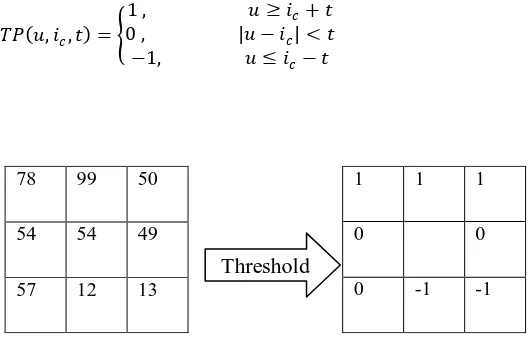
Local ternary pattern extends LBP to 3 value codes in which gray levels in a zone of width t around ic, and the
binary code is replaced by LTP code. Ternary pattern is given as
𝐿𝑇𝑃 𝑢, 𝑖𝑐, 𝑡 =
1 , 𝑢 ≥ 𝑖𝑐+ 𝑡
0 , |𝑢 − 𝑖𝑐| < 𝑡
−1, 𝑢 ≤ 𝑖𝑐− 𝑡
(6)
Ternary Code: 1100(-1)(-1)00
Figure 2: (a) LTP operator binary sequence (b) Binary outputs
When using LTP for visual matching we could use 3n valued codes, but the uniform pattern argument also applies in
the ternary case.
III APPROACH AND RESULT ANALYSIS
The present paper examines and evaluates the performance of different patterns for image classification and
retrieval. The following steps are involved for the proposed approach
Read a set of images of dimensions mxn whose intensity values ranges [0 255] Normalize the images and apply the binary or ternary pattern for texture extraction
Apply any feature extraction method like GLCM to these texture images and create a database While in testing process, an image is taken as query and the above steps are repeated
The stored database textured features and the query image textured features are compared with classical
Euclidean distance or any traditional classifier like SVM (support vector machine)[10] The results are displayed, and the metrics like precision and recall values are calculated.
78 99 50
54 54 49
57 12 13
1 1 1
0 0
0 -1 -1
International Journal in IT and Engineering, Impact Factor- 5.343
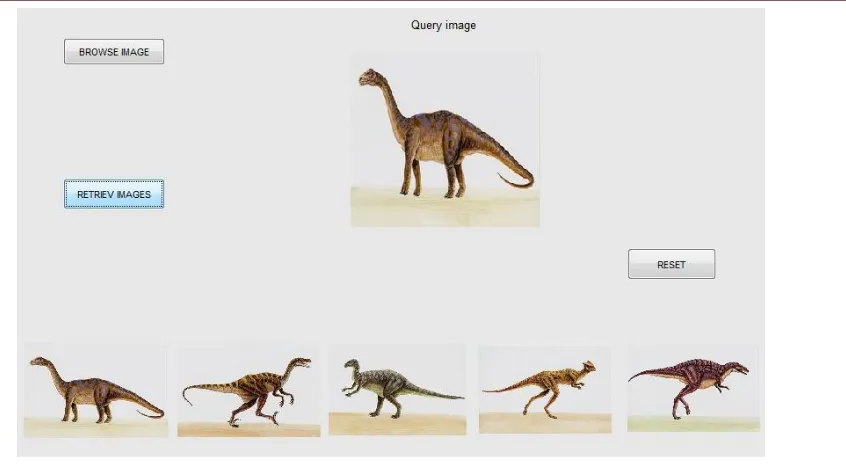
Figure 3: Retrieved images from the proposed approach using ternary Pattern
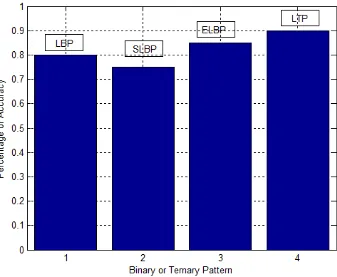
Figure 5: Performance Analysis of different binary and ternary patterns
IV. CONCLUSION
Image classification and retrieval using binary and ternary pattern is discussed in this paper. Both the patterns are
used for texture extraction , however these algorithms are tested using Berkeley image retrieval database images for
which the ternary patterns show an increment of 0.5-0.7 % with respect to the binary patterns. This algorithm can be
further applied on document retrieval application where the texture content plays a prominent role in classification.
REFERENCES
[1] Minh N. Do and Martin Vetterli ,” Rotation Invariant Texture Characterization and Retrieval using Steerable Wavelet-domain Hidden Markov Models” , IEEE transactions on multimedia ,Vol4-Issue 4,pg.no 517-527,2002 [2] Timo Ojala, Matti Pietikainen and Topi Maenpaa,” Gray Scale and Rotation Invariant Texture Classification with Local Binary Patterns”, IEEE Trans. Pattern Analysis and Machine Intelligence 1994.
[3] Chen J-L and Kundu A.,” Rotation and gray scale transform invariant texture identification using wavelet decomposition and hidden Markov model.” IEEE Trans. Pattern Analysis and Machine Intelligence 1994; 16:208-214.
[4] Cohen FS, Fan Z and Patel MA.,” Classification of rotated and scaled texture images using Gaussian Markov Random Field models.,” IEEE Trans. Pattern Analysis and Machine Intelligence 1991; 13:192-202.
International Journal in IT and Engineering, Impact Factor- 5.343
[7] Ojala T, Pietikainen M & Maenpa T , “Multiresolution gray-scale and rotation invariant texture classification with local binary patterns”, IEEE Transactions on Pattern Analysis and Machine Intelligence, 24(7):971-987.2002 [8] Q. Tao and R. N. J. Veldhuis. “Illumination normalization based on simplified local binary patterns for a face verification system”, In Biometrics Symposium 2007 at The Biometrics Consortium Conference, Baltimore, Maryland, pages 1–7, USA, September 2007. IEEE Computational Intelligence Society.
[9] Amnart Petpon and Sanun Srisuk, ”Face Recognition with Local Line Binary Pattern”, 5th
International Conference on Image and Graphics 2009, DOI 10.1109/ICIG.2009.123
[10] C. Cortes and V. Vapnik, “Support-vector networks,” Machine Learning, vol. 20, no. 3, pp. 273-297, 1995. [11] V.Vapnik, Statistical Learning Theory, John Wiley and Sons, New York, 1998.