An Improved Automated Multi Level Intrusion Detection and Log
Management System In Cloud Computing.
ALABI O. A1
DEPARTMENT OF COMPUTER SCIENCE UNIVERSITY OF PORT HARCOURT, NIGERIA
UWALAKA C. S2
DEPARTMENT OF ENGINEERING
NIGERIAN NAVAL ENGINEERING COLLEGE, SAPELE ABSTRACT
Information and Communications Technology (ICT)] has come to stay. As a result, most of our
institutions have decided to move their important files to the cloud and do online transactions –
allocation of resources to reviewer, proper storage of the big data from hackers. Cloud also
involves multi-mesh distributed and service oriented paradigms, multi-tenancies, multi-domains,
and multi-user autonomous administrative infrastructures which are more vulnerable and prone
to security risks. Cloud computing service architecture combines three layers of inter-dependent
infrastructure, platform and application; each layer may suffer from certain vulnerabilities which
are introduced by different programming or configuration errors of the user or the service
provider. A cloud computing system can be exposed to several threats including threats to the
integrity, confidentiality and availability of its resources, data and the virtualized infrastructure
which can be used as a launching pad for new attacks. The problem becomes even more critical
when a cloud with massive computing power and storage capacity is abused by an insider
intruder as an ill-intention party which makes cloud computing a threat against itself.
INTRODUCTION
It is efficient and cost economical for
consumers to use computing resources as
much as they need or use services they want
from Cloud Computing provider. Especially,
Cloud Computing has been recently more
spotlighted than other computing services
because of its capacity of providing
unlimited amount of resources. Moreover,
consumers can use the services wherever
Internet access is possible, so Cloud
Computing is excellent in the aspect of
accessibility. Cloud Computing systems
have a lot of resources and private
information, therefore they are easily
threatened by attackers (Enisa, 2009).
Especially,
System
administrators
potentially can become attackers. Therefore,
Cloud Computing providers must protect the
systems safely against both insiders and
outsiders.
Intrusion Detection Systems (IDSs) are one
of the most popular devices for protecting
Cloud Computing systems from various
types of attack. Because an IDS observes the
traffic from each VM and generates alert
logs, it can manage Cloud Computing
globally (Roberto et al, 2008). Another
important problem is log management.
Cloud Computing systems are used by many
people, therefore, they generate huge
amount of logs. So, system administrators
should decide to which log should be
analyzed first.
Based Computing(SBC), and Network
Computing, rather than a entirely new type
of computing technique [JaeHyuk, 2010].
An Intrusion Detection System (Commonly
referred to IDS) is a system that replaces the
typical task of system administrators of
constantly reviewing the log files in attempt
to spot any abnormal records. And by
abnormal we mean any records that indicate
a malicious activity by the user. These
malicious activities include a wide variety of
actions that usually tend to attack and/or
damage the system being the target. This
method was enough for monitoring the
activities of small group of people within a
private organization.
But with the expanded usage of computing
system and by the development of complex
interconnected networks, this is no longer an
applicable method. Automated methods
were needed to make the task faster and
easier [Kemmerer and Vigna,(2002]. This
was the first step towards the Generally,
IDs can be defined as the tools, methods,
and resources that help to identify, assess,
and report unauthorized or unapproved
network activities. The intrusion detection
part of the name is a bit of a misnomer, as an
IDS system doesn’t actually detect
intrusions. It rather detects activities in
traffic that may or may not be an intrusion.
Intrusion detection is usually part of an
overall security architecture that is installed
around a system or device [Foster et al,
2008)
Materials and methods
This project work is based on Multi-level intrusion detection and log management in cloud computing is an embracing topic in the determinant of how applications are developed and installed on a server, intrusion detection systems which acts as an antivirus is also installed to fight against cyber-attacks. For the purpose of this research work, the researcher shall be limited to developing an address book application (software) which will be installed on a server for us to be able to test the strength of
multilevel intrusion and log management in cloud computing.
[Gruschka and Jensen, 2010]: work on cloud attack policy. The interface between a service instance and an user can be considered as a client-to-server interface, that is vulnerable to all types of attacks that are possible in common client-server architectures, including SQL injection, buffer overflow, privilege escalation, SSL certificate spoofing, phishing attacks, and flooding attacks.
[Thomas and Narayanaswamy, 2011]: work on intrusion detector system that detect attacks in the incoming traffic, the IDSs are typically parameterized by a threshold T. The IDS uses a theoretical basis for decidingg the thresholds for analysing the network traffic to detect intrusions. Changing this threshold allows the change in performance of the IDS. If the threshold is very low, then the IDS tends to be very aggressive in detecting the traffic for intrusions. However, there is a potentially greater chance for the detections to be irrelevant which result in a large number of false alarms. A large threshold on the other hand will have an opposite effect; being a bit conservative in detecting attacks. However, potential attacks may get overlooked by this method.
Yee et. al (2012): have proposed an intrusion detection system designed specifically to detect certain attacks against web services. The Web Service they proposed cannot be controlled by users and aims at protecting the web services themselves. Therefore, we can consider this as an intrusion detection system designed to protect the cloud itself which is usually the location where web services are hosted.
at network nodes and/or supplied by different vendors. The model however assumes the existence of already configured intrusion detection services. It also doesn’t allow the clients within the cloud of network to determine the protection requirements but rather use the ID service from one vendor and replaces it if it doesn’t suit their demands. Methods of achieving Goal
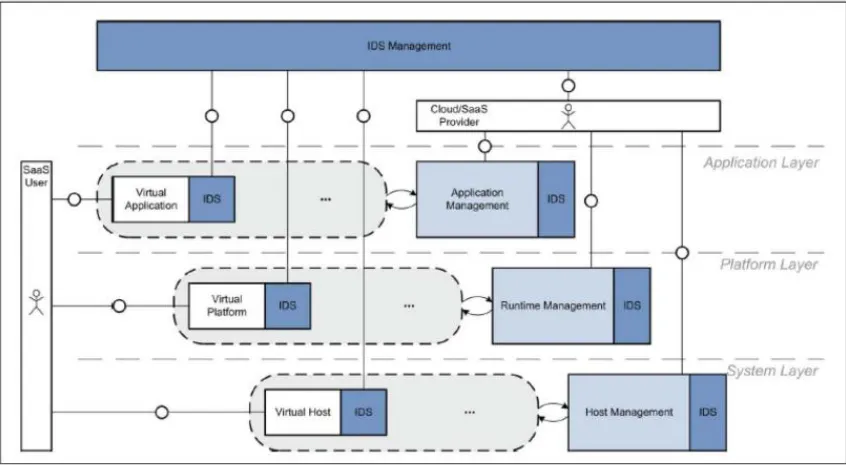
We proposed a Two protection level to solves the trends in intrusion detection system. The first is the Host-Based Protection (HIDS), and the second is the Network-Based Protection (NIDS).
Host-Based IDS
This is where the intrusion detection system is intended to protect a single host. This is usually achieved using a special software running on the host and utilize fire-wall like strategies to intercept traffic and analyze it to report any malicious traffic.
Network-Based IDS
This type of IDS is usually used to protect a complete network segment. In order for them to be able to do this task, they are typically placed on the network perimeter in a place that allows it to read all the exchanged traffic with the protected network segment
MD5 Algorithms
Fig. 1 The Architecture of the Proposed System
MD5 (Message Digest 5) Algorithms will be
used to secure this line of internet because
MD5 is a security algorithm that secure
information from a sender to the Receiver .
in this project work we will used Anomaly
Detection (The main advantage of anomaly
detection systems is that they can detect
previously unknown attacks. By defining
what’s normal, they can identify any
violations, whether it is part of the threat
model or not. In actual systems however, the
advantage of detecting unknown attacks is
paid for in terms of high false-positive rates.
Anomaly detection is also difficult to train
in highly dynamic environments.) and
Misused Detection (The misuse-based
intrusion detection systems attempt to model
the abnormal behavior, any occurrence of
which clearly indicates system abuse. For
example, an HTTP request referring to the
cmd.exe file may indicate an attack.
The main disadvantage of misuse detection
systems is that they can detect only known
attack for which they have a predefined
signature. These techniques require the
modeling
and
development
of
new
signatures for each newly discovered attack.
These signatures must then be added to the
published signature database
IDS in cloud (signatures to monitor the traffic originating from or destined to the other virtual machines).
Figure 5-2 displays the results obtained when measuring the process size for each of the two cases. As clearly visible in the figure, the process size for using the CIDS to protect multiple networks is very similar to using “Snort” for protecting a single network. his behavior stays the same despite the number of subscribed signatures. The architecture of CIDS Web Service is expected to give such result since the only addition difference is length of the same number of signatures. The remaining process components are all the same. The process size overhead is very small compared to the original snort process size.
We now measure the detection rate of heavy and hostile traffic. Figure 5-3 shows the obtained results for the effective attack detection rate for the two cases mentioned earlier. As the figure illustrates, the average attack detection rate is very high for the two cases.
Conclusion
As a final conclusion, the CIDS have been a successful Web Service for managing intrusion detection systems in cloud networks and provide it as a service to the cloud clients. The system component of the CIDS is very scalable and extremely effective in memory utilization, and supports large volumes of traffic
Reference
A. Bosin, N.Dessì, and B. Pes,(2012): "Service Based Approach toa New Generation of Intrusion Detection Systems "in Sixth European Conference on WebServices,Dublin,pp.215-224. Enisa H.Y, 2009: Efficient Cloud Computing with Secure Data Storage using AES, International Journal of Advanced Research in Computer and Communication Engineering Vol. 4, Issue 6, 23-34
I. Foster, Y.Zhao, Raicu ,and S.Lu, (2008): "Cloud Computing and Grid Computing 360-Degree Compared, "in Grid Computing Environments Workshop, GCE.
JaeHyuk A.T, 2010: “Data Partitioning Technique to Improve Cloud Data Storage Security”, International Journal of Computer Science and Information Technologies, Vol. 5 (3) , 2014, 3347-3350
R.A. Kemmerer and G. Vigna,(2002) "Intrusion Detection: A Brief History and Overview, "IEEE Security and Privacy Magazine, vol.35, no.4, pp.27-30.