c e-ISSN: 2348-6848, p- ISSN: 2348-795X Volume 2, Issue 12, December 2015
International Journal of Research (IJR)
Available at http://internationaljournalofresearch.orgAnalysis of Cloud Databases by Using Adaptive Encryption
Algorithm
V. Swarna
[email protected]
Under the guidance of
G. Minni
(ASSISTANT PROFESSIOR), M.Tech
NIMRA COLLEGE OF ENGINEERING & TECHNOLOGY, IBRAHIMPATNAM
Abstract:
The cloud database as a service is a novel paradigm that can support several Internet-based applications, but its adoption requires the solution of information confidentiality problems. We propose a novel architecture for adaptive encryption of public cloud databases that offers an interesting alternative to the trade-off between the required data confidentiality level and the flexibility of the cloud database structures at design time. We demonstrate the feasibility and performance of the proposed solution through a software prototype. Moreover, we propose an original cost model that is oriented to the evaluation of cloud database services in plain and encrypted instances and that takes into account the variability of cloud prices and tenant workload during a medium-term period. The proposed architecture guarantees in an adaptive way the best level of data confidentiality for any database workload, even when the set of SQL queries dynamically changes. The adaptive encryption scheme, which was initially proposed for applications not referring to the cloud, encrypts each plain column into multiple encrypted columns, and each value is encapsulated into different layers of encryption, so that the outer layers guarantee higher confidentiality but support fewer computation capabilities with respect to the inner layers. we propose the first analytical cost estimation model for evaluating cloud database costs in plain and encrypted instances from a tenant’s point of view in a medium-term period. It takes also into account the variability of cloud prices and the possibility that the database workload may change during the evaluation period. Key words: Cloud Database; Confidentiality; Encryption; Adaptively; Cost Estimation Model
I. INTRODUCTION
c e-ISSN: 2348-6848, p- ISSN: 2348-795X Volume 2, Issue 12, December 2015
International Journal of Research (IJR)
Available at http://internationaljournalofresearch.orgdynamically changes. The adaptive encryption scheme, which was initially proposed for applications not referring to the cloud, encrypts each plain column into multiple encrypted columns, and each value is encapsulated into different layers of encryption, so that the outer layers guarantee higher confidentiality but support fewer computation capabilities with respect to the inner layers.
2. SYSTEM ANALYSIS Existing System:
The cloud computing paradigm is successfully converging as the fifth utility , but this positive trend is partially limited by concerns about information confidentiality and unclear costs over a medium-long term .We are interested in the Database as a Service paradigm (DBaaS) that poses several research challenges in terms of security and cost evaluation from a tenant’s point of view. Most results concerning encryption for cloud-based services are in applicable to the database paradigm. Other encryption schemes, which allow the execution of SQL operations over encrypted data, either suffer from performance limits or they require the choice of which encryption scheme must be adopted for each database column and SQL operations.
Proposed System:
The proposed architecture guarantees in an adaptive way the best level of data confidentiality for any database workload, even when the set of SQL queries dynamically changes. The adaptive encryption scheme, which was initially proposed for applications not referring to the cloud, encrypts each plain column into multiple encrypted columns, and each value is encapsulated into different layers of encryption, so that the outer layers guarantee higher confidentiality but support fewer computation capabilities with respect to the inner layers. we propose the first analytical cost estimation model for evaluating cloud database costs in plain and encrypted instances from a tenant’s point of view in a medium-term period. It takes also into account the variability of cloud prices and the possibility that the database workload may change during the evaluation period. This model is instanced with respect to several cloud provider offers and related real prices. As expected, adaptive encryption influences the costs related to storage size and network usage of a database service. However, it is important that a tenant can anticipate the final costs in its period of interest, and can choose the best compromise between data confidentiality and expenses.
Architecture:
Implementation Modules:
1. Adaptive encryption 2. Metadata structure
3. Encrypted database management
4. Cost Estimation of cloud database services 5. Cost model
6. Cloud pricing models 7. Usage Estimation
Adaptive encryption:
The proposed system supports adaptive encryption methods for public cloud database service, where distributed and concurrent clients can issue direct SQL operations. By avoiding an architecture based on one [or] multiple intermediate servers between the clients and the cloud database, the proposed solution guarantees the same level of scalability and availability of the cloud service. Figure 1 shows a scheme of the proposed architecture where each client executes an encryption engine that manages encryption operations. This software module is accessed by external user applications through the encrypted database interface. The proposed architecture manages five types of information.
• Plain data is the tenant information;
• Encrypted data is stored in the cloud database;
• Plain metadata represent the additional information that is necessary to execute SQL operations on encrypted data; • Encrypted metadata is the encrypted version of the metadata that are stored in the cloud database;
c e-ISSN: 2348-6848, p- ISSN: 2348-795X Volume 2, Issue 12, December 2015
International Journal of Research (IJR)
Available at http://internationaljournalofresearch.orgMetadata structure:
Metadata include all information that allows a legitimate client knowing the master key to execute SQL operations over an encrypted database. They are organized and stored at a table-level granularity to reduce communication overhead for retrieval, and to improve management of concurrent SQL operations. We define all metadata information associated to a table as table metadata. Let us describe the structure of a table metadata .Table metadata includes the correspondence between the plain table name
and the encrypted table name because each encrypted table name is randomly generated. Moreover, for each column of the original plain table it also includes a column metadata
parameter containing the name and the data type of the corresponding plain column (e.g., integer, string, timestamp). Each column metadata is associated to one or more onion metadata, as many as the number of onions related to the column.
Encrypted database management:
The database administrator generates a master key, and uses it to initialize the architecture metadata. The master key is then distributed to legitimate clients. Each table creation requires the insertion of a new row in the metadata table. For each table creation, the administrator adds a column by specifying the column name, data type and confidentiality parameters. These last are the most important for this paper because they include the set of onions to be associated with the column, the starting layer (denoting the actual layer at creation time) and the field confidentiality of each onion. If the administrator does not specify the confidentiality parameters of a column, then they are automatically chosen by the client with respect to a tenant’s policy. Typically, the default policy assumes that the starting layer of each onion is set to its strongest encryption algorithm.
Cost Estimation of cloud database services:
A tenant that is interested in estimating the cost of porting its database to a cloud platform. This porting is a strategic decision that must evaluate confidentiality issues and the related costs over a medium-long term. For these reasons, we propose a model that includes the overhead of encryption schemes and variability of database workload and cloud prices. The proposed model is general enough to be applied to the most popular cloud database services, such as Amazon Relational Database Service.
Cost model:
The cost of a cloud database service can be estimated as a function of three main parameters:
Cost = f(Time, Pricing,Usage) where:
• Time: identifies the time interval T for which the tenant requires the service.
• Pricing: refers to the prices of the cloud provider for subscription and resource usage; they typically tend to diminish during T.
• Usage: denotes the total amount of resources used by the tenant; it typically increases during T .In order to detail the
pricing attribute, it is important to specify that cloud providers adopt two subscription policies: the on-demand
policy allows a tenant to pay peruse and to withdraw its subscription anytime; the reservation policy requires the tenant to commit in advance for a reservation period. Hence, we distinguish between billing costs depending on resource usage and reservation costs denoting additional fees for commitment in exchange for lower pay-per-use prices. Billing costs are billed periodically to the tenant every billingperiod.
Cloud pricing models:
Popular cloud database providers adopt two different billing functions, that we call linear L and tiered T. Let us consider a generic resource x, we define as xb its usage at the b-th
billing period and px b its price. If the billing function is tiered, the cloud provider uses different prices for different ranges of resource usage. Let us define Z as the number of tiers, and [ˆx1, . . . , ˆxZ−1] as the set of thresholds that define all the tiers. The uptime and the storage billing functions of Amazon RDS are linear, while the network usage is a tiered billing function. On the other hand, the uptime billing functions of Azure SQL is linear, while the storage and network billing functions are tiered.
Usage Estimation:
c e-ISSN: 2348-6848, p- ISSN: 2348-795X Volume 2, Issue 12, December 2015
International Journal of Research (IJR)
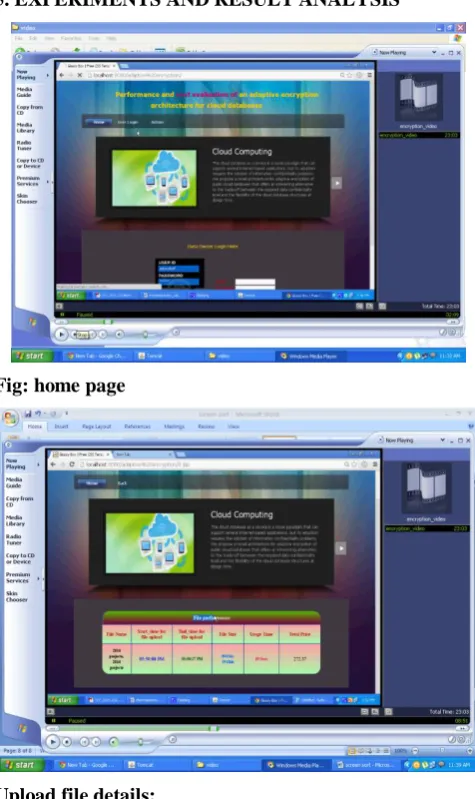
Available at http://internationaljournalofresearch.org5. EXPERIMENTS AND RESULT ANALYSIS
Fig: home page
Upload file details:
Encrypted metadata retivel from database
:
Database Name: encryption
Table name: register
6. CONCLUSIONS
There are two main tenant concerns that may prevent the adoption of the cloud as the fifth utility: data confidentiality and costs. This paper addresses both issues in the case of cloud database services. These applications have not yet received adequate attention by the academic literature, but they are of utmost importance if we consider that almost all important services are based on one or multiple databases. We address the data confidentiality concerns by proposing a novel cloud database architecture that uses adaptive encryption techniques with no intermediate servers. This scheme provides tenants with the best level of confidentiality for any database workload that is likely to change in a medium-term period. We investigate the feasibility and performance of the proposed architecture through a large set of experiments based on a software prototype subject to the TPC-C standard benchmark. Our results demonstrate that the network latencies that are typical of cloud database environments hide most overheads related to static and adaptive encryption. Moreover, we propose a model and a methodology that allow a tenant to estimate the costs of plain and encrypted cloud database services even in the case of workload and cloud price variations in a mid-term horizon. By instantiating the model with actual cloud provider prices, we can determine the encryption and adaptive encryption cost of data confidentiality. From the research point of view, it would be also interesting to evaluate the proposed or alternative architectures under different threat model hypotheses.
REFERENCES
[1] R. Buyya, C. S. Yeo, S. Venugopal, J. Broberg, and I. Brandic, “Cloud computing and emerging it platforms: Vision, hype, and reality for delivering computing as the 5th utility,” Future Generation Computer Systems, vol. 25, no. 6, pp. 599–616, 2009.
c e-ISSN: 2348-6848, p- ISSN: 2348-795X Volume 2, Issue 12, December 2015
International Journal of Research (IJR)
Available at http://internationaljournalofresearch.org[3] H.-L. Truong and S. Dustdar, “Composable cost estimation and monitoring for computational applications in cloud computing environments,” Procedia Computer Science, vol. 1, no. 1, pp. 2175 – 2184, 2010, iCCS 2010.
[4] E. Deelman, G. Singh, M. Livny, B. Berriman, and J. Good, “The cost of doing science on the cloud: the montage example,” in Proc.2008 ACM/IEEE Conf. Supercomputing, ser. SC ’08. Piscataway, NJ, USA: IEEE Press, 2008, pp. 50:1–50:12.
[5] H. Hacig¨um¨us¸, B. Iyer, and S. Mehrotra, “Providing database as a service,” in Proc. 18th IEEE Int’l Conf. Data
Engineering, Feb. 2002.
[6] G. Wang, Q. Liu, and J. Wu, “Hierarchical attribute-based encryption for fine-grained access control in cloud storage services,” in Proc. 17th ACM Conf. Computer and communications security. ACM, 2010, pp. 735–737.
[7] Google, “Google Cloud Platform Storage with
server-side encryption,”
http://googlecloudplatform.blogspot.it/2013/08/ google-cloud-storage-now-provides.html, Mar. 2014.
[8] H. Hacig¨um¨us¸, B. Iyer, C. Li, and S. Mehrotra, “Executing sql over encrypted data in the database-service-provider model,” in Proc. ACM SIGMOD Int’l Conf. Management of data, June 2002.
[9] L. Ferretti, M. Colajanni, and M. Marchetti, “Distributed, concurrent, and independent access to encrypted cloud databases,” IEEE Trans. Parallel and Distributed Systems, vol. 25, no. 2, Feb. 2014.
[10] R. A. Popa, C. M. S. Redfield, N. Zeldovich, and H. Balakrishnan, “CryptDB: protecting confidentiality with encrypted query processing,” in Proc. 23rd ACM Symp. Operating Systems Principles, Oct. 2011.
[11] C. Gentry, “Fully homomorphic encryption using ideal lattices,” in Proc. 41st ACM Symp. Theory of computing, May 2009.
[12] A. Boldyreva, N. Chenette, and A. O’Neill, “Order-preserving encryption revisited: Improved security analysis and alternative solutions,” in Proc. Advances in Cryptology – CRYPTO 2011. Springer, Aug. 2011.
[13] P. Paillier, “Public-key cryptosystems based on composite degree residuosity classes,” in Proc. Advances in Cryptology – EUROCRYPT99. Springer, May 1999.
[14] D. Song, D. Wagner, and A. Perrig, “Practical techniques for searches on encrypted data,” in Proc. IEEE Symposium on Securityand Privacy., May 2000.
[15] L. Ferretti, F. Pierazzi, M. Colajanni, and M. Marchetti, “Security and confidentiality solutions for public cloud database services,” in Proc. Seventh Int’l Conf. Emerging Security Information, Systemsand Technologies, Aug. 2013.
[16] A. Greenberg, J. Hamilton, D. A. Maltz, and P. Patel, “The cost of a cloud: research problems in data center networks,” SIGCOMMComput. Commun. Rev., vol. 39, no. 1, pp. 68–73, Jan. 2008.
[17] L. Popa, S. Ratnasamy, G. Iannaccone, A. Krishnamurthy, and I. Stoica, “A Cost Comparison of Data Center Network Architectures,” in Proc. ACM Int’l Conf.
Emerging Networking Experimentsand Technologies, 2010.
[18] R. N. Calheiros, R. Ranjan, A. Beloglazov, C. A. De Rose, and R. Buyya, “Cloudsim: a toolkit for modeling and simulation of cloud computing environments and evaluation of resource provisioning algorithms,” Software: Practice and Experience, vol. 41, no. 1, pp. 23–50, 2011.
[19] O. Goldreich, Foundations of Cryptography: Volume 2, Basic Applications. Cambridge university press, 2004.
[20] J. Daemen and V. Rijmen, The design of Rijndael: AES – the advanced encryption standard. Springer, 2002.
[21] B. Schneier, “Description of a new variable-length key, 64-bit block cipher (blowfish),” in Proc. Cambridge Security Work. Fast SoftwareEncryption, Dec. 1993.
[22] L. Ferretti, M. Colajanni, and M. Marchetti, “Supporting security and consistency for cloud database,” in
Proc. Fourth Int’l Symp. Cyberspace Safety and Security. Springer, Dec. 2012.
[23] Amazon Web Services, “Amazon Relational Database Service,” http://aws.amazon.com/rds, Mar. 2014.
[24] EnterpriseDB, “Postgres Plus Cloud Database,” http: //enterprisedb.com/cloud-database, Mar. 2014.
[25] Microsoft, “Windows Azure SQL Database,” http: //www.windowsazure.com/en-us/services/data-management, Mar. 2014.