A Methodology to Securely Transfer a Secret Image Based on
Reversible Color Transformations and HSV Color Model.
Sk.Ahammad
1& Koteswarao.M.
21.M.Tech student,Amara Institute of Engineering&Technology,JNTUK,NRT,AP. 2. Assistant professor,Amara Institute of Engineering&Technology,JNTUK,NRT,AP.
Abstract:
Images from different sources or locations are often used and are transffered using the internet for different purposes, such as important and confidential enterprise archives, document storage systems, medical imaging systems, and military image databases. This kind of images may contain secret or confidential information since it should be protected from leakage during transmissions. A methodology for secure image transferring is most needed, which is to transfer a secret image into a meaningful Secret Fragment Mosaic image with size almost same and looking similar to the pre selected target image. The mosaic image is the final outcome of arranging of the block fragments of a secret image in a way so as to disguise the other image called the target image. The mosaic image, which looks similar to a randomly selected target image, which is used for hiding of the secret image by color transforming their characteristics similar to the blocks of the target image. Such technique is necessary so for the lossless recovery of the transmitted secret image. The appropriate information is embedded into the mosaic image for the recovery of the transmitted secret image.
Index Terms—Color transformation; data
hiding; image encryption; mosaic image; secure image transmission.
Introduction
Now in these days, images from various sources are often used and are transmitted through the internet for various applications, such as confidential enterprise archives, document storage systems, medical imaging systems, and military image databases. These images usually contain private or confidential information so that they should be protected from leakages during transmissions. Recently, many methods have been proposed for securing image
transmission, for which two common
paper, we propose an approach for secure image transmission is needed, which is to transform a secret image into a meaningful Secret Fragment Mosaic image with size almost same and looking similar to the preselected target image. The mosaic image is the outcome of arranging of the block fragments of a secret image in a way so as to disguise the other image called the target image. The mosaic image, which looks similar to a randomly selected target image, which is used for hiding of the secret image by color transforming their characteristics similar to the blocks of the target image. Such technique is necessary so for the lossless recovery of the transmitted secret image. The appropriate information is embedded into the mosaic image for the recovery of the transmitted secret image. The rest of this paper organized as follows: Section 2 discusses related works. Section 3 discusses proposed system. Section 4 covers the detailed algorithms for mosaic image creation and secret image recovery and Section 5 concludes the paper.
Fig.1. Illustration of creation of secret-fragment-visible mosaic image proposed. Accordingly, we propose in this study a new method that creates secret-fragment visible mosaic images with no need of a database; any
image may be selected as the target image for a given secret image. Fig. 2 shows a result yielded by the proposed method. Specifically, after a target image is selected arbitrarily, the given secret image is first divided into rectangular fragments, which then are fit into similar blocks in the target image according to a similarity criterion based on color variations. Next, the color characteristic of each tile image is transformed to be that of the corresponding block in the target image, resulting in a mosaic image which looks like the target image. Such a type of camouflage image can be used for securely keeping of a secret image in disguise of any pre-selected target image. Relevant schemes are also proposed to conduct nearly-lossless recovery of the original secret image.
(a)
(c)
Fig. 2. A result yielded by proposed method. (a) Secret image. (b) Target image. (c) Secret-fragment-visible mosaic image created from (a) and (b).
Related Works
This section describes the various existing schemes which are compared in this paper. 2.1 A New Secure Image Transmission
Technique via Secret-fragment-Visible
Mosaic Images by Nearly Reversible Colour Transformations.
In this paper, Ya-Lin Lee propose a technique for the transmitting of the secret image securely and lossless. This method transforms the secret image into a mosaic tile image having the same size like that of the target image which is preselected from a
database. This colour transformation is
controlled and the secret image is recovered lossless from the mosaic tile image with the help of the extracted relevant information generated for the recovery of the image .
2.2 A Keyless Approach to Image
Encryption, by Indian Institute of
Technology Roorkee.
This paper shows a keyless approach to encryption methods which are used to encrypt
images. We make the use of this paper to apply the keyless approach in the proposed method. This is done by generating relevant information with the help of some RMSE value which help to rotate the tile images to a certain angle. 2.3 JPEG: Still Image Data Compression Standard
Here, W. B. Penne baker tries to explain that the main obstacle in many applications is the quantity of data required to represent a digital image. For this we would need an image compression standard to maintain the quality of the images after compression. To meet all the needs the JPEG standard for image compression includes two basic methods having different operation modes: A DCT method for ―lossy‖ compression and a predictive method for ―lossless‖ compression.
Proposed System
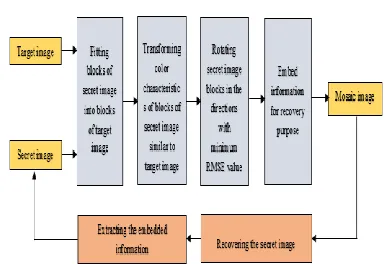
To securely transmit a secret image and recover it losslessly by method of creating a mosaic image using HSV color model. Embedding text into the secret image to be transmitted by data hiding and to implement keyless approach for secret image transmission. To securely transmit a secret image and recovering it without any loss by method of creating a mosaic image. The proposed method is new in that a meaningful mosaic image is created.
The proposed method includes two main phases 1) Mosaic image creation
Figure .3. Flow Diagram of proposed method
Algorithm of Proposed Method
The detailed algorithms for mosaic image creation and secret image recovery may now be described in Algorithms 1 and 2 respectively. Algorithm 1: Mosaic image creation T-target image, S-secret image, F-mosaic image
Stage 1. Fitting blocks of secret images into blocks of target blocks
1. If the size of T is different from S, change the size
2. Divide S and T into n blocks of same size 3. Compute the means and the standard deviations (SD) of each tile [1]
4. Compute the average SD 5. Sort the tile images in S and T 6. Map tile between S and T 7. Create F
Stage2.Transforming color characteristics of blocks of secret image similar to target image 8. For each mapping from secret to target calculate the mean and SD
9.Each pi in each block of F with color value ci, transform ci into a new value using ci’’=qc(ci-μc) + μc’
a. If ci’’ is not less than 255 or if it is not greater than0, then change to be 255 or 0
Stage 3. Rotating secret image blocks in the direction with minimum RMSE value
10. Compute the RMSE values
11. Rotate tile into the optimal direction with the smallest RMSE value
Stage 4. Embed information for recovery purpose
12. For each tile image in F, construct a bit stream M for recovering T
Index, rotation angle θ°, means and the SD quotients
13. Generate a bit stream Mt by K 14. Embed Mt into F
Stage 4. Embed information for recovery purpose
12. For each tile image in F, construct a bit stream M for recovering T
Index, rotation angle θ°, means and the SD quotients
13. Generate a bit stream Mt by K
14. Embed Mt into F
Algorithm 2: Secret image recovery T-target image, S-secret image, F-mosaic image Stage 1. Extracting the embedded information. 1. Extract the bit stream Mt by K .
2. Decompose Mt into n bit streams.
3. Decode M for each tile image to obtain the data items.
Index, rotation angle θ°, means and SD quotients.
Stage 2. Recovering the secret image. 4. Recover tile images by the following steps
Rotate tile in the reverse direction and fit the resulting block content into T to form an initial tile image
use the extracted means and related SD quotients
scan T to find out pixels with values 255 or 0
take the results as the final pixel values 5. Compose all the final tile images to form the desired secret image S
RESULT AND DISCUSSIONS
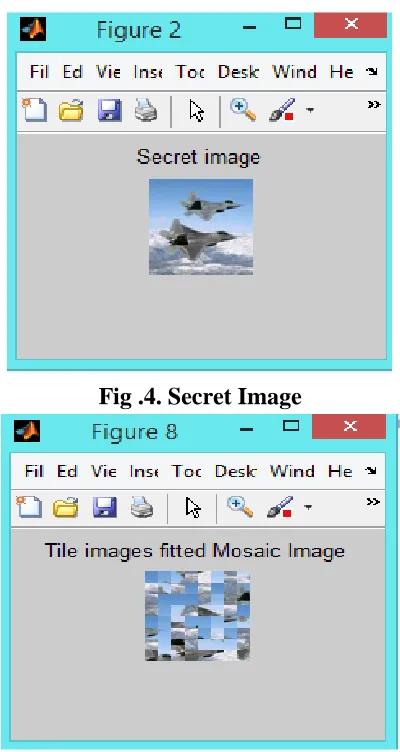
The first figure is the target image which is pre selected from the database and are divided into target blocks and the second figure is the plane which is the secret image and it is divided into tile blocks. Third figure is the result of calculating mean, standard deviation and average standard deviation for each target block and tile block and then sorting the blocks according to the result of average standard deviation. Next map the sorted target blocks with the tile blocks, fit these blocks in a mosaic form.
In fig 4 transform the color of all the pixels of each tile block using mean and standard deviation rotate each transformed tile block to 90, 180 and 270 degrees, and calculate the root mean square error. In fig 5 embed the relevant information for future recovery of the secret image nearly losslessly. Fig 6 is the output of the watermarked mosaic image.
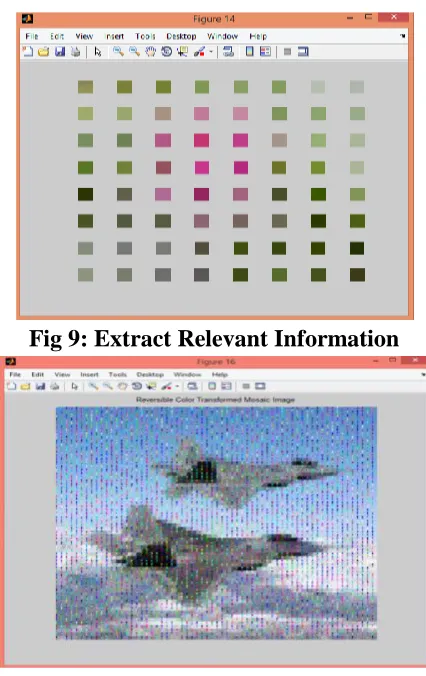
In fig 7 we do the reverse process to recover the secret image by extracting the information that we embedded in the mosaic image. In fig 8 we recover the secret image using the extracted information.
Fig .3. Target Image
Fig .4. Secret Image
Fig .6. Color Transformed Mosaic Image
Fig .7. Embed Relevant Information
Fig .8. Water Marked Mosaic Image – Output
Fig 9: Extract Relevant Information
Fig .10. Reversible Color Transformed Mosaic Image
Conclusion
References
[1] A New Secure Image Transmission Technique via Secret-fragment-Visible Mosaic
Images by Nearly Reversible Color
Transformations, Ya-Lin Lee, Student Member, IEEE, and Wen-Hsiang Tsai, Senior Member, IEEE Transactions on Circuits and systems for video Technology, vol. 24, no. 4, April 2014
[2] I. J. Lai and W. H. Tsai, ―Secret-fragment-visible mosaic image-A new computer art and its application to information hiding,‖ IEEE Trans. Inf.Forens. Secur. , vol. 6, no. 3, pp. 936–945, Sep. 2011.
[3] A Keyless Approach to Image Encryption, Siddharth Malik, Anjali. Sardana Indian Institute of Technology Roorkee, India. 2012 International Conference on communication Systems.
[4] JPEG: Still Image Data Compression Standard, W. B. Pennebaker and J. L. Mitchell, New York, NY, USA: Van Nostrand Reinhold, pp. 34–38, 1993.
[5] E. Reinhard, M. Ashikhmin, B. Gooch, and P. Shirley, ―Color transfer between images,‖ IEEE Comput. Graph. Appl., vol. 21, no. 5, pp. 34–41, Sep.–Oct. 2001.