Adaptive Sampling Fuzzy Controlled Based Fault
tolerance in Wireless Sensor Network
Ganesh D R Dr. Kiran Kumari Patil Dr. Suresh L
Research Scholar Professor, School of Computing and IT, Principal
Reva University Reva University, Bangalore CI - Tech, Bangalore
[email protected] [email protected] [email protected]
Abstract—Wireless sensor network is made of
distributed wireless sensor node which sense environment variables and report to base station. Wireless sensor network are increasingly applied in industrial and defense applications. Faults happen in sensor network due to reasons like environmental disturbance and battery energy depletion. Also sensors fail transiently or permanently due to manufacturing defect. In field, due to fault of sensor nodes, the applications built on events from sensors is bound to fail and may cause severe damages. In this work, we propose a efficient fault tolerance method for wireless sensor network. Our mechanism is based on adapting the sampling rate in sensors depending on its data importance and a using spatial temporal correlation to achieve fault tolerance.
I. INTRODUCTION
Wireless sensor networks (WSNs) have received significant attention in recent years due to their potential applications in military sensing, wildlife tracking, traffic Surveillance, health care, environment monitoring, building structures monitoring, etc. WSNs can be treated as a special family of wireless ad hoc networks. A WSN is a self-organized network that consists of a large number of low-cost and low powered sensor devices, called sensor nodes, which can be deployed on the ground, in the air, in vehicles, on bodies, under water, and inside buildings. Each sensor node is equipped with a sensing unit, which is used to capture events of interest, and a wireless transceiver, which is used to transform the captured events back to the base station, called sink node.
Sensor nodes collaborate with each other to perform tasks of data sensing, data communication, and data processing. Nodes in WSNs are prone to failure due to energy depletion, hardware failure, communication link errors, malicious attack, and so on.
When a number of sensors fail for whatever may be the reason the resulting network topology may be disconnected which in result is considered as a failure of set of nodes. The nodes that have not failed become disconnected from the rest of the network.
The application built on sensor network will be affected because of sensor node failure and especially if it is safety related applications and because of node failure, critical events are missed and disasters happen the loss is tremendous. Fault tolerance must be provided in the network , so that even in case of node failures, the critical events are not missed. Also certain times faults can be introduced in the path by forged packets by attackers or faults can be introduced due to dissemination. Also with increasing application of mobile agents, faulty agents can be disseminated into network.
and the method for adapting sampling is decided using Fuzzy logic.
II. SURVEY
In [1] , authors proposed a real time QOS based routing and fault tolerant mechanism for handling real time traffic in wireless sensor network. Congestion , link failure and void problems are handled in this solution. The approach is based on designing redundant path for transmission to handled QOS and faults. But energy is consumed fast and the life time of the network is reduced.
In [2], authors proposed a 1-hop neighbor sensor monitoring to detect faults and the faulty node is isolated from network temporally and if fault persists the node is isolated permanently. Faulty nodes are not isolated in this approach and due to this network partitions happen. This approach can detect faults in the data sensed by sensors but it cannot detect data forward faults.
In [3], authors proposed a approach for placing more nodes in the network but splitting them to active and redundant nodes. Redundant nodes are first kept in sleep position and then woke up to compensate the coverage lost due to fault in active node. But this approach is not scalable for bigger networks as the cost of redundant nodes will increase.
In [4] authors proposed Least-Disruptive topology Repair algorithm to move the nodes to avoid network partition problem. The network partition is measured and nodes are relocated to cover the network partition. It is not always possible to relocate the nodes in un attended environment and also the number of relocation in this approach is high.
In [5] authors proposed a clustering based fault recovery using redundant nodes. Some Nodes within cluster are kept in sleep state and activated to cover for coverage loss. The approach is not
optimized for multiple faults.
In [6] authors proposed a fault node recovery algorithm when sensor nodes shutdown due to energy depletion. The idea of fault tolerance is based on reused routing path in this work. The approach can work only for dense sensor network.
In [7] authors proposed a heterogeneous relay node based approach for fault tolerance. Nodes have different transmission radius. Each nodes have two paths and in case of faults, redundant paths are used. But this approach is complex at sensor nodes with different routing paths.
In [8] authors proposed a energy aware fault tolerant method called Informer homed routing. The network is clustered and fault is handled in two modes within cluster and inter cluster. Due to this energy is conserved. The approach does not deal with cluster head becoming faulty.
In [9] authors proposed a distributed hierarchical Wireless sensor network architecture for fault management. To locate and analyze fault Gateway devices are added into the network. Agent move around to detect faults. This approach is of high overload because of additional network components.
sudden failure and shutdown, this approach does not work well.
In [11], authors proposed two algorithms named Full 2-Connectivity Restoration Algorithm (F2CRA) and Partial 3-Connectivity Restoration Algorithm (P3CRA), which restore a faulty WSN in different aspects. F2CRA constructs the fan-shaped topology structure to reduce the number of deployed nodes, while P3CRA constructs the dual-ring topology structure to improve the fault tolerance of the network. F2CRA is suitable when the restoration cost is given the priority, and P3CRA is suitable when the network quality is considered first. The network is deployed in a way to handle fault tolerance in both of these solution and the solution assumes the number of fault nodes that be in the structure. When the number of fault node assumption fails , the entire fault tolerance mechanism built into network fails.
In [12] , authors proposed a redundant nodes based fault tolerant mechanism. The approach used k-connectivity based steiner approach to decide the optimal number of redundant nodes to be placed in the network. By optimizing the number of redundant nodes, the author tried to reduce the cost of sensor network. The approach lacked coverage ratio but increased the connectivity problem.
In [13], authors applied multi agent architecture for fault management. The multi agent system proposed by author had resource manager, a fault tolerance manager and a load balancing manager. Fault tolerance manger applied the idea of agent broadcast to move around and avoid faulty paths. The approach is scalable but suffers from energy depletion problem.
In [14], authors proposed Reuleaux Triangle approach , to characterize k-coverage with the help of Helly's Theorem and the analysis of the intersection of sensing disks of k sensors. Using a deterministic approach, authors showed that the sensor spatial density to guarantee k-coverage of a convex field is proportional to k and inversely proportional to the sensing range of the sensors. This is a deployment time approach which provides
the number of sensors to be deployed in area based on continuous coverage. But this kind of
approaches fails when the particular area is destroyed also not suitable for random deployments.
In [15] , authors presented a distributed fault detection and node management using cellular automata. Linear cellular automata runs in every node and every sensor node learns it own state using cellular automata. The faulty nodes are detected by temporal and spatial correlation of its data by neighboring nodes. The models for fault detection is learnt at many places and this redundancy results in energy depletion in sensor nodes.
III. PROBLEM DEFINITION
In a wireless sensor network of size N nodes, some nodes can fail with random probability due to many reasons like manufacturing faults. Due to this fault the data from a sensing area can be faulty or not be captured. In some cases like battery energy
depletion, depleting accuracy of sensors etc, the fault can be predicted.
The energy of sensor deplete in proportion to the sampling interval. The sampling interval must be varied over a period of time in operation of sensor to prolong its life time till it is replaced. Due to adaptive of sampling interval the application demand is affected. So a effective method must be devised to c compensate for the data loss. By adaptive sampling rate and compensating for the data loss effective fault tolerance can be done on network, till the sensor is replaced.
IV. PROPOSED SOLUTION
The applications running in base station can demand data from sensors according to its requirements. In this work, we model the
application requirements based on two parameters
2. Tolerant degree of error.
These two parameters can be different for different zones in the network.
The network is split into mesh grids and the application requirement for each grid is known priori.
[Iz, Ez]
Z = [0,…..N]
Figure 1
Where Iz is the interval of data arrival and the Ez is maximum error tolerance.
Every time node sends the data to the Sink, the residual energy is also sent from the node.
Based on the residual energy of node, data interval and Error tolerance required, Reconstruction Degree(RD) in the zone, a Fuzzy logic system calculates the sampling rate to be set for the node and the sampling rate decided is sent to the node. Based on the sampling rate , the node adjusts its sampling duration for sensing and sends the values to the sink.
Out of these input parameters, the residual energy, data interval, Error tolerance are all direct
parameters and the Reconstruction Degree is a
indirect parameter. Reconstruction degree is
dependent on the correlation value of sensor with its neighbor nodes in the same zone.
The correlation is based on time and spatial. To calculate the correlation the historic values of sensors are kept at sink. For each sensor, to its neighboring sensor in the same zone, the correlation is calculated using the formula
Where E is the expected
value operator, cov means covariance, and corr is correlation coefiicient in values between 0 and 1. All the neighbor nodes are sorted based on correlation coefficient from higher to lower and the expected error between the sensor values based on coefficient is calculated and the number of sensors (nse) whose error value is less the error threshold set for application in that zone is found.
Based on the time correlation between the sensor values, ARIMA model is constructed and the maximum error ratio (ME) is measured.
The Reconstruction Degree (RD) is measured as
RD = α (nse) + (1- α)(1/ME)
RD is an indication of how far the data from sensor can be reconstructed using spatial and temporal correlation for the case of missing values in between sampling interval by the application.
Fuzzy function for sampling rate decision is depended on following input parameters.
1. RE (Residual Energy) normalized in between 0 to 1.
2. DI (Data Interval) normalized in 0 to 1 based on min and max values of it. 3. (ET) Error Tolerance is in form of
percentage from 0 to 100.
The input values are categorized to three ranges L,M,H according to fuzzy membership function below.
The membership function of RE in figure 2.
Figure 2
The membership function of DI in figure 3.
Figure 3
The membership function of RE in figure 4.
Figure 4
The membership function of RE in figure 5.
Figure 5
The membership function of output variable sampling rate is Figure 6.
Figure 6
The rule set for decision is given below
RE DI ET RD Sampling
L L L L H
L L L M H
L L L H H
L L M L H
L L M M H
L L M H H
L L H L H
L L H M M
L L H H M
L M L L M
L M L M M
L M L H M
L M M L H
L M M M H
L M M H H
L M H L H
L M H M H
L M H H H
L H L L M
M L L L M
M L L M M
M L L H M
M L M L M
M L M M M
M L M H M
M L H L M
M L H M M
M L H H M
M M L L M
M M L M M
M M L H M
M M M L M
M M M M M
M M M H M
M M H L M
M M H M M
M M H H M
M H L L M
M H L M M
M H L H M
M H M L M
M H M M M
M H M H M
M H H L M
M H H M M
M H H H M
H L L L M
H L L M M
H L L H M
H L M L L
H L M M L
H L M H L
H L H L L
H L H M L
H L H H L
H M L L L
H M L M L
H M L H L
H M M L L
H M M M L
H M M H L
H M H L L
H M H M L
H M H H L
H H L L L
H H L M L
H H L H L
H H M L L
H H M M L
H H M H L
H H H L L
H H H M L
H H H H L
Table 1
The sampling rate is decided on the fuzzy de-membership and returned to the node. The node adjusts it sampling rate, so as to reduce it energy consumption. But the application requirement of data arrival may be shorter than the sampling interval. So for this case, the constructed spatial and temporal model results are applied to a linear function to get the value for that time.
P = W1*P1 + W2*P2.
Where W1 and W2 is a constant satisfying the relation W1+W2=1.
V. RESULT
We have implemented the proposed solution in jprowler simulator and tested with following setup
No of sensors 100-500
Area of deployment 1000 * 1000 m
Sensor range 50m
Deployment model Random
Data rate 10 packets/ sec
MAC protocol 802.11 a
No of base station 1
Propagation model One way
Type of antenna Omni
Simulation Duration 10 minutes
Energy at Node 50joule
Table 2
Faults were introduced into network at interval of 20 seconds and the top 5 nodes in the replacement list is replaced. Each node failed with random probability and a node which failed in last interval was not failed.
The performance of the system is measured in terms of following metrics
1. Average Error for faulty nodes
2. Fault Detection Accuracy 3. Fault Detection Latency 4. Network Overhead
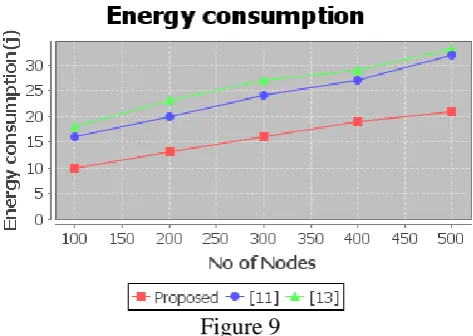
5. Average Energy Consumption
Average Error for faulty nodes is measured as the sum of error between observed and predicted data for each faulty node divided by total number of
faulty nodes.
Fault Detection Accuracy is measured in terms ratio of no of faults detected to the total number of faulty nodes at that period of time. Fault Detection Latency is measured in terms of average difference of time between fault occurrence time and the fault detected time. Network overhead is measured in terms of number of packets exchanged in the network. Energy consumption is measured in terms of total of energy consumed at each node divided by number of nodes.
The proposed solution was compared with solution [11] and [13].
The number of nodes was increased from 100 to 500 and average error for faulty node was measured. The result is below in Figure 7
Figure7
The network overhead is measured by varying the nodes from 100 to 500 and the result is below in Figure 8.
Figure 8
From the results, it can be seen that the network overhead is less in the proposed approach.
We measured the average energy consumption by varying the nodes from 100 to 500 and the result is below in Figure 9.
Figure 9
From the result , the energy consumption is less in the proposed solution thereby increases the life time of the sensor network.
VI. CONCLUSION
We have surveyed the current solutions for fault tolerance in this work and proposed a efficient adaptive sampling based fault tolerance to provide
short term fault tolerance in wireless sensor network. We have measured the accuracy of data capture in presence of faults and proved that our solution has better accuracy..
REFERENCES
[1] Bijun Li, Ki-Il Kim. An (m, k)-FirmReal-Time Aware Fault-Tolerant Mechanism in Wireless Sensor Networks, International Journal of Distributed Sensor Networks (IJDSN), volume 2012, pages 1-12, 2012.
[2] Arunanshu Mahapatroa, Pabitra Mohan Khilar. Transient Fault Tolerant Wireless Sensor Networks, Procedia Technology, volume 4, pages 97-101, 2012
.
[3] J. Sony., W. Bailing, P. Xiyar, Li Jianfeng and Zhong cheng, ―A Recovery Based on Minimum Distance redundant Nodes Fault Management in WSNs,‖ International Journal of control and automation, vol 6,No.2 April 2013
[4] Ameer A. Abbasi, Mohamed F. Younis and Uthman A. Baroudi, “Recovering From a Node Failure in Wireless Sensor-Actor Networks With Minimal Topology Changes,”IEEE Transactions on Vehicular Technology, vol.62, no. 1, pp. 256-271,2013.
[5] Song Jia, Wang Bailing and PengXiyuan,“ An Efficient Recovery Algorithm for Coverage Hole in WSNs,” in Proc. 2nd International Conference on
Advanced Signal Processing., ASTL Vol. 18, pp. 5-9, 2013
[6] Hong-Chi Shih, Jiun-Huei Ho, Bin-Yih Liao, and Jeng-Shyang Pan, “Fault Node Recovery Algorithm for aWireless Sensor Network,” IEEE Sensors Journal, vol. 13, no. 7, pp. 2683-2689,2013
Heterogeneous Wireless Sensor Networks, IEEE Transactions on Mobile Computing, vol.9, no.5, pp. 643–656, 2010
[8] Meikang Qiu, Zhong Ming , Jiayin Li , Jianning Liu , Gang Quan and Yongxin Zhu , “Informer homed routing fault tolerance mechanism for wireless sensor networks,” Journal of Systems Architecture, vol. 59, pp. 260-270, 2013.
[9 T. H. Liu, S. C. Yi, and X. W. Wang, “A Fault Management Protocol for Low-Energy and Efficient Wireless Sensor Networks,” Journal of Information Hiding and Multimedia Signal Processing, vol. 4, No. 1, pp. 34-45, 2013.
[10] D.D. Geetaa, N. Nalinib,Rajashekhar C. Biradar Fault tolerance in wireless sensor network using hand-off and dynamic power adjustment approach Journal of Network and Computer Applications Volume 36, Issue 4, July 2013
[11] Zeng Y, Xu L, Chen Z Fault-Tolerant Algorithms for Connectivity Restoration in Wireless Sensor Networks Sensors (Basel). 2015 Dec 22;16(1)
[12]
Pu J., Xiong Z., Lu X. Fault-tolerant
deployment with connectivity and partial
k-connectivity in sensor networks. Wirel.
Commun. Mob. Comput. 2009;9:909–919.
doi: 10.1002/wcm.638
[13] HwaMin Lee, Se Dong Min Multi-Agent System for Fault Tolerance in
Wireless Sensor Networks KSII TRANSACTIONS ON INTERNET AND INFORMATION
SYSTEMS VOL. 10, NO. 3, Mar. 2016.
[14] H.M. Ammari and S.K. Das, “Fault tolerance measures for large-scale wireless sensor networks,” Journal ACM Transactions on Autonomous and Adaptive Systems (TAAS), Vol. 4, No. 1, pp.1-28, 2009. Article (CrossRef Link).
[15] Indrajit Banerjee, Prasenjit Chanak, Biplab Kumar Sikdar and Hafizur Rahaman, "DFDNM: A
Di stributed Fault Detection and Node Management Scheme for Wireless Sensor Network," Commu nications in Computer and Information Science, Vol. 192, pp 68-81, 2011
Ganesh D R received his M.Tech and B.EDegrees in Computer Science and Engineering from
Visvesvaraya Technological University,Belaga viin 2013 and 2011 respectively. He is currently associated with Computer Science & Engineering Department as a faculty member of Cambridge Institute of Technology, Bangalore, Karnataka State, India. He is a Research Scholar in the Dept. of Computer Science& Engineering at Reva University, Bangalore, India. His current areas of research are Wireless Sensor Networks, Computer Networking.
Dr.
KiranKumariPatil, is Professor at School of Computing and Information
Technology and Director University Industry Interaction Center, REVA
UNIVERSITY, Bangalore. She has pursued her Doctorate (Ph. D.) degree in Computer Science & Engineering at Chennai. She posses Masters in Engineering from Darmstadt Technical University, Darmstadt, Germany. Her research interest includes Innovative Mobile Application
Development, mHealth Care and ICT for rural development. She has more than fifty research publications to her credit, published in various national and international Journals and
Application Monitor" at India Innovative Forum in Bangalore I. She is the member of various
International Professional Bodies and also served as Editorial Board Member for reputed journals, conferences.