Available online:
https://edupediapublications.org/journals/index.php/IJR/
P a g e | 644Color Image Indexing by Exploiting the Simplicity of the
EDBTC Method
Lingamguntla.Vijaya Sree (M.E.)
& K . Chaitanya,
Assistant Professor, Department of CSE, ANU College of Engineering & Technology, Acharya Nagarjuna University, Guntur, A.P., (522510), INDIA
[email protected] & [email protected]2
A
bstract
This paper presents a novel approach called Error Diffusion Block Truncation Coding (EDBTC) to extract the texture and features of an image. Here, two methods are introduced such as Color Histogram Feature (CHF) and Bit Pattern Histogram Feature (BHF), to measure the similarity between the query image and the target image in database as well as to extract the features of an image. The EDBTC produces two color quantizers and a bitmap image which are further processed using Vector Quantization (VQ) to generate the image feature descriptor. As documented in experimental result, the proposed indexing method outperforms the former BTC-based image indexing and the other existing image retrieval schemes with natural and textural datasets. Thus, the proposed EDBTC is not only examined with good capability for image compression, but it also offers an effective way to index images for the content-based image retrieval (CBIR) system.
Index Terms: Content-Based Image Retrieval, image indexing, Error Diffusion Block Truncation Coding, Vector Quantization.
1.
I
ntroduction
In the last decade, there has been a rapid growth of the Internet has enormously increased the number of image collections available. The accretion of these image collections (including art works, satellite and medical imagery) has attracted more and more users in various professional fields for example geography, medicine, architecture, advertising, design, fashion and publishing. Image retrieval system provides a set
of images from a collection of images in the database that matches the user’s needs in similarity evaluations such as image content similarity, edge, and color similarity. Early image retrieval methods found the desired images by matching keywords that are manually assigned to each image [2][3].
A typical CBIR system, involves two phase indexing and searching phase. In a CBIR system, the low-level image feature descriptor is extracted from an image which later can be employed to index the images in a database. In the searching phase, the image features are derived by the retrieval system from an image submitted by a user (as query image). These features are later utilized for similarity matching on the feature vectors stored in the database. The CBIR system offers an easy way for a user to search a digital image from a large database [1].
Available online:
https://edupediapublications.org/journals/index.php/IJR/
P a g e | 645database are then evaluated and retrieval is performed with the help of an indexing scheme [4].
The Content Based image retrieval is needed to retrieve images that are more appropriate, along with multiple features for better retrieval accuracy. Generally in a search process using any search engine, which is through text retrieval, which won’t be so accurate. So, we have to go for Content Based image retrieval. Content Based Image Retrieval is also known as query by image content (QBIC) and content-based visual information retrieval (CBVIR). Two important issues in Content-Based Image
Retrieval (CBIR) are similarity measurements and the representation of the visual features.
The motivation of this paper is to increase the speed of retrieval results of Content Based Information Retrieval (CBIR) systems by employing error diffusion block truncation coding (EDBTC) of database images followed by unsupervised clustering. Content Based Image Retrieval (CBIR) has become one of the most discussed research topics in recent years having significant role in art collections, medical diagnosis, military, architectural and engineering design, crime prevention etc.
Fig.1. Process of CBIR system
2. EXISTING TECHNIQUE FOR FEATURE EXTRACTION
Visual feature extraction is the basis of any content-based image retrieval technique. Widely used features include color, texture, shape and spatial relationships. Because of the subjectivity of perception and the complex composition of visual data, there does not exist a single best representation for any given visual feature. Multiple approaches have been introduced for each of these visual features and each of them characterizes the feature from a different perspective. Read more: Image Retrieval -
Existing Techniques, Content-Based (CBIR) Systems - Features, Visual, Data, and Color.
Color is one of the most widely used visual features in content-based image retrieval. It is relatively robust and simple to represent. Various studies of color perception and color spaces have been proposed, in order to find color-based techniques that are more closely aligned with the ways that humans perceive color. The color histogram has been the most commonly used representation technique, statistically describing combined probabilistic properties of the various color channels (such as the (R)ed, (G)reen, and (B)lue channels), by capturing
Query Image
Feature Extraction
Image matching and
indexing
Retrieval Image
Relevance feedback
Image Database
Feature extraction
Available online:
https://edupediapublications.org/journals/index.php/IJR/
P a g e | 646the number of pixels having particular properties. For example, a color histogram might describe the number of pixels of each red channel value in the range [0, 255]. Figure 3 shows an image and three of its derived color histograms, where the particular channel values are shown along the x-axis, the numbers of pixels are shown along the y-axis, and the particular color channel used is indicated in each histogram. It is well known that histograms lose information related to the spatial distribution of colors and that two very different images can have very similar histograms.
Texture refers to the patterns in an image that present the properties of homogeneity that do not result from the presence of a single color or intensity value. It is a powerful discriminating feature, present almost everywhere in nature. However, it is almost impossible to describe texture in words, because it is virtually a statistical and structural
Property There are three major categories of texture-based techniques, namely, probabilistic/statistical, spectral, and structural approaches. Probabilistic methods treat texture patterns as samples of certain random fields and extract texture features from these properties. Spectral approaches involve the sub-band decomposition of images into different channels, and the analysis of spatial frequency content in each of these sub-bands in order to extract texture features. Structural techniques model texture features based on heuristic rules of spatial placements of primitive image elements that attempt to mimic human perception of textural patterns.
The well known Tamura features include coarseness, contrast, directionality, line-likeness, regularity, and roughness. Different researchers have selected different subsets of these heuristic descriptors. It is believed that the combination of contrast, coarseness, and directionality best represents the textural patterns of color images. Figure 4 illustrates various textures.
Shape representation is normally required to be invariant to translation, rotation, and scaling. In general, shape representations can be categorized as either based or region-based. A
boundary-based representation uses only the outer boundary characteristics of the entities, while a region-based representation uses the entire region. Shape features may also be local or global. A shape feature is local if it is derived from some proper subpart of an object, while it is global if it is derived from the entire object. A combination of the above features are extracted from each image and transformed into a point of a high-dimensional vector space. Using this representation, the many techniques developed by the information retrieval community can be used to advantage. As the dimensionality of the underlying space is still quite high, however, the many disadvantages caused by the curse of dimensionality also prevail.
3
E
DBTC
I
mage
I
ndexing
Available online:
https://edupediapublications.org/journals/index.php/IJR/
P a g e | 647Fig. 2. Schematic diagram of the proposed image retrieval framework.
First, the image is encoded using EDBTC to obtain the two representative quantizers (quantization levels) and the bitmap image. An image feature descriptor representing the image content is then constructed from the two quantizers and bitmap image.
A. Vector Quantization
Vector quantization (VQ) compresses an image in lossy mode based on block coding principle. It is a fixed-to-fixed length algorithm. The VQ finds a codebook by iteratively partitioning a given source vector with its known statistical properties to produce the code vectors with the smallest average distortion when a distortion measurement is a priori given. At the end of the training stage, the hard binarization is performed for all code vectors as the final result using the soft centroid principle. Given the color codebook 𝐶 = {𝑐1, 𝑐2, … , 𝑐𝑁𝑐}, the VQ indexes the
EDBTC minimum and maximum quantizers using the following formula:
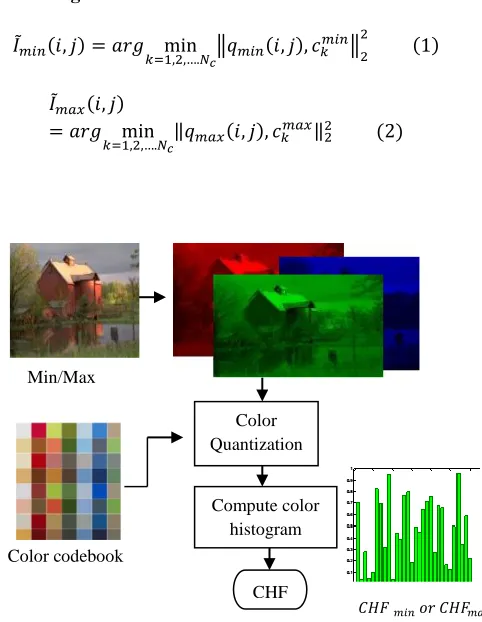
𝐼̃𝑚𝑖𝑛(𝑖, 𝑗) = 𝑎𝑟𝑔 min
𝑘=1,2,….𝑁𝑐‖𝑞𝑚𝑖𝑛(𝑖, 𝑗), 𝑐𝑘 𝑚𝑖𝑛‖
2 2
(1)
𝐼̃𝑚𝑎𝑥(𝑖, 𝑗)
= 𝑎𝑟𝑔 min
𝑘=1,2,….𝑁𝑐
‖𝑞𝑚𝑎𝑥(𝑖, 𝑗), 𝑐𝑘𝑚𝑎𝑥‖22 (2)
Fig.3. Illustration of CHF computation.
Min/Max Quantizer
𝐶𝐻𝐹 𝑚𝑖𝑛 𝑜𝑟 𝐶𝐻𝐹𝑚𝑎𝑥 Color
Quantization
Compute color histogram
CHF Color codebook
Image database
EDBTC compression
Color
quantization Compute color histogram CHF
BHF Compute bit
pattern histogram Bitmap image
quantization
Feature extraction
Query image EDBTC
compression
Feature extraction
Similarity
computation Retrieved image Offline part
Available online:
https://edupediapublications.org/journals/index.php/IJR/
P a g e | 648B. Color Histogram Feature (CHF)
The CHF is derived from the two EDBTC color quantizers, while BHF is computed from EDBTC bitmap image. In this study, the 𝐶𝐻𝐹𝑚𝑖𝑛 and 𝐶𝐻𝐹𝑚𝑎𝑥
are developed from the color minimum and maximum quantizer, respectively. The 𝐶𝐻𝐹𝑚𝑖𝑛 and
𝐶𝐻𝐹𝑚𝑎𝑥 capture color information from a given
image. These features represent the combination of pixel brightness and color distribution in an image. The 𝐶𝐻𝐹𝑚𝑖𝑛 and 𝐶𝐻𝐹𝑚𝑎𝑥 features can be computed
using the following equations:
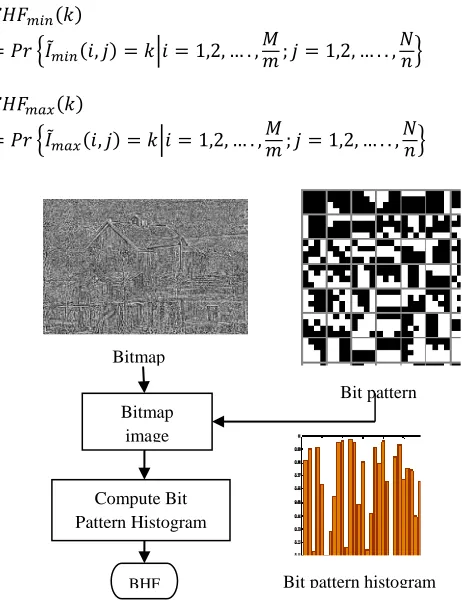
𝐶𝐻𝐹𝑚𝑖𝑛(𝑘)
= 𝑃𝑟 {𝐼̃𝑚𝑖𝑛(𝑖, 𝑗) = 𝑘|𝑖 = 1,2, … . ,𝑀𝑚; 𝑗 = 1,2, … . . ,𝑁𝑛} (3)
𝐶𝐻𝐹𝑚𝑎𝑥(𝑘)
= 𝑃𝑟 {𝐼̃𝑚𝑎𝑥(𝑖, 𝑗) = 𝑘|𝑖 = 1,2, … . ,𝑀𝑚; 𝑗 = 1,2, … . . ,𝑁𝑛} (4)
Fig. 4. Illustration of BHF computation.
In a nutshell, the 𝐶𝐻𝐹𝑚𝑖𝑛 and 𝐶𝐻𝐹𝑚𝑎𝑥 are the
VQ-indexed histogram from the color minimum and maximum quantizers, respectively. It only calculates the occurrence of certain color codewords appeared in an image. Figure 3 illustrates the CHF computation of the proposed EDBTC image retrieval system.
C. Bit Pattern Histogram Feature (BHF)
Another feature generated from a VQ-indexed EDBTC datastream is the BHF. This feature captures the visual pattern, edge, and textural information in an image. The BHF can be obtained by tabulating the occurrence of a specific bit pattern codebook in an image. The BHF can be generated using the following equation:
𝐵𝐻𝐹(𝑘)
= 𝑃𝑟 {𝑏̃(𝑖, 𝑗) = 𝑘|𝑖 = 1,2, … . ,𝑀𝑚; 𝑗 = 1,2, … . . ,𝑁𝑛} (5)
Figure 4 shows the flowchart of the BHF computation. The BHF can be viewed as the histogram of the indexed bit pattern of the EDBTC bitmap image. The color and bit pattern feature can be used individually or together based on the user’s preference.
D. Image Retrieval with EDBTC Feature
The similarity distance computation is needed to measure the similarity degree between two images. The distance plays the most important role in the CBIR system since the retrieval result is very sensitive with the chosen distance metric. The image matching between two images can be performed by calculating the distance between the query image given by a user against the target images in the database based on their corresponding features (CHF and BHF). After the similarity distance computation, the system returns a set of retrieved image ordered in ascending manner based on their similarity distance scores. The similarity distance between the two images, namely query and target images, can be formally defined as follows:
𝛿(𝑞𝑢𝑒𝑟𝑦, 𝑡𝑎𝑟𝑔𝑒𝑡)
= 𝛼1∑
|𝐶𝐻𝐹𝑚𝑖𝑛𝑞𝑢𝑒𝑟𝑦(𝑘) − 𝐶𝐻𝐹𝑚𝑖𝑛𝑡𝑎𝑟𝑔𝑒𝑡(𝑘)| 𝐶𝐻𝐹𝑚𝑖𝑛𝑞𝑢𝑒𝑟𝑦(𝑘) + 𝐶𝐻𝐹𝑚𝑖𝑛𝑡𝑎𝑟𝑔𝑒𝑡(𝑘) + 𝜀
𝑁𝑐
𝑘=1
+ 𝛼2∑
|𝐶𝐻𝐹𝑚𝑎𝑥
𝑞𝑢𝑒𝑟𝑦(𝑘) − 𝐶𝐻𝐹 𝑚𝑎𝑥
𝑡𝑎𝑟𝑔𝑒𝑡(𝑘)|
𝐶𝐻𝐹𝑚𝑎𝑥𝑞𝑢𝑒𝑟𝑦(𝑘) + 𝐶𝐻𝐹𝑚𝑎𝑥𝑡𝑎𝑟𝑔𝑒𝑡(𝑘) + 𝜀
𝑁𝑐
𝑘=1
+ 𝛼3∑
|𝐵𝐻𝐹𝑞𝑢𝑒𝑟𝑦(𝑘) − 𝐵𝐻𝐹𝑡𝑎𝑟𝑔𝑒𝑡(𝑘)|
𝐵𝐻𝐹𝑞𝑢𝑒𝑟𝑦(𝑘) + 𝐵𝐻𝐹𝑡𝑎𝑟𝑔𝑒𝑡(𝑘) + 𝜀 𝑁𝑐
𝑘=1
(6)
Bitmap image
Bitmap image Quantization
Compute Bit Pattern Histogram
BHF
Bit pattern codebook
Available online:
https://edupediapublications.org/journals/index.php/IJR/
P a g e | 649where 𝛼1, 𝛼2, and 𝛼3 are the similarity weighting
constants representing the percentage contribution of the CHF and BHF in the proposed image retrieval process. The value 1 means that the color or bit pattern feature is catered in the similarity distance, while the value 0 meaning that the color or bit pattern feature is disabled in the distance computation. A small number ε is added into denominator to avoid the mathematic division error. The 𝐶𝐻𝐹𝑞𝑢𝑒𝑟𝑦 and
𝐵𝐻𝐹𝑞𝑢𝑒𝑟𝑦 denote the color and bit pattern feature
descriptors of the query image, respectively, while the symbols 𝐶𝐻𝐹𝑡𝑎𝑟𝑔𝑒𝑡 and 𝐵𝐻𝐹𝑡𝑎𝑟𝑔𝑒𝑡 represent the
image descriptors of the target image in database.
E. Performance Measurement
The successfulness of the proposed EDBTC retrieval system is measured with the precision, recall, and Average Retrieval Rate (ARR) value. These values indicate the percentage of relevant image returned by a CBIR system with a specific number of retrieved images L. The precision (P(q)) and recall (R(q)) values are defined as:
𝑃(𝑞) =𝑛𝑞
𝐿 (7)
𝑅(𝑞) =𝑛𝑞 𝑁𝑞
(8)
where 𝑛𝑞 and 𝑁𝑞 denote the number of relevant
images against a query image q, and the number of all relevant images against a query image q in database. A higher value in precision and recall exhibits the better retrieved result.
The other metric employed to measure the retrieval performance is the ARR value which can be formally defined as:
𝐴𝑅𝑅 = 1
|𝐷𝐵|∑ 𝑅(𝐼𝑖, 𝑛)]𝑛≥16
|𝐷𝐵|
𝑖=1
,
𝑅(𝐼𝑖, 𝑛) =
𝑛𝑞
𝑁𝑞
,
where the |DB| denotes the total number of images in the database. Similar to the precision and recall rates, a greater ARR value indicates that the image retrieval
system performs well/better in retrieving a set of similar images. Normally, a set of returned image is more preferable to a user.
4.
S
imulation
R
esults
Fig.5. original image
Fig.6. grayscale image
original Image
Available online:
https://edupediapublications.org/journals/index.php/IJR/
P a g e | 650Fig.7. Bit Map Image
Fig.8. Compressed image
Fig.9. Maximum Color Quantizer
Fig.10. Minimum Color Quantizer
Fig.11. Restored image
Fig.12. histogram of max and min quantizer
Bit Map Image
compressed image
Maximum Color Quantizer
Minimum Color Quantizer
Restored Image
0 100 200 300
0 200 400 600 800 1000 1200 1400
Histogram of Maximum quantizer
0 100 200 300
0 200 400 600 800 1000 1200 1400
Available online:
https://edupediapublications.org/journals/index.php/IJR/
P a g e | 651Method Average Precision
recall
SVM 0.72 0.53
Neural network 0.73 0.45
Proposed method
0.75 0.21
Table1. Comparision of average precision value of proposed and existing methods.
5.
C
onclusion
A new method is proposed in this study for color image indexing by exploiting the simplicity of the EDBTC method. A feature descriptor obtained from a color image is constructed from the EDBTC encoded data (two representative quantizers and its bitmap image) by incorporating the VQ. The CHF effectively represents the color distribution within an image, while the BHF characterizes the image edge and texture. The experimental results demonstrate that the proposed method is not only superior to the former BTC-based image indexing schemes, but also the former existing methods in the literature related to the content based image retrieval. To achieve higher retrieval accuracy, another feature can be added into the EDBTC indexing scheme with the other color spaces such as YCbCr,
Hue-Saturation-Intensity, lab, etc. An extension of the EDBTC image retrieval system can be brought to index video by considering the video as a sequence of images. This strategy shall consider the temporal information of the video sequence to meet the user requirement in the CBIR context.
R
eferences
[1] H.M David, “Three Different Shades of Ethical Hacking: Black, White and Gray,” in GSEC Practical Assignment, Version 1.4b, Option 1, Feb 23, 2004. [2] Jing-Ming Guo, and Heri Prasetyo, Content-based Image Retrieval Using Error Diffusion Block Truncation Coding Feature, IEEE Trans. Image Processing, Vol. 25, No. 4, May 2015.
[3] Felci Rajam, S Valli, A Survey on content based image retrieval,Life Science Journal, 2013
[4] Sung-Hyuk Cha, Comprehensive Survey on Distance/Similarity Measures between Probability Density Function, International journal of mathematical models and method in applied science, Vol. 1, No. 4, Jun. 2007.
[5] E. J. Delp and O. R. Mitchell, “Image coding using block truncation coding,” IEEE Trans. Commun., vol. 27, pp. 1335–1342, Sept. 1979. [6] Y. G. Wu, and S. C. Tai, “An efficient BTC image compression technique,” IEEE Trans. Consum. Electron., vol. 44, no. 2, pp. 317-325, 1998. [7] J. M. Guo, and Y. F. Liu, “Joint compression/watermarking scheme using majority-parity guidance and halftoning-based block truncation coding,” IEEE Trans. Image Process., vol. 19, no. 8, pp. 2056-2069, Aug. 2010.
[8] J. M. Guo, “Improved block truncation coding using modified error diffusion,” Electron. Lett., vol. 44, no. 7, Mar. 2008.
[9] Y. F. Liu, J. M. Guo, and J. D. Lee, “Inverse halftoning based on the Bayesian theorem,” IEEE Trans. Image Process., vol. 20, no. 4, pp. 1077-1084, Apr. 2011.
[10] J. M. Guo, and Y. F. Liu, “High capacity data hiding for error-diffused block truncation coding,” IEEE Trans. Image Process., vol. 21, no. 12, pp. 4808-4818, Dec. 2012.
Lingamguntla. Vijaya Sree
Available online: