436 | P a g e
A FRAMEWORK FOR AUTHENTICATING OF
NUMEROUS DATA COPIES OVER MISTRUSTFUL
CLOUD SERVER
P. Anil Kumar
1, D Murli Krishna Reddy
2 1Pursuing M.Tech (CSE), 2Working as Assistant Professor (CSE),
Nalanda Institute Of Engineering & Technology (NIET), Kantepudi(V),
Sattenpalli(M),Guntur(D, Andhra Pradesh (India)
ABSTRACT
For purpose of increasing level of scalability, durability and availability, severalclients may need their data to
bereplicated on several cloud servers. The multiple copies the cloud service provider(CSP) is needed to store,
the much payments the clients are charged. Here we propose a pairing-based provablemulti – copy data
possession (PB-PMDP) scheme, which offers here there are four things we have toconsider one is Data
Owner, Third party Authorization (TPA), cloud service provider(CSP) and Authorized person. Data owner will
simple upload the file it means it simply shared to TPA, then TPA will receive the file and will upload into
multiple cloud services providers (CSP) here there multiple cloud server are there for storing the data on it, if
any unauthorized user change the original content uploaded by the data owner in cloud database that message
is transferred to data owner, then immediately data owner will need to react about the modification of data,
here we are proposing the three mechanisms i.e., security of data ,data integrity means providing the
confidentiality of data if any modifications or changes are happened in the cloudand will know about the
capacity data storage.Authorized person will have the permissions like view the files which are uploaded by the
user, download the files, and update the files etc..,
I. INTRODUCTION
Subcontracting data to a centralized cloud service provider (CSP)permits organizations to store large data on the
CSP than onpersonal systems. Such outsourcing also permitsvalid users to remotely accessing the data from
variousgeographic locations.
Once the data has been outsourced to a remote CSP,which may not be trustworthy, the data owners lose
thedirect control over their sensitive data. This lack of controlraises new formidable and challenging tasks
related to dataconfidentiality and integrity protection in cloud computingsystems. The confidentiality issue can
be handled by encryptingsensitive data before outsourcing to remote servers.As for data integrity, the data
owners need to have strongevidence that the cloud servers still possess their data andit is not being tampered
with or partially deleted over time,especially because the internal operation details of the CSPmay not be known
to cloud customers. Consequently, manyresearchers have focused on the problem of provable datapossession
437 | P a g e
PDP is a system for accepting information trustworthiness over remote servers. In a run of the mill PDP model,the information proprietor produces some metadata/data for an information record to be utilized later for check
purposes through a test reaction convention with the remote/cloud server. Analysts have proposed diverse
varieties of PDP plans under distinctive cryptographic suspicions; e.g., see [1]–[7].
PDP plans exhibited in [1]–[7] concentrate on a solitary duplicate of the document and give no evidence that the
CSP stores different duplicates of the proprietor's record. More subtle elements and a near investigation of
different PDP plans can be found in our specialized report [8].Curtmola et al. [9] were the first to present a
various imitation PDP (MR-PDP) plan that makes numerous duplicates of a proprietor's document and review
them. The MR-PDP plan expands information accessibility; a ruined information duplicate can be recreated
utilizing copied duplicates on different servers. The collaboration between approved (clients who have the
privilege to get to the proprietor's document) and the CSP was not considered in [9]. The MR-PDP plan bolsters
private unquestionable status, i.e., just the information proprietor can check information ownership. Open
unquestionable status is a key element in remote information checking plans to maintain a strategic distance
from debate that may happen between the information proprietor and the CSP. Assigning the reviewing
procedure (without uncovering mystery keys) to a trusted outsider for checking the information uprightness can
comprehend such quest
Main contributions.Here our contributions can be classified as follows:
Here we are proposing a new approach called pairing –based provable multi-copy data
possession(PB-PMDP) scheme.in this scheme provides as an passable guarantee that the cloud service provider stores all
copies that are accepted upon in the service agreement. And these copies are complete. The valid user can
faultlessly access the duplicates received from the CSP. The PB-PMDP structure supports
communityverifiability.
We legitimize the effectiveness of the proposed PB-PMDP plan through execution examination,
exploratory results, and correlation with the MR-PDP model [9]. Also, we talk about a slight alteration of
the proposed PB-PMDP plan to distinguish defiled duplicates.
We demonstrate the security of our plan against conniving servers.
II. OUR SYSTEM AND ASSUMPTIONS
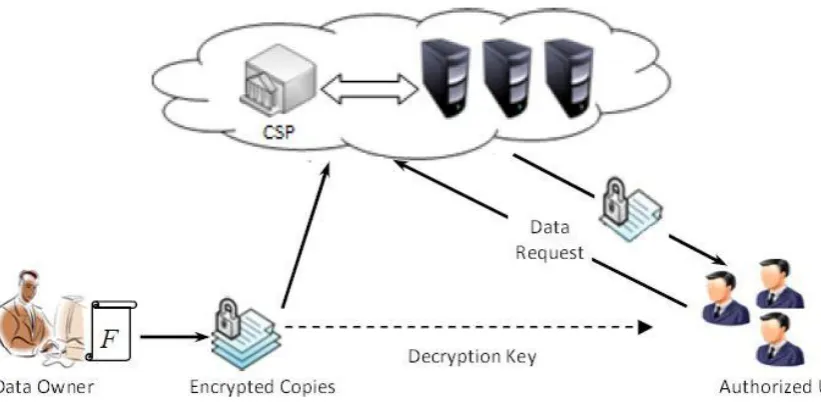
Framework segments. The distributed computing stockpiling model considered in this work comprises of three
fundamental parts as outlined in Figure 1: (i) an information proprietor that can be an individual or an
association initially having delicate information to be put away in the cloud; (ii) a CSP who oversees cloud
servers and gives paid storage room on its framework to store the proprietor's records; and (iii) approved clients
438 | P a g e
Figure 1: Cloud Computing Data Storage System Model.
The capacity model utilized as a part of this work can be received by numerous handy applications. For
instance, in e-wellbeing applications, a trusted government association can be considered as the information
proprietor, and the doctors as the approved clients who have the privilege to get to the patients' restorative
history put away on cloud servers. In this work, we concentrate on touchy chronicled and warehoused
information, which is vital in numerous applications, for example, advanced libraries and
galactic/restorative/experimental/lawful vaults. Such information is liable to occasional change, so we regard
them as static.
Outsourcing and accessing. The information proprietor has a document F comprising of m pieces and the CSP
offers to store n duplicates f e Fig1_i_n of the proprietor's record in return for pre-determined charges metered
in GB/month.
For information secrecy, the proprietor scrambles his information before outsourcing to the CSP. An approved
client of the outsourced information sends an information access solicitation to the CSP and gets a document
duplicate in a scrambled structure that can be decoded utilizing a mystery key imparted to the proprietor. The
approved client is unconscious of which duplicate has been gotten.
Threat model. The uprightness of clients' information in the cloud may be at danger because of the
accompanying reasons. To begin with, the CSP – whose objective is prone to make a benefit and keep up a
notoriety – has a motivating force to conceal information misfortune (brought about by episodes like equipment
disappointment, administration blunders, noxious assaults) or recover discarding so as to stockpile information
that has not been or is seldom gotten to. Second, a deceptive CSP may store less duplicates than what has been
439 | P a g e
III. PROPOSED PB-PMDP SCHEME
A. Overview and Rationale
Generating unique differentiable copies of the data file isthe core to design a multi-copy provable data
possessionscheme. Identical data copies enable the CSP to simplydeceive the owner by storing only one copy
and pretendingthat it stores multiple copies. Using a simple yet efficientway, the proposed scheme generates
distinct copies utilizingthe diffusion property of any secure encryption scheme.There will be an unpredictable
complete change in theciphertext, if there is a single bit change in the plaintext.The interaction between the
authorized users and the CSP isconsidered through this methodology of generating distinctcopies, where the
former can decrypt and access a file copyreceived from the CSP without recognizing the copy
index.Homomorphic linear authenticators (HLAs) [10], [14],[16] are basic building blocks in the proposed
scheme. Weutilize the BLS HLAs [10].
Table I: Notation of cryptographic operations
IV. PERFORMANCE ANALYSIS AND EXPERIMENTA RESULTS
The record F utilized as a part of our execution examination and exploratory results is of size 64MB partitioned
in squares of 4KB. Without loss of sweeping statement, we accept that the coveted security level is 80-bit.
Along these lines, we use an elliptic bend characterized over Galois field GF (p) with |p| = 160 bits (a point on
this bend can be spoke to by 161 bits utilizing packed representation [18]), and the measure of the RSA modulus
N is 1024 bits.
4.1. Performance Analysis
The computation cost for the MR-PDP and PB-PMDPschemes is estimated in terms of the used
cryptographicoperations, which are notated in Table I. G indicates a groupof points over a suitable elliptic curve
in the bilinear pairing,and QRN is the set of quadratic residues modulo N.
To perform a reasonable examination between our plan and the MR-PDP plan [9], we expect two little
adjustments to the first MR-PDP model exhibited in [9]. To start with, we accept that the squares' files being
tested are the same over all duplicates (this supposition is a streamlining for the confirmation calculations of
[9]). Second, for the CSP to demonstrate the pieces' ownership (not simply just their whole), every square being
tested ought to be increased by an arbitrary worth.
Let n, m, and s mean the quantity of duplicates, the quantity of pieces per duplicate, and the quantity of areas per
440 | P a g e
duplicate. Let the keys utilized with _ and be of size 128 bits. Table II displays a hypothetical examination forthe setup, stockpiling, correspondence, and calculation expenses of the two plans.
Table II: Storage, correspondence, and calculation costs for MR-PDP and PB-PMDP plans. The images utilized
as a part of the correlation is characterized in Table I. y There are an improvement for this reaction to be 1024 +
160n bits utilizing hashing.
V. CONCLUSION
Here We have proposed a BP-PMDP scheme. The communication between the valid users and the CSP is
careful in our system. Furthermore, the proposed system supports public verifiability, and permits limitless
number of checking. Safety examination is given in [8]. Through performance examination, experimental
outcomes, and contrast with the MR-PDP model, we have defensible the competence of the future scheme. The
confirmation time of PB-PMDP is almost independent of the more number of file reproductions. In this
proposed scheme is to identify the corrupted copies,and provide the data integrity.
REFERENCES
[1] G. Ateniese, R. Burns, R. Curtmola, J. Herring, L. Kissner,Z. Peterson, and D. Song, ―Provable data
possession at untrusted stores,‖ in CCS ’07, 2007, pp. 598–609.
[2] K. Zeng, ―Publicly verifiable remote data integrity,‖ in Proceedings of the 10th Int. Conference on
Information and Communications Security, ser. ICICS ’08, 2008, pp. 419–434.
[3] Y. Deswarte, J.-J.Quisquater, and A. Sa¨ıdane, ―Remote integrity checking,‖ in 6th Working Conference
on Integrity and Internal Control in Information Systems (IICIS), 2003, pp. 1–11.
[4] D. L. G. Filho and P. S. L. M. Barreto, ―Demonstrating data possession and uncheatable data transfer,‖
Cryptology ePrint Archive, Report 2006/150, 2006.
[5] F. Seb´e, J. Domingo-Ferrer, A. Martinez-Balleste,Y. Deswarte, and J.-J. Quisquater, ―Efficient remote
data possession checking in critical information infrastructures,‖ IEEE Trans. on Knowl. and Data Eng.,
vol. 20, no. 8, 2008.
[6] M. A. Shah, R. Swaminathan, and M. Baker, ―Privacypreserving audit and extraction of digital contents,‖
Cryptology ePrint Archive, Report 2008/186, 2008.
[7] E. Mykletun, M. Narasimha, and G. Tsudik, ―Authentication and integrity in outsourced databases,‖
441 | P a g e
[8] A. F. Barsoum and M. A. Hasan, ―Provable possession and replication of data over cloud servers,‖ CentreFor Applied Cryptographic Research (CACR), University of Waterloo, Report 2010/32, 2010.
[9] R. Curtmola, O. Khan, R. Burns, and G. Ateniese, ―MRPDP:multiple-replica provable data possession,‖
in 28th IEEE ICDCS, 2008, pp. 411–420.
[10] H. Shacham and B. Waters, ―Compact proofs of retrievability,‖ Cryptology ePrint Archive, Report
2008/073, 2008.
[11] A. Juels and B. S. Kaliski, ―PORs: Proofs of Retrievability for large files,‖ in CCS’07, 2007, pp. 584–
597.
[12] R. Curtmola, O. Khan, and R. Burns, ―Robust remote data checking,‖ in StorageSS ’08, 2008, pp. 63–68.
[13] K. D. Bowers, A. Juels, and A. Oprea, ―Proofs of retrievability: theory and implementation,‖ in CCSW
’09, 2009, pp. 43–54.
[14] Y. Dodis, S. Vadhan, and D. Wichs, ―Proofs of retrievability via hardness amplification,‖ in TCC ’09,
2009, pp. 109–127.
[15] K. D. Bowers, A. Juels, and A. Oprea, ―Hail: a highavailability and integrity layer for cloud storage,‖ in
CCS ’09, 2009, pp. 187–198.
[16] G. Ateniese, S. Kamara, and J. Katz, ―Proofs of storage from homomorphic identification protocols,‖ in
ASIACRYPT ’09, 2009, pp. 319–333.
AUTHOR DETAILS
P. Anil Kumar pursuingM.Tech (CSE) from Nalanda Institute Of Engineering
&Technology (NIET), Kantepudi(V), Sattenpalli(M), Guntur(D)-522438, Andhra
Pradesh.
D Murli Krishna Reddyworking asAssistant Professor (CSE) from Nalanda
Institute Of Engineering &Technology (NIET), Kantepudi(V), Sattenpalli(M),