740 | P a g e
ENERGY EFFICIENT DATA UPLOADING USING
PREDICTIVE ALGORITHM
Hemalatha.K
1, Rahimunnisa.K
2, Madhavi.A.T
31-Postgraduate Student, Department of Electronic and Communication,
Easwari Engineering College, Chennai
2-Professor and Head, Department of Electronic and Communication,
Easwari Engineering College, Chennai
3-Assistant Professor, Departmentof Electronic and Communication,
Easwari Engineering College, Chennai
ABSTRACT
Mobile crowd sensing produces large scale sensing of data in the physical world more economically by investing the most updated sensors on mobiles.The greatest success in mobile crowd sensing is achieved by uploading the sensing data to the cloud server continuouslycomparing to mobile crowd sensing the traditional uploading of data requires more data,more of cost,impact on performance of the mobiles and battery storage.In this paper we propose an uploading of large data framework in energy-efficient way using wirelesssensor networks(WSN). Specifically,the data uploading at the sensors in the wireless sensor network is proposed. If there is some data to send to the cloud server then the sensor senses the data automatically and upload the data to the cloud server and if there is no data to upload the sensors will turnback to OFF condition so there will be less energy consumption using predictive based algorithm.In this work the novel infrastructure is proposed by integrating wireless sensor network and cloud computing.
Keywords: Cloud Management, Data Managementenergy Consumption, Mobile Crowd Sensing.
I INTRODUCTION
Cloud computing permits companies to improve the capacity of the network rapidly without the need for new
infrastructure investment and similarly the capacity can be quickly and efficiently decreased. “Recent IBM
report of 2010 states thatcloud is a new consumption and delivery model for many IT-based services, in which
the user doesn’t need to know anything about the technology they see only the service”. Demandnetwork access
to a shared pool of configurable computing resource which enable the resource as most convenient resource is
the model of cloud computingwith pools of information,storage resource, computing power and network the
cloud offers the use of collection of service, infrastructure, information and application was researched by “US
National institute of standards and technology”.“Components that can be provisioned, decommissioned, scaled up or down providing for a power consumption and on demand utility-like model of allocation and consumption
741 | P a g e
distributed to monitor physical conditions such as temperature,sound and pressure and to cooperatively passtheir data through the network to other location. The modern networks are bi-directional, which enables control
of sensor activity.The WSN is built using "nodes" from a hundredto thousands, where each node is connected to
one cluster head sensors. “Aradio transceiver, a microcontroller, an electronic circuit for interfacingwith the
sensors and an energy source, usually a battery or an embedded form of energyharvesting”.A sensor nodewill be
varying in its size from that of a shoebox size to grain of dust, although functioning "nodes" of genuine
microscopic dimensions have yet to be created. The topology of the WSNs can vary from a simple star
networkto an advanced multi-hop network. “The cost of sensor nodes is variable, ranging from hundredstoof
dollars to a few cents, which depends on the complexity of the individual sensor nodes”. constraints on
resources such as energy, memory, computational speed and communications bandwidth is due to the
constraints in size and cost.
II PROPOSED SYSTEM
In this section we propose a system to upload energy efficient data to the cloud using the wireless sensor
network. In this system we need to make each decision based on the present scenario in the network as soon as
sensor is encountered with data the data is uploaded using data uploader with high energy efficiency to cloud.
The IEEE802.11f is the wireless sensor network used here because it has maximum data rate, speed in the
system.
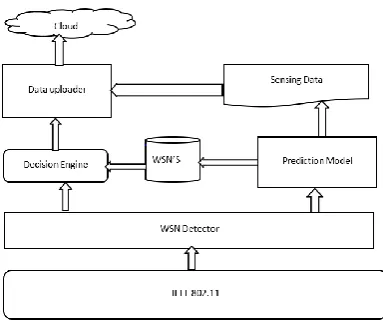
The hardware is more compatible and the manufacturing rate is low. As illustrated in figure 1 Internet Access
Point Protocol(IEEE802.11) which provide wireless access point among multivendor systems the output of this
signal is detected by the WSN detector. The prediction model predicts the present data and upcoming data
based on the present situation in the WSN Network in regular interval basis. Based on the encountered and
upcoming data from the WSN Sensors, the decision engine will make decision on how to exploit encountered
WSN’s and drive the data uploader to upload the sensing data using wireless sensors in the WSN network. The
key issue in the proposed system is that during the data uploading cycle, we do not know all WSN sensors in
advance to make global optimal decision. Instead, we need to make decision based on the comparison of history
on data uploading inthe past and the present situation at which WSN sensors is encountered
The prediction algorithm is used in this work because the greedy based algorithm as the disadvantage of harder
to understand the algorithm. Even with the correct algorithm, it is hard to prove why it is correct. Greedy based
algorithm needs lots of creativity but in case of predictive based decision algorithm decision trees require
relatively less effort from users for data preparation, Non-linear relationship between parameters donot affect
tree performance, best feature of using trees for analytics is easy to interpret and explain to executives and also
decision trees implicitly perform variable screening or feature selection so we are using predictive algorithm for
data uploading to cloud.
we present a suitable decision-making scheme, i.e. the prediction-based scheme, as explained in the following
742 | P a g e
Figure 1: Block Diagram
2.1. PREDICTION BASED SCHEME
In order to make optimal decision,we propose prediction-based scheme. The idea is that although the future
WSN data are unknown they can be predicted based on the historical data. Even though it is still difficult to
analyse the start time, energy consumption and duration of every future WSN(Sensor) data due to dynamic
nature of mobile usage. Instead we group all the WSN Sensors to certain levels and then predict the expected
duration of each WSN sensor signal(data)level during the data uploading cycle.
2.2 THROUGHPUT
The maximum rate at which something can be processed or the maximum rate of production is called
Throughput. When used in the context of communication networks, such as sensor node packets, network
throughput is the rate of successful message delivery over a communication channel. The data in these
messages belong to delivered over a physical or logical link, or it can pass through a certain network node. The
equation below is used to calculate throughput of the network.
Throughput=(number of received bytes*8)/(time*10000
)
2.3.DELAY OF NETWORK
The delay of a network is said to be how long it takes for a bit of data to travel across the network from one
node or endpoint to another. Delay is measured in multiples or fractions of seconds. The equation below is used
743 | P a g e
III SIMULATION RESULTS
Inthis research,an energy efficiency data uploading to cloud using predictive based scheme and we use the
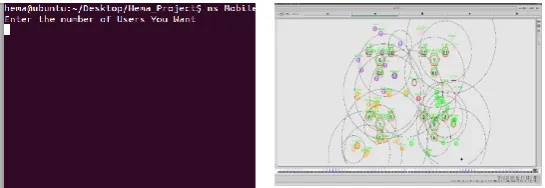
Wireless Sensor Network(WSN) and sensors for faster data transmission in the network. Figure 3.1shows the
number of users (minimum of 50 and above users) in the network. Figure 3.2 shows the data transmission in the
network. Figure 3.3(a)shows the information (data delivery ratio,throughput,delay, data loss) about the data
transmission in network. Figure 3.3(b)shows throughput in the network. Figure 3.4(a) shows delay and
Figure3.4(b)average delay of the network. This are the process to upload energy-efficient data to cloud using
Wireless Sensor Network.
Figure 3.1 Number of users in network Figure 3.2 Data transmission in network
Figure 3.3(a) information about data transmission. (b) Throughput of network
Figure 3.4(a) delay (b)average delay
IV CONCLUSIONS
Integration of Cloud Computing and Wireless Sensor Network will provide benefits to organisations and the
research development area. Organisations will benefit more by utilising Cloud storage and an optimised system
for processing, storage and retrieval of WSN generation data. The proposed system WSN Cloud Computing
will provide an optimal approach to user management, access control, storage and retrieval of distributed data
744 | P a g e
REFERENCES
[1]D. T. Wagner, A. Rice, and A. R. Beresford, “Device Analyzer: Large-scale mobile data collection,” in
Workshop on Big Data Analytics.
[3] N. D. Lane, Y. Chon, L. Zhou, Y. Zhang, F. Li, D. Kim, G. Ding, F. Zhao, and H. Cha, “Piggyback Crowd
Sensing (PCS): Energy Efficient Crowdsourcing of Mobile Sensor Data by Exploiting Smartphone App
Opportunities,” in Sensor System, pp. 7:1–7:14.
[9] R. Rahman, K. Barker, and R. Alhajj, “Replica placement strategies in data grid,” Journal of Grid
Computing, vol. 6, no. 1, pp. 103–123, 2008.
[10]J.Kangasharju,J.Roberts,andK.W.Ross,“Objectreplicationstrategies in content distribution networks,”
ComputerCommunication., vol. 25, no. 4, pp. 376–383, Mar. 2002.
[11] S. Abdelwahab, B. Hamdaoui, M. Guizani, and T. Znati, “Replisom: Disciplined tiny memory replication
for massive IoT devices in lte edge cloud,” Internet of Things Journal, IEEE, vol. PP, no. 99, pp. 1–1, 2015.
[12] Z. Al-Arnaout, Q. Fu, and M. Frean, “A divide-and-conquer approach for content replication in wans,”
Computer. Network., vol. 57, no. 18, pp. 3914–3928, Dec. 2013.
[13] F. u. A. A. Minhas and M. Arif, “Mox: A novel global optimization algorithm inspired from oviposition
site selection and egg hatching inhibition in mosquitoes,” Appl. Soft Computer., vol. 11, no. 8, pp. 4614– 4625,
Dec. 2011.
[14] R. N. Calheiros, R. Ranjan, A. Beloglazov, C. A. F. De Rose, and R. Buyya, “Cloudsim: A toolkit for
modelling and simulation of cloud computing environments and evaluation of resource provisioning
algorithms,” Software. Practical. Experiment., vol. 41, no. 1, pp. 23–50, Jan. 2011.
[15] S. Zaman and D. Grosu, “A distributed algorithm for the replica placement problem,” Parallel and
Distributed Systems, IEEE Transactions on, vol. 22, no. 9, pp. 1455–1468, Sept 2011.
[16] J. Cihlar and J. Howarth, “Detection and removal of cloud contamination from AVHRR images,” IEEE
Trans Geosci Remote Sens, vol. 32, no. 3, pp. 583-589, May 1994.
[17] P. Li, L. Dong, H. Xiao, M. Xu., “A cloud image detection method based on SVM vector machine.”
Neurocomputing, vol. 169, pp. 34-42, 2015.
[18] Q. Zhang and C. Xiao, “Cloud Detection of RGB Color Aerial Photographs by Progressive Refinement
Scheme,” IEEE Trans Geosci Remote Sens, vol. 52, no. 11, pp. 7264-7275, Nov. 2014.
[19] Z. An, Z. Shi, “Scene Learning for Cloud Detection on Remote-Sensing Images,” IEEE J. Sel. Top. Appl.