Scholarship@Western
Scholarship@Western
Electronic Thesis and Dissertation Repository
8-10-2018 2:00 PM
A Practical and Practice-Sensitive Account of Science as
A Practical and Practice-Sensitive Account of Science as
Problem-Solving
Problem-Solving
Frédéric-Ismaël Banville The University of Western Ontario
Supervisor
Sullivan, Jacqueline A.
The University of Western Ontario Graduate Program in Philosophy
A thesis submitted in partial fulfillment of the requirements for the degree in Doctor of Philosophy
© Frédéric-Ismaël Banville 2018
Follow this and additional works at: https://ir.lib.uwo.ca/etd
Part of the Philosophy of Science Commons
Recommended Citation Recommended Citation
Banville, Frédéric-Ismaël, "A Practical and Practice-Sensitive Account of Science as Problem-Solving" (2018). Electronic Thesis and Dissertation Repository. 5676.
https://ir.lib.uwo.ca/etd/5676
This Dissertation/Thesis is brought to you for free and open access by Scholarship@Western. It has been accepted for inclusion in Electronic Thesis and Dissertation Repository by an authorized administrator of
i
Philosophers of science have recently begun to pay more attention to scientific practice, moving away from the discipline’s focus on theories. The creation of the Society for Philosophy of Science in Practice in 2006, as well as the emergence of scholarship on
experimental practice (e.g. Sullivan 2009; 2010; 2016) as well as on the tools scientists use to construct explanations and theories (e.g. Feest 2011) all point to a disciplinary shift towards a more practice-conscious philosophy of science. In addition, scholars are realizing the
potential social relevance of philosophy of science and identifying the obstacles that stand in the way of realizing said potential (e.g. Douglas 2010). The aim of this dissertation is to propose a novel descriptive framework for philosophy of science, one that rests on the idea that scientific practice should be described as accurately as possible so that philosophical discussions of science rest on a solid descriptive base and can more easily be of use in engaging users and practitioners of science. The dissertation is organized along the stages of developing what I call the dynamic-iterative model of scientific practice. In chapter 1, I clarify the project’s philosophical background and outline six conditions of adequacy on a descriptive model of science. These conditions allow me to evaluate the three descriptive models reviewed in chapter 2. Chapter 3 combines Nickles’ problem-solving view of science (1981) with core insights from the heuristics and biases literature into a workable version of the dynamic-iterative model. I then apply the model to the case of place cell research in chapter 4 as a test of the model’s usefulness and applicability. In chapter 5 I evaluate the model with respect to my six conditions and assess its strengths and weaknesses. The dynamic-iterative model is a flexible descriptive framework that not only allows for more complete philosophical analyses of cases than other current models, but also supports important practical applications.
Keywords
Philosophy of Science, Philosophy of Neuroscience, Scientific Practice, Problem-Solving,
ii
Co-Authorship Statement
Part of this dissertation discusses research conducted in collaboration with Jessey Wright.
Specifically, section 6.1.1 is based on conference presentations co-authored with Jessey
iii
Acknowledgments
This project is the result of a very complex and dynamic process which involved too many
people to count, let alone name. That said, I can identify a few without whom it simply could
not have happened.
I first want to thank my supervisor, Dr. Jacqueline Sullivan for her support, guidance and,
most importantly, her patience. My decision to join the philosophy department at the
University of Western Ontario was directly influenced by Jackie’s arrival, and it was through
my interactions with her that my project took on its current shape. I also wish to thank Jessey
Wright for providing me with feedback, advice and, crucially, for his role as a semi-willing
interlocutor during countless lunchtime brainstorming sessions. I am also grateful to Danny
Booth, Chris Shirreff, Dylan Gault, Guillaume Beaulac and Robert Foley for their support
and advice, academic or otherwise. I am indebted to the members of the Lab Associate
program, especially those who made it possible, including Jackie Sullivan, Robert Foley and
Christopher Viger, as well as to the Brain and Mind Institute community, and Dr. Melvyn
Goodale, who welcomed me in his lab.
I also wish to thank my thesis examination committee for their time and insight: Dr. Gillian
Barker, Dr. Melvyn Goodale, Dr. Tim Kenyon, and Dr. Wayne Myrvold.
I cannot express how thankful I am to my partner, Sarah Warren. Sarah, you have witnessed
every stage of this project, and I don’t think I could have seen it through without your
unending support and faith in me. I love you.
I also wish to thank my family. Their support was invaluable throughout this process.
Funding for parts of this research was provided by the Social Sciences and Humanities
iv
Table of Contents
Abstract ... i
Co-Authorship Statement... ii
Acknowledgments... iii
Table of Contents ... iv
List of Tables ... vii
List of Figures ... viii
Chapter 1 ... 1
1 Introduction: the turn to practice ... 1
1.1 Motivations: descriptive accuracy and engagement ... 1
1.2 Sources of insularity ... 5
1.3 Core tenets: four shifts ... 10
1.4 The need for a new descriptive framework ... 15
Chapter 2 ... 20
2 Problem-solving as a description of scientific practice... 20
2.1 Preliminary considerations... 21
2.2 Laudan... 28
2.2.1 Evaluation ... 32
2.3 Hattiangadi ... 38
2.4 The constraint-inclusion model: defining problems for practice ... 44
2.5 Conclusion ... 52
Chapter 3 ... 54
3 Heuristics, description and prescription ... 54
3.1 Why heuristics matter ... 55
v
3.2.1 Heuristics are fixed procedures ... 63
3.2.2 Heuristics are liable to fail ... 64
3.2.3 Heuristics facilitate problem-solving ... 65
3.2.4 Heuristics generate new problems ... 66
3.2.5 Heuristics offer no guarantee of success ... 67
3.3 Constraint-inclusion and heuristics: putting the pieces together ... 69
3.4 Conclusion ... 81
Chapter 4 ... 83
4 Applying the dynamic-iterative model... 83
4.1 Place cells and neural representation ... 84
4.1.1 Place Cells: The Conceptual Background... 84
4.1.2 Neural representations ... 96
4.2 Bechtel’s decomposition and localization analysis... 99
4.3 The dynamic-iterative analysis ... 104
4.3.1 Historical interlude... 104
4.3.2 Analysis... 107
4.4 Conclusion ... 113
Chapter 5 ... 115
5 Evaluating the model... 115
5.1 Dealing with objections ... 115
5.1.1 The model leaves out explanatory problems ... 116
5.1.2 The model cannot account for the motivational aspects of practice ... 117
5.1.3 The distinction between goals and problems is unclear ... 118
5.1.4 The model can only account for explanatory goals ... 120
5.1.5 The model imposes a rigid sequence on scientific practice ... 123
vi
5.3 Strengths and Weaknesses ... 130
5.4 Situating the model ... 133
5.5 Conclusion ... 140
Chapter 6 ... 141
6 Conclusion ... 141
6.1 A practical application ... 141
6.1.1 A novel teaching strategy... 145
6.2 Future work ... 149
Bibliography ... 154
vii
List of Tables
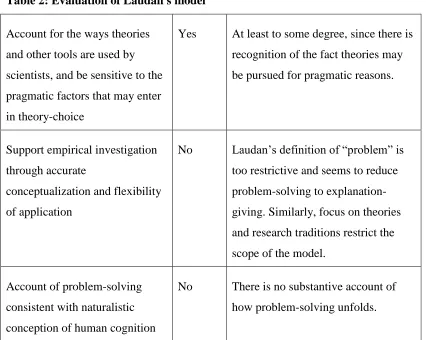
Table 1: Adequacy conditions on models of scientific practice ... 26
Table 2: Evaluation of Laudan's model ... 36
Table 3: Evaluation of Hattiangadi's model ... 43
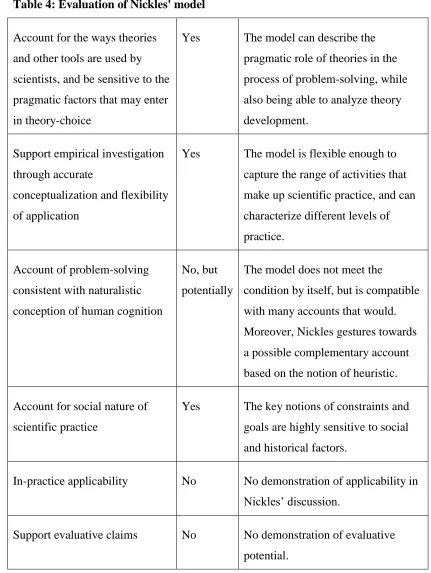
Table 4: Evaluation of Nickles' model ... 51
Table 5: Properties of heuristics ... 63
Table 6:Taxonomy of scientific problems ... 78
viii
List of Figures
Figure 1: Origins of intellectual debate (Giunti 1988, 424) ... 39
Figure 2: Debate from fig. 1 at a later stage (Giunti 1988, 424)... 40
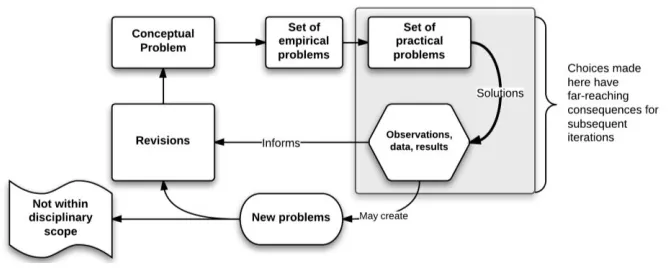
Figure 3: The dynamic-iterative model of scientific practice ... 80
Figure 4: Maze used in preliminary training in Tolman et al. 1946. The “H” represents the general direction of the goal box. (Image taken from O’Keefe and Nadel 1978, 70) ... 89
Figure 5: Sunburst maze used in Tolman et al. 1946. Most rats headed in the direction H, which is where the goal box was located during training. (Image taken from O’Keefe and Nadel 1978, 71) ... 90
Figure 6: T-alley maze (Elliott 1928, in Tolman 1948) ... 105
Figure 7: Simplified dynamic-iterative model ... 147
Figure 8: Simplified model filled in with details of example case ... 147
Chapter 1
1
Introduction: the turn to practice
Disciplinary shifts come in many forms and seldom occur in a coordinated manner.
Philosophy of science, concerned almost exclusively with the logical structure of theories
and their epistemic justification from the 1950’s onwards, is becoming more interested in
accounting for scientific practice. This shift in focus is reflected in the establishment of
the Society for Philosophy of Science in Practice in 2006, the emergence of scholarship
on experimental practice (Sullivan 2009; 2010), on the role of measuring devices for the
advancement of science (Chang 2004), and analyses focusing on the tools that support the
generation of explanations rather than the explanations themselves (see, e.g. Ankeny
2000 on descriptive models in biology, Feest 2011). While topics of interest have shifted,
descriptive models of science have not yet caught up. Philosophers interested in practice
have been developing novel analytical tools or borrowing them from the social sciences,
but there is no general descriptive model that can attend to these features of science that
are becoming more central to the discipline. The aim of this dissertation is thus to
propose a novel descriptive framework for philosophy of science, one that rests on the
idea that scientific practice should be described as accurately as possible so that
philosophical discussions of science rest on a solid descriptive base. To motivate this
project, I provide a clear statement of the intellectual tradition within which the model I
propose fits. This tradition is associated with what some scholars have called the
“Practice Turn” (Soler et al. 2014b; Woody 2014), which corresponds to the emergence
of greater interest in the study of scientific practice.
1.1
Motivations: descriptive accuracy and engagement
According to Soler at al., while the idea of a “Practice Turn” suggests a clearly
identifiable point of origin (either temporal or theoretical) as well as a certain coherence,
neither are occurring in the context of the Practice Turn (Soler et al. 2014b, 2). It is more
appropriate to speak of a set of “practice trends”, inspired by a shared set of
(viz. including the history, sociology and philosophy of science). Similarly, Woody
characterizes the Practice Turn as a set of interrelated approaches that share a family
resemblance through their rejection of abstraction either in relation to the
characterization of science or of scientists (Woody 2014, 123). Thus, the definition of
“Practice Turn” I develop here is primarily built on its negative aspects. By getting clear
on what these approaches have in common, I aim to tease out a list of methodological
requirements for a theory of science to qualify as “practice-oriented”, viz. qualify as a
theory which takes into account the important aspects of scientific practice while
avoiding the descriptive inaccuracy associated with highly abstract theories of science.
Interest in practice-oriented approaches in philosophy of science and neighboring
disciplines is evident from the emergence and increasing importance of the Society for
Philosophy of Science in Practice (hereafter SPSP) established in 2006. The SPSP’s
mission statement provides some insight into the aims and methodological commitments
characteristic of practice-oriented approaches. The mission statement begins with the
observation that philosophy of science as a discipline is characterized by a focus on the
relationship between scientific theories and the world, often ignoring or disregarding
scientific practice. On the other hand, sociological and historical studies of science and
technology overemphasize practice at the detriment of attention to the world, sometimes
going as far as willfully discounting it as a product of social construction. The issue here
is that each discipline is focusing on a relevant part of the scientific process while
ignoring another, equally important part of it. What the SPSP advocates is simply a
philosophy of scientific practice that takes all these aspects into account – theories,
practice, and how those relate to the world.
The SPSP defines “practice” as “organized or regulated activities aimed at the achievement of certain goals” (“SPSP” 2017). The epistemology of practice, then, is
tasked with elucidating the kinds of activities required to generate knowledge (at least, on
the reasonable assumption that science aims at generating knowledge). The SPSP also
believes that many traditional debates in philosophy of science may benefit from being
recast in terms of practice. The general approach they recommend is, first, a concern with
of understanding how pre-existing knowledge is applied to practical contexts, but also
how the intended use of this knowledge shapes its very development. Second, they
recommend increased attention to the way human artifacts such as conceptual models and
laboratory instruments mediate the relationships between theories and the world (a topic
van Fraassen’s constructive empiricism dealt with extensively, along with Latour and Woolgar’s ethnographical studies). Finally, the mission statement advocates for increased
interdisciplinary outreach.
The program put forward by the SPSP is a concerted effort to get at the source of the
discipline’s (perceived) lack of impact on scientific and social spheres. On this topic, Heather Douglas remarks that “[standard] philosophical positions have not proven adequate for the contexts [that involve science practitioners and users of science]”
(Douglas 2010, 318). The reason for this is the insular nature of philosophy of science.
This insularity is in part due to pressures to de-politicize the discipline in the tense
political climate of the 1950’s which was accompanied by a narrowing of the set of acceptable topics for the discipline’s flagship journal Philosophy of Science (Douglas
2010, 320-321). This process stands in stark contrast to the by-laws of the Philosophy of
Science Association (PSA), which initially stated that the association would be dedicated
to furthering a diverse research agenda and emphasized the importance of socially
relevant practical consequences (Douglas, 2010, 320), and is reflected in changes to the
journal’s content over the years (see Douglas 2010, 320 for a detailed list of the topics
and authors). An example of this disciplinary narrowing is the introductory chapter to
Feigl and Brodbeck’s anthology (1953) in which Brodbeck argues that questions related
to the social context and significance of science, the social role of scientists and any
related ethical issues are not part of philosophy of science proper. Philosophy of science,
on this view, is directed at epistemological questions about science: what explanation is,
low impact factor outside of its academic sphere is a result of the discipline being insular:
its concerns do not match those of practitioners and users of science1.
Scholarship on the Practice Turn suggests the movement was a direct reaction to
perceived inadequacies of established approaches in science studies writ large2, and that
its criticisms were targeted at the traditional approach’s lack of descriptive accuracy and
relevance for the day-to-day practice of science. I take descriptive accuracy to be a
necessary step towards my goal of bolstering the potential impact of philosophy of
science outside of its disciplinary boundaries. Although it likely is not sufficient,
descriptive accuracy will be a core concern as I develop my descriptive framework.
Given this uniformity in what is rejected, the fact the criticisms are made in the spirit of
making science studies more descriptively accurate, and the fact that this failure in
descriptive accuracy is coextensive with the difficulty of applying insights from
philosophy of science outside its disciplinary sphere, I take it as given that understanding
what is rejected in terms of research goals and methods for philosophy of science
amounts to identifying those disciplinary concerns that led to philosophy of science’s
insularity. Further, it amounts to identifying the aspects of traditional philosophy of
science that weakened the descriptive accuracy of its mainstream theories. The crucial
piece needed to understand the motivations behind the Practice Turn is thus a clear
statement of what it was a reaction to.
1Douglas’ proposed solution is coherent with the methodological recommendations associated with the
Practice Turn. Specifically, she argues that the best way out of the quandary posed by the discipline’s insularity is to adopt an “on-the-ground” methodology, which she admits is nothing new (without citing specific examples). It seems reasonable to assume she is thinking of ethnographic work in the vein of Latour and Woolgar’s Laboratory Life (1986). Where she innovates is that she encourages the actual engagement of philosophers in socially relevant contexts (e.g. policy circles). I believe it important to flag that my project stops short of providing a full account of the role of social values and social contexts for analyses of science, but as I demonstrate in later chapters, the model can easily accommodate these factors, at least in principle.
2 Soler et al. (2014) assert that the Practice Turn occurred both in philosophy of science and in history and
1.2
Sources of insularity
“Traditional” philosophy of science is understood as any account that takes theory choice
and confirmation (or justification) of theories along with the explication of the logic that
governs these processes to be the central concerns of philosophy of science, typical of the
early-to-mid 20th century. This overlooks the nuances of these views as well as a number
of divergent projects that were of interest at the time, but this picture, truncated as it is,
will suffice for the purposes of understanding the context in which the Practice Turn
occurred3. Note that both the research goals and the methods of traditional philosophy of
science contribute to this problem with descriptive accuracy, since research goals
partially determine which methods are used. I treat those in isolation but will draw
attention to key interactions when appropriate. I also want to make very clear that I do
not accept this picture of 20th century “mainstream” philosophy of science as historically
or conceptually accurate. However, this is the understanding proponents of the Practice
Turn had of the discipline when they formulated their criticisms, and thus it is the picture
we need to understand if we are to properly understand the methodological shifts that
informed practice-oriented approaches.
In this picture, Carnap and Popper act as representatives of the “traditional” approach. Hacking remarks that Carnap and Popper “disagreed on much, but only because they agreed on basics” (Hacking 1983, 3). First, both held natural science to be the highest
form of human rationality. That is, both considered science to require strict adherence to
rules of logic (although they disagreed on the status of inductive reasoning as Popper was
an inductive skeptic). Second, both viewed observation as entirely separate from theory
and, importantly, held a clear distinction between the context of discovery and the
context of justification. Discounting the conditions in which discoveries are made as
work for other disciplines (sociology or psychology), both Carnap and Popper saw the
job of the philosopher of science as that of evaluating the product of scientific work
3 If the picture of traditional philosophy of science I sketch here feels like a strawman, I can only point to
its resemblance to the picture provided in scholarship on the Practice Turn, and stress that whether it is a fair representation of these theories is somewhat irrelevant since the Practice Turn was a reaction to this
(theories in particular); she is concerned with providing an account of the justification of
scientific products and with providing a clear logic of confirmation and theory choice,
both of which are seen as the central concerns of scientists (Hacking 1983, 6). In what
follows I break down the traditional view of philosophy of science into three sets of
claims: claims about the nature of science (its aims, its structure, etc.) (e.g. Popper 1959;
Nagel 1961), claims about the nature of philosophy of science (its aims, its methods, etc.)
(e.g. Feigl and Brodbeck 1953; see also Douglas 2010 for a short history of the evolution
of philosophy of science) and claims about scientists (specifically, whether scientists fit a
certain model, how they approach their work and how they should approach their work)
(e.g. Popper 1962).
The first set of claims concerns the goals of science and its status as the archetypal
rational human activity. Science is thought, on this view, to aim at uncovering the truth
about the natural world, to provide an understanding of the natural world4. For instance,
Popper holds that scientific theories aim at the truth (although we can never know that a
theory is true, only that it has not been refuted yet). This view of science is echoed in folk
understanding of science (Lombrozo et. al 2008), as well as in certain science education
initiatives (see for instance “Science Aims to Explain and Understand” 2016, a page
developed in the context of the Understanding Science initiative). Importantly, there is no
indication that critics of the traditional view disagree that scientists pursue such goals.
The issue is that such goals may be too far removed from the day-to-day practice of
science to be motivationally relevant (Rouse 2002, 104, see also section 1.3 below).
Traditional views take these goals as the central motivations of science and draw a line
from these goals to the way scientists should work if they are to attain them. Suppose that
the goal of science is to explain and understand. If science explains and understands the
4Here “understanding” is intended to capture explanatory understanding. This is distinct from what one
world by devising theories, then the core mechanic of science has to do with theories.
The notion of theory appears to be a prime candidate for a unit of analysis, an “end product” of the scientific process that can be assessed and thus the most pressing task for
philosophers of science is to explicate how theory-choice functions and should function.
It is unsurprising that experiment and observation are seen as secondary aspects on this
view, only relevant to the extent that they provide supporting or disconfirming evidence
for theories (Soler et al. 2014b; Hacking 1983). In fact, in at least one recent work
explicitly presented as a teaching resource for philosophy of science, i.e.
Godfrey-Smith’s Theory and Reality (2003), discussions of conceptions of experimentation only
meaningfully come up in chapters devoted to sociology of science. This is telling given
the book’s chronological structure (Godfrey-Smith 2003, xiii): concerns about
experimentation only became part of the disciplinary landscape in the 1980’s with the
publication of Latour and Woolgar’s ethnographical studies of laboratory practice (1979)
and Shapin and Schaffer’s study of the dispute between Hobbes and Boyle on the role of
experimentation in science (1985).
This conception is accompanied by a corresponding view of the job of the philosopher of
science, which is to provide an account of how theories are justified (either through
confirmation or corroboration) and how scientists choose which theories they accept or
reject. The general strategy is to identify the logical rules that govern the justification of
theories. Carnap thought induction was an appropriate approach. One could make
observations and build up to general statements on the basis of these individual
observations (Hacking 1983, 3). On this view, scientific rationality is a matter of
carefully supporting hypotheses and theories through observation until a theory is
sufficiently well-supported and accepted. On the other hand, Popper rejected induction
for much the same reasons as Hume, viz. that our psychological propensity for
generalizing from experience provides no logical basis for inductive generalization.
Popper holds that scientific rationality is a matter of deduction, of forming hypotheses
from which we can deduce some empirical consequences that can then be tested
(Hacking 1983, 4). The overall picture here is one where the philosopher of science
whatever logical system she develops and is supposed to account for the way theories are
justified and ultimately accepted or rejected5.
Because of this very narrow focus, traditional approaches commonly draw a strict
distinction between the context of discovery and the context of justification. Philosophy
of science has historically been concerned with the latter: is the theory or hypothesis that
results from the discovery sound? Is it reasonable, or well-supported? The circumstances
of discovery, which include things such as who made the discovery, what social context it
was made in, who funded the research, etc. are of no interest to philosophers (Hacking
1983, 6). History, and accompanying contextual factors, are not entirely ignored by
traditional approaches, but used “only for purposes of chronology or anecdotal
illustration, just as Kuhn said” (Hacking 1983, 6). This sharp separation between
discovery and justification and its accompanying disregard for the details of history will
turn out to be a common target for critics of traditional approaches.
The a priori approaches characteristic of traditional philosophy of science had a clear
advantage, however: normativity comes for free. Because approaches built on a priori
principles specify rules of reasoning and rules for evaluating evidence, the normative
component of philosophy of science comes built-in with the descriptive component. If
scientists do not follow the rules derived from the basic principles, then they are not
doing what they should be doing. The view of scientists as idealized rational agents
seems to be a background assumption in many theories, despite the rarity of explicit
discussions of conceptions of scientists. In part, this lack of attention to scientists and
what they can do suggests that this was not a pressing concern for philosophers of
science. Popper’s theory of scientific change is a notable exception. Scientific change
happens through a two-step process of conjecture and attempted refutation that repeats
endlessly (since Popper is an inductive skeptic, we can never know that a theory is true,
5 Note that the idea that acceptance and rejection are the only attitudes scientists can have towards a theory
only that it has not been refuted yet). The first step involves a scientist offering a
conjecture about some aspect of the world that needs explaining. A good conjecture is
one that enables novel predictions. The second step involves subjecting the hypothesis to
critical tests to show that it is false. At this point, the process starts over again: regardless
of whether the hypothesis was refuted, the scientist comes up with another conjecture,
which is then tested, and so on. On this view, a good scientist exhibits two key
characteristics. First, she can come up with imaginative, bold ideas, and original
contributions. Second, she needs to be unwavering in her willingness to subject her ideas
to rigorous testing, no matter how ground-breaking, or, in some cases, how attached she
may have become to those ideas (see Godfrey-Smith 2003, 60–62 for a more detailed
discussion). On some readings, this view imposes stringent demands on scientists, both in
terms of their cognitive capacities and of their behavior (Thornton 2016; Andersen and
Hepburn 2016, see also Mayo 1991 for a discussion of novelty and severity of tests).
This view of scientists as highly rational (to the point of idealization) is a common target
for criticism. Woody (2014, 126) uses it as a contrast point between traditional and
practice-oriented approaches, that is, as one of the main points of departure between
traditional views and their critics. Bechtel and Richardson (2010, chap. 1) discuss how
the traditional view of scientific rationality is descriptively impoverished because it
requires scientists to reason in a way that is not realistic for human agents with limited
computational resources (a point also made by Wimsatt 2007a, chap. 1)6.
Overall, traditional philosophy of science is characterized by its construal of what the
core concerns of science are (to provide explanations, to accept the best theories, to
justify those theories), its construal of what the task of philosophy of science is (to
provide a descriptive and normative account of the logical structure of explanation, of the
justification of theories, of theory-choice) and a set of theoretical commitments that
6 Importantly, this idealized view of scientists as well as its descriptive inadequacy is the cornerstone of the
follow from these (the discovery/justification distinction, the construal of scientists as
ideal rational agents, the lesser importance of history). As discussed in 1.1, the
motivation behind the practice turn was, in effect, the rejection of this general view of
science and philosophy of science, largely because of its descriptive inaccuracy. In this
section, I have provided a picture of what proponents of the Practice Turn are rejecting
when they reject traditional approaches to science studies. In the next section I discuss
some of the shared methodological prescriptions put forward to remedy the situation.
1.3
Core tenets: four shifts
Soler and colleagues view the practice turn as a collection of “practice trends” which
share a family resemblance and are unified by what they reject (see Soler et al. 2014, 3).
This family includes widely diversified approaches, from ethnographic studies of
scientific practice on the side of sociology of science (e.g. Latour and Woolgar 1986) to
Hacking’s “new experimentalism” (1983) on the side of philosophy of science. Diverse
as they may be, there is an identifiable common motivation behind such projects:
traditional approaches developed overly idealized and truncated accounts of science
which are inappropriate as descriptions of actual scientific practice (Soler et al. 2014a,
11). Beyond the obvious (inaccurate accounts of something should be rejected because
they are inaccurate), an important reason to reject a descriptively inaccurate account is
that poor descriptive accounts make poor foundations for normative accounts. Wimsatt
harshly criticizes traditional models of scientific rationality (or, rather, traditional models
of rationality as applied to the analysis of the practice of science) on the basis that not
only are they overly idealized and inaccurate, but that trying to adhere to them might
actually be counterproductive: “[their normative status] hides how badly these
idealizations perform as descriptions of our actual behavior and also give misleading
advice about what we should do about the deviations we do detect” (Wimsatt 2007, 17,
corrective procedures be implemented, but that implementing such procedures could be
actively detrimental to the process they are supposed to improve7.
This section looks at what proponents of the Practice Turn came up with to rectify the
situation. Because the Practice Turn itself is a complex phenomenon in terms of history
and theoretical diversity, my strategy is to focus on broad commonalities. Woody’s
discussion of chemistry’s periodic law includes a useful summary of the Practice Turn in terms of four interrelated shifts in focus, each being a “retreat from a certain form of abstraction” (Woody 2014, 123-125). This interpretation is coherent with Soler’s and
with the one I adopted, as Woody’s idea of four shifts away from abstraction can be
rephrased as a rejection of the abstraction characteristic of traditional approaches.
The first shift is one from conception to representation. Theories are construed as artifacts
or representations as opposed to abstract conceptual objects characterized by their logical
structure. It is not the case that theories are now devoid of any logical structure. Rather,
this is a shift in how theories are studied by philosophers of science. The idea is akin to
the relationship between propositions as abstract objects and the specific statements that
express them (Woody 2014, 123). Theories are evaluated through the models they
generate, their predictions, specific explanations and so on, as opposed to being evaluated
on their logical structure or soundness alone. Woody’s analysis of chemistry’s periodic
law (a theoretical entity) is an example of this shift. She argues that the predictive success
of the periodic law was highly contingent on the representational tools used to express it
(Woody 2014, 126-127). Specifically, the representational format of Mendeleev’s tables
was such that it made it very easy to predict the existence of new elements since “gaps”
would appear in the table. Meyer’s graphical representations, on the other hand, showed
no such gaps. Neither representational format was particularly well-suited to making
predictions about the properties of new elements, however, but because of social factors
7 As an example, triage systems used by volunteer rescue workers rely on very small sets of cues to allow
borne out of the scientific community’s goals, there was enough value attributed to the
first kind of predictions to ensure the entrenchment of Mendeleev’s tables in the
discipline (Woody 2014, 137)8.
The second shift is one from a priori to empirical methods, especially with regards to the
normative aspect of philosophy of science. Normative principles are built bottom-up from
an observation of scientific practice as opposed to being derived top-down from a priori
principles. More generally, the Practice Turn replaces a priori analyses with empirical
examinations of scientific reasoning as it happens in particular contexts (Woody 2014,
123). This is a major departure from the traditional approach, and it is accompanied by a
number of new methods derived from the sociology and history of science. An example
of this is found in recent work in the philosophy of neuroscience. For instance, Sullivan
(2009) argues that paying attention to the basic features of experiments in neuroscience
highlights serious problems for Bickle’s “ruthless reductionism” (2003, 2006), the idea
that statistically significant differences in behavioral performance which are attributed to
genetic or pharmacological manipulations warrant the claim that the molecular changes
that result from these manipulations (and thus, the interventions) explain the behavioral
changes (hence Bickle’s phrase “reduction-in-practice”). Sullivan’s argument begins with
the identification of two basic features of experimental practice in neuroscience9: 1) the
experimental design, which includes general specifications on how to set up the
experiment (materials and methods used), and 2) the experimental protocol, which
includes step-by-step instructions for running the experiment. After showing that designs
and protocols are not identical across laboratories (one may use a different drug than
another, for instance), she argues that the model is not in good evidential standing with
respect to actual experimental practice. In Bickle’s case, it is because the differences in
8 There are two things to note here. First, Woody takes her analysis to be representative of all four of the
shifts associated with the Practice Turn. My use of her argument as an example of the first shift should not be taken to imply otherwise. Second, she highlights the fact that the view she develops is novel in the sense that it links theory with practice, while it is more common to see work focusing on experimental practice that eschews any focus on theory.
9 Sullivan is primarily interested in behavioral and electrophysiological experiments in cellular and
experimental designs and protocols across laboratories undermine the strength of his
claim that experiments reduce cognitive and behavioral changes to molecular changes. At
best, Sullivan argues, these constitute local reductions, with nowhere near the generality
that Bickle takes them to have and he does not provide an account of how they could be
generalized (Sullivan 2009, 522–523)10. Moreover, Sullivan remarks that scientists must
fulfill conflicting requirements in the form of the reliability of the data production
process and the (external) validity of the interpretive claims made on the basis of said
data. Reliability requires that the data allow for the discrimination of competing
hypotheses in the context of the laboratory, which imposes constraints on the data
production process. External validity, on the other hand, requires that interpretive claims
be true of the phenomenon as it occurs in the world, which requires the inclusion of
additional factors in the experimental design. The result is that reliability pushes towards
simplifying experimental design while external validity pulls towards increasing their
complexity (Sullivan 2009, 535). In conjunction with the diversity of investigative aims
found in scientific research these conflicting prescriptions give rise to a multiplicity of
experimental protocols. While this multiplicity is not itself an issue for the discipline, it
does undermine the global unificatory picture put forward by Bickle. This shows how
attention to actual scientific practice can be crucial for philosophers of science.
The third shift concerns the way scientists are described in philosophical theories of
science. The ideal rational scientist is replaced by a human practitioner, the
characteristics of which can be drawn from various sources including empirical
psychology, folk psychology, or any other relevant account of human cognitive capacities
and skills. Woody’s analysis of chemistry’s periodic law “makes crucial reference to the general perceptual capacities of practitioners” (Woody 2014, 145), inasmuch as the entrenchment of Mendeleev’s tables was in part due to the fact they were easier to use than Meyer’s graphical representations (Woody 2014, 137, 145).
10 Sullivan also criticizes Craver’s idea of “mosaic unity of neuroscience” (2007), but her criticism of
I want to insist on the importance of this shift. The analogy between the practice of
normal science and puzzle solving proposed by Kuhn serves as a good illustration of the
way in which psychological factors matter. Rouse explicates the analogy as follows:
during normal science, certain well-defined “puzzles” constitute the bulk of scientific
research and are assumed to have unique and accessible solutions, much like traditional
puzzles do (e.g., crosswords puzzles). An apparent weakness of the analogy – that
“puzzles” are trivial and lack the intellectual significance we usually associate with
science is in fact its most important insight. The apparent disanalogy actually captures the
way the “big goals” of science are often too removed from day-to-day activities to be
motivationally significant (Rouse 2002, 104). Similarly, it is not an unreasonable view
that the very high-level theoretical concerns on which scholars like Carnap and Popper
focused are not part of the day-to-day issues that scientists grapple with11. They probably
do think about those but are more preoccupied with proximal goals. This is why their
attitudes towards theories are more varied than simply “acceptance” and “rejection”. The fact that Newton’s laws do not apply in certain circumstances (extremely small scales, for
instance) might justify their rejection by a perfectly rational scientist, but the fact is they
are a reasonably good approximation that gets the job done most of the time. The mental
stance of a scientist applying Newton’s laws cannot be said to be one of straightforward
acceptance, but it isn’t one of rejection either. Unless one understands that scientists
pursue smaller-scale goals than that of “understanding nature”, these attitudes are
difficult to understand. Similarly, the very idea that there is something like an identifiable
“traditional” philosophy of science is not one I fully endorse, but I use it here as a
reasonably good approximation because it allows me to formulate a workable
characterization of the Practice Turn for the purpose of teasing out methodological
recommendations that I can then use to formulate a descriptive model of scientific
practice. Discussing scientific rationality, Hacking notes that “accepting and rejecting
theories is a rather minor part of science” (Hacking 1983, 15) and agrees with Laudan
11 This points to the importance of the psychological factors involved in science. This is a major concern
that there are many cognitive stances scientists can take with respect to theories beyond
these two. The pragmatic use of a theory is one such example. This shift is crucial, as the
problem-solving approach that grounds the model I develop in later chapters is a direct
consequence of taking seriously the cognitive limitations and characteristics of human
agents. Instead of idealizing scientists as perfectly rational, practice-oriented scholars
such as Nickles, Bechtel, Richardson and Wimsatt all rely on empirical psychology and
observation of in-context scientific practice to develop their accounts of how science
functions. Similarly, scholars such as Sullivan and Woody rely on naturalistic
descriptions of scientific practice which take psychological and sociological factors
seriously. Sullivan’s point with regards to the conflicting desiderata of reliability and
external validity is essentially a point about the psychological and social factors that
motivate scientists (2009). Woody’s account of the acceptance of Mendeleev’s tables also relies on an identification of psychological and sociological factors, viz. Mendeleev’s tables were easier to use and more in line with the goals of chemistry’s community.
The fourth shift is one from the knowing (individual) subject to social epistemology,
recognizing the intrinsically social nature of science and thus shifting the discipline’s perspective from that of the individual to that of scientific communities. Woody’s
analysis of the periodic law rests in large part on identifying the goals of the communities
that used the various representations of periodicity, and these goals provide part of the
explanation for the entrenchment of Mendeleev’s tables (Woody 2014, 145). This stands
in stark contrast to the kind of analysis that could be proposed by an imaginary proponent
of the traditional approach, which would likely not include social factors in an
explanation of the adoption of the periodic table as those are seen as external to
philosophy of science.
With this understanding of the Practice Turn in hand, I can now explain how my project
fits within that tradition and provide a clear statement of how I proceed.
1.4
The need for a new descriptive framework
The Practice Turn can be understood as a shift away from methods that rest on a
from such abstractions also motivates a shift in methodology, as the understanding of
what the job of philosophers of science is shifts along with a better understanding of how
science actually functions, how practice unfolds. To go back to the SPSP’s mission
statement, focusing on scientific practice amounts to focusing on the activities that
scientists engage in to meet certain goals. Depending on what these goals turn out to be,
scientists will engage in different activities, and it is reasonable to assume that different
activities correspond to different contexts of practice, each with its own epistemic norms
and standards. The four shifts discussed above form a loosely cohesive set of
methodological prescriptions and I take them to constitute the core of practice-oriented
approaches in general. Each of them is a specific case of the overarching rejection of
abstraction-as-idealization and in that sense the Practice Turn is a shift in methods. One
way to think about this methodological shift is as a shift towards naturalistic methods.
Such methods focus on providing a faithful description of scientific practice, one
grounded in empirical observations of said practice and any related factors
(psychological, historical, sociological, etc.).
Such approaches seem to stand a much better chance to be descriptively accurate, but this
accuracy does not come for free. Indeed, practice-oriented approaches deal with some
challenges which are direct consequences of their methodological commitments. The first
is that because of their focus on case studies, they run the risk of getting stuck at the level
of particularity and may struggle to provide insight beyond the scope of these cases
(Woody 2014, 125). This worry is reinforced by the fact that the program outlined in the
SPSP’s mission statement seems to suggest the kind of diversity of epistemic standards
and, perhaps, descriptive accounts, discussed in the previous paragraph. This is not a
problem in and of itself, but having an overarching or systematic model of science (while
not strictly speaking necessary), would be beneficial not only for the discipline itself
because it would provide a way to bridge a plurality of case-level analyses, but also for
its potential for engagement outside of academic circles and in interdisciplinary contexts,
because the resulting analyses of scientific practice would be descriptively accurate and
thus would serve as a solid basis for evaluative and normative claim as well as direct
practice that would allow philosophers of science interested in practice as well as users
and practitioners of science to “speak the same language”.
The second challenge is a consequence of the abandonment of idealized views of science.
Because these come with built-in normativity, those normative principles need to be
secured from a different source. The preoccupation with descriptive accuracy that
characterizes practice-oriented approaches comes with the risk of being purely
descriptive (Woody 2014, 125). I do not mean to imply that practice-oriented
philosophers approach science without analytical tools at all. My point is that the
emphasis on descriptive accuracy can, potentially, result in lesser attention to normative
matters, and while I take accurate description to be a prerequisite for relevant normative
work, one of the more obvious ways philosophers can engage with scientists is by
providing relevant and ultimately valuable normative recommendations (both in terms of
how to “do” science and in a variety of other ways that range from how to aptly
communicate scientific results to ways such results can be used in policymaking, for
instance).
The resources needed to construct a descriptive model that can deal with these two
challenges and prove useful in the context of a disciplinary shift towards
practice-conscious work are present in recent (and less recent) work in philosophy of science,
although they have not, as of now, been “put together”. Kuhn’s Structure of Scientific
Revolutions (1970) outlines objections to traditional analyses of science which are similar
to those that motivated the Practice Turn, although they are not discussed in a substantial
way in the literature (with the notable exception of Rouse 2002). His construal of normal
science as the solving of puzzles is particularly interesting, as it spurred the development
of a family of theories of science centered on the related notion of problem-solving
(somewhat indirectly in the case of Laudan and Hattiangadi). These theories offer the
building blocks for a model of science that can accommodate the inherent pluralism that
comes with the methodological project of the Practice Turn and, importantly, provide a
way to deal with the challenges of specificity and normativity. I provide detailed reasons
my goal is to develop a descriptive model of scientific practice from the building blocks
scattered through the literature on science as problem-solving.
My first step will be to propose a way to deal with the scope and normativity challenges
outlined above. Chapter 2 introduces the notion of problem-solving as a basis for a
descriptive framework of scientific practice. The idea is to show that scientific practice
can be aptly described in terms of organized problem-solving activities. I begin with
identifying six adequacy conditions that a descriptive model of science must meet if it is
to function as an apt description of scientific practice, and I then review three models of
science as problem-solving (Laudan 1978; Hattiangadi 1978, 1979; Nickles 1981) and
argue that Nickles’ is the only one that shows sufficient promise for my purposes. From
there, I use Nickles’ model to develop a general description of science as
problem-solving.
Chapter 3 deals with the task of providing a description of how problem-solving happens
in science. The description of science as problem-solving does not by itself provide an
account of how it moves along. Moreover, while the problem-solving account deals with
the scope problem, the issue of normativity remains unsolved. I argue that the best way to
complete the model outlined in chapter 2 is to add the notion of heuristic, that is, the
notion of an economical cognitive strategy that facilitates problem-solving, into the mix.
After providing some arguments in support of this idea, I show how the notion of
heuristic provides an account of how scientists solve problems, and how the resulting
model of scientific practice not only meets the six conditions outlined in chapter 1, but
also provides an avenue to resolve the potential issue with normativity: because heuristics
are liable to systematic failures, it is possible, at least in principle, to identify when and
how a heuristic goes wrong, thus providing a possible basis for normative
recommendations. The chapter is rounded out by various illustrations of how heuristics
are employed within scientific practice and by a preliminary statement of what I call the
dynamic-iterative model of scientific practice. The model relies on the notions of
problem-solving and heuristics as well as on a taxonomy of scientific problem and an
account of how different types of problems relate to one another in a dynamic, iterative
Chapter 4 introduces the dissertation’s central case study: the case of the use of
representational frameworks in neuroscience, in particular in the explanation of spatial
learning and navigation. I first begin with an historical analysis of the role that the notion
of representation played in the discovery of place cells, and then analyze the development
of the place cell research agenda in terms of problem-solving and heuristics. I compare
this analysis to that of Bechtel (2014) and show that the dynamic-iterative model allows
for a richer understanding of the role representational frameworks play in neuroscience
than Bechtel’s model does. The application of the model to the case study is also meant
as a demonstration that the model fulfills the six conditions outlined in chapter 2 and in
particular the crucial requirement of being applicable in practice by philosophers of
science.
Finally, chapter 5 begins with some objections to the model. Responding to these
objections allows me to implement some conceptual revisions and clarifications to the
dynamic-iterative model, in particular with respect to the taxonomy of scientific
problems. These revisions made, I evaluate the model with respect to the six adequacy
conditions and discuss its general strengths and weaknesses before moving on to
comparing the dynamic-iterative model to other heuristics-based accounts of science,
primarily Bechtel and Richardson’s (2010). I spend the remainder of the chapter
discussing the model’s philosophical applications. In the concluding chapter, I discuss a
potential practical application of the model, viz. its use as a framework for teaching
philosophy of science to non-philosophers, which I take to be a promising first step in
strengthening philosophy of science’s potential impact outside of its disciplinary
confines. This last task brings me all the way back to the initial motivations discussed in
section 1.1. My aim is not only to develop a better descriptive framework for
philosophers of science. Rather, my aim is to develop a framework that helps
philosophers of science “export” their insights to other domains, and hopefully fulfill
Chapter 2
2
Problem-solving as a description of scientific practice
The aim of this chapter is twofold. First, I establish the conceptual foundations of the
model I develop in the dissertation, which means I need to do two things: 1) explain how
science can be aptly described as a problem-solving enterprise and 2) settle on a working
definition of “problem’, by which I mean a definition that can be used to analyze the case
study developed in chapter 4 and is flexible enough to be amended or otherwise revised
following an analysis of its application.
Second, I want to argue that a problem-solving view of science is a natural fit for the
development of a synthetic model of scientific practice that takes seriously the insights
and methodological recommendations of the Practice Turn. I do this by showing that such
a view provides a way to overcome the scope challenge discussed in the introduction,
which is a consequence of the emphasis on empirical methods applied to case studies.
Such methods are likely to be more descriptively accurate than the idealization-based
methods criticized by proponents of the Practice Turn, but they may also struggle with
making claims that go beyond these case studies. Simply put, construing scientific
practice as organized activities, and describing these activities as problem-solving
activities, makes it possible to provide a general description of scientific practice in terms
of problem-solving.
The chapter is divided in four sections. I first provide some reasons as to why the general
framework of problem-solving is the right starting point for understanding science, along
with conditions of adequacy for the model (2.1). In sections 2.2 and 2.3, I discuss two
models of science as problem-solving: Laudan’s (1978) and Hattiangadi’s (1978, 1979).
These two sections have a shared structure: I first provide an overview of the model,
identify its relevant contributions, and then identify its shortcomings. In both cases, the
models are found wanting because they fail on (at least) the practical applicability and the
view of problem-solving, which I argue avoids the problems of Laudan and Hattiangadi’s
models and provides a more apt description of scientific practice (2.4).
2.1
Preliminary considerations
The aim of this section is to lay out three reasons that justify the focus on
problem-solving models. First, there is a rich body of work that shares a common origin with
practice-oriented approaches, and indeed shares many concerns with critics of traditional
philosophy of science, that begins with the idea that problem-solving plays an important
role in the practice of science. One point of origin for this idea can be traced to Kuhn’s
Structure of Scientific Revolutions (1970), which outlines objections to the traditional
analyses of science that resemble those that motivated the Practice Turn. While its
importance for the movement is recognized, discussions of his work in relation to the
Practice Turn are scant (Rouse 2002 being a notable exception). Kuhn’s work did,
however, inspire the development of all three problem-solving models I will evaluate in
this chapter. Kuhn likened the practice of normal science to the solving of “puzzles”, or “problems”. Rouse explicates the analogy as follows: during normal science, certain
well-defined “puzzles” constitute the bulk of scientific research and are assumed to have
unique and accessible solutions, much like traditional puzzles do (e.g., crosswords
puzzles). An apparent weakness of the analogy is that it paints “puzzles” as trivial and
does not account for the intellectual significance we usually associate with the regular
practice of science, thus making it disanalogous. The disanalogy, however, captures the
way philosophy of science often misses the fact that the “big goals” of science are too
removed from day-to-day activities to be motivationally significant (Rouse 2002, 104).
Rouse argues that the solving of well-defined, bounded puzzles captures the way
scientists pursue proximal goals that range from explaining a given phenomenon, to
charting relevant regularities in phenomena (McMullin 1979), to securing grants or
replicating experimental results and so on. This basic shift in the understanding of what it
is philosophy of science needs to account for (i.e. the shift from providing accounts of
science as a large-scale enterprise geared towards lofty goals to providing an account of
the nitty-gritty, day-to-day practice of science construed as solving well-defined,
as such, looking at the approaches derived from this insight is likely to provide
interesting avenues for developing a general descriptive scheme that fits with the
methodological constraints of the Practice Turn.
Kuhn’s views on the problem-solving aspect of normal science spurred the development
of a family of theories of science centered on the notion of problem-solving (somewhat
indirectly in the case of Laudan and Hattiangadi). I believe that problem-solving offers a
promising basis for a model of science that can accommodate the inherent pluralism that
comes with the methodological project of the Practice Turn. Thus, the first reason for
focusing on those models is that since the literature on science as problem-solving
developed around the same time as the Practice Turn and shares many of the goals and
concerns of practice-oriented work, it is at the very least reasonable to think that the two
may share as-of-yet unexamined similarities. I aim to show that synthesizing the
methodological and disciplinary aims of practice-oriented approaches with those of
problem-solving models is a promising avenue for developing a descriptively accurate
model of science.
Second, the literature on problem-solving provides a characterization of practice that can
be very useful in crafting accurate descriptions of science with which philosophers of
science can work. Recall the definition of practice proposed by the Society for
Philosophy of Science in Practice: “organized or regulated activities aimed at the achievement of certain goals” (“SPSP” 2017). Assuming this definition is at least in the
ballpark of a relevant construal of practice in the context of science, then philosophy of
science can be said to be interested in elucidating the kinds of activities involved in
generating scientific knowledge and what considerations (internal or external to science)
shape and determine these activities and the way they are carried out. One way this kind
of methodology can be implemented is to develop a general characterization of the
activities that make up scientific practice, one that is flexible enough to accommodate the
range of activities that occur in various contexts but that also offers conceptual tools for
describing and understanding these activities. A problem-solving model, which takes
scientific practice to be made up of numerous instances of problem-solving, has the
episode. Each episode occurs within a context, and from this contextual information it is
possible to tease out the objectives towards which these activities are directed, and the
“rules” (accepted methodologies, theoretical traditions, etc.) that constrain the
problem-solving process. These episodes can be broken down further by identifying sub-problems
that crop up in the context of the higher-level episode, making it possible to develop both
fine-grained accounts of practice and more general accounts. This is how
problem-solving models can overcome the challenge of the restricted scope of practice-oriented
methodology: they can provide the conceptual tools for detailed, case-study-level
accounts of scientific practice, while providing the conceptual tools to bridge those
case-study-level analyses to general descriptions of scientific practice, by showing how the
activities involved in solving the sub-problems relate to higher-level problems.
Third, the literature on problem-solving in science is complemented by a rich body of
empirical work on human problem-solving. Given the importance of realistic descriptions
of scientific activities for my project and, crucially, of accurate descriptions of scientists
themselves, this knowledge is an important resource. So far, I have argued that construing
scientific practice as made up of numerous problem-solving episodes is consistent with
the aim of increasing the accuracy of our descriptions of science. These activities are
performed by scientists, and scientists are human. The empirical literature on human
problem-solving thus provides ample knowledge that is of direct relevance to the
descriptive project of philosophy of science construed as the study of the problem-solving
activities that make up scientific practice. In fact, philosophers of science have already
tapped into psychology to develop accounts of explanation (Bechtel 2008) and discovery
(Bechtel and Richardson 2010), explicitly developing these accounts as “naturalistic”
accounts of science that rely on human psychology to define familiar concepts such as
scientific rationality, giving central importance to the strategies employed by humans to
solve problems (a significant chunk of which are heuristic in nature, see chapter 3) and
how those strategies are used in scientific contexts. My contribution to this literature is to
synthesize the literature on problem-solving with the insights of the Practice Turn and the
recent work on heuristics in science. Thus, the third reason for the relevance of
problem-solving models is that we already have a large body of work from which to draw accounts
These considerations are meant to set the stage for the remainder of the chapter, which
focuses on providing support for the claim that problem-solving models can overcome
the scope challenge while respecting the methodological constraints outlined in the
introduction. A reminder of these constraints and their justification is required here, since
I will be using them to assess the problem-solving models in the next sections.
Recall that descriptive accuracy is the overarching concern motivating the criticisms that
“unites” the Practice Turn. This concern with descriptive accuracy translates to four shifts
away from methods that rely on idealization of science and of scientists. First, theories
are thought of as artifacts, tools that are evaluated not only on their logical structure or
empirical adequacy, but also on their practical uses in a given context. The
characterization of this shift needs to be amended so that the artifacts relevant to
philosophical analyses of scientific practice are not limited to theories, since there are
many areas of science in which there are no large-scale theories. Thus, this shift is
perhaps best understood as the reinterpretation of theories as another tool that scientists
can use in pursuing their goals, as opposed to the development of a theory being the only
recognized goal of scientists (which does not preclude that scientists may well have the
goal of developing a theory). From this shift, I derive the first adequacy condition for a
descriptive model of scientific practice: it needs to be able to account for the ways
theories and other tools are used by scientists and be sensitive to the pragmatic factors
that may enter in theory-choice.
The second shift is a shift from a priori to empirical methods, which is to say that
descriptions of science should be constructed through empirical investigation. This shift
supports the condition that an appropriate model of practice needs to be flexible enough
that it can be applied to a wide variety of cases and provide something akin to a
framework, or a toolbox, for analyzing case studies, as opposed to a rigid model that
would be imposed on a case study. Simply put, the shift to empirical methods comes with
the desiderata that whatever descriptive scheme is used should be able to support
empirical investigation, and thus should have some measure of flexibility so that it can be
Third, there is a shift from idealized conceptions of scientists to more realistic,
naturalistic accounts of scientists and of scientific rationality. From this I derive the
condition that the model should give a psychologically realistic account of the activities
that make up scientific practice. Putting this in terms of problem-solving, a model’s
account of how problem-solving happens should take into consideration known facts
about human cognitive capacities and limitations. That is, the model should be a model of
problem-solving, it should spell out what problem-solving is, and how it happens, within
the limits of human cognition.
The fourth shift concerns the social dimension of science, which is given proper
consideration, thus making historical and social context integral to the analysis of
particular cases. The fourth constraint is that a good model needs to be able to
accommodate relevant contextual elements of case studies, be they historical, social,
cultural, etc.
To these four constraints, I want to add two further conditions. The first of these (fifth
overall) should be thought of as a meta-condition that provides a general normative
framework not only for the choice of appropriate solving models, but also for the
development of any account of scientific practice. As such, the four conditions discussed
above are in service of this condition which is that the problem-solving model should be
useful in practice. That is, just as scientists are humans, with bounded cognitive
capacities, so are philosophers. The model’s usefulness must not depend solely on its
theoretical applicability and descriptive power, but also, and crucially, on whether it can
actually be implemented by philosophers of science. This means that the model must be
useful in the sense of picking out relevant aspects of scientific practice as well as useful
in the sense of not making unreasonable demands from its users in terms of time and
cognitive resources. Moreover, my goal in developing this view of science as
problem-solving is to construct a model of scientific practice that can be applied to cases old and
current, one that can be put to work in academic and non-academic contexts. Thus, if a
model is in theory very sound and very useful, it might still fail the in-practice
applicability test. This is part of what motivates the use of a case study: I want to show