© 2017, IJCSMC All Rights Reserved 418
Available Online atwww.ijcsmc.com
International Journal of Computer Science and Mobile Computing
A Monthly Journal of Computer Science and Information Technology
ISSN 2320–088X
IMPACT FACTOR: 6.017
IJCSMC, Vol. 6, Issue. 5, May 2017, pg.418 – 422
Efficient Approach to Enhance the Mobility Schemes
with Node Clone Detection for Maximizing Network
Lifetime of Wireless Network
Neha Sen
Dept. of Computer Engineering, Vidyalankar Institute of Technology, Mumbai, Maharashtra
ABSTRACT: To detect the clone nodes is the fundamental problem in Wireless Sensor Network (WSN). The objective of distributed node clone detection is to detect clone nodes with minimum communication and storage overhead. If the clone nodes remain undetected, it can disrupt the network functions making it vulnerable to attacks. Hence false data can be injected or the legitimate data can be taken out. Mobility models of MANET have been still research area in mobile computing and in wireless network with lots of mobility algorithms to design the efficient mobility model. This paper focused on five different techniques such as Enhanced mobility-based Opportunistic Routing protocol, hybrid routing scheme, General-order Linear Continuous-time mobility model, impact with Opportunistic Routing Algorithm and three-hop store-carry-accelerate-forward scheme and their comparison.
KEYWORDS: Mobile ad hoc network, Capacity, delay, throughput, Opportunistic Routing, interference prediction, location popularity.
I. INTRODUCTION
To design a system that will detect the clone nodes in a distributed way such that no central authority is responsible for detecting the node clone IDs present in the network and to route the messages in an energy efficient way to prolong the network lifetime. Mobility scheme plays the important role in designing the different mobility models for mobile ad hoc network (MANET). Mobility models have been broadly classified into many models such as Entity Mobility Models, Correlated/Group Based Mobility Models, Human or Sociality Based Mobility Models and Vehicular Mobility Models.
This paper, discusses five different mobility schemes such as Enhanced mobility-based Opportunistic Routing protocol, hybrid routing scheme, General-order Linear Continuous-time mobility model, impact with Opportunistic Routing Algorithm and three-hop store-carry-accelerate-forward scheme. These mobility schemes provide the better capacity-throughput-delay tradeoffs, overhead and packet delivery ratio. But these method also have some problem so to overcome such problems improve version of mobility scheme is proposed here to detect clone nodes with minimum communication and storage overhead.
BACKGROUND
Many studies on mobility models have been done to develop the mobility scheme in recent past years. Such schemes are:
© 2017, IJCSMC All Rights Reserved 419
with the purpose of improving the network capacity and system throughput [2]. GLC mobility model has been proposed with the Compound Gaussian point process functional general framework obtains analytical results on the mean value and moment-generating function of the interference prediction and providing the simulation result with the effectiveness and accuracy [3]. The analysis of different kinds of mobility models with the mobility traces is presented with the impact of the performance in terms of throughput and delay using the Opportunistic Routing Algorithm [4]. The three hop algorithm that is store-carry-accelerate-forward that improves the performance in terms of throughput-delay tradeoffs in location popularity based scenario [5].
This paper introduces five mobility scheme ie Enhanced mobility-based Opportunistic Routing protocol, hybrid routing scheme, General-order Linear Continuous-time mobility model, impact with Opportunistic Routing Algorithm and three-hop store-carry-accelerate-forward scheme. These are organizes as follows. Section I Introduction and Background. Section II discusses literature review and related work. Section III discusses existing methodologies.
Section IV discusses comparison between different mobility schemes. Section V proposed method. Finally section VI
Conclude this review paper.
II. LITERATUREREVIEWANDRELATEDWORK
In research literature, many mobility models have been studied to provide various mobility schemes and improve the performance in terms of capacity-throughput-delay tradeoffs, overhead and packet delivery ratio. Mohammad Tahooni et al. [1] have worked on the candidate selection and candidate coordination of EMOR that gives the better performance with respect to various mobility models. And provide the better and stable performance for different mobility models.
Zhenzhi Qian et al. [2] has proposed the hybrid scheme combining the previous routing scheme using multicast transmission for upper and lower bound for better network capacity such as improving the throughput and capacity of network.
Yirui Cong et al. [3] has worked on the analysis of the interference prediction in MANET with finite number of node by proposing the General-order Linear Continuous-time (GLC) Mobility Model for node mobility describe the dynamics of moving node. Also proposed the Compound Gaussian point process functional (CGPPF) as a general framework.
Suvadip Batabyal et al. [4] has presents the analysis of various mobility models with the mobility traces with the impact of Opportunistic Routing Algorithm. And also shows the effect on the performance of the mobility models in terms of throughput and delay.
Jingjing Luo et al. [5] have shown the impact of location popularity using Three-Hop relay algorithm that is store-carry-accelerate-forward to improve the capacity and delay tradeoff that means delay is decrease without scarifying the overall capacity of the mobility model using popular cell in network.
III. EXISTING METHODOLOGIES
Many mobility schemes have been implemented over the last several decades. There are different methodologies that are implemented for different mobility models i.e Enhanced mobility-based Opportunistic Routing protocol, hybrid routing scheme, General-order Linear Continuous-time mobility model, impact with Opportunistic Routing Algorithm and three-hop store-carry-accelerate-forward scheme.
Enhanced mobility-based Opportunistic routing protocol: Enhanced Mobility-based Opportunistic Routing protocol (EMOR) is a hop-by-hop protocol consists of two phase candidate selection and candidate coordination. In candidate selection algorithm first neighbor list is check and remove the dead node and node which is out of coordination range. After that candidate set is sort based on ID if respective node ID is in the neighbour list then it calculate EPP over candidate set. In coordination phase when node selects its candidate it put them into header of packet and then broadcast it. When node receives the packet it first checks for ID in header. If not exist then it will drop packet otherwise candidate will wait for time according to priority. EMOR uses predicted position of node and link delivery probability between current node and its neighbor [1].
Hybrid routing scheme: The Multicast capacity networks by ad hoc routing scheme for upper bound and lower bound is developed. The scheduling scheme is present to improve the throughput and capacity of the network. In the first phase, a multicast source node routes the packets to a BS. In the second phase, the packets are routed to the cells that contain destinations. In the last phase, BSs of these cells broadcast packets to the destinations. At last the hybrid routing scheme for both the upper-lower bound under both ad hoc network and cellular network is being proposed. Hybrid routing Scheme RH evaluates both pure ad hoc routing and cellular routing RC, and adaptively selects a better scheme analyze the upper bound of multicast capacity for hybrid routing [2].
© 2017, IJCSMC All Rights Reserved 420
they are homogenous first-order linear mobility models. The one-dimensional homogenous continuous-time mobility model can be used to recover the Gauss-Morkov Mobility model [3].
Impact with Opportunistic Routing Algorithm: Analyzes the various mobility models and then collect the mobility traces using many Trace Collection method as polling-based event-based methods and then Modelling the Contacts from Traces with each trace have specified format. The impact of proposed methodology that is Opportunistic Routing Algorithm, which shows the impact of performance of mobile network in terms of Contact Time and Inter Contact time. Contact time (CT) is time interval during which two mobile nodes are within each other’s communication range and can exchange messages and Inter-Contact Time (ICT) is defined as the time elapsed between two successive contact periods for a given pair of devices. Various mobility models have been proposed with their analysis and impact of performance in Mobile Opportunistic Network (MON) with the different power law distribution [4].
Three-hop store-carry-accelerate-forward scheme:
1)If S-D pair is exist in the cell then select such a pair over all possible pairs within the cell. If the source has a new packet to send to the destination, then transmit it and then delete it from its buffer. Otherwise remain idle. 2) If there is no S-D pair within the cell, then design a node in the cell as sender. If it is a popular cell and the designated sender has packets, transmit all the packets in its buffer to all other nodes in the cell with the assistance of AP. If a packet is received by its destination successfully, delete the packet from the buffers of all nodes holding it. Else remain idle. If it is not a popular cell, independently choose another node as receiver among the remaining nodes in the cell with the two options [5].
IV. COMPARISON BETWEEN DIFFERENT MOBILITY SCHEMES
EMOR protocol shows how packet delivery ratio and end-to-end delay affect in random waypoint mobility model, random direction mobility model and manhattan mobility model [1]. Hybrid routing scheme performed in both strong and weak mobility regimes with infrastructure support. When the mobility is strong, both ad hoc routing and cellular routing are available to achieve multicast scenario. [2]. GLC mobility model shows the interference prediction and improve the performance using three mobility models that are 2D Brownian Motion, 2D Brownian Motion with Inertia and UCM in 3D space [3]. Opportunistic routing algorithms shows the analysis of mobility models with mobility trace in different scenarios like conferences, university campus, public places to study the movement pattern of human, wildlife and vehicles [4].Three hop algorithms shows how location popularity affect the performance in terms of delay-capacity and buffer size [5].
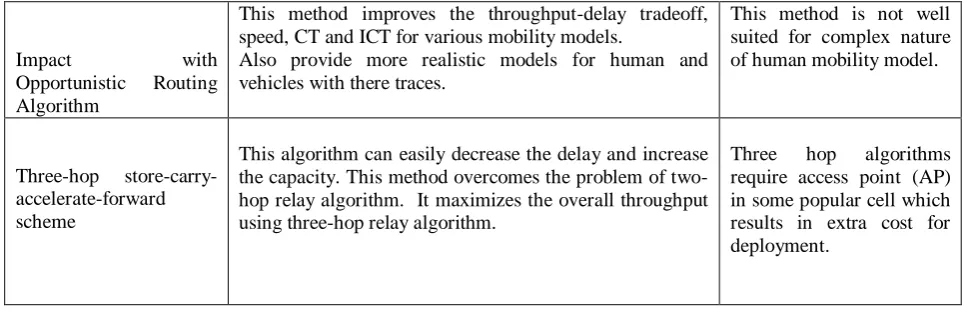
Following table shows comparison between different mobility schemes.
Mobility scheme Advantages Disadvantages
Enhanced
mobility-based Opportunistic Routing protocol
With help of the OR and EMOR various parameter of different mobility model can be enhanced such as delivery ratio, latency and avoid duplication of packets, reduce delay and increase overall transmission of packets.
Different protocols used by
EMOR have different
drawback. AODV has high packet loss CBF suffer from high latency. GPSR does not give better delivery ratio. OR suffer from duplicate packet due to failure of coordination zone and also more than on node send same packet if they can not overhear each other.
hybrid routing scheme
This method improves the throughput and the network capacity due to multicast transmission of packets. Hybrid routing scheme provide the better performance than single routing scheme.
Design of such real
hybrid model which
combines both ad hoc and cellular routing is very complex as compare to previous one.
General-order Linear Continuous-time
mobility model
This proposed method is very efficient and scalable in wireless network.
It reduces the overall interference by predicting them under different mobility models.
The drawback of this method can not predict the interference beyond the Gaussian.
© 2017, IJCSMC All Rights Reserved 421
Impact with
Opportunistic Routing Algorithm
This method improves the throughput-delay tradeoff, speed, CT and ICT for various mobility models.
Also provide more realistic models for human and vehicles with there traces.
This method is not well suited for complex nature of human mobility model.
Three-hop store-carry-accelerate-forward scheme
This algorithm can easily decrease the delay and increase the capacity. This method overcomes the problem of two-hop relay algorithm. It maximizes the overall throughput using three-hop relay algorithm.
Three hop algorithms require access point (AP) in some popular cell which results in extra cost for deployment.
TABLE 1: Comparison between different mobility schemes.
V. PROPOSEDMETHODOLOGY
In this work, mobility scheme is important and difficult task to analyse and discuss about various methods based on different parameters i.e accuracy, packet delivery ratio, time, overhead, throughput, delay, capacity, energy etc. There are still problems which troubles in this field. New mobility method called efficient approach to detect and repair the failure link which overcomes the problem link failure at the time of transmission of packets. Another method is trusted index based scheme for distributed cluster is proposed in this research to provide better performance than existing clustering method in terms of packet delivery ratio and response time and overcome the complexity of earlier clustering method.
In this work, Chord is used to implement Distributed Hash Table. It forms an overlay network upon a physical sensor network. Each node is placed at a Chord co-ordinate responsible for a segment of a periphery. Each node possesses the information of its direct predecessor and successor nodes in the Chord ring. The Chord protocol supports just one operation: given a key, it maps the key onto a node. Depending on the application using Chord, that node might be responsible for storing a value associated with the key.
Nodes are distributed in the network, thus an adversary can place the clone nodes of a compromised node at a different location from the original node acting as a legitimate node of that network. The clone node is having the legitimate keys and ID to communicate with other nodes and can participate in all network activities. Thus detection of node clones in the network in a distributed way is required to make the network functions without any attackers interception.
Distributed Hash Table, DHT-based protocol is a fully decentralized, key-based caching and checking system constructed to catch the cloned nodes. Chord is used to implement Distributed Hash Table. It forms an overlay network upon a physical sensor network. Each node is placed at a Chord co-ordinate responsible for a segment of a periphery. Each node possesses the information of its direct predecessor and successor nodes in the Chord ring. The Chord protocol supports just one operation: given a key, it maps the key onto a node. Depending on the application using Chord, that node might be responsible for storing a value associated with the key. Chord uses consistent hashing to assign keys to Chord nodes. The consistent hash function assigns each node and key an m-bit identifier. Identifiers are
ordered on an identifier circle modulo 2m. Key k is assigned to the first node whose identifier is equal to or follows (the identifier of ) k in the identifier space. This node is called the successor node of key k, denoted by successor(k). If identifiers are represented as a circle of numbers from 0 to 2m−1, then successor(k) is the first node clockwise from k.
VI. CONCLUSION
The new mobility method proposed is the efficient approach to detect and repair the failure link. It overcomes the problem of link failure at the time of transmission of packets. Thus clone nodes will be detected in a distributed way using a DHT-based detection protocol. Hence the proposed work considers the routing of message in an energy efficient way which considers the energy to route the messages which will help in increasing the network lifetime.
ACKNOWLEDGEMENT
© 2017, IJCSMC All Rights Reserved 422
REFERENCES
1. Mohammad Tahooni, Amir Darehshoorzadeh, Azzedine Boukerche, “Mobility-based Opportunistic Routing for Mobile Ad-Hoc Networks”,
ACM, 10.1145/2653481.2653485, September 2014.
2. Zhenzhi Qian, Xiaohua Tian, Xi Chen, Wentao Huang, Xinbing Wang,“Multicast Capacity in MANET with Infrastructure Support”, IEEE TRANSACTIONS ON PARALLEL AND DISTRIBUTED SYSTEMS,Vol. 25, No. 7, July,2014
3. Yirui Cong, Xiangyun Zhou, Rodney A. Kennedy, “Interference Prediction in Mobile Ad Hoc Networks with a General Mobility Model”,
IEEE TRANSACTIONS ON WIRELESS COMMUNICATIONS,Vol. 14, No. 8, August 2.
4. Suvadip Batabyal, Parama Bhaumik, “Mobility Models, Traces and Impact of Mobility on Opportunistic Routing Algorithms: A Survey”,
IEEE COMMUNICATION SURVEYS & TUTORIALS, Vol. 17, No. 3, September 2015.
5. Jingjing Luo, Jinbei Zhang, Li Yu, Xinbing Wang, “Impact of Location Popularity on Throughput and Delay in Mobile Ad Hoc Network”,
IEEE TRANSACTIONS ON MOBILE COMPUTING,Vol. 14, No. 5, MAY 2015.
BIOGRAPHY