An Innovative Study on CBIR with RGB Components Using
PCA
M.Sumathi1* Dr.S.Pannirselvam2 Dr.R.Sankarasubramanian3
Ph.D Research Scholar, Associate Professor & Head, Associate Professor Department of Computer Science
Erode Arts and Science College Erode-638 009, Tamilnadu, India.
E-mail:[email protected], [email protected], [email protected]
Abstract— Information technology paved a strong position in every application of daily life with information processing systems. Due to its rigid development the traditional test processing system are focus their version on image processing. Image process is an appreciable methodology but even it has the issues in image retrieval. Also color image domination in the present society hence it emerges with a full volume technology for commercial people. In this paper we, made an innovative study on content based image retrieval based on color components. In general the image retrieval takes place on RGB with the gradient color histogram, HSV, color Correlogram etc. In this research the image is get enhanced and normalized; then the color components are separated into Red, Green and Blue components using the Principal Component Analysis (PCA). With the individual color component the feature set is established based on the individual color component for image retrieval from the image database. The key innovation in this study is to validate the PCA which can be suitable for further processing.
Keywords — RGB, HSV, CBIR, PCA
I. INTRODUCTION
Image processing replaces the traditional text processing systems and made a reckoned position in every field of human survival especially in the area of Information processing. Due to its rapid development and the emergence of the digital images which evolved around the information world for various purposes; Content Based Image Retrieval is the process of retrieving the desired query image from a huge number of databases based on the contents of the image. Color, texture, shape and local features are some of the general techniques used for retrieving a particular image from the images in the database.
The main components of CBIR are the features which includes the Geometric shape, colors and the texture of the image. Features can be of two types like low-level features and semantic features. It is applied in various fields such as Military, Education, Research and space science are some of the areas where the CBIR technique finds its prime importance. It is hard to visualize Multi-dimensional space. Principal component analysis is a famous multivariate technique and is mainly used to reduce the dimensionality of multi variables to two or three dimensions. PCA summarizes the variation in correlated multi variables to a set of uncorrelated variables, each of which is a particular linear combination of the original variable.
Among the images color image dominated the entire image databases specifically for identification, recognition and retrievals. Image retrieval using the color image will take place using various color components. The innovative thing is to make an adoptive and method to retrieval based on the RGB components and the study and its finding are presented in the following section.
II. RELATED WORKS
Arti et al., used an image retrieval algorithm based on CCM (Color Co-occurrence Matrix) [1]. The CCM for each pixel of an image is found using the Hue Saturation Value (HSV) of the pixel and then compared with CCM of the images in the database and the images are retrieved. Content Based Image Retrieval (CBIR) is a technique which uses visual features of image such as color, shape and texture, etc. [2]. Images are retrieved on the basis of similarity in features where features of the query specification are compared with features from the image database to determine which images match similarly with given features. Feature extraction is a crucial part for any of such retrieval systems.
system can be improved by improving the indexing, retrieval design and feature extraction mechanism and to reduce the time better clustering approach through image decomposition & feature extraction can be used [6]. An approach for content-based image retrieval content-based on color and texture data [7]. In this regard, color histogram and color moment are used as color feature; further, PCA statistical method is applied to reduce dimensions. A hybrid feature extraction approach of our research and solution to the problem of designing a CBIR system manually [8]. Two features are used for retrieving the images such as color and texture. Color feature is extracted by using different color space such as RGB, HSV and YCbCr. Histogram attributed relational graphs (HARGs) to represent images, where each node in the graph represents an image region and each edge represents a relation between two regions [9]. The given query is converted to a FARG, and a low complexity Histogram graph matching algorithm is used to compare the query graph with the FARGs in the database. Different techniques are as well as the combinations of them to improve the performance [10]. Also defined the effect of different matching techniques on the retrieval process. Most content-based image retrievals (CBIR) use color as image features. However, image retrieval using color features often gives disappointing results because in many cases, images with similar colors do not have similar content. An image retrieval method using both color features and combined features based on color moments and Gabor texture [11]. Color in HSV color space, texture using wavelet transform and shape feature using thresholding is used to retrieve images from the database [12]. Content based image retrieval is becoming source of fast and exact retrieval. The applications of CBIR are in dermatology and blood cell detection etc. Image has features like color, texture and shape. Various techniques are employed by researchers to extract images from database by using single feature as well making combination of those features. Color scheme with HSV color space making use of color histogram [14]. A comparison with Corel dataset and evaluation with parameters precision, recall and f-measure are computed [15]. Color features in CBIR are used as in the color histogram, color moments, conventional color correlogram and color histogram. Color space selection is used to represent the information of color of the pixels of the query image. Texture features are used in different CBIR systems along with color, shape, geometrical structure and sift features.
Anusree et al., applied Automatic face annotation facilitates improved retrieval and organization of digital images [16]. Annotation of human faces is done using PCA and MLP. Two scenarios are for naming people in an image finding all faces, and assigning names to all faces. For naming, free text type of annotation is used. This makes annotation task easier, but more difficult to use the annotation later for image retrieval. In 2012 sheeba et al., [17] used the more recent relevance feedback
queries by estimating the user’s ideal query using the positive and negative examples given by the user. The current relevance feedback based systems estimate the ideal query parameters on only the low-level image features such as color, texture, and shape. These systems work well if the feature vectors can capture the essence of the query. With a few positive and negative examples, the relevance feedback system will be able to return reasonably accurate results.
Harshini developed an appearance based face recognition method called Singular Value Decomposition (SVD) is different from Principal Component Analysis (PCA), which effectively considers only Euclidean structure of face space for analysis which lead to poor classification performance in case of great facial variations such as expression, lighting, occlusion and so on, due to the fact the image gray value matrices on which they manipulate are very sensitive to these facial variations [18]. In 2015 Deepa Joseph et al., [19] PCA works best in situations where relationship among pixels is linear. Thus face recognition is done with PCA which maintains data reduction. B.Kumar [20] used two conventional and widely used techniques known as Principal Component Analysis (PCA) and Discrete Wavelet Transform (DWT) are used for feature extraction. Both techniques are based on entirely different approaches. The results for the two techniques are analyzed and compared. The classification is performed with a benchmark classifier support vector machine.
III. METHODOLOGY
A. Techniques For Implementing Colour Based Extraction[5]
3.1 Color Histogram
A histogram is a graphical representation of the number of pixels in an image. It may be of bar graph, whose X-axis represents the tonal scale, and Y-axis represents the number of pixels in an image in a certain area of the tonal scale. It also represents the distribution of the composition of colors in the image. It shows different types of colors appeared and the number of pixels in each type of the colors appeared. Two types of color histograms, Global Color Histograms (GCHs) and Local Color Histograms (LCHs). A GCH represents one whole image with a single color histogram while the LCH divides an image into fixed blocks and takes the color histogram of each of those blocks.
3.2 Local Color Histogram
Full Resolution Red image
Represents one whole image with a single color histogram, using the global color histogram an image will be encoded with its color histogram. The distance between two images will be determined by the distance between their color histograms.
Color spaces: The color space plays a significant role for image retrieval based on color features. There are 11 color models (RGB, I1I2I3, YIQ, HSV, HSI, YUV, LAB, XYZ, CMYk, YCbCr and HMMD). The RGB image is first converted into one of the color spaces then the feature exaction is done.
RGB Color Space: Color space is RGB stands for Red-Green-Blue. This space consists of the additive primary colors of light Red, Green and Blue. This histogram is the most used histogram in computer graphics and it uses its red, green and blue components to create a new color. To propose a new color it is necessary to increase the values of one or more of the components of the RGB components.
HSV Color Space: The HSV color space constituent Hue, Saturation and Value. Hue varies from 0 to 1.0, the corresponding colors vary from red through yellow, green, cyan, blue, magenta, and back to red, so that there are actually red values both at 0 and 1.0. As saturation varies from 0 to 1.0, the corresponding colors (hues) vary from unsaturated (shades of gray) to fully saturated. As value or brightness, varies from 0 to 1.0, the corresponding colors become increasingly brighter.
B. Principal Component Analysis
Digital image processing has been accomplished using various retrieval algorithms especially with feature extraction majorly in the low-level feature. Among the color image processing made a strong foot in image retrieval using various color features which are discussed in the previous section. Apart for the frequently used color features using common techniques, Principal Component Analysis was used in color image processing,
3D Column Vector X:
1. An RGB image having 3 components can be treated as a unit by expressing each group of three corresponding pixels as a vector Xi, representing a pixel i.
2. The 3-D column vector Xi for a pixel = [r g b], where r, g and b are the respective pixel values of the RGB components of the image.
3. Similarly, Extend it to the spectral band components where instead of RGB, we have b1, b2 …., bn; where b1, b2,…,bn are the respective pixel values of the spectral band image components.
4. For PCA, the input vector X is a vector of vector Xi. 5. For an m x n image, the vector X will be of length m X n
number of bands.
[image:3.595.312.534.106.402.2]C. Proposed Methodology
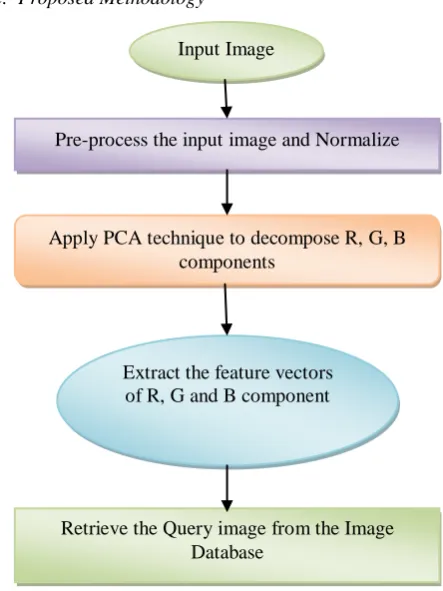
Fig. 1 Proposed Retrieval with PCA
From the above fig.1 the image retrieval takes place with the low-level features specifically color image. In this proposed methodology the color image is considered as input image and initially it get pre-process with adoptive filter and normalization is applied. Then the principal component analysis is applied for the extraction of RGB components as individual components the image after separation. In this method the original color image is decompose or demosaic into individual color components such as Red, Green and blue. Here both the images were get enhanced and normalized. After that the feature of the individual components are been extracted. The image retrieval takes place with any one of the component to retrieval the target image.
Retrieve the Query image from the Image Database
Input Image
Pre-process the input image and Normalize
Apply PCA technique to decompose R, G, B components
Full Resolution Green image Full Resolution Blue image Input Image Red component
Green Component Blue Component
From the above figures it show the original input and the remaining are the full image depends on the individual color components such as Red component, Green Component and Blue component etc.
In the proposed method after extracting the individual color components and the feature vector and vectors are extracted in the establishment of color feature set. The image retrieval is to be accomplished with the auto-correlation function. This method computes two estimates fH and fV of the full color image. The green components GH and GV of these images are obtained through horizontal and vertical interpolation, respectively and then the red and blue components are reconstructed using a bilinear interpolation of the color differences R - GH and B - GH for the horizontally estimated image fH, and of R – GV and B – GV for the vertically estimated image fV.
Next, for each pixel, a choice between fH and fV is performed. This approach proved to give good performance; however, it requires us to compute and compare two full color images.
IV. CONCLUSION
Digital image processing centers in the doors of every field of human survival also there are various image retrieval methods has been accomplished through low level features especially in the area of image retrieval based on the color features. In this paper an innovative study with a deep analysis on the content based image retrieval based on the color components. In this method the Input image is get pre-processed with adoptive filter and normalized. Then the RGB components and demosaic individually into Red, Green and Blue component respectively with Principal Component analysis. A feature set is established and finally, the image retrieval will take place using auto correlation function. The main contribution of this paper is to make decision that PCA can be considered or not for further processing of this proposed work. Hopefully, in this innovative study PCA is a simple and can provide better efficiency with better performance in image
retrieval compare to earlier methods. An integrated color component model is to be applicable for both gray scale and color images.
REFERENCES
[1] K. Arthi, J. Vijayaraghavan, “Content Based Image Retrieval Algorithm Using Colour Models”, International Journal of Advanced Research in Computer and Communication Engineering, Vol. 2, Issue 3, March 2013, ISSN: 2319-5940.
[2] Mohd. Danish, Ritika Rawat, Ratika Sharma, “A Survey: Content Based Image Retrieval Based On Color, Texture, Shape & Neuro Fuzzy”, Journal Of Engineering Research And Applications, Vol. 3, Issue 5, pp.839-844, Sep-Oct 2013, ISSN : 2248-9622.
[3] Pragati Ashok Deole, Rushi Longadge, “Content Based Image Retrieval using Color Feature Extraction with KNN Classification”, International Journal of Computer Science and Mobile Computing, IJCSMC, Vol. 3, Issue 5, May 2014, pg.1274 – 1280, ISSN 2320–088X.
[4] Komal Mirchandani, T.Rajani Mangala, “Content Based Image Retrieval”, International Journal of Industrial Electronics and Electrical Engineering, Volume-4, Issue-3, Mar. 2016, ISSN: 2347-6982.
[5] Shradha Naik, Umesh A. Bapat, “Quad histogram Based Image Retrieval”, Journal of Computer Engineering (IOSR-JCE), PP 46-51,e-ISSN: 0661,p-ISSN: 2278-8727.
[6] Aasia Ali Sanjay Sharma, “A Review: Content Based Image Retrieval Architecture and Technique”, International Journal of Advanced Research in Computer Engineering & Technology (IJARCET) Vol. 6, Issue 9, September 2017, ISSN: 2278 – 1323.
[7] Mohammad Sadeq Navabi and Zahra Ahmadi Brooghani, “Content-Based Image Retrieval through Combined Data of Color Moment and Texture”, IJCSNS International Journal of Computer Science and Network Security, Vol.17 No.2, February 2017.
[8] Suresh M B, B Mohankumar Naik, “Content Based Image Retrieval using Color and Texture Content”, International Journal of Computer Trends and Technology (IJCTT), Vol. 48, No. 2, June 2017.
[9] Asma Naz, Durgesh Warbude, Jaishree Boaddh, “Content Based Image Retrieval Based on YCbCr Approach”, International Journal of Innovative Research in Computer and Communication Engineering, Vol. 5, Issue 2, pp.1581-1587, February 2017, ISSN (Print): 2320-9798x. [10] Jagdamb Behari Srivastava1, Sanjeev Kumar, “Concept
Engineering and Technology, Vol. 6, Issue 6, pp:12061-12066, June 2017, ISSN(Online): 2319-8753.
[11] Shahadat Hossain and Rafiqul Islam, “A New Approach of Content Based Image Retrieval Using Color and Texture Features”, British Journal of Applied Science & Technology, Vol. 21, No.3, pp. 1-16, 2017, ISSN: 2231-0843.
[12] Pradeep Kumar Kaushik, “Image Retrieval Based On
Integration Between Histograms In Hsv Color Space With Texture Feature And Shape Feature”, International Journal of Scientific & Engineering Research Vol. 8, Issue 10, pp. 445-450, Oct 2017, ISSN 2229-5518. [13] Bandna Kumari, Shruti Bharadwaj, “A Study and usage
of Visual Features in Content Based Image Retrieval Systems”, International Journal of Advanced Research in Computer Science, Vol. 8, No. 5, May-June 2017, ISSN No. 0976-5697.
[14] Bandna Kumari, “CBIR Systems: Results of Feature
Extraction with Color Feature Comparison with Standard Database”, International Journal of Innovative Research in Computer and Communication Engineering, Vol. 5, Issue 11, Nov. 2017, ISSN(Online): 2320-9801.
[15] Anum Masood, Muhammad Alyas Shahid, Muhammad
Alyas Shahid, “Content-Based Image Retrieval Features: A Survey”, Int. J. Advanced Networking and
Applications, Vol. 10, Issue 01, pp. 3741-3757, 2018, ISSN: 0975-0290.
[16] Anusree B S, Resmy V R, “Face Annotation and Similar
Image Retrieval using PCA and MLP”, International Journal of Computer Science and Information Technologies, Vol. 6, No.2 , 2015, 1300-1302.
[17] Sheeba Abraham, J. Bethanney Janney, Sindu Divakaran,
“Content Based Image Retrieval Using Principle Component Analysis”, Vol. 3, Issue 4, pp.331-334, Oct - Dec 2012, ISSN : 2229-4333.
[18] K. Harshini M. Narayana, “Content Based Image
Retrieval Using Singular Value Decomposition”, International Journal of Engineering Innovation & Research Vol. 1, Issue 5, pp.459-466, ISSN : 2277 – 5668.
[19] Deepa Joseph, Ajai Mathew, “Content Based Image
Retrieval of Corel Images Along With Face Recognition”, International Journal of Computer Science and Mobile Computing, Vol. 4, Issue.11, pg. 136-142, November- 2015.
[20] B. Kumar, “Feature Extraction Using Principal