A
L a n g u a g e I d e n t i f i c a t i o n A p p l i c a t i o n B u i l t o n t h e J a v a
C l i e n t / S e r v e r P l a t f o r m
Gary Adams
Sun Microsystems Laboratories
Two Elizabeth Drive
Chelmsford, MA 01824-4195, USA
gary. a d a m s © e a s t , sun. t o m
Philip Resnik
Dept. of Linguistics and UMIACS
University of Maryland
College Park, MD 20742, USA
r e s n i k ~ u m i a c s , umd. e d u
Abstract
We describe an experimental system im- plemented using the J a v a ( T M ) program- ming language which demonstrates a va- riety of application-level tradeoffs available to distributed natural language processing ( N L P ) applications. In the context of the World Wide Web ( W W W ) , it is possible to provide value added functionality to legacy documents in a client side browser, a docu- ment server or an intermediary agent. Us- ing a well-known ngram-based algorithm for a u t o m a t i c language identification, we have constructed a system to dynamically add language labels for whole documents and text fragments. We have experi- mented with several client/server configu- rations, and present the results of tradeoffs made between labelling accuracy and the size/completeness of the language m o d e l s .
1 Introduction
In the 1.1 release of the Java Developers Kit(TM), a wide selection of text processing and international- ization interfaces have been added to the base Java package 1 making the package usable for multilingual
1A few pointers to online Java resources. Java Developer Kit :
< U RL:http://www.javasoft.com/products/ jdk/1.1/index.html>
Java Server(TM) Product Family :
< URL:http://jeeves.javasoft.com/products/ java-server/index.html>
HotJava(TM) Browser :
< U RL:http://www.javasoft.com/products/ HotJava/index.html>
Java internationalization :
< U RL:http://java.sun.com/products/ jdk/1.1/docs/guide/intl/index.html>
Java Workshop :
< U RL:http://www.sun.com/workshop/index.html> Java JIT :
< U RL:http://www.sun.com/workshop/ java/jit/index.html>
text processing. T h e Java programming language, the portable Java virtual machine and the basic web infrastructure of client web browsers and document resource protocols provide a widely deployed plat- form suitable for distributing NLP applications. Our research is targeted at shallow machine translation and summarization of multilingual web pages. 2 To properly bootstrap this technology we require ap- propriate language labels on documents. Language labels m a y be present at a whole document or collec- tion of documents level for large granularity appli- cations or at a structural component (SGML entity level) for fine grained uses. (Yergeau et al., 1997) Using an ngram language model (Dunning, 1994), we have explored a variety of mechanisms for adding language labels to legacy documents as part of the normal end user experience of the World Wide Web. T h r e e obvious places the language labels could be added to legacy documents are within an end user web browser, within a document repository server and within an intermediary proxy server. We have experimented with several client/server configura- tions, and present the results of tradeoffs m a d e be- tween labelling accuracy and the size/completeness of the language models .
2
A u t o m a t i c Language Identification
Although the general framework will support a va- riety of algorithms for automatic language identifi- cation, our implementation is based on Dunning's (1994) character ngram approach, which is concep- tually quite simple and achieves good performance even given relatively small training sets (50K of training text is more than enough, and one can make do with as little as 1-2K), and even when the strings to be classified are quite short (e.g., 50 characters). Essentially, the m e t h o d involves con- structing a probabilistic model (or "profile") based on character ngrams for each language in the classi- fication set, and then performing classification of an2Sun Microsystems Laboratories efforts in International Linguistic Applications:
< URL:http: / /www.sunlabs.com/research /ila/ >.
unknown string by selecting the model most likely to have generated that string.
Although the model itself is quite simple, some subtle and not-so-subtle issues do arise in putting the algorithm into practice. First among these is the problem of matching the character set of the input text to the character set assumed by the language profiles - - for example, Shift-JIS and EUC-Japan are frequently used to encode Japanese documents in the PC and Unix worlds, respectively. Docu- ments currently found on the W W W are often in- sufficiently labeled to indicate the language of text or the encoding of the characters within the docu- ment. We believe that use of Unicode will become increasingly widespread, obviating this problem, al- though for the time being we avail ourselves of the reasonable tools available 3 for identifying and con- verting a m o n g character sets.
Second, sparse training d a t a is a significant fac- tor in n g r a m modeling, even at the level of charac- ter co-occurrences, since we consider character se- quences up to 5 characters in length. We have ex- perimented with simple add-k smoothing and, not- ing known problems with t h a t method (Gale and Church, 1990), we have also experimented with G o o d - T u r i n g smoothing (Good, 1953) - finding, to our surprise, t h a t the simple "add ½" is only slightly less accurate.
Table 2 shows the performance of the language identification algorithm when run on Dunning's (1994) English/Spanish test set, using language pro- files for English and Spanish constructed from train- ing sets of 50K characters each and varying the size of the ngrams and length of the test strings. This experiment used Good-Turing smoothing and also adopted a simplified approximation of conditional probabilities used by Dunning (personal communi- cation) in his experiments. Each row of the table shows the language and length of the test strings, the ngram size, the number of test strings classified correctly and incorrectly, and the percentage correct. Third, in an environment where computation m a y more efficiently be done on the client side rather t h a n the server side, the size of the language pro- files becomes relevant, since computation cost must be traded off against communication cost for the d a t a needed in order to perform the classification. Given t h a t probabilities for low frequency items can be poorly estimated anyway, we have experimented with eliminating low-frequency items from the pro- file - - e.g., treating singletons (ngrams appearing just once in the training data) as if they never ap- peared at all and using the smoothed-zero value for them instead, thus trading model size against classification accuracy. Again to our surprise, we
~Xemacs internationalization : < U RL:http://www.xemacs.org/ xemacs-faq.html~interna.tion Miza.tion >
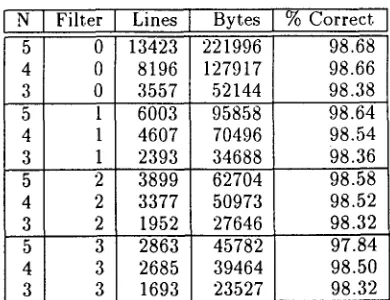
have found that quite reasonable classification per- formance is sustained even when filtering out not only singletons but even ngrams t h a t appear twice and even three times in the training s e t . (see Ta- bles 3-5).
Table 1 shows the dramatic size reduction that takes place as smaller window sizes are used in train- ing the language models. In the current implemen- tation plain text files are used for m a x i m u m porta- bility of the resources. An application t h a t uses a 5-gram model without filtering any of the training data would use a 220K model containing 13K ob- served ngrams, with an average accuracy of 98.68% for 100-500 character length strings. If the same ap- plication can function effectively with a marginally lower accuracy rate of 98.32%, then the same train- ing d a t a can be used to produce a profile a full order of magnitude smaller (a 23K profile containing only 1.6K ngrams), by using a trigram model and filter- ing out those trigrams whose observed frequency is less t h a n 4. This 10X reduction in size for this par- ticular resource could mean supporting 10 times as many languages with the same m e m o r y footprint or delivering the linguistic resource 10 times as fast for a client side computation.
Finally, standardization of language labels must be addressed; this work follows the ISO standards for language and country codes for internationaliza- tion ([SO, 1988b; ISO, 1988a; Yergeau et al., 1997; Alvestrand, 1995).
3 C l i e n t / S e r v e r A r c h i t e c t u r e
In designing a distributed application several deci- sions can be built into the architecture of the prod- uct or left as runtime decisions. By using a Java vir- tual machine as the target platform, the same code can run on a server machine or within the client graphical user interface. A sophisticated program can determine at startup whether the c o m p u t a t i o n resources ( m e m o r y and CPU) on the server machine or on the client workstation are b e t t e r for the more complex algorithms.(In our testing we work with a S p a r c S t a t i o n ( T M ) 10 file server, an U l t r a l ( T M ) with 500M of m e m o r y as a high end client and a SparcStation 2 remote client over a 28.8 Kb m o d e m connection as a low end client.)
this section, we discuss the incorporation of lan- guage identification at three possible locations: the client's Web browser, the document server, and be- tween t h e m at a proxy Web server.
3.1 C l i e n t W e b B r o w s e r
We have e x p e r i m e n t e d with two e x t r e m e client con- figurations. Our high end client has fast C P U and a large m e m o r y pool. O u r low end client has b o t h a slow C P U and small m e m o r y footprint. T h e high end client easily caches large language profiles and is capable of c o m p u t i n g the best possible language labels. W h e n the network resources are available to the high end client, it makes the m o s t sense to per- f o r m the language labeling within the client browser. On the low end client, the available network b a n d w i d t h was the driving architectural consider- ation. W h e n high b a n d w i d t h was available, delegat- ing c o m p u t a t i o n s to the server system provides the best language labels and the best t h r o u g h p u t to end users. In disconnected or low b a n d w i d t h situations, the client m u s t p e r f o r m its own labeling. In these situations, less accurate language labels with reason- able responsiveness is preferred over slow but m o r e correct results.
T h r e e p r i m a r y techniques were used to i m p r o v e the responsiveness of the client side language la- belling interfaces. Basically, they all a t t e m p t to min- imize the work t h a t is performed and to overlap the work whenever possible with other end user interac- tions.
• Asynchronous processing for perceived respon- siveness. End users perceive s y s t e m responsive- ness in terms of its ability to react to their re- quests when they are presented to the system. Within our application there are clear points during s y s t e m initialization and end user pa- r a m e t e r selection when large a m o u n t s of net- work b a n d w i d t h and c o m p u t a t i o n resources are needed. Using the builtin threading capabilities of the J a v a environment, we s t a r t the resource intensive operations when they are indicated, b u t allow the user to continue interacting with the user interface. If the user requests an op- eration t h a t requires an uninitialized resource a message is presented and the application blocks until the resource is available.
• Degraded language profiles for smaller footprint.
Our language identification profiles have been built with 3, 4 and 5 character n g r a m windows. In addition to varying the n g r a m window size we have e x p e r i m e n t e d with removal of singleton and doubleton observations in the training data. While this amplifies the sparse d a t a problem, it does not significantly i m p a c t the end user per- ceived error rates for large granularity text ob- jects, e.g., labeling a typical webpage with 1000
characters of t e x t u a l information.
• Subset of language profiles for specific user needs. We have been working with a m i x t u r e of western European and Asian languages 4. For remote clients it is worth the e x t r a effort to preselect the languages t h a t will be m o s t bene- ficial to distinguish on the client machine. For demonstration purposes we use a dozen western languages and preload a few profiles during the initialization of the sample configuration.
3.2 D o c u m e n t S e r v e r
A typical d o c u m e n t server is designed to service a large n u m b e r of end user requests. While they are usually configured with large a m o u n t s of disk stor- age, they are not always the best c o m p u t a t i o n a l re-- sources available on the network. For static web- pages, it is easy to include a language labeling tool for off-line d o c u m e n t m a n a g e m e n t . T h e labeling tool would be used to convert text/htmlfile into mes- sage/http files. 5
For real t i m e information such as news wires or other database generated replies the s a m e off line language labeling tools could be used with C o m m o n G a t e w a y Interface ( C G I ) 6 scripts to a u t o m a t i c a l l y add language labels to d y n a m i c a l l y generated web- pages.
3.3 P r o x y W e b S e r v e r
A proxy server is an intermediary p r o g r a m t h a t pro- vides value added functionality to d o c u m e n t s as p a r t of the transmission process. A proxy server could be configured close to the end user or close to the d a t a source depending on the network topology. Proxy servers m a y also be employed as a shared work- group or enterprise wide facility, e.g., d e p a r t m e n t level proxies can share cached webpages, or an en- terprise wide proxy could add an e x t r a level of ac- cess controls. By introducing language labeling at a proxy server it is possible to combine the benefits of webpage caching and t r a n s p a r e n t content negoti- ation to reuse previously c o m p u t e d headers. 7
4We selected 200K of sample text from the W W W for the following languages: Chinese, Czech, Danish, Dutch, English, Finnish, French, German, Greek, Hun- garian, Italian, Japanese, Korean, Norwegian, Polish, Portuguese, Spanish, Swedish, and Turkish. We use 50K of text for training the models, 50K for use in entropy calculations and 100K heldout for testing purposes. Pre- liminary experiments indicate that performance compa- rable to what we have seen with the English/Spanish test set will also be achieved with other language pairs.
5Apache server documentation for variant files: < U RL:http://www.apache.org/docs/
mod/mod_a~is.html>
< U RL:http://www.apache.org/docs/ mod/mod_negotiation.html> 8Common Gateway Interface 1.1 :
< U RL:http://hoohoo.ncsa.uiuc.edu/cgi/> rTarnsparent content negotiation in H T T P :
4 J a v a C l a s s e s
The p r i m a r y reusable Java module written for lan- guage labeling in our system is called a frequency table class. A main() routine is provided in the class to provide a stand-alone interface for generating new language profiles from training data. T h e generated language profiles are self documenting text files indi- cating the parameters used in creating the language model and the algorithms used for smoothing and filtering the training data. Methods are provided in the frequency table class for saving and loading the profiles to disk and for scoring individual strings from a loaded profile.
Specialized classes were also written to provide connections within a client environment (in Java lingo an "applet") and within a proxy H T T P server (again in Java lingo a "servlet"). In both the servlet and applet applications of the language labeling class the J a v a p l a t f o r m provided the basic class loading infrastructure to allow a c o m m o n shared module and the distributed platform for running those al- gorithms transparently on a client or server system.
5
D i s c u s s i o n
In this paper, we have described a Java s implemen- tation of a character n g r a m language labeling algo- rithm. This NLP module was successfully reused in a client side Java application, in an offiine docu- ment m a n a g e m e n t system and embedded within an H T T P proxy server. With the rapid deployment of the globally available Java infrastructure, a tremen- dous o p p o r t u n i t y exists for resusable NLP compo- nents.
T h e distributed nature of our particular applica- tion, led us to explore possible tradeoffs between the accuracy needed for client side language labeling and the size of the language models. By selecting smaller ngram windows sizes and by disgarding infrequently observed ngrams from our language profiles we can reduce the size of the models by an order of mag- nitude with an insignificant loss of precision for our target application.
T h e tradeoffs we have explored in the context of a u t o m a t i c language identification are relevant more generally to natural language processing in the dis- tributed setting m a d e possible by the Java infras- tructure. At a minimum, our observations with re- spect to character-based language models are likely to be applicable to the word-based language mod- els used in other statistically-driven NLP applica-
koen/conneg/>
IETF - HTTP Working Group : < U RL:http://www.ics.uci.edu/ p u b / i e t f / h t t p / >
aSun, Java, Java Developers Kit, Hot Java, and Ul- tral are trademarks or registered trademarks of Sun Microsystems, [nc. in the United States and other countries.
N Filter Lines
5 0 13423
4 0 8196
3 0 3557
5 1 6003
4 1 4607
3 1 2393
5 2 3899
4 2 3377
3 2 1952
5 3 2863
4 3 2685
3 3 1693
Bytes 1 % C o r r e c t
221996 98.68
127917 98.66
52144 98.38
95858 98.64
70496 98.54
34688 98.36
62704 98.58
50973 98.52
27646 98.32
45782 97.84
39464 98.50
23527 98.32
Table 1: Language profile sizes
tions. Beyond that, similar client/server tradeoffs are likely to be i m p o r t a n t even in strictly knowledge based systems. Part-of-speech tagging and phrase identification, foreign word translation, and topic la- beling are among the operations that promise to en- hance intelligent search and browsing on the Web, and the present paper represents a beginning step to- ward making decisions about where to locate these operations' computations and data.
R e f e r e n c e s
H. Alvestrand. 1995. RFC 1766: Tags for the iden- tification of languages, March.
Ted Dunning. 1994. Statistical identification of lan- guage. Computing Research L a b o r a t o r y Techni- cal Memo MCCS 94-273, New Mexico State Uni- versity, Las Cruces, New Mexico.
W. Gale and K. Church. 1990. W h a t ' s wrong with adding one? IEEE transactions on Acoustics, Speech, and Signal Processing.
I.J. Good. 1953. T h e population frequencies of species and the estimation of population parame- ters. Biometrika, 40(3 and 4):237-264.
ISO. 1988a. ISO3166 - codes for the representation of names of countries.
ISO. 1988b. ISO639 - code for the representation of names of languages.
[image:4.612.317.512.75.225.2]Lang I En Sp En Sp En Sp En Sp En Sp En Sp En Sp En Sp En Sp
Length I N Correct Wrong
t00 3 983
100 3 973
200 3 984
200 3 981
500 3 498
5OO 3 5OO
100 4 988
100 4 976
200 4 986
200 4 983
500 4 500
500 4 500
100 5 991
100 5 973
200 5 986
200 5 984
5OO 5 50O
500 5 500
% Correct
17 98.3
7 99.3
16 98.4
19 98.1
2 99.6
0 t00.0
12 98.8
4 99.6
14 98.6
17 98.3
0 100.0
0 100.0
9 99.1
7 99.3
14 98.6
16 98.4
0 100.0
0 100.0
Table 2: Language identification performance using full profiles
Lang Length N Correct
En 100 3 986
Sp 100 3 972
En 200 3 979
Sp 20O 3 981
En 500 3 498
Sp 5O0 3 5OO
En 100 4 989
Sp 100 4 973
En 200 4 983
Sp 200 4 982
En 500 4 499
Sp 500 4 500
En 100 5 989
Sp 100 5 973
En 200 5 982
Sp 2OO 5 985
En 500 5 500
Sp 50O 5 500
Wrong % Correct
14 98.60
8 99.18
2 1 97.90
19 98.10
2 99.60
0 100.00
11 98.90
7 99.29
17 98.30
18 98.20
1 99.80
0 100.00
11 98:90
7 99.29
18 98.20
15 98.5O
0 100.00
0 100.00
Table 4: Language identification performance using reduced profiles (filtered doubletons)
Lang Length N Correct
En 100 3 986
Sp 100 3 973
En 200 3 980
Sp 200 , 3 981
En 500 3 498
Sp 500 i 3 500
En 100 ~4 989
Sp 100 4 973
En 200 4 982
Sp 200 4 983
En 500 4 500
Sp 500 4 500
En 100 5 990
Sp 100 5 974
En 200 5 984
Sp 2O0 5 984
En 500 5 500
Sp 5OO 5 5OO
Wrong % Correct 14 7 20 19 2 0 11 7 18 17 0 0 10 6 16 16 0 0 98.60 99.29 98.00 98.10 99.60 100.00 98.90 99.29 98.20 98.30 100.00 100.00 99.00 99.39 98.40 98.40 100.00 100.00
Table 3: Language identification performance using reduced profiles (filtered singletons)
Lang Length N Correct
En 100 3 984
Sp 100 3 973
En 200 3 979
Sp 200 3 981
En 500 3 499
Sp 5OO 3 5OO
En 100 4 990
Sp 100 4 972
En 200 4 983
Sp 200 4 981
En 500 4 499
Sp 5OO 4 50O
En 100 5 979
Sp 100 5 961
En 200 5 974
Sp 2OO 5 985
En 500 5 497
Sp 500 5 496
Table 5: reduced
Wrong % Correct
16 98.40
7 99.29
21 97.90
19 98.10
1 99.80
0 100.00
10 99.00
8 99.18
17 98.30
19 98.10
1 99.80
0 100.00
21 97.90
19 98.06
26 97.40
15 98.50
3 99.40
4 99.20
[image:5.612.61.550.114.330.2] [image:5.612.63.555.438.655.2] [image:5.612.59.561.439.652.2]