Towards Abstractive Multi-Document Summarization Using Submodular
Function-Based Framework, Sentence Compression and Merging
Yllias Chali University of Lethbridge Lethbridge, Alberta, Canada
Moin Tanvee University of Lethbridge Lethbridge, Alberta, Canada
Mir Tafseer Nayeem University of Lethbridge Lethbridge, Alberta, Canada [email protected]
Abstract
We propose a submodular function-based summarization system which integrates three important measures namely impor-tance, coverage, and non-redundancy to detect the important sentences for the sum-mary. We design monotone and submod-ular functions which allow us to apply an efficient and scalable greedy algorithm to obtain informative and well-covered sum-maries. In addition, we integrate two abstraction-based methods namely sen-tence compression and merging for gener-ating an abstractive sentence set. We de-sign our summarization models for both generic and query-focused summarization. Experimental results on DUC-2004 and DUC-2007 datasets show that our generic and query-focused summarizers have out-performed the state-of-the-art summariza-tion systems in terms of ROUGE-1 and ROUGE-2 recall and F-measure.
1 Introduction
Existing multi-document summarization tech-niques mainly fall into two categories: extrac-tive and abstracextrac-tive. Extracextrac-tive approach selects important source sentences to cover the overall concepts of the document set (Erkan and Radev, 2004;Lin and Bilmes,2010;Boudin et al.,2015; Parveen and Strube, 2015; Parveen et al., 2015; Cheng and Lapata, 2016; Nallapati et al., 2017). This method is very popular because of its sim-plicity and speed. But it mostly generates less con-densed summaries with redundant information. On the other hand, abstractive summarization is a way of natural language generation and using this approach, it is possible to produce human-like summaries (Rush et al.,2015;Chopra et al.,2016;
Wang and Ling,2016). It requires deep language understanding. Though this technique is complex and less popular than the extractive approach, it is possible to produce more informative and fluent summary. For generating abstractive summaries, researchers often try to modify the candidate sen-tences by either shortening and compressing it (Knight and Marcu,2000;Berg-Kirkpatrick et al., 2011;Filippova et al.,2015) or by merging several sentences which is called sentence fusion ( Barzi-lay and McKeown,2005;Cheung and Penn,2014; Bing et al.,2015).
In this paper, we divide the whole task of sum-marization in two main phases: document shrink-ing and summarization. In the first phase, we ap-ply sentence compression and merging to produce concise and new candidate sentences for the mary. In the second phase, we represent sum-marization as a submodular function maximiza-tion problem under budgeted constraints. While generating summaries, our system considers three important measures namely importance, coverage, and non-redundancy to ensure summary quality. We design three submodular functions for each these measures. The importance property of the summary considers how much relevant informa-tion present in a summary. The coverage measure ranks the sentences based on the fact of how rep-resentative they are of the document cluster. The third objective function is designed for measur-ing non-redundancy of the summaries. This met-ric assigns a score to a sentence based on how many distinct concepts it contains and how dis-similar it is with the other summary sentences. We design the summarization model for both generic and query-focused summarization. Finally, a mod-ified greedy algorithm is applied which obtains near optimal summaries guaranteed to be within (1−1/√e)of the optimal solution.
2 Related Work
Most of the research on document summarization are extractive which principally based on two im-portant objectives, namely maximizing the rele-vance and minimizing the redundancy (Carbonell and Goldstein,1998;Erkan and Radev,2004). Be-sides, formulation of summarization as a maxi-mum coverage problem with knapsack constraint (MCKP) (Takamura and Okumura, 2009;Morita et al., 2011) have been used. Recently, summa-rization has also been considered as a submodu-lar function maximization (Lin and Bilmes,2010, 2011;Dasgupta et al., 2013) where greedy algo-rithms were adopted to achieve near optimal sum-maries. However, the main drawback of all the ex-tractive approaches is that they can not avoid the inclusion of insignificant information which de-grades the summary quality.
On the other hand, the abstractive approach in a multi-document setting aims at generating summaries by deeply understanding the contents of the document set and rewriting the most rel-evant information in natural language. Two re-cent abstractive techniques are most commonly used to accomplish the task: sentence compres-sion (Knight and Marcu, 2000) and sentence fu-sion (Barzilay and McKeown, 2005). In the re-cent years, sentence compression is jointly used with the extractive system to improve summary quality (Berg-Kirkpatrick et al.,2011;Martins and Smith, 2009). In addition, sentence fusion-based models have also been proposed where sentence fragments from multiple sentences are combined to cover more information in a concise manner (Barzilay and McKeown, 2005; Filippova et al., 2015;Ganesan et al., 2010;Thadani and McKe-own, 2013; Cheung and Penn, 2014;Bing et al., 2015).
3 Document Shrinking
In this phase, we used sentence compression and sentence merging to prepare a better and more concise document set before approaching the ac-tual summarization task.
3.1 Sentence Compression
Sentence compression is a technique of shorten-ing sentences which can be used with the extrac-tive system to improve summary quality. Consider the following example sentence as a candidate sen-tence of the summary:
“According to a newspaper report, a total of 4,299 political opponents died or disappeared dur-ing Pinochet’s term.”
In this sentence, we can see the part shown in the italic font is not carrying much signifi-cance and can be removed. We removed these sort of insignificant sub-parts of sentences follow-ing Berg-Kirkpatrick et al., (2011)’s compression technique.
In addition, we removed the sub-clauses related to the reporting verbs from sentences following (Chali and Uddin,2016), like in the following ex-ample sentence:
Cambodian parties agreed to a Coalition gov-ernment led by Hun Sen, the official said.
We considered mostly used reporting verbs such assaid, told, reported, andannouncedto find out subclause. It is known that the sentence which contains a reporting verb is always the ‘root’ of the dependency tree. Following this rule, we traversed the tree to find out the subclause related to the re-porting verb and removed it from the sentence.
3.2 Sentence Merging
Sentence merging is a technique to create a more informative sentence by merging the information from different source sentences. According to Bing et al., (2015), human summary writers usu-ally merge the important facts in different verb phrases (VPs) about the same entity into a sin-gle sentence. Based on this assumption, we de-sign a sentence merging technique. While Bing et al., (2015), took phrases as the basic linguistic unit and merge phrases to produce a summary, we take sentences as the basic linguistic units and merge them to generate new sentences for the summary. For example, the following sentences: (1) Cam-bodian prime minister Hun Sen has ruled through violence, (2)Hun Sen threatened to eliminate op-ponentscan be merged as (3)Hun Sen has ruled through violence and threatened to eliminate op-ponents. For merging two sentences, we identify the sentences which start with a coreferent subject in order to preserve the gramaticality of the newly generated sentence, which is a key challenge in ab-stractive summarization.
sen-tence is generated from two sensen-tences if they share a coreferent NP as the subject but have different VPs. We picked the sentences closest to each other for merging and produced the new sentences. The natural order of the sentences has thus been pre-served.
After this phase, we obtain a cluster of doc-uments containing concise sentences. Now, this document set is the input of our document sum-marization phase.
4 Document Summarization
We consider text summarization as a budgeted submodular function maximization problem sim-ilar to the recent works of (Lin and Bilmes,2011), but our proposed monotone submodular objective function is significantly different from their work, which is discussed in this section.
4.1 Problem Definition
Suppose U be the finite set of all textual-units (sentence) in the documents. Our task of summa-rization is to select a subsetS⊆Uthat maximizes the submodular function. Since there is a length constraint in standard summarization tasks (e.g., DUC1evaluations), we consider the problem as a
submodular function maximization with budgeted constraints:
max
S⊆U n
f(S) :Pi∈Scosti≤Bmax o
(1) where,costi is the non-negative cost of selecting the textual-unit i and Bmax is the budget. The value of Bmax could be the number of words or bytes in the summary.f(S)is the submodular ob-jective function that scores the summary quality.
4.1.1 Generic Summarization
We design a monotone submodular objective func-tion composed of three important objectives for document summarization. These objectives are responsible for measuring summary’s importance, coverage and non-redundancy property. The pro-posed objective function is:
f(S) =αr(S) +βc(S) + Λh(S) (2) where, r(S) measures summary’s importance quality,c(S)measures summary’s coverage qual-ity, h(S) measures summary’s non-redundancy
1http://www-nlpir.nist.gov/projects/duc/index.html
quality andα,β, andΛare non-negative trade-off coefficients which can be tuned empirically2.
As we know, the linear combination of the sub-modular functions is subsub-modular (Lin and Bilmes, 2011) and all the proposed subparts of our objec-tive function are submodular, the functionf(S)is also submodular.
One of the basic requirements of a good sum-mary is that it should contain the most impor-tant information across multiple documents. To model this property, we introduce a new mono-tone nondecreasing submodular function based on theatomic concept. In our definition, atomic con-cepts are the atomic terms that bear significance in a sentence. Our system, therefore, considers only verbs, named-entities, and adjectives as atomic concepts (excluding the stop words). Our pro-posed submodular function is:
r(S) =XN
i=1
1
pos(Si)Ωi.λSi (3) where,λSi ∈ {0,1},λSi = 1if sentenceSi is in
the summary, otherwiseλSi = 0. Ωiis the
impor-tance score of sentenceSiandpos(Si)denotes the position of sentenceSiin the document.
We consider the relevance of the summary as the summation of the importance scores of the sentences in it. First, we utilize the Markov ran-dom walk model used by (Hong and Nenkova, 2014; Mihalcea and Tarau, 2004) to score each concept from the document set. Then we score every sentence based on the weight of the con-stituent words in the sentence. We only decrease the weight of the constituent concepts when it appears in multiple sentences in the summary. While sentence similarity-based approaches (Lin and Bilmes,2011) do not consider the individual word’s importance to model the importance prop-erty, our proposed submodular function is based on the atomic concept and this model encourages coverage of most of the important concepts across the documents.
A good summary has the capability to cover most of the important aspects of a document set. To formulate this, we consider a submodular ob-jective function which utilizes the following ‘sen-tence similarity-based approach’ based on “facil-2The values for the coefficients are 1.0, 1.0 and 5.0 forα,
ity location objective” (Cornuejols et al.,1977).
d(S) =X
i∈V
maxj∈Ssim(i, j) (4)
where, sim(i, j) denotes the deep semantic sen-tence similarity between sensen-tence i and j. For measuring the similarity between sentences, we used the Word2Vec sentence similarity measure (Mikolov et al., 2013). We first remove all the stop words3 which do not add much meaning to
the sentence and then run Word2Vec4on the words
in both sentences. We calculate the average vector for all words in both sentences and use cosine sim-ilarity between vectors to find the semantic simi-larity between sentences. Finally, following equa-tion (4), a sentence’s eligibility to be included in the summary depends on how similar it is with all the other sentences in the document cluster.
Minimizing redundant information in the sum-mary is handled by the following submodular function:
h(S) = X
Ck∈η(S)
σ(Ck)− X
i,j∈S,i6=j
sim(i, j) (5)
where, sim(i, j) is the deep semantic sentence similarity between summary sentence i and j,
σ(Ck) is the weight of k-th concept term, and η(S)is the set of all distinct terms in the summary. The first part of the function h(S) is based on atomic-concept which scores the summary by measuring the weighted sum of the unique con-cept terms in the summary. In the second part, we penalize the summary redundancy by measur-ing semantic similarity among the summary sen-tences. Finally, our task is to maximize the pro-posed submodular functionf(S)to produce a rel-evant, well-covered, and non-redundant summary using the modified greedy algorithm for submod-ular function (Lin and Bilmes,2010).
The reason behind choosing this algorithm is that a solution is guaranteed to be within a constant factor(1−1/√e)of the optimal solution when the objective function is monotone submodular. Since the scoring functionf(s)of our proposed summa-rizer is non-decreasing monotone submodular, we thus use the following greedy algorithm to obtain the near optimal solution.
3 http://jmlr.org/papers/volume5/lewis04a/a11-smart-stop-list/english.stop
4https://code.google.com/archive/p/word2vec/
Algorithm 1A Greedy algorithm for maximizing the objective function
Require: A minimization LP in standard form.
Ensure: Integral solution, IR1 to the LP. 1: S← ∅, M ← {1, ..., N}
2: whileM 6= 0do
3: q ←argmaxp∈Mf(S∪{(cpp)})r−f(S)
4: if Pj∈SCj + Cq ≤ Bmax and f(S ∪ {q})−f(S)≥0then
5: S ←S∪ {q} 6: end if
7: M ←M \ {q} 8: end while
9: t∗←argmaxt∈{1,...,N},ct≤Bmaxf({t}) 10: iff(t∗)> f(S)then
11: returnt∗
12: else returnS 13: end if
4.2 Query-focused Summarization
For the query-focused summarization phase, we propose the following objective function:
f(S) =αr(S) + Υq(S) + Λh(S) (6) where, r(S) measures summary’s importance quality, q(S) measures summary’s query rele-vance quality, h(S) measures summary’s non-redundancy quality and α, Υ, and Λ are non-negative trade-off coefficients which can be tuned empirically5.
We keep the importance and non-redundancy re-ward function similar to the generic summarizer described in the previous section. In addition, we design a query relevance objective function which considers the two important aspects: (1) how re-lated summary sentences are with the query?, and (2) how much query dependent information is cov-ered in the summary?
q(S) =ψ.X j∈S
Sim(q, sj) +θ.nj,q (7)
where, Sim(i, j) is the similarity between sum-mary sentence j and query q, here similarity means the cosine similarity of the average word vectors obtained from Word2Vec (Mikolov et al., 2013) for the query and the summary sentence.
nj,q is the number of query terms present in the 5The values for the coefficients are 1.0, 10.0, and 5.0 for
summary sentence j. ψ, and θ are non-negative trade-off coefficients which have been tuned em-pirically during the experiments6.
5 Experiments
To evaluate our generic and query-focused sum-maries, we use DUC-2004 and DUC-2007 datasets, respectively. We perform some basic pre-processing on all the documents such as tokeniza-tion, part-of-speech tagging and document coref-erence resolution using Stanford CoreNLP ( Man-ning et al., 2014). We also use Porter’s stem-mer (Porter,1999) for stemming all the words and remove all the stop words from the smart stop words list7. For query-focused summarization, we
use word vectors from Word2Vec (Mikolov et al., 2013) which allows us to obtain better similarity scores between the sentences and the queries. We evaluate our system generated summaries using the automatic evaluation toolkit ROUGE version 1.5.5 (Lin,2004).
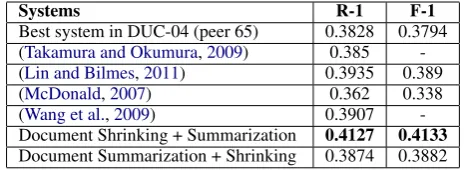
We compare the results of our systems (i.e., document shrinking + summarization or document summarization + shrinking) with other state-of-the-art generic summarization methods. The com-parison is shown in Table 1 where we report the values of ROUGE-1 recall and F-1 measure8 of
different approaches. From the table, we can see that our generic multi-document summarizer (doc-ument shrinking + summarization) significantly outperforms those systems in all measures. This result suggests the effectiveness of sentence com-pression and merging phase in our system. It also shows the effectiveness of using semantic similar-ity measures to select important sentences in the summary. Moreover, our system also uses a sepa-rate redundancy function which also helps to gen-erate summaries with less redundancy compared to the systems which only concentrate on sum-mary’s coverage and relevance. These results also confirm that the proposed strategy can improve summary quality.
We compare our query-focused summarizer with other state-of-the-art query summarization methods. Table 2 shows the comparison in terms 6The values for the query relevance coefficients are 4.0 and 2.0 forψandθrespectively, as found empirically using the development set DUC-2006 during the experiments.
7 http://jmlr.org/papers/volume5/lewis04a/a11-smart-stop-list/english.stop
8ROUGE runtime arguments for DUC-2004: ROUGE -a -c 95 -b 665 -m -n 4 -w 1.2
Systems R-1 F-1
Best system in DUC-04 (peer 65) 0.3828 0.3794 (Takamura and Okumura,2009) 0.385 -(Lin and Bilmes,2011) 0.3935 0.389
(McDonald,2007) 0.362 0.338
(Wang et al.,2009) 0.3907
-Document Shrinking + Summarization 0.4127 0.4133
Document Summarization + Shrinking 0.3874 0.3882
Table 1: Results on DUC-2004 Datasets
Systems R-2 F-2
Best system in DUC-07 (peer 15) 0.1245 0.1229 (Lin and Bilmes,2011) 0.1238 0.1233 (Toutanova et al.,2007) 0.1189 0.1189 (Haghighi and Vanderwende,2009) 0.118 -Document Shrinking + Summarization 0.1258 0.1264
Document Summarization + Shrinking 0.1133 0.1149
Table 2: Results on DUC-2007 Datasets
of ROUGE scores9 between our system and the
best performing systems. From the table, we can say that our query-focused multi-document sum-marizer (document shrinking + summarization) outperforms the best-known systems in 2007. It is notable that the best system in DUC-2007 takes the topic title as a query and uses Ya-hoo search engine to get a ranked set of retrieved documents which were used later to calculate the query relevance score (Pingali et al.,2007). How-ever, our system is totally unsupervised and does not use any external source for the summary gen-eration.
6 Conclusion
In this paper, we proposed a new summarization framework using different submodular functions with deep semantic features and abstraction-based methods. Abstraction-based methods help the sys-tem to obtain concise and more informative can-didate summary sentences. We selected the best sentences for the summary by maximizing the sub-modular objective function. The empirical results show that our generic and query-focused summa-rization model outperform the state-of-the-art sys-tems.
Acknowledgments
This research was supported by the Natu-ral Sciences and Engineering Research Council (NSERC) of Canada and the University of Leth-bridge.
References
R. Barzilay and K. R. McKeown. 2005. Sentence fu-sion for multidocument news summarization. Com-putational Linguistics, 31(3):297–328.
T. Berg-Kirkpatrick, D. Gillick, and D. Klein. 2011. Jointly learning to extract and compress. In Pro-ceedings of the 49th Annual Meeting of the Associ-ation for ComputAssoci-ational Linguistics: Human Lan-guage Technologies-Volume 1, pages 481–490. As-sociation for Computational Linguistics.
L. Bing, P. Li, Y. Liao, W. Lam, W. Guo, and R. J. Pas-sonneau. 2015. Abstractive multi-document sum-marization via phrase selection and merging. Pro-ceedings of the 53rd Annual Meeting of the Associ-ation for ComputAssoci-ational Linguistics and the 7th In-ternational Joint Conference on Natural Language Processing.
F. Boudin, H. Mougard, and B. Favre. 2015. Concept-based summarization using integer linear program-ming: From concept pruning to multiple optimal solutions. In Proceedings of the 2015 Conference on Empirical Methods in Natural Language Pro-cessing, pages 1914–1918. Association for Compu-tational Linguistics.
J. Carbonell and J. Goldstein. 1998. The use of mmr, diversity-based reranking for reordering documents and producing summaries. In Proceedings of the 21st annual international ACM SIGIR conference on Research and development in information retrieval, pages 335–336. ACM.
Y. Chali and M. Uddin. 2016. Multi-document summa-rization based on atomic semantic events and their temporal relationships. InAdvances in Information Retrieval, pages 366–377. Springer.
J. Cheng and M. Lapata. 2016. Neural summariza-tion by extracting sentences and words. In Proceed-ings of the 54th Annual Meeting of the Association for Computational Linguistics (Volume 1: Long Pa-pers), pages 484–494, Berlin, Germany. Association for Computational Linguistics.
J. C. Cheung and G. Penn. 2014. Unsupervised sen-tence enhancement for automatic summarization. In Proceedings of the 2014 Conference on Em-pirical Methods in Natural Language Processing (EMNLP), pages 775–786. Association for Compu-tational Linguistics.
S. Chopra, M. Auli, A. M. Rush, and S. Harvard. 2016. Abstractive sentence summarization with attentive recurrent neural networks. Proceedings of NAACL-HLT16, pages 93–98.
G. Cornuejols, M. L. Fischer, and G. L. Nemhauser. 1977. Location of bank accounts to optimize float: An analytic study of exact and approximate algo-rithms. Management Science, 23(8):789–810.
A. Dasgupta, R. Kumar, and S. Ravi. 2013. Summa-rization through submodularity and dispersion. In Proceedings of the 51st Annual Meeting of the As-sociation for Computational Linguistics ACL, pages 1014–1022.
G. Erkan and D. R. Radev. 2004. Lexrank: graph-based lexical centrality as salience in text summa-rization. Journal of Artificial Intelligence Research, pages 457–479.
C. Fellbaum, editor. 1998. Wordnet: An Electronic Database. MIT Press.
K. Filippova, E. Alfonseca, C. A. Colmenares, L. Kaiser, and O. Vinyals. 2015. Sentence compres-sion by deletion with lstms. InProceedings of the 2015 Conference on Empirical Methods in Natural Language Processing, pages 360–368.
K. Ganesan, C. Zhai, and J. Han. 2010. Opinosis: a graph-based approach to abstractive summarization of highly redundant opinions. InProceedings of the 23rd international conference on computational lin-guistics, pages 340–348. Association for Computa-tional Linguistics.
A. Haghighi and L. Vanderwende. 2009. Exploring content models for multi-document summarization. In Proceedings of Human Language Technologies: The 2009 Annual Conference of the North American Chapter of the Association for Computational Lin-guistics, pages 362–370. Association for Computa-tional Linguistics.
K. Hong and A. Nenkova. 2014. Improving the estima-tion of word importance for news multi-document summarization. InProceedings of the 14th Confer-ence of the European Chapter of the Association for Computational Linguistics, pages 712–721. Associ-ation for ComputAssoci-ational Linguistics.
K. Knight and D. Marcu. 2000. Statistics-based sum-marization - step one: Sentence compression. In Proceedings of the 17th National Conference on Ar-tificial Intelligence, Austin.
H. Lee, A. Chang, Y. Peirsman, N. Chambers, M. Surdeanu, and D. Jurafsky. 2013. Determin-istic coreference resolution based on entity-centric, precision-ranked rules. Computational Linguistics, 39(4):885–916.
C.-Y. Lin. 2004. Rouge: A package for automatic eval-uation of summaries. In Proceedings of the 42nd Annual Meeting of the Association for Computa-tional Linguistics, Workshop on Text Summarization Branches Out.
H. Lin and J. Bilmes. 2011. A class of submodular functions for document summarization. In Proceed-ings of the 49th Annual Meeting of the Association for Computational Linguistics: Human Language Technologies-Volume 1. Association for Computa-tional Linguistics.
C. D. Manning, M. Surdeanu, J. Bauer, J. Finkel, S. J. Bethard, and D. McClosky. 2014. The stanford corenlp natural language processing toolkit. In Pro-ceedings of the 52nd Annual Meeting of the Associ-ation for ComputAssoci-ational Linguistics System Demon-strations.
A. Martins and N. A. Smith. 2009. Summarization with a joint model for sentence extraction and com-pression. InProceedings of the Workshop on Inte-ger Linear Programming for Natural Language Pro-cessing, pages 1–9. Association for Computational Linguistics.
R. McDonald. 2007. A study of global inference al-gorithms in multi-document summarization. In Eu-ropean Conference on Information Retrieval, pages 557–564. Springer.
R. Mihalcea and P. Tarau. 2004. Textrank: Bringing order into texts. In Proceedings of EMNLP 2004, pages 404–411, Barcelona, Spain. Association for Computational Linguistics.
T. Mikolov, I. Sutskever, K. Chen, G. S. Corrado, and J. Dean. 2013. Distributed representations of words and phrases and their compositionality. In In Ad-vances in neural information processing systems, pages 3111–3119.
H. Morita, T. Sakai, and M. Okumura. 2011. Query snowball: a co-occurrence-based approach to multi-document summarization for question answering. In Proceedings of the 49th Annual Meeting of the Asso-ciation for Computational Linguistics: Human Lan-guage Technologies: short papers-Volume 2, pages 223–229. Association for Computational Linguis-tics.
R. Nallapati, F. Zhai, and B. Zhou. 2017. Sum-marunner: An interpretable recurrent neural network model for extractive summarization. In Proceed-ings of the 31st AAAI Conference on Artificial In-telligence, San Francisco. AAAAI Press.
D. Parveen, H. M. Ramsl, and M. Strube. 2015. Top-ical coherence for graph-based extractive summa-rization. In Proceedings of the 2015 Conference on Empirical Methods in Natural Language Pro-cessing, pages 1949–1954. Association for Compu-tational Linguistics.
D. Parveen and M. Strube. 2015. Integrating im-portance, non-redundancy and coherence in graph-based extractive summarization. InProceedings of the 24th International Joint Conference on Artificial Intelligence, page 12981304.
P. Pingali, K. Rahul, and V. Varma. 2007. Iiit hyder-abad at duc 2007. InProceedings of the Document Understanding Conference.
M.F. Porter. 1999. An algorithm for suffix stripping. Program, 14(3):130–137.
M. A. Rush, S. Chopra, and J. Weston. 2015. A neu-ral attention model for abstractive sentence summa-rization. InProceedings of the 2015 Conference on Empirical Methods in Natural Language Process-ing, pages 379–389. Association for Computational Linguistics.
H. Takamura and M. Okumura. 2009. Text summa-rization model based on maximum coverage prob-lem and its variant. InProceedings of the 12th Con-ference of the European Chapter of the Association for Computational Linguistics, pages 781–789. As-sociation for Computational Linguistics.
K. Thadani and K. McKeown. 2013. Supervised sen-tence fusion with single-stage inference. In Pro-ceedings of the International Joint Conference on Natural Language Processing, pages 1410–1418. K. Toutanova, C. Brockett, M. Gamon, J. Jagarlamudi,
H. Suzuki, and L. Vanderwende. 2007. The pythy summarization system: Microsoft research at duc 2007. InProceedings of the Document Understand-ing Conference.
D. Wang, S. Zhu, T. Li, and Y. Gong. 2009. Multi-document summarization using sentence-based topic models. In Proceedings of the ACL-IJCNLP 2009 Conference, pages 297–300. Associa-tion for ComputaAssocia-tional Linguistics.