Feasibility Study for Ellipsis Resolution in Dialogues
by Machine-Learning Technique
Y A M A M O T O K a z u h l d e a n d S U M I T A E i i c h i r o A T R I n t e r p r e t i n g T e l e c o m m u n i c a t i o n s Research L a b o r a t o r i e s
E - m a i l : y a m a m o t o @ i t l , atr. co. j p
A b s t r a c t
A m e t h o d for resolving the ellipses that appear in Japanese dialogues is proposed. This m e t h o d resolves not only the subject ellipsis, but also those in object and other grammatical cases. In this approach, a machine-learning algorithm is used to select the attributes necessary for a res- olution. A decision tree is built, and used as the actual ellipsis resolver. The results of blind tests have shown that the proposed m e t h o d was able to provide a resolution accuracy of 91.7% for indirect objects~ and 78.7% for subjects with a verb predicate. By investigating the decision tree we found that topic-dependent attributes are necessary to obtain high performance res- olution, and t h a t indispensable attributes vary according to the grammatical case. The prob- lem of data size relative to decision-tree training is also discussed.
1 I n t r o d u c t i o n
In machine translation systems, it is necessary to resolve ellipses when the source language doesn't express the subject or other grammat- ical cases and the target must express it. The problem of ellipsis resolution is also troublesome in information extraction and other natural lan- guage processing fields.
Several approaches have been proposed to resolve ellipses, which consist of endophoric (intrasentential or anaphoric) ellipses and ex- ophoric (or extrasentential) ellipses. One of the major approaches for endophoric ellipsis in the- oretical basis utilizes the centering theory, ttow- ever, its application to complex sentences has not been established because most studies have
only investigated its effectiveness with succes-
sive simple sentences.
Several studies of this problem have been
made using the empirical approach. Among
them, Murata and Nagao (1997) proposed a scoring approach where each constraint is man- uMly scored with an estimation of possibility, and the resolution is conducted by totaling the points each candidate receives. On the other hand, Nakaiwa and Shiral (1996) proposed a resolving algorithm for Japanese exophoric el- lipses of written texts, utilizing semantic and pragmatic constraints. They claimed that 100% of the ellipses with exophoric referents could be resolved, but the experiment was a closed test with only a few samples. These approaches al- ways require some effort to decide the scoring or the preference of provided constraints.
Aone and Bennett (1995) applied a machine- learning technique to anaphora resolution in written texts. They a t t e m p t e d endophoric ellip- sis resolution as a part of anaphora resolution, with approximately 40% recall and 74% preci- sion at best from 200 test samples. However, they were not concerned with exophoric ellipsis. In contrast, we applied a machine-learning ap- proach to ellipsis resolution (Yamamoto et al., 1997). In this previous work we resolved the agent case ellipses in dialogue, with a limited topic, and performed with approximately 90% accuracy. This does not sufficiently determine the effectiveness of the decision tree, and the feasibility of this technique in resoh, ing ellipses by each surface case is also unclear.
We propose a m e t h o d to resolve the ellipses that appear in Japanese dialogues. This method resolves not only the subject ellipsis, but also the object and other grammatical cases. In this approach, a machine-learning algorithm is used to build a decision tree by selecting the neces- sary attributes, and the decision tree is used as the actual ellipsis resolver.
in the problem of ellipsis resolution. In the fol- lowing sections, we discuss topic-dependency in decision trees and compare the resolution effec- tiveness of each grammatical case. The problem of d a t a size relative to the decision-tree training is also discussed.
In this paper, we assume that the detection of ellipses is performed by another module, such
as a parser. W e only considered ellipses that are
commonly and clearly identified.
2 W h e n t o
R e s o l v e Ellipsis
in M T ?As described above, our major application for ellipsis resolution is in machine translation. In an MT process, there can be several approaches about the timing of ellipsis resolution: when analyzing the source language, when generat- ing the target language, or at the same time as translating process. Among these candidates, most of the previous works with Japanese chose
the source-language approach. For instance,
Nakaiwa and Shirai (1996) attempted to re- solve Japanese ellipsis in the source language analysis of J-to-E MT, despite utilizing target- dependent resolution candidates.
We originally thought that ellipsis resolution in the MT was a generation problem, namely a target-driven problem which utilizes some help, if necessary, of source-language informa- tion. This is because the problem is output- dependent and it relies on demands fl'om a target language, in the J-to-Korean or J-to- Chinese MT, all or most of the ellipses that must be resolved in J-to-E are not necessary to resolve.
ttowever, we adopted source-language policy in this paper, with the necessity that we con- sider a multi-lingual MT system T D M T (t.'uruse et al., 1995), that deals with both J-to-E and J- to-German MT. English and German grammar are not generally believed to be similar.
3
Ellipsis Resolution
b y M a c h i n e L e a r n i n gSince a huge text corlms has become widely available, the machine-learning approach has been utilized for some problems in natural lan- guage processing. The most popular touchstone in this field is the verbal case fl'ame or the trans- lation rules (Tanaka, 1994). Machine-learning algorithm has also been attempted to solve some
Table 1: Tagged Ellipsis Types
Tag Meaning
(lsg) first person, singular
(lpl/
<2sg>
(2pl)
<g>
<a)
first person, plural second person, singular second person, plural person(s) {n g e n e r a l - - anaphoric
discourse processing problems, for example, in discourse segment boundaries or discourse cue
words (Walker and Moore, 1997). This sec-
tion describes a method to apply a decision-tree learning approach, which is one of the machine- learning approaches, to ellipsis resolution.
3.1
Ellipsis Tagging
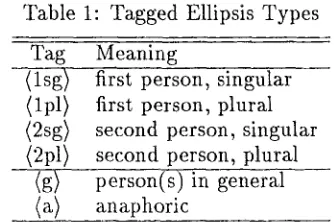
In order to train and evaluate our ellipsis re- solver, we tagged some ellipsis types to a di- alogue corpus. The ellipsis types used to tag the corpus are shown in Table 1. Each ellipsis marker is tagged at the predicate. We made a distinction between first or second person and
person(s) in general. Note that
'person(s) in
gcncral'
refers to either an unidentified or an unspecified person or persons. In Far-Eastern languages such as 3apanese, Korean, and Chi- nese, there is no grammatically obligatory case such as the subject in English. It is thus neces- sary to distinguish such ellipses.We also made a tag '(a)' which means the mentioned ellipsis is anaphoric; in case we need to refer back to the antecedent in the dialogue. In this paper we are not concerned with resolv- ing the antecedent that such ellipses refer to, because it is necessary to have another module to deal with the context for resolving such en- dophoric ellipses, and the main target of this paper is the exophoric ellipses.
3.2 L e a r n i n g M e t h o d
We used the
C~.5
algorithm by Quinlan (1993), [image:2.612.347.514.73.184.2]Table 2: N u m b e r of training attributes
A t t r i b u t e s Num.
Content words ( p r e d i c a t e ) 100
Content words (case frame) 100
Func. words (case particle) 9
Func. words (conj. particle) 21
Func. words (auxiliary verb) 132
Func. words (other) 4
Exophoric information 1
Total 367
nett (1995), which a t t e m p t e d to discuss prun- ing effects on the decision tree, no more con- clusions are expected other than a trade-off be- tween recall and precision. We leave the details of decision-tree learning research to itself.
3.3 T r a i n i n g A t t r i b u t e s
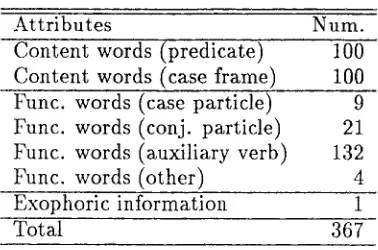
The training attributes t h a t we prepared for Japanese ellipsis resolution are listed in Table 2. Tile training attributes in the table are clas- sified into the following three groups:
• Exophoric information: Speaker's social role.
• Topic-dependent information:
Predicates and their semantic categories.
. Topic-independent information:
FunctionM words which express tense, modality, etc.
There is one approach that only uses topic- independent information to resolve ellipses
that appear in dialogues. However, we took
the position t h a t both topic-dependent and - independent information should have different
knowledge. Thus, approaches utilizing only
topic-independent knowledge must have a per- formance limit for developing an ellipsis resolu- tion system. It is practical to seek an a u t o m a t - ically trainable system t h a t utilizes both types of knowledge.
The effective use of exophoric information, i.e., from the actual world, m a y perform well for resolving an ellipsis. Exophoric information consists of a lot of elements, such as the time, the place, the speaker, and the listener of the ut- terance. However, it is difficult to become aware
of some of t h e m , and some are r a t h e r difficult to prescribe. Thus we utilize one element, the speaker's social role, i.e., w h e t h e r the speaker is the customer or the clerk. The reason for this is t h a t it m u s t be an influential a t t r i b u t e , and it is easy to detect in the actual world. M a n y of us would accept a real system such as a spoken- language translation system t h a t detects speech with i n d e p e n d e n t microphones.
It is generally agreed t h a t attributes to re- solve ellipses should be different in each case. Thus although we have to prepare t h e m on a case by case basis, we t r a i n e d a resolver with the same attributes.
Because we must deal with the noisy input t h a t appears in real applications, the training attributes, o t h e r t h a n the speaker's social role, are questioned on a morphological basis. We give each a t t r i b u t e its positional information, i.e., search space of m o r p h e m e s from the target predicate. Positional information can be one of five kinds: before, at the latest, here, next, and afterward. For example, a case particle is given the position of
'before',
the search position of a prefix 'o-' or'go-'
is the'latest',
and an auxil- iary verb is'after'
the predicate. The attributes of predicates, and their semantic categories are placed in'here'.
For predicate semantics, we utilized the top
two layers of
Kadokawa Ruigo Shin-Jiten, a
three-layered hierarchical Japanese thesaurus.
4 D i s c u s s i o n
In this section we discuss the feasibility of tile el- lipsis resolver via a decision tree in detail from three points of view: the a m o u n t of training data, the topic dependency, and the case differ- ence. The first two are discussed against ~ga(v.)' case (see subsection 4.3).
We used F-measures metrics to evaluate the
performance of ellipsis resolution. The F-
measure is calculated by using recall and pre- cision:
2 x P x R
r - P + R (1)
[image:3.612.90.279.82.207.2]Table 3: Training size and performance
Dial. Samp.
25 463
50 863
100 1710
200 3448
400 6906
(lsg) (2sg} (a) Total
71.0 55.6 66.2 59.0
76.4 69.7 71.5 67.2
82,1 76.4 77.0 73.2
85.1 79.8 79.7 76.7
84.7 81.1 82.0 78.7
4.1 A m o u n t o f T r a i n i n g D a t a
We trained decision trees with a varied num- ber of training dialogues, namely 25, 50, 100, 200 and 400 dialogues, each of which included a smaller set of training dialogues. The exper- iment was done with 100 test dialogues (1685 subject ellipses), and none were included in the training dialogues.
Table 3 indicates the training size and perfor- mance calculated by F-measure. This illustrates that the performance improves as the training size increases in all types of ellipses. Although it is not shown in the table, we note that the results in both recall and precision improve con- tinuously as well as those in F-measure.
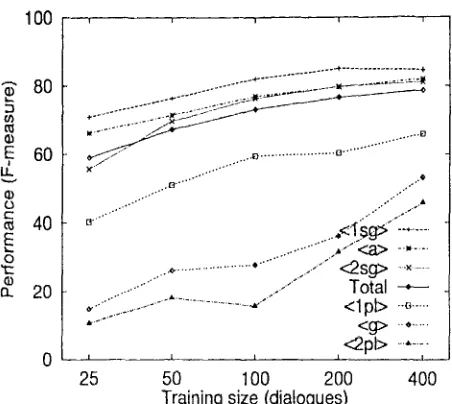
The performance difference of all ellipsis types by training size is also plotted in Fig-
ure 1 on a semi-logarithmic scale. It is in-
teresting to see from the figures that the rate of improvement gradually decelerates and that some of the ellipsis types seem to have practi- cally stopped improving at around 400 training dialogues (6806 samples). Aone and Bennett (1.995) claimed that the overall anaphora res- olution performance seems to have reached a plateau at around 250 training examples. This result, however, indicates that 1 0 4 ,.o 1 0 5 train-
ing samples would be enough to train the trees in this task.
The chart gives us more information that per- formance limitation with our approach would be 8 0 % ~ 85% because each ellipsis type seems to approach the similar value, in particular for those in large training samples (lsg) and (2sg). Greater performance improvement is expected by conducting more training in (2pl} and (g).
4.2 T o p i c D e p e n d e n c i e s
It is completely satisfactory to build resolution knowledge only with topic-independent infor- mation. Itowever, is it practical? We will dis- cuss this question by conducting a few experi-
100 -.,
80
E 60
t l .
0) o
40
o '1:=
a_ 20
. . . - - - + . . . ÷
7/" " . . . . : ~ - . . . B . . . Q . . .
- - ' " ' " ' " •
[image:4.612.314.540.63.265.2] [image:4.612.76.294.77.177.2]. . . . Z
... " .... ..-'" <2sa>~ ...
... "" Total 4 - -
. " " . . . . ' <1o1> -'~ ...
< g > ..o ...
<2pl> ...
I oL~__ l I I
25 50 100 200 4 0 0
Training size (dialogues)
Figure 1: Training size and performance
merits.
We utilized the A T R travel arrangement cor- pus (Furuse et al., 1994). The corpus contains dialogues exchanged between two people. Var- ious topics of travel arrangements such as im- migration, sightseeing, shopping, and ticket or- dering are included in the corpus. A dialogue consists of 10 to 30 exchanges. We classified di- alogues of the corpus into four topic categories:
H1 tlotel room reservation, modification and cancellation
H2 Ifotel service inquiry and troubleshooting
HR Other hotel arrangements, such as hotel se- lection and an explanation of hotel facilities
R Other travel arrangements
Fifty dialogues were chosen randomly fl'om the corpus in the topic category H1, H2, R, and the overall topic T ( = H1 + H2 + HR + R) as train- ing dialogues. We used 100 unseen dialogues as test samples again, which were the same as the samples used in the training-size experiment.
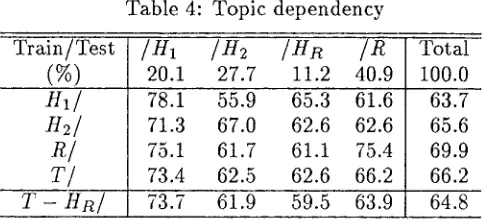
Table 4 shows the topic-dependency of each topic category that we provide with the F- measure. For instance, the first figure in the
'T/'
row (73.4) denotes that the accuracy withTable 4: Topic d e p e n d e n c y
T r a i n / T e s t
(%)
H1/
H2/
R~
T~
/H1
/t12
/HR
/R
T o t a l20.1 27.7 11.2 40.9 100.0
78.1 55.9 65.3 61.6
71.3 67.0 62.6 62.6
75.1 61.7 61.1 75.4
73.4 62.5 62.6 66.2
63.7 65.6 69.9 66.2
T - Ht{/ 73.7 61.9 59.5 63.9 64.8
The results illustrate t h a t very high accu- racy is obtained when a training topic and a
test topic coincide. This implies the impor-
tance not to train dialogues of unnecessary top- ics if the resolution topic is imaginable or re- stricted, in order to obtain higher performance. A m o n g four topic subcategories, topic R shows the highest accuracy (69.9%) in total perfor-
mance. T h e reason is not t h a t topic R has
something i m p o r t a n t to train, but t h a t topic R contains the most test dialogues chosen at random.
The table also illustrates t h a t a resolver trained in various kinds of topics ( ' T / ' ) demon- strates higher resolving accuracy against the testing d a t a set. It performs with b e t t e r than average accuracy in every topic compared to one which is trained in a biased topic. By looking at some examples it m a y be possible to build an all-around ellipsis resolver, but topic-dependent features are necessary for b e t t e r performance.
The 'T - H R / ' resolver shows the lowest per-
formance (59.5%) against ' / H R ' test set. This
result is more evidence supporting the impor- tance of t o p i c - d e p e n d e n t features.
4.3 D i f f e r e n c e in S u r f a c e C a s e
We applied a machine-learned resolver to agent case ellipses ( Y a m a m o t o et al., 1997). In this paper, we discuss w h e t h e r this technique is ap- plicable to surface cases.
We examined the feasibility of a m a c h i n e - learned ellipsis resolver for three principal sur-
face cases in Japanese, 'ga', 'wo', and 'ni '1.
Roughly speaking, t h e y express the subject, the direct object, and the indirect object of a sen-
tence respectively. We classified the 'ga' case
into two samples: a predicate of a sentence with
a 'ga' case ellipsis that is a verb or an adjective.
l\'Ve c a n n o t investigate o t h e r optional cases due to a lack of samples.
Table 5: P e r f o r m a n c e of m a j o r types in case
C a s e
ga(adj.)
WO
ni(isg) {2sg) (a)
Total58.3 68.1 85.9 79.7
66.7 - - 97.7 95.6
95.2 95.7 81.9 91.7
ga(v.) 84.7 81.1 82.0 78.7
In other words, this distinction corresponds to w h e t h e r a sentence in English is a be-verb or a general-verb sentence. Henceforth, we call t h e m
'ga(v.)' and 'ga(adj.)' respectively.
The training a t t r i b u t e s provided are the same in all surface cases. T h e y are listed in Table 2. In the experiment, 300 training dialogues and 100 unseen test dialogues were used. The fol- lowing results are shown in Table 52 . The table illustrates t h a t the ga(adj.) resolver has a simi- lar performance to the ga(v.) resolver, whereas the former has a distinctive t e n d e n c y toward the latter in each ellipsis type. The ga(adj.) case resolver produces unsatisfactory results in (lsg) and (2sg} ellipses, since insufficient samples ap- peared in the training set.
In the 'wo' case, more t h a n 90% of the sam- ples are tagged with (a), thus t h e y are easily rec- ognized as anaphoric. Although it m a y be diffi- cult to decide the antecedents in the anaphoric ellipses by using information in Table 2, the re- sults show t h a t it is possible to simply recog- nize them. After recognizing that the ellipsis is anaphoric, it is possible to resolve t h e m in other contextual processing modules, such as center- ing.
It is i m p o r t a n t to note t h a t a satisfactory per-
formance is presented for the 'ni' case (mostly
indirect object). One reason for this could be t h a t m a n y indirect objects refer to exophoric persons, and thus an approach utilizing a deci- sion tree that makes a selection from fixed de- cision candidates is suitable for 'hi' resolution.
5 I n s i d e a D e c i s i o n T r e e
A decision tree is a convenient resolver for some kinds of problems, but we should not regard it as a black-box tool. It tells us what attributes are i m p o r t a n t , w h e t h e r or not the attributes are
[image:5.612.57.299.76.186.2]6 9
¢.~
C} Z
5000
2000
1000
500
200
1 O0
50
300
. i L = i
500 1000 2000 5000 10000
Training samples
ga(v.) ga(a.}
n l
W O x
.i.
Figure 2: Training samples vs. nodes
Table 6: D e p t h and m a x i m u m width of decision tree
ga/25 /100 /400 ga(adj.) wo ni
Depth 27 34 49 28 10 18
W i d t h 26 58 146 52 10 28
sufficient, and sometimes more. In this section, we investigate decision trees and discuss them in detail.
5.1 T r e e S h a p e
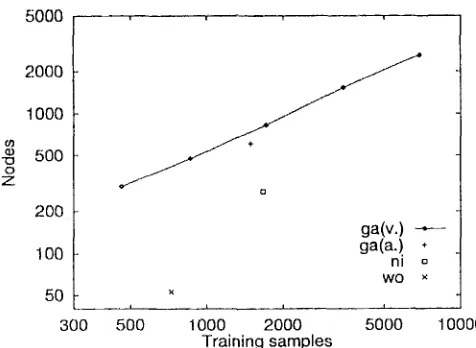
The relation between the n u m b e r of training samples and the number of nodes in a decision tree is shown logarithmically in Figure 2. It is clear from the chart t h a t the two factors of 'qa(v.)' ease are logarithmically linear. This is because no pruning is conducted in building a decision tree. We also see t h a t a more compact tree is built in the order of 'wo', 'hi', 'ga(adj.)' and 'ga(v.)'. This implies t h a t the 'wo' case is the easiest of the four cases for characterizing the individuality a m o n g the ellipsis types.
Table 6 shows node depth and the m a x i m u m width in the decision trees we have built. By studying Table 5 and Table 6, we can see that the shallower the decision tree is, the b e t t e r the resolver performs. One explanation for this m a y be t h a t a deeper (and m a y b e bigger) decision tree fails to characterize each ellipsis type well, and thus it performs worse.
5.2 A t t r i b u t e C o v e r a g e
We define a factor 'coverage' for each attribute.
A t t r i b u t e coverage is the rate of the samples
used to reach a decision a b o u t the samples used to build a decision tree. If an a t t r i b u t e is used at the top node of a decision tree, the a t t r i b u t e coverage is 100% in the definition, because all samples use it (first) to reach their decision. From this, we can learn the participation of each attribute, i.e., each a t t r i b u t e ' s importance.
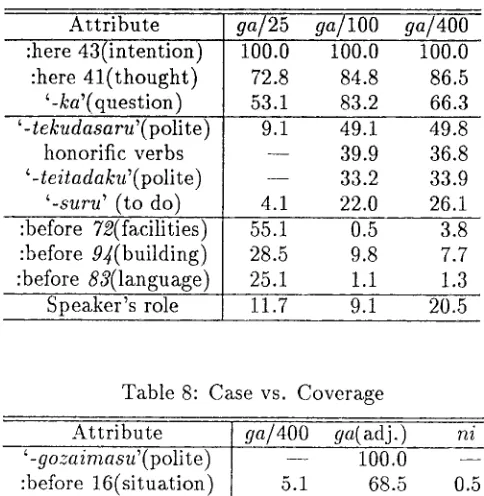
Some typical attribute-coverages are ex- pressed in Table 7. Note t h a t 'ga(25)' denotes the results o f ' g a ( v . ) ' with 25-dialogue training. A glance at the table will reveal t h a t the cover- age is not constant with an increasing n u m b e r of training dialogues. Itere we build a hypothe- sis from the table t h a t more general attributes are preferred with a increase in training size.
The table illustrates t h a t the topic-
independent attributes increase with a rise
in training size, such as '-tek~tdasaru' or '-
teitadaku' (both auxiliary verbs which express
the hearer's action toward the speaker with the speaker's respect). The table shows in contrast t h a t the topic-dependent attributes decrease, such as ':before 72' (a category in which words
concerned with intention are included before
the predicate mentioned) or ':before 9/~'. There are also some t o p i c - i n d e p e n d e n t words such as
'-ka' (a particle t h a t expresses that the sentence
is interrogative) or ':before ~ I / ~ 3 '3 which are still i m p o r t a n t regardless of the training size. This indicates the advantages of at machine- learning approach, because difficulties always arise in differentiating these words in manual approaches.
Table 8 also contrasts typical coverage in sur- face cases. It illustrates t h a t there is a distinct
dilference between 'ga(v.)' atnd 'ga(adj.)'. The
resolver of the 'ga(adj.)' case is interested in a n o t h e r cases, such as '-de' or contents of an-
other case ':before 16/3~', whereas 'ga(v.)' case
resolver checks some predicates and influential functional words. Coverage of each a t t r i b u t e in
the 'hi' case. has similar tendencies to those in
the 'ga(v.)' case, except for a few attributes.
6 C o n c l u s i o n a n d F u t u r e W o r k
This paper proposed a m e t h o d for resolving the ellipsis that appear in J a p a n e s e dialogues. A machine-learning algorithm is used as the ac-
3We practically regard them as topic-independent
words, because expressing the speaker's inten-
[image:6.612.62.300.64.238.2]Table 7: Training Size vs. Coverage
A t t r i b u t e :here 43(intention)
:here 41(thought) '-ka'(question)
ga/25 ga/lO0 ga/400
100.0 100.0 100.0
72.8 84.8 86.5
53.1 83.2 66.3
'-tekudasaru'(polite)
9.1 49.1 49.8honorific verbs - - 39.9 36.8
'-teitadaku'(polite)
- - 33.2 33.9'-suru'
(to do) 4.1 22.0 26.1:before 72(facilities) 55.1 0.5 3.8
:before 94(building) 28.5 9.8 7.7
:before 83(language) 25.1 1.1 1.3
Speaker's role 11.7 9.1 20.5
Table 8: Case vs. Coverage
A t t r i b u t e
ga/400
ga(adj.)ni
'-gozaimasu'(polite)
- - 100.0 - -:before 16(situation) 5.1 68.5 0.5
:before 34(statement) 5.3 59.0 11.2
'-de'(case particle) 5.2 23.9 1.9
'-el-go'
46.4 7.0 100.0:here 43(intention) 100.0 - - 49.8
:here 41(thought) 86.5 - - 43.5
Speaker's role 20.5 33.1 28.0
tual ellipsis resolver with this approach. The results of blind tests have proven that the pro- posed m e t h o d is able to provide a satisfactory resolution accuracy of 91.7% in indirect objects, and 78.7~ in subjects with verb predicates.
We also discussed training size, topic depen- dency and difference in grammatical case in a decision tree. By investigating decision trees, we conclude that topic-dependent attributes are also necessary for obtaining higher performance, and that indispensable attributes depend on the grammatical case to resolve.
Although this paper limits its scope, the pro- posed approach may also be applicable to other problems, such as referential property and the number of nouns, and in other languages such as Korean. In addition, we will explore contex- tual ellipses in the future, since it was found that most of the ellipses that appeared in spo- ken dialogues are found to be anaphoric in the
WO' c a s e .
Acknowledgment
The authors would like to thank Dr. Naoya Arakawa, who provided data regarding case el-
lipsis. We are also thankful to Mr. Hitoshi
Nishimura for conducting some experiments.
References
C. Aone and S. W. Bennett. 1995. Evaluat- ing A u t o m a t e d and Manual Acquisition of
Anaphora Resolution Strategies. In
Prec. of
33rd Annual Meeting of the A CL,
pages 122- 129.O. Furuse, Y. Sobashima, T. Takezawa, and
N. Uratani. 1994. Bilingual Corpus for
Speech Translation. In
Prec. of AAAI'9g
Workshop on the Integration of Natural Lan-
guage and Speech Processing,
pages 84-91. O. Furuse, J. Kawal, H. Iida, S. Akamine,and D.-B. Kim. 1995. Multi-lingual Spoken- Language Translation Utilizing Translation
Examples. In
Prec. of Natural Language Pro-
ccssing Pacific-Rim Symposium (NLPRS'95),
pages 544-549.
M. Murat~ and M. Nagao. 1997. An Estimate of Referents of Pronouns in Japanese Sen- tences using Examples and Surface Expres-
sions.
Journal of Natural Language Process-
ing,
4(1):87-110. written in Japanese. H. Nakaiwa and S. Shirai. 1996. Anaphora Res-olution of Japanese Zero Pronouns with Deic-
tic Reference. in
Prec. of COLING-96,
pages812-817.
J. R. Quinlan. 1993.
C~.5: Programs for" Ma-
chine Learning.
Morgan Kaufmann.H. Tanaka. 1994. Verbal Case Frame Ac-
quisition from a BiliunguM Corpus: Grad-
ual Knowledge Acquisition. In
Prec. of
COLING-9J,
pages 727-731.M. Walker and J. D. Moore. 1997. Empirical
Studies in Discourse.
Computational Linguiso
tics,
23(1):1-12, March.K. Yamamoto, E. Sumita, O. Furuse, and H. Iida. 1997. Ellipsis Resolution in Dia-
logues via Decision-Tree Learning. In
Prec.
of Natural Language Processing Pacific-Rim
[image:7.612.58.300.87.335.2]A T R ~ - ~ " " ~ '" ~ . . . .
E - m a i l : y a m a m o t o © i t l , atr. co. j p
~, H ~ I . % I o ) i ~ i I ~ . I L ) ~ , ' C l t , :: t 6 ~ ' ~ I I t a .
: i ¢ o i i I ~ 0 ) l l l l l ' ~ . ~ 5 I I I : ; I , 1 1 1 1 1 } (-i~l~ll:s,jWo)Ifllit _I1.) l l ] t £ ~.~ I ! i k I ~ o
~g~,~W'l~, ~'lil~-~5-~l]~O)i~$~;,j,: (decision
ll~/tT~-~'it~ (exophoric ellipsis) c/)1t7~ <k ~ l ; ~ ' l t f i
f it'!" ~7"~
(endophoric ellipsis) O)~,~ll ~ V' 5 Pfi]~ ,. £ & c
¢ llI~ k 1_., X ; l l r ~ I ' ~ l l : t ~ J - m $17~_'.li~ka,,'~a)tJ $.x/t k - I ;i, ,;
l'l:¢-.7£1"(llzlI-l!~©lfll'l;k~l[£: b - d , 71D!]-I.~I" :~-I i l~C lflil k l ~ l J l I / f f I - - ' i - I t~?.: : - ~ x , t 1 " 5 " " . / - i x a) <;9. k 11 t,, ?.: 7J:LlI'lq-:a) 7f,'j v,"@tk ¢ :l~-;.$:-"t-&o ¢~¢:I:-};!~, 4 $ ~ © ~ - e ' ~ x , Miajg #.,. ~ / ' } - . ~ x k t , , t - " ; t q . 6 , f d . ~ t ~ t , , L : ~ , JulY_
:k o)tt1~¢,£ f~ b_ t- m o
h ~ l - ~ t , [/~'J ~Ik Fl:J ~ILt~t-cIl-l-3,),21
.-~-c:l'~l I ¢~ f c ) ~ l : ¢ l i ~ i - 1 - D c P_ ¢ l'f~i.l, b/.:o FC~J JlI:PZgb-CIl, !~)ill-~l),JWT)"!!;/6#.J-dk
b , ~:Ff~J,~-itlD,l"-t:.£ t~.ilI, D- ~ ~ k $ - e -3 1:o
~0;5o
D+i6 S o
710 4 ,---, 10 5 I J ' ] / W ' T P " L ~ ' - [ - ~ 7 - O ~ $ o ~O"JW.~