Diffusion of Emergency Warnings via Multi-Channel
Communication Systems
An empirical analysis
Michael Klafft
FOM University of Applied Sciences and
Fraunhofer Institute for Open Communication Systems FOKUS Berlin, Germany
[email protected] Abstract—This paper analyzes the propagation of emergency
alerts and emergency-related information via multi-channel communication systems. Results of two empirical studies are presented. The first study was conducted with 362 test users in a rural area in Germany and analyzes how quickly recipients actually notice a warning after it has been issued via multiple channels (SMS, E-Mail, pagers). The second study involving 13,950 participants from Hamburg, Germany, focuses on information search behaviour and analyzes access patterns to a disaster-related website after distribution of an official (test) warning message.
Keywords— Multi-channel alerting systems; alert propagation; information search behaviour.
I. INTRODUCTION
After the end of the “cold war”, investments in alerting systems for the general population were reduced in many European countries. As a consequence, the previously existing alerting infrastructure (sirens in particular) was either dismantled, or its coverage and / or availability decreased due to lack of maintenance. In the meantime, authorities mainly relied on mass media (TV, radio) to close the gap on the last mile when alerting the public. More recently, however, attempts have been made to use other technologies to communicate with citizens in emergency situations. This relates both to single-channel approaches (like cell broadcasting [1], which is currently the preferred solution in the Netherlands), or multi-channel alerting systems which combine, for example, SMS, e-mail, and RSS feeds [2]. The question, however, is how quickly recipients actually notice warnings distributed via recently established multi-channel alerting tools. Additionally, it would be desirable to know if and how recipients access additional information and instructions beyond the often very limited amount of text provided in the first warning. This paper is going to address these issues by summarizing existing research on alert distribution (section II.). Subsequently, results from two case studies in Germany are presented. The first case analyzes the perception velocity of warnings jointly issued via SMS, e-Mail and pagers (section III.), and the second case focuses on information search patterns on an official, dedicated alert
information website after conducting a mass test alert (section IV). Finally, the paper concludes with a summary and outlook (section V).
II. PREVIOUS RESEARCH ON EMERGENCY ALERTING
According to Jagtman [1] and the United Nations [3], successful alerting depends on passing the following steps:
a. alert messages must be sent properly [1],
b. messages have to be received by the individual [1],
c. messages must be read [1], d. messages must be understood [3], e. messages must be verified [3],
f. messages must be personalized [3], and
g. the recipient has to carry out the action required in the message [1].
A lot of research has been conducted to analyze the first steps of the alerting process, i.e. sending and receiving alert messages. These studies have mainly followed three different approaches:
1. Analysis of statistics for different media, such as the technical coverage, the availability of the medium among the population, and usage statistics (e.g., the proportion of people who have turned on their radio or TV to different channels, or the number of mobile phones or other devices being connected to wireless communication networks at any given point in time). These statistics provide valuable input on the ability to send, and, in theory, reach a recipient. A prominent study following this approach for Germany is [4]. However, this research provides less insight into the dimensions of noticing/reading, understanding, and acting.
2. A second approach uses dissemination simulation models to obtain insights into emergency alert propagation. Studies following this approach have
This research was in part financed by the European Commission through the Opti-Alert project grant (Grant Agreement No. 261699).
been conducted in the United States [5]. These models included multi-channel alerting. Their empirical fit to real-world alert propagation data was fairly accurate. However, due to the time of publication of these studies, more recent communication media like SMS or e-mails have not been included in the analysis. 3. A third approach analyzes the perception of alert
messages by collecting user feedback after test alerts. Such analyses have, for example, been conducted for automated fixed-line telephone calls ([6], in Australia) and for cell broadcasts and SMS ([1], in the Netherlands). However, these trials did not analyze the potential of combining multiple alert channels to reach the public.
As can be seen, existing studies either do not take recent communication technologies into account, fail to address multi-channel alerting, or are focused on sending and receiving messages, but not on noticing the alert. The goal of this paper is to narrow some of these existing gaps on alert message dissemination.
III. DIFFUSION OF MULTI-CHANNEL ALERTS
In order to analyze the diffusion of alert messages, which are sent simultaneously via multiple communication channels, a trial was conducted in Aurich County in Northern Germany. The trial used the “Katwarn” multi-channel alerting system [7], which offered the possibility to distribute alerts via SMS, e-mail, and pagers1. In total, 362 test-users were acquired with the help of the regional emergency management authority. These test-users were mainly people who were able to act as first responders, as multipliers or they had the competence and the resources to play a supportive role in emergency manage-ment. This setting was chosen because it is of particular relevance to reach people with a first response capability in emergency situations. Overall, about 92% of trial participants had some affiliation to emergency management or self-help volunteer organizations, whereas 8% were members of the general public (mainly relatives of people from the first group).
Before starting the trial, 99% of participants registered their mobile phone number so that they could receive SMS alerts. Some 156 participants (43%) subscribed to alerting via e-mail. Seven test users (2%) were provided with dedicated paging devices (due to the cost issues and limited availability of pagers, these devices had to play a minor role in this trial). In total, 160 alert recipients (44%) chose more than one communication channel.
The test itself was conducted as follows: Before the trial, all registered participants were informed about the alerting procedure. They were informed that they would receive a test
1 The Katwarn system is currently available in five German
cities and five counties (as of November 21st, 2012).
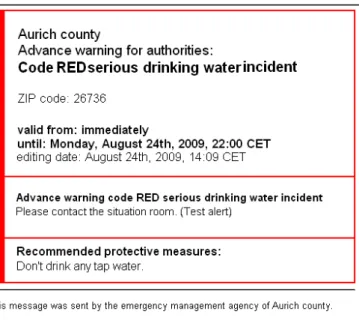
alert in the days to come, and were asked to confirm the alert via e-mail or SMS as soon as they had noticed and read the corresponding message. Emergency managers in the situation room of Aurich County then randomly chose the timing for starting the trial. The alert message was finally generated and sent on August 24th, 2009 at 14:09 CET. Figure 1 displays the
distributed alert message:2
Figure 1: Test alert message distributed via e-mail
As can be seen from the figure, the alert message followed a standardized coding scheme and comprised the following information:
- information about the authority who is responsible for issuing the alert,
- information on the severity of the alert following a colour-based scheme (here: alert level red, severe danger),
- information about the reason for the alert (drinking water incident),
- area for which the alert has been issued (here: ZIP code 26736),
- expected duration of the alert,
- instructions what to do (contact the situation room), and,
- recommended protective measures (don’t drink any tap water).
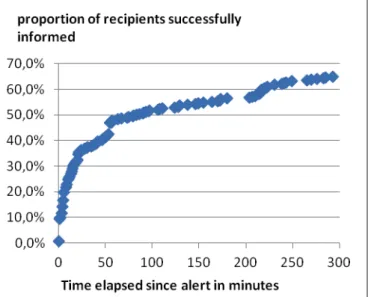
After issuing the alert, responses from the test users about noticing the warning were collected and analyzed. Figure 2 shows – over a time period of five hours after the alert – the proportion of trial participants who had actually read and confirmed the alert.
2 This is the alert message distributed via e-mail. The message
Figure 2: Proportion of trial recipients noticing the alert
As can be seen from Figure 2, approx. 25% noticed and read the alert within ten minutes. This ratio increased to 32.4% within twenty minutes, to 47.9% within one hour and reached 64.8% after five hours. The ratio then increased further to 88.3% within 48 hours.
The results indicate that, compared to previous studies [5], using multi-channel alerting via SMS and e-mail (and, to a very limited extent, pagers) can be more effective than alerting via mass media in the short term3, but is slightly inferior to
alerting via sirens. However, it must be taken into account that, after having noticed a siren, additional action is required by the recipient to determine the nature of the emergency and recommended protective actions. The system presented here provides this information immediately.
Another interesting pattern observed from the users’ feedback is the relevance of interpersonal effects. On several occasions, users jointly provided feedback, such as “Me and my wife received the alert” or “Fifteen colleagues in office XYZ received the alert”. In these cases, one user apparently noticed the alert first and informed his or her peers, who subsequently verified if they also had received the warning.
As stated above, 88.3% of the trial participants confirmed to have received an alert. We therefore tried to find out what happened to the remaining participants. As can be seen from Figure 3, technical problems when distributing the message were observed with about 2% of test users, mainly due to incorrect phone numbers (5 cases) but also due to failures to send e-mails (one incorrect e-mail address, one case where the mailbox had run out of space). An additional 3.3% of test users explicitly complained not to have received any alert at
3 In more densely populated areas, this may require a
prioritization agreement with mobile network operators to assure fast delivery of SMS alerts.
all, although no technical failures could be observed in the distribution process. In these cases, alert recipients were probably temporarily out of reach of the mobile phone network when the alert SMS was sent (rural area!), or they had switched off their mobile phone so long that the SMS expired (e.g., due to a broken cell phone, as reported in one case).
Figure 3: User feedback (after 48 hours)
With 94.2% of test users providing feedback, the response rate of the trial was very high. However, some caveats have to be made when interpreting the results. First, the results may only apply to daytime alerts on a working day in a rural area. Response patterns in major cities might differ substantially, and the swiftness of response is likely to decrease drastically at night when the majority of recipients will be asleep. SMS alerts only provide a limited wake-up effect (and, unless synchronized with a smartphone, e-mails will provide no wake-up effect at all). Furthermore, the newly established alerting system mainly attracted test users with some affinity to self-help and volunteer organizations. Although the findings are likely to be representative for these groups, it remains to be seen if a similar alerting performance could be achieved when addressing “ordinary people” without any particular interest in disaster management.
IV. ACCESSING INFORMATION WEBSITES AFTER AN ALERT
In the previous section, the first steps of the alerting process (sending, receiving, noticing) have been analyzed. A second case study went one step further and analyzed how many people actually verify an alert message on the internet. As stated before, the initial alert usually only includes the minimum of information which the recipient needs to know. Additional information is usually provided by the authorities via radio and TV, and, in particular, over the authorities’ own websites. In many countries, the population is well aware of such websites and visits or intends to visit official information pages in case of disasters [8].
The second case study was once again conducted with the “Katwarn” alerting system, this time involving all 13,950 registered users from the city of Hamburg. SMS alerts were
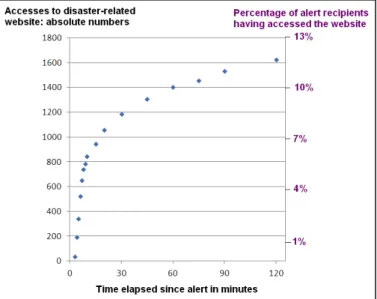
sent to all participants, an additional 2,234 users (16%) received alerts via e-mail (alerting via pagers was not available in this case). Due to data protection and privacy laws and the current terms and conditions of the service, users could not be questioned directly about their information search behavior. Instead, they were provided with a tinyURL in their alert messages and were asked to access a dedicated website for further information. The study then focused on observed actual user behaviour. After sending the test alert message at 9:58 a.m. on September 6th, 2012, the log files of the information website were analyzed to see how often and with which devices the site had been accessed. In order to avoid counting one user multiple times, page impressions originating from the same IP address were counted as one access. Figure 4 illustrates how many people visited the disaster related web page after sending the alert.
Figure 4: Proportion of alert recipients accessing a disaster-related information website
Within ten minutes, 845 page visits (corresponding to 6.1% of alert recipients) were identified. This number increased to 1187 (8.5%) within 30 minutes, to 1402 (10.1%) within one hour and to 1623 (11.6%) within two hours. After 24 hours, the ratio reached 17.4%. Overall, the number of citizens who actually consulted the additional disaster website was rather limited. Several reasons can be identified for this observation:
- The setting was theoretical: for legal reasons, and in order to avoid creating mistrust and anger among the recipients, the alert clearly had to be labeled as a test alert. Therefore, there was no real sense of urgency and many test participants probably did not see the necessity to click on the link in the message.
- Alert messages are already designed to include the most relevant information. The focus of all messages is clear and precise. This was also confirmed in a test involving 206 participants, where 98% of
pre-testers agreed that alert messages were clear, and 84% indicated that they would know what to do after having received the alerts and their instructions. - A third reason may be that at the time of the alert,
most likely several users did not have immediate access to the internet and thus did not have the time and opportunity to access the website within the time frame under analysis.
An interesting question is how those who decided to visit the disaster-related website actually accessed it. A log file analysis revealed that most people (73.9%) did so via mobile devices. This was not surprising given the fact that SMS-based alerting was the standard communication channel used by all test participants in this case. Among the operating systems of the visitor’s devices, iOS was the dominant platform (42.4%), followed by Android (25.9%). This is in sharp contrast to the distribution of these platforms in the general market, where currently more than three times as many Android-based devices are sold than devices using iOS [9]. About one quarter of website visitors used PCs and laptops. Different variants of Windows (except Windows Phone) were installed on 15.7% of devices, and MacOS could be identified on 3.4%. Figure 5 presents an overview of the operating systems on the devices which were used to visit the disaster-related website.
Figure 5: Operating systems of devices accessing a disaster-related website after a test-alert
The statistics presented in Figure 5 indicate where to commit software development resources, for example with regard to official emergency alert apps for different mobile platforms. Such alert apps, which offer the potential for profiling and more personalized emergency communication, have recently become available to the general public [10].
V. SUMMARY AND OUTLOOK
In this paper, results from a field test with a multi-channel alerting system have been analyzed. Results indicate that the short-term alerting performance of such a system (which
offers SMS, e-mails and pagers as communication channels) could be better than alerting via radio and TV, but would be somewhat inferior to traditional alerting via sirens. However, the system presented here should not be considered as a replacement of traditional ways of alerting, but rather as an extension. As of now, legal and contractual constraints (opt-in of recipients required due to data protection laws, no prioritization agreement in place with mobile network operators) limit the reach in practice. Experiences from the ten areas where the Katwarn system currently is available show that typically between one and three per cent of the population decides to register for such disaster alerting services. Nevertheless, this means that a sizable portion of the population can be reached, if the observed multiplication effects are taken into account (parents informing schools and kindergartens, husbands informing their spouses, people at work informing their colleagues). Alert messages that follow a well-structured message design with clear instructions (as discussed in section III) meet the immediate information requirements of the majority of recipients. Nevertheless, dedicated information websites linked to an alert (and, possibly, optimized for visualization on mobile devices) can be a valuable extension for citizens with special information needs. Taking the increasing availability of smartphones into account, dedicated disaster alert apps may take personalization and alert notification even one step further in the future. However, as such apps have only recently become available, the long-term impact on alert effectiveness remains to be seen. The European research project Opti-Alert currently analyzes how alert personalization can increase the perceived usefulness of alert messages and thus compliance with alert instructions. Results of these studies are expected until the end of 2013.
REFERENCES
[1] H. M. Jagtman, “Cell broadcast trials in the Netherlands: Using mobile phone technology for citizens alarming”, Reliability Engineering and System Safety, vol. 95 no. 1, pp. 18-28, 2010.
[2] M. Klafft, T. Kräntzer, U. Meissen, A. Voisard. „SAFE: A Sensor-Actuator-based Early Warning System for Extreme Weather Conditions”. In: Pebesma, E.; Bishr, M.; Bartoschek, T. (eds.): Proceedings of the International 6th Geographic Information Days, Münster: IfGIprints, pp. 329-330, 2008.
[3] United Nations. “Global Survey of Early Warning Systems – An assessment of capacities, gaps and opportunities toward building a comprehensive global early warning system for all natural hazards”. Report prepared at the request of the Secretary-General of the United Nations, UN/ISDR, 2006.
[4] V. Held. “Technology Options for an Early Alert of the Population”, Zivilschutzforschung vol. 45, Bonn: BBK, 2001
[5] G. O. Rogers, J. H. Sorensen. “Diffusion of Emergency Warning: Empirical and Simulation Results”. Risk Analysis vol. 11, pp. 117 -134, 1991.
[6] Office of the Emergency Service Commissioner of Victoria. Community Information and Warning System – The Report of the Trial and Evaluation. Melbourne: The Department of Justice of Victoria. 2006 [7] Fraunhofer FOKUS: „KATWARN – Katastrophenwarnung für alle
Fälle“ [KATWARN – Disaster alerts for all situations], http://www.fokus.fraunhofer.de/de/espri/_pdfs/KATWARN.pdf (accessed November 13th, 2012).
[8] Dressel, K.; Pfeil, P.; Schindler, H. „Report on Mass Media Usage Patterns“ [in case of disasters], Opti-Alert project report, unpublished, 2012.
[9] Pepitone, J. „Samsung races past Apple in smartphone market share“. CNNMoney, August 10th, 2012, http://money.cnn.com/2012/08/08/
technology/smartphone-market-share/index.html (accessed November 19th, 2012)
[10] CombiRisk: „Katwarn“, https://itunes.apple.com/de/app/katwarn/ id566560753?mt=8 (accessed November 21st, 2012)
This paper has been published as:
Michael Klafft: Diffusion of Emergency Warnings via Multi-Channel Communication Systems - An Empirical Analysis. In: Proceedings of the 2013 IEEE Eleventh International Symposium on Autonomous Decentralized Systems (ISADS), pp. 295-299, ISBN 978-1-4673-5068-6.
The publication is copyrighted by IEEE and is provided for personal, non-commercial use only. All other uses require prior permission by IEEE.