JAS-mine: A new platform for microsimulation and agent-based modelling
Matteo G. Richiardi
Institute for New Economic Thinking at the Oxford Martin School, University of Oxford
Nuffield College and Collegio Carlo Alberto
[email protected]
Ross E. Richardson
Institute for New Economic Thinking at the Oxford Martin School, University of Oxford
[email protected]
ABSTRACT:
We introduce JAS-mine, a new Java-based computational platform that features tools to
sup-port the development of large-scale, data-driven, discrete-event simulations. JAS-mine is specifically designed
for both agent-based and microsimulation modelling, anticipating a convergence between the two approaches.
An embedded relational database management system provides tools for sophisticated input-output
communi-cations and data storage, allowing the power of relational databases to be used within an object-oriented
frame-work. The JAS-mine philosophy encourages the separation of distinct concepts, objects and functionalities of
the simulation model, and advocates and supports transparency, flexibility and modularity in model design.
For instance, JAS-mine allows to store the list of regressors and their estimated coefficients externally to code,
making it easy to change the specification of regression models used in the simulation and achieving a complete
parallelisation between the tasks of the econometricians and those of the programmers. Moreover, tools for
uncertainty analysis and search over the parameter space are also built in.
KEYWORDS:
SIMULATION PLATFORM, MICROSIMULATION, AGENT-BASED, SOFTWARE,
OPEN-SOURCE
1 INTRODUCTION
We introduce JAS-mine (Java Agent-based Simulation library - Modelling In a Networked Environment), a
new Java-based computational platform that features tools for discrete-event simulations encompassing both
dynamic microsimulation (MS) and agent-based (AB) modelling. With the aim to develop large-scale,
data-driven models, JAS-mine brings real and simulated data together by facilitating the integration of real world
data into simulation models. Object-relational mapping is used to embed a relational database management
system, allowing the power of relational databases to be used within an object-oriented Java framework.
JAS-mine provides specific simulation tools, along with a template for simulation architecture design. In
par-ticular, JAS-mine is built around the idea that model development generally involves the task of several people,
who should work in parallel, possibly building on pre-existing models and modules developed either by the
same research team or by other teams. This is what the ‘mine’ in JAS-mine stands for. The motivation for this
modelling approach is the recognition that the real bottleneck in computational modelling comes not from
processor power but from the human element of designing and writing code. Hence, parallelisation in
devel-opment, and not just parallelisation in execution, becomes crucial.
1To minimise the time it takes for model
developers to create and develop software projects, transparency, flexibility and modularity are to be preferred
over brevity of the code and performance. This is achieved by keeping distinct concepts, objects and
functional-ities separate as much as possible. To this end, data representation and management is automatically handled by
the simulation engine, allowing the modeller to focus on developing the behavioural algorithms and processes
of the model. Moreover, JAS-mine supports the idea that the model developer should be given full control over
modelling issues, whereas the platform should be responsible for technical issues.
The software follows the open-source paradigm, meaning that it is freely available for people to use, review
and help develop further, thus encouraging the refinement of the platform over time. JAS-mine aims to use
standard, open-source tools that are available in the open-source community whenever possible.
Classes of models that can be built using the JAS-mine platform include not only agent-based models, but static
and dynamic microsimulations, involving either discrete or continuous time (events can be scheduled in regular
or irregular time-steps), and can feature open or closed populations.
This paper is not a tutorial on how to use JAS-mine; for such information we refer the user to the extensive
documentation that can be found online, and a detailed description of an implementation of LIAM2’s Demo07
model in JAS-mine (Richiardi & Richardson, 2016).
2Instead, this paper discusses the philosophy of JAS-mine,
the type of computational problems it is designed to address, its architecture and features.
The paper is organised as follows: Section 2 provides a motivation for JAS-mine, its design philosophy and
the issues it addresses; Section 3 describes important specifications of the platform; Section 4 highlights some
key features; Section 5 discusses the possible modes of running JAS-mine; Section 6 presents performance
characteristics of a demonstration model and Section 7 offers our concluding remarks.
2 MOTIVATION
2.1 Why
another
platform?
JAS-mine is specifically designed to provide tools for both dynamic microsimulation and agent-based modelling,
anticipating the convergence of the two approaches (Richiardi, 2013).
Historically, AB models and microsimulations have followed different trajectories, with AB models focusing
more on theoretical issues and MS models being more data-oriented, often featuring processes modelled as
probabilistic regressions. In general, AB models are structural models with a primary concern on
understanding
,
while microsimulations are reduced-form models geared towards
forecasting
. As data becomes more readily
available and technology becomes increasingly sophisticated at handling such data, there has been an inevitable
trend of convergence between AB and MS modelling styles, with AB models evolving to be more empirical in
nature and MS models integrating interactions and feedback effects.
Agent-based and microsimulation models exhibit many of the same features and can be described as belonging
to the same class of discrete-event simulations. Indeed, from a mathematical and computational perspective the
two approaches are identical; they are recursive models in which the number and individual states of the agents
in the system are evolved by applying a sequence of algorithms to an initial population. However, the differences
in scope and perspective between MS and AB modelling has impinged on the structure of the computer models
used within each community.
AB models lead naturally to an explicit object-oriented representation, while MS models are generally built
around a database which is evolved forward in time. This has led to the development of simulation toolkits
which are specific to each field, such as NetLogo (Wilensky, 1999), RePast (North et al., 2013) and MASON
(Luke et al., 2005) for AB modelling, and Modgen (Statistics Canada, 2009), LIAM2 (De Menten et al., 2014)
and JAMSIM (Mannion et al., 2012) for MS modelling to name just a few.
In particular, existing agent-based tools such as NetLogo and RePast are not designed for large-scale, data-driven
modelling. Input and output (I/O) communications play only a secondary role, and the analysis and
visualiza-tion of model outcomes are often mixed up with model structure. This hard coding and lack of a clear modular
structure makes it difficult to perform design of experiments (DOE) on the model, hindering their use in
large-scale, data-driven projects where modularity and efficiency are vital aspects in understanding the behaviour of
the model.
On the other hand, existing microsimulation platforms such as LIAM2 and Modgen are designed with
mi-crosimulation structures in mind.
3This generally imposes a programming style with a very strict, ad-hoc
gram-mar and syntax. Not only can such demands end up being too much of a model design straight-jacket – especially
for AB modelling – but they also represent a considerable investment for the model developer, who is required
to learn an idiosyncratic language just to use the specific MS toolkit. One microsimulation platform that shares
JAS-mine’s emphasis on portability, scalability and open-source access, is the OpenM++ software (OpenM++,
2013). However, as OpenM++ is an implementation of the Modgen language, it suffers from similar issues to
Modgen with regards to coding style and language.
Evolving out of the JAS project (Sonnessa, 2004) that dates back to 2004, JAS-mine was created to make the
de-velopment of ‘hybrid’ AB-MS models easier and to allow researchers to use the same tools for both approaches,
to exploit economies of scale in learning and coding.
Hybrid AB-MS models might have agents interacting locally, on the basis of local information, in the AB spirit.
Behavioural rules are generally expressed as more or less complicated if-else statements. However, agents might
also have some probabilistic transitions, as in Orcutt-type microsimulations. For instance, consumers might
randomly receive leaflets from producers, select the best offer, and then shop from that specific seller; or they
might be influenced by their acquaintances (who might themselves evolve endogenously). Either way, it is a
one-to-one transaction between one consumer and one producer that eventually takes place, affecting the
bal-ance sheet of both parties. At the same time, the researcher might choose to model the individual working
status according to some estimated transition model, without the need to specify the worker-firm interaction.
Hence, hybrid AB-MS models allow to blend more structural (AB) and more reduced-form (MS) modelling
approaches.
JAS-mine was designed specifically to give the modeller such flexibility, together with the tools needed to build
large-scale, data-driven models. It leaves the model developer with full control over modelling issues, whilst
taking care of the technical issues behind the scenes. It is written in the widely used Java programming language
and should thus be readily accessible to a large population of programmers. Its unique combination of features
distinguish it from all of the aforementioned platforms.
2.2 Why Java?
JAS-mine employs the most widely used and well-supported computing language available at this time – Java.
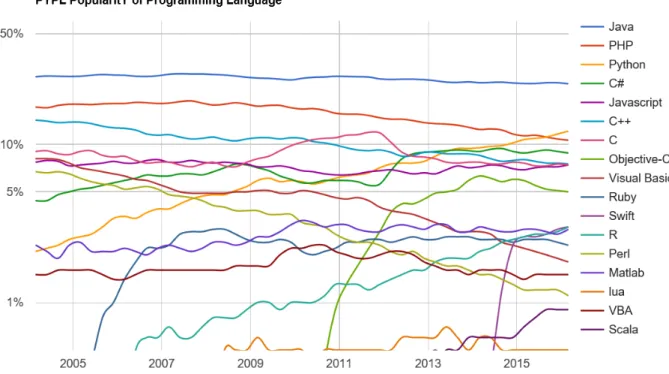
Figure 1 from the ‘PopularitY of Programming Language (PYPL) Index’ illustrates the popularity of the most
popular programming languages since 2004, quantifying the proportion of searches on Google for tutorials of
specific programming languages. Across the whole period of time analysed, the Java programming language has
maintained its lead as the most popular language with around 25% of all searches and, at the time of writing in
2016, has double the market share compared to the next most popular language, Python.
4This popularity enables the JAS-mine platform to benefit from the enormous contribution of human hours
that have gone into developing a vast array of freely available, state-of-the-art Java tools. Furthermore, Java
performs well in comparison with other widely used languages such as C (and C++) and Python, over a number
of standard benchmarks, see Figure 2.
A user who develops an ability to code in Java in order to use, or even through using, the JAS-mine platform
will obtain a widely applicable skill in high demand; such a skill is a valuable addition to any computational
modeller’s skill-set and will stand him or her in good stead regardless of whether their career is within academia
or industry. Indeed, the learning curve for a new user of JAS-mine mainly rests on their ability to learn how to
use the Java programming language.
A direct competitor of Java – and its Scala variant – is Python, which is experiencing an increasing usage due
to its flexibility.
5In fact, Python is a multi-paradigm programming language, meaning that it can support both
Figure 1: The most popular languages in the PYPL PopularitY of Programming Language Index
The index is created by analyzing how often language tutorials are searched on Google, fromhttp://pypl.github.io/PYPL.html. Java has consistently been the most popular programming language over recent history and, at the time of writing in 2016, has 24.1% market share, double the amount of the next most popular language, Python.
Figure 2: Smaller is better: the benchmark times for operations implemented in a number of programming
languages relative to C
.
and aspect-oriented programming, while specific extensions can provide support for other paradigms,
includ-ing design by contract and logic programminclud-ing. One of the biggest differences between Python and Java is the
handling of variables. Java follows
static typing
, which requires to define the type of a variable when the variable
is declared, and does not allow type changes in the program (though a variable can be cast into another type). In
contrast, Python uses
dynamic typing
, which allows to change the type of a variable in the program. Dynamic
typing is easier for the novice programmer; however, static typing can reduce the risk of bugs. Also, Java runs off
the Java Virtual Machine, meaning that it is platform-independent. On the other hand, Python is a compiled
language: the Python code is compiled into a code that the particular operating system used can understand.
There are many Python interpreters: for instance, PyPy is a Python interpreter and just-in-time compiler which
overcomes one of the main limitations of Python, namely speed, by compiling the program in C. However,
PyPy only works with a subset of Python’s libraries. For instance, it does not work with ‘pandas’, a popular
Python library for data manipulation and analysis.
Apart from LIAM2, which is specifically designed for dynamic microsimulations in discrete time, other
simu-lation platforms written in Python include the Python implementation of RePast, called RePast Py.
6An alternative to general purpose programming languages such as Java, Python or C++, or to platform specific
languages such as Modgen (based on C++), LIAM2 (based on Python) or NetLogo (based on Scala/Java), is
the use of all-purpose statistical packages, such as MATLAB, R or Stata. While examples of agent-based models
written in MATLAB and microsimulation models written in Stata abound, to the best of our knowledge they
make use of no tools to help with routine tasks in microsimulation modelling, such as the scheduling of the
events, exchange of information between agents, etc. MATLAB has a block diagram environment for
multi-domain simulation and Model-Based Design – Simulink – and a specific modelling and data analysis tool for
discrete-event simulations, such as hybrid system models, agent-based models, state charts, and process flows.
However, the tool (and MATLAB itself) is proprietary, and does not seem to have diffused into the field of
social sciences. MATLAB can also run Dynare, a widely used platform for handling dynamic stochastic general
equilibrium (DSGE) and overlapping generations (OLG) models. While Dynare also enables the development
of models with heterogeneous agents, such models all remain in the rational expectations–optimal behaviour
framework (or variations thereof), a framework which is often not shared by agent-based and microsimulation
models.
On the other hand, specific microsimulation libraries exist for R, such as the package for Post-Keynesian
Stock-Flow Consistent modelling developed by Antoine Godin.
7With respect to MATLAB (or its open-source clone,
Octave) and Stata, R is very flexible and powerful, and fully exploits the collaborative nature of open-source
projects, with new and improved packages being continuously introduced. However, programming in R is
of-ten quite cumbersome and far from intuitive, with different packages ofof-ten doing similar things in different ways
and with different syntax. Moreover, R (as in MATLAB) is built around arrays (in particular matrices), while
agent-based models and microsimulations benefit from an explicit object-oriented representation (see below),
in particular when it comes to modelling the interaction between individuals.
8Finally, R (as in MATLAB) can
easily run into performance issues, especially if the modeller is not careful to avoid loops through an accurate
vectorisation of the code, which in itself often leads to less intuitive and transparent syntax.
which is mainly used for business applications.
92.3 The JAS-mine Philosophy
Above all, JAS-mine stresses transparency, flexibility and modularity of the code, even (when there is a conflict)
at the expense of brevity and performance.
10The goal is to facilitate the model design and coding phase,
min-imising the time it takes model developers to create and develop large scale, data-driven discrete-event simulation
projects.
JAS-mine’s general principles maintain that model developers should be given full control over modelling
is-sues; there should be no constraints on model specifications and no behavioural choices hidden in higher level
functions, though the platform should assist in the implementation. In addition, the platform should take
responsibility for technical issues such as setting parameters, managing the simulation schedule and I/O
com-munications, the collecting of statistics, inspection and monitoring, and debugging.
Moreover, things that are conceptually distinct should be kept separate whenever possible, as discussed in detail
in Section 3. For example, JAS-mine advocates the separation of the input data and parameters from the model
code. This enables the parameters, and even the econometric and statistical specifications of regression processes
in the model, to be changed without touching the code-base. This allows for efficient and flexible division of
labour across time and space; users can collaborate and separately develop their own modules to be integrated
into the overall project. This separation of distinct components encourages modularity, clarity and transparency.
JAS-mine favours the use of Object-Oriented Programming (OOP) for its natural ability to represent the agents
(individuals, households, firms,
etc.
) within AB and MS models. This programming paradigm further
encour-ages well-structured code that is divided into packencour-ages and class hierarchies, supporting powerful computational
modelling concepts such as encapsulation and inheritance (Luna & Stefansson, 2000; Gilbert & Terna, 2000).
JAS-mine aims to support the model building process by using transparent, well organized and documented
functions. Being an open-source project, developers have access to all the JAS-mine source code should they
wish to inspect and even refine it.
11This helps to avoid the ‘black box’ nature that some modelling platforms
suffer from, whilst encouraging further development of the platform. Moreover, JAS-mine inherits the
object-oriented programming structure of packages and classes from Java, further facilitating the organization of code
in a transparent, uncluttered manner. In addition, the JAS-mine website contains numerous tutorials, tips,
demo models and the application programming interface (API), so that the model developer can find the
nec-essary information to make the most of the JAS-mine tools.
123 JAS-MINE SPECIFICATIONS
JAS-mine’s design principles encourage adhering to a strict modelling discipline that maintains the separation
between things that are conceptually separate. A clear distinction is made between objects with a modelling
content, which specify the structure of the simulation, and objects which perform useful but auxiliary tasks,
from enumerating categorical variables to building graphical widgets, from creating filters for the collection of
Figure 3: The structure of JAS-mine’s Manager classes.
The Collector acts as an intermediate layer between the Model class (which controls the model specification such as agents, their interaction and envi-ronment) and the Observer (which displays information about the state of the simulation in the Graphical User Interface). The Collector aggregates information about the model objects (agents), and calculates any statistics needed either by the Model’s objects (agents) themselves or for the Observer. The Collector can export the data to the output database or to csv files as required.
agents to computing aggregate statistics to be saved in the output database. This motivates the discussion in
Subsections 3.1 and 3.2.
3.1 The Structure of a JAS-mine Project
A widespread paradigm used in the simulation of complex, agent-based models is Swarm (Minar et al., 1996),
a system for organising discrete-event simulations where the computational objects of the simulation are
par-titioned into two separate groups:- those involved in describing the underlying model and those involved in
observing what is happening. This mimics laboratory experiments in the natural sciences where the subject
matter - the
Model
- is usually viewed as separate from the
Observer
performing the experiments.
The purpose of the Observer is to inspect the model’s objects. Through the Observer, the state of the simulation
can be monitored and graphically represented in real time, while the simulation is running. However, for the
purpose of analysis and validation, the Observer alone may not be adequate because it implies the need to define
in advance the aspects and aggregations on which to analyze the simulation outcome.
According to a different approach, the simulation is aimed exclusively at producing numerical outputs which
can be analyzed in depth ex-post using ad-hoc statistical-econometric tools.
JAS-mine combines these two different approaches extending the
Model-Observer
paradigm so as to include an
intermediate layer called the
Collector
that calculates statistical values and persists simulation modeling outputs
in the database in the most transparent way, minimizing the impact on model implementation, see Figure 3.
These layers are implemented within a JAS-mine project by objects called
managers
, who organise and manage
• The Model manager class deals mainly with specification issues, such as the creation of objects such as
agents within the simulation, a description of relations and interactions between objects and the
envi-ronment of the simulation, and defines the model’s schedule of events.
• The Collector manager class introduced by JAS-mine takes care of recording and storing data from the
model (data persistence). It builds the data structures and routines needed to collect data, and computes
statistics required by the simulation objects and for analysis of the simulation run after completion. Its
schedule specifies the frequency for sampling the agents, updating the aggregate statistics, and saving data
into the output database.
• The Observer manager class builds and updates graphical widgets such as time-series plots or cross-sectional
histograms in the JAS-mine graphical user interface to enable the user to inspect the state of the
simula-tion in real time and monitor some predefined outcome variables as the simulasimula-tion unfolds.
Each manager class contains code defining its own schedule of events, with the Model schedule arranging events
that will occur between agents and their environment, the Collector schedule specifying when to calculate and
record statistics of the underlying model, and the Observer schedule determining when to update the charts in
the JAS-mine graphical user interface.
This three-layer methodological protocol allows for extensive re-use of code and facilitates model building,
de-bugging and communication. Additionally, we highlight that there can be more than one type of each manager;
for example two Model managers can be developed separately and easily assimilated into a JAS-mine project, as
the JAS-mine simulation engine handles the aggregation of the two Models’ schedules into the simulation
en-gine’s event queue. This allows for the creation of complex structures where agents of different Models can
interact. Each Model is implemented in a separate Java class that creates the objects and plans the schedule of
events for that Model.
For a detailed description of a JAS-mine project that demonstrates the separation of tasks into the
Model-Collector-Observer structure, we refer the reader to Richiardi & Richardson (2016), which presents the porting
of LIAM2’s Demo07 demographic microsimulation model into JAS-mine.
3.2 Separation of Data and Code
JAS-mine favours the separation of data representation and management – which is automatically handled by
the simulation engine – from the implementation of processes and behavioral algorithms, which should be the
primary concern of the modeller.
In practicality, JAS-mine advocates the partitioning of data from the code-base, with all parameters and input
tables stored either in Microsoft Excel files (.xls or .xlsx format) or in an input database. Although not a
require-ment, JAS-mine recommends that the only hard-coded parameters in the code-base are so-called ‘
GUI
param-eters
’. These GUI parameters are ones that the user wishes to directly set and possibly change during runtime;
they are annotated as such (using the
@GUIparameter
Java annotation) to enable JAS-mine to recognise and
display them in the graphical user interface (GUI). This results in quicker, more robust and more transparent
model building, simplifying modular development and subsequent extension and modification.
For example, this separation allows the rapid iteration of model specification, as it is possible in JAS-mine to
change not only the input data and parameters easily, but also to change a model’s econometric or statistical
specifications without changing any of the code: JAS-mine’s regression package provides tools to import and
inspect data from Microsoft Excel files, such that only the enumerated regression covariates and
correspond-ing coefficients are used in the regression models. Thus, by removcorrespond-ing a row containcorrespond-ing a regression covariate
and its corresponding coefficient from the Excel file, the JAS-mine regression object automatically removes this
covariate from any related calculations, without the need to change any line of code in the code-base.
This separation of code and data greatly facilitates the evaluation of different econometric specifications and
scenario analysis, in addition to the exploration of the parameter space. Moreover, this modular design allows
for easier collaboration and efficient division of labour across time and space; an econometrician in one part of
the world can develop the econometric (regression) model specifications, whilst a programmer in another part
of the world writes the simulation code-base of the JAS-mine project in parallel.
3.3 Input - Output Communications
A key feature of JAS-mine is its integration of input and output (I/O) communication tools within the
mod-elling platform. By structuring the platform around a relational database management system (RDBMS),
JAS-mine provides built-in utilities for communicating with underlying relational databases. These tools enable
the user to import data from an input relational database and export data to an output relational database by
writing just a single line of code for each operation.
Relational databases are an optimal way of storing vast amounts of data, potentially featuring complex
inter-relationships. The statistical analysis of simulation output is possibly intensive in computing time, so
time-constraints may limit such analysis in real-time, especially in large-scale applications. A common solution is to
limit such analysis to a small subset of output variables, however this requires identifying the output of interest
before the simulation is executed. If it is then decided that additional computations are necessary to better
un-derstand how the model behaves, the simulation has to be run again; the bigger the model, the more impractical
this solution becomes. Relational databases make it feasible to keep track of a much larger set of variables and
the relationships between agents in complicated simulation models, facilitating
post-mortem
analysis.
The benefits of having the simulation output stored as a relational database are larger when there are more object
types in the model. For example, in an AB model where workers apply to vacancies issued by firms, there are
four object types: workers, applications, vacancies, and firms, with each worker possibly applying to more than
one vacancy, each vacancy possibly receiving more than one application, and each firm possibly posting more
than one vacancy.
13Moreover, attributes of each agent type can also be classified: for instance, all vacancies in
the same industry/sector/area might share the same base wage, hours of work, paid holidays etc., as bargained
between unions and firms. Rather than duplicating this information for each posted vacancy, we might store
these characteristics in a separate table, to which each vacancy refers. A relational database keeps track of all
the relationships between tables, as identified by primary and foreign keys. An alternative to using a relational
database is to probe individual objects and save them in separate, unconnected tables, and indeed JAS-mine
allows the user to follow this route and save the simulation outcome as separate text files (see Subsection 3.3.2 and
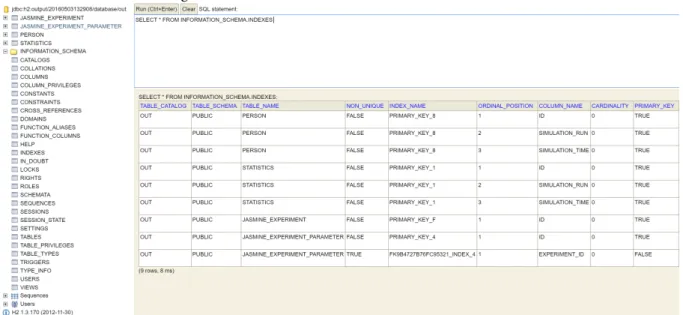
Figure 4: A screenshot from the Hibernate H2 console.
The console displays the information schema of a microsimulation model of labour force participation. There are two main tables: one containing panel data on individual agents (PERSON), and one containing time series aggregate data (STATISTICS). An additional table (JASMINE EXPERIMENT PARAMETER) contains the value of the model parameters (as set by the user through the GUI), while the JASMINE EXPERIMENT table contains information about the specific run (run id and time stamp).
Section 6). Then, the relationship between the different tables can be inferred by looking at columns with the
same name: for instance, the existence of a column named ‘worker id’ in the WORKER, APPLICATION and
VACANCY tables can be interpreted as workers applying to vacancies, and vacancies selecting one job applicant
among all the received applications. However, there is nothing that tells the user that those different columns in
different tables actually contain the same information: this knowledge must come from knowledge of the model
structure. With the idea that the statistician analysing the model outcome can be different from the programmer
coding the model, who may be different from the researcher specifying the model, storing all the relationships
between attributes and agent types might be valuable.
The JAS-mine GUI contains a database explorer that links to a database console, allowing the user to inspect
the input and output databases through Structured Query Language (SQL) style commands.
14As an example,
Figure 4 depicts the information schema of the embedded database of a JAS-mine project.
15Once the simulation has ended, the output database that JAS-mine has created can be loaded into the user’s
favourite statistical software (such as R, Stata etc.). This enables the user to employ all the powerful functionality
of these programs to analyse the results of the simulations.
Each JAS-mine project can work with two databases: an
input
database and an
output
database. The input
database can contain sets of model parameters and coefficients, and an initial population to be evolved forward
in time by the simulation model. Any input values or population of agents could potentially be overwritten
(i.e. in the
Model
class) after importing them if it were ever necessary to change the inputs. In addition, the
Hibernate console provides tools that enable the user to construct input databases, e.g. using data from
comma-separated values (csv) files.
The output database can hold data at both the individual agent (unit record) level and aggregate level, for
ex-ample storing statistics that have been calculated within the model during the simulation. The output database
records the changes in the simulated population, either by sampling it at regular intervals in time or by
record-ing individual events that happen to individual agents possibly at irregular times. The output archives the state
of the system, including the initial period, and contains a copy of the parameters and coefficients used in the
simulation, so as to avoid indeterminacies regarding how the data were produced. Thus, JAS-mine produces a
copy of all the files in the input directory to store in the output directory, alongside the output database.
3.3.1 Relational databases in JAS-mine
As we have seen, relational database structures are useful when wishing to store data from models with lots of
inter-connected classes of agents with a variety of relationships, such as one-to-one, one or
many-to-many connections. This is the case, for example, in simulations with complex many-to-many-to-many-to-many types of
relation-ships.
Relational databases in JAS-mine contain a separate table for each entity (agent type). When constructing and
storing data in an output database, JAS-mine produces a separate table for each Java class in the project that has
been labelled with an
@Entity
Java annotation – we shall call such Java classes ‘Entity Classes’. Each table in the
database contains data from instances (the agents or ‘objects’ in Object-Oriented parlance) of the corresponding
Entity Classes. A specific row in a table corresponds to an individual agent at a specific time in the simulation and
is identified by a key containing numbers representing the agent’s identity, the simulation time and simulation
run (useful for identifying a run within JAS-mine’s multi-run execution mode, see Subsection 5.3). Such a key
corresponds to JAS-mine’s
PanelEntityKey
data type (annotated with
@Id
), which must be declared in each
Entity Class and be uniquely defined for each instance (agent) of the Entity Classes. Standard SQL queries can
then be used to find a specific agent at a specific simulation time and simulation run in the database.
The output database records every data field that is defined in an Entity Class unless the field is annotated with
the
@Transient
label. Basic data types such as individual numbers, strings, booleans and enumerated types are
easily represented in the database, however only the reference field pointing to a more complicated Java Object
would be stored for user-defined data types.
This introduces our discussion to the nature of relationships between agent types. It is possible for agents to
have one-to-one, many-to-one and many-to-many relationships. In the labour market example of the previous
section, the relationship between workers and vacancies is many-to-many, meaning that a worker can apply to
many vacancies, and a vacancy can receive applications from many workers. Persisting a many-to-many
relation-ship is complicated because the list of vacancies each worker has applied to is
a priori
of indeterminate length, as
is the list of workers that have applied to any single vacancy. Persistence is then achieved by introducing an
Ap-plication class that contains a pointer to the vacancy and the worker. Each apAp-plication refers to one and only one
link between a vacancy and a worker, and each link consists of one and only one application. The data that are
saved in the database during the simulation refer to three different entities (workers, vacancies and applications)
and are characterized by two different data structure (panel vs. population) however, thanks to the JAS-mine
persistence engine, the appropriate keys are automatically added. This results in linked tables that can be easily
manipulated in the subsequent analysis.
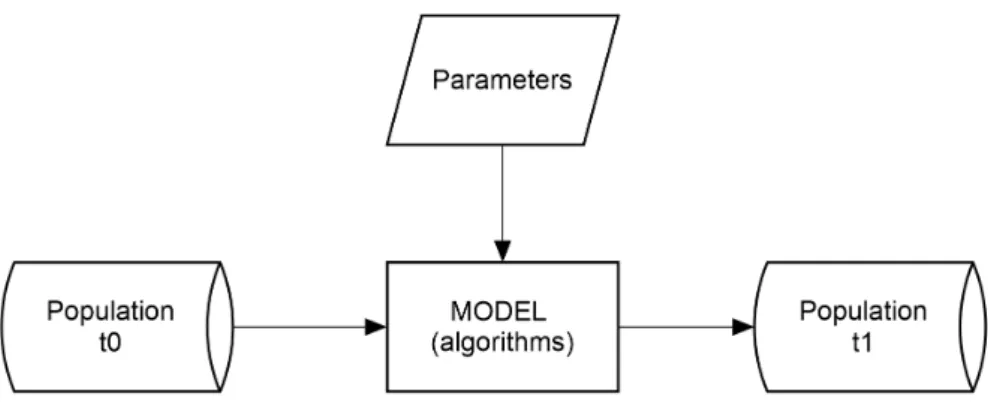
Figure 5: The structure of a microsimulation model.
Simulations can be viewed as data structures which evolve through time according to predefined rules and parameters.
3.3.2 Embedded Relational Database Management System via Object-Relational Mapping
A natural way of coding systems of interacting agents, possibly belonging to different entities featuring
hierar-chical levels is through object-oriented programming (OOP). Indeed, this is the software paradigm best suited
to represent and manipulate the sort of input data commonly found in AB and MS models such as population
data. On the other hand, large-scale input and output data - especially in complex projects - are best stored in
a relational database. Indeed, the traditional perspective of microsimulation modelling is that simulations are
data structures which evolve through time according to predefined rules and parameters (see Figure 5). Database
relational modelling however, is less intuitive than OOP and requires a specific language such as SQL to retrieve
and modify the data.
JAS-mine overcomes the issues of interaction between the simulation and the I/O data by using an embedded
RDBMS. An embedded RDBMS is a database management system which is tightly integrated with an
applica-tion software that requires access to stored data, such that the database system is ‘hidden’ from the applicaapplica-tion’s
end-user and requires little or no ongoing maintenance. By default, JAS-mine uses the Hibernate (H2) database
format, however other databases that support embedding can be used, such as Microsoft Access, Hypersonic
SQL, Apache Derby, etc.
16To change the database type, it is sufficient to reconfigure the
persistence.xml
file,
which otherwise does not need to be modified. Also, by pointing the file
persistence.xml
to a database server it
is possible to use the database in server mode, through a network interface.
Embedding is achieved using Object-Relational Mapping (ORM), a programming technique for converting
data between incompatible type systems in OOP languages, see Figure 6.
17ORM is used in JAS-mine to
facil-itate the integration of the object-oriented software system with a relational database (Keller et al., 1993). An
ORM product (JAS-mine uses Hibernate) constructs an object-oriented interface to provide services on data
persistence, while abstracting at the same time from the implementation characteristics of the specific RDBMS
used.
Thus, all of the complex operations required to integrate the relational database management system into
JAS-mine takes place behind the scenes. The ORM masks the complex activities involved in the creation, extraction,
update and deletion of data behind simple commands, drastically reducing the amount of code required and
removing a considerable burden for the model developer. These activities would have previously taken up a
Figure 6: Object-Relational Mapping
In JAS-mine the interaction between the simulation and the (input and output) data is achieved using Object-Relational Mapping (ORM), a pro-gramming approach that facilitates the integration of object-oriented software systems with relational databases. An ORM product (JAS-mine uses Hibernate) constructs an object-oriented interface to provide services on data persistence, while abstracting from the implementation characteristics of the specific relational database management system used.
large amount of the time required to write, test and maintain simulation models.
On the down-side, choosing an ORM paradigm introduces a software layer that impacts on performance, an
aspect that is relevant to data-intensive applications like simulations. Translating the entity-relational model
that is typical of a database into an object-based model requires additional activities that may slow down data
upload, reading and exporting. Given the continuous increase in the speed and power of modern computers,
we opt for a lean architectural structure even at the cost of slowing the simulation engine down. JAS-mine,
however, does provide an alternative mechanism to export output data if the user wishes to increase the speed
of the simulation. Instead of storing data in the output relational database, the user can choose to export data
into comma-separated values files (csv), with a different csv file for each class of object exported. This can increase
the speed of output substantially and is achieved simply by changing the value of two boolean arguments, either
through the JAS-mine GUI or directly in the Collector class(es).
18We explore the impact on the execution speed,
of exporting data to the database and csv files in Section 6.
3.4 System Requirements & Database Size Limits
The only major requirement needed to use JAS-mine is the ability to run Java (version 7 or later) on a computer.
JAS-mine has been tested on 32-bit and 64-bit Windows, Linux and Mac operating systems. The necessary
random access memory (RAM) requirements to run a simulation successfully depends on the size (e.g. number
of agents) and complexity of the simulation model, and the size of any input or output data involved. The
minimum requirements to run Java 7 are a RAM of at least 128MB for 64-bit Windows XP and 64MB for
32-bit Windows XP, and around 124MB of hard drive memory to run on Windows.
19Development of JAS-mine projects can be facilitated using an integrated development environment, and we
suggest using Eclipse Integrated Development Environment as we have produced a Plugin that can be used
with Eclipse to help quickly set-up a JAS-mine project with the recommended file structure (see Subsection 4.6
for more information). Consequently, the system requirements in order to do this depend on Eclipse, which
currently requires around 500MB of hard drive memory.
If using the default choice of database format – Hibernate (H2) – the size limits of any input or output databases
handled in a JAS-mine simulation are determined by Hibernate’s technology.
20In particular, the database file
size limit is 4 terabytes (TB) (when using the default page size of 2KB) or larger when using a higher page size.
The maximum number of rows (records) per table is 2
64, and the minimum main memory required is around
1MB for each 8GB of database file size. There are no limits for the number of columns (attributes) in the database
tables, other than those imposed by the memory and storage capacity of the computer.
4 KEY JAS-MINE FEATURES
We describe a number of useful features that JAS-mine provides to the model builder.
4.1 Simulation Time
JAS-mine allows great flexibility with regards to the time that an event can be scheduled. Whereas some
mi-crosimulation platforms such as LIAM2 only allow events to be scheduled at regular time-steps labelled by
integers (‘discrete-time’), time in JAS-mine is a continuous variable. This means that JAS-mine can handle
complicated sporadic events that are scheduled at irregular time intervals, possibly sampled from a continuous
probability distribution such as the exponential distribution to model inter-arrival times of events
correspond-ing to Poisson processes. This flexibility is indeed required to implement the AB-MS hybrid model described
in Section 6.
In addition, events that are scheduled for the same time can have their relative order specified using JAS-mine’s
scheduling methods
21; this may be necessary to ensure strict causality in a simulation model. Dynamic
schedul-ing is also possible within JAS-mine; events need not all be specified at the start of the simulation but can also
be scheduled during runtime, for example by the agents themselves scheduling events that they will perform in
the future.
4.2 Statistics
The JAS-mine release uses the Colt libraries for High Performance Scientific and Technical Computing
devel-oped at CERN, and the Apache Commons Math libraries in order to provide useful mathematical and statistical
utilities.
22The JAS-mine statistical library deals with the construction and update of cross-sectional and time
series objects: statistics over a single agent (e.g. whether the agent is active or not) or a cross-section of agents
(the activity rate) are overwritten on updating, but they can feed time-series objects which keep memory of past
values. In addition, the overall population can be refined to a sub-population using filters to separate out agents
that don’t exhibit the required properties, such as a specific age or gender. The approach is fully modular:
statis-tics can be computed on time-series objects (say, the maximum and minimum stock price in a given period of
time), and stored for instance in other time-series objects. Furthermore, when a time-series object is updated, it
automatically updates all the objects on which it is based.
For examples of how JAS-mine’s statistical tools can be used, we refer the reader to both the documentation on
the JAS-mine website and implementations in JAS-mine’s demonstration projects.
23,244.3 Regressions and Uncertainty Analysis
Sophisticated regression libraries allow a complete separation of regression specifications from the code. There
is currently support for linear regressions, binary logistic, binary probit, multinomial logistic and multinomial
probit regressions. The structure of the regressions can be delegated to the data stored in Microsoft Excel files
(.xls and .xlsx), which contains both the name of regression covariates and corresponding coefficients for each
covariate. During the simulation, the JAS-mine simulation engine will search for a particular definition of a
regression covariate in the code and calculate its quantity for each agent that the regression applies to. The
sep-aration of regression specifications from the code mean that a regression covariate can be removed from the
model simply by removing the covariate’s corresponding row in the Excel spreadsheet. Furthermore,
regres-sion coefficients can be updated between simulation executions merely by changing the values within the Excel
spreadsheet.
As utilised in Richardson et al. (2016); Richardson & Richiardi (2016), regression utility tools are available to
facilitate the analysis of uncertainty in model parameters, pointing to the imprecision of the estimates and/or
externally provided parameters (Bilcke et al., 2011).
25One approach to deal with this uncertainty (Creedy et al.,
2007) prescribes to bootstrap the regression coefficients of the estimated equations from their estimated joint
distribution (e.g. multivariate normal in the case of multinomial probit regressions) with mean equal to the
point estimate and covariance matrix equal to the estimated covariance. Bootstrapping needs to be performed
only once, at the beginning of each simulation run: the entire simulation is then performed with the
boot-strapped values of the coefficients. JAS-mine allows for a simple implementation of this ‘brute-force’ approach,
by providing a bootstrapping method in the Regression library to be used within a multi-run execution mode.
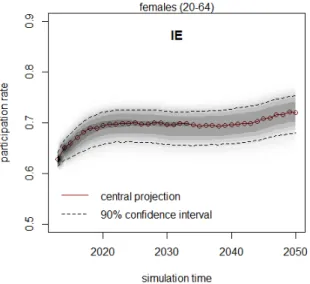
26The simulation is run many times, each using a different set of regression coefficients. The result is a distribution
of model outcomes, around the central projections obtained with the estimated coefficients, as can be seen in
Figure 7, taken from Richardson et al. (2016).
4.4 Alignment
Alignment is a technique widely used in dynamic microsimulation modelling to ensure that the simulated totals
conform to some exogenously specified targets, or aggregate projections (Baekgaard, 2002; Klevmarken, 2002;
Li & O’Donoghue, 2014).
Alignment is a way to incorporate additional information which is not available in the estimation data. The
underlying assumption is that the AB or MS model is a poor(er) model of the aggregate, but a good model of
individual heterogeneity: by forcing the microsimulation outcomes to match the targets in a way that is as least
distortive as possible, the microsimulation model is left with the task of distributing the totals in the population.
In general, the above assumption is very dangerous and unwarranted, and alignment should be looked at with
great suspicion.
Nevertheless, a number of alignment algorithms are available from the JAS-mine libraries.
27These include
Resampling Alignment (Leombruni & Richiardi, 2006; Richiardi & Poggi, 2014), Sidewalk Alignment,
Mul-tiplicative Scaling Alignment, Sorting By the Difference between predicted probability and a random number
Figure 7: The effects of parameters uncertainty.
JAS-mine’s regression utility tools is used to bootstrap regression coefficients during a multi-run execution of a simulation over 1000 runs. The chart was produced using kernel density estimation from analysis of the simulation’s output database performed by the statistical software program ‘R’.
(SBD), and Sorting By the Difference between logistic adjusted predicted probability and a random number
(SBDL). Descriptions of these alignment algorithms can be found in Li & O’Donoghue (2014).
28,294.5 Matching
JAS-mine has specific tools contained within the
Matching
package, to perform matching between two
collec-tions of agents based on some specific criterion. The matching methods are called from outside the agents to
be matched, for instance by the
Model
class. The simplest algorithm is a one-way matching procedure
imple-mented in JAS-mine’s
SimpleMatching
class, where the agents in one collection (e.g. females) choose to match
with the agents in the other collection (e.g. males), who remain passive with regards to the matching process.
Matching is used to simulate the marriage between females and males within the population in the Demo07
demonstration model (Richiardi & Richardson, 2016).
30More details and discussion can be found on the
JAS-mine website.
314.6 Extensions & Third-Party Solutions
The fact that JAS-mine projects are written in the Java programming language means that there are many
state-of-the-art third-party solutions freely available for the modeller to use, not only within the code itself but also
during the development of the code. For example, the Eclipse Integrated Development Environment (IDE)
is available to use with JAS-mine; it features a wide variety of built-in development tools such as a powerful
debugger, in-line help facility, refactoring tools and a Git version control system.
32Furthermore, a vast collection
that can be used to discover bottlenecks – the places in the code that take the longest time to execute – in order
to aid the developer in making code run faster and more efficiently.
Moreover, a JAS-mine Plugin for Eclipse IDE exists that helps the model developer set up a standard JAS-mine
project structure automatically within Eclipse.
33This standard JAS-mine project features the recommended
package structure and class names, and contains templates of the necessary classes with the required code in
order to make the project ready for immediate execution. The project dependencies are handled by the Apache
Maven Project, which automatically downloads the correct versions of files required by the project in order to
run.
34This enables the model developer to be instantly productive, as he or she can concentrate on writing the
fundamental code to specify the model processes and agents’ behaviour, rather than worrying about how to set
up the JAS-mine project.
4.7 Simulation Scenarios
Once the input of a model scenario has been specified by the model developer (for example, in MS Excel files
that hold the scenario parameters), such a model scenario can be executed at a later time by a user of the
mi-crosimulation model. The model developer can make it easy for a non-technical user to choose model scenarios
by setting up dropdown boxes on the JAS-mine GUI that specify either the whole scenario or different
com-ponents of the scenario. For example, the Labour Force Participation demo model has a dropdown box that
allows the user to select which one of six possible countries to simulate, and the model has been built in such
a way that the appropriate input Excel files containing the relevant parameters for the chosen country are
au-tomatically loaded by JAS-mine.
35Another example is the Theoretical Health Inequality Model described in
Section 6, where the GUI contains two dropdown boxes allowing the user to select the type of city scenario and
the income inequality scenario.
365 EXECUTION MODES AND GRAPHICAL USER INTERFACE
JAS-mine supports three different types of execution mode:-
interactive
mode,
batch
mode and
multi-run
mode.
We discuss these modes in detail, and also provide a description of the main steps that occur ‘under the bonnet’
when a JAS-mine simulation is initiated.
5.1 Interactive mode and Graphical User Interface
The most common mode for prototyping a JAS-mine project, developing an intuition about how the
under-lying model works and demonstrating it to an audience is the interactive mode. This features a graphical user
interface such as that illustrated in Figure 8, which allows users to inspect a number of the simulation’s output
quantities in real-time and assess the impact of a change in model parameters.
37The GUI is built using the
professional quality JFreeChart open-source Java libraries and can be pre-configured by a model developer to
fa-cilitate the use of JAS-mine simulation models by non-technical users such as policy makers, who can easily set
parameter values and launch a simulation with just a few clicks of the mouse, and observe the resulting graphical
and textual output on display.
38Figure 8: Interactive Mode
Screenshot of the JAS-mine graphical user interface showing output from the Extended Schelling demonstration model, available at www.jas-mine.net/demo/extended-schelling.
The GUI contains a control panel at the top that allows the user to pause the simulation, execute individual
events step-by-step, and reduce the speed of the simulation (if, for example, the user deems it useful when
ob-serving the evolution of the model output). Below the control panel are parameter boxes listing
GUI parameters
and their default values, with a box for each Model, Collector and Observer featuring
GUI parameters
. The
user can adjust parameters before executing the simulation, and there is also the possibility of updating the
pa-rameter values during the simulation. Below the papa-rameters box, is the place where graphical output can be
displayed. There is a rich graphical library allowing extensive visualization options in JAS-mine. As can be seen
in Figure 8, graphics include time series plots and geographic maps. This screenshot of the JAS-mine GUI is
from the Extended Schelling model, which combines the well known segregation model by Thomas Schelling
(1969) that is illustrative of the AB approach, with demographic features of birth and death processes that are
typical of dynamic microsimulations. The model can be downloaded from the JAS-mine website.
39Below the
charts is the output stream where textual information can be displayed, such as a model’s output, running time
and any error messages, in addition to information about any associated relational database.
The interactive mode is launched by default when executing the
Start
class of a standard JAS-mine project (as
created using the JAS-mine Plugin for Eclipse IDE tool that was discussed in Subsection 4.6).
5.2 Batch mode
On the other hand, if the user desires to run a simulation model in the shortest possible time, JAS-mine can
run in batch mode where the GUI and other unnecessary parts of the project can be switched off (e.g. the
project’s
Observer
class) in order to optimise speed of execution. This is possible due to the modular nature
of JAS-mine code, embodying the JAS-mine philosophy of keeping conceptually distinct components of the
project separate. The project can be run on High Performance Computing (HPC) clusters, offering the potential
to run simulations that require much greater memory and processing power. In addition, Java has tools for
parallelisation, concurrency and multithreading, enabling simulations to run across multiple cores if the user so
desires.
5.3 Multi-run mode
Finally, the multi-run mode can be executed using the project’s
MultiRun
class (as created using the JAS-mine
Plugin for Eclipse IDE tool that was discussed in Subsection 4.6), that calls the JAS-mine simulation engine’s
multi-run tools to handle the sequential execution of simulations. This may be utilised to estimate the stochastic
error of the simulations, facilitate ‘design of experiments’ (DOE) analysis and the optimisation of simulation
output quantities.
40In addition, parameter uncertainty analysis can be undertaken using the multi-run mode
and JAS-mine’s regression utility tools to bootstrap regression coefficients (see discussion in Section 4.3). The
user should note that JAS-mine’s input/output communication handling in multi-run mode is such that all
data is exported into a single output relational database, indexed by the simulation time and run number. This
allows the user to easily analyse the variation of output across simulation runs (and possibly over a variety of
parameter domains) using their favourite statistical software (e.g. R, Stata, etc.).
5.4 Main Steps in a JAS-mine Simulation
A JAS-mine simulation begins when the main method of the Start class (found in a JAS-mine project’s
Experi-ment package) is executed.
41This invokes an instance of the JAS-mine simulation engine, sets up the experiment
builder, and creates the JAS-mine GUI if desired. If the JAS-mine GUI is indeed launched, the user can adjust
any GUI parameter settings for the simulation run and then click on buttons in the GUI control panel to build
the simulation experiment and start its execution. Otherwise, the main method in the Start class can call the
sim-ulation engine to start the simsim-ulation using the engine’s startSimsim-ulation method (this is useful when running
the simulation without the JAS-mine GUI in batch mode, for example on a high performance computer).
During the build process, the Start class’ buildExperiment method is executed. The buildExperiment method
constructs the
manager
classes (introduced in Subsection 3.1) required for the experiment and adds them to
the simulation engine; this must include a Model class (found in the project’s Model package) and can include
Collector and Observer classes, and even additional Model classes if they exist.
When the manager classes are constructed, the buildObjects and buildSchedule methods in each class are called.
The buildObjects method creates all the internal objects that are required for the class; the buildObjects method
in a Model class typically creates a collection of agents to be simulated (with the blueprint for building an agent
held in a separate Agent class), the buildObjects method in a Collector class may construct statistical objects
(potentially from JAS-mine’s statistical package in order to collect data from the agents, while a buildObjects
method in an Observer class usually builds the graphical objects (such as those available in JAS-mine’s GUI
packages) required to display aspects of the state of the simulation that the user wishes to inspect.
The buildSchedule method in each manager class adds the class’ events to the simulation’s list of events.
42The
buildSchedule method in the Model class typically specifies events relating to repeated processes that evolve the
population of agents over time, and can also include an event that terminates the simulation at a specified time in
the future. The buildSchedule method in the Collector class usually contains events in which the model data is
sampled and possibly exported to a comma-separated values (csv) file or the output database; the buildSchedule
method also sets the frequency or times during the simulation at which these events occur. The
buildSched-ule method in the Observer class determines the frequency at which the graphical output of the simulation is
updated in the GUI. This gives complete freedom to the modeller to specify how often to sample the model’s
data and how frequently to update any graphical output; the modeller may, for example, cut the time it takes a
simulation to complete by reducing the frequency in which data is exported to output files or displayed in the
GUI.
After the simulation run has started, the run ends when the simulation engine fires a termination event – such
an event could have been scheduled for a specified simulation time, or could be contingent on some other events
that might occur, such as the case when the population of agents become extinct so that there are no more agents
to evolve. For an experiment involving only a single simulation run, the simulation is over and if the GUI was
used, the graphical output will remain displayed on screen until the user closes the GUI shell window. For a
multi-run experiment, the next simulation run (usually with a new set of parameters) will be built and executed
and the cycle will continue until all the required simulation runs have terminated.
Figure 9: Interaction structure in the Theoretical Health Inequality Model
.
The interaction between states (attributes) of individual agents and across a hierarchy of aggregation levels in the Theoretical Health Inequality Model. For each agent, E is the education level, Y is the income level, H is the health index, D is the mortality probability and L is the geographic location. Source: Wolfson et al. (2016).