Electrical and Computer Engineering Conference
Papers, Posters and Presentations
Electrical and Computer Engineering
3-2019
Anomaly Detection Approach Using Adaptive
Cumulative Sum Algorithm for Controller Area
Network
Habeeb Olufowobi
Howard University
Uchenna Ezeobi
Howard University
Eric Muhati
Howard University
Gaylon Robinson
Howard University
Clinton Young
Iowa State University, [email protected]
See next page for additional authorsFollow this and additional works at:
https://lib.dr.iastate.edu/ece_conf
Part of the
Controls and Control Theory Commons
This Conference Proceeding is brought to you for free and open access by the Electrical and Computer Engineering at Iowa State University Digital Repository. It has been accepted for inclusion in Electrical and Computer Engineering Conference Papers, Posters and Presentations by an authorized administrator of Iowa State University Digital Repository. For more information, please [email protected].
Recommended Citation
Olufowobi, Habeeb; Ezeobi, Uchenna; Muhati, Eric; Robinson, Gaylon; Young, Clinton; Zambreno, Joseph; and Bloom, Gedare, "Anomaly Detection Approach Using Adaptive Cumulative Sum Algorithm for Controller Area Network" (2019).Electrical and Computer Engineering Conference Papers, Posters and Presentations. 68.
Anomaly Detection Approach Using Adaptive Cumulative Sum
Algorithm for Controller Area Network
Abstract
The modern vehicle has transformed from a purely mechanical system to a system that embeds several
electronic devices. These devices communicate through the in-vehicle network for enhanced safety and
comfort but are vulnerable to cyber-physical risks and attacks. A well-known technique of detecting these
attacks and unusual events is by using intrusion detection systems. Anomalies in the network occur at
unknown points and produce abrupt changes in the statistical features of the message stream. In this paper, we
propose an anomaly-based intrusion detection approach using the cumulative sum (CUSUM) change-point
detection algorithm to detect data injection attacks on the controller area network (CAN) bus. We leverage
the parameters required for the change-point algorithm to reduce false alarm rate and detection delay. Using
real dataset generated from a car in normal operation, we evaluate our detection approach on three different
kinds of attack scenarios.
Keywords
CAN, intrusion detection, data injection, sequential methods, changepoint detection, CUSUM
Disciplines
Controls and Control Theory | Electrical and Computer Engineering
Comments
This is the author's version of the work. It is posted here by permission of ACM for your personal use. Not for
redistribution. Olufowobi, Habeeb, Uchenna Ezeobi, Eric Muhati, Gaylon Robinson, Clinton Young, Joseph
Zambreno, and Gedare Bloom. "Anomaly Detection Approach Using Adaptive Cumulative Sum Algorithm
for Controller Area Network." (2019). DOI:
10.1145/3309171.3309178
.
Authors
Habeeb Olufowobi, Uchenna Ezeobi, Eric Muhati, Gaylon Robinson, Clinton Young, Joseph Zambreno, and
Gedare Bloom
Anomaly Detection Approach Using Adaptive Cumulative Sum
Algorithm for Controller Area Network
Habeeb Olufowobi
Howard University [email protected]Uchenna Ezeobi
Howard University [email protected]Eric Muhati
Howard University [email protected]Gaylon Robinson
Howard University [email protected]Clinton Young
Iowa State University [email protected]
Joseph Zambreno
Iowa State University [email protected]
Gedare Bloom
Howard University [email protected]
ABSTRACT
The modern vehicle has transformed from a purely mechanical system to a system that embeds several electronic devices. These devices communicate through the in-vehicle network for enhanced safety and comfort but are vulnerable to cyber-physical risks and attacks. A well-known technique of detecting these attacks and un-usual events is by using intrusion detection systems. Anomalies in the network occur at unknown points and produce abrupt changes in the statistical features of the message stream. In this paper, we propose an anomaly-based intrusion detection approach using the cumulative sum (CUSUM) change-point detection algorithm to de-tect data injection attacks on the controller area network (CAN) bus. We leverage the parameters required for the change-point al-gorithm to reduce false alarm rate and detection delay. Using real dataset generated from a car in normal operation, we evaluate our detection approach on three different kinds of attack scenarios.
CCS CONCEPTS
•Security and privacy→Intrusion detection systems; Secu-rity protocols;
KEYWORDS
CAN, intrusion detection, data injection, sequential methods, change-point detection, CUSUM.
ACM Reference Format:
Habeeb Olufowobi, Uchenna Ezeobi, Eric Muhati, Gaylon Robinson, Clinton Young, Joseph Zambreno, and Gedare Bloom. 2019. Anomaly Detection Approach Using Adaptive Cumulative Sum Algorithm for Controller Area Network. InACM Workshop on Automotive Cybersecurity (AutoSec ’19), March 27, 2019, Richardson, TX, USA.ACM, New York, NY, USA, 6 pages. https://doi.org/10.1145/3309171.3309178
Permission to make digital or hard copies of all or part of this work for personal or classroom use is granted without fee provided that copies are not made or distributed for profit or commercial advantage and that copies bear this notice and the full citation on the first page. Copyrights for components of this work owned by others than the author(s) must be honored. Abstracting with credit is permitted. To copy otherwise, or republish, to post on servers or to redistribute to lists, requires prior specific permission and/or a fee. Request permissions from [email protected].
AutoSec ’19, March 27, 2019, Richardson, TX, USA
© 2019 Copyright held by the owner/author(s). Publication rights licensed to ACM. ACM ISBN 978-1-4503-6180-4/19/03. . . $15.00
https://doi.org/10.1145/3309171.3309178
1
INTRODUCTION
Increasingly, automobiles are becoming more advanced in terms of the numerous electronic control unit (ECU) embedded in them and their interaction with the outside environment. The automotive system continues to embed several computing devices which have become an essential part of the vehicle architecture. With these ECUs, modern vehicles are more connected to the outside world and external networks through various remote surfaces that pro-portionally increase to new vehicle features. Similar to computing devices, these ECUs are susceptible to cyber and physical attacks. This susceptibility has opened up the vehicular system to remote and physical attacks. Researchers have demonstrated how these remote surfaces can be exploited to compromise the vehicular net-works and control the entire vehicle operations remotely [2, 7, 10]. Koscher et al. [7] were the first to demonstrate and performed prac-tical attacks on vehicles by sniffing the controller area network (CAN) bus messages and reverse engineering of the ECU codes to take control of a range of automotive functions. Hoppe et al. [4] demonstrated possible attacks on the CAN bus and their vulnerabil-ities while Miller and Valasek [10] demonstrated an attack on the Jeep Cherokee by exploiting the weakness in the WiFi network code generation protocol. Similarly, attacks on the Bluetooth connection of a car has been demonstrated by Checkoway et al. [2]. These attacks produce unexpected changes in the patterns of messages communicated on the bus.
Of most importance is the security of the in-vehicle network that facilitate the communication of ECUs over various networks and protocols. A prominent network is the CAN that provides shared priority-based communication designed to be simple and efficient, but with no security mechanism. Remote attacks have been demonstrated on the network exploiting this security weakness to manipulate, degrade and take over control of a vehicle. Some of the major concerns are the broadcast nature, the lack of message authentication and encryption which presents an opportunity for the adversary to use them as an access point to carry out a large-scale attack on the vehicle.
Detecting changes in statistical properties of a network stream have been broadly studied in different domains, and change-point detection approach has been applied [18, 21]. The key idea of this
AutoSec ’19, March 27, 2019, Richardson, TX, USA H. Olufowobi et al.
detection approach is to model CAN bus messages as a sequence of measurement over time to describe the vehicle behavior. Hence, detecting abrupt changes in the network can be formulated and solved as a change-point detection problem. Due to external and internal events such as fuzzy and DOS attacks on the bus, there can be a significant change in the behavior of the messages broadcast on the CAN bus. Change-point analysis can be used to determine the point or multiple points in time where the changes occurred and their degrees with a sequential approach (average delay) while controlling the false alarm rate [1]. Hence, we implement the adap-tive cumulaadap-tive sum (CUSUM) change-point detection procedure for time series analysis to model CAN bus messages.
In this work, we investigate the performance of the anomaly-based sequential change-point detection using CUSUM algorithm to detect data injection attacks on the CAN bus. The change-point detection monitors and compares the features of the observed mes-sage sequence against a predetermined pattern of normal behavior of the bus to detect any significant deviation. We leverage the features of the detection algorithm to reduce the number of false positive and increase the detection accuracy. Also, we examine the performance of the algorithm with different tuning parameters and the effect of attack intensity. We evaluate the effectiveness of our approach using a real-world CAN dataset. The datasets represent different attack scenarios. The main contributions of this paper are in threefold:
(1) We develop a sliding window approach to identify sequential patterns of CAN bus logs which are used to characterize the adaptive CUSUM algorithm for detecting message injection attacks in real-time.
(2) We use the model to differentiate normal and anomalous messages at varied intervals based on significant changes compared to a reasonably selected threshold value. (3) We prototype and evaluate the performance of our detection
algorithm using CAN logs generated from a real vehicle.
1.1
Threat Model
In this paper, we assume that an adversary can perform read and write operation on the CAN bus. A read operation involves eaves-dropping and intercepting messages while a write operation in-volves forging, replaying and transmitting anomalous messages on the bus. An adversary can gain access to the CAN network through physical or remote attack surfaces to target a particular node or compromise the entire network. To evaluate the effectiveness of our detection algorithm, we investigate the following attack scenarios: (1) Data injection attack: An adversary can execute a replay or man-in-the-middle attack by sniffing the legitimate opera-tion of the network. In this attack, a victim ECU message structure is imitated and injected into the bus at random to disrupt the normal working of the network.
(2) Denial of service (DoS) attack: In a DoS attack, the CAN bus is flooded with too many messages of high priority keeping the network busy and unavailable to other nodes.
(3) Fuzzy attack: In this attack scenario, the adversary injects randomly spoofed messages of different ID. As a result, nodes in the network receive lots of messages that can cause mal-function of the vehicle.
These attacks vectors are connected. An adversary starts by intercepting messages on the bus and reverse engineer them to un-derstand their properties. The decoded messages are then injected into the network to alter the vehicle behavior. With this, an adver-sary can launch a DoS attack on the network that could paralyze the entire operation of the vehicular networks. The severity of the impact of potential attacks depends on the vehicular component targeted by the adversary, i.e., an attack on the vehicle brake system, steering, and accelerator will have more impact than an attack on the infotainment system.
2
BACKGROUND
2.1
Controller Area Network Protocol
Overview
The controller area network (CAN) standard is a serial communica-tion protocol that implements the carrier sense multiple access pro-tocols with collision detection and arbitration on message priority (CSMA/CD+AMP) developed for use in automotive applications. It is principally the dominant communication protocol in the modern automobile, as well as used in industrial automation and embed-ded control applications. Messages sent in the bus are broadcast to the entire node on the network. CAN efficiently implements static fixed priority non-preemptive scheduling of messages through bus arbitration. Nodes with a lower arbitration ID have higher priority and always wins bus access. When a message wins arbitration and starts transmission, it becomes non-preemptible.
The CAN bus protocol was designed to be a robust communi-cation protocol with sophisticated error detection and handling capabilities. However, CAN has different inherent security vulner-abilities because it implements no security mechanism to protect messages exchanged on the network. These vulnerabilities make it attractive to cyber attackers to easily monitor, intercept and inject malicious messages in the network.
An adversarial node can perform impersonation and replay at-tacks on spoofed messages to disrupt the bus operation and com-promise the driver and passenger safety. Also, since the messages sent on the bus are not encrypted, reverse engineering can be used to understand vehicle functions. Besides, arbitration of the message protocol can be exploited through the transmission of high priority messages continuously. An adversary can launch a DoS attack us-ing the message arbitration method by continuously floodus-ing the network with malicious messages that are of high priority.
2.2
Sequential Change-Point Detection
Sequential anomaly detection describes a problem of detecting pat-terns in an observation at which one or more abrupt changes occur in a data sequence. Analyzing sequences in data is a statistical ap-proach and theory for processing data in which the total number of observations is not fixed but depends somehow on the observed data as they become available. Therefore, the anomaly detection problem can be modeled as a change-point detection problem [19]. This work explores the performance of anomaly detection tech-niques based on the sequential data model using the change-point approach to characterize the pre-change parameters with unknown post-change parameters. A change-point is an instance in time
Anomaly Detection Using Adaptive CUSUM Algorithm for CAN AutoSec ’19, March 27, 2019, Richardson, TX, USA
where the statistical properties of the data before and after this in-stance are noticeably different. It represents a transition in the state of the process that generates the data. The requirement for quality control motivates the development of change-point detection [14]. In sequential change-point detection, the goal is to detect as quickly as possible the point in time a change occurs in a statistical model of data and flag an alert signifying the change while reducing the false alarm rate. When an attack is detected at timet, the time series shows a statistical change around or at a time greater thant. For a quick response, the sequential hypothesis testing is often used when an attack occurs which saves memory and computation time. Thus, we consider the CUSUM statistics which is the basis of the change-point detection procedure. With a very light computation load, CUSUM uses the features of sequential and non-parametric tests to detect attacks in a time series data and is asymptotically optimal for a wide range of change-point detection problems when the time series are independent identically distributed (i.i.d.) with a parametric model [21].
3
CUSUM FOR CAN ANOMALY DETECTION
CUSUM algorithm was first proposed by Page [15] and is based on hypothesis testing developed for i.i.d. random variables. The CUSUM algorithm is a sequential detection technique useful for detecting irregular patterns that cause changes in an observation. To detect changes in the distribution, CUSUM periodically com-putes two sums, the upper control limit and the lower control limit, which represents the cumulative deviation between the expected value and the observed value. This detection rule is a comparison of the cumulative sum with an adaptive threshold which is not only updated online but also keeps a total memory of the useful information contained in the past observations. An essential feature of this algorithm is in determining and defining the regular pattern of the dataset. Deviations relative to this pattern are classified as anomalies when the upper or lower control limit exceeds a certain threshold. Using a sliding window approach, CUSUM can detect small shifts in statistical parameters (e.g., mean) relative to the regular pattern. The output of the algorithm is the potential list of anomalies along with the corresponding plot of the time series and its anomalies. This detection algorithm is a cost-effective and straightforward approach that can be adapted to different vehicles. A computing module (dongle) running the CUSUM algorithm can be connected to the vehicle OBD-II port and act as a monitoring node on the CAN bus.
3.1
Adaptive CUSUM Algorithm
Adaptive CUSUM is proposed to solve the problem of unknown parameters that vary over time. The combination of the process of detecting change and parameter estimation is a practice consid-ered to give better performance [18]. The idea is to estimate the parameters in a continuous form with the CUSUM test starting im-mediately regardless of the estimation accuracy. Since more sample estimation could lead to more accurate estimation, the estimation process continues while performing detection. Therefore, we model the messages transmitted in the CAN bus using change-point detec-tion procedure. A change can be modeled using two hypotheses,θ0 andθ1with thresholds 0 andh. The first hypothesis represents the
statistical distribution of CAN message stream before the change while the second represent the distribution after the change. The essential steps in this algorithm are on how to decide betweenθ0 andθ1and how to estimate the time of change efficiently from the measured sample of the message instances. These steps are called the detection and estimation steps respectively. We follow an online approach to develop the CUSUM algorithm as described in [3]. The framework of the adaptive CUSUM algorithm used to model messages transmitted in the CAN bus is described below.
LetM={M1,M2, . . . ,Mn}be a random set of messages observed sequentially, and are independent and identically distributed on the CAN bus network. MessageMrepresents a data frame on the CAN bus and each of the messages are released sequentially. MessageM is said to be "in-control" at first and eachMifollows a probability density function (PDF),p(Mi,θ)depending on the deterministic parameterθ. These parameters are assumed to be known meanµ and varianceσ2. This messages may contain a change that occur abruptly at timetHccalled the out-of-control that is modeled by an
instant modification to the value ofθ. Therefore,θ =θ0before
H
tc,pre-change, andθ=θ1after that,post-change. When a change occurs, an alarm should be signaled as soon as possible for a proper action to be taken with few false positives. In the detection step, the problem is to decide between two possible hypothesesH0andH1
from observed messagesM. The instantaneous log-likelihood ratio test is used to decide between the hypothesis i.e., test for signaling a change, which is given by:
Si =ln p(Mp(Mi,θ1)
i,θ0)
!
(1)
and the cumulative sum from 0 tonis:
Sn= n X
i=0
Si (2)
The decision functionGnand the change time estimatetHcare: Gn=Sn− min 1≤tc≤n Stc−1 (3) H tc = min 1≤tc≤n Stc−1 (4)
Equations 2, 3, and 4 gives the direct form of the CUSUM al-gorithm. For the real-time detection of change, the equations are rewritten in a recursive form and are given by:
Sn =Sn−1+Sn (5)
The decision functionGn compared to a positive threshold is given by:
Gn={Gn−1+Sn}+, (6)
where{a}+=sup(a,0). Once the abrupt change has been detected, equation 4 can be used to estimate the change timetcfrom the measured samplesM1,M2, . . . ,Mnefficiently. Thus, the sample size
Mi, the reference valuekwhich determines the level of past memory held by the CUSUM statistics and the varying decision limitshare the tuning parameters required for operating an adaptive CUSUM.
AutoSec ’19, March 27, 2019, Richardson, TX, USA H. Olufowobi et al.
Table 1: Overview of the dataset
Type of Attack Total Normal Messages
Injected Messages DoS Attack 3,665,771 3,078,250 587,521 Fuzzy Attack 3,838,860 3,347,013 491,847 Spoofing the drive gear 4,443,142 3,845,890 597,252 Spoofing the RPM gauge 4,621,702 3,966,805 654,897
3.2
Detection Approach
A significant feature of the proposed detection approach is the rate at which message instances are released and transmitted in the CAN bus. In normal operation, each message instance has a regular frequency or interval. When a message injection attack occurs on the bus, this rate or interval will change significantly as the ECUs under the attack will also be transmitting their message. Thus, the rate of messages on the bus is increased more than double the average rate. To characterize the message frequency, we use a window-based technique to extract a fixed length of overlapping windows from the attack-free dataset. The frequency of each mes-sage instanceMiin the unique windowωi is maintained and they form the training set.
The process steps we use in detecting abrupt changes in each window follows as described in Section 3.1. We compute the PDF
p(Mi)by calculating theµandσ2of each sampleMi of the dataset using the maintained frequency of message instances inωi. We then calculate the CUSUM,Snas described in equation 5 by calculating the instantaneous log-likelihood ratioSi given by:
Si= µM1−µM0 σ2 M Mi−µM1+µM0 2 ! . (7)
When an abnormal event is detected, and there is a shift in the process mean, the algorithm terminates and signals an alarm. The algorithm considers at least five average run length (ARL) before the alarm signals for the out-of-controlARL1that is measured in a steady state. The steady-state ARL values are based on the delayed shifts in our chosen parameters.
4
EXPERIMENTAL VALIDATION
An evaluation was conducted using real CAN dataset available for research purposes1. This dataset contains the normal vehicle operation and four different types of message injection attacks to disrupt the operation of the car. These attacks include DOS, fuzzy, and spoofing of the gear and vehicle RPM. The recorded datasets are logged through the OBD-II port of a real vehicle with complete knowledge of the ground truth of the normal and injected messages. The DOS attack dataset contains attacks where the most domi-nant message with ID 0000 is injected every 0.3 milliseconds while the fuzzy dataset contains attacks where random message IDs are injected every 0.5 milliseconds to meddle with the vehicle opera-tions. Other datasets are spoofing the drive gear and the rpm where their respective IDs are injected every 1 millisecond. Table 1 shows an overview of the overall number of messages in the dataset.
To measure the performance of our algorithm, we used the ARL function. The ARL function is the expected number of samples
1https://sites.google.com/a/hksecurity.net/ocslab/Datasets/CAN-intrusion-dataset
(a) Message ID 1F1. (b) Message ID 153.
(c) Message ID 164. (d) Message ID 220.
Figure 1: Plots of CUSUM algorithm with reference parame-terkfixed to0.5and varied at(0.5∗σ)for attack free dataset. before alarm signals. The signal can be an actual shift in the process mean or false alarm. The ARL function takes two values with respect toθ and is given by:ARL =Eθ[Nd], whereNd is the detection time of the adaptive CUSUM algorithm, and the parameterθis the assumed constant for all message instances. With respect toθ, the ARL function takes two values:θ=θ0, the in-controlARL0is the
expected number of samples before a false alarm, andθ=θ1, the out-of-controlARL1is the expected number of samples before a
shift in the mean is detected. A specific value is required forARL0 while we aim to minimizeARL1value over a range of process shifts. We also evaluate the performance by calculating the true positive rate (TPR) and the false positive rate (FPR) after measuring the true negative, true positive, false positive, and false negative.
4.1
Experimental Setup
The behavior of messages in the CAN bus can be learned by ex-amining the average number of message instances and intervals between the subsequent message of the same ID. Our goal is to obtain the optimal parameters by learning these features.
We run our detection algorithm on the attack-free dataset to achieve the lowest possible false positives based on the selected interval, threshold, and window size. We learned the number of message instances in 0.335 seconds window with a usual choice of
k=0.5 andh=3 as the CUSUM value is never greater than 3 as shown in Figure 1. These parameter values are chosen based on the performance of the algorithm on the attack-free dataset such that the algorithm reaches desired performance in respect to the mean time between false alarmsARL0and mean detection delayARL1.
As observed in the Figure 1, the CUSUM algorithm was run for 14 seconds for the attack-free dataset for different IDs with multiple instances. The graph stays in-control, and there is no presence of a change in the mean or false alarm asGn is calculated. It is also common to set the value ofkat(0.5 to 1) of the standard deviationσ. Therefore, we varied the value ofkusing the standard
Anomaly Detection Using Adaptive CUSUM Algorithm for CAN AutoSec ’19, March 27, 2019, Richardson, TX, USA
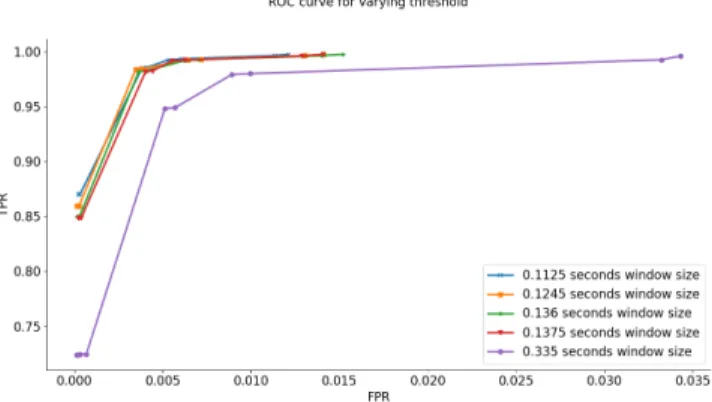
Figure 2: Adaptive CUSUM Algorithm performance on vary-ing thresholds for different window sizes usvary-ing RPM dataset deviation while keeping other variables constant as depicted in the Figure 1. We realized thatkat(0.5∗σ)has a better chance of detecting small shifts early. Cumulative results of the CUSUM are presented using the receiver operating characteristics (ROC) showing how performance of the algorithm changes with varying threshold for different window sizes as shown in Figure 2. As the window size increases, the relative variability of messages increases, thus resulting in higher TPR and FPR.
4.2
Experimental Results
We conducted three different experiments with the parameters ob-tained from the attack-free dataset to evaluate the adaptive CUSUM algorithm. As in the case of the attack-free dataset, we assume that the first five windows of the attack datasets do not contain anomalous messages instances and they form the training set used in estimating the parameters. In our datasets, these windows do not contain any attack data. We expect the mean of the message instances to change at an unknown time. We set the detection threshold h = 3 to detect attacks very quickly with low false alarm rate. When an attack is detected, the decision function grows con-tinuously after the change, and an alarm is signaled when it is greater than the threshold.
For spoofing the gear and the RPM dataset, we identified the injected IDs and plotted the message instances against time in sec-onds in the samples and CUSUM graphs corresponding to both IDs. Figure 3 shows the plots for the attack-free dataset instances and the one-sided CUSUM chart for gear and rpm IDs. Visual inspection reveals that there is no alarm signal asGn <h.
The corresponding Figure 4 shows the same plots with the CUSUM signaling an alarm when the values ofGn >h. As shown in the figure, the algorithm analyzed the incoming messages to calculate the CUSUM parameters and started detection when it reached a steady state. IfGn≈1 is greater thanh=3, the CUSUM algorithm alert that change has occurred and an alarm is signaled before the algorithm terminates. Similar plots were obtained with spoofing the RPM gauge dataset and the DOS attack dataset. The figures show the successful detection of the injected IDs with a very short delay. By manual analysis of both datasets, we observe that the first set of injections for the spoofing gear dataset was around timet =1.2682 while our detection algorithm signals the alarm att≈1.30. This implies that the detection delay for the gear data injection isnd ≈0.032. Similarly, manual inspection of the RPM
(a) Message distribution (b) CUSUM statistic.
Figure 3: Plot of message instances against the time (secs) and CUSUM algorithm for gear ID with a thresholdh=3for attack free dataset.
(a) Message distribution (b) CUSUM statistic.
Figure 4: Plot of message instances against the time (secs) and CUSUM algorithm for gear ID with a thresholdh=3for spoofing the drive gear dataset.
gauge dataset reveals the set of injections occurred att=0.9667 seconds, and our detection algorithm signaled the alarm att≈1.08 seconds which imply that the detection delay is on the average ofnd =0.113. Furthermore, we conduct similar analysis on the fuzzy and the DOS attack dataset, and their detection delays are
nd=0.092 andnd =0.165 seconds respectively. The corresponding ROC curve for fuzzy attack dataset is shown in Figure 5.
To enhance the performance of our detection algorithm, we remark that varying the required parametersk,h,and large enough window sizeωimproves the detection accuracy. While executing the algorithm at different time intervals, we obtained different results, and the number of false alarms ranged between different interval counts. Subsequently, when the threshold value is lowered with the same window size, a degraded performance is noticed, i.e., the false positive rate increased significantly. Similarly, when the window size is decreased using the same interval and threshold values, we get a high rate of false alarms.
5
RELATED WORK
Anomaly-based intrusion detection system has been applied to traditional network-based systems to detect anomalous behaviors in the network. As most messages in the CAN bus tend to be periodic, detection approach using message inter-arrival time, entropy, and frequency have been proposed to analyze and detect anomalous behavior in the network [11–13, 16].
Taylor et al. [20] developed an anomaly detector by learning to predict the next data word originating from each sender in the bus using long-short-term memory (LSTM) recurrent neural network
AutoSec ’19, March 27, 2019, Richardson, TX, USA H. Olufowobi et al.
Figure 5: ROC curve of varying thresholds for different win-dow sizes using fuzzy attack dataset.
for CAN bus anomaly detection. In [6] a deep learning based IDS is proposed to monitor CAN packet broadcast on the network by capturing the underlying statistical features of data and use them to detect attacks. Also, [9] proposed a fuzzy algorithm to distinguish between legitimate CAN messages generated by human driver and the injected messages generated by an attacker. Our approach differs from prior work because we focus on detecting anomalies by identifying changes in the statistical properties of the observed messages on the CAN bus based on the hypothesis testing.
Change-point detection has been applied to several systems in-cluding wireless network protocols, application, and CPS [5, 8, 17]. Tang et al. [17] used the non-parametric CUSUM test to find abrupt changes in a process without anya prioristatistical knowledge and detected the real-time backoff misbehavior problem in IEEE 802.11 based wireless networks. Huang et al. [5] proposed the use of adaptive CUSUM algorithm for defending against false data in-jection attacks in smart grid networks using a Markov-chain-based analytical model. Similarly, [8] applied the CUSUM test as a collab-orative quickest detection model to identify changes in distributed ad hoc networks. However, to the best of our knowledge, this pa-per presents the first application of the change-point detection approach to identify anomalous behavior in CAN.
6
CONCLUSION
In this paper, we present an anomaly intrusion detection system to identify message injection attacks on CAN bus. The proposed approach is based on change-point detection techniques using adap-tive CUSUM algorithm to detect statistical changes and intrusions in CAN bus message stream. We utilized the instance of messages in a sample window and carefully chosen tuning parameters to identify differences in the statistical properties and detect irregu-lar patterns of the messages. Analytical results have shown that the proposed detection algorithm can efficiently detect data injec-tion attacks with low detecinjec-tion delay. Through our experiment, we showed that when the required parameters are carefully selected, there is high detection accuracy with low false alarm rate. Future work will compare the performance of the adaptive CUSUM algo-rithm with other anomaly detection approaches and analyze the algorithm performance under different attack scenarios and inten-sity. Additionally, we aim to find other interesting characteristics of the messages that can be used for hypothesis testing.
ACKNOWLEDGMENTS
This material is based upon work supported by the National Science Foundation under Grant No. CNS 1646317 and CNS 1645987.
REFERENCES
[1] Rudolf B Blazek, Hongjoong Kim, Boris Rozovskii, and Alexander Tartakovsky. 2001. A novel approach to detection of denial-of-service attacks via adaptive sequential and batch-sequential change-point detection methods. InProceedings of IEEE systems, man and cybernetics information assurance workshop. Citeseer, 220–226.
[2] Stephen Checkoway, Damon Mccoy, Brian Kantor, Danny Anderson, Hovav Shacham, Stefan Savage, Karl Koscher, Alexei Czeskis, Franziska Roesner, and Tadayoshi Kohno. 2011. Comprehensive Experimental Analyses of Automotive Attack Surfaces. InUSENIX SECURITY. USENIX.
[3] Pierre Granjon. 2013. The CuSum algorithm-a small review. (2013).
[4] Tobias Hoppe, Stefan Kiltz, and Jana Dittmann. 2008. Security threats to automo-tive CAN networks–practical examples and selected short-term countermeasures. InInternational Conference on Computer Safety, Reliability, and Security. Springer, 235–248.
[5] Yi Huang, Jin Tang, Yu Cheng, Husheng Li, Kristy A Campbell, and Zhu Han. 2016. Real-time detection of false data injection in smart grid networks: an adaptive CUSUM method and analysis.IEEE Systems Journal10, 2 (2016), 532–543. [6] Min-Joo Kang and Je-Won Kang. 2016. Intrusion detection system using deep
neural network for in-vehicle network security.PloS one11, 6 (2016), e0155781. [7] K. Koscher, A. Czeskis, F. Roesner, S. Patel, T. Kohno, S. Checkoway, D. McCoy,
B. Kantor, D. Anderson, H. Shacham, and S. Savage. 2010. Experimental Security Analysis of a Modern Automobile. In2010 IEEE Symposium on Security and Privacy. 447–462. https://doi.org/10.1109/SP.2010.34
[8] Chengzhi Li, Husheng Li, and Huaiyu Dai. 2008. Collaborative quickest detec-tion in adhoc networks with delay constraint-part II: Multi-node network. In Information Sciences and Systems, 2008. CISS 2008. 42nd Annual Conference on. IEEE, 600–605.
[9] Fabio Martinelli, Francesco Mercaldo, Vittoria Nardone, and Antonella Santone. 2017. Car hacking identification through fuzzy logic algorithms. InFuzzy Systems (FUZZ-IEEE), 2017 IEEE International Conference on. IEEE, 1–7.
[10] C. Miller and C. Valasek. 2015. Remote exploitation of an unaltered passenger vehicle.Unknown Journal(2015).
[11] Michael R Moore, Robert A Bridges, Frank L Combs, Michael S Starr, and Stacy J Prowell. 2017. Modeling inter-signal arrival times for accurate detection of CAN bus signal injection attacks: a data-driven approach to in-vehicle intrusion detection. InProceedings of the 12th Annual Conference on Cyber and Information Security Research. ACM, 11.
[12] Michael Müter and Naim Asaj. 2011. Entropy-based anomaly detection for in-vehicle networks. InIntelligent Vehicles Symposium (IV), 2011 IEEE. IEEE, 1110– 1115.
[13] Habeeb Olufowobi, Gedare Bloom, Clinton Young, and Joseph Zambreno. 2018. Work-in-Progress: Real-Time Modeling for Intrusion Detection in Automotive Controller Area Network. In2018 IEEE Real-Time Systems Symposium (RTSS). IEEE, 161–164.
[14] Opeyemi Osanaiye, Kim-Kwang Raymond Choo, and Mqhele Dlodlo. 2016. Change-point cloud DDoS detection using packet inter-arrival time. InComputer Science and Electronic Engineering (CEEC), 2016 8th. IEEE, 204–209.
[15] Ewan S Page. 1954. Continuous inspection schemes.Biometrika41, 1/2 (1954), 100–115.
[16] Hyun Min Song, Ha Rang Kim, and Huy Kang Kim. 2016. Intrusion detection system based on the analysis of time intervals of CAN messages for in-vehicle network. InInformation Networking (ICOIN), 2016 International Conference on. IEEE, 63–68.
[17] Jin Tang, Yu Cheng, and Weihua Zhuang. 2014. Real-time misbehavior detection in IEEE 802.11-based wireless networks: An analytical approach.IEEE Transac-tions on Mobile Computing13, 1 (2014), 146–158.
[18] Alexander G Tartakovsky. 2014. Rapid detection of attacks in computer networks by quickest changepoint detection methods. InData analysis for network cyber-security. World Scientific, 33–70.
[19] Alexander G Tartakovsky, Boris L Rozovskii, Rudolf B Blazek, and Hongjoong Kim. 2006. A novel approach to detection of intrusions in computer networks via adaptive sequential and batch-sequential change-point detection methods. IEEE Transactions on Signal Processing54, 9 (2006), 3372–3382.
[20] Adrian Taylor, Sylvain Leblanc, and Nathalie Japkowicz. 2016. Anomaly detection in automobile control network data with long short-term memory networks. In Data Science and Advanced Analytics (DSAA), 2016 IEEE International Conference on. IEEE, 130–139.
[21] Haining Wang, Danlu Zhang, and Kang G Shin. 2004. Change-point monitoring for the detection of DoS attacks. IEEE Transactions on dependable and secure computing1, 4 (2004), 193–208.