PROCEEDINGS OF HEALTH SCIENCE
“FK-DIKUA”
Editors:
Heru Santoso Wahito Nugroho
Angelito E. Alvarado
Sanglar Polnok
David Ackah
Yessy Dessy Arna
Publisher:
Forum Ilmiah Kesehatan (FORIKES)
2017
Page--- ii --- ISBN 978-602-1081-13-6
Proceedings of Health Science “FK-DIKUA”
Editors:
Heru Santoso Wahito Nugroho (Indonesia)
Angelito E. Alvarado (Philippines)
Sanglar Polnok (Thailand)
David Ackah (Ghana)
Yessy Dessy Arna (Indonesia)
Publisher:
Forum Ilmiah Kesehatan (FORIKES)
2017
Page--- iii --- ISBN 978-602-1081-13-6
Proceedings of Health Science “FK-DIKUA”
Editors:
Heru Santoso Wahito Nugroho (Indonesia)
Angelito E. Alvarado (Philippines)
Sanglar Polnok (Thailand)
David Ackah (Ghana)
Yessy Dessy Arna (Indonesia)
ISBN 978-602-1081-13-6
Publisher:
Forum Ilmiah Kesehatan (FORIKES)
2017
Address: Cemara Street 25, Dare, Sukorejo, Ponorogo, Indonesia 63453
Phone: +6285853252665, +6281335718040
Email: [email protected]
Website: http://forikes.webs.com
Cover and Layout:
Heru Santoso Wahito Nugroho
Page--- iv --- ISBN 978-602-1081-13-6
PREFACE
Proceeding of Health Sciences “FK-DIKUA” is part of the launching event of The
Alumni Communication Forum of Doctoral Program in Health Sciences of Airlangga
University, Indonesia. In this event presented scientific articles in the areas of health,
written by researchers from several countries, namely Indonesia, the Philippines,
Thailand, and India. Scientific publication also involves the editors of several countries,
namely Indonesia, the Philippines, Thailand, and Ghana.
We hope that these proceedings can contribute significantly to the development of
science and technology in the field of health.
Surabaya, April 22, 2017
Editors
Page--- v --- ISBN 978-602-1081-13-6
TABLE OF CONTENTS
Cover --- i
Title page 1 --- ii
Title page 2 --- iii
Preface --- iv
Table of contents --- v
BIOPSYCHOSOCIOCULTURAL (BPSC) PARADIGM AS A HOLISTIC HEALTH PARADIGM Muhammad Anshari (1-6)
A NURSING CARE QUALITY MODEL DEVELOPMENT BASED ON NURSE PERFORMANCE ANALYSIS AND SATISFACTION OF NURSE AND PATIENT
Abdul Muhith (7-14)
THE ROLE OF ZINC AND CYSTEINE AMINO ACID ON GROWTH BIOMARKER OF STUNTING TODDLER’S BONE AFTER GIVING HIGH DOSAGE OF VITAMIN A
Hendrayati, Bambang Wirjatmadi, Merryana Adriani (15-23)
THE INFLUENCE OF SERVANT OF GOD’S KNOWLEDGE AND SKILL TOWARD VCT SUPPORT FOR INDIVIDUAL WHO HAVE RISK OF HIV AND AIDS
Imelda F.E. Manurung (24-26)
SURVEILLANCE SYSTEM OF HIV/AIDS SUSPECT DETECTION BY CADRE EMPOWERMENT AT BULUKUMBA DISTRICT, SOUTH SULAWESI, INDONESIA
Masriadi, Darmi Indrawati, Syamsul Bakhri (27-30)
ANALYSIS FACTOR THAT INFLUENCED INDEPENDENCE OF HEAD INJURY PATIENTS WHO WERE EVER NURSED AT EMERGENCY INSTALLATION OF RSUD DR. R. KOESMA TUBAN
Ahsan, Tina Handayani, Moh. Ubaidillah Faqih (31-36)
THE INFLUENCE OF GIVING ZINC TOWARD SERUM ZINC CONTENT ON POSTPARTUM MOTHERS
Lydia Fanny (37-39)
DISTRIBUTION OF CARIES BASED ON PUFA INDEX ON COLLEGE STUDENTS OF STUDENT STUDY SERVICE (KKN) PARTICIPANTS
Ristya Widi Endah Yani, Hadi Prayitno, Heru Santoso Wahito Nugroho, Angelito E. Alvarado, Sanglar Polnok, Dincy Devassy (40-41)
EARLY MARRIAGE OF MARRIAGE DISPENSATION IN EAST JAVA, INDONESIA (CHALLENGE OF TEENAGERS’ READINESS TOWARDS GOLDEN GENERATION 2045)
Iswari Hariastuti (42-47)
UNMET NEED OF FAMILY PLANNING ON REPRODUCTIVE AGE COUPLE IN MAKASSAR Rahmawati (48-55)
THE EFFECT OF CHILDREN’S HEALTH SERVICES AND MOTHERS’ CHARACTERISTICS AGAINST THE DEVELOPMENT OF UNDER-TWO-YEARS-OLD TODDLERS
Tri Riana Lestari (56-61)
THE EFFECTIVENESS OF RED BETEL LEAF EXTRACT (Piper crocatum) AGAINST THE MINIMUM INHIBITORY CONCENTRATION AND MINIMUM BACTERICIDAL CONCENTRATION OF BACTERIA SALMONELLA TYPHI
Moch. Achwandi (62-67)
ADVERSITY QUOTIENTS AS THE DETERMINANT OF COLLEGE STUDENT’S SELF-ACTUALIZATION ABILITY IN STUDENT EXECUTIVE BOARD (BEM) MEMBERS
Page--- vi --- ISBN 978-602-1081-13-6
Byba Melda Suhita, Devi Prista Prawisudiarko (68-72)
THE NECESSITY OF DEVELOPING THE EFFECTIVE COPING MECHANISM FOR WOMEN IN PENITENTIARY
Sabina Gero (73-78)
THE CORRELATION BETWEEN COPING STRATEGY OF AUTISTIC CHILDREN’S PARENTS AND THE PARENTING PARENTS
Ambar Asnaningsih (79-83)
THE CORRELATION BETWEEN HEALTHY HOUSE CONDITION AND DYSPNEA FREQUENCY OF PULMONARY TUBERCULOSIS PATIENTS
Abdul Muhith, Himawan Saputra, Sandu Siyoto (84-88)
INTERVENTION AND INTEREST KATUK LEAVES AND MALE PAPAYA FLOWER OF NUTRITIONAL STATUS OF PREGNANT WOMEN TRIMESTER II (4-6 MONTHS)
Tanty Wulan Dari, Noer Saudah (89-93)
Page --- 7 --- ISBN 978-602-1081-13-6
THE DEVELOPMENT OF NURSING CARE QUALITY MODEL BASED ON THE ANALYSISOF NURSE’S PERFORMANCE AND NURSE’S AND PATIENT’S SATISFACTION
Abdul Muhith1
1= Institute of Health Science “Majapahit”, Mojokerto, Indonesia E-mail: [email protected] ; [email protected]
ABSTRACT
The basic shifting of competitive quality in hospital was not only determined by profits, but also creation value and additional value for customers. Nurses, who were often having contact with patients and spending their time to serve patients, had a major role in treating patient’s health. Patient’s satisfaction which was as a quality indicator was the successful key for the competition of health nursing in hospital. The aim of this study was to develop a nursing care quality model based on the behavior of nursing performance, organizational and work behavior as well as patient’s satisfaction. The method used was a cross sectional study, with 14 inpatient rooms, and 176 nurses. Areas of research were: organizational factors (organization and leadership culture), performance factors (feedback and variations of work), nurse’s characteristics (motivation, attitude, commitment, and mental models), nursing practice, interpersonal communication, nurse’s and patient’s satisfaction. The results showed; 1) nursing practice was influenced by performance factors and not influenced by organizational factors; 2) interpersonal communication or professional nursing was influenced by nursing practice; 3) Professional care was influenced by nurse’s satisfaction; 4) Patient’s satisfaction was influenced by professional nursing. The results also implied: organizational culture was dominated by clan and market culture, right leadership coaching; by improving the provision of feedback and variations would improve nurse’s performance, high motivation and commitment, enough attitude and mental models (independence), and enough nurse's and patient’s satisfaction. Based on the results, the recommended models were: 1. Providing freedom for nurses in nursing practices and improving their communication skills or professional nurses; 2. Providing more incentives and feedback, as well as various works or responsibilities; 3. Maintaining or increasing clan and market culture; 4. Coaching was more suitable than nursing team performance.
Keywords: Quality, Nursing Care, Performance, Satisfaction
INTRODUCTION
The development of health services in Indonesia had been successful in improving health care more evenly. The progress of science and technology had resulted that population of educated and controlled information increased more, so that they could select and demand to obtain qualified health care (Supriyanto and Ernawaty, 2010). Therefore, it needed to be learnt development issues and opportunities that arose in health development efforts and one of them was the quality of health care. Quality of health care as the quality of service was an important part that needed more attention of healthcare provider. Services quality packaging which would be produced should be one of hospital marketing strategies that would sell services to users. Hospital management should always try to make product and services which were offered to be able to endure or to be continuous, so they could capture market share.
Health care organizations, such as hospitals were essentially public services organizations. Hospitals needed to have an excellent service quality character in accordance with patient’s expectations. Interaction between health workers and patients could be done by giving trust and credibility. Patients were hospital users who had right to assess service performances. The better the assessment of patients, the better the quality of health care in hospital (Donabedian, 1980).
The quality of nursing care in hospital depended on skill, speed, ease, and accuracy in performing nursing act. This meant that nursing services depended on the efficiency and structural effectiveness in the whole systems of a hospital. Nursing service quality was one of the basic necessities of every person. So far, the experts in health and nursing field were trying to improve: the quality of self, profession, nursing equipment, managerial ability and quality of nursing care (Potter and Perry, 2005).
In 2005 the Directorate of Nursing Services of Health Department (Direktorat Pelayanan Keperawatan Depkes) in collaboration with the World Health Organization (WHO) conducted an assessment of nursing care in East Kalimantan, North Sumatra, West Java, East Java, and Jakarta –
Page --- 8 --- ISBN 978-602-1081-13-6
Indonesia which indicated that: 1) 70.9% of nurses over the last 3 years never joined training, 2) 39.8% of nurses still performed non-nursing duties, 3) 47.4% of nurses did not have a written job description, and 4) had not been developed specifically nurses performance evaluation.
Data in Hospitals of Gresik in 2010 showed that the ratio (comparison) of nurses and beds had not qualified the standard of Depkes, 2005 that meant the number of nurses was still less (SK. Menkes RI 262 / Menkes / PER / VII / 2005). Indicators data of inpatient services at RSUD Gresik in 2010 showed that the use of BOR (Bed Occupancy Rate), inpatient units had been efficient. As well as with the indicator data services of inpatient unit at Semen Gresik Hospital in 2010 that showed the condition of BOR (Bed Occupancy Rate) was in standard category. It meant that the use of hospital beds was categorized as efficient one. Indicator data of inpatient service unit at Petro Kimia Gesik Hospital in 2010 showed the use of Bed Occupacy Rate was compliant and efficient, although in 2009 and 2010 there was increase in the number of nurses and beds. While, indicator data of inpatient services unit at Muhammadiyah Gresik Hospital showed the utilization of beds was still not efficient and less standard category.
Quality of service and implementation of hospital nursing care in Gresik had not qualified the standard yet (100%). Semen Gresik Hospital was better because the level of patient’s satisfaction had fulfilled the concept of Pareto 80:20. Based on the description of the data in the background of this research showed about how the importance of nursing care. Moreover, the purpose of this research was to develop nursing care quality models based on analysis of nurse’s performance and nurse’s and patient’s satisfaction.
METHOD
This cross-sectional study was conducted in March 2011 to February 2012. The population of this research was all inpatient units of hospitals in Gresik, namely RSUD Gresik, Semen Gresik Hospital, Petro Kimia Gresik Hospital, and Muhammadiyah Gresik Hospital. The samples were all heads of inpatient units, nurses, and patients with the inclusion criteria: had one of three types of culture (clan, market, and hierarchy culture) and had one of two types of leadership (coaching and directing leadership). RSUD Gresik and Semen Gresik Hospital were hospitals that qualified the inclusion criteria. The sample size of this study was 14 inpatient units who were selected by simple random sampling technique. Furthermore, data were collected, and then analyzed with Partial Least Square (PLS).
RESULT
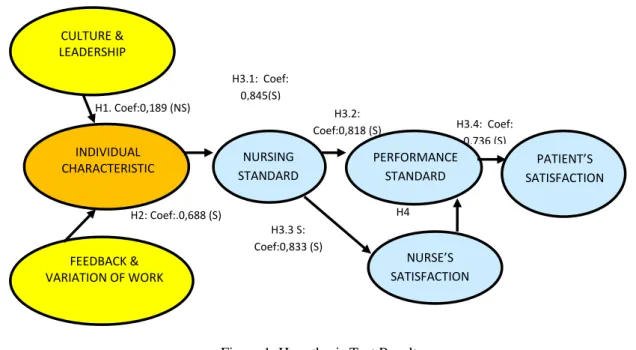
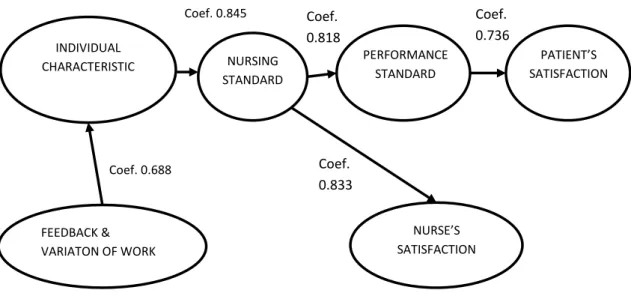
The summary of this research could be seen in figure 1 and figure 2 below:
Figure 1. Hypothesis Test Result
H4 Koef: 0,152 (S) H3.4: Coef: 0,736 (S) H3.2: Coef:0,818 (S) H3.1: Coef: 0,845(S) H1. Coef:0,189 (NS) H2: Coef:.0,688 (S) H3.3 S: Coef:0,833 (S) INDIVIDUAL CHARACTERISTIC CULTURE & LEADERSHIP FEEDBACK & VARIATION OF WORK PATIENT’S SATISFACTION NURSE’S SATISFACTION PERFORMANCE STANDARD NURSING STANDARD
Page --- 9 --- ISBN 978-602-1081-13-6
Figure 2. Final Research Model
Line 1: Starting from nurse’s feedback and variation of work→ nurse’s individual characteristics →
nursing care standard→ professional performance standards of nurse → patient’s satisfaction. The findings provided the evidence that nursing characteristics and individual characteristics of nurses were important determinants in applying nursing care standard and nursing professional performance standard in order to improve or increase patient’s satisfaction. These findings also indicated that external conditions (feedback and variations of nursing) and internal (attitudes, motivation, commitment, and mental model or independence of nurses) were determining factors or variables (enablers) on improving nurse's performance quality.
Line 2: Starting from nurse’ feedback and variation of work → nurse’s individual characteristic→
nursing care standard→ nurse's satisfaction. These findings indicated that nurse’s feedback and variations of work and nurse’s internal conditions (attitude, motivation, commitment, mental model, or independence of nurses) could be determining factors or variables (enablers) of nurse’s satisfaction.
DISCUSSION
The Influence of Organizational and Leadership Culture through Nurse’s Individual Characteristics
Figure 1 showed that there was no influence of organizational and leadership culture of inpatient unit leader through individual characteristics of room nurses. Organizational culture type of room was dominated by clan culture (50%), market culture (28.6%), and hierarchy culture (21.4%).
Clan culture by Cameron and Quinn (2006), was a culture that oriented a collaboration, emotional attachment, and a culture that focused on maintaining flexibility, attention to the staff, team members with commitment as its trigger value, and staff development and high staff participation, whereas, culture market indicated competing orientation with compliance based service of patient’s need as its trigger. Hierarchical culture was supervision and controlled based culture with a trigger value of efficiency and discipline.
It could be concluded that clan culture that dominated was conformity with nurse’s characteristic in giving high motivation and commitment of work. Hierarchical culture was needed on situation and mental model or nurse’s reliance through weak task, because hierarchical culture was supervision and controlled oriented culture through the work of subordinates. Leadership type of inpatient unit leader was mostly coaching (57.8%), and then directing (42.9%). Leadership coaching or mentor and facilitator would establish effective communication between team members and foster their strong participation among its members. Coaching in organizational culture reflected in clan culture. Coaching was a leadership behavior with orientation direction of high correlation and high task. Control of decision-making remained the leader task (Cameron and Quinn, 2006).
The results showed that coaching leadership type tended to be good in increasing motivation and commitment (> 80%), such as clan culture but it was weak on the mental models or independence and
Coef. 0.845 INDIVIDUAL CHARACTERISTIC Coef. 0.688 Coef. 0.833 Coef. 0.736 Coef. 0.818 FEEDBACK & VARIATON OF WORK PATIENT’S SATISFACTION NURSE’S SATISFACTION PERFORMANCE STANDARD NURSING STANDARD
Page --- 10 --- ISBN 978-602-1081-13-6
attitude of nurses (<49%). Directing leadership tended to give enough value to all characteristic components of nurses (commitment, motivation, mental models or independence, and attitude of nurses).
A study conducted by Lewin, Leppitt, and white in Gillies (1989) showed that group produced a greater quantity of work if it was under directing leadership but it would be better quality of work if it was under coaching leadership. According to Gillies (1989), the factors that determined the best leadership style were existed situation including difficulty and complexity of tasks assigned: time available for completion of task, group size, communication patterns within the group, educational background, and employee’s experience. The characteristics were very suitable and in accordance with nursing team method, also according to nursing professional performance, which emphasized collaboration and participation. Since most of clan organizational culture and coaching leadership type, organizational and leadership culture types which were performed by leader were relatively homogeneous in each nursing room, or culture. Besides, leadership type of headspace would have no influence on motivation, attitude, commitment and mental model or independence of nurses. Leadership that was owned by inpatient unit leader had no significant effect on nurse’s individual characteristics and job satisfaction that was felt by nurses. It might be caused by work period of inpatient unit leader and nurse was on average so that the leadership style that was applied by unit leader did not give influence to nurses.
The results showed that there was no significant influence of culture and leadership of inpatient unit leader through nursing care quality (nursing care standards, professional performance standards of nurse , and nurse’s and patient’s satisfaction) in hospitals of Gresik.
The Influence of Feedback and Variation of Work toward Nurse’s Individual Characteristics
The results of the research informed that there was a significant influence of feedback and variations of nursing job which was affected professional performance standards of nurse . Feedback and variations on professional performance standards of nurse affected nurse’s characteristics (motivation, commitment, attitude and mental model or independence of the nurses). The research proved that the research hypothesis 2 was true. Feedback from employers was still low (50% was proceeded) and the variation of work was quite high (71.4%), so it could be predicted when the feedback as supervision and control efforts were improved and added a little more variety of work or not monotonous work anymore. Besides, it would provide an increased motivation, commitment, and attitude and mental model of nurse’s performance, then, ultimately it affected professional performance standards of nurse . This was in accordance with the theory of Kopelman (1986), that work factors affected nurse’s performance through meditation of motivation and commitment factor. Hence, it needed priority and attention to feedback from unit leader in order to increase motivation and commitment of their subordinates with consequences on performance improvement.
The results showed that there was a significant effect of feedback and variations of nurses in inpatient unit of nursing care quality (nursing care standard, professional performance standards of nurse , and nurse’s and patient’s satisfaction) through the nurse’s individual characteristics (motivation, attitude, commitment and mental model or independence) in hospitals of Gresik.
The Influence of Characteristics toward Nursing Care Quality
The analysis result of proved line showed that there was a significant influence of nurse’s individual characteristics (motivation, attitude, commitment, mental model, or independence) toward nursing care quality, which were: 1. Nurse’s individual characteristics toward nursing care standard, 2. Nursing care standard toward professional performance standards of nurse and nurse’ satisfaction and 3. Professional performance standards of nurse toward patient’s satisfaction. This result showed that the hypothesis was proved.
The Influence of Characteristics toward Nursing Care Standard
The analysis result of proved line showed that there was a significant effect of nurse’s individual characteristics (motivation, attitude, commitment and mental model, or independence) through standards compliance of nursing care (Figure 1).
Motivation and commitment of nurses at work were highly rated, so it needed to be maintained and increased continuously. Attitudes and mental models to be able to work independently and
Page --- 11 --- ISBN 978-602-1081-13-6
professionally were still less. When nursing services quality contributed in capturing hospital competition, independence and professional in terms of nursing care should be a concern of every hospitals (Leebov and Scott, 1994). Nursalam (2011), the results of the study concluded that rewards, training and development, leadership and division of work schedule had an influence on nurse's satisfaction.
The Influence of Nursing Standard toward Professional Performance Standards of Nurse
Those who carried out a better adherence of nursing care standard would also conduct better professional performance standards of nurse (interpersonal communication) in patients, similarly to nurse’ satisfaction. The results showed as what Nursalam (2011) had explained that there was a significant influence of nursing care standards through professional performance of the nurse.
The Influence of Nursing Standard toward Nurse’s Satisfaction
The implementation of nursing care standard influenced on nurse’s satisfaction. Nurse's satisfaction was one indicator of nurse loyalty, so that loyal nurses would be motivated to provide better services to the patients.
Nurse’s satisfaction in support of organization with reference to Abraham Maslow's theory was most of nurse’s satisfaction was on the affiliation need and it was needed a supervision in performing the work. Maslow's theory was analogue of motivation theory. Moreover, the analysis result of proved line showed that there was an influence on nursing care standard toward nurse's satisfaction.
The Influence of Nurse’s Professional Performance toward Patient’s Satisfaction
The analysis result of proved line showed that there was an influence of patient’s satisfaction toward the implementation of the professional performance standards of nurse. Patient’s satisfaction toward the professional performance standards of nurse in inpatient unit was quite satisfied in terms of caring, collaboration, empathy, courtesy, and sincerety . Empirical study on satisfaction level was quite satisfied; it meant that although there was an influence, this suggested that nurse’s professional performance should be increased if hospitals would be successful in capturing competition.
Nurses were those who were directly involved in patient care. Nurse’s professional performance could be perceived by the patient. This statement was in accordance with Supriyanto and Ernawaty, (2010) who stated that health care was a type of "Credence quality" product which meant that although patients often took advantage, they remained in ignorance of what was valued. Patient’s satisfaction among caregivers that could be observed was the process of delivering services or nursing professional standards, and not on nursing aspects itself (nursing practice standards). This was in accordance with the concept of health services quality by Donabedian (1980).
The Influence of Nurse’s Satisfaction toward Professional Performance Standards of Nurse
The results showed that nurse’s motivation was high. It was same as high assessment on work commitment and enough on mental attitude of nurses. Basically, nurse’s productivity was influenced by various factors such as education level, training, motivation, work ethic, work experience, mental attitude, physical condition, technology, social security, health and safety of workplace, management and policies implemented, especially leadership (Supriyanto Ratna, 2010).
Nurse’s attitude in nursing care or assessment activity until evaluation was sufficient. This was possible because nursing care was a job of nurse’s skill manifestation that was routine, so it was just enough to give a boost employment. The research proved that there was an association of work variation toward nurse’s characteristic, especially working attitude.
Nursing Care Quality Model Development
Nursing care quality model development referred to quality system and findings of the analysis of performance research (empirical) and theoretical study.
Page --- 12 --- ISBN 978-602-1081-13-6
The basic assumption
The old model of nursing care put more emphasizes on implementation of nursing care (nursing care and caring process), not comprehensively considered all components of performance or quality system by Donabedian (1980), which included structural components (input), process, and outcome.
Second Assumption
Evolution of quality paradigm was originally driven from "provider-driven" to "customer driven”. Customer driven was one key to success in capturing human resource competition (competitive advantage). Customer driven was service quality that tried to fulfill the customer’s needs and expectations.
From both assumptions, nursing care quality development, started from the current outcomes condition (patient’ satisfaction and nurse’s satisfaction), then, it was analyzed the cause in quality processes (application of nursing care and nurse’s professional performance). Problems of quality processes were analyzed in component structure.
Patient’s and Nurse’s Satisfaction Outcome
Patient’ Satisfaction
The results showed that patient’s satisfaction in terms of caring, collaboration, empathy, courtesy and sincerety was categorized as quite satisfied. Patient’s satisfaction was one indicator of quality services which were provided and capital to get more and loyal patients. Loyal patients would reuse the same health care when they needed it again. In fact, it was known that loyal patients would invite other people to use the same health care facilities (Kaplan, 1996).
Nurse’s professional performance related to their ability in communicating and having interactive relationships in performing therapeutic nursing had to be improved. Patients were more easily assessing how nurses delivered services of nursing technical aspects. Hence, the task of nursing professional organizations was how to improve therapeutic communication skills of nurse as complement in delivering nursing care standards. This could be additional education outside in nursing profession.
The quality development of nurse’s professional performance could be done by providing training in both on / off the training about the right therapeutic communication. On the job training, it could be done by involving nurses in a seminar on nursing, providing opportunity for nurses to attend training that was associated with increasing competency of nurses. Moreover, it could also bring in relevant trainers from outside. Thus, the mental competence and working model or independence of nurses could be improved. In off-the-job training, thing could be done was increasing the education level of nurses in strata one (S1).
Nurse’s Satisfaction
Performance might be in the form of speed, ease, and comfort of how nurses provided medical services, especially nursing at a relatively fast caring time, ease in fulfilling patients' needs and the given pleasantness by paying more attention to cleanliness, friendliness, and completeness of hospital equipment.
The results showed that the nurses' satisfaction was more influenced by the implementation of nursing care standard that could be done if it was compared with organizational support (facilities, salaries, promotions, and the suitability of type of work). The perceived value of nurses on application of nursing care standard in assessment, diagnosis, and planning was high (100% could be implemented properly), while implementation and evaluation had not been able to be done completely (100%). Organization support was perceived by nurses until in reasonably satisfied level.
The results above indicated that nurses still needed to be improved their capability to implement nursing care standard by improving the competence (knowledge and skills). Similarly, organization support which was conducive and facilitative for nurses to apply nursing care standard fully.
The Development of Organizational and Leadership Culture of Inpatient Unit Leader
Organization was built with a set of values, as crystallization of individual value, group and eventually became a common value (Cameron and Quinn, 2006). Research conducted by Cameron and Quinn (2006) could be determined that there were four cultural types or organizational leaderships, those
Page --- 13 --- ISBN 978-602-1081-13-6
were clan, hierarchy, market and adhocracy leadership. Typology of culture, business organization leadership based on the theory of management: effective performance, leadership, and skill management. From this management theory, it was raised indicators (measurement tool) in six measurement dimensions.
The results of the study informed that organizational culture type was largely dominated by Clan culture (emphasizing collaboration and teamwork), and had started market oriented culture or patient’s need fulfillment. Most of leadership type of room leader was dominated by coaching leadership (leadership with the type of assistance). Directing leadership was still found in nurse’s teamwork. This showed that nurses were not proved in doing professional cooperation.
Job Characteristics Development (Feedback and Variations)
Employee did their functions and activities related to satisfaction and commission, so it could be added other factors, which were: 1. Expectations of commission, 2. Perception of task, 3. External encouragement or leadership, 4. Needs based on Maslow, and 5. Work factors (design , task variation, feedback, monitoring, and control). Job-related factors, the results of research informed that feedback was less done by inpatient unit leader and nursing job variation was quite varied.
If the process was associated with the theory of Kopelmen (1986), work factors that were feedback, variation, work design, workload, and job design affected individual performance toward attitudes, knowledge, ability, and motivation variables. Generally, it could be concluded that the lack of feedback that was done by inpatient unit leader could affect nurse’s individual performance.
Suggestion to do was giving feedback as a mean of leader controlling. Inpatient unit leader did control, supervision, and checking, and not too much focus on non-nursing task.
Development of Attitude, Motivation, Commitment and Mental Model or Independence of Nurse
Commitment and motivation of nurses were high, but the ability to run a self-reliance or independence was still enough, thus, coaching and directing leadership types at room were still felt necessary. However, with increased levels of competence through on / off-the-job education, making nurses capable in carrying out nursing care quality (able), then supporting leadership type could be considered.
Situational leadership type meant that there was no any best suited to all conditions of interest, and subordinates behavior condition. The fact of the research was it found all types of situational leadership, such as delegating, supporting, coaching, and directing. Coaching and directing leadership types were widely practiced by inpatient unit leader in order to enhance nurse’s independence in implementing nursing care independently and professionally.
On the job training was required in workplace for knowledge management; the QC (Quality Control) aimed to make a good nurse independence. Besides, there was the remuneration of nurses. Currently remuneration was the most effective forms to increase nurse’s commitment. Remuneration of nurses could be done in the form of rewards system and focused on nursing team.
On the job training could also be done in the form of hand skill improvement of nurses. It was expected to increase commitment and mental models or independence in the nurse’s work. Nurse would believe more in their ability. In the off-job training that needed to be proposed was an increase in nurse’s education level to strata one (S1)/bachelor degree. In principle, improving processes and inputting with on the job training or off the job training would have an impact on knowledge management and improvisation of communication skills. Of course, the input - process - outcome should get a support of organizations (hospitals), as well as the role of nurse professional organizations.
CONCLUSION Model Test Result
Organizational and leadership culture of inpatient unit leader did not significantly influence nurse’s characteristics (motivation, attitude, commitment and mental model or independence of nurses). Organization culture type was largely dominated by clan culture (emphasizing collaboration and teamwork), and had been already started a market oriented culture or fulfillment of patient’s needs. Leadership type of inpatient unit leader was dominated by coaching leadership (leadership with the type
Page --- 14 --- ISBN 978-602-1081-13-6
of assistance). Directing leadership type was still found in nurse work team. Feedback and variations significantly influenced nurse’s characteristics (motivation, attitude, commitment and mental model or independence of nurses). Feedback was less done by inpatient unit leader and nursing job variation was quite varied. Motivation and commitment level of employment were high, while working attitude and independence of professional work as a nurse (mental models) were in enough categories.
Nurse’s characteristics (motivation, attitude, commitment and mental model or independence of nurses) significantly influenced nursing care quality (nursing care standards, professional performance standards of nurse, and nurse’s and patient’s satisfaction). 1) There was a significant influence of nurse’s individual characteristics toward nursing care standard. 2) There was a significant influence of nursing care standard toward the professional performance standards of nurse. 3) There was a significant influence of nursing care standard toward nurses' satisfaction. 4) There was a significant influence of professional performance standards of nurse toward patient’s satisfaction. Nurse’s satisfaction had no significant influence on implementation of professional performance standards of nurse. Nurse’s satisfaction of organization support was quite satisfied. Nursing care standards were activities which were related to competence (knowledge and skills), while nurse’s professional performance was related to soft skills, which received less attention in the process of nurse’s education.
Nursing Care Quality Development Model Proposed
The nursing care model had to be prepared by principle; 1. Based on research analysis line, 2. Reality or factual condition descriptive analysis, and 3. Synthesis of descriptive results and line of research, then developed a model that referred to the customer’s needs and expectations (customer driven) which leaded to hospital quality competition (competitive advantages). Generally, the development of nursing care quality models that existed referred to a comprehensive quality system.
REFERENCES
Cameron, K.S., dan Quinn R.E., 2006. Diangnosis and changing organizational cultur, john wiley and sona, Inc, San fransisco.
Depkes, 2005. Standar tenaga keperawatan di rumah sakit, Departemen Kesehatan Republik Indonesia. Donabedian, A., 1980. Aspects of medical care administration, Harvad University, Press.
Gilles, D.A., 1989. Management a systems approach, Philadelphia:W.B. Saunders. Company.
Herzberg, F., 1977. One more time: how do you Motivate employee? The manajement proses, Edisi 2, New York; Macmillan.
Kaplan, R.S., dan Norton D. J., 1996. Balanced scorecard, translating strategy into action. Harvard Business School Press.
Kopelman, R.E., 1986. Managing productivity in organizations, Mc Graw-Hill Book Company, New York.
Leebov, W., dan Scott G., 1994. Service quality improvement the customer satisfaction for health care, Hospital Publishing, Inc, America.
Luthans, F., 1995, Organizational Behavior, Seventh Edition, International Edition, New York, Mc Graw-Hill Inc.
Maholtra, K.N., 2003. Marketing research, Prentice-Hall Inc, New York.
Nursalam, 2011. Manajemen keperawatan aplikasi dalam praktik keperawatan, Salemba Raya, Jakarta. Potter, A.P., dan Perry G.A., 2005. Fundamental keperawatan: Konsep, Proses dan Praktek, Penerbit
Buku Kedokteran EGC, Jakarta.
Robbins, S.P., 2002. Organizational behavior, 10th ed. Oct 16., Prentice Hall Internationa Inc, San Diago State University.
Stoners, J.A., dan Freeman R.E., 1992. Management, 5th –ed, Prentice Hall, Engle Wood Cliffs, New Jersey, United State of America.
Supriyanto, S., dan Ratna, 2007. Manajemen mutu, Health Advocacy, Surabaya.
Supriyanto, S., dan Ernawaty., 2010. Pemasaran Industri Jasa Kesehatan, PT ANDI, Yogjakarta. Tjiptono, F, 2006. Manajemen Jasa, Penerbit Andi, Jogjakarta
Woodruff, G, 2002. Understanding your customer, opportunities, need, value and satisfaction, First Edition, Infinity Books, A Maya Blackwell Imprint. New delhi.