ASSESSING INTERACTIONAL COMPETENCE IN
A MULTIPARTY ROLEPLAY TASK: A MIXED-METHODS STUDY
A DISSERTATION SUBMITTED TO THE GRADUATE DIVISION OF THE UNIVERSITY OF HAWAI‘I AT MĀNOA IN PARTIAL FULFILLMENT OF THE
REQUIREMENTS FOR THE DEGREE OF
DOCTOR OF PHILOSOPHY IN
SECOND LANGUAGE STUDIES NOVEMBER 2018
By
Patharaorn Patharakorn
Dissertation Committee: James Dean Brown, Chairperson
Gabriele Kasper Thom Hudson Betsy Gilliland
ACKNOWLEDGEMENTS
I would like to thank all my committee members, Dr. Brown, Dr. Kasper, Dr. Gilliland, Dr. Im, and Dr. Hudson, without whom this dissertation would not have been remotely possible. This statement is such a cliché. But as I reflect on my six years here at UH, I cannot help but feel tremendously fortunate, and so grateful, that I have had such strong support from each of the committee members. More than my profound respect for their academic expertise in their
respective fields is my admiration for their passion and dedication for teaching and mentorship. I am thankful to have learned from all of them about the kind of person I would like to one day be for my students.
I would also like to thank Chulalongkorn University Language Institute, who had provided financial security for me during the first four years of my education here, and also for allowing me the time away from my teaching responsibility to pursue this personal and academic growth. This dissertation was also possible thanks to the generous funds from Small Grants for Doctoral Research in Second or Foreign Language Assessment from ETS. Their support was essential during the data collections of this study.
Finally, I would like to thank my parents, my family, my husband and my friends for all their unconditional love, support, reassurance, and encouragement.
ABSTRACT
In an effort to develop an assessment instrument in measuring interactional competence (IC) with a method that is congruent with the current research findings on IC and IC
development (e.g., Hall, Hellermann, & Pekarek Doehler, 2011; Pekarek Doehler & Pochon-Berger, 2015), the present study investigated students’ performances on a multiparty roleplay on a task called Socializing. Using the sequential mixed methods design (Greene, 2007; Tashakkori & Teddlie, 2003), the study explored empirical evidence garnered through qualitative and quantitative research methods to test if the proposed rubric can provide a valid and reliable measurement of IC on this performance assessment task.
The participants of this study were 180 undergraduate engineering students at a university in Thailand who were taking an EFL course that targets social communication skills in
professional contexts. Students were randomly grouped together and were asked to have a conversation for 10 minutes, in a roleplay task which they must introduce themselves as their character and try establishing business contacts for their hypothetical companies. The data for this study included 34 video-recordings of the group roleplay performances.
Conversation analysis (Clift, 2016; Sacks, 1992; Schegloff, 2007; Sidnell & Stivers, 2013) was employed to identify comparable interactional activities and determine the
interactional methods students utilized in carrying out those activities. The productive activities are self-introduction, work talk, business contact exchange, post-conference arrangement talk, and an interaction to bring about the termination of the roleplay performance. Three recipient actions include students’ management and display of their understanding, students’ management of alignment, and finally, their display of affiliative stance.
Six raters from various teaching and training backgrounds were recruited to apply the proposed rubric in evaluating the students’ IC on the eight items, combining both productive and
recipient actions. The Many-Faceted Rasch Measurement (Linacre, 1989) with the Partial Credit Scoring model (Masters, 1982) provided integrated measurement reports of the rating practice. The findings revealed that students’ ability on this IC construct mostly exceed the difficulty of the socializing task. Self-introduction and understanding display had been identified as the two easiest items, followed by alignment display, work talk, affiliation display, activity termination, making post-conference arrangements, and bringing up contact exchange, respectively. The analysis also suggested that most raters were reliable in applying the rating scale, though they demonstrated a higher degree of uniformity in evaluating productive activities compared to their ratings of recipient actions. Overall, the mixed methods research design is seen to have provided a much-needed framework in this process of exploring the validity evidence of the proposed rubric in assessing IC for the multiparty roleplay performances on the socializing task.
TABLE OF CONTENTS
Acknowledgements………..………..………... iv
Abstract………..………..………... v
List of Tables………..……… vii
List of Figures………... viii
Chapter 1. Introduction………..……….. 1
Background: A Look Back at IC in Language Testing and Assessment ………. 3
Overview ……….………. 4
Chapter 2. Theoretical Framework………... 7
Interactional Competence and Interactional Competence Development..……… 7
The Order of Interaction………. 8
Turn-Taking System……….……… 8
Sequence Organization .….………... 9
Sequential Organization or Overall Structural Organization .……….. 10
IC and IC Development ………..……… 12
Turn-Taking Practice ………...……… 14
Repair Practices ……… 15
Sequence Organizations ………... 15
IC in Language Assessment ………. 21
IC in Language Assessment Through CA Lens……….. 24
Assessment Performance as Social Practices ………...…… 24
IC as Target Construct of Assessment ………. 28
Validity and Validation in Language Assessment ………... 30
Chapter 3. Research Framework………..………... 36
Mixed methods Research………...……… 36
MMR Typologies and Designs………...………..……….. 38
MMR for Language Testing and Assessment Research……….…………... 40
Challenges in Mixing Conversation Analysis with Quantitative Methods……... 40
Performance assessment……….………...… 42
Raters ……….. 44
Rubrics ……… 45
Scale Development and Validation ……… 46
Chapter 4. Method……… 48
Assessment Contexts and Tasks……… 48
The Assessment Task………...………... 49
Research Questions………...……… 52
MMR Study Design……….. 53
Phase I: Qualitative Analysis.……… 53
Student Participants….……… 54
Data Analysis……….………. 55
Phase II: Quantitative Analysis………. 56
Raters……….. 57
Data Screening……..……….. 57
Data Analysis……….. 58
Work Talk ………. 69 Contact Exchange ……….……… 81 Post-conference Arrangements …..………... 94 Activity Termination ………...……...…... 106 Recipient Actions……….……….. 112 Understanding………..………… 113 Alignment……… 115 Affiliation……….… 120 Conclusion ……….… 124
Chapter 6. Discussion of Qualitative Results……….……. 125
Research Question 1.……….……… 125
Research Question 2……….………... 128
Research Question 3….………. 130
Chapter 7. Quantitative Results ..……… 137
Descriptive Statistics and Correlation Analyses….……….. 133
Checking for Unidimentionality……… 136
FACETS Measurement Reports……… 139
Rater Measurement Report……….……. 142
Student Measurement Report………...……… 144
Item Measurement Report……….... 146
Category Measurement Report ……….……….. 147
Modified Category Measurement Report ………..………. 152
FACETS Interaction Analysis ………..……… 154
Rater-Item Interaction ………. 154
Rater-Student Interaction ………...………. 158
Student-Item Interaction ……….……… 163
Conclusion ……… 168
Chapter 8. Discussion of Quantitative Results ………..………… 169
Research Question 4 ……….… 169
Research Question 5 ……….……… 170
Research Question 6 ……….………… 174
Chapter 9. Conclusion ………..…………... 178
Research Summary ……….. 178
Limitations of the Study ………...……… 180
Implications ………...……….. 181
Suggestions for Future Study ……… 183
References ……….. 185
Appendix A: Excerpt from the Socializing Unit textbook ……….………… 206
LIST OF TABLES
1. Summary of MMR Methodological Purposes and Design Considerations ………. 39
2. Descriptive Statistics of Participants’ Scores on the Original Rubric ………. 55
3. Raters’ Background Profiles ……… 57
4. A Summary of CA Findings of Typical Sequence Organization for the Production Activities ……….. 126
5. Descriptions of Successful and Problematic Managements of Each Activity ………… 129
6. The Proposed Rubric for Assessing IC of the Targeted Task ………. 132
7. Descriptive Statistics ………... 133
8. Inter-item Correlation Matrix Based on Composite Scores ……… 134
9. Interrater Correlation Matrix ………... 135
10.PCA for Composite Scores for eight Items on the Proposed Rubric ……….. 137
11.Component Loadings from PCA Based on Composite Scores ………... 138
12.Measurement Report for Raters ……….. 143
13.Selected Measurement Report for Underfit Students ………. 145
14.Measurement report for items ………. 146
15.Rating Scale (Partial Credit) Statistics ……… 149
16.Modified (3 Levels) Rating Scale (Partial Credit) Statistics ………... 152
17.Bias Calibration Report: Rater-Item Interaction ………. 156
18.Bias Calibration Report: Rater-Student Interaction ……… 159
LIST OF FIGURES
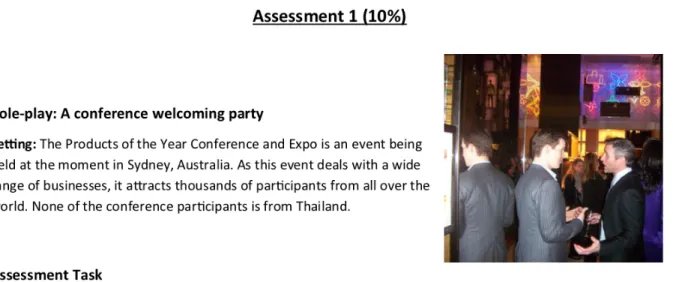
1. Set-up sheet for the socializing task ………..……….. 50
2. The original rubric used in-course ……….. 51
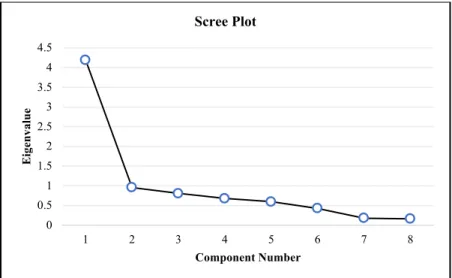
3. Scree Plot for Composite Scores for Eight Items on the Proposed Rubric ………. 138
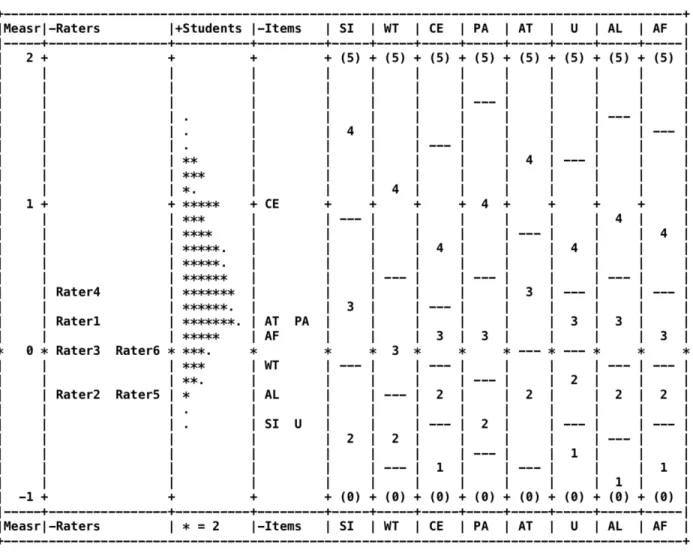
4. FACETS Summary: All Facets Vertical Ruler ……… 140
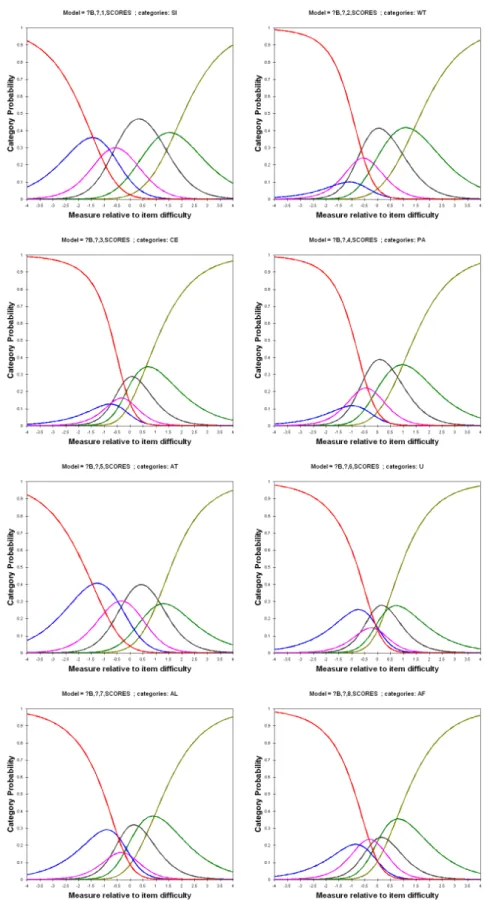
5. Rating Scale Category Probability Curves ……….. 151
6. Modified (3 levels) Rating Scale Category Probability Curves ……….. 153
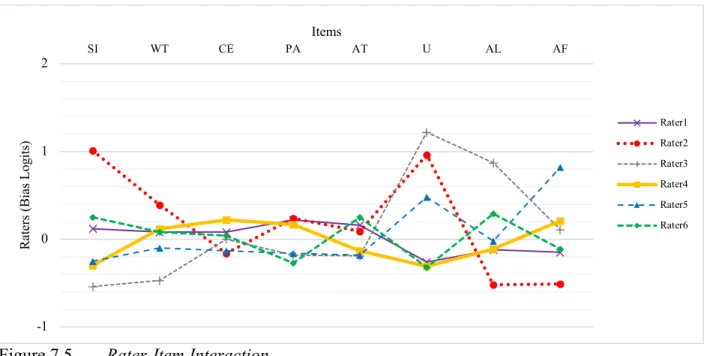
7. Rater-Student Interaction Analysis (Rater 2) ……….. 162
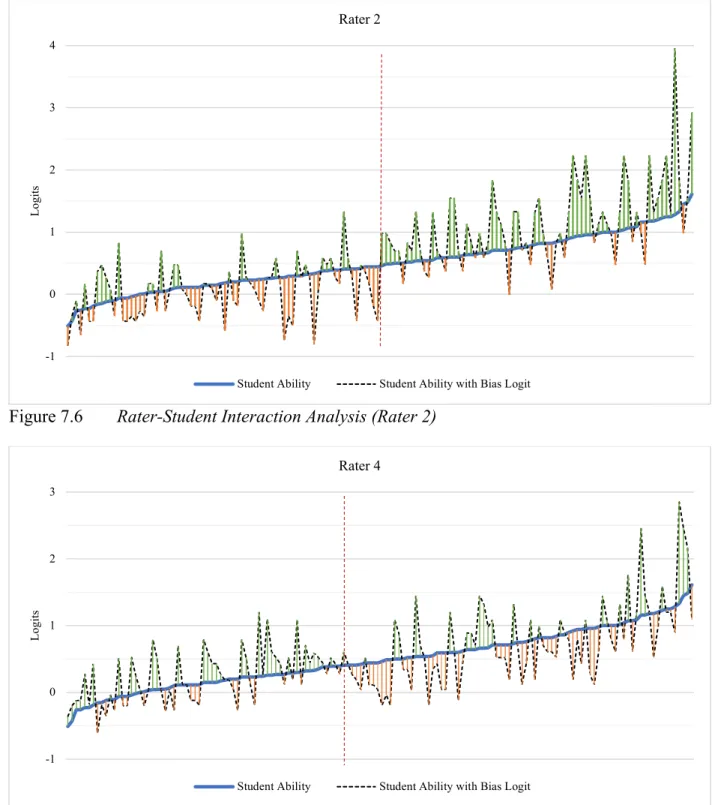
8. Rater-Student Interaction Analysis (Rater 4) ……….. 162
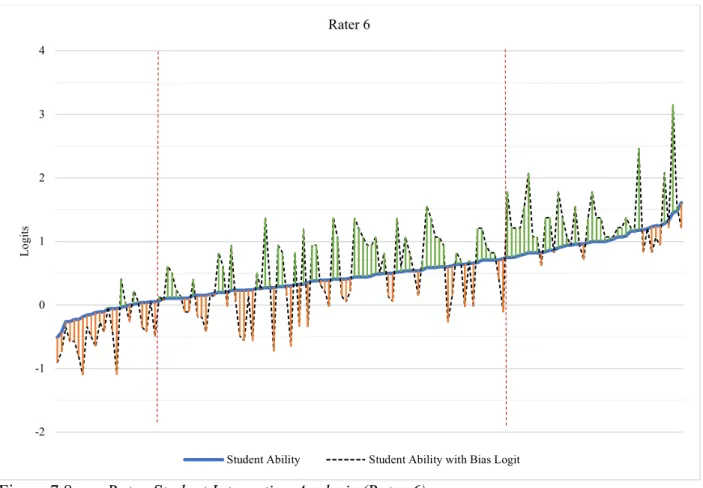
9. Rater-Student Interaction Analysis (Rater 6) ……….. 163
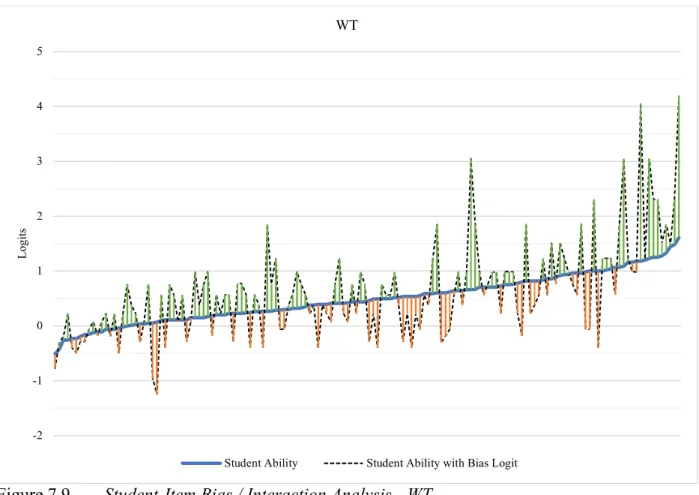
10.Student-Item Bias / Interaction Analysis – WT ………... 166
CHAPTER 1 INTRODUCTION
Talk is a site where individuals come together to articulate and manage their collective histories via their resources (Hall, 1995). The ability to participate competently in talks and conversations is one of the most fundamental goals of learning an additional language. Derived from communicative competence (Bachman, 1990; Canale, 1983; Canale & Swain, 1980), interactional competence (IC) is commonly understood as the ability to interact naturally and appropriately in social situations. The definitions being used and referred to as IC seem to have evolved over the years. When Kramsch (1986) proposed the concept of IC as part of her
argument for a redirection of language teaching goals from ‘proficiency’ to ‘interactional
competence,’ she urged that language teaching practices should move away from focusing solely on linguistic accuracy in favor of fostering IC - the teaching and learning of 'interactional
processes' and discursive skills in order to cultivate learners’ intercultural awareness in cross-cultural interactions (p. 370). Since then, the study of IC had flourished in the field of language testing and assessment, led by the work of Young and He (1998) and McNamara (1997). The interests in IC among language testers coincides with the emerging research interests among conversation analysts in second language learners' interactional practices (i.e., Firth & Wagner, 1997; Hall, 1995)
However, when it comes to how second language spoken discourse is evaluated, this ability to interact competently is still undertheorized in language assessment. Most traditional rating scales tend to focus on linguistic skills and their fluency of delivering the message, which comprise two major aspects of test takers' ability, accuracy and fluency, when oral performances are being assessed (Lazaraton, 2014). These traditional linguistic skills refer to criteria such as
grammatical accuracy and complexity, pronunciation, and vocabulary. The fluency criterion usually refers to the 'flow' of delivery, and could include consideration of cohesion and coherence of speech. These criteria do not sufficiently capture skills required in interactive communication because they lack a sensitivity to "inter-" individual skills that an examinee displays in relation to his or her co-participants. In other words, with this traditional approach, the occasion of talk and interaction in speaking test formats is merely used as a stage for assessing other constructs. The skills which go into enabling talk-in-interaction to take place have been mainly overlooked or underrepresented by performance rubrics and traditional test construct definitions.
While many of the go-to criteria in assessing a spoken discourse have been directly borrowed from assessing written discourse (i.e., grammatical accuracy, vocabulary, or
coherence), other criteria which are unique to assessing oral production mostly reflect the time-sensitive nature of the spoken discourse. Language testing may have evolved far enough to be able to score the “fluency” construct consistently by measuring pauses, speech rates, or a count of dysfluency markers (Fulcher, 2015). However, as we can see that there is a vast difference between "fluency" in a monologue and "fluency" in a normal conversation, this fixed view of "fluency", and the fact that language testers have gotten more consistent in recognizing it as such may actually be problematic.
In a recent movement in language testing, attention has turned to the construct of
interactional competence (IC) (e.g., Al-Gahtani & Roever, 2012; Roever & Kasper, 2018; Youn, 2015), providing a possible framework which can be used to look at interactional skills in spoken discourse in its own right. This line of research inquiry shares a goal to help validate the
assessment practices that wish to say something about test takers’ ability to conduct themselves in normal conversations in their second languages.
Background: A Look Back at IC in Language Testing and Assessment
In the earlier form of incorporating social constructs into the assessment of
communicative competence (Bachman, 1990; Canale & Swain, 1980), much work had been done on assessing pragmatic competence (Brown, J. D., 2001; Brown, J. D. & Ahn, 2011; Grabowski, 2013; Hudson, 2001; Hudson, Detmer, & Brown, 1992, 1995; Kasper & Ross, 2013; Roever, 2011; Yamashita, 2008; Youn, 2013) before it was extended to the more encompassing construct of IC.
Attempts in creating an assessment of IC, however, have been scarce, and we see more use of interactional ability criteria as part of the rubrics which are used for assessing
communicative language competence in classroom contexts and some specific occupational contexts. Quite likely, the notion that IC is fundamentally situated and co-constructed (Young, 2011; Young & He, 1998) had made matters surrounding assessing IC complicated.
Many studies, however, have shed light on the importance of possible interactions between raters, scoring rubrics, and certain interactional features of student performances. Douglas (1994) found little relationship between scores on a test and the language actually produced by test takers. He discussed that it is possible that raters might have been influenced by aspects of language performance that have to do with communicative language ability that was not present in the scoring criteria. More association between scores and performance was found in another study into the IELTS speaking test. In comparing high and low scoring test takers, Seedhouse (2012) found that high scoring students systematically have interactional ability to develop topics more extensively in interaction, display engagement in their participation, and construct their a ‘professional’ and ‘internationally oriented’ identity through their talk. May (2011) has taken the rater’s perspective to see what interactional features are salient to them, pointing to future research directions compatible with that of Seedhouse (2012) and Douglas
(1994) that rubrics with explicit data-derived criteria for IC are needed for assessing oral
communicative performance. At the very least, these findings point to a strong susceptibility that raters implicitly have towards IC, and it is with this belief that this current study is attempting to make IC more explicit.
Overview
The important question of “whose competence?” asked by McNamara (1997) in reference to the co-contributing nature of social actions, remains open for further exploration. Given the institutional use of most language tests is to provide information about an individual language learner's knowledge and ability, it is useful to have a model which can help untangle individual contributions from what is collectively accomplished. One of the main tasks at hand is to establish what observable attributes for interactional competence look like in second language assessment, so that we can optimize the tasks and rating instruments to better suit the aspects of IC that second language users and test takers can display.
In order to explore the construct of IC in oral assessment tasks, IC addressed in this study is situated in an elicited talk in a group roleplay task. The task chosen as the target of this study was designed to assess socializing skills in a work-related informal situation when English was used as a lingua franca. This group roleplay format was chosen because it involves unscripted talk among four to six participants who have individual and collective goals they have to achieve in the roleplay. Also, it is this talk-in-interaction element that would allow for plenty of
opportunities to inspect how IC can play a role in determining the success or failure of performance in this task.
This study’s aims are first to make explicit the construct of IC displayed in this specific context and task. Then, a performance data-driven rubric for assessing those aspects of IC will be constructed and checked for its reliability and validity.
To address this co-construction notion within IC, this study adopts the approach of IC development studies (Nguyen, 2012a; Pekarek Doehler & Pochon-Berger, 2015; Pekarek Doehler, Wagner, & González-Martinez, 2018) that argues we can examine an individual's competence display while paying attention to how the competence is co-constructed by
participants in interaction. In other words, this study takes a slightly different viewpoint from the mainstream view of IC in language assessment (more discussion on this view in Chapter 2), as it seeks to provide evidence to support that, in a given specific set of actions and situations,
individuals can show themselves to be more or less interactionally competent, and this could be viewed as the person's interactional competence within that co-construction (Kasper & Ross, 2013).
This study reports the development process of a data-driven rating scale which targets the construct of IC situated in a multiparty open roleplay task taken from an existing classroom assessment task used since 2012 called a socializing task.
The literature review is divided into two chapters. Chapter 2 provides a summary of theoretical frameworks including the literature on IC and IC development, IC as a construct in language assessment, and the validity and validation framework for assessing language
performance. Chapter 3 addresses as the research framework the mixed methodsapproach adopted in this study. This chapter discusses mixed methodsresearch designs, its strengths and potential weaknesses, and the challenges in combining certain qualitative and quantitative research methods. Additionally, Chapter 3 also reviews the literature surrounding performance
assessment, including the issues of raters' reliability, rubric construction and application, and rating scale development and validation procedures.
After reviewing the theoretical and research methodological frameworks, Chapter 4 presents the research questions this study is designed to investigate. The chapter also provides a detail description of the current study's sequential mixed methods design, the data collection methods, and data analysis procedures. Given the sequential mixed methods design of the study, the study divides the result and discussion chapters into two parts. Chapter 5 reports the
qualitative findings from student performance data, and Chapter 6 provides a discussion of the findings in relation to the corresponding research questions. Then, the quantitative results from implementing the proposed rubric for assessing IC are reported and discussed in Chapters 7 and 8. Lastly, the final chapter concludes the study by discussing its limitations, potential
CHAPTER 2
THEORETICAL FRAMEWORK
To provide the theoretical underpinnings for this study, three areas of literature are covered in this chapter. First, the bulk of this chapter will review the currently available work on the construct of interactional competence and interactional competence development in L2 learners. Second, the chapter will then discuss the treatment of IC in the field of language assessment, and finally, the chapter will provide a summary of test validity and validation framework concerning the assessment of L2 performance.
Interactional Competence and Interactional Competence Development
To develop an assessment of interactional competence (IC) in second language learners, language testing researchers can draw from the cumulative body of research on L2 interactional competence and interactional competence development. This area of research interests has been studied by conversation analysis (CA) researchers, whose methodological orientation is informed by the long tradition of sociology’s ethnomethodology (Garfinkel, 1967). Because CA pays close attention to conversation participants' micro-management of local semiotic resources, it can provide a rigorous analytical toolkit for studying IC as it enables researchers to capture moment-by-moment interactional work with an intricate level of detail. In this section, the structural organizations of interaction, as described in foundational CA studies, will be discussed before the chapter provides a summary of findings pertaining to second language learners' IC and IC development based on ethnomethodological conversation analysis (EMCA) research. Then, the status of interactional competence as an assessment construct in the field of language assessment will be reviewed and discussed.
The Order of Interaction
Conversation Analysis (CA) research has taken an interest in describing in detail the procedural infrastructure of interaction – the way in which competent members of a speech community manage their talk. Following Garfinkel's ethnomethodology in describing social interaction, it is important to note that researchers should take the emic, or the participants’, perspective in analyzing action-in-interaction as it was produced and oriented to in the first place by the participants for the co-participants, not the analysts (Schegloff & Sacks, 1973). CA investigates the day-to-day conversations under the idea that there are orders at all points in interaction, and it is this structural procedure which members socially share that enables them to communicate with one another (Sacks, 1992; Sacks, Schegloff, & Jefferson, 1974). CA treats occurrences of conversation or talk-in-interaction as achievements that both the speaker and listener co-construct together in a moment-by-moment sequential organization. In order to be able to describe IC later in the chapter, some brief reviews of CA’s concepts which constitute the building blocks of social interaction are necessary.
Turn-taking system. Central to the participation methods of talk-in-interaction, Sacks et al. (1974) proposed that conversations are composed of turns, and that turns appear in an
emergent sequential structure. As a building block in conversation, a turn is a package where an action is implemented, and this is also referred to as turn-constructional unit or TCU (Schegloff, 2007) which can be realized in a form or sentences, clauses, phrases, or lexical items. Rather than adhering to any linguistic properties of an utterance, talk-in-interaction is organized and regulated by the participants one TCU at a time (see Clift, 2016 for discussion on how grammar is configured in interaction). In taking turns at talk, we are constantly oriented to a possible completion of an ongoing TCU as a transition relevant point (TRP) to issue the next TCU. A critical feature of a turn is that it constitutes an action recognizable in and to that particular
context and co-participants. Linguistic and grammatical resources are part of the ingredients in producing and interpreting TCUs, but so are other phonetic and non-verbal resources (Clift, 2016). In general, speakers take turns in producing one TCU at a time. In cases where the current speaker needs more than one turn to talk, for example in the case of story-telling, then some interactional work is required to project that a multi-turn unit is forth-coming (e.g., “Did you hear about …?”), so that the recipient would hold off taking their turn to make room for such units. From this scenario, projecting a multi-turn unit and recognizing appropriate points at which to withhold a turn are interactional accomplishments initiated by one participant and co-constructed into being with the other co-participants.
When the goals of the interaction are observable either from within the interaction or imposed upon the participants by their institutional goals (Sanders, 2003), inferrentially
observable still in the interaction, we should then be able to judge the degree of accomplishment given the design and composition within their turn construction units (TCUs).
Sequence organization. CA is particularly concerned with how utterances can accomplish a certain action not only because of their designs but also their placements. The current action projects what is the relevant action in the next adjacent turn. In the same vein, an utterance is, therefore, interpretable in relation to what immediately precedes it. In analyzing conversational data, CA focuses on ‘adjacency pairs' as a unit of sequence construction (Schegloff, 2007; Schegloff & Sacks, 1973), or sequence co-construction to be more precise. Many conversational actions occur in pairs, such as question-answer, request-grant/refusal, or even a hello-hello greeting exchange. It is important to note, however, that the first action makes relevant the next action, but it does not determine what must come next (Kasper & Ross, 2013). For example, when someone understands a turn being directed at themselves, they may display their understanding by nodding, uttering some tokens like ‘uh-huh’ (Schegloff, 1982a) or
‘oh!’(Heritage, 1984a) or ‘I see,’ or they may formulate a response that showcases their understanding as they come up with relevant responding actions. It should be noted that these different tokens do not just signify understanding; they can carry out different social actions that can be later observed in the on-going streams of interaction.
Adjacency pair structure is found to be very stable and can be applied in describing many types of sequence organizations, from very straightforward sequences to much more complex, subtle, and nuanced conversational activities (Heritage, 1984b), e.g., confirming allusions (Schegloff, 1996). With adjacency pair construction, actions in the first and second pair parts are mutually accountable. When the relevant or expected ‘next’ action does occur, it is
characteristically treated as normal and requires no special explanation. On the contrary, when an expected or relevant ‘next’ action does not occur or is not forthcoming, the breaching party is then held accountable, with some form of explanations or accounts are then expected (see Schegloff, 2007 for in-depth explanations).
The point here is that these are some of the normative ways of making understanding visible to others; because it is normative, it is recognizable by the interlocutors, and possibly also analysts if they share the membership knowledge of the speakers. With that said, however, members' conduct can deviate from the norms. When one party in a conversation behaves differently from the norms, there are observable consequences that both parties may have to deal with through initiating repair sequences until things normalize again. What is treated as normal by the participants is observable to researchers because even when the norms are violated, it is still noticeable as participants would then provide an account for those anomalies in their interactions.
Sequential organization or overall structural organization. Similar to the sequence organization of turns, when one sequence is brought to a close, another sequence can then be
launched next with or without some transition activities in between. Schegloff (2007) refers to the overall sequential organization as the sequences of sequences. In ordinary conversations, the next sequence can be formulated as a reciprocal sequence in the same activity-type series, conducting the same action in reverse direction, i.e., "how about you?” (Schegloff, 1986). Another kind of relationship between sequences can be more tight-knit so that they make up a larger course of action in successive parts. Each sequence implements the next stage in the course of action (Schegloff, 2007). Jefferson considered the sequential organization of this kind a "socially organized ‘package' which contains standard components in a standard order of
occurrence" (Jefferson, 1988, p. 418 emphasis in the original).
Describing multiple sequences of action grouped together with an overall structural organization is an open-ended endeavor for conversation analyst researchers in identifying recurring practices regularly found across a given corpus (i.e., Jefferson, 1988). For example, an episode of talk during an opening of a birthday present would involve sequences from
acknowledging the giver, reading the card, opening the gift, positively assessing the gift, and then finally thanking the giver (Good & Beach, 2005). In another example from a more professional discourse, an episode of consultation during a medical visit at a doctor’s office would involve sequences from presenting the concern, gathering information, diagnosing, until treating the concern (Robinson, 2003; Robinson & Heritage, 2006).
The shape and order of the course of action form a supra-sequential coherence which Sacks (1992) called a “big package” (p. 354) or a set of pre-organized sequences (p. 355). The coherence derived from the overall structural organization can help explain the conceptualization of activity as a unit of interaction (Robinson, 2013) or an interactive practice (Hall, 1995). An important methodological point in analyzing interactional activities is that CA takes an emic analytical perspective; thus, describing overall structural organization must focus on how
participants orient to such organization as normative, coherent, and as something that once they ‘departed from,’ they must ‘return to’ (Heritage & Sorjonen, 1994). Robinson (2013) noted from the longstanding research on institutional talk that the studies of overall structural organization are more commonly reported in institutional interactions, (e.g., Drew & Heritage, 1992; Heritage & Clayman, 2010) given their often explicit institutional goals compared to those of ordinary conversations. This line of study of institutional interactions tends to invoke the interactional rights, expectations, and obligations associated with such identities from within the interaction, and thus can render a great help in informing the standard setting in language assessment practices.
IC and IC Development
A number of studies in recent decades have discussed the nature of IC (e.g., Hall, 1995; Hall et al., 2011; Kasper, 2009; Kasper & Ross, 2013; Nguyen, 2012a). Hall (1995) used the term IC to refer to the ability to participate competently in interactive practices. In her study of teacher and student interactional competencies in classroom interaction, competent management included an ability to develop and manage topical talk, which entails both an ability to construct utterances and an ability to figure out what is going on topically. In the first edited volume on the topic of IC, Hall et al. (2011) proposed that IC can be viewed in two parts: the knowledge of relevant available resources and the ability to make use of them to carry out interactional work in ongoing talks. The first part subsumes under the second as IC is only observable in interaction (Mehan, 1979).
The tenets of IC are operationalized to mirror the apparatus of CA. This entails an ability to competently and appropriately conduct turn-taking, sequence organization, repair practices, and topic management, and also invoke relevant participation frameworks, etc. These kinds of
abilities tend to be implicit among competent members of any speech community. However, for interactions which involve parties who are not-yet-competent speakers such as second language learners, the cumulative body of work that describes their L2 interactional competencies can be found in ethnomethodology-oriented second language acquisition studies using conversation analysis (CA) as their research method (CA-SLA for short) (i.e., Brouwer & Wagner, 2004; Gardner & Wagner, 2004).
Kasper and Wagner (2011) point out that CA-SLA work is doubly concerned with IC. On the one hand, it seeks to explain the kinds of competence that enable learners to acquire their L2 either inside or outside the classrooms, and on the other hand, it studies the L2 speakers' IC when IC is the learning target in itself. The former area of research has been instrumental in describing in detail the occasions in which L2 learners display their IC through mobilizing their available resources and accomplishing social actions in interaction with their co-participants (i.e., Lee, Y.-A., 2006; Theodórsdóttir, 2011). In the latter area of research, studying developmental stages of L2 IC poses a set of challenges for CA-SLA researchers given that CA does not normally make analytical claims beyond what is observable in the here and now, so researchers are faced with an inherent challenge of how to deal with the concept of development and identify the process in which development of IC can be observable.
The challenges are neatly summarized by Pekarek Doehler and Wagner (2010), who pointed out that development in the form of observable differences between time A and time B can be due to changes in the local context instead of changes due to development, or in the cases of cross-sectional research, due to their differed levels of IC. In conducting comparative research in CA, either longitudinal studies or cross-sectional studies, analysts are confronted with two methodological challenges: first, how to warrant comparability across their collection, and second, how the changes or differences in interactional practices can be documented and
showcased (Pekarek Doehler & Berger, 2018). In other words, the challenge facing researchers is that they need to establish commonalities among interactional occurrences, enough that they can be categorized as doing the same action. They also need to establish differences among the occurrences enough that their claim of change or development is then warranted.
Despite these challenges, several significant contributions capturing different dimensions of IC development among L2 learners have been made. These studies typically traced a
developmental trajectory of a distinct action or course of action; for example, turn-taking (Cekaite, 2007) or storytelling (Pekarek Doehler & Berger, 2016). Longitudinal studies of IC development contribute to our understanding of how learners’ methods of accomplishing an action or a course of action change or develop over time, while cross-sectional studies offer evidence as to how learners at different proficiency levels differ in the ways they accomplish an action or a course of action. Discussing the existing work on L2 IC development, the findings below are grouped based on their different analytical targets, starting from interactional
mechanisms of turn-taking practice and repair practice, to sequence organizations of actions and course of actions.
Turn-taking practice. In a study which traced IC development of a Kurdish child’s self-selection practice in doing turn-taking during classroom interactions in a Swedish L2 context, Cekaite (2007) demonstrated how the self-selecting practice had progressed from
non-participation to disruptive self-selection through non-traditional techniques to eventually
conducting self-selection in conventionally appropriate ways. The study showed that later in the data collection, the child could issue self-selections at non-disruptive and sequentially
appropriate positions showing an awareness of TRPs or TCU boundaries. Moreover, the designs of the child’s self-selection were also found to have improved in the topical relevance with ongoing talk. This also shows how the teacher had over time oriented to the child’s self-selection
practices as more appropriate, which in turn shaped the child’s interactional practice to develop in this direction.
Repair practices. CA’s repair refers to the class of treatments needed when interactional troubles arise. Troubles can be anything which participants judge as impeding their
communication. The one who initiates the repair is the one who perceives it as repairable. This is a very important competence as it is a vital mechanism for the participants to address and resolve any troubles in speaking, hearing, and understanding (Schegloff, Jefferson, & Sacks, 1977).
In Hellermann’s (2011) large-scale project he studied how language learners
accomplished repairs when they just communicated among themselves, in comparison to how repairs are accomplished in talk between language learners and native speakers. He found that language learners do produce repair regularly in the same location to the native speakers' norm. He was able to show that the ‘next turn repair-initiation' could be fundamental to human
interactional culture (p. 166), regardless of language. He also found that learners at a later point use a wider repertoire for doing other-initiated repair, like using embodied actions, open class initiators (Drew, 1997), and more specific repair initiators; the learners were able to treat a variety of objects as repairable in talk, such as discourse structure or a course of interactional actions.
Sequence organizations. Sequence organization refers to a series of turns that are normatively organized together to enact courses of meaningful actions in interaction (Schegloff, 2007). Special attention has been given to identifying L2 learners’ IC development in initiating an action or opening a course of action. Pekarek Doehler and Pochon-Berger (2015) highlighted some crucial requirements on the part of the speakers as they are initiating a sequence or
managing an opening sequence of a course of action. First, the speaker needs to display to their co-participants what actions or what course of actions are being opened so that the actions are
recognizable. Also, the speaker needs to display the local relevancy of the upcoming course of actions to the ongoing interaction so that the actions are acceptable for the co-participants. To meet these requirements, speakers must recipient-design or customize their turns to fit situations and the co-participants present at the time of talk.
The action which has been studied the most is the opening of a storytelling sequence (Jefferson, 1978; Mandelbaum, 2013; Sacks, 1972). As we briefly mentioned earlier, storytelling sequence is rather special in that in order to launch the sequence, the normal turn-taking
mechanism must be put on hold to make room for one party to take an extended amount of turns while the others take a back seat as they participate in storytelling talk (Sacks, 1992). In a study which compared unsolicited story opening practices among ESL students at the beginner and intermediate levels, Hellermann (2008) reported that beginner learners are less successful than intermediate learners at displaying the local relevancy of their story to the ongoing talk in
launching the story. Beginner level students also tend to skip the pre-storytelling sequence which has a crucial function of signaling their co-participants of the forthcoming change in their turn-taking system and helps facilitate such transition. The difference between the two levels in Hellermann’s study is an ability to recipient-design their storytelling opening. This also corroborates with another study of a larger corpus by Lee and Hellermann (2014) which also reported similar results.
Pekarek Doehler and Berger (2016) conducted a longitudinal study tracking the development of Julie, an advanced L2 French speaker from Germany, while she stayed with a host family in France over the period of nine months. The researchers demonstrated that while Julie was able to do some prefatory work in launching her storytelling at the beginning of the study, towards the end of her stay, her story prefacing sequence became more extensive and better recipient-designed. This included her control over a larger variety of techniques to display
local relevancy of the upcoming story with the ongoing talk and to signal to her co-participants what kinds of story were about to be underway to aid their reception and expectation of the story.
Another type of action which has been researched for IC development in sequence initiation is students negotiating task opening. Hellermann (2007, 2008) reported a similar trajectory in that beginning level students’ task openings are most of the time abrupt, showing no prefatory work with minimal to no recipient design to ensure recipiency and mutual recognition of the task opening before progressed to task accomplishment. On the other hand, intermediate learners were more able to engage in task opening talk and showed greater ability to recipient-design their talk.
In another type of action, IC development in transitioning from one topic in conversation to another has also been studied.Before we proceed, it should be noted that CA treats the notion of ‘topic’ differently compared to what is commonly understood of topic organization. CA does not focus on what the topic is about, but rather what the participants treat as a topic during talk-in-interaction. Schegloff (2007) suggests that it is better to examine topic with respect to action than with respect to topicality, as treating topic in its topicality has shown to be more
complicated than it appeared to be (see Schegloff, 1990 for more detailed discussion). Topic management is, therefore, a kind of interactional accomplishment of a series of sequence organizations: topic initiation, topic maintenance, topic shift, and topic closure.
Lee and Hellermann (2014) studied topic shifting practice among second language learners of English in South Korea. This longitudinal data is part of a 10-month weekly speech practice. In each session, members take turns to produce a five-to-fifteen-minute long
presentation. The study featured one of the students, tracing how this speaker handled topic shift during her storytelling. In this study, Lee and Hellermann (2014) showed that the focal speaker was able to improve their change of topic from an abrupt topic shift at the beginning of the study
to being able to signal a topic shift appropriately by employing topic shift markers to coordinate with the recipient that of what is to come.
In a cross-sectional study which compared the performances of learners at different proficiency levels in initiating requests in roleplays, Al-Gahtani and Roever (2012, 2013) demonstrated that while the higher proficiency group managed their requests using the methods similar to the L1 findings, the lower proficiency learners were more likely to launch their request with minimal to no pre-request sequence. To establish what typical competent interactions look like, Excerpt 2.1 below is reproduced from Schegloff (2007).
Excerpt 2.1 Request Sequence Reproduced from Schegloff (2007, p. 47)
1 Bon: Fpre à But- (1.0) Wouldju do me a favor? Heheh
2 Jim: Spre à e(hh) depends on the favor::, go ahead,
3 Bon: Didjer mom tell you I called the other day?
4 Jim: No she didn’t.
5 (0.5)
6 Bon: Well I called. (.) [hhh ]
7 Jim: [Uhuh]
8 (0.5)
9 Bon: Fb à .hhh ‘n I was wondering if you’d let me borrow
10 your gun.
The organization of a request sequence is one of many activities very well documented in CA literature. In English, there is some preliminary interactional work that speakers would normally attend to before one party launches a request. This type of turns is functioned as pre-sequence as the action carried out in such sequence is to obtain the legitimacy for the main action to be launched later. In the above excerpt, Bonnie issued a pre-request in line 1, “would you do me a favor?”, to check if she could have Jim’s permission to launch a request. In line 2, we can see that Jim gave a go-ahead signal while being explicit that his permission is only for Bonnie to launch her request, and not that he agreed to the unspecified favor she was asking. Bonnie’s actual request came much later in lines 9-10, finally revealing that she wanted to borrow Jim’s gun. By deferring her request with multiple hearable breathings and other delays after the pre-request has been ratified, Bonnie displayed that her pre-request was carrying a high degree of
In contrast to the example above from L1 data, Excerpt 5.2 reproduced from Al-Gahtani and Roever (2011, p. 58) below illustrates a request produced by a low proficiency learner. The sequence organization of this request initiation is problematic because the talk progressed from greeting sequence in lines 1-2 to P's request in line 3 lacking any preliminary exchange
normatively found in competent request formulation.
Excerpt 2.2 Lecture Notes, Beginner
1 P: hi teacher
2 I: hello:: ((name))
3 à P: this me (.) I want paper (.) my cla::sses (.) OK?
In a series of studies by Al-Gahtani and Roever (2012, 2013, 2018), which analyzed how students from different proficiency levels carried out requests and refusals, they found that an ability to employ prefatory work in conducting their requests and refusals increases as they move up the proficiency levels from little to no use of pre-sequence as the above example illustrated to a much more recipient-designed turn formats employing lexical and sequential resources much closer to what has been reported on L1 data.
The summary so far has focused on the findings of IC and IC development particularly of L2 learners. However, some studies have also documented IC development of L1 speakers during their professional training. Rine and Hall (2011) discussed how international teaching assistants demonstrated their ability to more appropriately invoke participation frameworks to be recognized as competent teachers through orienting to “teacher space” and become more teacher-like in the ways they started and ended their lessons. Nguyen (2011) looked at pharmacist-patient consultations and studied the pharmaceutical interns' IC development. In an advice-giving
sequence during the consultation, Nguyen discussed the interns' increased ability to design their explanations in a way that is easier for their recipients to understand, making their consultation more effective. Later in the program, the intern was able to produce advice that uses less
technical terms and more specific to how the patients can observe his or her symptoms for when there is an allergy.
This dimension of IC relates to how relevant roles, stances, and identities are being appropriately invoked in talk. This layer of work is highly pervasive, and it could equally be communicatively obligated, as well as communicatively strategized. Role relationships that we often encounter are, for example, teacher-student, parent-child, expert-layperson. Realizing these roles, as well as the socially accepted stances and identities, takes interactional work. Hence, one has to be interactionally competent in being able to do so appropriately.
Taking all things together, we can see that IC encompasses more than the control over linguistic or grammatical resources. It involves the abilities to maintain and coordinate social interactions with co-participants, to invoke relevant identities through talk-in-interaction, and to repair the course of action when any troubles in interaction arise. With the growing body of findings on IC development, the trajectory generally identified as more interactionally competent is quite uniform in pointing towards accomplishments of actions that are more efficient and resourceful.
This take on second language acquisition focusing on IC development is worth pursuing for a number of reasons. First, it puts the notion of language use at the center of the language learning agenda. Brouwer and Wagner (2004) highlighted this alternative view as they noted that an account of language learning cannot just pay attention to the formal linguistic items as in psycholinguistically oriented SLA work (also see Atkinson, 2011). We must recognize
interactional skills and interactional resources at all points of the learning experience and study how the L2 speakers construct their actions and make sense of their world as they participate in their L2 discourse community. Moreover, the learners are no longer viewed as handicapped language users (Veronis & Gass, 1985), or inferior to their native speaker counterpart in any
permanent ways. With this view on language learning, learning to participate in an
interactionally competent manner is not limited to only second language speakers, but includes any speakers who are entering a new discursive practice of which they are not a member. A discourse practice can be defined at a professional level, community level, or any specialized form of talk.
IC in Language Assessment
The construct of IC has been given a rather unique status in language testing and assessment compared to other assessment constructs. Older key papers on IC in the field of language assessment argued that IC is fundamentally co-constructed, local, and situated (McNamara, 1997; Young, 2000; Young & He, 1998). Some skepticism had been expressed about the possibility and practicality of measuring the construct of IC in language assessment (Fulcher, 2010), but the field of language testing and assessment was reluctant and cautious as to how the construct of IC should be treated and operationalized. Although having voiced the importance for the language testing field to operationalize and interpret IC for individual learners, McNamara (1997) pointed out that this need will not be easily fulfilled given the inherently social nature of IC.
A small movement within the field of language assessment attempted to cope with this social construct – to untangle this notion of co-construction-- by treating it as variables (e.g., Bonk & Van Moere, 2004; Brown, A., 2003, 2005; Davis, 2009; Galaczi, 2014; Gan, 2010; O'sullivan, 2002; Ockey, 2009). Nakatsuhara (2013) studied factors of learner characteristics to see how individual test takers affect the co-construction of group oral tests, and May (2011) took the raters’ perspective to see what interactional features are salient to them, pointing to future
research directions that rubrics with explicit data-derived criteria for IC are needed for assessing oral communicative performance.
While attempts in teasing out co-participants’ contribution to the overall shape and patterns of conversation can help language testers better control for irrelevant variables from having exerted unwanted biases in the process of performing or rating interactional data, it has not provided many answers as to what the ability to interact in social situations actually look like and where can such IC constructs are located in individual learners.
There is a strong trend of language testers bandwagoning on identifying “features” of interaction which are perceived as displaying mutual accomplishments. Galaczi (2008) conceptualized patterns of co-construction into four styles: collaborative, parallel, asymmetry and blend, based on dimensions of mutuality, equality, and conversational dominance. Many researchers have since adopted this model in explaining the different patterns of co-construction (Brooks, 2009; Davis, 2009; Galaczi, 2014; Kley, 2015). Based on this model, there is an association that collaborative pattern of interaction will allow for “better” co-construction. This view is pervasive and has been borrowed to be used in rubrics for communicative competence which also assess other aspects of competence such as grammatical competence (Ockey, 2014; Ockey, Koyama, Setoguchi, & Sun, 2015).
This view and treatment of IC should be problematized for two reasons. First, co-construction is a manner through which participants make sense with and of each other. Jacoby and Ochs (1995) commented that all social actions are co-constructed, so by extension, there could be nothing that is social that is “less” co-constructed, or not co-constructed. Second, without specifying what is being co-constructed, how can we know that being collaborative should be the goal of any testing situation?
It might be a misconception, however, to think that IC is entirely co-constructed. With conversation analysis methodology, Kasper and Ross (2013) pointed out that we can assess individual IC in any joint formation, provided that we look at one's contribution to the ongoing talk in relation to what came before his/her turn, sequence, or even to overall trajectory of activity, and considered how those prior actions constrain or enable his production.
Participants in interaction are both constrained and enabled by the co-participants' actions. In that sense, interactional competence is distributed between the
participants; no-one owns it. But it is equally important to recognize that the coparticipant's prior turn opens up an opportunity space for the current speaker's actions, it does not determine them. Individual participants do show themselves as more or less interactionally competent at particular interactional moments. With these cautions, we proceed. (Kasper & Ross, 2013, p. 11)
To guide our attention to different layers of actions in interaction, language assessment can borrow from CA studies, which shares the interests on the construct of IC. Nguyen (2012a) suggests that we can examine an individual's competence display while paying attention to how the competence is co-constructed by participants in interaction. In a testing or assessment situation, raters can look for evidence to support how, in a given specific set of actions and situations, individuals can show themselves to be more or less interactionally competent, and this could be viewed as the person's interactional competence within that co-construction (Kasper & Ross, 2013). A skilled participant with strong interactional competence is someone who in that situation can make good use of the resources that are available. These resources include
linguistic and pragmatic resources to the practices – knowledge of rhetorical scripts, knowledge of lexis and syntactic patterns, knowledge of turn-taking management, knowledge of topical organization and the means to transition from one topic to another (He & Young, 1998).
IC in Language Assessment Through a CA Lens
Kasper and Ross (2013) classified language testing research interests relating to the construct of IC based on two concerns: first, to describe the interactional organization of oral performance assessment with claims to assess learners’ second language interactional ability, and second, to define and operationalize IC as part of the target assessment constructs.
This first line of interest consists of a larger body of literature describing interactional features of different types of oral performance tasks. Even though the studies under this strand may not always brand themselves as being directly related to IC, it is important to recognize that these studies have illuminated such rich descriptions of test-related IC required of test takers in different types of elicited performance. This consideration of IC is therefore directly related to the construct validity of any test instruments whenever they are being used to elicit some form of oral interaction production. This is because knowing what actions are being carried out, by what resource and how, is closely linked to the issue of task design and the construct validity of the task, whether it assesses what you intend to assess.
Assessment performance as social practices. With respect to providing interactional descriptions for multiple forms of oral assessment, the oral proficiency interview (OPI) has by far been investigated the most given the long history of its applications when it comes to
assessing oral ability in many high stake tests like the ACTFL OPI (Lazaraton, 2002; Tominaga, 2013) and the IELTS speaking test (Seedhouse, 2013; Seedhouse & Egbert, 2006).
Contemporary findings have agreed that the language samples elicited through the OPIs
underrepresent the construct of conversations in everyday contexts because of their considerable differences in sequential structures, topic organization, preference organization. Also, the pre-specified turn-taking allocation structure between examiners and examinees are vastly different from that of ordinary conversations (He & Young, 1998; Lazaraton, 2002, 2008; Van Lier, 1989;
Young & Milanovic, 1992). Recent research on OPIs acknowledges that OPI are a specific kind of institutional discourse, a tool for eliciting evidence of spoken language ‘proficiency,’ and an occasion designed for test takers to produce language samples which demonstrate their control over various discourses and grammatical structures (Ross, 2017; Seedhouse & Nakatsuhara, 2018).
On treating the OPI as an institutional practice with the specific goal to elicit proficiency displays, some studies have focused on describing the examiner's practices during OPIs.
Research findings revealed the extent to which the examiners influenced the language samples during the OPI interactions to help examiners become more efficient in reliably eliciting ratable speech samples (Kasper, 2006; Kasper & Ross, 2007; Lazaraton, 2002; Seedhouse & Egbert, 2006). For example, in a high stake speaking test like IELTS, examiners are advised not to initiate repairs when the examinees seem to misunderstand their questions or when their responses appear incomprehensible, as the inability to provide relevant answers is already serviceable as evidence for language proficiency placement (Seedhouse & Nakatsuhara, 2018). Other studies have focused on describing the interactional features of test takers which can go into the revisions of task design or the adjustment of its assessment criteria. For example, Tominaga (2013) investigated storytelling sequences, produced as part of ACTFL OPIs, and described how the task afforded opportunities for the test takers to display their Japanese L2 IC. She found that although the test takers’ storytelling had observably become more effective at the time of the re-test, their scores did not necessarily reflect that. Her study underscores the
importance of rating scales that are sensitive to interactional improvement in learner’s social practices.
While the OPI format is recognized for its shortcomings in eliciting the range of
for a wide range of interactive practices since they are not restricted by the interviewer-guided question-answer structure (Grabowski, 2013; Kasper & Youn, 2018; Kormos, 1999; Okada, 2010; Okada & Greer, 2013).
An ethnomethodological (EM) approach which informs CA's take on roleplay has been instrumental in countering the negative associations of roleplay and simulation with
inconsequential, inauthentic, and unnatural interaction,. from the empirical focus on how
roleplay participants manage their interactions under the parameters of roleplay in the first place (Kasper & Youn, 2018). EM study roleplays as a social activity, and its findings display the order of roleplay interaction from the participants' emic perspectives. Therefore, the question of whether the interaction is unnatural or inconsequential becomes an empirical inquiry into how the participants treat the interaction as such (Huth, 2010). In particular, EM analysis on roleplay and simulations helps elucidate how participants invoke the roles or identities specified in the roleplay set up through employing membership knowledge of the social categories associated with those roles (Watson & Sharrock, 1990). Meanwhile, Francis’s (1989) analysis of simulated interaction reminds us that regardless of whether one participates in a roleplay or simply interacts as oneself, the contingency of interaction and its locally oriented character still remain the same (p. 54).
In ACTFL OPI roleplays, where the interviewer and interviewee would make a transition from the OPI portion to the roleplay portion as part of the test progressivity, Okada (2010) reported that to competently complete the roleplay, test candidates have to display their
knowledge of the appropriate sequence organization of the action required by the roleplay which can be drawn directly from ordinary conversation. To illustrate this point, a transcript from Okada (2010) is reproduced below in Excerpt 2.3.
Excerpt 2.3 Okada (2010, p. 1660); “Cleaning Shop” (I: Interviewer, C: Candidate)
35 I: yes ma’am, may I help you.
36 C: yes uh my jacket is covered with mu:d uh:::
37 mm (1.9) can you clean it for me?
In this situation, the candidate assumed the role of a customer while the interviewer was playing the role of a shopkeeper. In producing her response in line 36-37, the candidate
displayed an understanding of the previous action in line 35, and the social activity which normatively takes place at a cleaning shop. The candidate also displayed her IC in producing her request in a sequentially appropriate manner, with an account in line 36 that functioned as pre-request.
Interestingly, Okada’s (2010) observation of the examiner’s performance during the roleplay revealed a still-asymmetric turn-taking allocation and rights to topic nomination. Given that the roleplay is part of the OPI test, the interviewer remained the gatekeeper of when to move on the next topic and what topics got blocked or ratified in the roleplay conversation. Okada and Greer (2013) reported that the interviewer would pursue a task-relevant response by employing multiple questions or withhold their uptake of the candidate’s actions which did not follow the activity required by the task, resulting in extensive delays in which the candidates could then self-repair to correct their action.
To sum up what we learned so far about roleplays, the common requirement which the participants need seems to be the membership knowledge of what playing the roles would generically entail. This includes the knowledge of the social activities which are categorically bounded to a certain social group. When participants are asked to roleplay as “themselves” (i.e., Walters, 2007) or any character that they “know” how to play, their interactions are therefore authentic in the sense that the participants bring personal biography, epistemic resources, and membership knowledge to display and enact a social activity in the roleplay.
For these reasons, roleplay is seen as an appropriate test format particularly for assessing pragmatic competence in interaction (Grabowski, 2013; Kasper & Youn, 2018; Youn, 2015), and by extension for assessing social actions and courses of actions, provided that the roleplay, “as an interactionally constituted activity, is seen as affording the necessary infrastructure for
examining how test takers produce and understand social action-in-interaction through turns and sequences” (Kasper & Youn, 2018, p. 4)
IC as target construct of assessment. The distinction between IC in assessment summarized earlier and the IC assessment addressed in this section is that while the former’s goal is seeking to describe, the latter’s goal is to measure. Therefore, this section discusses instrumental designs and assessment benchmarks that have been established for assessing L2 IC operationalized under the EMCA approach.
Existing findings from IC development on L2 data suggest a positive correlating trend between language proficiency and IC as operationalized in those studies (i.e., Al-Gahtani & Roever, 2018; Hellermann, 2008); however, to assume that IC will always correlate with language proficiency would be a mistake. Studies which have investigated IC development in professional discourse, such as Nguyen (2012b), showed that even highly proficient speakers fine-tuned their interactive practices while adapting into a new institutional activity that was not familiar to them. One key consideration that we should keep in mind is that IC is activity
specific. While making predictions about future performance within the confines of similar actions or courses of actions might be allowable, generalizing IC measured in one activity type onto another action will be highly problematic.
In the earlier form of incorporating social constructs into the assessment of ‘language use’ under the framework of communicative competence (Bachman, 1990; Canale & Swain, 1980), much work centered on assessing pragmatic competence (Brown, J. D., 2001; Brown, J.
D. & Ahn, 2011; Grabowski, 2013; Hudson, 2001; Hudson et al., 1992, 1995; Roever, 2011; Yamashita, 2008; Youn, 2013), which was defined as cross-cultural pragmatic ability in three speech acts: request, apology, and refusal. The second wave of the pragmatic assessment derived from this framework has since then been extended to incorporate pragmatic competence in interaction (Ross & Kasper, 2013; Youn, 2013, 2015), which taps more into the construct of IC.
In assessing pragmatic competence in interaction, Youn (2013, 2015) designed two open roleplay tasks, one in which the test takers interacted with an interlocutor and another in which they interacted with a partner, to elicit their performance on doing requests and agreeing on a meeting time. The rating criteria of her study included the following: content delivery, language use, sensitivity to the situation, engage with interaction, and turn organization. Youn (2013, 2015) operationalized in detail the target interactional accomplishments for each criterion which is particularly sensitive to the consideration of IC. In the two criteria which directly address interactional aspects, engage with interaction and turn organization, Youn included the
following considerations in her rubric’s descriptors. Under the criterion engage with interaction, raters were directed to check whether the students designed their turns in a way that cohesively responded to the prior turns. Under turn organization, students’ performances were checked for adjacency pairs completions in a time-sensitive manner (Youn, 2015). Interestingly, her
quantitative findings through multifaced Rasch analysis or FACETS (Linacre, 1998b) indicated that these IC related criteria were the two easiest criteria in her study, pointing to the possibility that the L2 speakers might have developed IC well before they mastered other aspects of L2 competence.
As for an assessment of IC on its own, there has not been any assessment framework which has operationalized the construct consistently or systematically. On the reasons of this difficulty, Ross (2018) cited IC's multicomponential nature which as a consequence makes it
hard to operationalize and the fact that observing IC in real-time can be too subtle to warrant IC as an independent criterion.
However, there is currently a prevailing push in this direction given its potential
contributions to assess the construct which has been lacking in oral proficiency assessment. In a recent special issue in the journal Language Testing, the authors explored the construct of IC and its related issues including the relationship between IC and proficiency level, listener response as a distinct feature in the IC construct, assessment formats and tasks that can elicit IC display, and the specific criteria that are incorporated into a rating scale for IC assessment (Plough, 2018). Notable findings which pointed to the direction of assessing situated and action-specific IC can be drawn from Ross’s (2018) study, which revealed how listener responses as part of IC are dependent upon the task, and Kim's (2018) study, which analyzed communication for specific purposes and reported that in an interaction between L2 air traffic controllers, the profession-specific competence is perceived as more consequential than language proficiency.
While it is challenging to operationalize IC for measurement purposes, there seem to be an agreement that the field cannot “dispose of the difficulties by simply defining them out of existence” (McNamara, 1996, p. 83). Given the current research’s attempt to propose and
validate a framework for assessing IC in this chosen group roleplay interaction, the next and final section of this chapter provides a brief overview on the concept of validity in language testing and assessment.
Validity and Validation in Language Assessment
The concept of validity is one of the key topics of studies in the field of educational measurement which has provided the basis of our understanding of valid observation in many disciplines aiming to measure unobservable cognitive psychological traits like “knowledge” or