PROOF COVER SHEET
Author(s): Fiona KingArticle title: Professional learning and the individual education plan process: implications for teacher educa-tors
Article no: RJIE 1398180 Enclosures: 1) Query sheet
2) Article proofs
Dear Author,
Please find attached the proofs for your article.
1. Please check these proofs carefully. It is the responsibility of the corresponding author to check these and approve or amend them. A second proof is not normally provided. Taylor & Francis cannot be held responsi -ble for uncorrected errors, even if introduced during the production process. Once your corrections have been added to the article, it will be considered ready for publication
Please limit changes at this stage to the correction of errors. You should not make trivial changes, improve prose style, add new material, or delete existing material at this stage. You may be charged if your correc -tions are excessive
(we would not expect corrections to exceed 30 changes).
For detailed guidance on how to check your proofs, please paste this address into a new browser window: http://journalauthors.tandf.co.uk/production/checkingproofs.asp
Your PDF proof file has been enabled so that you can comment on the proof directly using Adobe Acrobat. If you wish to do this, please save the file to your hard disk first. For further information on marking corrections using Acrobat, please paste this address into a new browser window:http://journalauthors.tandf.co.uk/produc -tion/acrobat.asp
2. Please review the table of contributors below and confirm that the first and last names are struc-tured correctly and that the authors are listed in the correct order of contribution. This check is to ensure that your names will appear correctly online and when the article is indexed.
Sequence Prefix Given name(s) Surname Suffix
1 Fiona King
2 Orla Ní Bhroin
Queries are marked in the margins of the proofs, and you can also click the hyperlinks below.
Content changes made during copy-editing are shown as tracked changes. Inserted text is in red font and re-visions have a blue indicatorå. Changes can also be viewed using the list comments function. To correct the proofs, you should insert or delete text following the instructions below, but do not add comments to the existing tracked changes.
AUTHOR QUERIES
General points:
1. Permissions: You have warranted that you have secured the necessary written permission from the ap -propriate copyright owner for the reproduction of any text, illustration, or other material in your article. For further guidance on this topic please see:
http://journalauthors.tandf.co.uk/copyright/usingThirdPartyMaterial.asp
2. Third-party material: If there is material in your article that is owned by a third party, please check that the necessary details of the copyright/rights owner are shown correctly.
3. Affiliation: The corresponding author is responsible for ensuring that address and email details are correct for all the co-authors. Affiliations given in the article should be the affiliation at the time the research was conducted. For further guidance on this topic please see: http://journalauthors.tandf.co.uk/preparation/ writing.asp.
4. Funding: Was your research for this article funded by a funding agency? If so, please insert ‘This work was supported by <insert the name of the funding agency in full>’, followed by the grant number in square brackets ‘[grant number xxxx]’.
5. Supplemental data and underlying research materials: Do you wish to include the location of the un-derlying research materials (e.g. data, samples or models) for your article? If so, please insert this sentence before the reference section: ‘The underlying research materials for this article can be accessed at <full link>/ description of location [author to complete]’. If your article includes supplemental data, the link will also be provided in this paragraph. See <http://journalauthors.tandf.co.uk/preparation/multimedia.asp> for further explanation of supplemental data and underlying research materials.
6. The CrossRef database (www.crossref.org/) has been used to validate the references. Changes resulting from mismatches are tracked in red font.
AQ1 Please confirm that ‘professional development’ is the correct definition of ‘PD’, or correct.
AQ2 Please confirm that ‘Department of Education and Skills’ is the correct definition of ‘DES’, or correct.
AQ3 The spelling of Name for ‘Blackwell and Rosetti (2014)’ has been changed to match the entry in the references list. Please confirm that this is correct and provide revisions if needed.
AQ4 The reference ‘Holland and Hornby (2006)’ is cited in the text but is not listed in the references list. Please either delete the in-text citation or provide full reference details following journal style.
AQ5 Please confirm that the reference ‘King 2016’ is being referred to here or correct.
Mismatches between the original manuscript and CrossRef are tracked in red font. Please provide a revision if the change is incorrect. Do not comment on correct changes.
AQ8 Please check the ‘Department of Education and Science’, or correct.
AQ9 Please provide more reference details following journal style for ‘Individuals with Disabilities Education Act’.
AQ10 Has ‘King (forthcoming)’ been published yet? If so, please give details for references list following journal style.
AQ11 Please confirm that the reference ‘King 2014’ is being referred to here or correct.
AQ12 Please confirm that ‘create and learning paths’ is the correct definition of ‘CLPs’, or correct.
AQ13 Please confirm that the reference ‘King 2016’ is being referred to here or correct.
AQ14 Please confirm that ‘zone of proximal development’ is the correct definition of ‘ZPD’, or correct.
AQ15 Please confirm that ‘pedagogical content knowledge’ is the correct definition of ‘PCK’, or correct.
How to make corrections to your proofs using Adobe Acrobat/Reader
Taylor & Francis offers you a choice of options to help you make corrections to your proofs. Your PDF proof file has been enabled so that you can mark up the proof directly using Adobe Acrobat/Reader. This is the sim -plest and best way for you to ensure that your corrections will be incorporated. If you wish to do this, please follow these instructions:
1. Save the file to your hard disk.
2. Check which version of Adobe Acrobat/Reader you have on your computer. You can do this by clicking on the “Help” tab, and then “About”.
If Adobe Reader is not installed, you can get the latest version free from http://get.adobe.com/reader/. 3. If you have Adobe Acrobat/Reader 10 or a later version, click on the “Comment” link at the right-hand
side to view the Comments pane.
4. You can then select any text and mark it up for deletion or replacement, or insert new text as needed. Please note that these will clearly be displayed in the Comments pane and secondary annotation is not needed to draw attention to your corrections. If you need to include new sections of text, it is also possible to add a comment to the proofs. To do this, use the Sticky Note tool in the task bar. Please also see our FAQs here: http://journalauthors.tandf.co.uk/ production/index.asp.
5. Make sure that you save the file when you close the document before uploading it to CATS using the “Up -load File” button on the online correction form. If you have more than one file, please zip them together and then upload the zip file.
If you prefer, you can make your corrections using the CATS online correction form.
Troubleshooting
Acrobat help:http://helpx.adobe.com/acrobat.html
Reader help:http://helpx.adobe.com/reader.html
Please note that full user guides for earlier versions of these programs are available from the Adobe Help pages by clicking on the link “Previous versions” under the “Help and tutorials” heading from the relevant link above. Commenting functionality is available from Adobe Reader 8.0 onwards and from Adobe Acrobat 7.0 onwards.
Firefox users: Firefox’s inbuilt PDF Viewer is set to the default; please see the following for instructions on how to use this and download the PDF to your hard drive:
http://support.mozilla.org/en-US/kb/view-pdf-files-firefox-without-downloading-them#w_using-a-pdf-reader-plugin
Professional DeveloPment in eDucation, 2017 https://doi.org/10.1080/19415257.2017.1398180
Professional learning and the individual education plan process:
implications for teacher educators
Fiona King , Orla Ní Bhroin and Anita Prunty
school of inclusive and special education, institute of education, Dublin city university, Dublin, ireland
ABSTRACT
Policy and legislation internationally advocates curriculum access and inclusion for pupils with special educational needs. The individual education plan (IEP) process, which focuses on individual planning for pupils with special educational needs, has been mandated as a means of achieving this goal in many countries. As a concept it has been challenged in terms of its potential to perpetuate difference which is antithetical to inclusion. As a practice concerns have been raised regarding its development, implementation and review. In the Republic of Ireland (ROI) IEPs have been legislated for but not enacted. Nonetheless policy guidelines promote use of the IEP process and state funding supports teacher professional development in this area through an award-bearing model. This article draws on a mixed methods study to evaluate the impact of this award-bearing model on teachers’ professional learning, in the context of IEPs. Findings indicate enhanced teacher expertise for supporting curriculum access for individual learners. However collaborative practices to support contextualisation of learner goals into class planning and practice need to be addressed. This article argues for teacher educators to focus on enhancing teacher leadership and capacity building within schools to ensure that curriculum access is achieved within an inclusive environment.
Introduction
The importance of teacher professional learning has been promulgated in literature and in policies across the world (Organisation for Economic Cooperation and Development (OECD) 2005, Evans
2014). It is also reflected in the vast amounts of money spent by governments on teacher professional development (PD), despite economic downturns, in a bid to enhance student outcomes, as evidenced on international measures of educational effectiveness, and narrow the gap for low-attaining students (King 2014).
On a parallel vein, inclusion has been generally accepted as orthodoxy in many countries resulting in teachers having an increased diversity of students, including those with special educational needs (SEN) in their classrooms (Riddell et al. 2007). Acknowledging inclusion is a contested and elusive term with no universally agreed definition (European Agency for Development in Special Needs Education (EADSNE) 2013), this article conceptualises inclusion as the process of increasing the participation and engagement in learning of students with SEN in an inclusive environment with children who do
© 2017 international Professional Development association (iPDa)
KEYWORDS
Professional development; Professional learning; impact; individual education plan (ieP) process
ARTICLE HISTORY received 28 february 2017 accepted 24 october 2017
CONTACT fiona King [email protected] 5 10 15 20 25 30 35 AQ1
RJIE 1398180
14 November 2017 Initial CE: XX QA: XXColl:XX QC:XX
2 F. KING ET AL.
not have such needs (Government of Ireland 2004). Inclusion has challenged the established practices of teachers, resulting in wide-scale acceptance for the importance of teacher professional learning (O’Gorman and Drudy 2010, EADSNE 2013).
Central to inclusion is the individual education plan (IEP) process (Department for Education and Skills (DfES) 2001, Individuals with Disabilities Education Act (IDEA) 2004, National Council for Special Education (NCSE) 2006). An IEP is defined in the Irish context as ‘a written document prepared for a named student which specifies the learning goals that are to be achieved by the student over a set period of time and the teaching strategies, resources and supports necessary to achieve those goals’ (NCSE 2006, p. xii). It is a document and a process which serves two purposes: educational and accountability. Educationally, the document sets out the targets for the student’s learning and the expected learning outcomes. In terms of accountability, the IEP records and evaluates the effec-tiveness of provision for the student (Bateman 2011, Andreasson et al. 2013). IEPs are mandatory in many jurisdictions, for example, United States, United Kingdom, New Zealand, Australia, Canada, the Netherlands, Sweden and Saudi Arabia. Noteworthy, they are not mandatory in the Republic of Ireland (ROI). They have been proposed within the Education for Persons with Special Educational Needs (EPSEN) Act (Government of Ireland 2004) but this part of the Act to date has not been implemented
(Rose et al. 2012) due to economic constraints in Ireland. Thus, while IEPs are supported in policy
documents and acknowledged as good practice by the Department of Education and Skills (DES) they are not a legal requirement. In this context they are perceived as ‘best’ practice (NCSE 2006) and form part of all postgraduate programmes of PD funded by the DES.
This article explores the impact of an award-bearing model of PD on teachers’ professional learning in the context of IEPs in a bid to unpack any knowledge practice gap (Kennedy 2014). Additionally, it seeks to explore the nature of the PD to embed teachers’ changes in practices (Wearmouth et al. 2000), using King’s (2014) evaluation framework and, in so doing, to develop the framework. It considers implications for teacher educators nationally and internationally in planning PD experiences around the IEP process.
Following this introduction are five main sections: conceptual framework for evaluation of PD; professional learning; IEP process; methods including context, design and data analysis; findings; followed by a discussion of implications for teacher educators and some concluding comments.
Conceptual framework
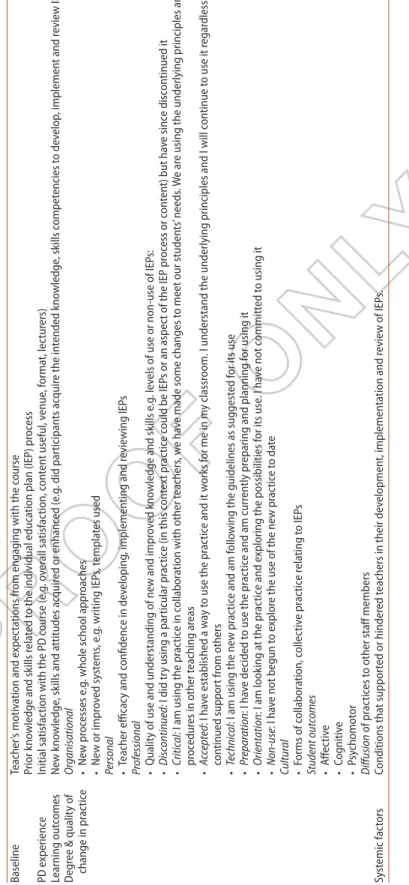
Exploring the impact of PD is arguably a weak link in the PD chain (King 2014), perhaps more so in the European context (Evans 2014). The area of impact of PD is still a growing field (Kennedy 2014) with few studies focused on the effectiveness of PD, on teachers’ professional learning in the context of the IEP process (Rose et al. 2012). King’s (2014) conceptual framework (see Table 1) for evaluating impact of PD which built on other previous well-established models, most notably that of Bubb and Earley (2010), Guskey (2002), Stake (1967) and Kirkpatrick (1959), was adopted for use in this study.
One of the critiques of previous models was the linear or hierarchical nature of change whereas King’s (2014) framework allowed for exploration of the complex nature of the many variables that impact teacher engagement with PD and teacher and student outcomes. This framework (see Table
1) has five aspects; Baseline explores teachers’ motivation and expectations for engaging with the PD; PD experience evaluates the ‘usefulness’ of and satisfaction with the PD (Kennedy 2015); Learning outcomes explores new knowledge; Degree and quality of change explores the knowledge practice gap (Kennedy 2014) and the degree to which the changes have taken place. This is arguably a particular strength of the framework which has built on the work of Hall and Hord (1987) thus allowing for a more detailed understanding of the changes in practice related to IEPs; and Systemic factors exploring factors that helped/hindered teachers in the development, implementation and review of IEPs.
The earlier-mentioned aspects are especially pertinent for this article as it seeks to inform teacher educators and in so doing enhance the award-bearing model and its value. The research questions that form the basis for this article are:
5 10 15 20 25 30 35 40 45 AQ2
PROFESSIONAL DEVELOPMENT IN EDUCATION 3 Table 1. Pr of essional dev elopmen t (PD ) impac t ev alua tion fr amew ork (K ing , 2014 ). Baseline teacher ’s motiv ation and e xpec ta tions fr om engag
ing with the c
ourse Prior k no wledge and sk ills r ela ted t
o the individual educa
tion plan ( ie P) pr oc ess PD e xperienc e initial sa tisfac
tion with the PD c
ourse ( e.g . o ver all sa tisfac tion, c on ten t useful , v enue , f orma t, lec tur ers) learning out comes n ew k no wledge , sk ills and a ttitudes ac quir ed or enhanc ed ( e.g . did par ticipan ts ac quir e the in tended k no wledge , sk ills c ompet encies t o dev elop , implemen t and r eview ie Ps?) D eg
ree & qualit
y of change in pr ac tic e O rganisational • n ew pr oc esses e .g
. whole school appr
oaches • n ew or impr ov ed sy st ems , e .g . writing ie Ps , t empla tes used
Personal • teacher efficac
y and c onfidenc e in dev eloping , implemen ting and r eviewing ie Ps Pr ofessional • Q ualit
y of use and understanding of new and impr
ov ed k no wledge and sk ills e .g . lev
els of use or non-use of
ie Ps: • D isc ontin ued: i did tr y using a par ticular pr ac tic e (in this c on te xt pr ac tic e c ould be ie Ps or an aspec t of the ie P pr oc ess or c on ten t) but ha ve sinc e disc on tinued it • Critic al: i am using the pr ac tic e in c ollabor
ation with other t
eachers
, w
e ha
ve made some changes t
o meet our studen
ts
’ needs
. W
e ar
e using the underlying principles and
pr oc edur es in other t eaching ar eas • Ac cept ed : i ha ve established a w ay t o use the pr ac tic e and it w orks f or me in m y classr oom.
i understand the underlying principles and
i will c on tinue t o use it r egar dless of con tinued suppor t fr om others • Technic al : i
am using the new pr
ac
tic
e and am f
ollo
wing the guidelines as suggest
ed f or its use • Pr epar ation : i ha ve decided t o use the pr ac tic e and am curr en tly pr
eparing and planning f
or using it • O rientation : i am look ing a t the pr ac tic e and e
xploring the possibilities f
or its use . i ha ve not c ommitt ed t o using it • Non -use : i ha ve not begun t o e xplor
e the use of the new pr
ac tic e t o da te Cultur al • forms of c ollabor ation, c ollec tiv e pr ac tic e r ela ting t o ie Ps Student out comes • aff ec tiv e • cog nitiv e • Psy chomot or D iffusion of pr ac tic es t
o other staff members
sy st emic fac tors conditions tha t suppor ted or hinder ed t
eachers in their dev
elopmen t, implemen ta tion and r eview of ie Ps . AQ11
RJIE 1398180
14 November 2017 Initial CE: XX QA: XXColl:XX QC:XX
4 F. KING ET AL.
• To what extent did PD impact on teachers’ professional learning related to the IEP process? • What can providers of PD learn from this to inform future PD experiences?
Professional learning
Professional learning, often used interchangeably in the literature with PD, is conceptualised in this article as the learning or growth that teachers experience from engaging with PD (Evans 2014, King
2014). Understanding this learning is pivotal for teacher educators as they design the model, content and structure of PD (Desimone 2009).
Models of PD
Kennedy (2005, 2014) theorised models of PD ranging from training models suited for transmission of new knowledge and skills, to collaborative professional inquiry models aimed at teachers’ trans-formative practices. Award-bearing models are situated within the ‘malleable’ category as they may support increased autonomy and agency (Kennedy 2014). Given that the postgraduate course for teachers in the ROI is funded, it remains to be seen to what extent the award-bearing model of PD was a ‘contributory factor to enhancing teacher agency’ (Kennedy 2014, p. 693) involving working with others to meet the needs of all students (Florian and Spratt 2013). This is especially pertinent given findings from the ‘Inclusive Research in Irish Schools (IRIS)’ report (Rose et al. 2015) highlighting that many class/subject teachers in the ROI believe that they lack the knowledge, skills and understanding to support effective curricular access for students with SEN.
Content of the award-bearing model
The PD programme aimed to improve teachers’ content-knowledge (Brigham et al. 2011) and class-room practice related to the IEP process (Desimone 2009, Vermunt and Endedijk 2011). It also included a large student-focused, curriculum-focused and collaboration-focused (O’Gorman and Drudy 2010) assignment requiring teachers to develop, implement and review an IEP in their own school context with one student as the focus. Teachers were required to assess and plan for three areas of the curric-ulum. Associated learning outcomes respond to the ranking of PD on the IEP process as the highest required competency by 816 teachers in ROI (O’Gorman and Drudy 2010). This is somewhat echoed by teachers in the Holland and Hornby (1992) study who rated highly the ability to develop realistic targets for children with SEN. Additionally findings from Jenkins and Ornelles (2009) argued for PD for all teachers on the IEP team. However little attention to date has been paid to the structure of PD around the IEP process.
Structure of the award-bearing model
The nature of the PD programme was such that it ran over one academic year rather than take place in one-off workshops (Kervin 2007), with teachers being released from school, with substitute cover, for two four-week blocks. The partnership between schools and the university (Brigham et al. 2011) also involved a further three weekends, an online engagement to support learning throughout the year and teachers received three school visits for formative and summative assessment related to their teaching practices. While the sole focus of the course was not on the IEP process the sole focus of the research and this article is related to the IEP.
This longer-term continuous, job-embedded PD that involved active and inquiry-based learning is conceivably the most effective for facilitating pedagogical change (Desimone 2009, Vermunt and Endedijk 2011) and sustaining changes (Pedder et al. 2008). Job-embedded PD has been aligned with teacher leadership which it is argued can enhance schools’ capacity to learn (Hunzicker 2012, Poekert 5 10 15 20 25 30 35 40
PROFESSIONAL DEVELOPMENT IN EDUCATION 5 2012). However teacher leaders need support in the form of collaborative cultures within their schools where learning is within an authentic context and socially constructed to enable diffusion of prac-tices to others (King 2014), thereby enhancing the system’s overall capacity (Frost 2012, King 2016). This is reflected in a recent policy shift in England which enhances the leadership role of a special educational needs coordinator (SENCo) (Department for Education (DfE) 2015). Given that many teachers engage with award-bearing courses in an individual capacity it will be interesting to see if teacher leadership was evidenced.
The IEP process
The IEP is underpinned by law in many countries affording it status as an educational and accountability tool. The IEP process is seen as the ‘conceptual and practical intersection of policy, schools, and families of students with disabilities’ and therefore ‘the foundation for effective special education … and positive student outcomes’ (Blackwell and Rossetti 2014, p. 12). However, the contested nature of IEPs is clearly evident in the international literature which is replete with arguments either proclaiming or challeng-ing their efficacy. A stark criticism by Mitchell et al. (2010) in their meta-analysis of 300 international studies highlighted the poor evidence for the efficacy of IEPs and the over-emphasis on the individual, undermining the extent to which IEP goals ensure access to the general education curriculum and consequently to an inclusive education (IDEA 2004, Blackwell and Rossetti 2014). In Sweden, concerns were expressed that ‘IEPs largely seem to be used primarily as administrative tools rather than to help meet the educational and developmental needs of the students concerned’ (Andreasson et al. 2013, p. 413). Student voice in the IEP process is not only a right (United Nations Convention on the Rights of the Child (UNCRC), United Nations 1990) but it supports student outcomes (Barnard-Brak and Lechtenberger 2010). The assumption that families and students are active, meaningful participants in the IEP process has been challenged (Andreasson et al. 2013, Blackwell and Rossetti 2014) with Mitchell et al. (2010) revealing that practice varies considerably. Similarly, research conducted in the ROI indicates that while the development of IEPs is an established practice, despite not being a legal requirement, there are inconsistencies with regard to approaches to the development, implementation and review of the process (Rose et al. 2012, NCSE 2015, Ní Bhroin et al. 2016). A common thread in all the aforementioned studies is the need for PD for all teachers to use the IEP as a functional tool in planning, implementing and reviewing educational practices. However, there is no guidance as to the type of PD needed for this.
Methods Context
This study was located in the ROI where the DES has funded teachers’ professional learning through postgraduate courses in seven universities. All three researchers were involved in teaching on the same Postgraduate Diploma in SEN. As such, it is an award-bearing model (Kennedy 2005) and the aim of this study was to explore the impact of this PD on participants 2–4 years after completion of the course. Given the concerns over lack of implementation (Guskey 2002, King 2014) and sustainability of practices, this research aimed to explore the longer-term impact of the PD on teachers’ knowledge, understanding and practices with a view to informing planning for future courses.
Teachers involved taught students with SEN and represented a range of settings including primary, post-primary, special school, and special unit and/or special class attached to a particular school type. For eligibility of a place on the course teachers in mainstream schools had to be involved in learning support and special education. For the purpose of this study, the term SEN teacher will be used. Design
There were two phases of data collection. Phase one was quantitative and involved the administration of a questionnaire designed to elicit teachers’ perceptions of their knowledge, understanding and 5 10 15 20 25 30 35 40 45 AQ3
RJIE 1398180
14 November 2017 Initial CE: XX QA: XXColl:XX QC:XX
6 F. KING ET AL.
practices related to the IEP process. Sampling was purposive as participants were chosen via postal survey from the 165 teachers who completed the Postgraduate Diploma in SEN in the academic years 2010–2011, 2011–2012 and 2012–2013. A response rate of 50.30% (n = 83) was secured.
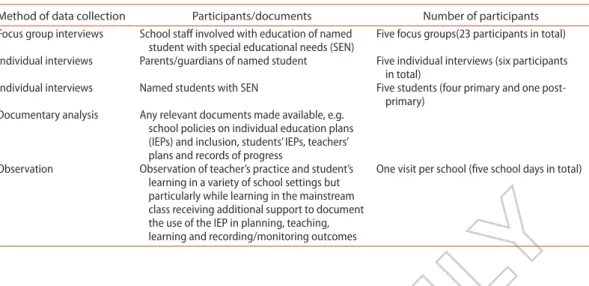
Phase two was qualitative, prioritising individual stories of experiences of PD (Burchell et al. 2002) allowing for a more nuanced exploration of impact (King 2014) to reflect the complexity of the social world (Coldwell and Simkins 2011). This phase involved follow-up case studies in four primary schools and one post-primary school, the only schools that self-selected for participation in phase two. The qualitative aspects of phase two involved schools selecting one child who has an IEP. Based on this, individual interviews with the parents of the child and the child were undertaken along with a focus group in each school with class teachers, SEN teachers, school principal and special needs assistant(s). The research team visited each school for the duration of one full day to carry out the interviews, focus groups, observation of the child in the mainstream class and support setting and analysis of documents made available by the school (Table 2).
Data analysis
An identification code was assigned to each questionnaire for tracking purposes and all responses were coded and entered into SPSS for statistical analysis. The final coding frame included a total of 136 variables. Qualitative data were converted to text form, and using NVivo 10, data sets were coded by two researchers using a combination of deductive and inductive coding (Miles and Huberman
1994). The inductive coding involved an iterative process of reading, re-reading and assigning codes to units of data within and across each data-set. For deductive coding, codes generated from the PD evaluation framework (King 2014) were applied across the entire data-set. The coding process led to the development and refinement of a coding scheme, with the final version consisting of 125 codes. These codes contributed to 14 categories across all data sources covering inclusion, planning, assessment, teaching approaches, review, collaboration, links, supports, evidence of influence of PD, and student voice, outcomes and experience. A third researcher independently assigned the codes to the observational data, to a random selection of documentation and to half of the randomly selected interview transcripts thus evincing source triangulation and adding to the trustworthiness of the process (Hammersley and Atkinson 2007). Percentage agreement was 93%, which exceeded the 65 to 75% agreement considered to be indicative of good reliability in qualitative research studies (Boyatzis
1998). Categories supported the emergence of four distinct but interrelated key themes; inclusion, collaboration, student experience and PD.
Table 2. Data collection.
Method of data collection Participants/documents Number of participants
focus group interviews school staff involved with education of named
student with special educational needs (sen) five focus groups(23 participants in total) individual interviews Parents/guardians of named student five individual interviews (six participants
in total)
individual interviews named students with sen five students (four primary and one post- primary)
Documentary analysis any relevant documents made available, e.g. school policies on individual education plans (iePs) and inclusion, students’ iePs, teachers’ plans and records of progress
observation observation of teacher’s practice and student’s learning in a variety of school settings but particularly while learning in the mainstream class receiving additional support to document the use of the ieP in planning, teaching, learning and recording/monitoring outcomes
one visit per school (five school days in total)
5 10 15 20 25 30
PROFESSIONAL DEVELOPMENT IN EDUCATION 7
For the purpose of this article key findings will largely draw on the theme of PD with reference to other themes where relevant for answering the research questions.
Findings
Findings will be presented by exploring the theme of PD from the qualitative data while also drawing on the quantitative data to substantiate or refute findings. Under the theme of PD were a number of sub-themes; evidence of teacher professional learning, changes in practice, student experience, and structure of the PD.
Evidence of teacher professional learning
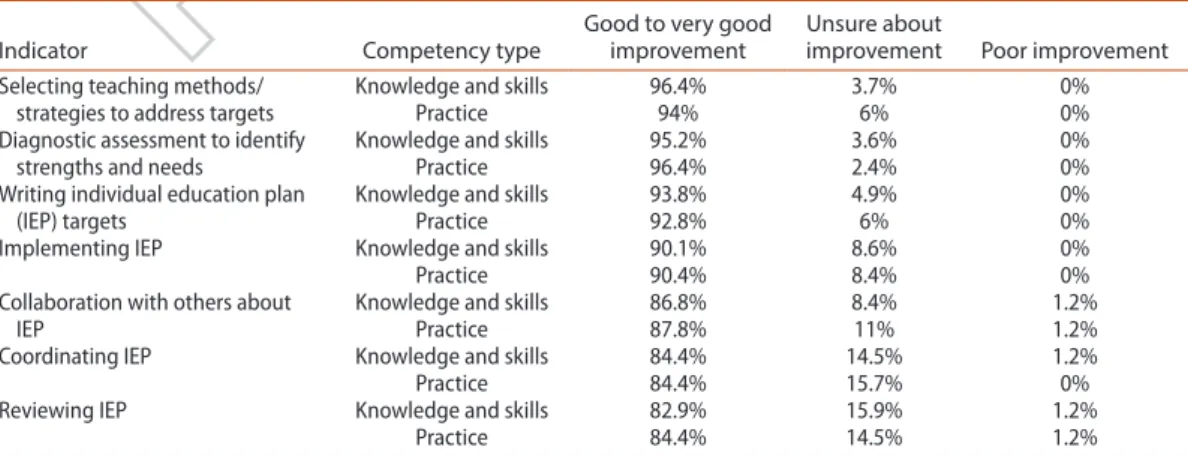
Documentary analysis evinced IEP documents which had incorporated much of the knowledge and skills developed as part of the PD course, for example, the structure of the IEP documents included results of assessment, priority learning needs and targets for the individual student along with teaching strategies for supporting student learning. These findings are further substantiated in the quantitative data (see Table 3) which shows teachers’ rating of increased knowledge, skills and practice related to the earlier aspects of the design and implementation of IEPs.
Evidence of assigning roles to individuals involved with the student along with dates for targets to be achieved and reviewed were also on some IEP documents. Overall teachers reported more positive outcomes in terms of ‘testing, student profiling…understanding of the process’ (Alison, School E, SEN teacher), along with the importance of having SMART targets. ‘Even just knowing how to write targets …was a big thing …’ (Noelle, School C, SEN teacher), echoing Holland and Hornby’s (2006) study, rating highly the ability to develop realistic targets for children with SEN. While documentary analysis of the IEPs showed a full range of targets; cognitive, affective and psychomotor skills, some teachers reported difficulty with establishing baselines, writing SMART targets and measuring progress in the affective domains e.g. social skills, which were described as ‘hard to measure and judge [improvement in ]’ (Tina, School B, Class teacher). Similar difficulties were reported for writing targets for students with complex needs.
Interestingly there was no evidence of IEP targets in class teachers’ plans or of IEP targets being addressed in observation of teaching in the mainstream class. Quantitative data indicates further development needed in the area of collaboration, coordination and reviewing the IEP (Ní Bhroin et al. 2016). Noteworthy, in many cases there is little or no gap between an increase in knowledge and skills and changes in practice in each of the areas in Table 3. So whether or not the award-bearing course was transmissive or transformative (Kennedy 2014) will now be explored further under the second sub-theme of changes in practice.
Table 3. teacher perceptions of enhanced or acquired knowledge, skills and practice.
Indicator Competency type Good to very good improvement Unsure about improvement Poor improvement
selecting teaching methods/
strategies to address targets Knowledge and skillsPractice 96.4%94% 3.7%6% 0%0% Diagnostic assessment to identify
strengths and needs Knowledge and skillsPractice 95.2%96.4% 3.6%2.4% 0%0% Writing individual education plan
(ieP) targets Knowledge and skillsPractice 93.8%92.8% 4.9%6% 0%0%
implementing ieP Knowledge and skills 90.1% 8.6% 0%
Practice 90.4% 8.4% 0%
collaboration with others about
ieP Knowledge and skillsPractice 86.8%87.8% 8.4%11% 1.2%1.2%
coordinating ieP Knowledge and skills 84.4% 14.5% 1.2%
Practice 84.4% 15.7% 0%
reviewing ieP Knowledge and skills 82.9% 15.9% 1.2%
Practice 84.4% 14.5% 1.2% 5 10 15 20 25 30 AQ4
RJIE 1398180
14 November 2017 Initial CE: XX QA: XXColl:XX QC:XX
8 F. KING ET AL. Changes in practice
Changes in practice were reported by all teachers as a result of engagement with the PD course, albeit it to varying degrees. Changes were evident in terms of planning, implementation and review of the IEP process. Teachers reported an increased focus on assessment and clearer target setting and this was also evident in documentary plans and observation of students in support teaching context. While there was some evidence of class teachers assessing student’s understanding of a lesson within the mainstream classroom there was little evidence of class teachers focusing on individual targets, the exception being class teachers of a special class in a mainstream school. Representative of teach-ers’ comments, Miriam (School D, SEN teacher) highlighted that prior to the course she ‘didn’t feel confident… a fear among staff…going into this role…they’re petrified of…all the different kinds of paperwork because they don’t understand them’. She urged that ‘more work needs to be done on that’. Perhaps this lack of confidence is indicative of why even at a planning level there was no evidence of contextualising IEPs into whole school planning and writing IEPs is the reserve of SEN teachers; ‘we only get people who have done the course to do these [write IEPs] because at least we’re all working from the same background’ (Colette, School C, SEN teacher). Arguably if IEPs are to be contextualised into whole school planning and delivery of curriculum then class teachers need to be involved also. Teachers need more support to progress from the perception of collaboration as information sharing, reflected in Emer’s comment that ‘everyone is on such a tight schedule that you know with the best will in the world it [sharing information] doesn’t happen too often’ (School E, SEN teacher).
In relation to parents, quantitative results indicate that 78.3% (n = 65) receive a copy of the IEP with 88.6% (n = 70) parental presence at IEP planning meetings. For example within the focus groups it was reported that the SEN teacher coordinates the IEP and passes it to the parents and class/subject teacher(s) (Bateman 2011) for comment before a final draft is written and shared with all involved. ‘I think it is very important that it is led by the teachers … the teachers are the right ones to be setting the targets, parents are not’ (parent, School E).
In terms of implementation teachers also reported feeling more competent in devising and teaching programmes in collaboration with others, in taking risks and trying out new ways of doing things. Examples of collaboration include station teaching and co-teaching as evinced from the observation data. However one teacher’s comment reflects that of many others when (s)he argued that classroom teachers ‘are often so bogged down with curriculum matters/large numbers that they don’t have time to do individual work on IEPs… leaving SEN teachers “working in a vacuum”’ (Questionnaire). This arguably explains the numerous calls in the data for PD for all teachers with Grace (School E, SEN teacher) stating ‘I don’t want them to think it is coming from us, it’s not, it’s just good practice in general’. Additionally, teachers felt it very helpful to have other colleagues within the school who had completed the programme already. ‘Each time somebody comes back with new training, they are continually train-ing us’ (Jane, School D, Deputy Principal, SENCo). When asked about the PD preparing teachers for a consultative role Colette (School C, SEN teacher) replied ‘we…did a module…on collaboration’. Despite this, the consultative role seems to have been limited to working with other SEN staff
Nevertheless, teachers reported innovative practices such as aligning individual targets with DEIS (Delivering Equality of Opportunity in Schools) (DES 2005) milestones for learning. Jane (School D, Deputy Principal and SENCo) said they are
‘used as a sort of teaching tool … for learning throughout the school … .’ This may represent an attempt to contex-tualise IEP goals into the curriculum and whole school planning. However, there is no evidence of class teachers incorporating the targets into their planning. A typical comment, in this respect: ‘I wouldn’t really be writing down my differentiation within my planning … that would be an innate thing that I would be doing within the classroom’ (Jo, School A, Class teacher).
Similarly reviewing of targets seems to happen informally with Alison stating that they are ‘constantly un-officially reviewing it’ (School E, SEN teacher) and Emer (School E, SEN teacher) considering it to ‘be a working document’. Findings from quantitative data show that although teachers consider their practice improved (84.4%, n = 70) in this area, only 31% (n = 26) tick student’s progress on the IEP targets. Documentary analysis reveals little evidence of dates for reviewing targets or assigning 5 10 15 20 25 30 35 40 45 50
PROFESSIONAL DEVELOPMENT IN EDUCATION 9
responsibility to adults to work towards achievement of individual targets. It is however important to explore the impact of the PD on the students’ experience.
Student experience
Observation revealed that the students with SEN were for the most part engaged and actively par-ticipated in their learning, whether in the mainstream class or withdrawal setting. The students’ participation and engagement were secured through use of hands-on activities, and for example, working in pairs or smaller groups using station teaching. In the withdrawal setting, where teaching was focused on addressing IEP learning targets, student progress and achievement were evident and made highly visible in the recording systems in place and to which the students contributed (for example, word ladders, School C; TEACCH® movement from left to right in completion of planned activities, School D; recording of completed comprehension cards with associated skills, School A). In the mainstream class, although not directly addressing IEP learning targets, teaching was responsive to individuals and to varied ability levels. By way of illustration, in one mainstream primary maths class, where children were required to calculate coordinates following whole class explanation and examples, the teacher had a booster table in the centre of the room and extended an open invitation to all of those who felt unsure of how to proceed to come round the table for additional teaching, allowing the children to self-select (School A). In this way, the student with SEN was enabled to participate on the same topic and at the same level as mainstream peers while experiencing achievement.
The majority (74.4%; n = 61) of teachers stated the IEP is used to measure student outcomes. Teachers’ perceptions of student outcomes were very positive, for example, ‘you can see the progress …laid out in the IEPs, whatever steps, things you want to achieve’ (Georgina, School B, Principal). Significantly, parents were happy that IEP targets were reviewed and monitored with some schools doing this annually and others biannually. One parent (School E) highlighted the importance of this in saying it ‘lets me know where he is at and lets me know where we want him to be in a few months time, so I just make lists from it and that’s very important’. Arguably the monitoring function of the IEP as indicated by the parent allows for tracking of progress which contributes to the understanding of student achievement.
All students had views, expressed preferences in terms of the IEP process with some preferring not to attend IEP meetings. Only 27.7% (n = 23) of respondents reported that students are provided with an opportunity to express their views with 44.6% (n = 37) indicating ‘sometimes’. ‘I think it depends on the child’s age. You know, the child thatA is dealing with … he’s well able to articulate his needs …, but with some of the younger children, it doesn’t always work, you know, they don’t really understand the process …’ (Principal, School D). Perhaps the PD did not emphasise student voice in the IEP process. Structure of the PD
Findings indicate teachers valued the collaborative, face-to-face and job-embedded or application-ori-ented elements for transferring learning into practice. For example:
The structure of the course was great … you go off for your month, and then you’re back in school … immediately putting into place what you’ve learnt … . (Colette, School C, SENCo)
Noelle valued the face-to-face nature of the course (School C, SEN teacher) finding it ‘much easier, than being in a live classroom …’ even though the online classes/discussion forums did provide oppor-tunities for information sharing.
Others felt supported by
the group I was with … four or five … real support during the course … we were back in our school we were still in touch … just having that network of teachers—because often you can be a lonely learning support teacher, and you may not have anyone to ask questions of, so I thought that was a real advantage doing the course … . (Noelle, School A, SEN teacher)
5 10 15 20 25 30 35 40 45
RJIE 1398180
14 November 2017 Initial CE: XX QA: XXColl:XX QC:XX
10 F. KING ET AL.
Interestingly, Emer noted:
the model is very good. It’s excellent. But I do think … the fact that Deirdre [another SEN teacher in her school] … did the course as well … I think the pooling of ideas, pooling of experience, pooling of learning is very important. (School E, SEN teacher)
In four out of five schools class teachers mentioned other SEN teachers, who had engaged with the PD previously, supporting them in learning about IEPs. While two of these class teachers acknowledged having some input on SEN in their undergraduate degree they felt
Now it’s more real life … I wouldn’t have felt confident after doing that three years [undergraduate degree]. So it was great to have that someone who knew what they were doing … I remember it in lectures all right but I had very little practice. (Laura, School E, class teacher)
Discussion and conclusion
The earlier findings will now be discussed in terms of any knowledge practice gap (Kennedy 2014) and in relation to the nature of the PD which supported teachers’ changes in practice (Wearmouth et al. 2000). This will be done with reference to the conceptual framework. Implications for teacher educators nationally and internationally in planning PD experiences around the IEP process will also be considered.
Data arising from King’s (2014) aspects of learning outcomes and the degree and quality of change suggest that new knowledge and skills, and changes in practices related to the IEP process was a per-vasive outcome for all teachers who had undertaken the programme. However the levels of use and understanding in this section allowed for a nuanced understanding of teachers’ practices related to the design, implementation and review of IEPs. The quantitative data demonstrated that generally IEPs appear to be used as a functional or pedagogical tool (Co-Ní Bhroin et al. 2016) with varied practice between technical and critical levels (King 2014) across the five case study schools. Overall teachers reported strong improvement in their use of diagnostic assessment to identify strengths and needs to inform IEP goals, with the exception of the non-academic targets (Ní Bhroin et al. 2016) and this was further corroborated in the focus group and documentary data. Also practices related to monitoring and reviewing of targets are reflective of somewhere between ‘non-use’ and ‘technical’ levels of use, mirroring conclusions from Prunty (2011). Acknowledging that the IEP may be a working document for all of the five case study schools the documentary evidence suggests that further work is required at an organisational level in terms of increasing class teacher involvement in officially reviewing progress to support contextualising IEP goals into the curriculum and a whole school approach to planning. While it is important not to focus solely on the individual and lose sight of the curriculum and the student’s teaching and social environment (Mitchell et al. 2010), it is equally important not to narrow the curriculum and lose the focus on the individual in favour of planning and teaching to milestones (Caruana 2015).
At a personal level teacher confidence and efficacy related to the IEP process was evinced. However there was little evidence of formal collaboration for coordination of the process. Despite 87.8% (n = 72) of SEN teachers reporting that their skills in collaborating with others about the student’s IEP had improved to the extent of either ‘very good’ or ‘good’, evidence indicates that collaboration relating to the IEP process requires further development. A number of teachers talked about the PD in terms of ‘training’ which suggests a technical rational approach to teaching and learning instead of one which more accurately represents its complexity, and requires more than informal collaborative practice with colleagues. One recurring sentiment expressed by teachers was the need for PD for all teachers (Jenkins and Ornelles 2009) despite many of the SEN teachers appearing to enhance capacity with other IEP team members. Conceivably, SEN teachers who have engaged with the PD do not feel confident in enhancing capacity within their own schools. Currently practices could be described at an ‘orientation’ level of use which arguably needs to be moved towards ‘accepted’ or ‘critical’ levels to enhance student outcomes; something for teacher educators to consider. Similar findings were echoed strongly in the questionnaire where 98.8% (n = 81) of teachers strongly agreed/agreed that PD on the IEP process is
5 10 15 20 25 30 35 40 45
PROFESSIONAL DEVELOPMENT IN EDUCATION 11
essential for all practising teachers. Perhaps supporting teachers to become teacher leaders through their job-embedded PD (Poekert 2012) might warrant consideration.
Low levels of student engagement and participation were reported consistent with findings from other Irish studies (Prunty 2011, Rose et al. 2015). Explanations for lower levels of children’s participa-tion provided by their teachers and parents are consistent with barriers typically reported in previous research (Lundy 2007, Blackwell and Rossetti 2014), including age and capacity of the children to engage in meaningful decision-making processes. Similarly in terms of parents being active, meaning-ful participants in the IEP process, practice varied considerably and the five schools are arguably not functioning at a critical level (King 2014) with practice reflective of ‘symbolic’ and not ‘real’ meaningful engagement (Skrtic 2005). This stands in contradistinction to 96.3% (n = 78) of teacher respondents in phase one who strongly agreed or agreed that involvement of parents was essential. King’s (2014) Systemic factors allowed for exploration of the nature of the PD which supported/hindered the design, implementation and review of the IEP process.
Support
Principals supported teachers by releasing them from school to engage with the award-bearing course. All principals attended the focus group interview, for at least some of the time, and demonstrated their procedural and conceptual knowledge of the IEP process. Georgina (School B, Principal) agreed to create time for SEN and class teachers to meet to review IEP targets. However PD was largely seen as ‘training…willing to send people out’ (Martin, School D, Principal) or ‘getting somebody in…a presenta-tion …’ (Rose, School A, Principal) instead of more transformative models of PD such as collaborative inquiry (Kennedy 2005, 2014) where the SEN teachers who had engaged with the award-bearing PD could serve beyond the classroom by engaging in other models of collaborative practice such as coach-ing, peer observation, mentorcoach-ing, and collaborative professional inquiry (Hunzicker 2012). Having teachers as change agents/leaders along with the development of collaborative cultures is important for implementation and sustainability of practices (Guskey 2002, King 2014, 2016); endorsing these aspects of support on the PD framework.
Initiative design and impact
Despite the IEP process being a complex one, teachers from the case study schools felt the assign-ment on the course supported them in impleassign-menting the process at school, albeit to varying degrees. Teachers liked being given a structure for the process and a template for the plan, ‘… kind of training and planning … keeps you really focused, what you need to do for the child … used it as a model, many times …’ (Alison, School B, SEN teacher). Teachers’ perceptions of the impact on student outcomes has led to them wanting to sustain the IEP process as ‘it is best practice really to have an IEP, and get everybody involved’ (Alison, School B, SEN teacher).
The design of the task/initiative and its perceived success for students was supportive for the individual teachers (King 2014, 2016). What is less clear is the suitability of the learning experience to promote and support collaborative cultures in schools; an essential component of the IEP process. Teacher agency
Teachers’ openness and willingness to engage with the IEP process along with being able to mediate barriers in a way that meets their personal and professional needs has influenced its sustainability (King
2016). For example, Colette (School C, SEN teacher) used her agency by calling the IEP an individual learning profile as IEPs are not legal and not endorsed by the teacher unions at secondary level.
Teaching and learning is a contextual and complex process influenced by various determinants at play; arguably those outlined here under Systemic factors, thus making this aspect of the framework influential for those planning and evaluating change.
5 10 15 20 25 30 35 40 45
RJIE 1398180
14 November 2017 Initial CE: XX QA: XXColl:XX QC:XX
12 F. KING ET AL.
Implications for teacher educators
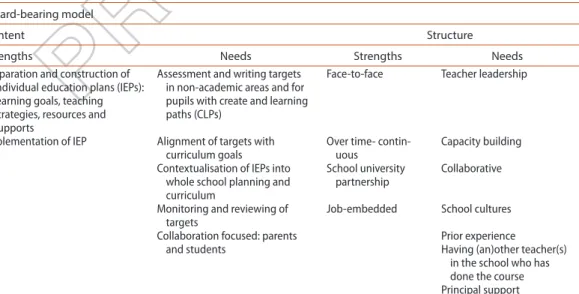
Overall findings highlighted strengths and needs in relation to the award-bearing model of PD (Table 4) allowing for an elucidation of the problems integral to understanding change in the schools; which we argue are instructive rather than accounts of practice.
While IEPs are being developed in all contexts, teachers’ use of practices with writing targets in non-academic areas and for students with more complex needs tends to be at the ‘orientation’ level (King 2014). Overall, further alignment is needed between IEP targets and curriculum goals to ensure that there is not an overemphasis on the individual and less on the student’s learning and social environment (Mitchell et al. 2010) and that IEPS are contextualised within whole school planning and delivery of curriculum (Ní Bhroin et al. 2016). Arguably SEN teachers need further support on collaboration with class teachers, to avoid working in a vacuum, by extending the IEP targets into class teachers’ plans and thus focusing on IEPs as a pedagogical tool across the school. Additionally, monitoring and reviewing of targets needs considerable attention so that IEPs are used as an educa-tional and an accountability tool (Bateman 2011, Andreasson et al. 2013) along with further support in meaningful collaboration with parents and accessing student voice in all aspects of the IEP process to align with the UNCRC; practices where there currently is a knowledge practice gap (Kennedy 2014). Noteworthy is teachers being able to narrow the knowledge practice gap by having prior experience before engaging with the course thus questioning the issue of mandatory PD before working in the role of an SEN teacher.
This article argues that the quality of IEPs is largely dependent on the quality of the collaborative practice involved in the process. Given the vast amounts of money spent on PD it is incumbent on teacher educators to support teachers to engender meaningful collaborative processes around the IEP. While it is evident that this award-bearing model was ‘useful’ (Kennedy 2014) for SEN teachers and facilitated linking theory and practice through a longer-term, face-to-face approach with the univer-sity, it clearly needs to consider how to address the issue raised by almost all participants calling for PD for all teachers; an epistemological and economical quandary. Arguably enhancing the job-em-bedded approach to PD to result in teacher leadership (Poekert 2012) and enhanced teacher agency and autonomy (Kennedy 2014) where teachers feel confident working with and through all teachers (Florian and Spratt 2013) might be worth consideration for teacher educators in getting collaborative practices and capacity building operating at a ‘critical’ level in schools. Noteworthy in three of the five case study schools more than one teacher engaged with the PD course at some stage. Arguably, Table 4. strengths and needs of the award-bearing model of professional development (PD).
Award-bearing model
Content Structure
Strengths Needs Strengths Needs
Preparation and construction of individual education plans (iePs): learning goals, teaching strategies, resources and supports
assessment and writing targets in non-academic areas and for pupils with create and learning paths (clPs)
face-to-face teacher leadership
implementation of ieP alignment of targets with
curriculum goals over time- contin-uous capacity building contextualisation of iePs into
whole school planning and curriculum
school university
partnership collaborative monitoring and reviewing of
targets Job-embedded school cultures
collaboration focused: parents
and students Prior experienceHaving (an)other teacher(s) in the school who has done the course Principal support 5 10 15 20 25 30 AQ12
PROFESSIONAL DEVELOPMENT IN EDUCATION 13
teachers influenced each other, reflective of the fact that teachers value the opinions of other teachers (Vermunt and Endedijk 2011). Whether or not having more than one teacher per school involved to support this process is worth consideration (Vermunt and Endedijk 2011) as is getting the principals involved to provide leadership support (King 2011). Furthermore, offering students ‘lived experiences’ of collaboration and leadership may also support narrowing the knowledge-practice gap here (King
forthcoming) as little t (practical experience) may help to make sense of big T (Theory) (Korthagen
2004) with teachers needing to have experience (t) to draw upon to understand the big T (Korthagen
2004).
Planning for this future PD should take cognisance of King’s (2014) ‘Systemic factors’ to support teacher engagement with the PD and implementation of changes (Table 5). The framework will allow for planning with the outcomes in mind and working backwards towards the ‘PD experience’ to best support the development of these outcomes (King, 2016), thus affirming the value of the framework (King 2014). It is hoped that the earlier mentioned insights may help teacher educators to understand the motivating factors for teachers engaging with award-bearing PD in a transformative manner (Burchell et al. 2002, King 2016) and in particular to focus on enhancing teacher leadership and capacity building within schools to ensure that curriculum access is achieved within an inclusive environment.
Disclosure statement
No potential conflict of interest was reported by the authors. Funding
This work was supported by the Dublin City University Incorporation Journal Publication Scheme [grant number n/a]. ORCID
Fiona King http://orcid.org/0000-0001-5749-1435 References
Andreasson, I., Asp-Onsjo, L., and Isaksson, J., 2013. Lesson learned from research on individual educational plans in Sweden: obstacles, opportunities and future challenges. European journal of special needs education, 28 (4), 413–426.
Table 5. Planning professional development (PD) (King, 2016).
Baseline Goals: Where are we now? Where do we want to go? Degree and quality of change student outcomes: What will the students be able to do?
organisational: What products/processes will help to achieve the outcomes e.g. policies, staff meetings, time, resources …
What instructional practices (evidence-based) and processes will produce the desired student outcomes? lived experiences of collaboration
Diffusion: How can we enable diffusion of the practices to other adults and students? lived experiences of leadership
systemic factors Support: What support will teachers need to enhance teacher engagement e.g. leadership support, change agents, professional learning community … ?
Initiative design and impact: is the PD design structured and research based, feasible and focused, meeting teachers at their zone of proximal development (ZPD), collaborative … ? Postiive impact on students?
Teacher agency: are the teachers open, willing and motivated to engage with change/a new
practice? Do teachers understand the pedagogy and pedagogical content knowledge (PcK) related to the task?
learning outcomes What knowledge, skills, attitudes will be needed to implement the new practices?
PD experience What activities/experiences/model of PD do teachers need to gain the required knowledge or skills? Does the model match the purpose?
5 10 15 20 25 AQ5 AQ13 AQ14 AQ15 AQ6 AQ7
RJIE 1398180
14 November 2017 Initial CE: XX QA: XXColl:XX QC:XX
14 F. KING ET AL.
Barnard-Brak, L. and Lechtenberger, D., 2010. Student IEP participation and academic achievement across time. Remedial and special education, 31 (5), 343–349.
Bateman, B.D., 2011. Individual education programs for children with disabilities. In: J.M. Kaufmann and D.P. Hallahan, eds. Handbook of special education. New York: Routledge, 91–106.
Blackwell, W.H. and Rossetti, Z.S., 2014. The development of individualized education programmes: where have we been and where should we go now? Sage Open [online], 1–15. DOI: 10.1177/2158244014530411 [Accessed 11 December 2016].
Boyatzis, R.E., 1998. Transforming qualitative research: thematic analysis and code development. London: Sage Publications. Brigham, F., Scruggs, T., and Mastropieri, M., 2011. Science education and students with learning disabilities. Learning
disabilities research and practice, 26 (4), 223–232.
Bubb, S. and Earley, P., 2010. Helping staff develop in schools. London: Sage.
Burchell, H., Dyson, J., and Rees, M., 2002. Making a difference: a study of the impact of continuing professional development on professional practice. Journal of in-service education, 28 (2), 219–230.
Caruana, V., 2015. Accessing the common core: strategies for writing standards-based IEP goals. Preventing school failure, 59 (4), 237–243.
Coldwell, M. and Simkins, T., 2011. Level models of continuing professional development evaluation: a grounded review and critique. Professional development in education, 37 (1), 143–157.
Department for Education (DfE), 2015. Special educational needs and disability code of practice: 0–25 years. London: DfE. Department for Education and Skills (DfES), 2001. Special educational needs code of practice. Nottingham: DfES
Publications.
Department of Education and Science (DES), 2005. Delivering equality of opportunity in schools: an action plan for educational inclusion. Dublin: Stationery Office.
Desimone, L.M., 2009. Improving impact studies of teachers’ professional development: toward better conceptualizations and measures. Educational researcher, 38 (3), 181–199.
European Agency for Development in Special Needs Education (EADSNE), 2013. Organisation of provision to support inclusive education- Literature review. Odense, Denmark: European agency for development in special needs education. Evans, L., 2014. Leadership for professional development and learning: enhancing our understanding of how teachers
develop. Cambridge journal of education, 44 (2), 179–198.
Florian, L. and Spratt, J., 2013. Enacting inclusion: a framework for interrogating inclusive practice. European journal of special needs education, 28 (2), 119–135.
Frost, D., 2012. From professional development to system change: teacher leadership and innovation. Professional development in education, 38 (2), 205–227.
Government of Ireland, 2004. Education for persons with special educational needs act. Dublin: The Stationery Office. Guskey, T.R., 2002. Does it make a difference? evaluating professional development Educational leadership, 59 (6), 45–51. Hall, G.E. and Hord, S.M., 1987Change in schools: facilitating the process. Albany, NY: SUNY Press.
Hammersley, M. and Atkinson, P., 2007. Ethnography: principles in practice. 3rd ed. New York: Routledge.
Holland, J. and Hornby, G., 1992. Competences for teachers of children with special educational needs. British journal of in-service education,18(1), 59–62. Published online 12 September 2006.
Hunzicker, J., 2012. Professional development and job-embedded collaboration: how teachers learn to exercise leadership. Professional development in education, 38 (2), 267–289.
Individuals with Disabilities Education Act, 2004. Individuals with Disabilities Education Improvement Act of 2004, 20 U.S.C. §614 et seq.
Jenkins, A.A. and Ornelles, C., 2009. Determining professional development needs of general educators in teaching students with disabilities in Hawaii. Professional development in education, 35 (4), 635–654.
Kennedy, A., 2005. Models of continuing professional development: a framework for analysis. Journal of in-service education, 31 (2), 235–250.
Kennedy, A., 2014. Understanding continuing professional development: the need for theory to impact on policy and practice. Professional development in education, 40 (5), 688–697.
Kennedy, A., 2015. ‘Useful’ professional learning … useful for whom? Professional development in education, 41 (1), 1–4. Kervin, L., 2007. Supporting elementary teachers at the ‘chalk-face’: a model for in-school professional development.
International electronic journal for leadership in learning, 11(10). University of Calgary [Online]. Available from: http://www.ucalgary.ca/iejll [Accessed 3 December 2008].
King, F., 2011. The role of leadership in developing and sustaining teachers’ professional learning. Management in education, 25 (4), 149–155.
King, F., 2014. Evaluating the impact of teacher professional development: an evidence-based framework. Professional development in education, 40 (1), 89–111.
King, F., 2016. Teacher professional development to support teacher professional learning: systemic factors from Irish case studies. Teacher development: an international journal for teacher professional development, 20 (4), 574–594. King, F., forthcoming. Evolving perspective(s) of teacher leadership: an exploration of teacher leadership for inclusion
at preservice level in the Republic of Ireland. International studies in educational administration, 45 (3). 5 10 15 20 25 30 35 40 45 50 55 60 AQ8 AQ9 AQ10
PROFESSIONAL DEVELOPMENT IN EDUCATION 15 Kirkpatrick, D.L., 1959. Techniques for evaluating training programs. Journal of the American society of training directors,
13, 3–9.
Korthagen, F., 2004. In search of the essence of a good teacher: towards a more holistic approach in teacher education. Teaching and teacher education, 20 (1), 77–97.
Lundy, L., 2007. ‘Voice’ is not enough: conceptualising Article 12 of the United Nations convention on the rights of the child. British educational research journal, 33 (6), 927–942.
Miles, M.B. and Huberman, A.M., 1994. Qualitative data analysis. 2nd ed. Thousand Oaks, CA: Sage Publications. Mitchell, D., Morton, M., and Hornby, G., 2010. Review of the literature on individual education plans: report to the New
Zealand ministry of education. Wellington: Ministry of Education.
National Council for Special Education (NCSE), 2006. Guidelines on the individual education plan process. Trim: NCSE. National Council for Special Education (NCSE), 2015. Supporting students with autism spectrum disorder in schools
(NCSE Policy Advice No. 5). Trim: NCSE.
Ní Bhroin, O., King, F., and Prunty, A., 2016. Teachers’ knowledge and practice relating to the individual education plan and learning outcomes for pupils with special educational needs. REACH journal of special needs education in Ireland, 29 (2), 78–90.
Organisation for Economic Cooperation and Development (OECD), 2005. Teachers matter: attracting, developing and retaining effective teachers. Paris: OECD Publications.
O’Gorman, E. and Drudy, S., 2010. Addressing the professional development needs of teachers working in the area of special education/inclusion in mainstream schools in Ireland. Journal of research in special educational needs, 10 (9), 157–167.
Pedder, D., Storey, A., and Opfer, V.D., 2008. Schools and continuing professional development (CPD) in England: state of the Nation research project report for the training and development agency for schools. Cambridge: University of Cambridge [online]. Available from: http://www.tda.gov.uk/cpd-leader/effective-cpd/~/media/resources/cpd-leader/ effective-cpd-research/cpd_statenation_report_survey.pdf [Accessed 20 December 2010].
Poekert, P.E., 2012. Teacher leadership and professional development: examining links between two concepts central to school improvement. Professional development in education, 38 (2), 169–188.
Prunty, A., 2011. Implementation of children’s rights: what is in ‘the best interests of the child’ in relation to the individual education plan (IEP) process for pupils with autistic spectrum disorders (ASD). Irish educational studies, 30 (1), 23–44. Riddell, S., et al., 2007. Managerialism and equalities: tensions within widening access policies for disabled students in
UK universities. Higher Education, 54 (4), 615–628.
Rose, R., et al., 2012. Individual education plans in the Republic of Ireland: an emerging system. British journal of special education, 39 (3), 110–116.
Rose, R., et al., 2015. Project IRIS – Inclusive Research in Irish Schools: a longitudinal study of the experiences of and outcomes for pupils with special educational needs (SEN) in Irish Schools. Trim: National Council for Special Education (NCSE).
Skrtic, T., 2005. A political economy of learning disabilities. Learning disability quarterly, 28, 149–155. Stake, R.E., 1967. The countenance of educational evaluation. Teachers college record, 68, 523–540. United Nations, 1990. United Nations convention on the rights of the child. Geneva: United Nations.
Vermunt, J.D. and Endedijk, M.D., 2011. Patterns in teacher learning in different phases of the professional career. Learning and individual differences, 21 (3), 294–302.
Wearmouth, J., Edwards, G., and Richmond, R., 2000. Teachers’ professional development to support inclusive practices. Journal of in-service education, 26, 37–48.
5 10 15 20 25 30 35 40