Lecture Notes in Electrical Engineering 365
Felix Pasila
Yusak Tanoto
Resmana Lim
Murtiyanto Santoso
Nemuel Daniel Pah
Editors
Proceedings of Second
International Conference
on Electrical Systems,
Technology and Information
2015 (ICESTI 2015)
Lecture Notes in Electrical Engineering
Volume 365
Board of Series editors
Leopoldo Angrisani, Napoli, Italy Marco Arteaga, Coyoacán, México Samarjit Chakraborty, München, Germany Jiming Chen, Hangzhou, P.R. China Tan Kay Chen, Singapore, Singapore Rüdiger Dillmann, Karlsruhe, Germany Haibin Duan, Beijing, China
Gianluigi Ferrari, Parma, Italy Manuel Ferre, Madrid, Spain Sandra Hirche, München, Germany Faryar Jabbari, Irvine, USA Janusz Kacprzyk, Warsaw, Poland Alaa Khamis, New Cairo City, Egypt Torsten Kroeger, Stanford, USA Tan Cher Ming, Singapore, Singapore Wolfgang Minker, Ulm, Germany Pradeep Misra, Dayton, USA Sebastian Möller, Berlin, Germany
Subhas Mukhopadyay, Palmerston, New Zealand Cun-Zheng Ning, Tempe, USA
Toyoaki Nishida, Sakyo-ku, Japan Bijaya Ketan Panigrahi, New Delhi, India Federica Pascucci, Roma, Italy
Tariq Samad, Minneapolis, USA
Gan Woon Seng, Nanyang Avenue, Singapore Germano Veiga, Porto, Portugal
Haitao Wu, Beijing, China
About this Series
“Lecture Notes in Electrical Engineering (LNEE)”is a book series which reports the latest research and developments in Electrical Engineering, namely:
• Communication, Networks, and Information Theory
• Computer Engineering
• Signal, Image, Speech and Information Processing
• Circuits and Systems
• Bioengineering
LNEE publishes authored monographs and contributed volumes which present cutting edge research information as well as new perspectives on classicalfields, while maintaining Springer’s high standards of academic excellence. Also considered for publication are lecture materials, proceedings, and other related materials of exceptionally high quality and interest. The subject matter should be original and timely, reporting the latest research and developments in all areas of electrical engineering.
The audience for the books in LNEE consists of advanced level students, researchers, and industry professionals working at the forefront of theirfields. Much like Springer’s other Lecture Notes series, LNEE will be distributed through Springer’s print and electronic publishing channels.
Felix Pasila
•Yusak Tanoto
Resmana Lim
•Murtiyanto Santoso
Nemuel Daniel Pah
Editors
Proceedings of Second
International Conference
on Electrical Systems,
Technology and Information
2015 (ICESTI 2015)
Editors
Felix Pasila
Department of Electrical Engineering Petra Christian University
Surabaya Indonesia Yusak Tanoto
Department of Electrical Engineering Petra Christian University
Surabaya Indonesia Resmana Lim
Department of Electrical Engineering Petra Christian University
Surabaya Indonesia
Murtiyanto Santoso
Department of Electrical Engineering Petra Christian University
Surabaya Indonesia
Nemuel Daniel Pah University of Surabaya Surabaya
Indonesia
ISSN 1876-1100 ISSN 1876-1119 (electronic) Lecture Notes in Electrical Engineering
ISBN 978-981-287-986-8 ISBN 978-981-287-988-2 (eBook) DOI 10.1007/978-981-287-988-2
Library of Congress Control Number: 2015960766 ©Springer Science+Business Media Singapore 2016
This work is subject to copyright. All rights are reserved by the Publisher, whether the whole or part of the material is concerned, specifically the rights of translation, reprinting, reuse of illustrations, recitation, broadcasting, reproduction on microfilms or in any other physical way, and transmission or information storage and retrieval, electronic adaptation, computer software, or by similar or dissimilar methodology now known or hereafter developed.
The use of general descriptive names, registered names, trademarks, service marks, etc. in this publication does not imply, even in the absence of a specific statement, that such names are exempt from the relevant protective laws and regulations and therefore free for general use.
The publisher, the authors and the editors are safe to assume that the advice and information in this book are believed to be true and accurate at the date of publication. Neither the publisher nor the authors or the editors give a warranty, express or implied, with respect to the material contained herein or for any errors or omissions that may have been made.
Printed on acid-free paper
This Springer imprint is published by SpringerNature
Contents
Part I Invited Speaker
1 Computational Intelligence Based Regulation of the DC Bus
in the On-grid Photovoltaic System. . . 3 Mauridhi Hery Purnomo, Iwan Setiawan and Ardyono Priyadi
2 Virtual Prototyping of a Compliant Spindle for Robotic
Deburring. . . 17 Giovanni Berselli, Marcello Pellicciari, Gabriele Bigi
and Angelo O. Andrisano
3 A Concept of Multi Rough Sets Defined on Multi-contextual
Information Systems. . . 31 Rolly Intan
Part II Technology Innovation in Robotics Image Recognition and Computational Intelligence Applications
4 Coordinates Modelling of the Discrete Hexapod Manipulator
via Artificial Intelligence. . . 47 Felix Pasila and Roche Alimin
5 An Object Recognition in Video Image Using Computer
Vision . . . 55 Sang-gu Kim, Seung-hoon Kang, Joung Gyu Lee
and Hoon Jae Lee
6 Comparative Study on Mammogram Image Enhancement Methods According to the Determinant of Radiography
Image Quality . . . 65 Erna Alimudin, Hanung Adi Nugroho and Teguh Bharata Adji
7 Clustering and Principal Feature Selection Impact
for Internet Traffic Classification Using K-NN. . . 75 Trianggoro Wiradinata and P. Adi Suryaputra
8 Altitude Lock Capability Benchmarking: Type 2 Fuzzy, Type 1 Fuzzy, and Fuzzy-PID with Extreme Altitude
Change as a Disturbance . . . 83 Hendi Wicaksono, Yohanes Gunawan, Cornelius Kristanto
and Leonardie Haryanto
9 Indonesian Dynamic Sign Language Recognition at Complex
Background with 2D Convolutional Neural Networks . . . 91 Nehemia Sugianto and Elizabeth Irenne Yuwono
10 Image-Based Distance Change Identification by Segment
Correlation . . . 99 Nemuel Daniel Pah
11 Situation Awareness Assessment Mechanism
for a Telepresence Robot . . . 107 Petrus Santoso and Handry Khoswanto
12 Relevant Features for Classification of Digital Mammogram
Images. . . 115 Erna Alimudin, Hanung Adi Nugroho and Teguh Bharata Adji
13 Multi-objective Using NSGA-2 for Enhancing
the Consistency-Matrix. . . 123 Abba Suganda Girsang, Sfenrianto and Jarot S. Suroso
14 Optimization of AI Tactic in Action-RPG Game . . . 131 Kristo Radion Purba
15 Direction and Semantic Features for Handwritten Balinese
Character Recognition System . . . 139 Luh Putu Ayu Prapitasari and Komang Budiarta
16 Energy Decomposition Model Using Takagi-Sugeno
Neuro Fuzzy . . . 149 Yusak Tanoto and Felix Pasila
17 Odometry Algorithm with Obstacle Avoidance
on Mobile Robot Navigation. . . 155 Handry Khoswanto, Petrus Santoso and Resmana Lim
Part III Technology Innovation in Electrical Engineering, Electric Vehicle and Energy Management
18 Vision-Based Human Position Estimation and Following
Using an Unmanned Hexarotor Helicopter . . . 165 Jung Hyun Lee and Taeseok Jin
19 The Role of Renewable Energy: Sumba Iconic Island, an
Implementation of 100 Percent Renewable Energy by 2020 . . . 173 Abraham Lomi
20 Electromechanical Characterization of Bucky Gel Actuator Based on Polymer Composite PCL-PU-CNT
for Artificial Muscle. . . 185 Yudan Whulanza, Andika Praditya Hadiputra, Felix Pasila
and Sugeng Supriadi
21 A Single-Phase Twin-Buck Inverter . . . 193 Hanny H. Tumbelaka
22 Performance Comparison of Intelligent Control of Maximum Power Point Tracking in Photovoltaic
System. . . 203 Daniel Martomanggolo Wonohadidjojo
23 Vehicle Security and Management System on GPS
Assisted Vehicle Using Geofence and Google Map. . . 215 Lanny Agustine, Egber Pangaliela and Hartono Pranjoto
24 Security and Stability Improvement of Power System
Due to Interconnection of DG to the Grid. . . 227 Ni Putu Agustini, Lauhil Mahfudz Hayusman, Taufik Hidayat
and I. Made Wartana
25 Solar Simulator Using Halogen Lamp for PV Research. . . 239 Aryuanto Soetedjo, Yusuf Ismail Nakhoda, Abraham Lomi
and Teguh Adi Suryanto
26 Artificial Bee Colony Algorithm for Optimal Power
Flow on Transient Stability of Java-Bali 500 KV. . . 247 Irrine Budi Sulistiawati and M. Ibrahim Ashari
27 Sizing and Costs Implications of Long-Term Electricity
Planning: A Case of Kupang City, Indonesia. . . 257 Daniel Rohi and Yusak Tanoto
28 Dynamic Simulation of Wheel Drive and Suspension System
in a Through-the-Road Parallel Hybrid Electric Vehicle . . . 263 Mohamad Yamin, Cokorda P. Mahandari and Rasyid H. Sudono
29 A Reliable, Low-Cost, and Low-Power Base Platform
for Energy Management System. . . 271 Henry Hermawan, Edward Oesnawi and Albert Darmaliputra
30 Android Application for Distribution Switchboard Design . . . 279 Julius Sentosa Setiadji, Kevin Budihargono and Petrus Santoso
Part IV Technology Innovation in Electronic, Manufacturing, Instrumentation and Material Engineering
31 Adaptive Bilateral Filter for Infrared Small Target
Enhancement. . . 289 Tae Wuk Bae and Hwi Gang Kim
32 Innovative Tester for Underwater Locator Beacon
Used in Flight/Voyage Recorder (Black Box). . . 299 Hartono Pranjoto and Sutoyo
33 2D CFD Model of Blunt NACA 0018 at High Reynolds
Number for Improving Vertical Axis Turbine Performance. . . 309 Nu Rhahida Arini, Stephen R. Turnock and Mingyi Tan
34 Recycling of the Ash Waste by Electric Plasma Treatment
to Produce Fibrous Materials. . . 319 S.L. Buyantuev, A.S. Kondratenko, E.T. Bazarsadaev
and A.B. Khmelev
35 Performance Evaluation of Welded Knitted E-Fabrics
for Electrical Resistance Heating. . . 327 Senem Kursun Bahadir, Ozgur Atalay, Fatma Kalaoglu,
Savvas Vassiliadis and Stelios Potirakis
36 IP Based Module for Building Automation System . . . 337 J.D. Irawan, S. Prasetio and S.A. Wibowo
37 Influence of CTAB and Sonication on Nickel Hydroxide
Nanoparticles Synthesis by Electrolysis at High Voltage. . . 345 Yanatra Budipramana, Suprapto, Taslim Ersam
and Fredy Kurniawan
38 Waste Industrial Processing of Boron-Treated by Plasma
Arc to Produce the Melt and Fiber Materials . . . 353 S.L. Buyantuev, Ning Guiling, A.S. Kondratenko, Junwei Ye,
E.T. Bazarsadaev, A.B. Khmelev and Shuhong Guo
39 Design of Arrhythmia Detection Device Based on Fingertip
Pulse Sensor . . . 363 R. Wahyu Kusuma, R. Al Aziz Abbie and Purnawarman Musa
40 Analysis of Fundamental Frequency and Formant Frequency
for Speaker‘Makhraj’Pronunciation with DTW Method . . . 373 Muhammad Subali, Miftah Andriansyah and Christanto Sinambela
41 Design and Fabrication of“Ha ( )” Shape-Slot Microstrip
Antenna for WLAN 2.4 GHz . . . 383 Srisanto Sotyohadi, Sholeh Hadi Pramono and Moechammad Sarosa
42 Investigation of the Electric Discharge Machining
on the Stability of Coal-Water Slurries. . . 393 S.L. Buyantuev, A.B. Khmelev, A.S. Kondratenko
and F.P. Baldynova
43 A River Water Level Monitoring System Using Android-Based
Wireless Sensor Networks for a Flood Early Warning System . . . . 401 Riny Sulistyowati, Hari Agus Sujono and Ahmad Khamdi Musthofa
44 The Influence of Depth of Cut, Feed Rate and Step-Over on Surface Roughness of Polycarbonate Material in Subtractive
Rapid Prototyping. . . 409 The Jaya Suteja
45 Adaptive Cars Headlamps System with Image Processing
and Lighting Angle Control . . . 415 William Tandy Prasetyo, Petrus Santoso and Resmana Lim
46 Changes in the Rheological Properties and the Selection of a Mathematical Model of the Behavior of Coal-Water
Slurry During Transport and Storage. . . 423 S.L. Buyantuev, A.B. Khmelev and A.S. Kondratenko
47 Design of a Fetal Heartbeat Detector. . . 429 Nur Sultan Salahuddin, Sri Poernomo Sari, Paulus A. Jambormias
and Johan Harlan
Part V Technology Innovation in Internet of Things and Its Applications
48 Network Traffic and Security Event Collecting System. . . 439 Hee-Seung Son, Jin-Heung Lee, Tae-Yong Kim
and Sang-Gon Lee
49 Paper Prototyping for BatiKids: A Technique to Examine Children’s Interaction and Feedback in Designing
a Game-Based Learning. . . 447 Hestiasari Rante, Heidi Schelhowe and Michael Lund
50 Tracing Related Scientific Papers by a Given Seed
Paper Using Parscit. . . 457 Resmana Lim, Indra Ruslan, Hansin Susatya, Adi Wibowo,
Andreas Handojo and Raymond Sutjiadi
51 Factors Affecting Edmodo Adoption as Online Learning
Medium. . . 465 Iwa Sungkono Herlambangkoro and Trianggoro Wiradinata
52 Principal Feature Selection Impact for Internet Traffic
Classification Using Naïve Bayes. . . 475 Adi Suryaputra Paramita
53 Study on the Public Sector Information (PSI) Service Model
for Science and Technology Domain in South Korea . . . 481 Yong Ho Lee
54 Digital Natives: Its Characteristics and Challenge
to the Library Service Quality . . . 487 Siana Halim, Felecia, Inggrid, Dian Wulandari
and Demmy Kasih
55 Web-Based Design of the Regional Health Service System
in Bogor Regency. . . 495 B. Sundari, Revida Iriana and Bertilia Lina Kusrina
56 Security Handwritten Documents Using Inner Product . . . 501 Syaifudin and Dian Pratiwi
57 Augmented Reality Technique for Climate Change Mitigation. . . . 511 Ruswandi Tahrir
58 Cyber Security for Website of Technology Policy Laboratory . . . . 521 Jarot S. Suroso
59 TAM-MOA Hybrid Model to Analyze the Acceptance of Smartphone for Pediatricians in Teaching Hospital
in Indonesia. . . 529 Oktri Mohammad Firdaus, Nanan Sekarwana,
T.M.A. Ari Samadhi and Kah Hin Chai
60 Development of the Remote Instrumentation Systems
Based on Embedded Web to Support Remote Laboratory. . . 537 F. Yudi Limpraptono and Irmalia Suryani Faradisa
61 Enhancing University Library Services with Mobile Library
Information System. . . 545 Singgih Lukman Anggana and Stephanus Eko Wahyudi
62 Multi Level Filtering to Classify and Block Undesirable
Explicit Material in Website. . . 553 Mohammad Iqbal, Hifshan Riesvicky, Hasma Rasjid
and Yulia Charli
63 Query Rewriting and Corpus of Semantic Similarity as Encryption Method for Documents in Indonesian
Language. . . 565 Detty Purnamasari, Rini Arianty, Diana Tri Susetianingtias
and Reni Diah Kusumawati
64 Securing Client-Server Application Design for Information
System Inventory. . . 573 Ibnu Gunawan, Djoni Haryadi Setiabudi, Agustinus Noertjahyana
and Yongky Hermawan
Part VI Technology Innovation in Information, Modelling and Mobile Applications
65 Analyzing Humanitarian Logistic Coordination
for Disaster Relief in Indonesia. . . 583 Tanti Octavia, I. Gede Agus Widyadana
and Herry Christian Palit
66 Surakarta Cultural Heritage Management Based
on Geographic Information Systems. . . 589 Ery Dewayani and M. Viny Christanti
67 Gray Code of Generating Tree ofnPermutation
withmCycles . . . 599 Sulistyo Puspitodjati, Henny Widowati and Crispina Pardede
68 Android and iOS Hybrid Applications for Surabaya
Public Transport Information. . . 607 Djoni Haryadi Setiabudi and Lady Joanne Tjahyana
69 Games and Multimedia Implementation on Heroic Battle
of Surabaya: An Android Based Mobile Device Application. . . 619 Andreas Handojo, Resmana Lim, Justinus Andjarwirawan
and Sandy Sunaryo
70 Streamlining Business Process: A Case Study of Optimizing a Business Process to Issue a Letter of Assignment
for a Lecturer in the University of Surabaya. . . 631 S.T. Jimmy
71 Design of Adventure Indonesian Folklore Game . . . 639 Kartika Gunadi, Liliana and Harvey Tjahjono
72 Measuring the Usage Level of the IE Tools in SMEs
Using Malcolm Baldrige Scoring System. . . 649 I. Nyoman Sutapa, Togas W.S. Panjaitan and Jani Rahardjo
73 Enumeration and Generation Aspects of Tribonacci Strings. . . 659 Maukar, Asep Juarna and Djati Kerami
74 A Leukocyte Detection System Using Scale Invariant
Feature Transform Method . . . 669 Lina and Budi Dharmawan
75 The Diameter of Enhanced Extended Fibonacci Cube
Interconnection Networks. . . 675 Ernastuti, Mufid Nilmada and Ravi Salim
76 Prototype Design of a Realtime Monitoring System of a Fuel Tank at a Gas Station Using an Android-Based Mobile
Application . . . 685 Riny Sulityowati and Bayu Bhahtra Kurnia Rafik
Introduction
This book includes the original, peer-reviewed research papers from the 2nd International Conference on Electrical Systems, Technology and Information (ICESTI 2015), held during 9–12 September 2015, at Patra Jasa Resort & Villas Bali, Indonesia.
The primary objective of this book is to provide references for dissemination and discussion of the topics that have been presented in the conference. This volume is unique in that it includes work related to Electrical Engineering, Technology and Information towards their sustainable development. Engineers, researchers as well as lecturers from universities and professionals in industry and government will gain valuable insights into interdisciplinary solutions in the field of Electrical Systems, Technology and Information, and its applications.
The topics of ICESTI 2015 provide a forum for accessing the most up-to-date and authoritative knowledge and the best practices in the field of Electrical Engineering, Technology and Information towards their sustainable development. The editors selected high quality papers from the conference that passed through a minimum of three reviewers, with an acceptance rate of 50.6 %.
In the conference there were three invited papers from keynote speakers, whose papers are also included in this book, entitled:“Computational Intelligence based Regulation of the DC bus in the On-Grid Photovoltaic System”, “Virtual Prototyping of a Compliant Spindle for Robotic Deburring” and “A Concept of Multi Rough Sets Defined on Multi-Contextual Information Systems”.
The conference also classified the technology innovation topics intofive parts: “Technology Innovation in Robotics, Image Recognition and Computational Intelligence Applications”, “Technology Innovation in Electrical Engineering, Electric Vehicle and Energy Management”,“Technology Innovation in Electronic, Manufacturing, Instrumentation and Material Engineering”, “Technology Innovation in Internet of Things and Its Applications”and“Technology Innovation in Information, Modeling and Mobile Applications”.
In addition, we are really thankful for the contributions and for the valuable time spent in the review process by our Advisory Boards, Committee Members and Reviewers. Also, we appreciate our collaboration partners (Petra Christian
University, Surabaya; Gunadarma University, Jakarta; UBAYA, Surabaya, University of Ciputra, Surabaya, Institute of National Technology, Malang and LNEE Springer, Germany), our supporting institution (Oulu University, Finland, Widya Mandala Catholic University, Surabaya and Dongseo University, Korea) and our sponsors (Continuing Education Centre, Petra Christian University, Surabaya and Patrajasa Resort Hotel, Bali).
On behalf of the editors Felix Pasila
Chapter 17
Odometry Algorithm with Obstacle
Avoidance on Mobile Robot Navigation
Handry Khoswanto, Petrus Santoso and Resmana Lim
Abstract Many algorithms have been devised on mobile robot navigation system. Some of them use algorithm based on newer concept like fuzzy logic or genetic algorithm. Some are stick on older algorithm like odometry. A simple, less inten-sive calculation algorithm for a lightweight telepresence robot is required. To accommodate the requirement, odometry algorithm is chosen specifically. Obstacle avoidance feature is proposed to enhance the algorithm. A mobile robot prototype is implemented using Arduino UNO, two DC geared motors, single caster wheel, and an ultrasonic sensor. Two kind of experiments are performed. Thefirst experiment is to verify that odometry algorithm is working. The second one is used to verify obstacle avoidance mechanism. The results are satisfying. Mobile robot can avoid the obstacle and reach the destination correctly. Further experiment is needed to decide about ultrasonic sensor placement in a real telepresence robot.
Keywords Odometry algorithm
Mobile robot Telepresence robot Arduino17.1
Introduction
An autonomous robot is required to have navigation capability. Given a certain destination point in its environment, the robot is expected to reach the destination autonomously. Many algorithms with different degrees of complexities have been devised in the recent years. Some of them use fuzzy logic [1–3], genetic algorithms [4–6]. Some also stick on older algorithm like odometry. Odometry is a basic method of navigation, used by virtually all robots [7]. Odometry also proven successfully used on project like Mars Exploration Rovers [8].
H. Khoswanto (&)P. SantosoR. Lim
Department of Electrical Engineering, Petra Christian University, Surabaya, Indonesia e-mail: [email protected]
©Springer Science+Business Media Singapore 2016
F. Pasila et al. (eds.),Proceedings of Second International Conference on Electrical Systems, Technology and Information 2015 (ICESTI 2015), Lecture Notes in Electrical Engineering 365, DOI 10.1007/978-981-287-988-2_17
There is a need to have a simple, less intensive calculation to support an ongoing project of telepresence robot with an open protocol framework [9]. In this case, a design decision has been made to do an exploration on the potential of odometry algorithm. An obstacle avoidance feature also proposed to enhance the algorithm when facing unexpected obstacle on the robot’s navigation route.
The paper describes how the odometry algorithm can be used by a mobile robot to reach a certain goal location using single ultrasonic sensor and servo motor. Using knowledge of wheel’s motion, an estimation of robot’s motion can be derived. The mobile robot prototype uses Arduino controller, L298 DC Motor driver, and disk encoder using optocoupler sensor. The mobile robot is differentially driven, it has a motor on the left and right side and equipped with single caster wheel on the back side. To add the capability of obstacle avoidance, a single ultrasonic sensor and Tower Pro micro servo motor are added to the prototype.
17.2
Hardware and Mechanic Design
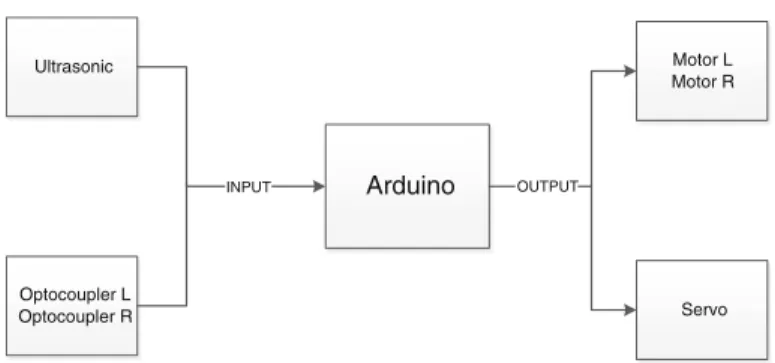
This paper designed mobile robot with the aim of reaching the destination point even though there are particular obstacles on its route. The system block diagram is given on Fig.17.1.
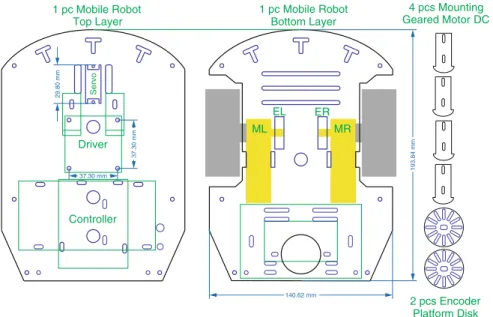
The robot uses ultrasonic sensors to detect the distance of objects in front of it. Ultrasonic sensors placed on servo motors so that it can rotate 180°. The rotation of the servo starting from−90°to 90°in increments of 45°. Using servo motors, the ultrasonic sensor is capable of facing onfive different directions (left, oblique left, front, oblique right, and right). To calculate the rotation of the motor, a mobile robot uses an acrylic disc encoder with 12 holes that can be read by optocoupler. Installation of disc encoder is parallel with the wheels. The actuator uses two geared DC motor with two shafts. Thefirst shaft installed on encoder disk and the other shaft is mounted on wheel. Figure17.2represent the mechanical design of mobile robot prototype. Arduino Ultrasonic Optocoupler L Optocoupler R INPUT Motor L Motor R Servo OUTPUT
Fig. 17.1 System block diagram
Figure 17.2 shown the top and bottom platform layer, and the mounting accessories for DC Geared Motor and disc encoder. On the top layer there is a square hole which is used to place a micro servo motors. Micro servo motor is used to enable the movement of ultrasonic sensor. The second devices on top layer are L298 DC motor driver and Arduino UNO controller. On bottom layer, there are two geared DC motors, namely motor left (ML) and motor right (MR). Two DC motors are installed using 4 mounting pieces in the right places. Each disc encoder has 12 holes for one rotation. So, one tick represents 30 degrees of rotation of the wheel. Each of these holes will generate a pulse that will be read by optocoupler sensor. An optocoupler, also known as an optoisolator or photocoupler, is an electronic com-ponent that interconnects two separate electrical circuits by means of a light sensitive optical interface. Figure17.3represents the implemented mobile robot prototype.
193.84 mm 140.62 mm 37.30 mm 37.30 mm 29.80 mm Servo Driver Controller EL ER ML MR 4 pcs Mounting Geared Motor DC 2 pcs Encoder Platform Disk 1 pc Mobile Robot Bottom Layer 1 pc Mobile Robot Top Layer
Fig. 17.2 Acrylic mobile robot platforms and mounting parts
Fig. 17.3 Mobile robot prototype
17.3
Odometry and Robot Model
Odometry is measurement method from motion sensor or rotation sensor to estimate change in position over time. Odometry is used by some robots, whether they be legged or wheeled, to estimate (not determine) their position relative to a starting location. This method is sensitive to errors due to the integration of velocity measurements over time to give position estimates. Rapid and accurate data col-lection, equipment calibration, and processing are required in most cases for odometry to be used effectively.
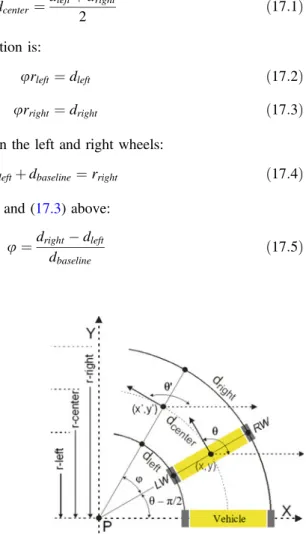
Figure17.4explain about detailed odometry geometry for our mobile robot. The vehicle starts from (x, y, θ) and destination position at (xʹ, yʹ, θʹ). The center between two wheels of the robot travels along an arc trajectory. Remembering that arc length is equal to the radius times the inner angle, the length of this arc is:
dcenter¼
dleftþdright
2 ð17:1Þ
On basic geometry, the equation is:
urleft¼dleft ð17:2Þ
urright¼dright ð17:3Þ Ifdbaselineis distance between the left and right wheels:
rleftþdbaseline¼rright ð17:4Þ Subtracting from Eqs. (17.2) and (17.3) above:
u¼drightdleft dbaseline
ð17:5Þ
Fig. 17.4 Odometry geometry for mobile robot
Wheel encoders give the distance moved by each wheel, left and right wheel. Assume the wheels are following an arc trajectory for short time scale.
x0¼xþdcentercos; ð17:6Þ y0¼yþdcentersin; ð17:7Þ ;0¼ ; þdrightdleft
dbaseline ð17:8Þ
Calculation of wheel circumference is needed to know how far motion of the robot. Mobile robot uses two wheels with 65 mm diameter. Each wheel is equipped with 12 holes disc encoder for one rotation. The equation is as follows.
Dtick¼tick0tick ð17:9Þ dleft¼2:p:r: Dtick left N ð17:10Þ dright¼2:p:r: Dtick right N ð17:11Þ
17.4
Software Design
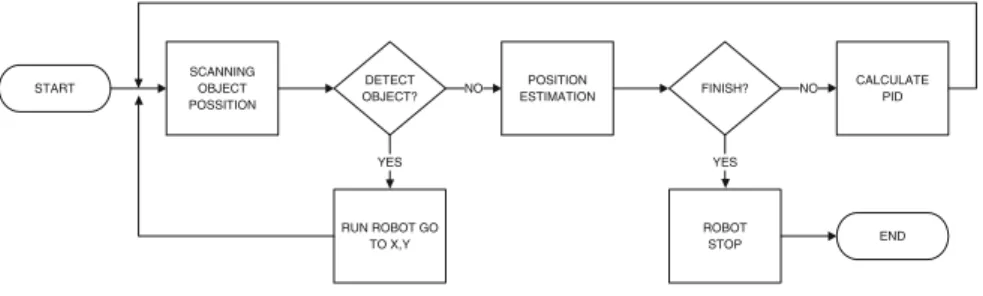
Theflowchart of the system is depicted on Fig.17.5. Position estimation is used to predict robot position by counting the pulse sent by optocoupler. The direction of the robot can be known from the result of pulse count from the left and right optocoupler. Robot reads the destination coordinate and always check the odometry pulses (dtick1 and dtick2). Controller updates the newest position of mobile robot (x_new, y_new, teta_new). After the robot gets the newest coordinate, controller calculates the difference between destination coordinate and current coordinate.
START SCANNING OBJECT POSSITION DETECT OBJECT? POSITION ESTIMATION FINISH? CALCULATE PID ROBOT STOP RUN ROBOT GO TO X,Y NO NO YES YES END
Fig. 17.5 Systemflowchart
Error is used to calculate PID parameters and determine the speed of left motor and right motor. This algorithm is repeated until destination point is reached.
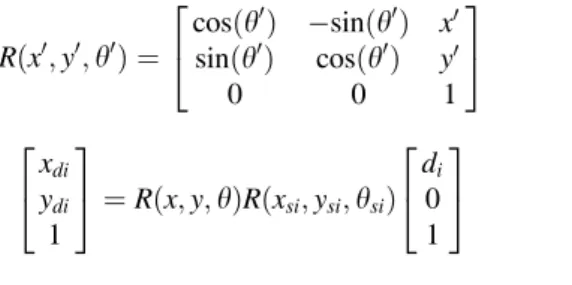
Obstacle avoidance mechanism begins with the reading of obstacle position. Servo will rotate the ultrasonic sensor and get the data of distance between robot and obstacles from several different angles (0, 45o, 90o, 135o, and 180o). Each distance is saved and transformed using rotation and 2D translation depicted in
Eqs.17.12and17.13. Equation17.12is derivation of Eq.17.13whereR(x,y,θ) is a
3×3 matrix. The transformation result gives the coordinate of world view depicted at Eq.17.13. R xð 0;y0;h0Þ ¼ cosðh0Þ sinðh0Þ x0 sinðh0Þ cosðh0Þ y0 0 0 1 2 4 3 5 ð17:12Þ xdi ydi 1 2 4 3 5¼R xð ;y;hÞR xð si;ysi;hsiÞ di 0 1 2 4 3 5 ð17:13Þ
17.5
Result and Discussion
Mobile robot starts at the origin, pointed down the xy axis. Its starting state is (x, y, θ) on (0, 0, 0) and the mobile robot will going to (xʹ, yʹ,θʹ). The experiment result will prove the usability of the navigation method.
The first experiment of mobile robot goes to goal without any obstacles with destinations coordinate (180, 50 cm). The second one goes to goal with obstacles with the same coordinate. Figure 17.6 shows how the mobile robot reach the destination on coordinates (180, 50 cm). The research experiment is completed with four obstacles. The obstacles are paper board sound damper with the height 25 cm and paper fold 1 cm. The obstacles are used to disturb ultrasonic wave transmission. From 10 experiments with 4 obstacles and random position a success rate of 90 % is achieved. Without obstacles, 100 % success rate can be achieved.
Start (0,0) Finish (150,80) Start (0,0) Finish (150,80) (a) (b)
Fig. 17.6 Experiment:awithout obstacles,bwith obstacles
17.6
Conclusion
Odometry method is able to carry the mobile robot to reach its destination. One of the weaknesses of the system is drifting of the wheels. In the second experiment paper board sound damper as obstacles is added. In this schema, the mobile robot still can reach its goal. Considering the result of the experiment, there is still a need of further experiment to decide on ultrasonic sensor placement on a real telepres-ence robot.
Acknowledgment This Research is funded by Competitive Research Grants fund of Indonesian Higher Education Directorate under contract no. 30/SP2H/PDSTRL_PEN/LPPM-UKP/IV/2015.
References
1. Oriolo, G.: Real-time map building and navigation for autonomous robots in unknown environments. IEEE Trans. Syst. Man Cybern. B Cybern. Soc.28(3), 316–333 (1998) 2. Yang, X., et al.: A layered goal-oriented fuzzy motion planning strategy for mobile robot
navigation. IEEE Trans. Syst. Man Cybern. B Cybern.35(6), 1214–1224 (2005)
3. Budiharto, W., et al.: Obstacles avoidance for intelligent telepresence robot using interval Type-2 FLC. CIC Express Lett.8(3), 821–827 (2014)
4. Sugihara, K., Smith J.: Genetic algorithms for adaptive motion planning of an autonomous mobile robot. In: International Symposium on Computational Intelligence in Robotics and Automation (1997)
5. Hu, Y., Yang, S.X.: A knowledge based genetic algorithm for path planning of a mobile robot. In: International Conference on Robotics and Automation (2004)
6. Sedighi, K.H., Ashenayi, K., Manikas, T.W., Wainwright, R.L., Tai, H.M.: Autonomous local path planning for a mobile robot using a genetic algorithm. In: Congress on Evolutionary Computation (2004)
7. Olson, E.: A primer on odometry and motor control (2004)
8. Maimone, M., et al.: Two years of visual odometry on the mars exploration rovers. J. Field Robot.24(3), 169–186 (2007)
9. Petrus, S., Handry, K.: Open protocol framework for telepresence robot. ARPN J. Eng. Appl. Sci.9(12), 2437–2440 (2014)