Holmes, Michael Henry
(2017)Comprehension based adaptive learning
sys-tems.
Doctoral thesis (PhD), Manchester Metropolitan University.
Downloaded from:
http://e-space.mmu.ac.uk/621011/
Usage rights:
Creative Commons: Attribution-Noncommercial-No
Deriva-tive Works 4.0
Please cite the published version
COMPREHENSION BASED
ADAPTIVE LEARNING
SYSTEMS
Michael Henry Holmes
A thesis submitted in partial fulfilment of the requirements of
Manchester Metropolitan University for the degree of Doctor of
Philosophy
School of Computing, Mathematics and Digital Technology
Manchester Metropolitan University
"Computer science will transform our cultures [...] It will help us learn what knowledge is. It will teach us how we learn, think and feel. Then we’ll be able
to change ourselves. This will change all our sciences and humanities."
Declaration
I hereby declare that except where specific reference is made to the work of others, the contents of this dissertation are original and have not been submitted in whole or in part for consideration for any other degree or qualification in this, or any other university. This dissertation is my own work and contains nothing which is the outcome of work done in collaboration with others, except as specified in the text and Acknowledgements.
Michael Henry Holmes 2017
Acknowledgements
I would like to thank my supervisors, Annabel, Keeley, Jim and Cathy, for their guidance. I would also like to give thanks to my husband, Sami, and to my mum, Mary, for their support and encouragement over the years. I would also like to thank those students of Manchester Metropolitan University’s Faculty of Science & Engineering who took part in the research; their contribution has been invaluable.
Abstract
Conversational Intelligent Tutoring Systems aim to mimic the adaptive be-haviour of human tutors by delivering tutorial content as part of a dynamic exchange of information conducted using natural language.
Deciding when it is beneficial to intervene in a student’s learning process is an important skill for tutoring. Human tutors use prior knowledge about the student, discourse content and learner non-verbal behaviour to choose when intervention will help learners overcome impasse. Experienced human tutors adapt discourse and pedagogy based on recognition of comprehension and non-comprehension indicative learner behaviour.
In this research non-verbal behaviour is explored as a method of com-putationally analysing reading comprehension so as to equip an intelligent conversational agent with the human-like ability to estimate comprehension from non-verbal behaviour as a decision making trigger for feedback, prompts or hints.
This thesis presents research that combines a conversational intelligent tutoring system (CITS) with near real-time comprehension classification based on modelling of e-learner non-verbal behaviour to estimate learner compre-hension during on-screen conversational tutoring and to use comprecompre-hension classifications as a trigger for intervening with hints, prompts or feedback for the learner.
To improve the effectiveness of tuition in e-learning, this research aims to design, develop and demonstrate novel computational methods for modelling e-learner comprehension of on-screen information in near real-time and for
10
adapting CITS tutorial discourse and pedagogy in response to perception of comprehension indicative behaviour. The contribution of this research is to detail the motivation for, design of, and evaluation of a system which has the human-like ability to introduce micro-adaptive feedback into tutorial discourse in response to automatic perception of e-learner reading comprehension.
This research evaluates empirically whether e-learner non-verbal behaviour can be modelled to classify comprehension in near real-time and presents a near real-time comprehension classification system which achieves normalised comprehension classification accuracy of 75%. Understanding e-learner compre-hension creates exciting opportunities for advanced personalisation of materials, discourse, challenge and the digital environment itself. The research suggests a benefit is gained from comprehension based adaptation in conversational intelligent tutoring systems, with a controlled trial of a comprehension based adaptive CITS called Hendrix 2.0 showing increases in tutorial assessment scores of up to 17% when comprehension based discourse adaptation is deployed to scaffold the learning experience.
Contents
List of Figures 19
List of Tables 23
Nomenclature 27
1 Introduction 29
1.1 About this research . . . 29
1.2 Aims . . . 30
1.3 Research questions . . . 31
1.4 Contribution . . . 32
1.5 Summary of research outcomes . . . 34
1.6 Structure of thesis . . . 35
2 Theories for e-learning 37 2.1 Introduction . . . 37
2.2 Theories of learning and teaching . . . 37
2.2.1 Cognitivism . . . 39
2.3 Evaluating learning . . . 43
2.3.1 Learning gain . . . 43
2.3.2 Anderson and Krathwohl’s taxonomy of educational ob-jectives . . . 45
2.3.3 Question response complexity . . . 46
12 Contents 2.5 Discussion . . . 48 2.6 Conclusion . . . 50 3 Comprehension assessment 53 3.1 Introduction . . . 53 3.2 What is comprehension? . . . 53
3.3 Assessing learner comprehension . . . 56
3.4 Automatic assessment of learner comprehension . . . 58
3.4.1 Assessing cognition by an affect proxy . . . 59
3.4.2 Atheoretic modelling of physical behaviour . . . 60
3.4.3 A simple machine learning approach to atheoretic be-havioural analysis and cognitive classification . . . 62
3.5 Discussion . . . 63
3.6 Conclusion . . . 65
4 Conversational intelligent tutoring systems and expert sys-tems 67 4.1 Introduction . . . 67
4.2 Background . . . 68
4.3 Can computers teach? . . . 69
4.4 The structure of a CITS . . . 70
4.5 Natural language interpretation . . . 72
4.5.1 Semantic analysis . . . 72
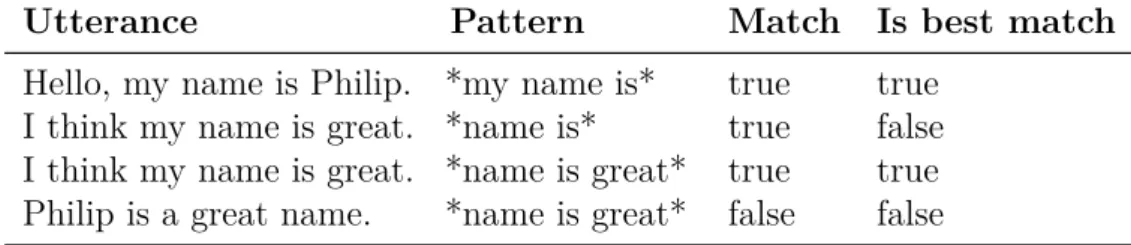
4.5.2 Pattern matching . . . 74
4.5.3 A combinatorial measure of text similarity . . . 76
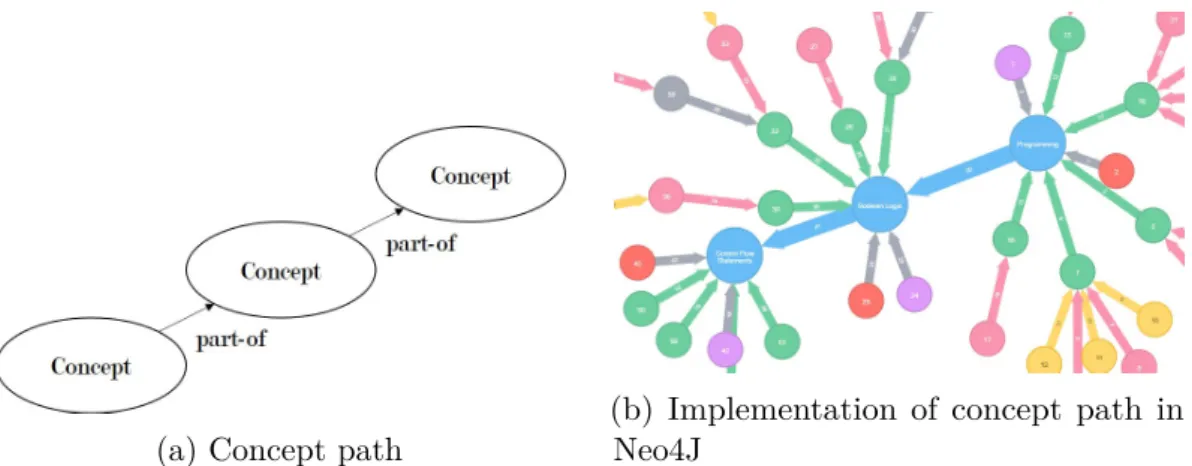
4.6 Encoding knowledge as a graph . . . 78
4.7 Directing goal-oriented conversation . . . 80
4.8 Adaptation and personalisation . . . 82
4.8.1 Immediate vs coaching micro-adaptation . . . 85
Contents 13
4.8.3 Timing feedback . . . 86
4.8.4 Beyond conversational content . . . 88
4.9 Evaluating conversational intelligent tutoring systems . . . 89
4.9.1 Evaluating the effectiveness of adaptation . . . 91
4.10 Discussion . . . 91
4.11 Conclusion . . . 93
5 Machine learning with Artificial Neural Networks 97 5.1 Introduction . . . 97
5.2 Simple artificial neural networks . . . 98
5.3 Multi-layer artificial neural networks . . . 100
5.4 Training artificial neural networks . . . 103
5.4.1 Training by back-propagation . . . 103
5.5 Challenges in supervised learning . . . 104
5.6 Conclusion . . . 104
6 Modelling and classifying patterns of non-verbal behaviour 107 6.1 Introduction . . . 107
6.2 Non-verbal behaviour . . . 107
6.3 Face and facial-feature detection . . . 109
6.3.1 Artificial neural networks . . . 110
6.3.2 Haar cascades . . . 112
6.4 Modelling non-verbal behaviour from image stream data . . . . 113
6.5 Classifying cognitive states from non-verbal behaviour . . . 114
6.6 Conclusion . . . 116
7 Hendrix 1.0: A conversational intelligent tutoring system for programming 117 7.1 Introduction . . . 117
7.2 Motivation . . . 118
14 Contents
7.3.1 Contributions . . . 119
7.3.2 Key functionality . . . 120
7.3.3 Challenges . . . 122
7.4 Hendrix 1.0 architecture and core components . . . 124
7.4.1 Interface . . . 126
7.4.2 Domain . . . 128
7.4.3 Tutor . . . 133
7.4.4 Student . . . 141
7.5 Conclusion . . . 142
8 Study: Evaluation of Hendrix 1.0 CITS 145 8.1 Introduction . . . 145 8.2 Research questions . . . 146 8.3 Contribution . . . 146 8.4 Tutorial content . . . 146 8.5 Study overview . . . 147 8.5.1 Ethics . . . 147 8.6 Participant information . . . 148
8.7 Does the intelligent conversational agent converse effectively? . . 148
8.7.1 Method . . . 148
8.7.2 Can the system answer learner questions? . . . 150
8.7.3 Can the system accurately mark learners’ answers pro-vided in discourse? . . . 151
8.7.4 Can the system accurately classify acts of speech? . . . . 153
8.8 Does the CITS facilitate learning? . . . 155
8.8.1 Method . . . 155
8.8.2 Has the user benefitted from using the system? . . . 156
8.9 Discussion . . . 158
Contents 15 9 Image pre-processing and comprehension classifier training 161
9.1 Introduction . . . 161
9.2 Behavioural indexing tool . . . 162
9.2.1 Model of non-verbal behaviour . . . 165
9.3 Classifier training and testing tool . . . 165
9.4 Conclusion . . . 166
10 Study: Exploring the relationship between reading compre-hension and learner non-verbal behaviour 167 10.1 Introduction . . . 167 10.2 Research questions . . . 168 10.3 Motivation . . . 168 10.4 Study procedure . . . 169 10.4.1 Ethics . . . 171 10.4.2 Participant information . . . 171 10.5 Method . . . 172
10.6 Results and discussion . . . 173
10.7 Further refining parameters for data treatment . . . 178
10.7.1 Method . . . 178
10.7.2 Results and discussion . . . 179
10.8 Conclusion . . . 182 11 COMPASS 185 11.1 Introduction . . . 185 11.2 Motivation . . . 185 11.3 Contributions . . . 187 11.4 Key functionality . . . 187 11.5 Software architecture . . . 188
11.6 Behavioural data model . . . 190
16 Contents
11.8 Estimating comprehension by analysis of non-verbal behaviour . 192
11.9 Conclusion . . . 194
12 Study: Training and evaluating COMPASS 195 12.1 Introduction . . . 195 12.2 Research question . . . 196 12.3 Study procedure . . . 196 12.3.1 Ethics . . . 197 12.3.2 Participant information . . . 198 12.4 Method . . . 199 12.4.1 Data collection . . . 199
12.4.2 Creating a training data set . . . 201
12.4.3 Training and evaluating the classifier . . . 202
12.5 Data . . . 203
12.6 Results and discussion . . . 204
12.7 Conclusion . . . 208 13 Hendrix 2.0 211 13.1 Introduction . . . 211 13.2 Contributions . . . 212 13.3 Comprehension classifications . . . 212 13.4 Key functionality . . . 212 13.5 Requirements . . . 214 13.6 User Interface . . . 215 13.7 Software architecture . . . 219 13.7.1 Hendrix 2.0 . . . 219 13.7.2 COMPASS . . . 222 13.7.3 Integration . . . 223 13.7.4 Data context . . . 223 13.8 Adaptation . . . 224
Contents 17
13.8.1 Adapting to weak non-comprehension classifications . . . 226
13.8.2 Adapting to strong non-comprehension . . . 227
13.9 Examples of tutorial conversation . . . 227
13.9.1 Setting a learning objective . . . 228
13.9.2 Introducing a concept . . . 229
13.9.3 Adaptation and intervention . . . 230
13.9.4 Responding to learner requests . . . 231
13.10Conclusion . . . 234
14 Study: Comprehension classification accuracy with a CITS 237 14.1 Introduction . . . 237 14.2 Motivation . . . 238 14.3 Research question . . . 238 14.4 Study overview . . . 238 14.4.1 Study procedure . . . 239 14.4.2 Ethics . . . 241 14.4.3 Participant information . . . 241 14.5 Method . . . 242
14.5.1 Results and discussion . . . 242
14.6 Discussion . . . 249
14.7 Conclusion . . . 250
15 Study: The effect of comprehension based adaptation on learn-ing outcomes 253 15.1 Introduction . . . 253 15.2 Motivation . . . 254 15.3 Research questions . . . 254 15.4 Study overview . . . 255 15.4.1 Study procedure . . . 255 15.4.2 Ethics . . . 255
18 Contents
15.4.3 Participants . . . 256
15.5 Method . . . 257
15.6 Results . . . 259
15.6.1 Overview of data collected . . . 259
15.6.2 The effect of adaptation on learner performance under formative assessment . . . 261
15.6.3 The effect of adaptation on learner performance under summative assessment . . . 263
15.7 Discussion . . . 265
15.8 Conclusion . . . 267
16 Conclusions and future work 269 16.1 Summary of research . . . 269
16.2 Summary of findings . . . 272
16.3 Novelty and contribution . . . 273
16.4 Limitations . . . 275
16.5 Future work . . . 275
Bibliography 277
Appendix A Pilot study tutorial content 293 Appendix B Comprehension classification pilot study results 313
List of Figures
4.1 Generic model of a CITS . . . 70
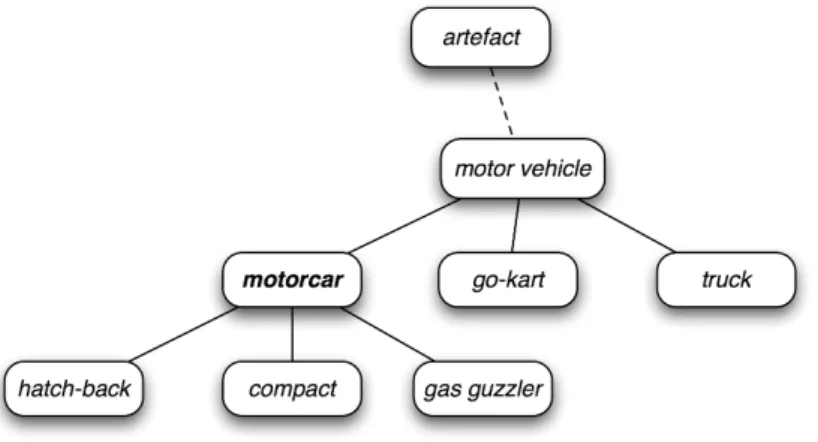
4.2 Example of WordNet semantic ontology (source: Bird et al. (2009b):online) . . . 73
4.3 Example of a basic ontology . . . 79
4.4 Example of a basic ontology . . . 79
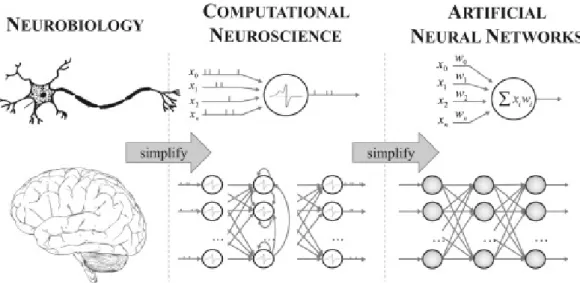
4.5 PARADISE evaluation framework diagram (Walker et al., 1997) 90 4.6 Example GQM for a conversational intelligent tutoring system . 91 5.1 Comparison of biological and artificial neural networks (source: Almási et al. (2016):32 . . . 98
5.2 Perceptron Network . . . 99
5.3 Multi-class Single Layer Perceptron Network . . . 99
5.4 Multi-layer Perceptron Network . . . 101
6.1 Haar-like features (Hatem et al., 2015) . . . 112
6.2 Facial feature detection with public domain haar cascades (Castrillón-Santana et al., 2008) . . . 113
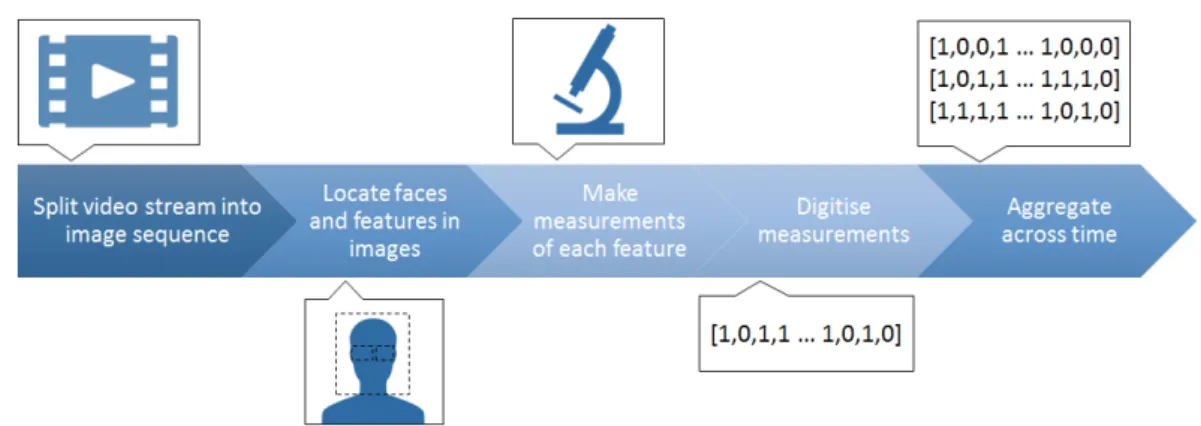
6.3 Process for modelling behaviour . . . 114
6.4 Summary of behaviour over time . . . 114
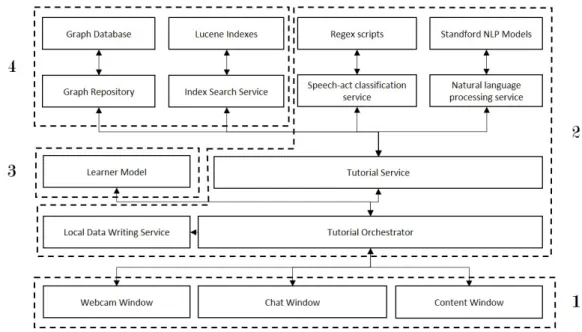
7.1 Hendrix 1.0 system architecture . . . 125
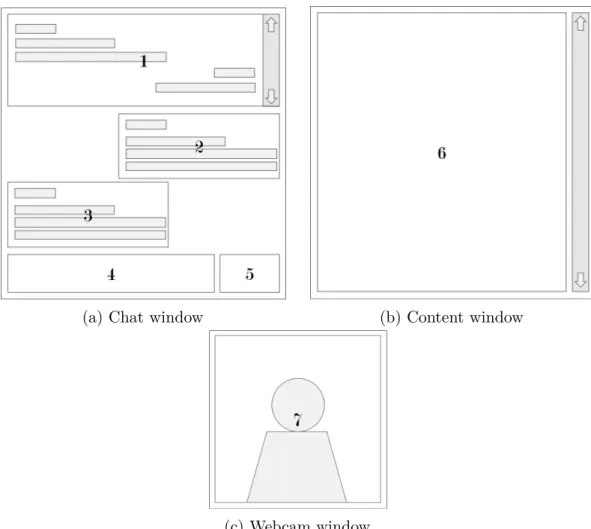
7.2 Hendrix 1.0 wireframe diagrams . . . 127
7.3 Knowledge graph structure . . . 130
20 List of Figures
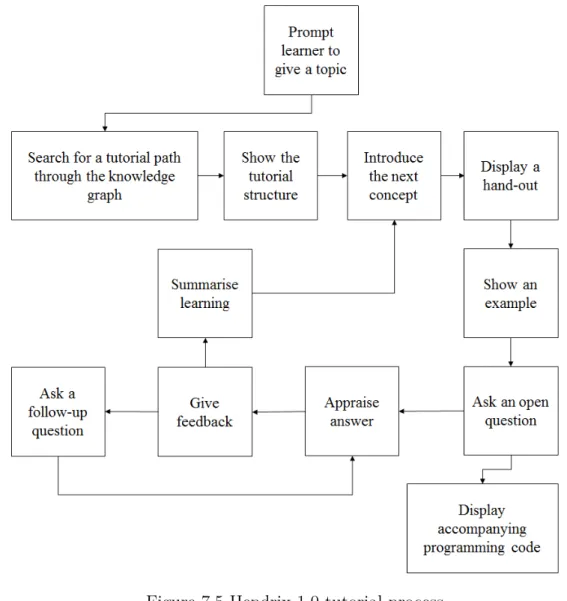
7.5 Hendrix 1.0 tutorial process . . . 132
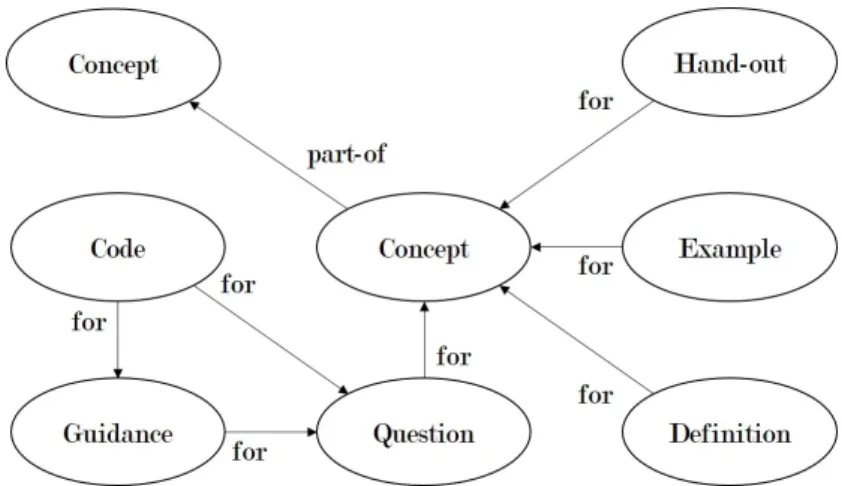
7.6 Hendrix 1.0 ontology of relationship between concept, question and guidance steps with order attributes . . . 132
7.7 Example dialogue demonstrating Hendrix 1.0 constructing a tutorial path . . . 135
7.8 Example dialogue showing a conversation in which Hendrix 1.0 asks a question, marks the answer and provides feedback . . . . 139
7.9 Example dialogue demonstrating Hendrix 1.0 identifying and responding to a request for definition . . . 141
8.1 GQM for evaluation of conversational function . . . 148
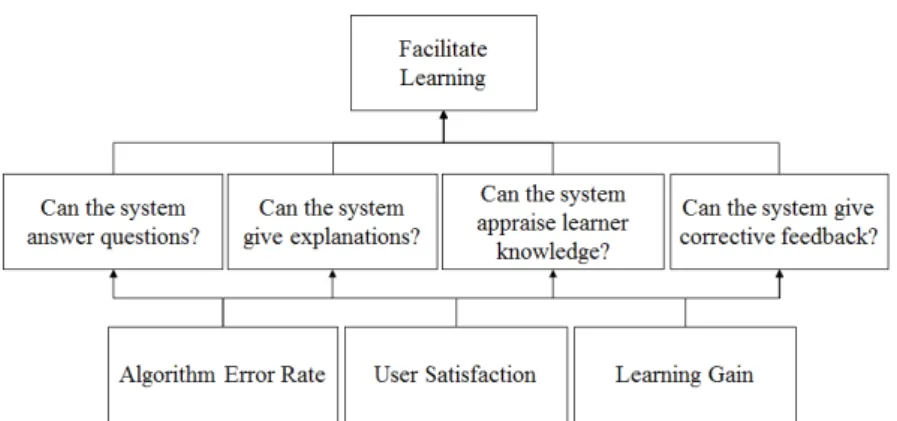
8.2 GQM for evaluation of learning facilitation . . . 156
10.1 Histogram of regression residuals for the model . . . 174
10.2 Partial regression plot for Interval variable against Test set Classification Accuracy (TeCA) . . . 175
10.3 Partial regression plot for Duration variable against Test set Classification Accuracy (TeCA) . . . 175
10.4 Partial regression plot for Delay variable against Test set Classi-fication Accuracy (TeCA) . . . 175
10.5 Average TeCA by window length . . . 176
10.6 ANOVA table for classification accuracy with dependent vari-ables window and delay . . . 180
10.7 Partial regression plot for delay variable . . . 181
11.1 Logical architecture of COMPASS . . . 189
11.2 Channel classification method for ‘eye fully closed’ . . . 192
11.3 Comparison of accuracy achieved by machine learning algorithms on pilot study data . . . 193
12.1 Screen shot of quiz system . . . 196
List of Figures 21
12.3 CBFV indexing process diagram . . . 201 12.4 COMPASS time-series for a correct answer period (Holmes et al.,
2017b) . . . 206 12.5 COMPASS time-series for an incorrect answer period (Holmes
et al., 2017b) . . . 207 12.6 COMPASS time-series for an incorrect answer period with change
of behaviour (Holmes et al., 2017b) . . . 207 13.1 Wireframe for the Hendrix 2.0 chat interface . . . 216 13.2 Wireframe for the Hendrix 2.0 camera verification . . . 216 13.3 Screen-shot: example of the Hendrix 2.0 chat interface during a
tutorial . . . 218 13.4 Hendrix 2.0 tertiary windows . . . 219 13.5 Hendrix 2.0 system architecture . . . 220 13.6 Hendrix 2.0 adaptation process . . . 226 13.7 Introduction to a concept and display ofhand-out sheet . . . 230
13.8 Splash screen for conversational intervention during questioning 232 13.9 Hendrix 2.0 answering a learner’s question . . . 234 14.1 Physical layout of experiment . . . 239 14.2 Demographics for participant group . . . 242 14.3 NVB extraction performance by ethnicity . . . 243 14.4 Makeup of CBFV dataset by ethnicity . . . 243 14.5 Average comprehension score by answer score for complex
ques-tions answered by White Males . . . 250 15.1 Gender demographics for control and experimental groups . . . 256 15.2 Ethnicity demographics for control and experimental groups . . 256 15.3 Academic level demographics for control and experimental groups257 15.4 Effect of adaptation as percentage change in question score for
List of Tables
4.1 Example of POS tagging . . . 72 4.2 Example of simple pattern matching . . . 75 4.3 Example of extended pattern matching rules . . . 75 6.1 Non-verbal behaviour channels . . . 109 7.1 Domain entities in Hendrix 1.0 knowledge graph . . . 129 7.2 Overview of formative tutorial question data . . . 135 8.1 User feedback questions . . . 149 8.2 Errors and satisfaction scores for learners asking questions . . . 151 8.3 Error rate for marking answers . . . 152 8.4 Error rate and satisfaction scores for marking answers . . . 153 8.5 Error rate for marking answers . . . 154 8.6 Satisfaction with conversational coherence . . . 155 8.7 Learning gain . . . 157 8.8 Two-sample one-tail T-tests comparing pre- and post-tutorial
increase . . . 157 8.9 Learning gain by academic level . . . 157 8.10 Learning gain by prior subject expertise . . . 157 9.1 Behavioural data model . . . 165 10.1 Table of data sets with different temporal configurations . . . . 173 10.2 Table of experimental parameters . . . 174
24 List of Tables
10.3 Table of data sets with different variable configurations . . . 177 10.4 Table of data sets with different variable configurations . . . 177 10.5 Table of data sets with different variable configurations . . . 179 10.6 Results of network training . . . 179 11.1 Behavioural data model . . . 191 11.2 Illustrative example of behavioural data model and cumulative
behavioural feature vector . . . 191 12.1 Ethnic demographic groups . . . 198 12.2 Example of questions in Bloom’s revised taxonomy of the
cogni-tive domain . . . 200 12.3 Overview of learners’ question answer data . . . 203 12.4 Breakdown of cumulative behavioural feature vectors extracted
from question response periods . . . 204 12.5 10-fold cross validation training . . . 205 12.6 Classifier performance . . . 205 12.7 Test set confusion matrices for group 5 classifier . . . 206 13.1 Setting a learning objective . . . 228 13.2 Introducing a new concept . . . 229 13.3 Exploring learner knowledge and enacting interventions based
on comprehension classification . . . 230 13.4 Introducing a new concept . . . 232 14.1 Table demonstrating the layout and content of results tables . . 244 14.2 Binary classifier accuracy for all participants . . . 245 14.3 Binary classifier accuracy for Male participants . . . 246 14.4 Binary classifier accuracy for Female participants . . . 246 14.5 Binary classifier accuracy for Asian Male participants . . . 246 14.6 Binary classifier accuracy for Other Male participants . . . 247 14.7 Binary classifier accuracy for White Male participants . . . 247
List of Tables 25
14.8 Binary classifier accuracy for simple questions . . . 248 14.9 Binary classifier accuracy for complex questions . . . 249 15.1 Overview of tutorial answer data . . . 259 15.2 Overview of tutorial question data . . . 260 15.3 Overview of formative tutorial question data by type . . . 260 15.4 Overview of formative tutorial question data by topic . . . 260 15.5 Overview of formative tutorial question data by Bloom’s
taxon-omy category . . . 261 15.6 Overview of summative pre- and post-tutorial MCQ scores . . . 261 15.7 Two sample t-tests comparing control and experimental group
question scores . . . 262 15.8 Two sample t-tests comparing control and experimental group
question scores for White Male subgroup . . . 263 15.9 Control group pre- and post-tutorial test scores and normalised
average learning gain . . . 264 15.10Experimental group pre- and post-tutorial test scores and
nor-malised average learning gain . . . 265 15.11Two tail two sample t-test for comparison of mean learning gain
between control and experimental groups . . . 265 15.12One tail two sample t-test for comparison of mean learning gain
within the control group . . . 265 B.1 Exploration of parameters for training data selection . . . 313
Nomenclature
Roman Symbols
API Application Programming Interface CA Conversational agent
CBFV Cumulative Behavioural Feature Vector CI Construction-integration theory
CITS Conversational Intelligent Tutoring System CLT Cognitive load theory
CNN Convolutional Neural Networks CSV Comma Separated Value DLL Dynamic Link Library FILO First in, last out GQM Goal Question Metric GUI Graphical User Interface MCQ Multiple Choice Quiz
MMU Manchester Metropolitan University NVB Non-verbal behaviour
28 Nomenclature
RNN Recurrent Neural Networks
Chapter 1
Introduction
This chapter introduces the research project, the research aims and objectives, and the research questions to be answered. The chapter gives an overview of the aims, outcomes and contributions of the research and the structure of this thesis.
1.1
About this research
The research presented in this thesis is motivated by the need to improve the effectiveness (Husbands and Pearce, 2012) of e-learning platforms. Literature review of educational practice (chapter 2), comprehension assessment (chapter 3) and the behaviour of intelligent tutoring systems (chapter 4) suggests that the timing of feedback micro-adaptations (sections 4.8.2 and 4.8.3) in relation to task context and comprehension state (section 3.2) plays an important role in the effectiveness of tuition.
This research presents a review of the best practice of human one-to-one tuition (section 2.6), explores comprehension and assessment to identify methods of computational analysis (3.6) and identifies the opportunity for improvement to timing of micro-adaptive behaviour by integration of near real-time comprehension assessment by analysis of learner non-verbal behaviour (3.4) as a trigger for immediate and contextualised feedback.
30 Introduction
The research experimentally evaluates the effectiveness of CITS which embody adaptive behaviours drawn from literature on education and CITS design (chapter 8), experimentally evaluates whether reading comprehension states can be classified by non-intrusive analysis of learner non-verbal behaviour (chapters 10 and 12), experimentally evaluates the accuracy of comprehension classifications made during discourse with a conversational agent (chapter 14) and experimentally evaluates the effect of comprehension based micro-adaptation on learning outcomes for students using a conversational intelligent tutoring system (CITS) (chapter 15).
The aim of this research is to design, develop and evaluate novel computa-tional methods for accurately classifying e-learner reading comprehension of on-screen information by near real-time observation of non-verbal behaviour using consumer grade computer hardware and peripherals, to demonstrate that comprehension classification can be used to time feedback micro-adaptation within a conversational intelligent tutoring system, and that timing feedback by comprehension assessment has an effect on learning outcomes.
1.2
Aims
1. Identify the effective behaviours of human tutors in one-to-one tuition 2. Identify the role of comprehension in learning and how comprehension
assessment is used in appraisal of understanding
3. Identify the current state of the art in adaptive behaviours for CITS and assess whether they meet best practice for human tuition
4. Design, develop and evaluate a conversational intelligent tutoring system (CITS) that is capable of tutoring computer programming effectively
1.3 Research questions 31
5. Design, develop and evaluate an automatic comprehension assessment and classification system for integration with e-learning environments, specifically CITS
6. Design, develop and evaluate a CITS system which improves learning outcomes by making timely pedagogic interventions based on assessment of learner comprehension
1.3
Research questions
To achieve the aims of the research (section 1.2), to improve e-learner educational outcomes by development of comprehension based adaptive CITS, six important research questions arise:
1. What are the effective behaviours of human tutors in one-to-one tuition? 2. What is comprehension and how is it assessed?
3. How do intelligent tutoring systems enact the effective behaviour of human tutors and could improvements be made?
4. Can a CITS tutor computer programming effectively at undergraduate level?
5. Can comprehension of on-screen information be classified accurately based on observation of e-learner non-verbal behaviour?
6. Does adaptation within a CITS, based on detection of non-comprehension states, improve learning outcomes for students?
In this research, questions are addressed using literature review, software design and development and empirical evaluation by experimentation with student participants at Manchester Metropolitan University.
32 Introduction
1.4
Contribution
This thesis details a programme of research, software design and development, and empirical evaluation through studies conducted with learners, that presents five contributions in the advancement of intelligent adaptive agent-based and conversational e-learning systems.
Literature review ties together prior work on educational practice, cognitive psychology, adaptive system design and affect-cognitive detection using machine learning to identify an opportunity to improve the micro-adaptive behaviour of CITS.
The literature review that is presented highlights the effective behaviour of tutors in one-to-one tuition (section 2.6), finds definition and explanation of reading comprehension (sections 3.2) and identifies the opportunity for improving the effectiveness of micro-adaptive behaviour in CITS (sections 4.8) by integration of comprehension assessment through computational analysis of learner behaviour (sections 3.4, 4.8.4 and 6.2).
To evaluate whether comprehension based micro-adaptation can improve learning outcomes for students using a CITS. A CITS named Hendrix has been designed and developed to tutor computer programming (Holmes et al., 2015a) (chapters 7 and 8). Hendrix contribution is two-fold: in its design and architecture and in its ability to appraise and use natural language, mathematics and programming code as part of a conversational tutorial.
To meet the aim of having Hendrix adapt to e-learner comprehension of on-screen information in near real-time, a novel comprehension classification system, named COMPASS, has been designed, developed and evaluated (chapters 11, 12 and 14). COMPASS consists of three primary components - the comprehension model, the behaviour extraction algorithm and the comprehension classifier.
The model of e-learner comprehension has been designed to encapsulate non-verbal behaviour over time and learner attributes (Holmes et al., 2017b) (chapters 11 and 12). The contribution of the model is in joining rich patterns
1.4 Contribution 33
of non-verbal behaviour with stratifying learner attributes including education level, gender and ethnicity. Doing so allows for distinct patterns of behaviour indicative of e-learner comprehension to be modelled within demographic strata.
To extract the comprehension model from web camera image data, a novel algorithm has been designed, developed and evaluated (Holmes et al., 2017a,b) (chapters 11 and 12). The contribution of the algorithm is in pairing near real-time face and facial feature detection using scale invariant detectors (Haar cascades) with a bank of artificial neural networks capable of producing de-scriptors of discrete non-verbal behaviours evident in sequential web camera images.
To classify the comprehension level expressed by the model, a novel artificial neural network based comprehension classifier has been designed, developed and evaluated (Holmes et al., 2017a,b) (chapters 11 and 12). The contribution of the classifier is in its learning of discriminant features so as to generalise about e-learner comprehension across multiple e-learning platforms.
COMPASS demonstrated a technique for modelling and classifying compre-hension in near real-time without use of specialist hardware or body attached sensors, and showed that patterns of non-verbal behaviour can be used to estimate comprehension with accuracy greater than 75%.
Finally, COMPASS has been integrated into a comprehension based adaptive conversational intelligent tutoring system, Hendrix 2.0. Hendrix 2.0 has been designed, developed and evaluated to assess whether comprehension based adaptation improves learning outcomes for students (Holmes et al., 2017a) (chapters 13, 14 and 15). The contribution of Hendrix 2.0 is its ability to detect e-learner comprehension of on-screen information during conversational tutoring and to adapt discourse and interaction to support students displaying non-comprehension indicative behaviours.
Hendrix 2.0 demonstrated that patterns of non-verbal behaviour learned from web camera image data, during a simple on-screen multiple choice quiz
34 Introduction
activity, are sufficiently generalised to successfully transfer across multiple on-screen learning environments without significant loss of accuracy.
1.5
Summary of research outcomes
This thesis details a programme of iterative research, software design, devel-opment and evaluation which has produced three novel systems - Hendrix 1.0, COMPASS and Hendrix 2.0. In this section a summary of the research outcomes is provided with these three distinct systems in mind.
Hendrix 1.0 is a conversational intelligent tutoring system designed to deliver short discursive tutorials on topics relating to computer programming at undergraduate level. Hendrix 1.0 was trialled in a pilot study (chapter 8) and shown to be a reliable conversational system which users found both useful and enjoyable to interact with. Hendrix 1.0 also showed tangible benefits (section 8.8.2) for users, with learners showing post-tuition learning gain of 22% (p= 0.2) for the cohort and 39.11% for the non-computing student group
(see section 2.3.1 for learning gain calculation).
COMPASS is an automatic near real-time comprehension classification system which uses computer vision and machine learning to automatically model patterns of learner non-verbal behaviour during mental processing of on-screen information. COMPASS was trained and evaluated using data gathered in a study (chapter 12) of e-learner behaviour during on-screen learning interactions. COMPASS achieved 75.8% classification accuracy for ‘comprehension’ and ‘non-comprehension’ states using test set data from the study.
Hendrix 2.0 integrated Hendrix 1.0 and COMPASS to create a comprehen-sion aware conversational intelligent tutoring system. Hendrix 2.0 is able to enact timely interventions in the learning process in response to near real-time estimates of learner comprehension.
Hendrix 2.0, using the COMPASS classifier, achieved 75.44% normalised classification accuracy (table 14.9) for ‘comprehension’ and ‘non-comprehension’
1.6 Structure of thesis 35
states. The result demonstrates that analysis of e-learner comprehension of on-screen information from non-verbal behaviour during conversation with a virtual tutor performs comparably with reported accuracy of analysis of learner comprehension during human-to-human verbal information recall tasks (Buckingham et al., 2014).
Maintaining accuracy from training and test data sets to real-world data (Chapter 14) demonstrated that the COMPASS classifier had successfully
learned generalised patterns of comprehension indicative behaviour.
In a study of the effect of adaptation on learning outcomes, comprehension based adaptation by Hendrix 2.0 (Chapter 15) resulted in a 17% increase (p = 0.2) in tutorial question scores for learners using the adaptive system
compared to learners using the non-adaptive system (section 15.6.2).
1.6
Structure of thesis
This research combines literature review, intelligent system design and develop-ment, and empirical evaluation. The thesis begins in Chapter 2 with a review of educational theory relevant to the practice of tutoring and methods for producing classroom oriented short tutorials, highlighting the importance of scaffolding and fading for developing cognitive skills in learners. Chapter 2 identifies comprehension as a key cognitive state on which scaffold learning is contingent.
Chapter 3 explores literature on both human and computerised analysis of comprehension in learning and examination scenarios. The chapter finds that human tutors effectively identify comprehension states in learners and that some successes have been reported using automatic computerised classification techniques.
Chapter 4 discusses the current state of the art in conversational intelligent tutoring systems, incorporating review of literature on issues of structuring knowledge, enacting pedagogy in intelligent agents, natural language processing,
36 Introduction
directing goal-oriented conversation and evaluating conversational systems. The chapter includes an in-depth review and discussion of adaptive behaviour in CITS and highlights the importance of timing feedback adaptations. The
chap-ter concludes with an outline, from lichap-terature, of the structure and behaviour of the CITS to be developed in this work.
Chapter 5 gives an introduction to machine learning with artificial neural networks. Chapter 6 gives an overview of the computational methods used in extracting NVB from image data, modelling behaviours and classifying behavioural patterns.
Chapters 7 and 8 detail the design, development and evaluation of a novel conversational intelligent tutoring system called Hendrix, designed to teach computer programming. Chapter 9 details the tools developed for image processing and comprehension classifier training. Chapter 10 presents an initial study and evaluation of techniques for computerised analysis of e-learner non-comprehension and non-comprehension classification during recorded on-screen tutoring with Hendrix.
Chapters 11 and 12 detail the design, development and evaluation of COM-PASS, an artificial neural networks based comprehension assessment and scoring system. Chapter 13 details the design and development of a comprehension based adaptive conversational intelligent tutoring system integrating Hendrix with COMPASS. Chapter 14 presents an empirical study of the accuracy of COMPASS comprehension classifications in the context of a CITS and Chap-ter 15 presents an empirical study of the effectiveness of tuition using the comprehension adaptive CITS.
Finally, Chapter 16 gives a summary of conclusions resulting from the research and an indication of developmental possibilities in this field.
Chapter 2
Theories for e-learning
2.1
Introduction
This chapter presents a review of literature on cognitive apprenticeship (section 2.2), evaluation of learning (section 2.3) and methods for producing instructional materials and systems (section 2.4).
Cognitive apprenticeship (section 2.2) is a style of teaching, a pedagogy that focuses on incremental development of cognitive skill in applied problem solving through exploration, challenge, discussion and collaboration between tutor and student.
Instructional design is a production method for creating educational tools and materials which is used widely in e-learning. Instructional design places a focus on identifying the purpose, objectives and function of design choices to ensure that the product, the educational tools and the materials can be evaluated effectively and improved.
2.2
Theories of learning and teaching
Ertmer and Newby (2013) emphasise the importance of theory in designing effective instruction, stating that ‘theories are a source of verified instructional strategies, tactics and techniques’. Literature (Ertmer and Newby, 2013;
Hay-38 Theories for e-learning
lock and Thangata, 2007; Jonassen et al., 1995) highlights three competing educational philosophies – Behaviourism, Cognitivism and Constructivism.
Behaviourism is primarily concerned with the performance of actions in response to environmental factors. The goal of behavioural learning theories is to elicit the desired response from a learner, given a certain stimulus. Ertmer and Newby (2013) define behaviourism by its focus on the consequence of performance. They suggest that behaviourism ‘equates to learning with changes in either the form or frequency of observable performance’ and assert that from a behaviourist view point, the learning process happens by repeated stimulus, performance and feedback cycles. However, in behavioural theory feedback is
ill-defined, its purpose is only to create a reinforcement between the expressed behaviour and either a positive or negative outcome.
Cognitivism comes from the models of cognitive science and places emphasis on the importance of understanding how learning occurs, rather than focusing on the behaviour expressed after learning. Cognitivist learning theories stress the supervision of the learning process and the shaping of internal mental models built through learning. As with behavioural theories, feedback is important. However, unlike behavioural theories, feedback is viewed as a mechanism for
guiding the learner to a correct mental model.
Constructivist principles describe a learning environment in which learners build ‘meaning, understanding and relevant practice’ (Jonassen et al., 1995) through authentic experiences and reflection. Haylock and Thangata (2007) describe constructivism at an ‘active process’ through which learners ‘construct new ideas or concepts based upon their current and prior knowledge’. They comment that, from a constructivist point of view, knowledge is not out there to be acquired but is constructed by the individual.
In this research a cognitivist approach has been adopted. Constructivism, with its focus on guided learning and collaborative development of ideas from
2.2 Theories of learning and teaching 39
building-blocks of knowledge, appears most applicable in a conversational scenario where interactions between learner and tutor are incremental in nature.
2.2.1
Cognitivism
Literature (Ertmer and Newby, 2013) describes cognitivist learning theories as focusing on the conceptualisation of learning processes. From a cognitivist viewpoint learning occurs through reception, organisation, storage and retrieval of information. Cognitivist learning theories are concerned not with what learners do, but with how they acquire the knowledge. A key strategy of cognitivist theories is simplification and standardisation (Ertmer and Newby, 2013). By representing information in simple chunks, or building blocks, the learners themselves are responsible for placing them in the correct order to create meaning in their own terms. Cognitivist learning theories use devices such as explanations, demonstrations and examples to guide learning. Cognitivist theories focus on the processes leading up to a learner response, such as mental planning, goal-setting and organisational strategies. Ertmer and Newby (2013) state that instructional situations should support learners to ‘code, transform, rehearse, store and retrieve’ information. Feedback is important for shaping mental models and should therefore be explicitly corrective.
Memory plays a critical role in cognitivist theories. Cognitivist instructional designers aim to help learners create effective mental models and associations. They use devices such as analogies and hierarchies to represent the relations between new and prior knowledge (Ertmer and Newby, 2013). It is through associations and mental models that cognitivists believe transference can occur. By understanding rules, concepts and boundaries a learner can identify simi-larities and differences between information and apply existing knowledge to novel information.
Cognitivist learning theories are associated with higher order skills such as problem-solving, reasoning and information processing. Cognitivist theories
40 Theories for e-learning
work well with the ASSURE model of instructional design, placing an emphasis on learner participation. Ertmer and Newby (2013) highlights planning and revision as examples of learner participation. Instructional designers should develop experiences and materials structured around hierarchies of knowledge to demonstrate relationships in information, emphasising structure, organisation and sequencing of concepts so as to guide the learner in making connections.
Apprenticeship and scaffolded learning
Cognitive apprenticeship (Collins et al., 1988) is a pedagogy for collaborative learning, intended to help bridge the gap between expert and novice knowledge and practice. It is suggested (Collins et al., 1988) that collaborative learning is facilitated by reciprocal teaching, during which both tutor (expert) and learner (novice) engage in an active exchange of question formation and solution
discovery.
To illustrate a viable cognitive apprenticeship scenario, Collins (Collins et al., 1988) discusses an activity in which both parties - expert and novice - appraise the same information. The expert leads with an opening question, requiring the novice to summarise, clarify or predict an aspect of the information. The novice can then explore the topic further by asking the expert a question. In the scenario, it is the expert’s responsibility to set direction and to provide support. The tutor uses corrective feedback, hints and suggestions to encourage the novice to formulate appropriate answers and questions. Support is faded in and out of the exchange so that the novice receives only as much support as absolutely necessary to complete a task.
Cognitive apprenticeship has been shown to be effective both in tutoring mathematical subjects (Schoenfeld, 1992) and in computer supported e-learning environments (Saadati et al., 2015). The strong focus on interaction, discussion and information exploration lends itself to conversational e-learning, such as OSCAR (Latham et al., 2014).
2.2 Theories of learning and teaching 41
Collins (Collins et al., 1988) describes a number of activities that support cognitive apprenticeship including reciprocal teaching in which learners are required to ask the tutor questions, summarising texts or other information and clarifying concepts through definition. Collins (Collins et al., 1988) also highlights six modes of teaching for delivering cognitive apprenticeship including expert demonstration (modelling), corrective feedback (coaching), prompting for knowledge (articulation), suggestions and hints (scaffolding) and fading support to allow the learner to take ownership of the learning process (exploration).
Scaffolding and fading are important concepts for cognitive apprenticeship. Wood and Wood (1996) describe ‘scaffolding’ as the ‘support that an adult provides in helping children to learn’. They draw a parallel between the notion of scaffold learning and Zone of Proximal Development (ZPD) (lon, 2016). The ZPD describes the gap between what a learner can achieve alone and what they could achieve, given guidance. Scaffolding attempts to bridge the ZPD by guiding a learner, using both cognitivist and constructivist methods, through problem-solving. Wood and Wood (1996) highlight five effective features of scaffolding:
1. The tutor serves to bridge the gap between a learner’s existing knowledge and skills, and the demands of the new task
2. The tutor provides structure to problem-solving by providing help and instruction in context
3. Guided participation allows the learner to participate actively in the learning process
4. Effective guidance transfers responsibility from the tutor to the learner 5. Not all guided participation is a deliberate attempt to teach
Wood and Wood (1996) describe a process of ‘contingent instruction’, where-by a tutor hands over responsibility for problem-solving to the learner. They suggest that in the first instance of difficulty, the tutor will immediately offer
42 Theories for e-learning
more specific instruction to guide the learner. However, they suggest that as the learner achieves greater mastery of the subject the tutor should reduce the specificity of the instruction – for example, replace explanation with metaphor. Wood and Wood (1996) refer to this process as ‘fading’.
Domain contingency is an important part of scaffolding learning. The tutor should offer suggestions of what to try next but should not prevent the learner from exploring – even if the motivation is seen as incorrect. The tutor should support the student in discovering the mistake for themself. This is a highly constructivist approach to learning and one which Wood and Wood (1996) recognise as difficult to achieve in a computer-based system. However, it is in this respect that there is clear advantage in using conversational agents to deliver instruction. While a conversation script cannot account for full freedom, sufficient conversational routes can be created to allow a degree of localised freedom to ask questions and explore ideas.
Wood and Wood (1996) highlight the following responsibilities for a contin-gency oriented computer-based tutoring system:
1. Provide instruction in the problem-solving context 2. Give immediate response to learner errors
3. Support successive approximations to competent performance 4. Provide reminders of the learning objective
Wood and Wood (1996) describe ‘temporal contingency’ as the timing of contingent intervention in relation to indicators of a learner’s cognitive-affective state. They suggest that a human tutor responds to body language, facial expressions and other non-verbal behaviour to decide when to intervene. They suggest that a human tutor acting contingently, having observed non-verbal behaviour that indicated learner difficulty, would intervene to scaffold the learning experience. While they suggest that this would not be possible in a computer-based tutoring system, recent advances in computerised analysis of
2.3 Evaluating learning 43
non-verbal behaviour (see Chapter 3) suggests that artificial intelligence could be used to perceive learner comprehension in near real-time during learning activities.
2.3
Evaluating learning
This section presents literature and methods for evaluating learning outcomes. Evaluation of learning outcomes is an important consideration in this research as a measure of success for a comprehension based adaptive learning system. In this section two approaches to measuring learning outcomes are highlighted: learning gain metrics (section 2.3.1) and a taxonomy of educational objectives (section 2.3.2). Both play an important role in defining objective measures of
learner performance and goal attainment.
2.3.1
Learning gain
Learning gain is a simple but widely adopted measurement of the effectiveness of tuition, for example in Colt et al. (2011); Graesser et al. (2003); Latham et al. (2014); Saadati et al. (2015); VanLehn (2011). Learning gain attempts to quantify the amount of value-add by measuring the distance between pre- and
post-tuition test scores.
There are multiple mathematical definitions of learning gain to be found in literature. Latham (2011) uses equation 2.1. This interpretation of learning gain provides an absolute measure of difference between pre- and post-tuition scores. The approach does not account for prior knowledge and the learning gain is liable to be skewed upwards by under-performance in the pre-tutorial test.
Colt et al. (2011) uses a relative measure (equation 2.2) which gives a percentage gain of those marks available in addition to the pre-tutorial test. For example, if a learner scores 80% on the pre-tutorial test then there are 20%
44 Theories for e-learning
of marks to be gained in the post-tutorial test. If the learner increases their score to 90% in the post-tutorial test then they have gained 10% and have a learning gain of 50%.
post-tutorial test score − pre-tutorial test score (2.1)
post-tutorial test score − pre-tutorial test score
100.0 − pre-tutorial test score (2.2)
In this research equation 2.2 taken from Colt et al. (2011) will be used to represent learning gain. The result of equation 2.2 can be converted to a percentage by multiplying by 100.
Learning gain has proved to be a contentious topic (Cronbach and Furby, 1970; Hake, 2010). The arguments against such a simplistic appraisal technique, discussed in (Hake, 2010), and originally presented in (Cronbach and Furby, 1970), are aimed at the reliability of the statistics produced.
Boyer et al. (2008) investigated the role of cognitive and emotional scaffolding on learning gain. A surprising finding from their work is that praise during
conversational tutoring has a negative effect on learning gain, a result of increasing confidence and misplaced self-efficacy. The result highlights the unanticipated complexity of variable interactions when motivation, emotion and social interaction are at play during learning.
With this in mind, learning gain alone is an insufficient measure of success. In this research learning gain will be used as part of an ensemble of measurements along with objective attainment, participant feedback and analysis of system function error rates.
2.3 Evaluating learning 45
2.3.2
Anderson and Krathwohl’s taxonomy of
educa-tional objectives
Definition of learning objectives is an important aspect of learner outcome evaluation. Defining objectives is no small task and, if done incorrectly, can undermine the learning process and make accurate evaluation impossible. To aid designers in creating effective objectives Anderson et al. (2000) propose a taxonomy based on Bloom’s original Taxonomy of Educational Objectives. Their model has two dimensions:
• Knowledge dimension
– Factual: Basic elements of knowledge required to solve a problem – Conceptual: The relationships between basic elements in a broader
context
– Procedural: Methods, algorithms and techniques for applying
knowledge
– Meta-cognitive: Understanding of cognition
• Cognitive dimension
– Remember: Recalling previously learned information from memory – Understand: Constructing meaning from various data sources – Apply: Using knowledge to implement a procedure
– Analyse: Differentiating, attributing and organising to distinguish
between components information
– Evaluate: Make judgements based on evaluation of evidence – Create: Manufacturing, reorganising or synthesising information
to produce a novel output
The model is principled on the view that an objective is a combinatorial statement of intent along these two dimensions. Anderson et al. (2000) suggest
46 Theories for e-learning
that an objective should contain a verb, representing the Cognitive Process Dimension and a subject word representing the Knowledge Dimension.
For example, ‘As a learner I should be able tocreate a for loop constructor
to iterate ten times’. This learning objective exposes factual, conceptual and procedural knowledge of loop constructors and iteration and allows the learner to demonstrate creativity as cognitive process.
Learning objectives can provide assessment milestones which are clearly defined and evaluable. Unlike learning gain, goal attainment does not need to map complex socio-cultural, linguistic or emotional interactions. The measure-ment of success in any given learning outcome is the student’s demonstrated competence within the bounds of the objective. Learning objective attain-ment can be measured within a tutorial by assessing competence on individual tasks, for example by marking answers to questions or appraising solutions to problems.
2.3.3
Question response complexity
In designing questions for a tutorial, it is important to consider the required complexity of response. For example, a simple question requiring only a single word answer, such as ‘true’ or ‘false’, may allow a learner to guess the answer easily. Complex questions, which cannot be guessed easily may require learners to formulate complex multi-part answers containing multiple keywords, phrases, mathematics or programming code, which can contain multiple conceptual elements.
2.4
Instructional design
Instructional design is the process through which an educator determines the best teaching methods to help specific learners achieve a specific goal IEEE (2015).
2.4 Instructional design 47
Gustafson and Branch (1997) define three orientations of models – classroom, product and system. The taxonomy describes the scope and requirements of a model in relation to instructional objectives, ranging from classroom models, which they describe as concerning ‘one or a few hours’ of instruction, to system models which are concerned with ‘course or entire curricula’.
Product oriented models, such as CADMOS-D and SCORM, are also associated with the design of e-learning and are commonly focused on the production of materials for distribution using computer systems (Botturi, 2003; Lai and Liou, 2007). Many product oriented models focus on the definition of learning objects and make use of standardised markup languages such as XML for modelling learning materials and interaction as objects.
While product oriented models appear relevant to Conversational Intelligent Tutoring System tutorial design, due to use of online computer technologies, the nature and intent of CITS is to mimic natural language interactions with a human tutor. As this research is oriented towards development of adaptive technology for the delivery of short tutorials, classroom models will be used to develop and evaluate learning materials.
Classroom models are typically concerned with only a few hours of in-struction often provided by a single instructor with limited resources. Simple design processes, such as ASSURE (Heinich et al., 1995), prescribe an iterative approach to materials development and evaluation.
The ASSURE model has six phases – Analyse Learners, State Objectives, Select Methods, Media and Materials, Utilise Media and Materials, Require Learner Participation, and Evaluate and Revise. ASSURE places a clear focus on identifying and defining learning objectives. Learning objectives are the evaluable outcomes by which iterative improvement is made. To design, develop and evaluate tuition for this research, ASSURE will be used as a process.
48 Theories for e-learning
2.5
Discussion
The research suggests that the most appropriate model of instructional design for the development of tutorials for a conversational intelligent tutoring system will be a classroom oriented model. The ASSURE model is particularly well suited to an interactive online system as it explicitly requires the participation of students – it is therefore geared towards this type of online tool. The ASSURE model provides the greatest specificity in terms of guiding a novice designer in understanding learners, creating achievable outcomes and evaluating the success of the design:
1. Analyse learners (accounting for demographics such as age, gender, eth-nicity and level of prior experience)
2. State objectives as behavioural outcomes using Bloom’s taxonomy for objective measurement of attainment
3. Select media, methods and materials by analysis of the learning context and technological environment
4. Utilise media, methods and materials in development of a system 5. Require student participation in a pilot study
6. Evaluate the performance based on goal attainment, appropriateness of materials and learner satisfaction
This process will be used to structure the design, development and evalu-ation of resources and computer systems in this research project. Anderson and Krathwohl’s taxonomy can provide a framework for the development of objectives, and as such are used to design evaluable learning outcomes for tutorial content.
Although behavioural learning theories would certainly be the simplest form of learning to implement in an online tutoring system, there are questions about the validity of the techniques used in promoting understanding. These
2.5 Discussion 49
theories would be applicable in an online instructional system but do not provide the kind of learning experience required to achieve the higher order skills at undergraduate level.
Constructivist learning theories promote the higher order skills an under-graduate tutor would need to promote, but such unstructured and free-roaming learning would be extremely difficult to bake-in to a scripted conversational agent. I also have concerns that the lack of clear behavioural objective outcomes in constructivist theories would make a resultant tutorial difficult to evaluate using statistical measures. Constructivist learning theories appear to be more appropriate for research, collaborative or flipped learning environments.
Cognitivist learning theories span the greatest range of Bloom’s cognitive di-mension without giving total freedom to the student. The cognitivist viewpoint allows for higher order learning by guiding the learner through demonstration and example. Associations and hierarchies allow students to develop a cognitive map of the knowledge domain in a structured way. This type of learning is well suited to a pre-determined scripted conversation in which a student can ask limited questions and be shown limited support information, as it mirrors strongly the knowledge domain programmable into a conversational script. Cognitivism is the most appropriate learning theory for the development of conversational tutorials as it places emphasis on discursive devices including:
• Explanation, demonstration and example • Analogy and metaphor
• Hierarchy and association representation • Challenge and corrective feedback
Cognitive apprenticeship sits between constructivist and cognitive theories. The approach sees the tutor as a guide, and places responsibility for learning on the student. In this approach the learner drives the process but the tutor makes
50 Theories for e-learning
helpful suggestions of what to try next and provides contextual information to help the learner decide which strategies to attempt.
These aspects of cognitivism, as part of a cognitive apprenticeship strategy, provide a definition of the requisite knowledge entities and behaviours for a conversational tutoring system. These will be used in design and implementation of the software solution in this research project.
Feedback is vital to apprenticeship but may be immediate or delayed – allowing the learner to try and fail, reflect and try again. This type of learning is often facilitated through scaffolding learning. Scaffolding provides an optimal combination of pedagogic devices for implementation in a dynamic e-learning system. The approach lends itself to conversational interaction, such as in a CITS, by promoting both aspects of guided learning and discovery. The limita-tions identified in literature, relating to timely and appropriate intervenlimita-tions in learning, are the motivation for this research. Contingent scaffolding for computer-based tutoring would be fully realised should comprehension classifi-cation based on learner non-verbal behaviour be integrated into a conversational intelligent tutoring system.
2.6
Conclusion
This chapter has presented an overview of literature relating to the methods, design strategies and evaluation of classroom based tuition.
The conclusions made here inform design choices in developing the com-prehension based adaptive conversational intelligent tutoring system, which
aims to mimic the behaviour of a human tutor. The best practice strategies identified in this chapter provide an initial blue print of system behaviour.
The literature reviewed in this chapter suggests a guided process of learning is appropriate, where the tutor leads the discussion, challenges the learner
to demonstrate knowledge, provides feedback on both content and methods to support advancement and gives correction when impasse is reached. The
2.6 Conclusion 51
literature suggests that concepts should be decomposed, with content and tasks placed in a meaningful order so as to provide structure to the learning, and that the tutor should engage the learner in activities using explanation, discussion, summary and demonstration.
The tutoring behaviours identified are conversational, adaptive and highly contextualised. In Chapter 4, the behaviour of conversational intelligent tu-toring systems are examined in detail to assess whether current technology is capable of performing human-like tutoring behaviour.
Literature has shown that adaptation of feedback is an important feature of human tutoring. Human tutors need to adapt to the needs of the learner, responding in context with summary, explanation or demonstration, as and when the learner is failing to comprehend information key to understanding of a concept.
Chapter 3 reviews and discusses literature oncomprehension and describes
how comprehension is defined and appraised in the context of computer
medi-ated conversation.
This chapter has presented a review of literature on techniques for evalu-ating learning in a classroom setting. The conclusions made on evaluation of learning inform the design of experimental methods. When testing the new comprehension based adaptive conversational intelligent tutoring system, in
addition to system functionality and user feedback, a measure of effect is sought to indicate whether the system itself, and its novel intelligent behaviours, have
meaningfully improved learning.
The conclusion drawn is that both objective attainment and learning gain are useful in evaluation. In evaluation objective attainment can give a granular, per topic, view on learning. Learning gain can provide a statistical measure of the effect learning on demonstrable knowledge.
Chapter 3
Comprehension assessment
3.1
Introduction
Comprehension is a key cognitive state for learning and one which educa-tionalists strive to assess accurately (Alibali et al., 1997; Cain and Oakhill, 2006; Machida, 1986; Webb et al., 1997). In this research, comprehension and non-comprehension states are sought to inform dynamic pedagogic adaptation in a conversational intelligent tutoring system.
This chapter presents an overview of literature on reading comprehension (section 3.2), reading comprehension assessment in education (section 3.3) and computational methods for automatic reading comprehension detection by analysis of non-verbal behaviour (section 3.4). Discussion and synthesis of literature is presented in section 3.5.
3.2
What is comprehension?
Snow (2002) comments on the difficulty of laying out a single definition of what reading comprehension actually entails. They state (Snow, 2002, p. 9), "A formal definition of reading comprehension may seem unnecessary because the term is used so widely and its meaning is assumed to be generally understood. Teachers think of reading comprehension as what students are taught to do in reading
54 Comprehension assessment
instruction during the early school years and as the reading capacities they are expected to display throughout the middle and high school years. Taxpayers and employers think of reading comprehension as one of the capabilities that high school graduates should have acquired during their years in school. University faculty view high levels of reading comprehension as a prerequisite to a student’s success. Yet, coming to a formal definition that is widely accepted turns out to be rather difficult. We believe that it is necessary, as a prerequisite to mapping the domains of knowledge relevant to formulating a research agenda in this area, to define comprehension in a way that clearly specifies its key elements." What Snow (2002) highlight is that comprehension is context and task specific. Within reading comprehension, as highlighted in guidance to educa-tionalists (Snowling et al., 2009) comprehension entails decoding of information, information reproduction and recall tasks. Anderson (1972) offers a tentative description, referring to comprehension as the ‘processes entailed when ideas get off a printed page into a person’s head’.
Snow (2002) define reading comprehension as "the process of simultaneously extracting and constructing meaning through interaction and involvement with written language.". They suggest that comprehension of written information entails three elements:
1. The reader who is doing the comprehending 2. The text that is to be comprehended
3. The activity in which comprehension is a part
(Snow, 2002) consider the learner and the task as important to comprehen-sion, in addition to the text.
Woolley (2011) define reading comprehension by stating that "Reading comprehension is the process of making meaning from text.". They go on to comment that "the goal, therefore, is to gain an overall understanding of what is described in the text rather than to obtain meaning from isolated words or sentences.".
3.2 What is comprehension? 55
Woolley (2011) suggest that there are two types of reading comprehension, a "text-based model which is a mental representation of the propositions of the text" and "a situation model consisting of what the text is perceived to be about.". The text-based model is based on knowledge of language, the meaning of words and the structure of sentences; this is the decodingactivity discussed
in Snowling et al. (2009). The situational model requires the learner to place the information in a context by integrating the decoded information with prior
knowledge. For the situational model (Woolley, 2011) refer to the work of linguist Walter Kitsch (Kintsch, 1998).
Constructions-integration (CI) theory (Kintsch, 1998) emerged from the field of linguistics as a conceptual model of the process for semantic understanding. CI describes comprehension as a mechanistic process of cognition through which symbols, such as words, are recognised and contextualised. According to CI, when an entity - a word, symbol or concept - is encountered then a network of related entities is automatically ‘constructed’ from memory. The network represents all the known attributes and relationships for the entity. ‘Integration’ of context then triggers the removal of irrelevant or incorrect
relations. Successful integration results in a coherent model of an entity, a word, symbol or concept, based on comprehension of its relations to other entities. The process of ‘construction’ and ‘integration’ is described by Kintsch (1998) as being automatic or subconscious and requiring minimal cognitive effort. However, failure of the automatic processes necessitates active problem-solving through which new relationships and associations are reasoned and learned. Kintsch (1998) suggests that active problem-solving is a cognitively expensive manual, conscious process.
Construction-integration theory provides a particularly useful procedural definition of comprehension, moving beyond indicators of comprehension and providing an explanation of the mechanics of information decoding,