Some pages of this thesis
may
have been removed for copyright restrictions.
If you have discovered material in AURA which is unlawful e.g. breaches copyright, (either
yours or that of a third party) or any other law, including but not limited to those relating to
patent, trademark, confidentiality, data protection, obscenity, defamation, libel, then please
read our
Takedown Policy
and
contact the service
immediately
Complex Systems with applications to
neuroscience
ERIK
CASAGRANDE
Doctor Of Philosophy
– ASTON
UNIVERSITY
–
March 2010
This copy of the thesis has been supplied on condition that anyone who consults it is
un-derstood to recognise that its copyright rests with its author and that no quotation from
the thesis and no information derived from it may be published without proper
acknowl-edgement.
This thesis presents an investigation, of synchronisation and causality, motivated by problems in computa-tional neuroscience. The thesis addresses both theoretical and practical signal processing issues regarding the estimation of interdependence from a set of multivariate data generated by a complex underlying dy-namical system.
This topic is driven by a series of problems in neuroscience, which represents the principal background motive behind the material in this work. The underlying system is the human brain and the generative process of the data is based on modern electromagnetic neuroimaging methods . In this thesis, the underly-ing functional of the brain mechanisms are derived from the recent mathematical formalism of dynamical systems in complex networks. This is justified principally on the grounds of the complex hierarchical and multiscale nature of the brain and it offers new methods of analysis to model its emergent phenomena. A fundamental approach to study the neural activity is to investigate the connectivity pattern developed by the brain’s complex network. Three types of connectivity are important to study: 1) anatomical connectivity refering to the physical links forming the topology of the brain network; 2) effective connectivity concern-ing with the way the neural elements communicate with each other usconcern-ing the brain’s anatomical structure, through phenomena of synchronisation and information transfer; 3) functional connectivity, presenting an epistemic concept which alludes to the interdependence between data measured from the brain network.
The main contribution of this thesis is to present, apply and discuss novel algorithms of functional connectivities, which are designed to extract different specific aspects of interaction between the underly-ing generators of the data. Firstly, a univariate statistic is developed to allow for indirect assessment of synchronisation in the local network from a single time series. This approach is useful in inferring the coupling as in a local cortical area as observed by a single measurement electrode. Secondly, different ex-isting methods of phase synchronisation are considered from the perspective of experimental data analysis and inference of coupling from observed data. These methods are designed to address the estimation of medium to long range connectivity and their differences are particularly relevant in the context of volume conduction, that is known to produce spurious detections of connectivity. Finally, an asymmetric temporal metric is introduced in order to detect the direction of the coupling between different regions of the brain. The method developed in this thesis is based on a machine learning extensions of the well known concept of Granger causality.
The thesis discussion is developed alongside examples of synthetic and experimental real data. The synthetic data are simulations of complex dynamical systems with the intention to mimic the behaviour of simple cortical neural assemblies. They are helpful to test the techniques developed in this thesis. The real datasets are provided to illustrate the problem of brain connectivity in the case of important neurological disorders such as Epilepsy and Parkinson’s disease. The methods of functional connectivity in this thesis are applied to intracranial EEG recordings in order to extract features, which characterize underlying spa-tiotemporal dynamics before during and after an epileptic seizure and predict seizure location and onset prior to conventional electrographic signs. The methodology is also applied to a MEG dataset containing healthy, Parkinson’s and dementia subjects with the scope of distinguishing patterns of pathological from physiological connectivity.
1 Introduction 12
1.0.1 Content of the thesis . . . 13
1.1 Modelling Framework: Dynamical systems in complex networks . . . 15
1.1.1 Brain state space model . . . 15
1.1.2 Modelling brain dynamics . . . 16
1.1.3 Connectivity in complex networks . . . 19
1.1.4 Emergent network phenomena . . . 20
1.2 Methods: functional connectivity . . . 22
1.2.1 Assessing local synchronisation using univariate statistics . . . 23
1.2.2 Multivariate statistics . . . 23
1.3 Overview of the thesis . . . 26
2 Neuroscience background materials 29 2.1 Neocortex modular architecture . . . 29
2.2 Electromagnetic techniques . . . 32
2.2.1 Brain imaging . . . 32
2.2.2 Electromagnetic observational paradigm . . . 34
2.2.3 The problem of volume conduction . . . 35
2.3 Materials: Pathological brain datasets . . . 37
2.3.1 Intracranial EEG datasets . . . 37
2.3.2 MEG Parkinson’s related Dementia study . . . 41
2.3.3 Photic EEG dataset . . . 44
2.4 Summary . . . 44
3 Single channel assessment of local synchronisation in neural systems 46 3.1 Introduction . . . 47
3.2 Synthetic example . . . 48
3.2.1 Description . . . 48
3.2.2 Simulation . . . 50
3.2.3 Discussion . . . 52
3.4 Manifold learning . . . 55 3.5 Feature extraction . . . 60 3.5.1 Dimension approach . . . 60 3.5.2 Complexity approach . . . 65 3.5.3 Entropy-MDL approach . . . 67 3.5.4 Discussion . . . 70 3.6 Summary . . . 72
4 Analogues-RBF Granger causality metric 74 4.1 Introduction . . . 74
4.2 Analogues-RBF Granger causality . . . 76
4.2.1 Training and test sets . . . 77
4.2.2 Single predictor . . . 77
4.2.3 Mutual Predictor . . . 80
4.2.4 Interdependence Granger metric . . . 82
4.2.5 Optimisation . . . 85
4.3 Simulations . . . 87
4.3.1 Discrete maps: Coupled Hénon Oscillators . . . 87
4.3.2 Chaotic dynamical systems: Coupled Lorenz oscillators . . . 93
4.3.3 Stochastic autoregressive systems . . . 95
4.4 Summary and discussion . . . 97
5 Univariate Synchronisation in Anomalous Brain Activity 100 5.1 Preprocessing . . . 101
5.2 Data analysis . . . 101
5.2.1 MEG Data . . . 101
5.2.2 Intracranial EEG dataset A . . . 106
5.2.3 Intracranial EEG dataset B . . . 112
5.3 Summary . . . 118
6 Bivariate Functional Connectivity in Anomalous Brain Activity 120 6.1 Multivariate functional connectivity analysis . . . 121
6.1.1 Intracranial dataset A . . . 122
6.1.2 Intracranial dataset B . . . 127
6.1.3 Photic epilepsy dataset . . . 130
6.2 Preliminary investigation of the problem of volume conduction . . . 132
6.2.1 MEG dataset . . . 133
7 Conclusion 138
7.1 General overview . . . 138
7.1.1 Dynamical systems in complex network applied to neuroscience . . . 139
7.1.2 Assessing local synchronisation using single EM channel . . . 140
7.1.3 Functional synchronisation . . . 141
7.1.4 Analogues-RBF Granger causality . . . 142
7.2 Discussions and future developments . . . 143
7.3 Final consideration . . . 146
A Phase Synchronisation 147 A.1 Instantaneous phase . . . 148
A.2 Mean Phase Coherence . . . 149
1.1 Schematic representation of the analysis problems in this thesis. . . 27
2.1 Important parts of the brain organisation. . . 31
2.2 Profile of part of brain with the MEG and EEG scalp recordings. . . 33
2.3 Schematic representation of the problem of volume conduction. . . 36
2.4 Snapshot of the intracranial EEG dataset A. . . 40
2.5 Snapshot of the intracranial EEG dataset B. . . 41
2.6 Regions of the brain as structured by the MEG channels available. . . 43
2.7 Portion of an EEG recording that shows Photosensitive Epilepsy. . . 45
3.1 Conceptual structure of the algorithm presented in this chapter based on state space recon-struction . . . 48
3.2 Lattice of coupled non-identical Rössler Oscillators as a model for local (mesoscopic) neo-cortical dynamics . . . 49
3.3 Simulation of 3 clusters of synchronisation in the Rössler lattice withε=2.5 andδ=0.009 51 3.4 Simulation of 7 clusters of synchronisation in the Rössler system withε=2.5 andδ=0.009 52 3.5 Sketch of the state space reconstruction . . . 54
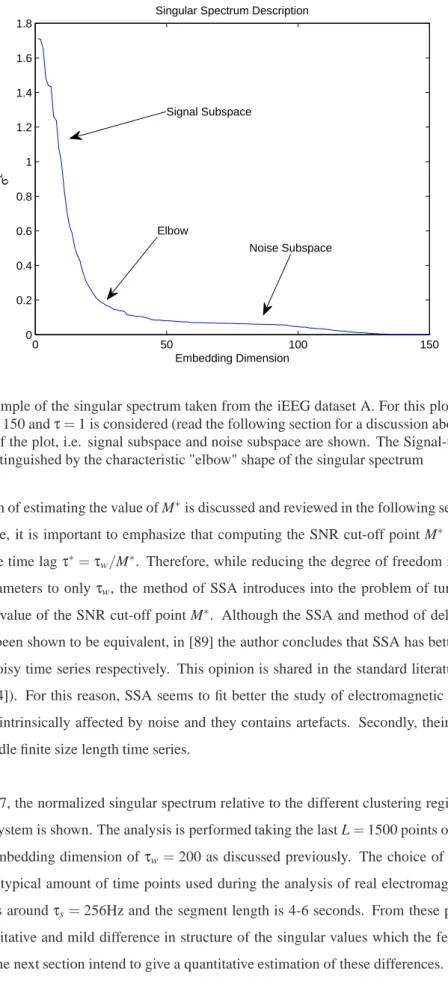
3.6 Example of the singular spectrum taken from the iEEG dataset A. . . 58
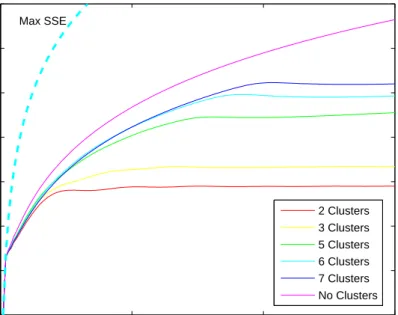
3.7 Plots of the singular spectrum for different clustering scenarios of the Rössler system. . . . 59
3.8 Plots showing the value of the cut-off M∗as a function of the window lengthτwfor different clustering regimes and for different value of the parameterλ . . . 63
3.9 Plots of the singular spectrum for different clustering scenarios superimposed with the cut-off values as function of the parameterλ . . . 64
3.10 Plots of the Ceand Cf with varying embedding dimension and for different clustering regimes 68 3.11 The Ceand M∗indexes forτw=150 as a function of the variance of a Gaussian additive noise sourceξsuperimposed to O(t) . . . 69
3.12 The spectral entropy index in combination with the MDL algorithm as a function of the Gaussian noise sourceξforτw=150 . . . 71
3.13 Plots showing the performance of CeMwith a source of additive AR(1) coloured noise . . . 72
4.1 The Radial basis function network model which is an extension of the Lorentz’s method of Analogues. . . 79
4.2 The mutual predictor model used in this thesis. . . 81
4.3 Graphical comparison between two other possible approaches considered in this thesis. . . 83
4.4 The circular block boostrapping method to produce the surrogate data. . . 84
4.5 Diagram of the structure of the synthetic models as discussed in the following sections. . . 88
4.6 Hénon map synchronisation patterns x vs y for identical systems, i.e. B=0.3. . . 89
4.7 An example of a realisation of 500 points of the variable y of the identical Hénon WCDS . 90 4.8 Tuning of the embedding dimension using cross-validation based on the prediction errors of exand ey. . . 91
4.9 Example of tuning the number of nearest neighboursς . . . 91
4.10 Example of tuning the number of radial basis functions . . . 92
4.11 Estimation of the Analogues-RBF Granger metric for the WCDS Hénon system. . . 94
4.12 Analogues-RBF Granger causality for the case of a WCDS Lorenz systems. . . 96
4.13 Tuning of the neighbours for the linear AR model. . . 97
4.14 Estimation of the Analogues-RBF Granger metric for the stochastic AR models . . . 98
5.1 Distribution of the single channel synchronisation index for different eyes conditions and for all the MEG sensors . . . 102
5.2 Median values and the 25th and 75th percentiles (errorbars) of CeM of the distributions in Figure 5.1 for different eyes conditions . . . 103
5.3 Mean value of the distributions of CeMin different regions of the MEG sensor space . . . . 105
5.4 Distributions of CeMin the case of the frontal and occipital lobes . . . 106
5.5 The median of the complexity of the global CeM as a function of the window lengthτw . . 106
5.6 Plot of singular spectrum entropy for the dataset A . . . 108
5.7 This figure shows a snapshot of CeMcomputed in some channels of the iEEG grid . . . 110
5.8 Average across channels of the indices CeMin the left and the signal power in the right . . 110
5.9 Normalized plot of the CeMusing a Z-score statistic with selected snapshots of the grid at different times . . . 111
5.10 Plot of the normalized power similar to Figure 5.9 . . . 112
5.11 Plot of singular spectrum entropy for the dataset B . . . 113
5.12 The right plot shows the graphical set up of a simulation of a synthetic time series produced by a Rössler lattice having two regimes of synchronisation . . . 114
5.13 Average of the complexity index around each of the 33 seizures of the dataset . . . 116
5.14 Average of the power around each of the 33 seizures of the dataset . . . 116
5.15 Grid of the dataset B during selected time instants from Figure 5.13 . . . 117
5.16 Grid of the dataset B during selected time instants from Figure 5.14 . . . 118
6.1 Conceptual structure of the data analysis protocol presented in this thesis . . . 121
6.2 Analysis of synchronisation for the iEEG dataset A. . . 124
6.3 Causality directions in the iEEG A grid . . . 126
6.5 Average of the MPC index µMPCfor two different parts of the grid . . . 129 6.6 Causality directions in the iEEG A grid . . . 130 6.7 Analysis of the photic epileptic dataset . . . 132 6.8 Plots that shows the analysis of MEG datasets for the eyes closed condition using the MPC
index. . . 134 6.9 Plots showing the performance of the PLI in the MEG dataset . . . 136
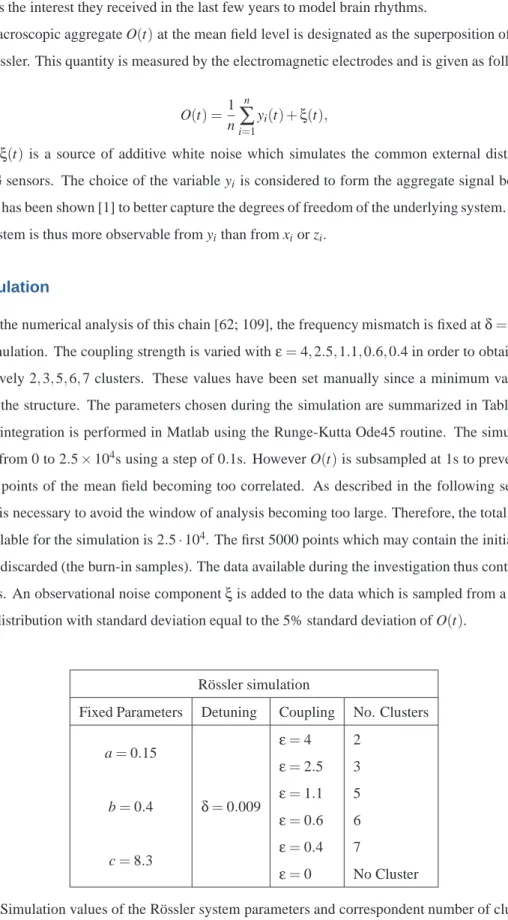
3.1 Simulation values of the Rössler system parameters and correspondent number of cluster found in the lattice . . . 50 5.1 Summary of some statistics relative to the distribution of the complexity measures . . . 102 5.2 Comparison of the median for the distribution of complexity measures in each group of
patients in the case of the selected areas . . . 104
———————————————————-At the end of this journey, this thesis could not have been written without the help of many people. I foremost would like to thank my supervisors Prof. David Lowe and Dr. Avgis Hadjipapas for the inspiration and the guidance I received pursuing this project. I am grateful to Prof. Lowe for the theoretical discussions we had, the extraordinary help and the useful directions he gave me to complete this work. His teaching are going beyond this thesis. I am really grateful to have worked with Dr. Hadjipapas. I have met really few people in my life with his dedication, his passion and his incredible "optimism" for the neuroscience research. His support was essential for me to understand this mystique field, helping me many times not to be discouraged by its quite often complications.
I would like to thanks all the member of the NCRG group for the academic assistance I received through seminars and caffeine break discussions. A particular thanks to Vicky for the administrative and logistic help she provided and Alex for solving most of my hardware and all the "penguin" problems. I would like to thank all the people I met at the Aston Vision Science. In particular, Arjan, Gareth, Ian, Stefano for the human and technical support for the analysis of the brain.
I have met many many friends and colleagues during this long journey. Their psychological and concrete support was essential to complete this work. The list is too long to mention all. Thanks to the guys of the "Lowe team": Thomas, Raji, Michel, Ming. Thanks to Mike, George, Manos and all the greeks for improving my geographical, historical and vocabulary skills. Thanks to Jan and Jim to show me that to hit a simple ball I need to stay calm. Thanks to Jack and Chris for technical, non-technical and nonsense discussion. Thanks for all the guys from the PG rota for the nice nights I spent looking at the stars (mostly the cloud), Paul, Robin, Ahmed, Joobee, Elaine... Thanks the Italian community in Birmingham, Luigi, Camillo, Daniela, Tiziana and Maria Teresa for making feel at home, feeding me with good food and helping me with the data analysis.
A special thank to Dr. Stephanie Feiereisen for the love and the support she gave me during all this time. More, thanks to the infinite patience she had in the darkest part of this experience. I had great time with you, Dr. Steffy.
I would like to thank my parents and my sister for the help I received in the many good and especially in the many bad periods. While being "a vagabondo" I have never lack of anything anywhere in the world this journey was taking me.
At last, I need to acknowledge and dedicate this piece of work to my grandparents. Through their simplicity they showed me many important virtues which include hard work, dedication and commitment. This thesis was not possible without their life teachings.
1
Introduction
This thesis addresses the general problem of extracting spatio-temporal information of interdependence
within an underlying system from a set of its observations. This estimation task has become an important
part of the general field of multivariate data analysis whose applications are widespread in many mod-ern social, engineering and scientific fields. While the methods developed in this work can be generally used in many of the previous fields, this thesis focuses, in particular, to questions posed in neuroimaging:
the underlying system is the human brain in which neural activity is measured with the help of the latest electromagnetic (EM) imaging techniques [7; 106; 64]: electroencephalography (EEG) and magnetoen-cephalography (MEG).
In the neuroimaging field, the most recent imaging technologies are able to sample the underlying brain substrate with greater spatio-temporal precision and accuracy [7]. This higher level of detail, unscrambled by these new measurement approaches, have offered a new view of some of the underlying structures of the brain: complexity and its properties such as self-organisation, adaptation and emergent phenomena [19; 22; 84; 29]. At this level of description, in fact, the complex nature of the brain has been shown to be due to the mutual interaction of many weakly coupled neural subsystems which are linked together into a complicated hierarchical structure. Analysis of connectivity, interdependence and interrelationship between and within complex systems such as the brain is thus fundamental to understand its internal mechanism of functioning [114].
As emphasized in this thesis, two fundamental types of interdependence, connectivity patterns or emer-gent phenomena, which occur among inner elements of the complex brain system, are important to study:
Causality and Synchronisation relationships. The former is related to a phenomenon of information transfer
between different part of the brain (drive-response relationships). The latter, instead, describes the system’s ability to correlate their internal mechanisms on time and it is believed to be the main form of neural coding of brain information [44; 45; 46; 59].
1.0.1
Content of the thesis
Motivated by the previous general considerations, the following main topics are specifically considered in this thesis:
Feature extraction of functional connectivity. The investigation of brain connectivity in this thesis, i.e. synchronisation and causality phenomena, is based only on the time series provided by EM tech-niques. We call this situation a model-free scenario which emphasizes that one does not have any other structural information about the brain apart from the observable data. This lack of knowledge of the underlying brain model dynamics is a typical case in neuroimaging since a detailed model is too complex. Only dynamics at the microscopic level are in fact understood while the general be-haviour of the brain at the global level is yet to be discovered. In practice, the processing of EM signals belongs in this project to an exploratory type of analysis.
Following the the recent framework of dynamical systems in complex networks [136; 5; 147] as reported in this introduction, this thesis specifically discusses and implements exploratory analysis techniques of functional brain connectivity. Functional connectivity refers to the generic concept of estimating the inner synchronisation and causality brain phenomena, which is instead called effective connectivity, from the set of EM data [43; 92]. In practice, functional connectivity is the
interde-pendence between the EM observable time series while effective connectivity is the more important relationships between the neural sources.
The following functional connectivity problems are particularly discussed in this work:
• A novel method to assess synchronisation at the local level in the neural complex network using a single channel EM recording is analysed in Chapter 3: Entropy-MDL complexity index.
• A novel measure of causality between two distinct points of the brain using a Radial Basis Func-tion (RBF) network [96; 10] is implemented in Chapter 4: Analogues-RBF Granger causality
metric.
• Two existing measures of bivariate synchronisation are considered: the Mean Phase Coherence (MPC) [116] index and the Phase Lag Index (PLI) [135], as formalized in the Appendix A. They are employed in this thesis to provide a measure of synchronisation in the data analysis and to bring about experimentally an important issue in functional connectivity: the problem of volume conduction [106; 108; 107; 135] in Chapter 2.
These three previous aspects belong to a general framework of interdependence analysis, which are important for the estimation of different features of the underlying neural network connectivity: local interactions, medium to short range interactions, directional interactions.
Examples of data analysis. Some specific neurophysiological datasets are presented to show possible ap-plications where these feature extraction methods can be applied and their strength. The specific data used in this thesis are
• MEG data relative to Parkinson disease. The data consists of labelled EM time series coming
from three types of population: Control, Parkinson’s and Parkinson’s Dementia subjects which are recorded during the resting state [14]. This pathology has been recently linked to the degen-eration of the anatomical effective connectivity of the brain for affected patients with respect to normal healthy subjects [14; 134]. For this reason, the dataset is considered as a good example for the material of this thesis. The purpose of the analysis of this dataset is twofold: firstly, it helps to provide a tool which is able to find differences in the pattern of functional
connectiv-ity between the population of patients and understand its clinical significance. This tool can
be useful for the automatic procedure of screening as well as understanding the deficiencies of the disease. Secondly, this dataset is useful to bring about the problem of volume conduction which affects the computation of functional connectivity for the case of scalp electromagnetic techniques such as MEG.
• EEG examples of epileptic activity. During epilepsy there is a transition from a pathological
but idle state to a massive synchronisation of the brain, either regional or global [73]. The methods in this thesis can help to study this phenomenon: when and where an epileptic seizure starts and how it spreads, i.e. causality, and synchronized over the time. In practice, the main
aim is to study the spatiotemporal occurrence of a seizure. Estimation of the state of the
func-tional connectivity with these methods, if relevant, provides useful information for further sig-nal processing stages such as seizure detection, localisation and prediction. Two intracranial EEG recordings have been extendedly used during the analysis of the methods proposed by the framework of analysis in this thesis. An extra small scalp EEG datasets was employed during the initial stages of this work.
It is not in the main goal of this project to provide new knowledge and novel insights in order to solve these disorders. These datasets have been employed to test and to discuss the methodological part of the thesis. Therefore, they can be considered as pilot studies for future more complete investigations.
Following the previous topic description, this thesis is conceptually divided in three parts: Chapter 1 and Chapter 2 present the introduction and background on the materials, methods and modelling strategies of the brain. Chapter 3 and Chapter 4 discuss in more details novel methods of electromag-netic interdependence signal processing. Chapter 5 and Chapter 6 carry out the specific analysis of a the pathological datasets. The descriptions of these datasets are presented in Chapter 2. In Chap-ter 3 and ChapChap-ter 4, during the theoretical part of the thesis synthetic datasets constructed to explore nonlinear dynamics in complex networks are used to support the validity of the methods developed.
1.1
Modelling Framework: Dynamical systems in complex networks
Neuroscience is a field interested in the study of the brain nervous system and its direct role to important human functions such as cognition, emotions, intelligence. The brain is one the most cited and exciting examples of complex systems since it is the central processing unit of the human organism. Its functioning is probably one of the greatest unsolved problems which has concerned generations of thinkers in many scientific fields. The challenges of the understanding of the brain is encoded in the following foremost question which the modern field of neuroscience is attempting to answer [61; 122]:
Problem 1. Binding Problem: How the unity of conscious perception is brought about by the distributed
activities of the central nervous system
In other terms, how the dynamics of single elements of the complex neural network integrates their behaviour with each other to bring about decision, action, perception or similar higher cognitive concepts. The latter capacities are seriously compromised in neurological disorders such as Epilepsy and Parkinson’s. Therefore, the other side of the binding problem is: how and why does the failure of neural integration
produce these pathologies?
1.1.1
Brain state space model
The solution of the binding problem has been addressed in the last three decades using the developments of the theory of dynamical systems applied to the brain [22]. Following this part of the literature, the most general neuroscience problem studied in this work can be stated mathematically as follows: an unknown un-derlying system, i.e. the whole human brain or part of it, is observed using a measurement approach which samples regularly its internal state and generates a set of electromagnetic data. The following generic State
Space representation is used in this thesis to model the brain-EM system
X
X
dX(t) dt = f(X(t),θX,u(t)) +ξ, x(t) = h(X(t)) +η, (1.1)where x(t)∈Rmis a continuous vector variable which represents the observations at the m electromag-netic sensors level and X(t)∈Rnis the state of the latent n neural sources level at time t. x is also referred as the sensor space while X the source space. Each of the n components of X(t)represents some defined physiological quantities of the neocortex, i.e. the part of the brain where these neural sources are situated. For instance, X(t)can be associated with the biochemical state of each neuron and the magnitude of n is of the order of 1011[22]. In practice, as discussed in Chapter 2, X(t)can be better defined as the descriptor of an ensemble of neurons called a Macrocolumn [105; 18]. The latter are considered as the fundamental computational units of the brain with numbers n that may vary between 104to 3×10³[105].
The termsξandηare generic random variables which are usually included in the state space repre-sentation to model internal sources of randomness and external disturbances, respectively. They can be
generally considered as identically distributed, additive, zero mean Gaussian random variables which thus can be decoupled from f(·)and h(·).
The function f(·):Rn→Rnis the vector field or flow of the differential equation in Eq. 1.1. f(·)which is unknown with current knowledge, is a generic function which models the physiological behaviour and histological connectivity of the brain system [18].θXis the set of control parameters which are constant (or
slowly changing compared to the time scale of the observations) and in general may define the topology and the biochemical properties of the brain as explained later in this thesis. u(t)is an optional argument which represents a set of external input functions. In practice, the brain is an open system and u(t)is designed to model the external somatosensory stimuli provided by the receptive fields neurons. This term is dropped during the development of this thesis since we are directly studying stimuli-related experiments.
The function h(·):Rn→Rm models the technical characteristic of the electromagnetic techniques which are expected to measure some of the inner features of the underlying brain. While the single neuron cannot yet be observed in vivo using these technologies, specific brain modules, aggregates of populations of neurons may be accessible. The recent improvement of these techniques such as EEG, MEG but also functional imaging such as fMRI [42], have in fact opened the analysis of the human brain to an increasing level of accuracy both in the spatial and in the temporal domain. Nevertheless, the function h(·)still mixes the true latent X which makes x only a macro aggregate signal. The current inability to know exactly the underlying structure of the brain and the impossibility to measure perfectly each of its single factors drives the analysis into an ill-posed inverse problem. A unique solution cannot be found that relates x to X. The description of h(·)is left for further explanation in Chapter 2 where the EM techniques used in this thesis are reviewed.
The EM data available for analysis x(t)can be considered in the format of a finite vector valued mul-tivariate time series{xi}Li=1={x1,x2,x3,···xL}. The latter is sampled from x(t)at discrete intervalsτs between t0=0 and tL=Lτs. In this perspective, in order to facilitate the discussion of Eq 1.1, the discreti-sation of the signals may also apply to the vector field f(·). In this case, f(·):Rn→Rnis known as a Map which updates at discrete intervalsτsthe state of the brain{Xi}Li=1.
1.1.2
Modelling brain dynamics
What is the nature of the function f(·)? The brain is a composite organ since it is a conglomeration of
mil-lions of neurons functioning in unison as better described in Section 2.1. It is established that single neurons do not act independently to each other but instead they are connected into populations with a hierarchical and modular scale of coupling [18]. Anatomical studies in neurophysiology have in fact shown different levels of this structure: at the microscopic level localized modules made by dense aggregations of neurons are responsible for the processing of specific basic features [132] such as sensorimotor stimuli. At a meso-scopic level, other more specialized and specific modules (for instance the macrocolumns) composed by the cooperation of the previous subsystems have been observed to exchange information by using a sparser form of connectivity. At the macro and global level, further higher structures account for the regulation of cognitive activities and finally, human consciousness [61].
This brain hierarchical structure gives a few important indications in order to understand the brain and directions to model its description function f(·). In particular, the latter micro-meso-macro description levels are both reason and cause of the nonlinearity, complexity and the principle of segregation and integration of the brain as emphasized in the specialized literature [131]: localized brain modules, at some points of the hierarchical scale, coordinate their internal functioning, enabling the formation of a global self-organized pattern but without allowing their own dynamics to be compromised. In other words, these modules can continue to be responsible for more specialized tasks (segregation), while still be part of the functioning of the whole brain process (integration): brain modules are quasi-independent elements which are weakly coupled with each other.
These findings and theories have led the research community in the last three decades to exploit new methods and areas from the fields of nonlinear analysis in order to offer better modelling tools as well as to allow the study of its EM signals. Two approaches, in particular, need to be mentioned here as subjects of investigation in this thesis: Nonlinear dynamics and deterministic chaos and the recent theory of dynamical
systems in complex networks [3; 5; 136].
The first area of research is based on the geometrical framework of dynamical systems where the brain (or a specific part under investigation), is simplified by a reductionist approach which uses a mean field or lumped models to simulate the dynamics of a large populations of neural elements [98]. These models are deterministic, nonlinear, dissipative and interesting concepts such as attractors, bifurcation phenomena and chaos have been used to study brain signals employed since the middle of the 1980’s [135].
The concept of an attractor, important using this deterministic framework, is often reported during the development of the thesis: whenξ=0 (determinism), the state X(t)is considered as a multidimensional point belonging to the phase space X. If f(·)is Lipschitz continuous a unique solutionϕ(t)to the initial value problem can be found. The curveϕ(t)defines a trajectory in the state space which starts from an initial condition point X(t=0),X0to the attractor of the differential equation. The latter is defined as the
set A of state space points invariant under f(·), i.e. f(A)⊆A, such that there is a basin of attraction B(A)
B(A) ={X|ω(X0)⊆A}, (1.2)
withω(X0)theω-limit sets of f(·)defined as
ω(X0) = \ T>0 cl [ t>T ft(X0) ! . (1.3)
where ft(·)is the evolution operator of f(·)after time t, T>0 is a generic large time instant and cl(·)is the operation of closure of a set.
In practice, at each hierarchical scale of the brain neural network, the integration of quasi-independent modules reduces the degree of freedom of the global brain aggregate f(·): the state space trajectory of f(·)is
unlikely to span the full space, i.e.Rn, but settle down to a lower dimensional subspace due to the effective degree of freedom of the system, i.e. the attractor. Depending on which part of the brain hierarchy is under study, different types of models f(·)and consequently attractors with distinct topological properties can be obtained: for instance fixed point attractors, limit cycles or strange attractors. Fixed point attractors are the simplest invariant limit sets and are typically found in linear and stable systems. This is probably not the case in the brain which is considered having a nonlinear behaviour. At the microscopic level, for instance, the behaviour of single neurons may be formulated using Hodgkin-Huxley, Morris-Lecar, Hindmarsh-Rose or other realistic neuronal models [74] which in general lead to limit cycle type of attractors. At an higher hierarchical scale, the coupling of populations of these nonlinear simpler models may result in more com-plicated topological structures such as strange attractors, which are limit sets that can be found in the basin of attraction of chaotic dynamical systems. Simulation studies and experimental findings have shown, the occurrence of these sets at the level of small populations of neurons [36; 86]. More importantly, these results have boosted the interest and excitement in the 1990’s for using chaos and dynamical systems theoretical tools to study brain dynamics also at the global hierarchical level.
However, no conclusive evidence of chaos has been found at the medium-large brain level during the last decade and, recently, several early discoveries have been criticized and re-evaluated [134]: Surrogate testing has shown that misinterpretation of methods from chaos theory can occur if the system behind the data is not chaotic [82]; Lower deterministic chaos is likely to occur in particular situations such as during epileptic seizures but not during normal brain functioning [98]; higher chaotic phenomena such as intermittency and itinerancy [82], that can occur during normal brain rhythms, are not yet well understood and are difficult to be discerned from randomness.
For these reasons, the focus of recent literature has shifted from the study of lumped deterministic chaotic systems to the more realistic study of nonlinear interactions. From a mathematical perspective, this new area of nonlinear time series analysis research is based on the theory of complex dynamical networks and it offers a new modelling framework to study f(·)and the mechanisms in the brain.
Within this framework, the modelling of the brain is decomposed into aggregates of quasi-independent and communicating dynamical systems which better describe its complex hierarchical structure: Weakly
Coupled Dynamical Systems (WCDS) [116]. These new tools may embody aggregate nonlinear and chaotic
lumped models and they allow the study of nonstationary, stochastic and high dimensional phenomena which are more likely to be found in the brain. Importantly for this thesis, the understanding of the brain system and its data analysis is performed through the estimation of its internal connectivities. As discussed in the following sections, the notion of connectivity can be associated with different aspects of a complex dynamical system network and thus to the brain organisation [71]: Anatomical, Effective and Functional
Connectivity [43] respectively, are terms which have been discussed in the neuroscience literature in order
to discern this particular dichotomy [92; 37]. The former two types of connectivities are intrinsic properties of the underlying complex dynamical system while the latter instead, is a data-dependent concept.
The thesis main contribution is to discuss some methods and problems of functional connectivity anal-ysis whose results can be use to understand the underlying effective or anatomical connectivities.
1.1.3
Connectivity in complex networks
Anatomical ConnectivityAnatomical connectivity is given by the structural physical links which form the concrete pathways and the topology for exchanging information between elements of the system [132]. It denotes what materials and pieces the system
X
is built from and how they are assembled.In mathematical terms [5], anatomical connectivity can be abstractly represented by a graph
G
(V,E)where V is a collection of vertices or nodes and E is a set of edges. From a neurophysiological perspective, E represents brain fibres such as axons or synapse which are the medium which joins the nodes. V refers to elements of the brain such as single neurons or clusters or populations of neurons depending on which hierarchical scale of the brain one wishes to consider as better explained in Section 2.1.
The graph
G
can be also expressed in matrix form by an adjacency matrix A which has entries ai j=1 if a direct link exists from j to i and 0 otherwise. If ai j∈R, i.e. the values ai jcan assume any real values, thenG
is known as a weighted graph. The latter type of graph, for instance can contain further information about the underlying topology, i.e. distances between nodes.Anatomical connectivity is not the direct subject of the investigation in this thesis. Its estimation usually requires data and procedures which are not considered in this work. For instance, Diffusion Tensor Imaging (DTI) [9] is a recent magnetic resonance method that can display the internal physical interconnection between neurons by tracking the diffusion of water in the brain fibrous structure. While not available in this thesis, knowing the brain anatomical connectivity is important because its topological information may give plausible constraints on the dynamical (and globally unknown) part of the model in Eq. 1.1 [92].
Effective Connectivity
Effective connectivity is defined as the influence that one neural system exerts over another either at a synaptic or a population level [43]. In practice, it describes how the internal model of the system commu-nicates, functions and exchanges information instead of how it is hard wired by the system’s anatomical connectivity.
From a mathematical point of view, the notion of effective connectivity is better associated with the decomposition of f(·)in Eq. 1.1 over the complex anatomical structure of
G
. This decomposition links f(·)to the family of weakly coupled dynamical systems. In this thesis we consider the following formalism
dX(j)(t) dt =fj X(j)(t),θfj +Ci j
∑
i6=j fij X(i)(t),X(j)(t),θfij +ξ. (1.4)where we consider a partition of the state X= (X1,X2, . . . ,Xn)T given by
P= (X(1),X(2), . . . ,X(M))T, (1.5) with
X(j)= (Xj1,Xj2, . . . ,Xjk j)
and J=
j1,j2, . . . ,jkj
is called the partitioning vector of P, such that the condition∑Mi kj=n,M≤n is satisfied.
In practice, the partition function P associates each subsystem X(j) to each node j of the anatomical graph
G
. The functions fj(·)are the dynamical descriptions of each of the nodes, i.e. the models of the brain modules at some points of its hierarchical structure. The fi j(·)are the functions which establish the coupling between brain modules. This coupling is further regulated by the parameters Ci jwhich in the case of Eq. 1.4 is an entry of the coupling matrix C. Ci jcan be considered a function of the previous adjacency matrix, i.e. Ci j=αi jai jfor some weighting termsαi j. The coupling Ci jis thus dependent on the existence of the correspondent edge ai jin the topology ofG
.Eq. 1.4 is a special case of the family of WCDS but can be further generalized for nonlinear and time dependent coupling and for discrete spatiotemporal systems. The latter are known in the literature as
Cou-pled Map Lattices (CML) [80].
WCDS are important tools for modelling and analysing the brain since they are the contact point be-tween structural (anatomical) and dynamical (effective) properties of the underlying neural system. In Chapters 3 and 4 we are interested to simulate medium-large brain dynamics as seen from EM measure-ments. Some WCDS models are thus considered in order to check the validity of the methods developed. Although, no medium-large brain model is currently available and these synthetic examples are only an oversimplification of the underlying complex dynamics, they still offer several advantages to simulate some characteristics of a simple brain behaviour as explained in Chapters 3 and 4. More importantly, as described next, within the framework of WCDS it is possible to address formally the definition of synchronisation and causality as the emergence relationships between elements of the network.
1.1.4
Emergent network phenomena
Synchronisation
Synchronisation is a complex dynamical relationship of effective connectivity. In the colloquial English, synchronisation means correlated in time behaviour between different processes [21], to occur at the same time or happen at the same time [69]. In practice, a more precise mathematical definition depends on the nature of this relationship and what is actually measured. In fact, while generally related for historical rea-sons to the interdependence of phases between harmonic oscillators, in the last decades new different types of synchronisation have been formalized [12]: identical synchronisation, lag synchronisation, generalized synchronisation, chaos synchronisation. The inclusion of a larger ontology of methods have blurred a pre-cise concept of synchronisation and have proven to be an obstacle to a unified and prepre-cise definition.
From a complex network perspective, synchronisation is defined as a complex dynamical process that results in an adjustment of rhythms of oscillating objects due to their weak interactions [116]. Given the previous decomposition in Eq. 1.4, synchronisation is a relationship of time correlation between the subsystems X(1)due to the weak coupling C. More specifically, following the the unified synchronisation scheme in [21] we have that
Definition 1. Given a WCDS
Z
as in Eq. 1.4 which is decomposed in two subsystemsX
andY
we sayX
andY
are synchronized on the trajectoryϕ(t)of the globalZ
with initial condition Z0= [X0,Y0], withrespect to the properties gX and gY, if there is a time independent mappingΘ(·)such as
Θ gX,gY
=0, (1.7)
where gX and gY are defined as properties of the system,Θ(·)is a generic function employed to com-pare the two properties andk·kis any norm function. In the previous definition, we have considered two subsystems
X
andY
of the global WCDS replacing the previous notation in Eq. 1.4, i.e. X(i)and X(j). BothΘ(·)and gX and gY define the particular type of synchronisation. For instance, gX may be a property of phase, frequency of oscillations, amplitudes, state of the system. We refer to [21; 12] for a more complete technical account of this unification scheme, a few examples of synchronisation and further details. Most importantly for the purpose of this thesis, Eq. 1.7 defines a distance metric between two elements of the WCDS. This concept of distance is later similarly re-proposed at the sensor level when we discuss func-tional connectivity using as the phase of the signals as a suitable property gX and gY.
Moreover, from a classical dynamical system perspective, instead, synchronisation can be also related to the concept of a Synchronisation Manifold [116; 12; 18]. This geometrical entity can be defined as the points in the phase space where Eq. 1.7 is satisfied. In practice, when some of the inner variables of the system
X
become synchronized , the system loses some of its degrees of freedom and the trajectoryϕ(t)lies in a sub-manifold of the whole phase space: the synchronisation manifold is thus a special type of at-tractor as described in Section 1.1.2. In the nonlinear dynamics field the basin of attraction and the stability of the synchronisation manifold is a topic of active research. In this thesis, as discussed in the next section, this estimation of the dimension of this manifold is the major ingredient for the theoretical development in Chapter 3.
Causality
Defining, estimating and reasoning with the concept of causality has proven to be a formidable problem which has brought about several centuries of debate from a philosophical and more recently scientific and statistical perspective. For space reasons and not to be engaged in any of these lengthy debates, we refer to [112] for a comprehensive scientifc account to the topic. Citing Clive Granger in [57]: Causality is a
concept whose definition people know what they do not like but few know what they do like. This statement
from an expert in the field emphasizes the vagueness of the concept and thus the difficulty in dealing with it.
From an effective connectivity point of view and thus rigourously, following the same reasoning of [40] and taking advantage of the dynamical system model in Eq. 1.1, causality can be better defined as a problem of inverse system identification: Taking the first order linear approximation of f(·)and let the state point X0∈Rnand f(·)be differentiable at X0we have
f(X) =f(X0) +JX0(X−X0) +o(|X−X0|
2), (1.8)
where the matrix JX0 is the Jacobian of the vector field f(·)at X0which is given by JX0= ∂ fi ∂Xj X0 . (1.9)
The differential elements in JX0, i.e. νi j=
∂fi
∂Xj, represent the causal links or the effective causal con-straint between Xiand Xjat X0. In practice, the coefficientνi jis responsible for the variation of the effect on Xi, i.e. dXidt(t), given the cause Xj. In the same manner, using the paradigm of WCDS in Eq. 1.4, it is
easy to see after a derivation thatνi j=Ci j. Therefore, estimating causality in a complex linear network is equivalent to estimate the coupling matrix C and in the more general case the entries of the Jacobian J along the trajectory of the underlying dynamical system.
In a model free scenario, the system of differential equations f(·)is not known a priori and from the data{xi}Li=1alone the value of Ci jand Ji jcannot uniquely be retrieved. In this thesis, therefore, a different perspective is considered in order to estimate information flow in the brain from a functional connectivity point of view: Granger causality. This approach, we can argue, is a weaker form of causality, nevertheless it allows algorithmic implementation and thus computability.
1.2
Methods: functional connectivity
Functional connectivity is defined as temporal correlation between measurable spatially remote neurophys-iological events which deviates from statistical independence [43; 132]. In other words, functional connec-tivity is specified as a generic pattern of interdependence that can be extracted from the time series{xi}Li=1.
It has a major role in the recent neuroscience literature, as emphasized in [62], where the fundamental problem faced by modern non-invasive techniques such as EEG/MEG can be stated as
Problem 2. [Observational problem] Can we observe collective neuronal activities from macroscopic
ag-gregate signals?
Collective activities stand for patterns of effective connectivity emerging between neural elements which regulates the functioning of the brain. What can neuroimaging techniques tell us about the brain distributed circuitry? [47]
As a mathematical problem, given an underlying complex dynamical network, can we observe the
in-trinsic dynamical mechanisms of this network from its observable{xi}Li=1? Being the latter, the only source
of information available in a model-free scenario, functional connectivity is thus the only computable form of interdependence and is the main aim of this thesis: novel machine learning and signal processing tech-niques are tested in the following chapters against synthetic and real datasets in order to discuss Problem 2. What do the time series{xi}Li=1tell us about the emergent phenomena of the underlying complex dynamical
1.2.1
Assessing local synchronisation using univariate statistics
Univariate statistics have been successfully applied for several years to analyse neurophysiological data. Strictly speaking, these methods cannot be considered as a tool of functional connectivity analysis since they are based on single time series. However, in this thesis we consider a single channel statistic because of the following reasons:
• It estimates a local measure of synchronisation, i.e. above the area which is produced by the single electromagnetic time series{xi}Li=1.
• Multivariate functional measures produce complex patterns of interdependence which explode com-binatorically with the number of time series. A single sensor measure is simple and its outcome is easy to visualize .
We study this statistic in Chapter 3, based on an information criterion which looks at the dimension, at the shape and at the complexity of the local synchronisation manifold. As described previously, when the underlying system is synchronized, it reduces its degree of freedom and the trajectory in state space lies in a lower dimensional manifold than in the case of no synchronized state. We do not have direct information about this manifold since it is latent. However firstly, due to theoretical results in dynamical systems theory, it is possible to reconstruct an equivalent version ˆX of the synchronisation manifold. Secondly, it is possible to extract from ˆX an estimate of dimension, shape and complexity of the original manifold. These quantities are invariants of X and ˆX.
Therefore, we consider an information theoretic method which uses this insight in order to assess syn-chronisation from a single time series: Spectral Singular Entropy. This method was previously discussed in [146; 97; 49]. In this thesis this method is further improved, discussed from a point of view of complex network as in [62] and subsequentally applied to the pathological electromagnetic datasets.
1.2.2
Multivariate statistics
In geometrical terms, we can consider each of the observable time series x={xi}Li=1as a point in a
mul-tidimensional m data space. Functional connectivity is explored by computing the statistical relationship between these points defining a distance metric d(x,y), with y={yi}Li=1a second signal from a different
electrode, which needs to be estimated from the data.
Functional Synchronisation
Synchronisation in functional terms is a possible metric dS(·,·)in the space of the observable time series which can be generally designed following the definition in Eq. 1.7. In this equation, however, we need to take into account two important points:
• gX is the underlying property being measured which needs to be substituted in Eq. 1.7 by g(x), the property measured at the sensor level [21], which may include the contribution of noise.
• the presence of the random termsξandηsuggests that Eq. 1.7 needs to be formulated in a proba-bilistic fashion.
An important question comes naturally at this point: What property of g needs to be employed to extract the synchronisation metric of functional connectivity from the EM signals? There is no unique answer for this question. Several comparison studies in synthetic (chaotic models) and physiological datasets in the recent literature have taken into account different metrics [87; 121] showing similar results. These metrics include for instance, linear correlation, coherence in frequency domain, mutual information, phase syn-chronisation, state space synsyn-chronisation, event synchronisation ( [114] for a comprehensive review). The main message is that a pragmatic choice should be taken according to the quality and the type of data and different metrics need to be employed [87]: for a complete exploratory study over a particular datasets, many methods should be employed and compared [22].
It is not this thesis’ purpose to further compare different methods and perform a complete exploratory analysis of the epilepsy and the Parkinson’s datasets available. Instead, the contribution of this thesis to debate is to consider two typologies of synchronisation measures based on phase relationships: the Mean Phase Coherence (MPC) [116; 87; 114] and the Phase Lag Index (PLI) [136].
The MPC index is one of the typical techniques in order to extract synchronisation in real data and it is specifically described in Appendix A. This index is computed using the Hilbert transform which is one of the possible approaches which retrieves phase information from broadband signals. Phase interdependence has been intensely used with success to study synchronisation in oscillatory systems such as the brain. The MPC is thus used alongside the univariate measure of synchronisation and the causality algorithm to support the extraction of features of functional connectivity in the epilepsy data in Chapter 6.
The PLI has been recently defined in order to cope with the problem of the EM observation function h(·)
in scalp EEG/MEG, and specifically volume conduction and active reference electrodes which are known as well as the problem of common sources [135]. The observation function, in fact, h(·)mixes the true sources of brain activity and typically produces highly correlated EM signals as better explained in Chapter 2. For this reason spurious synchronisation between sensors may appear when phase relationships are computed using the standard MPC index invalidating the analysis. This is a typical problem with scalp EEG and MEG techniques where the EM sensors are not placed close to the brain cortex. The PLI developed to cope with this problem is specifically discussed in Chapter 6.
Functional Causality
As described previously, in mathematical terms, the estimation of causality is a problem of inverse system identification. This estimation process requires strong prior information about the structure of the underly-ing system we do not have: in a model-free scenario, the observable time series{xi}Li=1are typically the
only sources of knowledge. In this model-free scenario, the literature suggests that hints of causal rela-tionships need to resort to the principle of temporal precedence [92]: if activity in area A occurs prior to
activity in area B, then activity in A "might" cause activity in B. "Might" is emphasized since the condition
is necessary but not sufficient for causality (spurious causality [112]).
a causal relationship it is necessary to look at their temporal coupled asymmetries. Therefore, a possible solution is to employ an asymmetric distance measure, i.e. d(x,y)6=d(y,x)which can explore the asym-metry in time as well. In this respect, different asymmetric distance metrics such as mutual information, state space synchronisation, synchronisation likelihood have been designed in the literature. However, as shown in [120], asymmetry in the metric can be due to differences in the degree of freedom of the systems underlying the time series rather than a genuine relationship of causality. A similar argument is taken in [128] as a criticism to mutual information as a measure of causality.
A different approach, suggested by Granger [56], considers a plausible definition of causality which follows the principle of temporal preference:
Definition 2. [Granger Causality] Given two observable univariate time series x={xi}Li=1and y={yi}Li=1
from un underlying WCDS
X
, if the k-step ahead predictor of x using the past observables of x and y together increases the predictability likelihood over a predictor using only x, than we can say that x and y are causally related.In practice, with this definition, causality asymmetries are tested using predictability across time. From a more general point of view, we can express the same concept in a probabilistic way:
If P(xi+k|x−i ,y−i )6=P(xi+k|x−i ) then y causes x (1.10) where x−i ={xs}is=1and yi−={ys}is=1are the time series point prior of the time i (past) xi+kis the k-step ahead predictor. Eq. 1.10 is defined in [128] as the measure of deviance from the Markov property.
In Chapter 4, we propose a novel metric of directional functional interaction which is driven by the concept of Granger causality and is implemented to estimate the metric in Eq. 1.10. A nonlinear mutual prediction algorithm in state space which has roots in the Lorentz method of analogues is considered. The latter is the simplest predictor which belongs to the family of nearest neighbour methods. A novel version of this predictor is studied here to account firstly to keep the simplicity and computational advantage of the Lorenz approach. Secondly, to implement an adaptive technique of regression in machine learning given by a radial basis function neural network (RBF) in order to design a data-driven approach to causality. The prediction error, as considered in Granger’s work, is a useful measure of dynamical interdependence which can be employed to estimate directionality of the coupling as well as its strength in neurophysiological data.
Functional Network Analysis
The previous two sections discussed the problem of measuring interactions using two conceptual distance metrics (one symmetric and the other one temporal assymetric) between elements in the space of the ob-servable data, i.e. time series,. In practice, these measures provide useful statistics in order to address the
problem of functional interdependence between two points of the brain at medium to large range connec-tivity. Local connectivity is addressed instead by looking at the single channel measure.
The outcome of computing these metric in all the sensor space is a pattern of global interaction which may be expressed in matrix form (similarity matrix) or by a graph. An important and recent body of the
complex network research applied to neuroscience is therefore involved with the analysis, the processing and the significance of this global connectivity. The latter becomes more intricate the more nodes the measurament system has and, for this reason, several statistics from graph, spectral and clustering theory have been employed to provide some summarising information about the underlying complex mechanism [136; 6].
In particular, the interest of the neuroscience community in using these statistics have been boosted by several recent studies which has related anatomical, effective and functional connectivity to Small-World types of network [8; 133]. In mathematical terms, this kind of network has the well known property of sparse connectivity, locally highly clustered areas and few long ranges connections [144]. In prac-tice, "small-worldness", firstly, fits the hierarchical structure described by the integration and segregation paradigm of the brain. Secondly, this hypothesis is supported by experimental anatomical findings, sim-ulations of synthetic biological networks and by studies of functional connectivity analysis (for a review see [136]).
The study of the global pattern of interaction is not part of the main core of this thesis: the principal subject of the discussion is centered on the problem of the metric; studying the global pattern will involve a series of more detailed discussions and mathematical tools which would enlarge the body of this thesis. Further specific links to functional network analysis will be discussed during the conclusion chapters.
1.3
Overview of the thesis
The brain is a complex and complicated brain organ formed by a network of neurons with a multiscale architecture which recent theories in computational neuroscience have considered studying with the frame-work of dynamical system in complex netframe-works. Within these theories, it is possible to describe emergent phenomena such as synchronisation and causality between neocortical elements as the processes respon-sible for the functioning of the brain. As described in Figure 1.1, these relationships are called effective connectivities while the topology of the brain network is referred to as anatomical connectivity. The main aim of this thesis is to extract these underlying quantities using novel methods of functional connectivity, i.e. the interdependence patterns of the electromagnetic signals generated from the brain complex system. The thesis is divided into the following chapters:
• Chapter 1 is providing the context for this thesis introduction.
• Chapter 2 introduces further conceptual background of recent relevant research in neuroscience. In
particular: we discuss some more details about the physiological reasons of using complex networks and WCDS in this thesis. Secondly, we consider the observation part of the state space model in Equation 1.1: electromagnetic techniques are optimal tools to measure dynamical processes in the brain as well as functional connectivity. These techniques may be affected by the problem of volume conduction which is further explained in this chapter. A possible solution to this problem is the Phase Lag Index (PLI), a novel approach of functional connectivity appeared recently in the literature.
Anatomical Connectivity
Single channel Synchronisation Fu nct ional Sy nchr onisa tion Gr ange r c ausa lit yEffective Connectivity
Functional Connectivity
Sy n chr onisa tion Cau sal ity Electrode Local Brain SubsystemFigure 1.1: Schematic representation of the analysis problems in this thesis. The underlying anatomical and effective connectivities are estimate at the electromagnetic sensor level by their functional counter-parts. This thesis consider some problems for single channel synchronisation, bivariate synchronisation and bivariate causality.
Finally, we also presents the description of the physiological datasets which are analysed to test the methods introduced in this thesis.
• Chapter 3 has the main aim of discussing how to characterize the degree of local synchronisation
underlying a single electromagnetic channel. We develop a novel method of analysis extending pre-vious solutions which are discussed in this chapter. These methods will be tested successfully against a synthetic WCDS we specifically constructed for this purpose. This example aims to simulate one of the simplest possible networks which mimics fundamental features of a cortical neural assembly.
• Chapter 4 explains the new perspective we introduced to measure directional interaction in
neu-rophysiological systems based on Granger causality. We explore a novel and computational effi-cient machine learning method for causality discovery: the Analogues-RBF Granger causality. This method is tested, as in the previous chapter, using exemplary synthetic datasets. These simulations will show the efficiency of the method proposed and explain some details of the algorithm.
• Chapter 5 shows the analysis of local synchronisation in the MEG and intracranial EEG datasets.
The results will be seen to support our approach of single channel complexity measures as method to detect anomalous brain activity.
• Chapter 6 displays the experimental findings for the analysis of multivariate functional connectivity in the pathological datasets. The results firstly further support the Analogues-RBF Granger causality approach in the case of real patients datasets. Secondly, this chapter discusses an important open issues the problem of volume conduction during the analysis of functional synchronisation.
• Chapter 7 concludes the thesis summarizing the main advances and indicating directions and
2
materials
In the previous chapter the motivations, the theoretical foundations and the methods of investigation of this thesis were introduced using the framework of dynamical complex networks. The main aim of this chapter is to describe further background materials of this thesis: the neocortex and its modular structure is discussed in Section 2.1 as the support for the theoretical models reviewed in the introduction; electro-magnetic measurement techniques are the optimal means to extract information about the underlying brain activity and its functional connectivity as described in Section 2.2; pathological datasets are presented in Section 2.3 as examples to support the methods of this project and their possible future and more complete applications.
2.1
Neocortex modular architecture
The human brain can be divided in different functional and anatomical parts (Figure 2.1). In [106] for instance, three main organs are considered: the brainstem, the cerebellum and the cerebrum. The brainstem is the lower part of the brain and it is the structure directly connected to the spinal cord. The cerebellum is believed to be the centre of integration of sensory information and motor control. The cerebrum or
forebrain is the largest part of the human brain and is divided in two almost equal hemispheres separated
by the longitudinal fissure. The outer part of the cerebrum is the cerebral cortex or neocortex which is a folded layered sheet of grey tissue on top of white matter which comprises 80 percent of the human brain overall. It has an area of roughly 1600 to 4000 cm2and a thickness of 2 to 5 mm [106]. The white
matter, is mostly composed of axons which are fibres that have the purpose to connect different parts of the neocortex at middle and long range (1cm to 15cm). The neocortex contains about 1011neurons which are
interconnected by 2·1014synapses [22]. More importantly, the neocortex is the most relevant part of the
brain in this thesis for two reasons:
• It is thought that cognitive functions in humans are generated in this area as well as pathological activity such as epilepsy and Parkinsons’ [19].
• The cortex is believed to produce most of the electric potential which can be detected by electromag-netic techniques [106].
In fact, both brainstem and cerebellum contain deeper sources and are not the object of investigation in this thesis. Therefore, this thesis investigation focused on the modelling and the analysis of connectivity of the neocortex.
Neocortical structures
From a top-to-bottom description, the neocortex is partitioned in hemispheres, divided in four lobes by the Rolandic and Sylvian fissures, i.e. Occipital, Parietal, Temporal and Frontal lobes [85], which are further split in regions (Broadman regions [105]). While these areas and specific brain function are in general not related, it is possible to associate some gross functions [85]. For instance, the occipital lobes contain the part of the neocortex which process visual information. This is an established fact which is further considered, for instance, during the analysis of the MEG dataset where difference between patients using occipital brain signals can be detected by the methods developed in this thesis.
From a bottom-to-top description, an important feature of the anatomy of the neocortex is that it has shown to be organized as a neural network with a complex multiscale and modular architecture [17; 106], supporting the use of models such as complex networks and WCDS as described in Chapter 1.
At the microscopic anatomical level the neuron is considered the minimal discrete element of the brain and its biochemical state can be considered as one of the entries of the vector X(t). This theory is well known as the "neuron hypothesis" and it is now universally accepted [85]. The basic modules, however, which are the effective units of operation of the neocortex are conjectured to be given by assemblies of neurons called cortical structures: microcolumns and macrocolumns [102; 79; 105; 18]. Microcolumns, which contains 80−100 neurons, can be found at a scale of 40−50µm and are considered as the irreducibly smallest unit of the neocortex [105]. Macrocolumns, instead, can be found the scale of 0.2−3mm and are assemblies of 105to 106 neurons interconnected by 1010 synapses [105; 18]. They are regarded as the fundamental unit for the brain organisation and function [18]. Metaphorically, macrocolumns can be thought of as fundamental subcircuits of the whole network while microcolumns, instead, can be associated to their irreducible inner components (resistors of these subcircuits for instance) [105].
Macrocolumns form the so called mesoscopic level of description and are important from a modelling perspective i