Privacy Preserving Recommender
Systems
A thesis submitted in fulfillment of the requirements for
the degree of Doctor of Philosophy
Shahriar Badsha
M.Eng.Sc, Faculty of Engineering
University of Malaya
School of Science
College of Science, Engineering, and Health
RMIT University
Melbourne, Victoria, Australia
December 17, 2018
Declaration
I certify that except where due acknowledgement has been made, the work is that of the author alone; the work has not been submitted previously, in whole or in part, to qualify for any other academic award; the content of the thesis is the result of work which has been carried out since the official commencement date of the approved research program; and, any editorial work, paid or unpaid, carried out by a third party is acknowledged.
Shahriar Badsha December 17, 2018
Acknowledgement
All the praises and thanks goes to God who gave me the opportunity to reach this endeavour. I would like to express my sincere gratitude and appreciation to a group of people for their kind support, guidance, advice and inspiration. This work would not have been possible without their cooperation.
First and foremost, I would like to thank my senior supervisors, Prof. Xun Yi and A/Prof. Ibrahim Khalil, who guided me to accomplish my research goals. Their effective supervision, constructive criticism, endless encouragement and continuous support have always kept me motivated and ensured a smooth candidacy for completion of this research. I would like to thank them for their patience and sincerity in helping me reach the finishing line of my PhD journey.
I would also like to thank my family members my father Abdul Mannaf, my mother Sufia Khatun and my wife Jakia Shamanta Shanta who always provided me mental strength and courage throughout my PhD journey. I am grateful for their prayers and sacrifice they have made for me. I am also very much excited to share the joy with my newly born daughter Sarrinah Maliha.
Last but not the least I would like to thank RMIT CSIT and CSIRO data61 for supporting my PhD scholarships. I appreciate the support of RMIT CSIT for providing a good research environment. Finally, I would like to express my gratitude to all my friends in and outside of RMIT who directly or indirectly supported me throughout this time.
Credits
Portions of the materials used in this thesis have previously appeared or under consideration in the following scientific publications:
Journals
• S. Badsha, X. Yi, I. Khalil, S. Nepal, D. Liu, E. Bertino, K. Y. Lam, “Privacy Preserving Location-Aware Personalized Web Service Recommendations,” inIEEE Transactions on Services Computing. doi: 10.1109/TSC.2018.2839587, (2018). (Impact Factor: 3.52, SJR: Q1)-Chapter 5
• S. Badsha, X. Yi, and I. Khalil, “A Practical Privacy-preserving Recommender System,” Data Sci. Eng., vol. 1, no. 3, pp. 161–177, (2016) -Chapter-3
• S. Badsha, X. Yi, I. Khalil: ”Privacy Preserving User based Web Service Recommendations”-IEEE Access, vol. 6, pp. 56647–56657 (2018). (SJR: Q1),Chapter 4
Conferences
• S. Badsha, X. Yi, I. Khalil, and E. Bertino, “Privacy preserving user-based recom-mender system,”in Proc. IEEE 37th Int. Conf. Distrib. Comput. Syst. (ICDCS), Jun. 2017, pp. 1074-1083(Core Rank- A)-Chapter 4
• S. Badsha, X. Yi, I. Khalil, D. Liu, S. Nepal, and E. Bertino, “Privacy preserving location recommendations,” in Proc. 18th Int. Conf. Web Inf. Syst. Eng. (WISE), Puschino, Russia, Oct. 2017, pp. 502-516. (Core Rank-A)-Chapter 5
v
• S. Badsha, X. Yi, I. Khalil, and A. Kelarev, “Private recommendations generation for vertically partitioned datasets,” in Proc. 21st Pacific Asia Conf. Inf. Syst. (PACIS), Langkawi, Malaysia, Jul. 2017, p. 163. (Core Rank-A)-Chapter 6
Contents
Declaration ii
Acknowledgement iii
Credits iv
Contents vi
List of Figures xiii
List of Tables xv
Abstract 1
1 Introduction 4
1.1 Types of Recommender Systems . . . 6
1.1.1 Centralized Dataset based Recommendations . . . 6
1.1.1.1 User based Recommender System . . . 6
1.1.1.2 Item based Recommender System . . . 8
1.1.1.3 Context-aware Recommender System . . . 9
1.1.2 Partitioned Dataset based Recommendations . . . 10
1.2 Privacy Concerns in Recommender Systems . . . 12
1.2.1 Privacy Breach and Types of Risks . . . 12
1.2.2 Users’ Privacy Risks are Proportional to Availability of Information . . 12
CONTENTS vii
1.2.2.1 Types of Private Information . . . 12
1.3 Background and Motivation . . . 13
1.3.1 Anonymization . . . 13
1.3.2 Obfuscation . . . 14
1.3.3 Homomorphic Encryption . . . 15
1.3.3.1 Encryption based Recommendations on Centralized Dataset . 15 1.3.3.2 Encryption based Recommendations on Distributed Dataset . 16 1.3.4 Motivation . . . 17
1.4 Research Challenges . . . 19
1.4.1 Privacy Challenges in Item based Recommendation . . . 19
1.4.2 Privacy Challenges in User based Recommendation . . . 20
1.4.3 Privacy Challenges in Context Aware Recommendation . . . 21
1.4.4 Privacy Challenges in Partitioned Dataset based Recommendations . . . 21
1.5 Research Questions . . . 22
1.6 Research Contribution . . . 24
1.7 Thesis Organization . . . 27
2 Background and Related Work 31 2.1 Underlying Crypographic Algorithms . . . 31
2.1.1 ElGamal Cryptosystem . . . 31
2.1.1.1 Distributed ElGamal Cryptosystem . . . 33
2.1.2 Boneh Goh Nissim (BGN) Cryptosystem . . . 34
2.1.3 Paillier Public-Key Cryptosystem . . . 35
2.2 Underlying Recommendation Algorithms . . . 37
2.2.1 Item based Recommendation . . . 38
2.2.1.1 Similarity Calculation . . . 38
2.2.1.2 Recommendation Generation . . . 38
2.2.2 User based Recommendation . . . 39
2.2.3 Weighted Slope One Predictor . . . 40
CONTENTS viii
2.3.1 Related Work on Privacy Preserving User and Item based
Recommen-dations . . . 40
2.3.2 Related Work for Privacy Preserving Context Aware Recommendation System . . . 42
2.3.2.1 Privacy Preserving Location Aware Web Service Recommendaion 43 2.3.2.2 Privacy Preserving Social Network based Location Recommen-dation . . . 45
2.3.3 Related Work on Partitioned Dataset based Recommendation . . . 46
3 Privacy Preserving Item-based Recommendation System 48 3.1 Motivation and Contribution . . . 49
3.2 Proposed Privacy Preserving Item based Recommender System . . . 52
3.2.1 Privacy Preserving Average and Similarity Computations . . . 53
3.2.1.1 Average Computation . . . 53
3.2.1.2 Similarity Computation . . . 56
3.2.2 Proposed Privacy Preserving Recommendation Generation . . . 59
3.2.2.1 Privacy Preserving Weighted Sum based Rating Prediction . . 59
3.2.2.2 Privacy Preserving Adjusted Weighted Sum-based Rating Pre-diction . . . 62
3.2.3 Numerical Examples of Proposed Method . . . 64
3.2.3.1 Average Computation . . . 65 3.2.3.2 Similarity Calculation . . . 66 3.2.3.3 Recommendation Generation . . . 67 3.3 Privacy Analysis . . . 70 3.4 Performance Evaluation . . . 72 3.4.1 Theoretical Analysis . . . 72 3.4.2 Performance Analysis . . . 72
3.4.2.1 Computation and Communication Costs . . . 73
3.4.2.2 Recommendation Accuracy . . . 76
CONTENTS ix
3.6 Epilogue . . . 77
4 Privacy Preserving User-based Recommendations 78 4.1 Privacy Preserving Item Ranking based on User Similarity . . . 79
4.1.1 Motivation and Contribution . . . 79
4.1.1.1 The Problem . . . 80
4.1.1.2 Limitations of Existing Solutions . . . 80
4.1.1.3 Our Contributions . . . 81
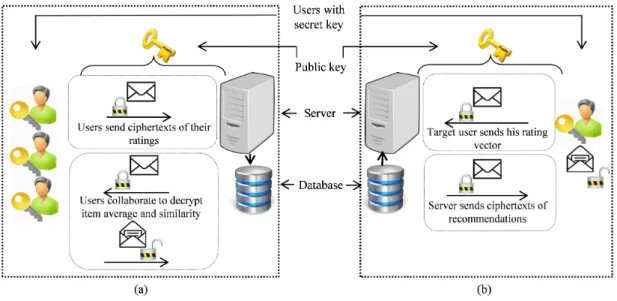
4.1.2 Proposed User based Recommendation Protocol . . . 82
4.1.2.1 Initialization . . . 84
4.1.2.2 Recommendation Generation . . . 85
4.1.3 Privacy Analysis . . . 90
4.1.3.1 Privacy Protection Against Users . . . 91
4.1.3.2 Privacy Protection Against Servers . . . 92
4.1.4 Performance Analysis . . . 92
4.1.4.1 Computation Costs . . . 93
4.1.4.2 Communication Costs . . . 95
4.1.4.3 Efficiency . . . 95
4.1.4.4 Comparison with Other Protocols . . . 97
4.1.5 Summary . . . 98
4.2 Privacy Preserving Item Ranking using Efficient Encrypted Search . . . 98
4.2.1 Motivation and Contribution . . . 99
4.2.2 Preliminaries . . . 100
4.2.2.1 Notations and Definitions . . . 100
4.2.2.2 The Distance Recoverable Encryption (DRE) Scheme . . . 100
4.2.3 System Model . . . 101
4.2.4 DRE based Search Scheme . . . 102
4.2.4.1 Key Generation . . . 103
4.2.4.2 Encryption . . . 103
CONTENTS x
4.2.5 Computing User Similarity Weight . . . 105
4.2.5.1 System Model . . . 105
4.2.5.2 Methodology . . . 105
4.2.6 Predicting Missing Ratings and Item Ranking . . . 107
4.2.6.1 Setting . . . 107 4.2.6.2 Protocol Description . . . 107 4.2.7 Privacy Analysis . . . 110 4.2.8 Performance Analysis . . . 111 4.2.8.1 Computation Complexity . . . 112 4.2.8.2 Efficiency . . . 115 4.2.8.3 Recommendation Accuracy . . . 116 4.2.9 Summary . . . 116 4.3 Epilogue . . . 117
5 Privacy Preserving Context Aware Recommendation System 119 5.1 Privacy Preserving Location Aware Web Service Recommendation . . . 120
5.1.1 Motivation and Contribution . . . 121
5.1.1.1 Motivational Scenario . . . 121
5.1.1.2 Our Contribution . . . 123
5.1.2 System Model . . . 124
5.1.3 Preliminaries . . . 125
5.1.3.1 Notations and Definitions . . . 125
5.1.4 Overview of the Proposed Framework . . . 126
5.1.4.1 User Filtering . . . 127
5.1.4.2 Web Service Recommendations . . . 127
5.1.5 Proposed Recommendation Protocol . . . 128
5.1.5.1 User Filtering . . . 128
5.1.5.2 Web Service Recommendations . . . 132
5.1.6 Privacy Analysis . . . 138
CONTENTS xi
5.1.7.1 Computation Complexity . . . 142
5.1.7.2 Communication Complexity . . . 144
5.1.7.3 Correlation between Geographical Locations and QoS-based Similarities . . . 144
5.1.7.4 Efficiency . . . 146
5.1.7.5 Recommendation Accuracy . . . 148
5.1.8 Summary . . . 148
5.2 Privacy Preserving Location Recommendation based on Social Network . . . . 149
5.2.1 Motivation and Contribution . . . 150
5.2.1.1 Motivational Scenaio . . . 150
5.2.1.2 Our Contributions . . . 150
5.2.2 Problem Statement . . . 151
5.2.3 Friendship-based Weighted Slope-one Predictor . . . 151
5.2.4 Proposed Privacy Preserving Location Recommendation . . . 153
5.2.4.1 System Model . . . 153 5.2.4.2 Pre-computation . . . 154 5.2.4.3 Location Recommendation . . . 155 5.2.5 Privacy Analysis . . . 158 5.2.6 Performance Analysis . . . 160 5.2.7 Summary . . . 162 5.3 Epilogue . . . 162
6 Privacy Preserving Recommendations on Partitioned Datasets 164 6.1 Motivation and Contribution . . . 165
6.1.1 Motivation . . . 165
6.1.2 Contributions . . . 166
6.1.3 Challenges . . . 167
6.1.4 Statement of the Main Problem . . . 167
6.2 Preliminaries . . . 168
CONTENTS xii 6.3 Proposed PWSOP-VPD . . . 169 6.3.1 Initialization . . . 170 6.3.1.1 Settings . . . 170 6.3.1.2 Protocol Description . . . 171 6.3.1.3 Generating Recommendations . . . 172 6.4 Security Analysis . . . 176
6.4.1 Privacy Protection against Users . . . 176
6.4.1.1 Target User . . . 176
6.4.1.2 Other User . . . 177
6.4.2 Privacy Protection against Servers . . . 177
6.4.2.1 RS . . . 177
6.4.2.2 DS . . . 177
6.4.3 Privacy Protection against Adversaries . . . 178
6.5 Performance Analysis . . . 178
6.5.1 Computation Cost . . . 179
6.5.2 Communication Cost . . . 179
6.5.3 Comparison with Existing Solutions . . . 181
6.6 Summary . . . 181
7 Conclusion and Future Work 182
List of Figures
1.1 Example of (a) Item based recommendations (b) User based recommendations. . 7
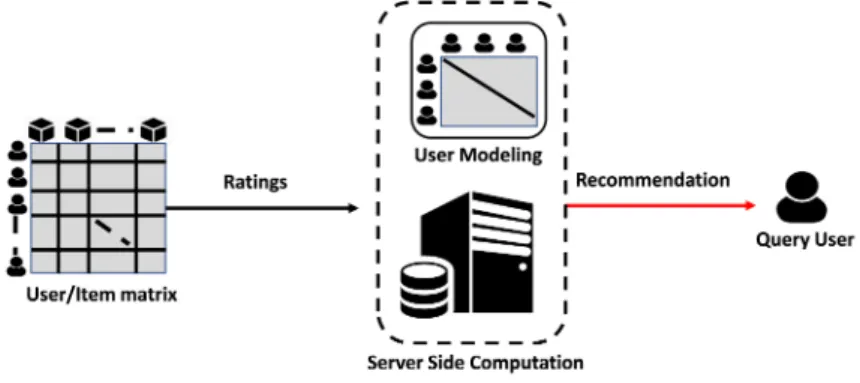
1.2 Architecture of User based recommendation. . . 7
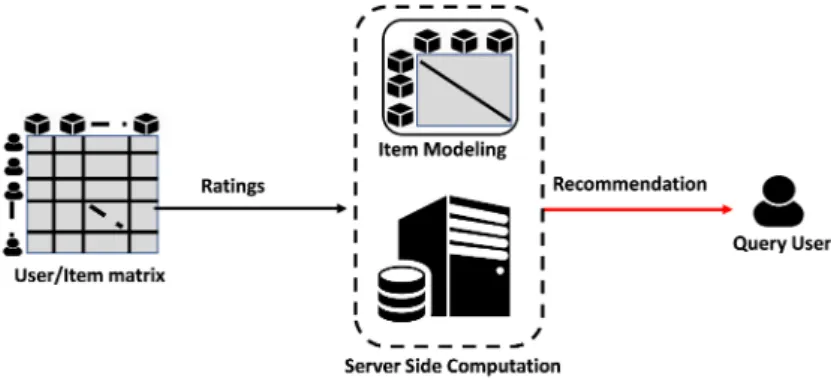
1.3 Architecture of Item based recommendations. . . 8
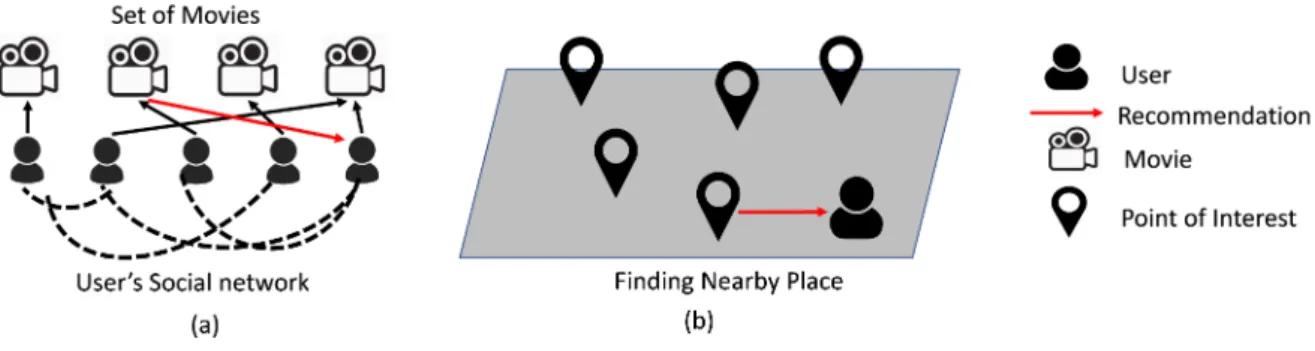
1.4 Context aware recommender system example. (a) Recommendation based on user’s social network. (b) Location recommendation based on distances. . . 9
1.5 Architecture of context aware recommendation. . . 9
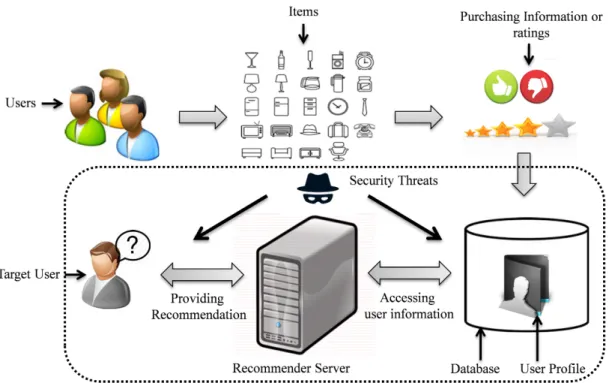
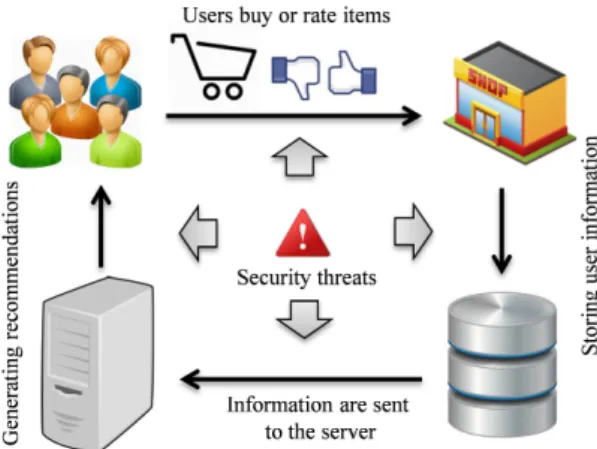
1.6 Traditional recommender system and its possible security concerns. . . 11
1.7 Partitioned dataset based recommendation. . . 11
1.8 A summary of research questions, research contributions and thesis organizations 24 3.1 Traditional recommender system and its possible security concerns. . . 49
3.2 Framework of proposed privacy preserving recommender system . . . 52
3.3 Computational cost of average calculation. . . 74
3.4 Computation cost of similarity calculation. . . 74
3.5 Computational cost of recommendation generation. . . 75
3.6 Comparison in-terms of total computation cost. . . 75
4.1 General architecture of our proposed model. (a) Initialization (b) Recommenda-tion generaRecommenda-tion. . . 83
4.2 Similarity computation between target userui and other users uk. . . 86
4.3 An example of decryption protocol . . . 89
LIST OF FIGURES xiv
4.4 Efficiency in-terms of computation and communication cost (wheren= 200,m=
500) . . . 96
4.5 System model. . . 101
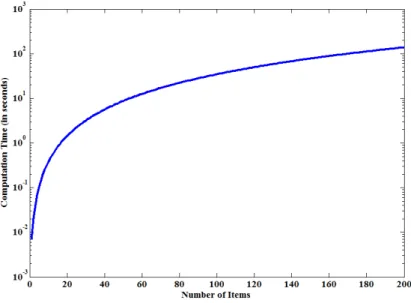
4.6 Required time of DRE based encryption and its effect on number of items for each user. . . 114
5.1 Personalized Web service ranking for Query User (QU) based on locations and QoS values by service provider and privacy issues while providing recommendations. 121 5.2 System model. . . 125
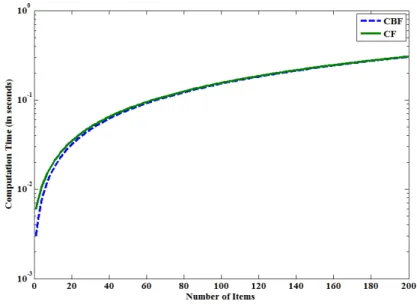
5.3 Performance Evaluation on Real World Dataset: Scalability of the Proposed System.145 5.4 The system model of our proposed protocol. . . 153
5.5 Computation (left) and communication (right) cost in worst case scenario. . . 162
6.1 Privacy threats in sharing data between different organizations. . . 168
6.2 General architecture of proposed model. . . 170
6.3 Example of proposed deviation computation in plaintexts. . . 172
List of Tables
2.1 User-item rating matrix. . . 37
2.2 Summarized classification of existing work. . . 41
3.1 Notations. . . 51
3.2 Rating matrix. . . 65
3.3 Similarity among the items. . . 68
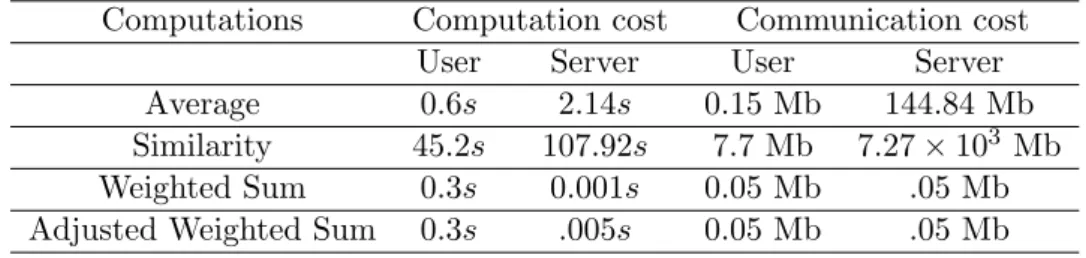
3.4 Computation and communication cost of the proposed model. . . 73
3.5 Performance of proposed protocol in terms of average, similarity and prediction. 73 4.1 Computation and communication cost of the proposed model. . . 92
4.2 Efficiency (m=500, n=200). . . 94
4.3 Notations and descriptions. . . 112
4.4 Computation complexity and required time of different entities of the system. . 113
5.1 Notations . . . 140
5.2 Computation and communication complexities of User Filtering. . . 141
5.3 Computation and communication complexities of Initialization, Similarity and Web service Recommendations. . . 141
5.4 Computation and communication costs of User Filtering. . . 141
5.5 Computation and communication cost when n = 338, n−n0 = 102, m = 5825 and m0 = 98. . . 143
5.6 Recommendation accuracy. . . 149
5.7 Computation and communication cost of the proposed model. . . 160 xv
LIST OF TABLES xvi
5.8 Performance of our protocol: time in seconds and bandwidth in MB. . . 161 6.1 Computation cost of different participants. . . 179 6.2 Communication cost of different participants. . . 180
Abstract
The recommender systems help users find suitable and interesting products and contents from the huge amount of information that are available in the internet. There are various types of recommender systems available which have been providing recommendation services to users. For example Collaborative Filtering (CF) based recommendations, Content based (CB) rec-ommendations, context aware recommendations and so on. Despite the fact that these recom-mender systems are very useful to solve the information overload problem by filtering interesting information, they suffer from huge privacy issues. In order to generate user personalized rec-ommendations, the recommendation service providers need to acquire the information related to attributes, preferences, experiences as well as demands, which are related to users’ confi-dential information. Usually the more information available to the service providers, the more accurate recommendations can be generated. However, the service providers are not always trustworthy to share personal information for recommendation purposes since they may cause serious privacy threats to users’ privacy by leaking them to other parties or providing false recommendations. Therefore the user information must be protected prior to share them to any third party service provider to ensure the privacy of users.
To overcome the privacy issues of recommender systems several techniques have been pro-posed which can be categorized into decentralization, randomization and secure computations based approaches. In decentralization based approach, the central service providers are re-moved and the main controls of recommendation services are given to participant users. The main issue with this kind of approach is that to generate recommendations, the users need to be dependant to other users’ availability in online services. If any user becomes offline, her information can not be used in the system. The randomization based techniques add noises to
2
users data to obfuscate them from learning the true information. However the main issue is that adding noise affects recommendation accuracy. On the contrary, the secure computations preserve user information while providing accurate recommendations.
In this thesis we preserve user privacy by means of encrypting user information, specifically their ratings and other related information using homomorphic encryption based techniques to provide recommendations based on the encrypted data. The main advantage of homomorphic encryption based technique is that it is semantically secure and computationally it is hard to distinguish the true information from the given ciphertext. Using the homomorphic based encryption tools and techniques we build different privacy preserving protocols for different types of recommendation approaches by analyzing their privacy requirements and challenges. More specifically, we focus on different key recommendation techniques and differentiate them into centralized and partitioned dataset based recommendation techniques. From available recommendation techniques, we found that some of the existing and popular recommendation techniques like user based recommendation, item based recommendation and context aware recommendation can be grouped into centralized recommendation approach. In partitioned dataset based recommendation, the user information can be partitioned into different organi-zations and these organiorgani-zations can collaborate with each other by gathering sufficient infor-mation in order to provide accurate recommendations without revealing their own confidential information. After categorizing the recommendation techniques we analyze the problems and requirements in terms of privacy preservation. Then for each type of recommendation ap-proach, we develop the privacy preserving protocols to generate recommendations taking their specific privacy requirements and challenges into consideration.
We also investigate the problems and limitations of existing privacy preserving recommen-dations and found that the current solutions suffer from huge computation and communication overhead as well as privacy of users. In the thesis we identify the related problems and solve the issues using our proposed privacy preserving protocols. As an overall idea, our proposed recommendation protocols work as follows. The users encrypt their ratings using homomorphic encryption and send them to service providers. We assume the service providers are semi honest but curious, they follow the protocol but at the same time try to find new information from the
3
available data. The service provider has the ability to perform homomorphic operations and it performs certain computations over encrypted data without learning any true information and returns the results to the query users who ask for recommendations. The system models of our privacy preserving protocols for different recommendation techniques differ from each other because of their different privacy requirements.
The proposed privacy preserving protocols are tested on various real world datasets. Based on the application areas of different recommendation approaches our gathered datasets are also different such as movie rating, social network, checkin information for different locations and quality of service of web services. For each proposed privacy preserving protocols we also present the privacy analysis and describe how the system can perform the computations without leaking the private information of users. The experimental and privacy analysis of our proposed privacy preserving protocols for different types of recommendation techniques show that they are private as well as practical.
Chapter 1
Introduction
The recommender systems are techniques and tools that provide suggestions for different prod-ucts or items which can be of use to a user. The suggestions help users to select which items to buy, what online news to read or what music to listen [1,2,3]. Online applications are some of the important parts of daily life for millions of users. People consume media (Youtube, Flickr, LastFM), do their shopping (Amazon, Ebay), and interact (Facebook, Gmail) online. Since the amount of content that is offered to users is often huge, the automated recommender systems are employed to make people’s life easier by helping find suitable information. In other words, by providing personalized recommendations, these systems can help people find interesting media, boost sales through targeted advertisements, or help people meet new friends. Because of their automated nature, the recommender systems can meet the demands of large online applications that operate on a global scale.
The recommender systems have proved in recent years to be a valuable means for cop-ing with the information overload problem. Ultimately a recommender system addresses this problem by pointing a user towards new, not-yet-experienced items that may be relevant to the users current task. Upon a user’s request, which can be articulated, depending on the recommendation approach, by the users context and need, the recommender systems gener-ate recommendations using various types of knowledge and data about users, the available items, and previous transactions stored in customized databases. The user can then browse the recommendations. All these user actions and feedbacks can be stored in the recommender
CHAPTER 1. INTRODUCTION 5
database and may be used for generating new recommendations in the next user-system in-teractions. As noted above, the study of recommender systems is relatively new compared to research into other classical information system tools and techniques (e.g., databases or search engines). Recommender systems emerged as an independent research area in the mid-1990s [4,5,2].
Usually “item” is the most general term used to represent what the recommender system recommends to any user. A recommender system traditionally focuses on any specific type of item such as news and CD. The recommender systems primarily focus on those users who lack enough personal experience to evaluate the potentially overwhelming number of alternative items that any web site may offer [3]. For example, a book recommender system, which assists users to select a book to read. A good example is Amazon.com, where the site employs a recommender system that assists users to personalize the online store for each customer [6]. Usually the recommendations are personalized and different users receive diverse recommen-dations based on their past preferences or experiences. However there are also no-personalized recommendation available which are much simpler to generate. For example, top five featured songs, top five selections of books etc. Although they may be effective and useful in certain cases but these no-personalized suggestions are not addressed by recommender system research. The personalized recommendations are usually offered as list of items which is ranked based on predicted weights or utilities of the items. To perform this ranking the recommender system tries to find based on the users’ constraints and choices what are the most suitable items are. In other words, the recommendation problem is reduced to the problem of predicting the missing ratings for the items that a user has not invoked before. Usually in any online system users buy or use any items and then provide ratings based on their experience on those items. There are more items left which are not invoked by the users in the system. As soon as we can predict the missing ratings on those items which are not rated before, we can recommend the items which are predicted to receive the highest ratings.
Users’ ratings on different items can be categorized into explicit and implicit ratings. The explicit ratings are considered as value given by the user. By the explicit ratings a user can express how strongly he/she likes the items or how the user feel about the item. The explicit
Types of Recommender Systems 6
ratings are considered as most strong source of information for recommender system. Typically the explicit ratings are ranged between 1 to 5 or 1 to 10 etc. The implicit ratings are inferred from observing users’ behaviours. For example, if a user has already invoked any item or not can be considered as implicit rating no matter if he/she provides any ratings or not. For example, a user buys any particular item several times. This means the user likes the item even if he/she does not provide any explicit ratings [7,8,9,2,10,11].
Usually the recommender system can be classified as (1) Content based recommendation (CB) [12, 13, 14], where the prediction of new ratings is evaluated by finding the similarities between the features of items which user has not invoked before and the other items. The highest predicted item is recommended. (2) Collaborative filtering (CF) based recommendation [15,16,17,18], where the ratings are predicted based on the similarity between either users or items ratings (unlike the content based). There are some hybrid methods [19,20,21] available where the CB and CF are combined together to generate composite recommendations.
1.1
Types of Recommender Systems
Although [7] provided an overview of the state of the art recommender system types as CF based recommender system, content based recommender system and hybrid, we found that all the basic types of recommender systems can be grouped into two main clusters: (1) cen-tralized dataset based recommendations (2) partitioned dataset based recommendations. The centralized dataset based recommendation can be categorized as user based recommender sys-tem, item based recommender system and context aware recommender system. In below we describe all types of recommendations system in detail.
1.1.1 Centralized Dataset based Recommendations
1.1.1.1 User based Recommender System
The user based recommender system [22, 23, 24, 25, 26, 27, 28, 29, 30, 31, 32, 33, 34], also called as Collaborative Filtering (CF) predicts the recommendations for the user based on the similarity among user preferences on items. The most similar user is identified to the target
Types of Recommender Systems 7
Figure 1.1: Example of (a) Item based recommendations (b) User based recommendations.
Figure 1.2: Architecture of User based recommendation.
user (whom to recommend) and based on the ratings of the similar user, recommendations are generated for target user. Specifically the user based recommender system works as follows:
• Calculating the similarity weight of all users with the target user who wants the recom-mendations. To do this, we need to define a similarity function similarity(u, i) where
u and i represents the target user and neighbor user respectively. Note that the users are represented as rating vector (rating on items). The more similar a neighbor is to the target user, the more weight to put into their similarity to influence the final recommen-dation result.
• Filtering a subset of users from the whole set of users based on the similarity weights. Although they can be filtered in different ways, a traditional system is to fix a threshold value and choose k nearest neighbors whose similarity is more than the threshold value. Although theoretically it is possible to consider all users in the system but selecting top k similar users is more practical.
Types of Recommender Systems 8
Figure 1.3: Architecture of Item based recommendations.
• Computing the final prediction on any unrated (no invoked before) items based on the k similar users’ weights and the available ratings on those target items from other users.
1.1.1.2 Item based Recommender System
In item based recommendation (also called as content based recommendation- CBF) [35, 35,
29, 36, 37, 38, 39, 40, 13, 41] the similarity between the items that the target user has rated and all other items are identified. Based on the most similar item’s rating, recommendations are generated for the target user. More specifically the item based recommender system works as follows:
• Weigh all items with respect to their similarity to the active item. Define a similarity functionsimilarity(i, j) that measures the similarity between the active item i and an-other itemj (since items are represented using rating profiles consisting of users ratings on the item in question, the similarity is computed based on the items rating profiles). • Form the active items neighborhood of similar items. The neighborhood can either be
such that it consists of the most similar items out of all items, independent of whether the active user has rated them or not, or it can be the set of the most similar items out of those the active user has rated. Typically only a subset of the k most similar items are selected.
• Compute a prediction on the active item for the active user using a prediction algorithm that is based on how the active user has rated items in the active items neighborhood.
Types of Recommender Systems 9
Figure 1.4: Context aware recommender system example. (a) Recommendation based on user’s social network. (b) Location recommendation based on distances.
Figure 1.5: Architecture of context aware recommendation.
1.1.1.3 Context-aware Recommender System
The context aware recommender systems [42, 43, 44, 45, 46, 47, 48, 49, 50, 51, 52, 53, 54] facilitate the recommendations by exploiting different context information that affects or in-fluence user preferences based on different situations. For example a user may like to watch a horror movie alone but would like to watch an action movie with friends. Therefore the tastes changes based on his/her company. Some of the important context information includes time, locations, social network etc. The incorporation of these context information into rec-ommender system [55, 56] leverages the value of these systems by improving the relevance of possible recommendations with respect to changing user needs [57,58].
Types of Recommender Systems 10
Context Information
As mentioned earlier the precision of recommendation results may get affected by different contextual information. For example an user may be more or less interested in a certain restaurant depending on the friends he/she is going with or the day of the week. For another instance, an user would like to visit only those restaurants which were visited by his/her close friends only [59,60,48,61,62]. The context information can be static or dynamic based on if they get changed or not.
Incorporating Context into Recommender System
The traditional recommender system relies solely on users’ ratings on different items. On the other side the context aware recommender system relies on not only the ratings but also the contextual information of users. Therefore a context aware recommender system can be formulate as a function as follows:
f :U sers×Items×Context−> Ratings
There are mainly three ways to integrate the context information into recommender system. (1) Contextual pre-filtering: where the context information are filtered before integrating them into recommender system (2) Contextual post filtering: where the context information are filtered after the traditional recommender system is applied into the user data (3) Contextual modeling: where the contextual information are integrated directly into the recommendation model.
1.1.2 Partitioned Dataset based Recommendations
One of the main purposes of recommender systems is to offer truthful and reliable referrals. To produce precise and dependable predictions, such systems should collect ratings from enough number of users. When online vendors own limited number of users data, it becomes a challenge to form reliable and large enough neighborhoods; that might cause low quality CF services. Additionally, inadequate number of users data lead to cold start problem, where e-commerce sites can recommend predictions for limited number of items. That might cause to lose cus-tomers due to the lack of accuracy in the recommendations received [63,16]. Therefore, holding
Types of Recommender Systems 11
Figure 1.6: Traditional recommender system and its possible security concerns.
Figure 1.7: Partitioned dataset based recommendation.
sufficient number of users ratings is imperative for the overall success of CF systems. Some companies, especially recently established ones, might not have enough users’ or items’ data for recommendation purposes. Moreover, customers may prefer different online vendors for shopping. On the other side, the users purchase different products from different companies. Consequently, ratings of the different items collected from same users for CF purposes might
Privacy Concerns in Recommender Systems 12
be vertically partitioned among multiple vendors. Therefore acquiring the ratings partitioned into different companies for better referrals [64,65,66].
1.2
Privacy Concerns in Recommender Systems
1.2.1 Privacy Breach and Types of Risks
The recommender systems require the datasets of users’ personal preferences which has disclo-sure risks by malicious intruders. These privacy breaches may involve deliberate acts such as hacking or snooping by different kinds of parties like the outsiders, fellow users or the service providers or outsiders. Such kind of incidents might have serious consequences depending of the sensitivity of the personal information [67,68]. Since the recommender systems are based on central storage of user profiles, it has been studied that three main threats may hamper the recommender system to perform properly: exposure, bias and sabotage [69]. The exposure is considered as privacy breach while the latter two are regarded as functional threats to the system.
1.2.2 Users’ Privacy Risks are Proportional to Availability of Information
In a recommender system, the more personal information is available to the server the more accurate recommendations can be generated. The information of users includes their identifi-cations, demographic information, behaviour, purchase pattern or history, ratings and so on. Such information are privacy sensitive and users are usually reluctant to share these informa-tion to any third party service providers [48,61,62].
1.2.2.1 Types of Private Information
The type of private information mainly depends on how an user or system defines the level of privacy which to be shared or not. However mostly any information related to user are considered as private. For instance, the users’ behavioural information may refer to his/her dynamic data such as activity, location, time etc. The demographic information may refer to
Background and Motivation 13
users’ age gender, age etc. The ratings refer to the range of votes which interprets how much (in a range of 1-10) an user like an item.
Providing or releasing such information to a recommendation server who is usually any third party service provider may pose undesirable privacy risks. The data could be sold to any other party without owners’ consent or intruder may hack and provide false recommen-dations. Therefore it is very important to protect such information while providing accurate recommendations.
1.3
Background and Motivation
Under the broader research context the existing privacy preserving recommendations system can be categorized into two areas: (1) Obfuscation based solutions [70,68,71, 72,73,74, 75,
76,10,77] and (2) Cryptography based solutions [78,79,67,80,81,82,83,84,75,85,86,87]. The main advantage of obfuscation based techniques are that they are efficient since they do not incur complicated manipulations on users information in order to preserve the privacy. However they lack rigorous privacy guarantees as well as affect the recommendation accuracy because of adding the noise.
In contrast, the cryptographic solutions rely on different cryptographic primitives such as homomorphic encryption, multiparty cryptographic computations, threshold encryption etc. There are two main advantages of cryptographic based solutions. First, these types of methods provide rigorous privacy guarantee because of secure computations, since one can perform certain computations on encrypted data without looking at any information (the server learns nothing except the ciphertexts). Second, there is no degradation of accuracy.
In below we briefly describe some existing privacy preserving recommender systems. The detailed related work can be found in next chapter.
1.3.1 Anonymization
The anonymization approaches remove any identifiable information such as link between users and the data to obfuscate the user profile. This kind of approaches has been widely studied
Background and Motivation 14
to protect the privacy in recommender system. Anonymization based approaches considers that the re-identification of individuals data is similar to the attack model where the published tables are joined with some external tables modeling the users background knowledge. To prevent these types of attacks Samarati et.al. [88] proposed a k-anonymity based approach where a computational disclosure technique was introduced for releasing information from a private table such that the identity of any individual to whom the released data refer cannot be definitively recognized. This approach protects against linking to other data. Byun et al. [89] proposed anonymizing relational data using clustering based techniques. A solution was carried out in the vector forms, where each dimension represents a numerical value. Although this work is for relational database, there is no direct application in the form of a graph. Cormode et al. [90] proposed a privacy preserving anonymization of bipartite graph where the main goal was to protect the association between the nodes in two partitions of the graph. Zhifeng et al. [91] presented a distributed anonymization based techniques where the scheme allows the users to anonymize their own data without accessing each others information.
1.3.2 Obfuscation
One type of privacy preserving recommender system is data perturbation methods where noises are injected on users’ private data before sending to the server for generating recommendation Zhang et al. [92] proposed two data reconstruction methods based on Singular Value De-composition and K-means clustering, that derive original private information from disguised data in existing perturbation collaborative filtering schemes. They also showed that the data perturbation techniques might not able to secure the data properly. Another SVD (Singu-lar Value Decomposition) based CF (Collaborative Filtering) with privacy has been proposed [74] maintaining acceptable accuracy for recommendation while protecting the privacy of user information based on randomized perturbation based schemes. A distributed mechanism for users in collaborative filtering has been proposed where the user item connection has been made secure so that untrusted server is not able to read it. A trade-off between privacy and recommendation accuracy has been minimized by solving this issue [71]. Few research works been carried out on differentially private recommender system which also took consideration of
Background and Motivation 15
minimizing the trade-off between security and recommendation accuracy. A method [10] based on differential privacy has been proposed where the algorithm has been factored into two parts: the aggregation which guarantees the privacy and aggregation which provides the recommen-dation learning the users information. Another example of differential private recommender system, proposed by Machanavajjhala et al. [93] who presented a graph link based recommen-dation and formalized the trade-off between privacy and accuracy. Extra noises are induced in these types of methods. Tianqing et al. [94] proposed a differential privacy for neighbourhood based CF, where the scheme is able to select private neighbor to protect the neighbors data. Their proposed solution reduces the magnitude of the noise than the traditional approaches as well.
1.3.3 Homomorphic Encryption
1.3.3.1 Encryption based Recommendations on Centralized Dataset Item based Recommendations
The homomorphic encryption techniques usually adopt cryptography to hide users’ private data. Canny [79] proposed a scheme for privacy preserving CF which reduces the filtering task to an iterative calculation of the aggregate requiring only addition of vectors of user data using homomorphic encryption techniques. This approach allows sums of encrypted vectors to be computed and decrypted without exposing individual rating information. Another research [67] has been carried out by the same author to protect individuals’ personal data only. This approach has been conducted based on probabilistic factor analysis model. It was also suggested for different kinds of statistical analyses purposes. Large computation and communication overhead is a common issue in generating private recommendations using homomorphic based techniques. Kikuchi et al. [95] addressed the large overhead in performing the cryptographical operations, which is proportional to the number of user and items. Therefore, they came up with reducing the computation and communication cost introducing clustering based CF where users and items are grouped together based on their similarity. Tada et al. [96] proved that, the computation cost for generating recommendation can be reduced using item based similarity
Background and Motivation 16
instead of user based. Therefore, the issue with scalability in recommender system was handled in their proposed work where privacy has been preserved using Paillier cryptosystem.
User based Recommendations
Erkin et al. [97] proposed a collaborative filtering based recommender system which uses efficient protocols based on homomorphic encryption and secure multiparty communication. They have also applied the approach in a social trust network [98] aiming similar outcomes to previous work where the additional overhead with regard to computation and communication is minimized by packing data. The main limitation of [97] is that, recommender server and decryption server need to communicate each other to achieve secure multiplication between two private message as well as intermediate decryption of private messages. Moreover, any user is able to communicate with decryption server which might cause serious damage to the system since the any user can be malicious and decrypt any other users’ information.
1.3.3.2 Encryption based Recommendations on Distributed Dataset
A recommender system is usually more successful and is able to provide more accurate rec-ommendation when sufficient data are available. One of the common scenarios in applying a recommender system involves distributing data among several different organizations. To generate a recommendation for a specific user, ratings from only one organization might not be adequate to predict accurate recommendations. Hence it is necessary to integrate data held by different organizations. However, the challenges arise when different data holders are reluctant to disclose their own data to other sites. Therefore to encourage them to take advan-tage of each others data for the sake of quality recommendations, privacy and confidentiality constraints for personal information have to be satisfied. The partitioning of the data can be horizontal, vertical or arbitrary. A horizontal partitioning occurs when multiple organi-zations contains different sets of users but the same set of attributes or items, while vertical partitioning distributes different sets of items but the same set of users among several sites. In arbitrary partitioning organizations hold disjoint sets of both users and items. Figure 1.7 shows an architecture of vertical partitioned dataset based recommendation [99,100].
Background and Motivation 17
Previous research has shown that vertical and arbitrary partitionings are more common and more difficult to handle than horizontal partitioning. It remains an open problem to generate accurate and secure recommendations for vertically partitioned data The partitioned data-based computation with privacy is a more challenging problem, which has been addressed by several researches. Yakut et al. proposed two privacy-preserving recommendation framework for arbitrary partitioned datasets [72, 101]. In their techniques user information was made secure by masking the ratings and recommendations were generated on the masked data. Rec-ommendations were generated using Self Organizing Map (SOM) and Naive Bias Classifier (NBC), in two different researches, respectively. Privacy-preserving weighted slope one pre-dictor was proposed for both horizontally and vertically partitioned datasets by [99, 100]. However, [99] showed that they need all organizations to actively communicate among each other. As a result, to generate recommendations for one user, all other organizations must come online and collaborate. Moreover, the organizations send their ciphertexts to other orga-nizations serially and this continues until the last organization receives. Problem arises when the number of organizations increases. In [100], they showed that, a rating can be split into multiple shares (which is necessary to to calculate item deviation securely). This shares can be increased by k. Computation and communication overhead increase when the number of k raises.
1.3.4 Motivation
The privacy concerns of recommender systems have been dealt with using various techniques such as: anonymization, randomization and differential privacy, cryptographic protocols etc.
The anonymization based techniques remove any identifiable information from the original data while preserving other structures of interests in the data. In real scenario it is tough to assume which part of the data has to be removed while other parts must be kept to remain useful. Similar to the anonymization based techniques, the randomization based methods alter the information in the datasets to inject a degree of uncertainty. Differential privacy based techniques add high level of noises to some particular information so that those are compu-tationally undistinguishable from others. The main drawbacks of these techniques are that,
Background and Motivation 18
they are hard to be proven and the noises make recommendation to perform less accurately. However, anonymization based techniques often face the difficulties to decide which portion of data need to be removed. Moreover, the privacy provided by these approaches often are not guaranteed when the data is sparse. Perturbation based techniques induce extra noises that affect to find similar users or items accurately.
Privacy preserving based on cryptographic protocol based techniques can be divided into two parts: without server and with server. The cryptographic protocol without server also called the secure multi-party computations do not trust the central server at all which result removing it from the picture. Therefore, it protects the privacy of the users against each other using homomorphic based techniques. These techniques overcome the issue with afore-mentioned methods however, since such schemes with decentralized structures works strongly taking power away from the service providers, the existing companies are not likely to agree with adopting.
The cryptographic protocols with a central server overcome the issues with multi-party based methods without server, where the server is offered to make use of centralization. The main challenge of these methods is that, because of adding a layer of encryption the efficiency degrades extensively. The cryptographic based protocols with secure two party computations are always more expensive to generate recommendations for users than the unprotected ones. To obfuscate the messages using these techniques, they need big size of keys as bigger the key, more difficult to crack the messages.
The main motivation of this thesis work has been summarized below.
• User information are sensitive, however potential threats to user privacy in both user and item based CF are often underestimated.
• Most of the current approaches fail to perform secured collaborative filtering efficiently while maintaining the balance between privacy and recommendation accuracy.
– Cryptographic based protocols introduce homomorphic cryptosystem for item based CF which requires huge number of iterative calculation, therefore, suffers from
in-Research Challenges 19
tensive computation cost [96].
– Due to the large number of potential users in most of the systems, it has been a bottleneck to find the similarity among the users efficiently in user based CF. This issue adds another dimension of barrier to secure the system in reasonable amount of computation and communication costs [102].
– The required amount of bandwidth to exchange the ciphertexts among the parties is extensive in current solutions[95,103].
1.4
Research Challenges
In this thesis we aim to address key challenges in different areas of recommendations system while preserving users privacy.
As mentioned earlier, to get personalized recommendation from the recommender server, it requires to learn users’ past preferences on different products as well as their personal informa-tion which may lead to data privacy and security issues. For this reason users are reluctant to share their personal information to the server. One very straightforward way is to add noise to user ratings so that the server is not able to find the true ratings. However only adding noise is not enough if they become useless to compute the recommendations. Specifically we need to hide the ratings such a way so that their preserve some features which is helpful to be used while perform the rating predictions. To address this challenge we use homomorphic based encryptions to preserve users privacy so that the encrypted ratings can be used to perform rating predictions.
1.4.1 Privacy Challenges in Item based Recommendation
The homomorphic based encryption techniques are useful to perform certain operations on encrypted data, mostly addition and multiplications. The process of generating item based recommendation consists of two steps: calculating similarity among the items and then pre-dicting the missing ratings based on the target users ratings on other similar items and the similarity weights. The main challenge is building such similarity computation protocol where
Research Challenges 20
ratings are encrypted and one central party or a recommender server can perform a set of homomorphic operations so that the similarity and prediction function can be achieved at the end of the protocol. Because of using homomorphic based encryptions, someone should hold the private key to decrypt the results. This raises another challenge since one central party may act maliciously and decrypt all encrypted information. Therefore it would be an effective idea to distribute the secret keys so that no central authority can have the power to decrypt the results, instead all the secret key holders agree and contribute to decrypt the results. The main issue of some existing privacy preserving item based recommendation [79,67, 95, 96] is that they suffer from huge computation and communication overhead as well as suffers from privacy threats.
1.4.2 Privacy Challenges in User based Recommendation
The main difference between the item and user based recommender system is that, unlike item based recommendation, in user based recommendation, we calculate the similarity between the users instead of items. Moreover, while predicting, other users’ ratings are used with the similarity weight. Although in terms of the similarity function its same to compute item and used based similarity, however, in terms of privacy preserving computation, its different. In private item based similarity computation, a single user can perform certain computations locally, for example multiplication of the ratings for different items. Moreover, while calculating the prediction, the multiplication between user ratings and user similarity, where both of them are private. The existing homomorphic tool based protocols propose to collaborate among the users and intermediate decryptions to facilitate such computations which raise huge communication bandwidth as well as privacy concerns. Therefore, our main challenge is how to build such protocol where one central authority can perform most of the required homomorphic computations while generating recommendation without learning any private information. Also we do not want to compromise minimum privacy and recommendation accuracy. Among some of the existing privacy preserving user based recommendation [97, 98] one common issue is that the decryption server and recommendation server have to communicate with each other significantly to achieve certain computation results by doing decryptions. This raises huge
Research Challenges 21
privacy threats to users’ private information.
1.4.3 Privacy Challenges in Context Aware Recommendation
Another very common and useful recommendation area is context aware recommendation where the users’ preferences/ ratings, recommendations depend on different contextual information. Although the user and item based recommendation are straightforward way to generate rec-ommendations, it would be useful to integrate the context information such as social network, locations of users into the recommender system. However, similar to users’ ratings the loca-tions and social network are also private information. Therefore, while encrypting the users preferences, it is also necessary to encrypt the contextual information so that the users’ private information are not leaked. The main challenge lies in how to integrate the context information prior or after the recommendation model in privacy preserving manner. For another exam-ple, an user wants recommendations based on close-by located users experiences. To facilitate such recommendation, the server has to find the close-by users based on the location first without knowing anything about their locations, then find the similarity among the filtered users without learning their ratings. Therefore, it is challenging to integrate the contextual information into the recommendation model without actually having any knowledge about the users’ contexts and performing privacy preserving predictions.
1.4.4 Privacy Challenges in Partitioned Dataset based Recommendations
To produce accurate recommendations, the recommendation service providers need sufficient data since more data that are available, the more accurate recommendation can be generated. As the amount of online vendors and customers are increasing day by day the users’ preferences can be distributed among multiple organizations or competing vendors. The problem is due to the privacy issues, companies are also reluctant to share their users’ confidential information to other companies which could help to provide more accurate recommendations. Furthermore, it is not legal disclosing users preferences; nevertheless, if privacy is protected, they can col-laborate to produce correct predictions. Therefore the main challenge lies in how to collect all users’ information by companies and then share the confidential information with other
com-Research Questions 22
panies without actually harming the confidentiality of users and at the same time generating recommendation to users. Another challenge is how to deal with sharing information among the huge number of organizations if they share similar set of users’ information. Sharing any company’s information to all others may increase the communication overhead and also may take long time to finish the process. One of the common issues of existing privacy preserving recommendation on partitioned datasets [72, 101, 99, 100, 99, 100] is that they require all parties to communicate with each other which raises huge communication overhead.
1.5
Research Questions
To address the aforementioned challenges, we aim to answer the following four main research questions.
R.Q-1. How to model a secure protocol for privacy preserving item-based recommender sys-tem where users’ privacy are preserved while generating without any loss of recommendation accuracy.
To answer this question we address the research challenges in terms of privacy issues of item based recommender system. We preserve users privacy by means of homomorphic encryption and the third party service provider is able to generate recommendation without learning any private information. To facilitate the private recommendation, the server calculates the simi-larities among the items based on the ratings provided by the users homomorphically and use the similarity value to recommend new items to the target user.
R.Q-2How to model secure protocol for user based recommender system which can hide user ratings from all parties in the recommender system and generate recommendation privately to users.
This research question is designed to address the research challenges in user based recommender system which is different than RQ-1 where the recommendations are generated based on the similarities among the users instead of the items. More specifically, we answer the question by
Research Questions 23
building a secure protocol where both user ratings and similarity are private while generating recommendations by server. The existing privacy preserving protocol require to make any one of the private information public or the parties in the recommender system need to collabo-rate each other to facilitate these types of computations. Our proposed protocol address these challenges by improving the privacy as well as efficiency.
R.Q-3 How to model a secure recommendation protocol for partitioned datasets where the user ratings are shared among multiple organizations and any user can get recommendations by combining the ratings of the organizations without revealing any private information.
We design this research question to address the challenges and privacy issues in distributed dataset based recommendations. There are such practical scenarios where different organiza-tions hold different set of products but same set of users. In this case merging all of ratings would generate more accurate recommendation, however the organizations are reluctant to share their users’ information to other organizations. By answering this research question, we show an effective protocol where different organization can collaborate with each other to generate more accurate recommendations for their users without compromising any privacy.
R.Q-4How to model secure context aware recommendation protocol where the recommenda-tions can be generated by integrating different contextual information of users privately, which influence their preferences as well as the recommendation results.
We answer this question by addressing the challenges in the recommender system where con-text information are to be integrated to generate suitable recommendations for users. For example, users may want to visit those locations which are visited by his/her close friends. Therefore, it is necessary that the recommendations results are influenced by user’s social friendship network. Similarly, there are certain areas where users’ preferences depends on their locations. Specifically we investigate two types of context information: social network of users and locations and analyze how these context information influence users’ preferences and their
Research Contribution 24
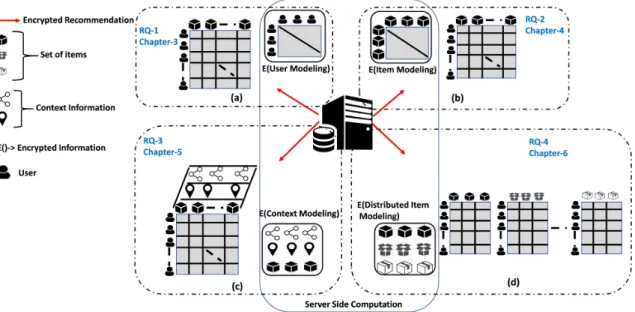
Figure 1.8: A summary of research questions, research contributions and thesis organizations
recommendations and how to incorporate these context information into recommender system in privacy preserving manner.
1.6
Research Contribution
To address the research questions defined previously and to overcome the challenges discussed in last section, extensive studies have been performed using different privacy preservation tools and cryptography based techniques. A summary of the organization of the novel contributions corresponding to the aforementioned research questions is presented in figure 1.8. Concretely the main contributions of this thesis are presented as follows.
1. Privacy Preserving Item based Recommendation
We propose a new privacy preserving item based recommender system, which allows the computations required for recommendations in a distributed manner and preserves user privacy without compromising recommendation accuracy and efficiency. We introduce the privacy protocol based on ElGamal encryption [104] which is based on public key cryptosystem. The main advantage of this cryptosystem is that, it is semantically secure
Research Contribution 25
and allows certain types of computations on the ciphertexts. Based on this cryptosystem, we are able to split the secret keys among the users so that no single authority holds the full power to have the secret key and decrypt. When the computation on encrypted data is complete, all users in the system can share the secret keys to decrypt the results. Our recommender server is assumed to be semi honest and does not collude with any party in the system. We also propose different privacy protocols on item average and similarity computations as well as recommendations generations by which the privacy of users are preserved. Specifically our main contributions are:
a) An efficient privacy preserving item-based recommender system to protect user pri-vacy during recommendation process by sharing the secret keys.
b) Privacy preserving item average and similarity computation protocols to calculate averages and similarities among the items without compromising user ratings. More-over, which items have been rated are also hidden during these processes.
2. Privacy Preserving User based Recommendation
In relation to the first contribution we further investigate the privacy preserving recom-mendation protocol based on the similarity among the users and their ratings on items. We mainly investigate the requirements of privacy protocols in terms of user based simi-larity computations followed by recommendation generations with the encrypted weights, which are user similarities. Based on our investigation we found that the existing works suffer from certain privacy issues (they require to decrypt intermediate results by the decryption server) and communication overhead on how they perform secure multipli-cation operation (which is one of the intermediate steps in generating recommendation) homomorphically under multiparty settings. To overcome these limitations, we propose a new privacy preserving protocol using Boneh Goah Nissim cryptosystem [105] where secure multiplication can be performed by a single server and overcomes the limitation of communication overhead as well as the privacy issues (we do not require to decrypt the intermediate results). To model the protocol, we set two servers, where one acts as recommendation server and another as decryption server who are semi honest but
curi-Research Contribution 26
ous to find the information. The proposed protocol leverage the recommender server to perform private recommendations without disclosing any private information.
3. Privacy Preserving Context Aware Recommendation
To facilitate the privacy preserving context aware recommender system, we explore the influence of different contextual information in recommendation. Among various con-textual information based recommendation, we limit our study and contribution among two specific contextual information: users friendship network and locations. These two information are equally sensitive as other user information such as ratings or prefer-ences on different products. More specifically we investigate users’ friendship network into point of interest recommendation and locations into web service recommendation as an application in privacy preserving manner. In point of interest recommendation, we propose a new privacy preserving protocol where users are able to select only few friends of him/her based on whom the users wants the recommendation results to be influenced without disclosing any private information. Similarly, in location aware web service recommendation, we propose a new privacy preserving protocol where the users are able to filter a set of users who are located nearby, since users locations usually effect in web service experience/preferences. The recommendation server can use the set of nearby users’ experiences to facilitate the recommendation on unobserved web services for target/ query user without disclosing or learning any private information.
In both scenarios we use real world datasets to conduct extensive experimental analysis and prove that the proposed protocols are practical as well as private.
4. Privacy Preserving Recommendation based on Partitioned Datasets
There is such scenario where the users’ information/ ratings are distributed among mul-tiple organizations and to generate satisfactory recommendations, these data need to be integrated. However, data related to user preferences are usually confidential and it is unlikely that any organization will agree to share its own data with other entities. To provide advanced facilities for securing privacy of data in distributed recommender sys-tems, we propose a new system called Privacy-preserving Weighted Slope One Predictor
Thesis Organization 27
for Vertically Partitioned Data. In this protocol we encrypt users’ confidential rating information by means of BGN cryptosystem [105] also propose a novel privacy preserv-ing item deviation protocol which is one of the important intermediate steps to generate recommendations in this scenario. More specifically, the proposed protocol generates recommendations in a privacy preserving manner by integrating users data distributed among several different organizations by means of encrypting user information. The proposed protocol is examined using a real world dataset and shows that the proposed method is secure and outperforms previous solutions interms of computation and com-munication costs.
1.7
Thesis Organization
The remaining chapters of this thesis is organized as follows.
• Chapter 2: Background and Related Work This chapter describes the underlying cryptographic algorithms that are used to encrypt confidential information related to recommender system and the homomorphic properties of those cryptosystem which are used as building blocks to build the privacy preserving recommender system in different application scenarios. We also describe the related work separately in terms of research questions and research contributions.
• Chapter 3: Privacy Preserving Item based Recommendation
This chapter describes the solutions to RQ-1. Here we present the solution of privacy issues while generating recommendation based on item similarity. Specifically we present the privacy preserving protocol for item based similarity and average rating computations. Moreover we present two different types of privacy preserving protocol for recommenda-tions: weighted sum and adjusted weighted sum. We enhance the traditional ElGamal cryptosystem so that the users in the system can share the secret keys and collaborate with each other to decrypt the final results. We also present another protocol where user can generate its own key pairs to facilitate homomorphic encryptions in order to get encrypted recommendations. The main contribution of this chapter corresponds to [106]
Thesis Organization 28
• Chapter 4: Privacy Preserving User based Recommendation
This chapter describes the solution to RQ-2. The user based recommendation is different than the item based one in terms of privacy requirements. Therefore the challenges to solve privacy issues while generating recommendations are also different. As discussed in research challenges, while computing the similarity between users and generating recom-mendations the existing approaches fail to meet the privacy and communication overhead simultaneously. To address this challenge we present a new privacy preserving protocol where a central server can perform the homomorphic operations to generate recommen-dations reducing the communication bandwidth and providing better privacy than the existing ones. We also provide an extended solution where we improve the computation overhead of privacy preserving user based recommendation by reducing the total user space prior to generating recommendations. Specifically the first approach is shown in the application of movie recommendation and the second approach is shown in the ap-plication of web service recommendations. The contributions of this chapter appear in [107]
• Chapter 5: Privacy Preserving Context Aware Recommendation
This chapter describes the solution to RQ-3. In this chapter we present privacy preserving protocols for context aware recommender system where we show the solutions to integrate the contextual information into recommender system in privacy preserving manner. We present two applications on privacy preserving context aware recommendations in this chapter divided into sections.
– 5.1: Privacy Preserving Friendship Aware Location Recommendations.
This section presents how to integrate friendship network into a location recom-mender system since social network influences the user preferences and how to facil-itate this recommendation in privacy preserving manner since users’ social network and checkin into different locations are private. The main contribution of this section appear in [108].