Montréal
Avril 2002
Série Scientifique
Scientific Series
2002s-41
Maximum Likelihood and the
Bootstrap for Nonlinear
Dynamic Models
Sílvia Gonçalves, Halbert White
CIRANO
Le CIRANO est un organisme sans but lucratif constitué en vertu de la Loi des compagnies du Québec. Le financement de son infrastructure et de ses activités de recherche provient des cotisations de ses organisations-membres, d’une subvention d’infrastructure du ministère de la Recherche, de la Science et de la Technologie, de même que des subventions et mandats obtenus par ses équipes de recherche.
CIRANO is a private non-profit organization incorporated under the Québec Companies Act. Its infrastructure and research activities are funded through fees paid by member organizations, an infrastructure grant from the Ministère de la Recherche, de la Science et de la Technologie, and grants and research mandates obtained by its research teams.
Les organisations-partenaires / The Partner Organizations •École des Hautes Études Commerciales
•École Polytechnique de Montréal •Université Concordia
•Université de Montréal
•Université du Québec à Montréal •Université Laval
•Université McGill
•Ministère des Finances du Québec •MRST
•Alcan inc. •AXA Canada •Banque du Canada
•Banque Laurentienne du Canada •Banque Nationale du Canada •Banque Royale du Canada •Bell Canada
•Bombardier •Bourse de Montréal
•Développement des ressources humaines Canada (DRHC) •Fédération des caisses Desjardins du Québec
•Hydro-Québec •Industrie Canada
•Pratt & Whitney Canada Inc. •Raymond Chabot Grant Thornton •Ville de Montréal
© 2002 Sílvia Gonçalves et Halbert White. Tous droits réservés. All rights reserved. Reproduction partielle permise avec citation du document source, incluant la notice ©.
Short sections may be quoted without explicit permission, if full credit, including © notice, is given to the source.
ISSN 1198-8177
Les cahiers de la série scientifique (CS) visent à rendre accessibles des résultats de recherche effectuée au CIRANO afin de susciter échanges et commentaires. Ces cahiers sont écrits dans le style des publications scientifiques. Les idées et les opinions émises sont sous l’unique responsabilité des auteurs et ne représentent pas nécessairement les positions du CIRANO ou de ses partenaires.
This paper presents research carried out at CIRANO and aims at encouraging discussion and comment. The observations and viewpoints expressed are the sole responsibility of the authors. They do not necessarily represent positions of CIRANO or its partners.
Maximum Likelihood and the Bootstrap
for Nonlinear Dynamic Models
*Sílvia Gonçalves
†and Halbert White
‡Résumé / Abstract
Nous proposons une approche unifiée pour analyser la méthode de bootstrap appliquée aux estimateurs de pseudo-maximum de vraisemblance dans le contexte de modèles non linéaires dynamiques où les données sont caractérisées par une dépendance d'époque proche. Nous appliquons nos résultats à la méthode de bootstrap de blocs mouvants de Künsch (1989) et Liu et Singh (1992) et nous démontrons la validité asymptotique de premier ordre de l'approximation du bootstrap à la distribution asymptotique de l'estimateur de pseudo-maximum de vraisemblance. Nous considérons aussi l'application du bootstrap à la réalisation de tests d'hypothèses. En particulier, nous démontrons la validité asymptotique des versions de bootstrap des tests de Wald et du multiplicateur de Lagrange.
We provide a unified framework for analyzing bootstrapped extremum estimators of nonlinear dynamic models for heterogeneous dependent stochastic processes. We apply our results to the moving blocks bootstrap of Künsch (1989) and Liu and Singh (1992) and prove the first order asymptotic validity of the bootstrap approximation to the true distribution of quasi-maximum likelihood estimators. We also consider bootstrap testing. In particular, we prove the first order asymptotic validity of the bootstrap distribution of suitable bootstrap analogs of Wald and Lagrange Multiplier statistics for testing hypotheses.
Mots-Clés : Bootstrap en bloc, pseudo-maximum de vraisemblance, modèle non linéaire dynamique, dépendance d'époque proche, test de Wald.
Keywords: Block bootstrap, quasi-maximum likelihood estimator, nonlinear dynamic model, near epoch dependence, Wald test.
*
We would like to thank Rui Castro and Nour Meddahi for many helpful discussions, and Jeff
Wooldridge for suggesting the logit example. In addition, we are grateful to numerous seminar participants on earlier versions of this paper, and to three anonymous referees and a co-editor for many valuable suggestions.† C.R.D.E, CIRANO and Université de Montréal, C.P.6128, succ. Centre-Ville, Montréal, QC, H3C 3J7, Canada. Tel: (514) 343 6556. Email: [email protected]. Gonçalves acknowledges financial support from Praxis XXI and a Sloan Dissertation fellowship.
‡
University of California, San Diego, 9500 Gilman Drive, La Jolla, California, 92093-0508. USA. Tel: (858) 534-3502. Email: [email protected]. White’s participation has been supported by the National Science Foundation, grants SBR-9811562 and SES 0111238.
1. Introduction
The bootstrap is a powerful and increasingly utilized method for obtaining conÞdence intervals and performing statistical inference. Despite this, results validating the bootstrap for the quasi-maximum likelihood estimator (QMLE) or generalized method of moments (GMM) estimator have previously been available only under restrictive assumptions, such as stationarity and limited memory. A main goal here is thus to establish the bootstrap’s Þrst order asymptotic validity in the framework of Gallant and White (1988) and Pötscher and Prucha (1991): extremum estimators for nonlinear dynamic models of stochastic processes near epoch dependent (NED) on an underlying mixing process. We treat primarily QML estimators for concreteness and because there are fewer results in this area. See Corradi and Swanson (2001) for a treatment of GMM estimation that draws on the results provided here.
We apply our results to the moving blocks bootstrap (MBB) of Künsch (1989) and Liu and Singh (1992). Here, this involves resampling blocks of the quasi-log-likelihood values. With misspeciÞed models, the associated scores are generally dependent, justifying our use of block bootstrap methods.
Results for bootstrapping extremum estimators are available for special cases. For example, Hahn (1996) shows Þrst order asymptotic validity of Efron’s bootstrap for GMM with i.i.d. data. Hall and Horowitz (1996) give asymptotic reÞnements for bootstrapped GMM estimators with stationary ergodic data. Andrews (2001) extends their results, establishing higher-order improvements of k-step bootstrap estimators (see Davidson and MacKinnon (1999)) for nonlinear extremum estimators, including GMM and ML. Both Hall and Horowitz (1996) and Andrews (2001) take the moment conditions deÞning the estimator to be uncorrelated after Þnitely many lags, obviating use of HAC covariance estimators. For stationary mixing processes, Inoue and Shintani (2001) prove asymptotic reÞnements for GMM applied to linear models where the deÞning moment conditions have unknown covariance.
Here, we do not attempt asymptotic reÞnements. Instead, we prove the consistency of the block bootstrap estimator of the QMLE sampling distribution for a broad class of models and data generating processes. SpeciÞcally, we avoid stationarity and restrictive memory conditions, and show that the block bootstrap distribution of the QMLE converges weakly to the distribution of the QMLE. Thus, bootstrap conÞdence intervals have correct asymptotic coverage probability.
for new bootstrap Wald and LM tests. The asymptotic validity of the percentile-t test follows from that of the Wald test, justifying use of MBB to construct percentile-t conÞdence intervals.
We illustrate MBB Þnite sample performance for conÞdence intervals via two Monte Carlo experi-ments. SpeciÞcally, we compute conÞdence intervals for 1) a logit model with neglected autocorrelation, and 2) a possibly misspeciÞed ARCH(1) model. In both cases the MBB outperforms standard asymp-totics, especially when robustness to autocorrelated scores is needed.
2. Consistency of the Bootstrap QMLE
We adopt the framework of Gallant and White (1988) (GW). The goal is to conduct inference on a parameter of interestθon from dataXn1, . . . , Xnnnear epoch dependent (NED) on an underlying mixing
process. Here,Xntis a vector containing both explanatory and dependent variables. We deÞne{Xnt}to
be NED on a mixing process{Vt} ifE
¡ Xnt2 ¢<∞and vk≡supn,t ° ° °Xnt−Ett−+kk(Xnt) ° ° ° 2 →0ask→ ∞. Here,kXntkp ≡(E|Xnt|p)1/pis theLpnorm andEtt−+kk(·)≡E
³
·|Ftt−+kk
´
,whereFtt−+kk≡σ(Vt−k, . . . , Vt+k)
is the σ-Þeld generated by Vt−k, . . . , Vt+k. If vk = O
¡
k−a−δ¢ for some δ >0,we say {Xnt} is NED of
size−a.We assume{Vt}is strong mixing; analogous results hold for uniform mixing. The strong mixing
coefficients are αk ≡supmsup{A∈Fm
−∞,B∈Fm∞+k}|P(A∩B)−P(A)P(B)|; we require αk →0 ask→ ∞ suitably fast.
Our methods involve using the MBB to resample certain functions of the data. Thus, consider a generic array of random variables{Znt:t= 1, . . . , n}. Let`=`n∈N(1≤` < n)be a block length, and
let Bt,` = {Znt, Zn,t+1, . . . , Zn,t+`−1} be the block of ` consecutive observations starting at Znt (` = 1
gives the standard bootstrap). For simplicity take n= k`. The MBB draws k = n/` blocks randomly with replacement from the set of overlapping blocks {B1,`, . . . , Bn−`+1,`}. Letting In1, . . . , Ink be i.i.d.
random variables distributed uniformly on{0, . . . , n−`}, we have{Znt∗ =Zn,τnt, t= 1, . . . , n}, whereτnt deÞnes a random array{τnt}≡{In1+ 1, . . . , In1+`, . . . , Ink+1, . . . , Ink+`}.
The QML estimatorˆθn solves the problem
max
Θ Ln(θ), n= 1,2, . . . ,
where Ln(θ) ≡n−1Pnt=1logfnt
¡
Xnt,θ¢, Xnt ≡ (Xn01, . . . , Xnt0 )0, t = 1,2, . . . , n, and θ belongs to Θ, a compact subset of Rp,p ∈N. Thus, Xnt contains all explanatory and dependent variables enteringfnt,
the “quasi-likelihood” for observation t. The function Ln is the “quasi-log-likelihood function”. GW
study the properties of the QMLE ˆθn (consistency and asymptotic normality) under certain regularity
assumptions, collected in Appendix A for convenience. Given the original sampleXn1, . . . , Xnn, let ˆθ
∗
n be a bootstrap version of ˆθn,solving
max
Θ L
∗
n(θ), n= 1,2, . . . ,
where L∗n(θ) ≡ n−1Pnt=1logfnt∗ (θ), and for n = 1,2, . . . and each θ ∈ Θ, {fnt∗ (θ),t= 1, . . . , n} is given by f∗
nt(θ) =fn,τnt(X
τnt
n ,θ),with τnt chosen by the MBB. Thus, the bootstrap QMLE resamples
the contributions logfnt
¡ Xt
n,θ
¢
to Ln(θ). This is often equivalent to directly resampling the data,
for example in linear regression where fnt depends only upon Xnt = (ynt, Wnt0 )0(ynt is the dependent
variable at time t and Wnt is a vector of explanatory variables at time t that may include lagged
dependent variables). In this case, resampling blocks of fnt
¡
Xnt,θ¢is equivalent to resampling blocks of Xnt = (ynt, Wnt0 )0, the “blocks of blocks bootstrap” (Politis and Romano, 1992). But if fnt depends on
the entire past historyXnt, it may not be possible to deÞne “tuples” of observables on which to apply the MBB. This is the case for GARCH models; for these, bootstrapping the QMLE does not involve directly bootstrapping the data.
WeÞrst show thatˆθ∗nconverges in probability toˆθn, conditional on all samples with probability
tend-ing to one. Conventionally,P∗ is the probability measure induced by the MBB. For a bootstrap statistic Tn∗ we writeTn∗ →0prob−P∗, prob−P if for anyε>0and anyδ >0,limn→∞P[P∗[|Tn∗|>ε]>δ] = 0.
Theorem 2.1. Let Assumption A hold. Then, ˆθn−θon→0prob−P.If also`n → ∞,and `n =o(n),
then ˆθ∗n−ˆθn→0 prob−P∗, prob−P.
Thus,ˆθnis asymptotically the bootstrap “pseudo-true parameter”. Nevertheless, as Andrews (2001)
notes, for given n, the MBB population Þrst-order conditions evaluated at ˆθn are not generally zero.
That is, E∗hn−1Ptn=1s∗nt³ˆθn ´i 6 = 0, where ns∗nt³ˆθn ´ =∇logfn,τnt ³ Xτnt n ,ˆθn ´o . To study higher-order properties of the bootstrap, Andrews (2001) therefore recenters the bootstrap objective function to L∗n(θ)−n−1Pnt=1E∗³s∗nt³ˆθn´´0θ. As the Þrst-order properties are unaffected, we leave this aside here. (See also Horowitz (1996) for a similar recentering of the criterion function in the GMM context.)
Next we show that the sampling distribution of√n ³
ˆ
θn−θon
´
of √n³ˆθ∗n−θnˆ ´,conditional onXn1, . . . , Xnn. For this, we strengthen Assumption A as follows: Assumption 2.1 2.1.a) ©snt ¡ Xnt,θ¢≡ ∇logfnt ¡ Xnt,θ¢ª is3r-dominated onΘuniformly in n, t= 1,2, . . . , r >2.
2.1.b) For some smallδ>0and somer >2, the elements of©snt
¡ Xt
n,θ
¢ª
areL2+δ−N EDon{Vt} of
size−2(rr−−21) uniformly on (Θ,ρ);{Vt} isα−mixing with αk of size −(2+r−δ2)r.
Assumption 2.2 n−1Pnt=1E(sont)E(sont)0 =o¡`−n1¢, where `n=o(n)and `n→ ∞.
The consistency of the MBB distribution depends crucially on the consistency of the MBB covari-ance matrix of the scaled average of the MBB-resampled scores {s∗nto}. With misspeciÞcation, {sont} is dependent and possibly heterogeneous. Accordingly, Assumption 3.1.b) takes{sont} to beL2+δ-NED on
a mixing process (see Andrews (1988)), for small δ > 0. Application of Gonçalves and White (2001) Theorem 2.1 shows the MBB covariance matrix of the scaled average of {s∗nto} is consistent under this NED condition for Bo
n+Uno, where Bno = var ¡ n−1/2Pn t=1sont ¢ , and Uo n = var∗ ¡ n−1/2Pn t=1[E(sont)]∗ ¢ , with {[E(so
nt)]∗} a MBB resample of {E(sont)}. Assumption 2.2 eliminates the biasUno asymptotically,
ensuring thatˆθ∗n converges to a normal with the correct covariance (cf. GW, p. 102).
Theorem 2.2. Let Assumption A as strengthened by Assumptions 2.1 and 2.2 hold. If`n→ ∞and`n=
o¡n1/2¢,then for anyε>0,Pnsupx∈Rp ¯ ¯ ¯P∗h√n³ˆθ∗n−ˆθn ´ ≤xi−Ph√n³ˆθn−θon ´ ≤xi¯¯¯>εo→0. Theorem 2.2 justiÞes using order statistics of the bootstrap distribution to form percentile conÞdence intervals for θonwith asymptotically correct coverage probabilities. Note that this does not justify using the variance of the bootstrap distribution to consistently estimate the QMLE asymptotic variance without further conditions, e.g. that
½ n³ˆθ∗n−ˆθn ´ ³ ˆ θ∗n−ˆθn ´0¾
is uniformly integrable (e.g. Billingsley, 1995, p. 338). This has been sometimes overlooked in the literature. Counterexamples to the consistency of the bootstrap variance of smooth functions of sample means in the i.i.d. context can be found in Ghosh et. al. (1984) and Shao (1992). See also Gonçalves and White (2000).
Bootstrapping the QMLE may be computationally costly as it requires an optimization for each resample. Davidson and MacKinnon (1999) have proposed approximate bootstrap methods based on a few iterations starting from the original QMLE, achieving the same accuracy as the fully-optimized
bootstrap. Let A∗n³ˆθn´=n−1Pnt=1∇2logfnt∗ ³ˆθn´be the MBB resampled estimated Hessian, and let n s∗nt ³ ˆ θn ´o
be the MBB resampled estimated scores. The one-step MBB QMLE is:
ˆ θ∗1n= ˆθn−A∗n ³ ˆ θn ´−1 n−1 n X t=1 s∗nt³ˆθn ´ .
Corollary 2.1. Let Assumption A as strengthened by Assumptions 2.1 and 2.2 hold. If `n=o
¡ n1/2¢,
then for any ε>0,Phsupx∈Rp ¯ ¯ ¯P∗h√n³ˆθ∗ n−ˆθn ´ ≤xi−P∗h√n³ˆθ∗ 1n−ˆθn ´ ≤xi¯¯¯>εi→0. Analogous results hold for the multi-step estimators under the same conditions.
3. Hypothesis Testing
The results of Section 2 do not immediately justify testing hypotheses about θon based on studentized statistics such as t- or Wald statistics. Nevertheless, they are the key to proving the ability of the bootstrap to approximate the distribution of studentized statistics, as we now show.
Let{rn:Θ→Rq}, withΘ⊂Rp,q ≤p,be a sequence of functions that have elements continuously
differentiable onΘ uniformly in n such that{Ron≡ ∇0rn(θon)} is O(1) with full row rank q, uniformly
in n. The Wald statistic for testing Ho : √nrn(θno) → 0 is Wn = nrˆn0
³ ˆ RnCˆnRˆ0n ´−1 ˆ rn, where rˆn = rn ³ ˆ θn´, Rˆn = ∇0rn ³ ˆ
θn´ and Cˆn = ˆAn−1BˆnAˆ−n1 is consistent for Cno = Aon−1BnoAon−1. In particular,
ˆ An = n−1Pnt=1∇2logfnt ³ Xnt,ˆθn ´ is an estimator of Aon ≡ E¡n−1Pnt=1∇2logfnt ¡ Xnt,θon¢¢ and Bˆn is such that Bˆn−Bno P
→ 0. For our context, Bˆn is a kernel-type variance estimator, e.g. a Bartlett
(Newey-West, 1987) or a Quadratic Spectral (Andrews, 1991) estimator. For Þrst order properties, we just need Bˆn to be consistent forBno. Our bootstrap Wald statistic is
Wn∗ =n(ˆr∗n−rˆn)0 ³ ˆ Rn∗Cˆn∗Rˆn∗0´−1(ˆrn∗−ˆrn), where we setrˆ∗n=rn ³ ˆ θ∗n´, Rˆ∗n=∇0rn ³ ˆ θn∗´and Cˆn∗ = ˆAn∗−1Bˆn∗Aˆ∗−n 1. Here, ˆ A∗n=n−1Ptn=1∇2logfn,τnt ³ Xτnt n ,ˆθ ∗ n ´ and Bˆn∗ is (3.1) Bˆn∗ =k−1 k X i=1 Ã `−1/2 ` X t=1 sn,Ini+t ³ XIni+t n ,ˆθ ∗ n ´! Ã `−1/2 ` X t=1 sn,Ini+t ³ XIni+t n ,ˆθ ∗ n ´!0 . ˆ B∗
n is the multivariate QMLE analog of the MBB variance estimator of Davison and Hall (1993) and
Bo
n, the covariance of the scaled average of the scores at θon. Analogously, Bˆn∗ estimates the bootstrap
covariance of the scaled average of the resampled scores at ˆθn,i.e. Bˆn∗ is anestimator of
(3.2) var∗ à n−1/2 n X t=1 s∗nt³ˆθn ´! = var∗ à k−1/2 k X i=1 à `−1/2 ` X t=1 sn,Ini+t ³ XIni+t n ,ˆθn ´!! .
Because the block bootstrap means`−1P`t=1sn,Ini+t ³
XIni+t
n ,ˆθn
´
are (conditionally) i.i.d., the estimator (3.1) of the (bootstrap population) variance (3.2) is just the sample variance of these means, with ˆθn
replaced by ˆθ∗n to mimic the replacement of θon withˆθn when computingBˆn. Note that in (3.1) we use
the bootstrap optimizationÞrst order conditions to setsˆ∗n≡n−1Ptn=1s∗nt³ˆθ∗n´= 0.
Götze and Künsch (1996) note that one must carefully choose the studentizing kernel variance es-timator. Instead of triangular weights, rectangular or quadratic weights should be used in estimating Bon. Further, ˆθ∗n should be recentered, as in Hall and Horowitz (1996) and Andrews (2001). These considerations do not affect our Þrst order results, but are important in applications.
To analyze the bootstrap Wald statisticWn∗ we strengthen Assumption 2.2:
Assumption 2.20 n−1Pnt=1|E(sonti)|2+δ=o ³
`−n1−δ/2
´
fori= 1, . . . , p.
Theorem 3.1. Let the assumptions of Theorem 2.2 hold as strengthened by Assumption 2.20. Then, under Ho,for all ε>0, if`=o
¡
n1/2¢, P[sup
x∈Rq|P∗(Wn∗≤x)−P(Wn≤x)|>ε]→0.
This proves the Þrst order asymptotic equivalence under the null of the bootstrap Wald and the original Wald statistic. Consistency of a bootstrap t-statistic studentized with Cˆn∗ follows by almost identical arguments, justifying the construction of MBB percentile-t conÞdence intervals.
The bootstrap also works for the Lagrange Multiplier (LM) statistic. Using notation analogous to GW, the LM statistic isLn and its bootstrap analog is
L∗n=n∇0L∗n
³
˜
θ∗n´A˜∗−n 1R˜n∗0³R˜∗nC˜n∗R˜n∗0´−1R˜∗nA˜n∗−1∇L∗n³˜θ∗n´,
where, with ˜θ∗n the constrained bootstrap QMLE, ∇L∗n³˜θ∗n´ ≡ n−1Pnt=1s∗nt³˜θ∗n´, R˜n∗ ≡ ∇0rn
³ ˜ θ∗n´, ˜ Cn∗ ≡ A˜∗−n 1B˜n∗A˜∗−n 1, and A˜∗n ≡ n−1Ptn=1∇2logfn,τnt ³ Xτnt n ,˜θ ∗ n ´ . Similarly, B˜∗n is as in (3.1) using ˜
θ∗n instead of ˆθ∗n,with `1/2∇L∗n³θ˜∗n´ subtracted off each term `−1/2P`t=1sn,Ini+t ³ XIni+t n ,˜θ ∗ n ´ because
Theorem 3.2. Let the assumptions of Theorem 2.2 hold as strengthened by Assumption 2.20. Then,
under Ho,for all ε>0, if`=o
¡
n1/2¢, P[sup
x∈Rq|P∗(L∗n≤x)−P(Ln≤x)|>ε]→0.
4. Monte Carlo Results
This section provides Monte Carlo evidence on the relative Þnite sample performance of the MBB and the asymptotic normal approximation for conÞdence intervals. We consider two practical examples of nonlinear models that are typically estimated by QML. The Þrst examines the MBB percentile-t and asymptotic normal coverage probabilities of conÞdence intervals in the context of logit models with neglected autocorrelation. Next we compare the MBB to asymptotic normal conÞdence intervals for possibly misspeciÞed ARCH models.
ConÞdence Intervals for Logit models
Let a dependent variableyttake the value0or1, whenever the unobservedyt∗ =Wt0β+εt is positive
or negative, respectively. Wt is a k×1vector of explanatory variables andβ a vector of parameters. We
generate εt as AR(1):
εt=ρεt−1+ p
1−ρ2v
t
withProb(vt≤a) = 1+exp(exp(a)a)for anya∈R. Thus, the DGP is logit with autocorrelated errors whenever ρ 6= 0. We estimate an ordinary logit model by QMLE ignoring the autocorrelation. The QMLE βˆn
remains consistent for β and asymptotically normal (cf. Gourieroux, Monfort and Trognon (1984) for the related probit model). Nevertheless, conÞdence intervals for β require an HAC covariance estimator using asymptotic normality, or a bootstrap conÞdence interval (e.g. a MBB with` >1).
Asymptotic normal intervals rely on tβˆ
i = √ n(βˆ ni−βi) √ˆ Cni,i
, where Cˆn = ˆA−n1BˆnAˆ−n1. We consider three
choices forBˆn: the outer product of the gradient (OP),Bˆn=n−1Pnt=1ˆsntsˆ0nt, and two HAC estimators,
using either the Bartlett (BT) or the Quadratic Spectral (QS) kernel. The MBB intervals are based on tβˆ∗ ni = √ n(ˆβ∗ni−βˆni) q ˆ C∗ ni,i
, whereCˆn∗ = ˆA∗−n 1Bˆn∗Aˆ∗−n 1, withBˆn∗ as in (3.1). The BT, QS, and MBB intervals are robust to neglected autocorrelation, whereas the OP intervals are not.
Choice of the block size/bandwidth is critical. We use Andrews’ (1991) procedure to compute a data-driven block length for BT, QS, and MBB, ensuring meaningful comparisons of our methods.
In the experiments, W contains a constant, and either one, two, three, or four random regressors, independently generated as AR(1) with autocorrelation coefficient equal to 0.5. The intercept is always
0, so on average half the yt’s are 0 and half are 1. The slope parameters are all set to 0.25. For each
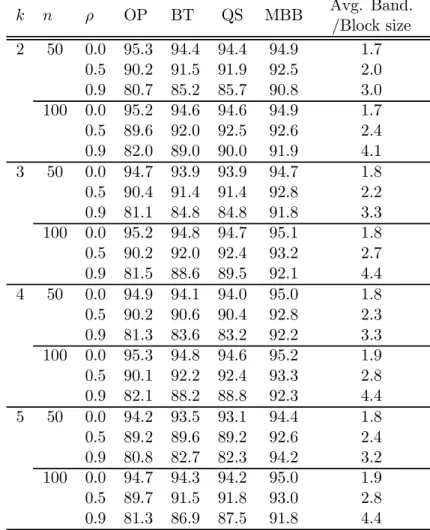
experiment we let ρ∈ {0,0.5,0.9}, and use 10,000 Monte Carlo trials with 999 bootstrap replications. We discarded 27 out of the 10,000 trials due to nonconvergence of the logit routine with k= 5,n= 50,
ρ = 0.9. Nonconvergence in the bootstrap resamples occurred on average less than 0.08% per Monte Carlo trial, for all experiments, except when k= 5, n= 50,ρ= 0.9, in which case this rate was 1.07%. When bootstrap optimization failed, we redrew new bootstrap indices. Table 1 reports coverage rates for theÞrst slope parameter.
Table 1. Coverage Rates of Nominal 95% symmetric Percentile-t Intervals: Logita
k n ρ OP BT QS MBB Avg. Band. /Block size 2 50 0.0 95.3 94.4 94.4 94.9 1.7 0.5 90.2 91.5 91.9 92.5 2.0 0.9 80.7 85.2 85.7 90.8 3.0 100 0.0 95.2 94.6 94.6 94.9 1.7 0.5 89.6 92.0 92.5 92.6 2.4 0.9 82.0 89.0 90.0 91.9 4.1 3 50 0.0 94.7 93.9 93.9 94.7 1.8 0.5 90.4 91.4 91.4 92.8 2.2 0.9 81.1 84.8 84.8 91.8 3.3 100 0.0 95.2 94.8 94.7 95.1 1.8 0.5 90.2 92.0 92.4 93.2 2.7 0.9 81.5 88.6 89.5 92.1 4.4 4 50 0.0 94.9 94.1 94.0 95.0 1.8 0.5 90.2 90.6 90.4 92.8 2.3 0.9 81.3 83.6 83.2 92.2 3.3 100 0.0 95.3 94.8 94.6 95.2 1.9 0.5 90.1 92.2 92.4 93.3 2.8 0.9 82.1 88.2 88.8 92.3 4.4 5 50 0.0 94.2 93.5 93.1 94.4 1.8 0.5 89.2 89.6 89.2 92.6 2.4 0.9 80.8 82.7 82.3 94.2 3.2 100 0.0 94.7 94.3 94.2 95.0 1.9 0.5 89.7 91.5 91.8 93.0 2.8 0.9 81.3 86.9 87.5 91.8 4.4
a10,000 Monte Carlo trials with 999 bootstrap replications each.
The main results are: a) when ρ = 0 all methods work well, even for n = 50; b) when ρ 6= 0 all intervals undercover, but the robust methods (BT, QS and MBB) outperform OP, as expected. The undercoverage is worse the larger is k and the smaller isn (an exception is MBB whenk = 5, ρ= 0.9, perhaps due to the larger rate of non-convergence); c) the MBB always outperforms BT or QS, especially for smallnand largek, and d) the average bandwidth/block size is larger for largerρandn, as expected.
ConÞdence Intervals for ARCH models We assume the following DGP:
(4.1) yt= ¯γ+εt, εt=vtht1/2, ht= ¯ω+ ¯αε2t−1.
A bar denotes true parameters and a superscriptodenotes pseudo-true parameters throughout. Usually
{vt}is assumed i.i.d. Here, we generatevt as AR(1):
(4.2) vt= ¯ρvt−1+ut, |¯ρ|<1, ut∼i.i.d. N ¡ 0,σ2u¢, σ2u = 1−¯ρ2. We can write (4.1)-(4.2) as yt = ¯γ+ ¯ρh1t/2h− 1/2 t−1 (yt−1−γ¯) +ht1/2ut, with ut ∼ i.i.d. N ¡ 0,σ2u¢. For ¯
ρ = 0, this is the usual ARCH(1). For ¯ρ6= 0 an extra term appears. Letting Ft−1 =σ(. . . yt−2, yt−1) and usingvt−1 =εt−1/h1t−/21, we haveE
¡ εt|Ft−1 ¢ = ¯ρh1t/2vt−1andE ¡ ε2t|Ft−1¢=ht ¡ 1−¯ρ2+ ¯ρ2v2t−1¢, so E¡yt|Ft−1 ¢ = ¯γ+¯ρh1t/2ht−−11/2(yt−1−γ¯)andvar ¡ yt|Ft−1 ¢
=σ2uht.We (mis)specify a Gaussian ARCH(1)
model parameterized by θ= (γ,ω,α)0:
yt=γ+et, et|Ft−1∼N(0, ht(θ)), t= 1, . . . , n,
with ht(θ) =ω+αe2t−1. The QMLEˆθn maximizes the log-likelihood
(4.3) Ln(θ) = 1 2n n X t=1
logft(θ), where logft(θ) =−
µ lnht(θ) + e2t ht(θ) ¶ .
The model is correctly speciÞed if and only if ¯ρ = 0. With misspeciÞcation the QMLE is generally inconsistent for ¯θ = (¯γ,ω¯,α¯) ; instead conÞdence intervals for pseudo-true parameters θo = (γo,ωo,αo)
pertain. We evaluateθoby simulation, as the value maximizing the expectation of (4.3), computed using 50,000 simulations. Considering the expected score corresponding toγ, we have
(4.4) E¡s1t ¡¯ θo¢¢=E µ αoεt−1 ht(θo) − ε2t h2 t(θo) (αoεt−1) + εt ht(θo) ¶ = 0, where¯θo = (¯γ,ωo,αo)0,ht ¡¯
θo¢=ωo+αoεt2−1and εt=yt−γ¯. For suitably symmetric joint distributions
of (εt,εt−1) centered at zero, it is plausible that this expectation equals zero, implying that γo = ¯γ, despite the misspeciÞcation. Proving this conjecture would distract us from our purpose here, but our simulations (with normal errors) always delivered γo = ¯γ. Accordingly we set γo= ¯γ in what follows.
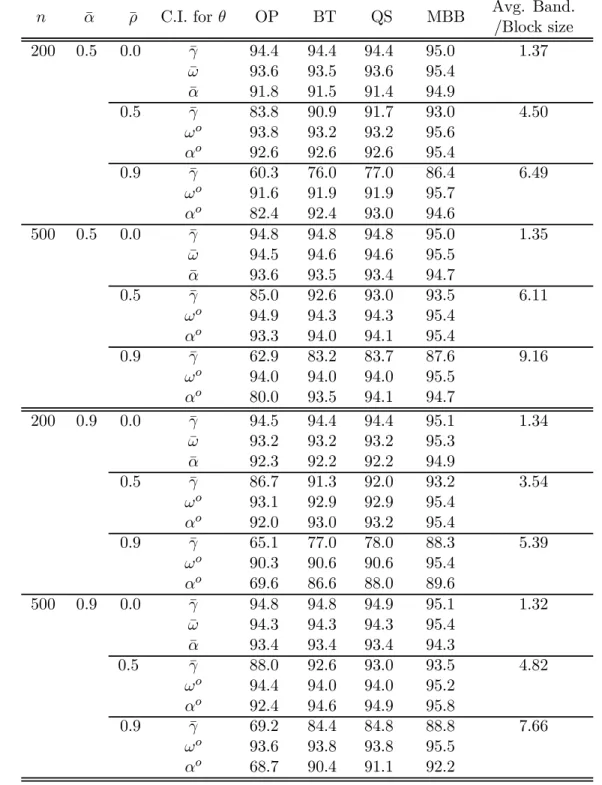
With misspeciÞcation, the scores are generally not a martingale difference sequence, justifying the use of robust inference on θo. As before, we consider OP, BT, QS and MBB. All but OP are robust to
Table 2. Coverage Rates of Nominal 95% symmetric Percentile-t Intervals: ARCHa
n α¯ ρ¯ C.I. for θ OP BT QS MBB Avg. Band. /Block size 200 0.5 0.0 γ¯ 94.4 94.4 94.4 95.0 1.37 ¯ ω 93.6 93.5 93.6 95.4 ¯ α 91.8 91.5 91.4 94.9 0.5 γ¯ 83.8 90.9 91.7 93.0 4.50 ωo 93.8 93.2 93.2 95.6 αo 92.6 92.6 92.6 95.4 0.9 γ¯ 60.3 76.0 77.0 86.4 6.49 ωo 91.6 91.9 91.9 95.7 αo 82.4 92.4 93.0 94.6 500 0.5 0.0 γ¯ 94.8 94.8 94.8 95.0 1.35 ¯ ω 94.5 94.6 94.6 95.5 ¯ α 93.6 93.5 93.4 94.7 0.5 γ¯ 85.0 92.6 93.0 93.5 6.11 ωo 94.9 94.3 94.3 95.4 αo 93.3 94.0 94.1 95.4 0.9 γ¯ 62.9 83.2 83.7 87.6 9.16 ωo 94.0 94.0 94.0 95.5 αo 80.0 93.5 94.1 94.7 200 0.9 0.0 γ¯ 94.5 94.4 94.4 95.1 1.34 ¯ ω 93.2 93.2 93.2 95.3 ¯ α 92.3 92.2 92.2 94.9 0.5 γ¯ 86.7 91.3 92.0 93.2 3.54 ωo 93.1 92.9 92.9 95.4 αo 92.0 93.0 93.2 95.4 0.9 γ¯ 65.1 77.0 78.0 88.3 5.39 ωo 90.3 90.6 90.6 95.4 αo 69.6 86.6 88.0 89.6 500 0.9 0.0 γ¯ 94.8 94.8 94.9 95.1 1.32 ¯ ω 94.3 94.3 94.3 95.4 ¯ α 93.4 93.4 93.4 94.3 0.5 γ¯ 88.0 92.6 93.0 93.5 4.82 ωo 94.4 94.0 94.0 95.2 αo 92.4 94.6 94.9 95.8 0.9 γ¯ 69.2 84.4 84.8 88.8 7.66 ωo 93.6 93.8 93.8 95.5 αo 68.7 90.4 91.1 92.2
a10,000 Monte Carlo trials with 999 bootstrap replications each. Pseudo-true parameters were calculated
by 50,000 simulations: forα¯= 0.5,(ωo,αo) = (0.07,0.798)when ρ¯= 0.5 and(ωo,αo) = (0.017,1.130) when¯ρ= 0.9; forα¯= 0.9, (ωo,αo) = (0.069,1.192) when ¯ρ= 0.5 and (ωo,αo) = (0.015,1.480) when ¯ρ= 0.9. γ¯= 1.0 and ω¯= 0.1 were set throughout.
misspeciÞcation. The OP interval is valid if theÞrst two conditional moments ofyt are not misspeciÞed.
Data on{yt} were generated by (4.1)-(4.2) with ¯γ= 1.0,ω¯ = 0.1 and six combinations of α¯ and ρ¯
taken from α¯ ∈ {0.5,0.9} and ρ¯ ∈ {0.0,0.5,0.9}. Table 2 contains results. We summarize as follows. When ¯ρ= 0 all methods tend to perform well, though the coverage of the BT and QS intervals tends
to slightly understate the true levels forω¯ and α¯. In contrast, the MBB intervals achieve almost correct coverage for ¯θ, with slight overstatement for ω¯. When ρ¯ = 0, the scores are a martingale difference sequence, and this is reßected in the bandwidth/block size parameter. When ρ¯ 6= 0, major Þndings are: (i) the OP intervals fail dramatically for ¯γ, exhibiting severe undercoverage which worsens as ρ¯
increases; (ii) the coverages of BT and QS for γ¯ are also well below the 95% nominal level, but we see clear improvement as n increases; (iii) the MBB outperforms the HAC methods; and (iv) the average chosen bandwidth/block size exceeds one, and tends to increase withn, as we expect.
5. Conclusion
The results presented here justify routine use of MBB methods for the QMLE in a general context. Further results in our setting establishing higher order improvements for the MBB (with recentering) are a logical next step and a promising subject for future work.
Appendix A: Assumptions and Proofs for Section 2
Throughout Appendix A,P is the probability measure governing the behavior of the original time series whileP∗
n,ωdenotes the probability measure induced by the bootstrap. For any bootstrap statisticTn∗(·,ω)
we writeT∗
n(·,ω)→0prob−Pn,∗ω, a.s.−P if for anyε>0there existsF ∈F withP(F) = 1such that
for allωinF,limn→∞Pn,∗ω[λ:|Tn∗(λ,ω)|>ε] = 0.We writeTn∗(·,ω)→0prob−Pn,∗ω, prob−P if for any
ε>0and for anyδ>0,limn→∞P £
ω:Pn,∗ω[λ:|Tn∗(λ,ω)|>ε]>δ¤= 0.Using a subsequence argument (e.g. Billingsley, 1995, Theorem 20.5), Tn∗(·,ω) →0 prob−Pn,∗ω, prob−P is equivalent to having that for any subsequence {n0} there exists a further subsequence{n00} such that Tn∗00(·,ω)→0 prob−Pn∗00,ω,
a.s.−P.For any distributionDwe write Tn∗(·,ω)⇒dPn,∗ω D prob
−P when for every subsequence there exists a further subsequence for which weak convergence underPn,∗ω takes place almost surely −P.
Assumption A is the doubly indexed counterpart of the regularity conditions used by GW.
Assumption A
A.1: Let(Ω,F, P)be a complete probability space. The observed data are a realization of a stochastic process ©Xnt :Ω→Rl,l∈N, n, t∈N
ª
, with Xnt(ω) = Wnt(. . . , Vt−1(ω), Vt(ω), Vt+1(ω), . . .), Vt:Ω→Rv,v∈N,and Wnt:×∞τ=−∞Rv →Rl such thatXnt is measurable for all n, t.
A.2: The functionsfnt :Rlt×Θ→R+ are such thatfnt(·,θ) is measurable for eachθ∈Θ, a compact
subset of Rp,p∈N,and fnt
¡
Xnt,·¢:Θ→R+ is continuous onΘa.s.−P,n, t= 1,2, . . . .
A.5: (i)©logfnt
¡ Xt
n,θ
¢ª
is Lipschitz continuous on Θ, i.e. ¯¯logfnt
¡ Xt n,θ ¢ −logfnt ¡ Xt n,θo¢¯¯ ≤ Lnt
|θ−θo|a.s.−P, ∀θ,θo ∈Θ, wheresupn©n−1Pnt=1E(Lnt)
ª
= O(1).(ii) ©∇2logfnt
¡
Xnt,θ¢ª is Lipschitz continuous on Θ.
A.6: For some r > 2: (i)©logfnt
¡
Xnt,θ¢ª is r−dominated on Θ uniformly in n, t, i.e. there exists Dnt : Rlt →R such that
¯ ¯logfnt
¡
Xnt,θ¢¯¯ ≤ Dnt for all θ in Θ and Dnt is measurable such that
kDntkr ≤ ∆<∞ for alln, t. (ii)
©
∇logfnt
¡
Xnt,θ¢ª is r-dominated on Θ uniformly in n, t. (iii) ©
∇2logfnt
¡
Xnt,θ¢ªis r-dominated onΘuniformly inn, t.
A.7: {Vt}is anα-mixing sequence of size−r2−r2, with r >2.
A.8: The elements of (i) ©logfnt
¡ Xt
n,θ
¢ª
are NED on {Vt} of size −12; (ii)
© ∇logfnt ¡ Xt n,θ ¢ª are NED on {Vt} of size −1 uniformly on (Θ,ρ), where ρ is any convenient norm on Rp, and (iii)
©
∇2logfnt
¡
Xnt,θ¢ªare NED on {Vt}of size −12 uniformly on(Θ,ρ).
A.9: (i) nBno ≡var³n−12 Pn
t=1∇logfnt
¡
Xnt,θon¢´o is uniformly positive deÞnite. (ii) ©Aon≡E¡n−1Pnt=1∇2logfnt
¡
Xnt,θon¢¢ªis uniformly nonsingular.
The usefulness of the following lemmas extends beyond the QMLE as they apply to prove the validity of bootstrap methods for other extremum estimators, such as GMM.
Lemma A.1 (IdentiÞable uniqueness of ˆθn). Let(Ω,F, P)be a complete probability space and let
Θ be a compact subset of Rp, p ∈ N. Let ©Q
n:Ω×Θ→R
ª
be a sequence of random functions continuous on Θ a.s.−P, and let ˆθn = arg maxΘQn(·,θ) a.s.−P. If supθ∈Θ
¯
¯Qn(·,θ)−Qn(θ)
¯ ¯→ 0 a.s.-P and if ©Qn:Θ→Rª has identiÞably unique maximizers {θon} on Θ, then nˆθn
o
is identiÞably unique onΘwith respect to{Qn} a.s.−P,i.e. there existsF ∈F,P(F) = 1, such that given anyε>0
and some δ(ε)>0, for each ω∈F,there existsN(ω,ε)<∞such that
sup n≥N(ω,ε) " max ηc(ˆθn,ε)Qn(ω,θ)−Qn ³ ω,ˆθn ´# ≤ −δ(ε)<0, where ηcn ³ ˆ θn,ε ´
is the compact complement of η
³ ˆ θn,ε ´ ≡ n θ∈Θ: ¯ ¯ ¯θ−ˆθn ¯ ¯ ¯<ε o . If instead supθ∈Θ¯¯Qn(·,θ)−Qn(θ) ¯
¯→0 prob−P then for any subsequencenˆθn0
o
ofnˆθn
o
, there exists a further subsequence nˆθn00
o
such thatnˆθn00
o
is identiÞably unique with respect to {Qn00}a.s.−P.
Lemma A.2 (Consistency of ˆθ∗n). Let(Ω,F, P)be a complete probability space and letΘbe a com-pact subset ofRp,p∈N. Let©Q
n:Ω×Θ→R
ª
be such that (a1)Qn(·,θ) :Ω→Ris measurable-F for
eachθ∈Θ;(a2) Qn(ω,·) :Θ→Ris continuous on Θa.s.−P. Letˆθn = arg maxΘQn(.,θ) a.s.−P be
measurable and assume there exists©Qn:Θ→Rªwith identiÞably unique maximizers {θon} such that (a3) supθ∈Θ¯¯Qn(·,θ)−Qn(θ)
¯
(A) ˆθn−θon→0prob−P.
Let (Λ,G) be a measurable space, and for each ω ∈ Ω and n ∈ N let ¡Λ,G, Pn,∗ω¢ be a complete probability space. Let ©Q∗n:Λ×Ω×Θ→Rª be such that (b1) Q∗n(·,ω,θ) : Λ → R is measurable-G for each(ω,θ) inΩ×Θ;(b2) Q∗n(λ,ω,·) :Θ→Ris continuous onΘ a.s.−P (i.e. for all λand almost all ω). Let nˆθ∗n:Λ×Ω→Θo be such that for each ω ∈ Ω, ˆθ∗n(·,ω) : Λ → Θ is measurable-G and
ˆ
θ∗n(·,ω) = arg maxΘQ∗n(·,ω,θ) a.s.−P. Assume further that (b3) supθ∈Θ|Q∗n(·,ω,θ)−Qn(ω,θ)|→0
prob−Pn,∗ω, prob−P. Then,
(B) ˆθ∗n(·,ω)−ˆθn(ω)→0, prob−Pn,∗ω, prob−P.
Lemma A.3 (Asymptotic Normality of ˆθ∗n). Let(Ω,F, P) be a complete probability space and let
Θ be a compact subset of Rp, p ∈ N. Let ©Q
n:Ω×Θ→R
ª
be such that (a1) Qn(·,θ) : Ω → R is
measurable-F for each θ ∈ Θ; (a2) Qn(ω,·) : Θ → R is continuously differentiable of order 2 on Θ
a.s.−P. Letˆθn= arg maxΘQn(·,θ) a.s.−P be measurable such thatˆθn−θon→0prob−P,where{θon}
is interior to Θ uniformly in n. Suppose there exists a nonstochastic sequence of p×p matrices {Bno}
that is O(1) and uniformly positive deÞnite such that (a3) Bno−1/2√n∇Qn(·,θon)⇒N(0, Ip). Suppose
further that there exists a sequence {An:Θ→Rp×p} such that {An} is continuous on Θ uniformly in
n, and (a4) supθ∈Θ¯¯∇2Qn(·,θ)−An(θ)
¯
¯ →0 prob−P, where {Aon≡An(θon)} is O(1) and uniformly
nonsingular. Then (A) Bno−1/2Aon√n ³ ˆ θn−θon ´ ⇒N(0, Ip).
Let (Λ,G) be a measurable space, and for each ω ∈ Ω and n ∈ N, let ¡Λ,G, P∗
n,ω
¢
be a complete probability space. Let ©Q∗
n:Λ×Ω×Θ→R
ª
be such that (b1) Q∗
n(·,ω,θ) : Λ → R is
measurable-G for each (ω,θ) in Ω×Θ; (b2) Q∗
n(λ,ω,·) : Θ → R is continuously differentiable of order 2 on Θ
a.s.−P. For each n = 1,2, . . . , let ˆθ∗n(·,ω) = arg maxΘQ∗n(·,ω,θ) a.s.−P be measurable such that
ˆ
θ∗n(·,ω)−ˆθn(ω)→0, prob−Pn,∗ω, prob−P.Assume further that (b3)B
o−1/2 n √n∇Q∗n ³ ·,ω,ˆθn(ω)´⇒dPn,∗ω N(0, Ip) inprob−P; (b4)supθ∈Θ ¯ ¯∇2Q∗ n(·,ω,θ)− ∇2Qn(ω,θ) ¯
¯→0prob−Pn,∗ω, prob−P. Then
(B) Bon−1/2Aon√n³θˆ∗n(·,ω)−ˆθn(ω)
´
⇒dPn,∗ω N(0, I
p) prob−P.
Lemma A.4 (Bootstrap Uniform WLLN). Let{q∗nt(·,ω,θ)}be a MBB resample of{qnt(ω,θ)}and
assume: (a) For each θ ∈ Θ ⊂ Rp, Θ a compact set, n−1Pnt=1(qnt∗ (·,ω,θ)−qnt(ω,θ)) → 0, prob−
Pn,∗ω, prob−P;and (b)∀θ,θo ∈Θ,|qnt(·,θ)−qnt(·,θo)|≤Lnt|θ−θo|a.s.−P,where
supn©n−1Pn
t=1E(Lnt)
ª
=O(1).Then, if`n=o(n),for any δ >0 andξ >0,
lim n→∞P " Pn,∗ω Ã sup θ∈Θ n−1 ¯ ¯ ¯ ¯ ¯ n X t=1 (qnt∗ (·,ω,θ)−qnt(ω,θ)) ¯ ¯ ¯ ¯ ¯>δ ! >ξ # = 0.
Lemma A.5 (Bootstrap Pointwise WLLN). For some r > 2, let {qnt :Ω×Θ→R} be such that for all n, t, there existsDnt:Ω→Rwith|qnt(·,θ)|≤Dnt for all θ∈Θand kDntkr≤∆<∞. For each θ∈Θlet {qnt∗ (·,ω,θ)} be a MBB resample of {qnt(ω,θ)}. If `n =o(n),then for any δ>0,ξ >0, and
for eachθ∈Θ, lim n→∞P " Pn,∗ω Ã n−1 ¯ ¯ ¯ ¯ ¯ n X t=1 (qnt∗ (·,ω,θ)−qnt(ω,θ)) ¯ ¯ ¯ ¯ ¯>δ ! >ξ # = 0.
Lemma A.6. Let {Qn:Ω×Θ→R} be a sequence of functions continuous on Θ a.s.−P and let
n
ˆ
θn:Ω→Θ
o
be such that ˆθn−θon → 0 prob−P. Suppose supθ∈Θ
¯
¯Qn(·,θ)−Qn(θ)
¯
¯→0 prob−P
where ©Qn:Θ→Rªis continuous onΘuniformly in n.Then,
(A) Qn
³
·,ˆθn(·)
´
−Qn(θon)→0 prob−P.
For each ω ∈Ω, let ¡Λ,G, Pn,∗ω¢be a complete probability space. If ˆθ∗n(·,ω)−ˆθn(ω) →0 prob−Pω∗,n,
prob−P andsupθ∈Θ|Q∗n(·,ω,θ)−Qn(ω,θ)|→0 prob−Pn,∗ω, prob−P,then
(B) Q∗n³·,ω,ˆθ∗n(·,ω)´−Qn
³
ω,ˆθn(ω)´→0 prob−Pn,∗ω, prob−P.
Proof of Theorem 2.1. We apply Lemma A.2 with Qn(·,θ) = n−1Pnt=1qnt(·,θ) and Q∗n(·,ω,θ) =
n−1Pn t=1q∗nt(·,ω,θ),whereqnt(·,θ)≡logfnt ¡ Xt n(·),θ ¢ ,and {q∗
nt(·,ω,θ)}is the MBB resample.
Con-ditions (a1)-(a3) are readily veriÞed under Assumption A. Assumption A.2. implies (b1) and (b2). To verify (b3) apply Lemmas A.4 and A.5, noting that `n =o(n). ¥
Proof of Theorem 2.2. We apply Lemma A.3 with the same choices of Qn(·,θ) and Q∗n(·,ω,θ)
as in Theorem 2.1. The result follows then by Polya’s theorem (e.g. Serßing, 1980, p. 20) since Cno = Aon−1BnoAon−1 is O(1) and the normal distribution is everywhere continuous. (a1)-(a4) can be veriÞed as in Theorem 5.7 of GW. (b1) and (b2) follow from A.2. Lemmas A.4 and A.5 imply (b4) given A.5(ii) and A.6(iii) and the conditions on`n. Lastly, we verify (b3). We have that (for anynand anyω)
n−1/2 n X t=1 s∗nt³·,ω,ˆθn ´ −n−1/2 n X t=1 snt ³ ω,ˆθn ´ =ξ1n+ξ2n+ξ3n, whereξ1n(·,ω)≡n−1/2Pnt=1(s∗nt(·,ω,θon)−snt(ω,θon)) ;ξ2n(ω)≡ −n−1/2 Pn t=1 ³ snt ³ ω,ˆθn ´ −snt(ω,θon) ´ ; and ξ3n(·,ω) ≡n−1/2Pnt=1 ³ s∗nt ³ ·,ω,ˆθn ´ −s∗nt(·,ω,θon) ´
.It suffices to show that for any subsequence n0 there exists a further subsequence n00 such thata.s.−P (i) Bno−001/2ξ1n00(·,ω) ⇒
dP∗
n00,ω N(0, I
p), and
(ii)ξ2n00(ω) +ξ3n00(·,ω)→0prob−Pn∗00,ω. The result then follows by Lemma 4.7 of White (2000), since
n00−1Pnt=100 sn00t
³
ω,ˆθn00
´
= 0 for all n00 sufficiently large, a.s.−P, by A.3(ii) and the F.O.C. for ˆθn00.
Theorem 2.2 of Gonçalves and White (2001) implies (i) under Assumption A strengthened by 2.1 and 2.2. To prove (ii), let F ≡F1∩F2, with F1 the set of ω on which (i) holds, and F2 the set on which the remaining conditions of Lemma A.3 hold. Note that P(F) = 1. For Þxed ω in F,two mean value expansions yield
ξ2n00(ω) +ξ3n00(·,ω) =ζn00(·,ω) √ n00³ˆθn00(ω)−θo n00 ´ , ζn00(·,ω) = n 00−1Pn00 t=1 ¡ ∇0s∗ n00t ¡ ·,ω,¯θ∗n00 ¢ − ∇0sn00t ¡
ω,¯θn00¢¢, with ¯θn00 and ¯θ∗n00 (possibly different) mean
values lying between ˆθn00 and θno00. Lemma A.6 implies ζn00(·,ω) → 0 prob−Pn∗00,ω for all ω ∈ F,
given the uniform convergence of ©∇2Q∗n00(·,ω,θ)− ∇2Qn00(ω,θ)ª and ©∇2Qn00(ω,θ)−An00(θ)ª, and
the convergences of¯θn00−θon00 and¯θ∗n00−θon00 to zero. Since √
n00³ˆθn00(ω)−θo n00
´
=O(1)onF, it follows that ξ2n00(ω) +ξ3n00(·,ω)→0prob−Pn∗00,ω forω∈F,P(F) = 1. ¥
Proof of Corollary 2.1. We can show√n³ˆθ∗1n−ˆθn´−√n³θˆ∗n−ˆθn´→0prob−Pn,∗ω, prob−P, given the deÞnition of ˆθ∗1n and the fact that Aˆ∗n−Aˆn→0 prob−Pn,∗ω, prob−P,by Lemma A.6. ¥
Proof of Lemma A.1. LetF ≡ n ω : ˆθn(ω)−θon→0 o ∩©ω: supΘ¯¯Qn(ω,θ)−Qn(θ) ¯ ¯→0ª.By The-orem 3.4 of White (1994),P(F) = 1. Fixε0 >0andωinF. Then, there existsN0(ω,ε0)<∞such that
for alln > N0(ω,ε0), ¯ ¯ ¯ˆθn(ω)−θon ¯ ¯ ¯<ε0. Because{θo
n}is identiÞably unique onΘ, givenε0 >0there
ex-istsN1(ε0)<∞andδ0(ε0)>0such thatsupn≥N1(ε0)
£ maxηc(θo n,ε0)Qn(θ)−Qn(θ o n) ¤ ≡ −δ0(ε0)<0,where
η(θon,ε0) ≡ {θ∈Θ:|θ−θon|<ε0}. By Corollary 3.8 of White (1994), there exists N2 ¡
ω,δ0(ε0)¢ < ∞ such that for all n > N2
¡ ω,δ0(ε0)¢, ¯ ¯ ¯Qn ³ ω,ˆθn(ω) ´ −Qn(θon) ¯ ¯
¯< δ0(4ε0). Also, for alln > N2 ¡ ω,δ0(ε0)¢, maxηc(θo n,ε0)Qn(ω,θ)≤maxηc(θon,ε0)Qn(θ)+ δ0(ε0) 4 . LetN(ω,ε0) = max © N0(ω,ε0), N1(ε0), N2 ¡ ω,δ0(ε0)¢ª. Hence sup n≥N(ω,ε0) " max ηc(ˆθn(ω),2ε0)Qn(ω,θ)−Qn ³ ω,ˆθn(ω)´ # ≤ sup n≥N(ω,ε0) · max ηc(θon,ε0)Qn(ω,θ)−Qn(θ o n) + δ0(ε0) 4 ¸ ≤ sup n≥N(ω,ε0) · max ηc(θo n,ε0) Qn(θ)−Qn(θon) +2δ 0(ε0) 4 ¸ ≤ −δ 0(ε0) 2 .
Set ε = 2ε0 and δ(ε) = δ0(ε2/2) > 0 to obtain the result for all ω in F and P(F) = 1. If instead
supΘ¯¯Qn(ω,θ)−Qn(θ)
¯
¯→0prob−P, then for any{n0} there exists{n00}such that
supΘ¯¯Qn00(ω,θ)−Qn00(θ)
¯
¯ = o(1) and ˆθn00(ω)−θon00 =o(1) a.s.−P. The result thus holds for {n00}
a.s.−P. ¥
Proof of Lemma A.2. (A) follows by Theorem 3.4 of White (1994) under (a1)-(a3). To prove (B), note that for any subsequence {n0}, by Lemma A.1 there exists {n00} such that
n
ˆ
θn00
o
is identiÞably uniquea.s.−P, given (a1)-(a3). Now apply Theorem 3.4 of White (1994). ¥
Proof of Lemma A.3. (A) follows by White’s (1994) Theorem 6.2 under (a1)-(a4). To prove (B), it suffices to show that for any subsequence {n0} there exists a further subsequence {n00} such that B∗−n001/2A∗n00
√
n00³ˆθ∗n00(·,ω)−ˆθn00(ω)´ ⇒dPn∗00,ω N(0, I
p), a.s.−P. This follows by applying White’s
(1994) Theorem 6.2 to an appropriately chosen subsequence, given ω inF such thatP(F) = 1. ¥
Proof of Lemma A.5. Fixθ∈Θ, and write n−1Pn t=1(qnt∗ (θ)−qnt(θ)) =Q1n+Q2n, with Q1n≡n−1 n X t=1 (qnt∗ (θ)−E∗(qnt∗ (θ))), and Q2n≡E∗ Ã n−1 n X t=1 q∗nt(θ) ! −n−1 n X t=1 qnt(θ),
where we omitω to conserve space. Q2n→0prob−P sinceE∗
¡ n−1Pnt=1q∗nt(θ)¢=n−1Pnt=1qnt(θ) + OP ¡` n ¢
(cf. Lemma A.1 of Fitzenberger (1997)) and n` →0. By Chebyshev’s inequality, for anyδ >0, P∗ n,ω(|Q1n|>δ) ≤ δ12n−1var∗ ¡ n−1/2Pn t=1q∗nt(θ) ¢ , where var∗¡n−1/2Pn t=1q∗nt(θ) ¢
has a closed form expression involving products of qnt(θ) and qn,t+τ(θ) (cf. Gonçalves and White (2001)). Under the
domination condition on {qnt(θ)} and the properties of the MBB, repeated application of Minkowski
and Hölder’s inequalities yields°°var∗¡n−1/2Pnt=1qnt∗ (θ)¢°°r 2
=O(`)for some r >2. Thus, by Markov’s inequality,P£Pn,∗ω(|Q1n|>δ)>ξ¤=O
³¡`
n
¢r/2´
→0 given `=o(n). ¥
Proof of Lemma A.6. (A) holds by White (1994, Corollary 3.8). (B) By uniform continuity ofQ¯n on
Θ, given ε>0 there existsδ(ε)>0such that ¯¯¯Q¯n(θ)−Q¯n
³ ˆ θn´¯¯¯>ε/3 implies ¯ ¯ ¯θ−ˆθn ¯ ¯ ¯>δ(ε).So P h Pn,∗ω³¯¯¯Q∗n ³ ·,ω,ˆθ∗n ´ −Qn ³ ω,ˆθn´¯¯¯>ε ´ >ε i ≤P · Pn,∗ω µ sup Θ | Q∗n(·,ω,θ)−Qn(ω,θ)|>ε/3 ¶ >ε/3 ¸ +P · Pn,∗ω µ 2 sup Θ ¯ ¯Qn(ω,θ)−Q¯n(θ) ¯ ¯>ε/3 ¶ >ε/3 ¸ +PhPn,∗ω³¯¯¯ˆθ∗n−ˆθn ¯ ¯ ¯>δ(ε)´>ε/3i≡ξ1+ξ2+ξ3, with obvious deÞnitions. By uniform convergence ofQ∗n(·,ω,θ)−Qn(ω,θ)to zero,ξ1 →0.Similarly, by uniform convergence ofQn(·,θ)−Q¯n(θ)to zero,ξ2→0sinceξ2≤P
¡
2 supΘ¯¯Qn(ω,θ)−Q¯n(θ)
¯
¯>ε/3¢. Finally, ξ3 →0because ˆθ∗n(·,ω)−ˆθn(ω)→0prob−Pn,∗ω, prob−P.¥
Appendix B: Proofs for Section 3
Throughout Appendix B, C denotes a generic constant. The dependence of the bootstrap variables on
ω and onnwill also be omitted as it is not relevant for the arguments made here.
Lemma B.1 (Studentization of the sample mean). Let{Xnt}satisfy Assumptions 2.10 and 2.2 of
Gonçalves and White (2001), where Assumption 2.20 is strengthened by A.2.20 n−1Pnt=1|µnt−µ¯n|2+δ =o
³
`−n1−δ/2
´
for someδ such that0<δ≤2.
Then, if`n→ ∞with`n=o
¡
n1/2¢we have that for anyε>0,limn→∞P ¡
P∗¡¯¯ˆσ∗n2−σˆ2n¯¯>ε¢>ε¢= 0,where σˆ2n= var∗¡√nX¯n∗¢and σˆ∗n2 =k−1Pki=1³`−1/2Pt`=1¡XIi+t−X¯n∗
¢´2 .
Lemma B.2. Let{Xnt} and{Znt} satisfykXntk2+δ≤∆andkZntk2+δ ≤∆, t= 1, . . . , n,n= 1,2, . . . ,
for any 0<δ ≤2 and some ∆<∞. Let k=n/`. If {Ii}ki=1 are i.i.d. uniform on {0, . . . , n−`} and if `n→ ∞ and `n=o
¡
n1/2¢, then for anyε>0,
lim n→∞P à P∗ﯯ¯ ¯k− 1 k X i=1 `−1 ` X t=1 Xn,Ii+t ` X t=1 Zn,Ii+t ¯ ¯ ¯ ¯ ¯> n 1/2ε ! >ε ! = 0.
Proof of Theorem 3.1. By GW’s Theorem 7.5 Wn ⇒ Xq2 under Ho. Next, we prove Wn∗ ⇒dP∗
Xq2 prob−P. A mean value expansion of rn
³ ˆ θ∗n´ around ˆθn yields √n ³ rn ³ ˆ θ∗n´−rn ³ ˆ θn ´´ ⇒dP∗
N(0, RonCnoRon0)prob−P,implyingn(ˆr∗n−rˆn)0(RonCnoRon0)−1(ˆrn∗−rˆn)⇒dP∗ Xq2 prob−P.Thus, it suffices
to prove: (i) Rˆ∗n−Ron → 0 prob−P∗, prob−P ; (ii) Aˆ∗n−Aon → 0 prob−P∗, prob−P ; and (iii)
ˆ
B∗n−Bno → 0 prob−P∗, prob−P. (i) follows by continuity ofrn on Θ (uniformly in n) and because
ˆ
θ∗n−θon →0 prob−P∗, prob−P by Theorem 2.1; similarly, by Theorem 2.1 and Lemma A.6, we have
ˆ
A∗n−Aˆn→0prob−P∗, prob−P, which implies (ii) sinceAˆn−Aon→0prob−P. To prove (iii), consider
˜ Bn∗o =k−1 k X i=1 Ã `−1/2 ` X t=1 ¡ sn,Ii+t ¡ XIi+t n ,θon ¢ −s¯∗no¢ ! Ã `−1/2 ` X t=1 ¡ sn,Ii+t ¡ XIi+t n ,θon ¢ −¯s∗no¢ !0 =k−1 k X i=1 `−1 ` X t=1 sn,Ii+t ¡ XIi+t n ,θon ¢X` t=1 s0n,I i+t ¡ XIi+t n ,θon ¢ −`s¯∗nos¯∗no0, (B.1)
where s¯∗no = n−1Ptn=1s∗nt(θon). By Lemma B.1 B˜n∗o −Bn,o1 → 0, prob−P∗, prob−P, where Bn,o1 = var∗¡n−1/2Pnt=1s∗nt(θno)¢. By Gonçalves and White’s (2001) Corollary 2.1, Bn,o1−Bno → 0, prob−P, implying B˜n∗o−Bno →0, prob−P∗, prob−P. Thus, it suffices that Bˆn∗−B˜n∗o→0,prob−P∗, prob−P. From (3.1) and (B.1) we can writeBˆn∗−B˜n∗o=D1+D2,where
D1 ≡ k−1 k X i=1 `−1 " ` X t=1 sn,Ii+t ³ XIi+t n ,ˆθ ∗ n ´X` t=1 s0n,Ii+t³XIi+t n ,ˆθ ∗ n ´ − ` X t=1 sn,Ii+t ¡ XIi+t n ,θon ¢X` t=1 s0n,Ii+t¡XIi+t n ,θon ¢#
and D2 ≡ `s¯∗no¯sn∗o0. Note that ¯s∗no = B o1/2
n Bno−1/2(¯sn∗o−s¯on) +B o1/2
n Bno−1/2s¯on ≡ E1 +E2, with s¯on =
n−1Pnt=1sont. We have E1=OP∗¡n−1/2¢prob−P by Gonçalves and White’s (2001) Theorem 2.2, and E2 = OP
¡
n−1/2¢ by the CLT for {so
nt}. Thus, D2 → 0 prob−P∗, prob−P. To show that D1 → 0 prob−P∗, prob−P we take a mean value expansion about θo
n of a typical element of D1 and apply Lemma B.2 twice with Xnt= supθ∈Θ
¯ ¯ ∂ ∂θ0snt,j ¡ Xnt,θ¢¯¯and Znt = supθ∈Θ ¯ ¯snt,j ¡ Xnt,θ¢¯¯. ¥
Proof of Theorem 3.2. The proof follows GW (Theorem 7.9, p. 128) using Lemmas B.1 and B.2.
Proof of Lemma B.1. The proof consists of two steps: (1) showσ˜∗n2−ˆσ2n →0 prob−P∗, prob−P, where ˜σ∗n2 = k−1Pki=1³`−1/2P`t=1¡XIi+t−X¯α,n
¢´2
, with X¯α,n = E∗
¡¯
Xn∗¢; (2) show σˆn∗2−˜σ∗n2 → 0 prob−P∗, prob −P. Let Aˆi = `−1/2P`t=1¡Xi+t−X¯n∗
¢ and Ai = `−1/2P`t=1¡Xi+t−X¯α,n¢ so that ˆ σ∗n2 =k−1Pki=1Aˆ2I i and σ˜ ∗2 n,1 =k−1 Pk
i=1A2Ii. (1) By two applications of Markov’s inequality it suffices to show E¡E∗¯¯σ˜∗2
n −σˆ2n
¯ ¯p¢
= o(1) for some p > 1. We take p = 1 +δ/2 with 0 < δ ≤ 2. Since E∗¡˜σ∗2 n ¢ =E∗¡A2 I1 ¢ = (n−`+ 1)−1Pni=0−`A2
i ≡σˆ2n(cf. Künsch (1989, Theorems 3.1 and 3.4)), we have
E∗¯¯σ˜∗n2−ˆσ2n¯¯p =E∗ ¯ ¯ ¯ ¯ ¯k− 1 k X i=1 ¡ A2Ii−E∗¡A2I1¢¢ ¯ ¯ ¯ ¯ ¯ p ≤k−pCE∗ ¯ ¯ ¯ ¯ ¯ k X i=1 ¡ A2Ii−E∗¡A2I1¢¢2 ¯ ¯ ¯ ¯ ¯ p/2 ,
by Burkholder’s inequality, because©A2
Ii−E
∗¡A2
I1
¢ª
are (conditionally) i.i.d. zero mean. For1< p≤2, x ≥ 0 and y ≥ 0, the inequality (x+y)p/2 ≤ xp/2 +yp/2 implies E∗
¯ ¯ ¯Pki=1 ¡ A2I i−E ∗¡A2 I1 ¢¢2¯¯ ¯p/2 ≤ kE∗¯¯A2I 1 −E ∗¡A2 I1¢¯¯ p so that E∗¯¯σ˜n∗2−σˆ2n¯¯p ≤ 2pCk−(p−1)E∗|AI1|
2p. Thus, it suffices that
k−(p−1)E³E∗|AI1|
2p´=o(1).Some algebra yieldsE³E∗
|AI1| 2p´ ≤C(F1+F2+F3), where F1 = (n−`+ 1)−1 n−` X i=0 `−pE ¯ ¯ ¯ ¯ ¯ ` X t=1 Zn,i+t ¯ ¯ ¯ ¯ ¯ 2p ;F2 = (n−`+ 1)−1 n−` X i=0 `−p ¯ ¯ ¯ ¯ ¯ ` X t=1 ¡ µn,i+t−µ¯α,n¢ ¯ ¯ ¯ ¯ ¯ 2p , and F3 = (n−`+ 1)−1Pni=0−``−pE ³¯¯ `Z¯α,n ¯ ¯2p´
, with Znt ≡ Xnt −µnt, and for any {Ynt} Y¯α,n =
(n−`+ 1)−1Pin=0−``−1P`
t=1Yn,i+t = Pnt=1αntYnt with αnt = (n−`1+1)`min{t, `, n−t+ 1}. Under
As-sumption 2.10,E ¯ ¯ ¯P`t=1Zn,i+t ¯ ¯
¯2p < C`p (cf. Gonçalves and White (2001), p.18 for a similar argument), implying k−(p−1)F
1 = O ³¡`
n
¢p−1´
= o(1), and similarly for k−(p−1)F
3. If µnt = µ for all t, F2 = 0 because µ¯α,n =Pnt=1αntµ=µ asPnt=1αnt = 1. Otherwise, by A.2.20,F2 =o(1), so k−(p−1)F2 =o(1). For (2), note AˆIi = √ `¡X¯Ii−X¯n∗ ¢ , where X¯Ii =`− 1P` t=1XIi+t, and Ai = √ `¡X¯Ii−X¯α,n ¢ , implying ˆ σ∗n2−σ˜∗n2 =−`¡X¯n∗−X¯α,n ¢2 =OP∗¡n`¢→0 prob−P, since √n¡X¯n∗−X¯α,n ¢ ⇒dP∗ N(0,1)prob−P
by Theorem 2.2 of Gonçalves and White (2001). ¥
Proof of Lemma B.2. Let Sn,i1 = P`t=1Xn,i+t and Sn,i2 =
P`
t=1Zn,i+t.By Markov’s inequality, for
some1< p≤2,it suffices to show n−p/2E∗³¯¯¯k−1Pki=1`−1Sn,I1
iS 2 n,Ii ¯ ¯ ¯p´→0prob−P. Letp= 1 +δ/2,
0<δ ≤2, and noteE∗³¯¯¯k−1Pki=1`−1Sn,I1
iS 2 n,Ii ¯ ¯ ¯p´≤C(F1+F2), with F1=E∗ ﯯ ¯ ¯k− 1 k X i=1
`−1¡Sn,I1 iSn,I2 i−E∗¡Sn,I1 iSn,I2 i¢¢ ¯ ¯ ¯ ¯ ¯ p! and F2 =E∗ ¯ ¯ ¯ ¯ ¯k− 1 k X i=1 `−1E∗¡Sn,I1 iSn,I2 i¢ ¯ ¯ ¯ ¯ ¯ p .
By the Burkholder and cr-inequalities F1 ≤ C`−pk−(p−1)E∗ ¯ ¯ ¯Sn,I1 1Sn,I2 1 ¯ ¯ ¯p ≤ C`−pE∗ ¯ ¯ ¯Sn,I1 1Sn,I2 1 ¯ ¯ ¯p, since n Sn,I1 iS 2 n,Ii−E ∗³S1 n,IiS 2 n,Ii ´o
are i.i.d. zero mean, andk−(p−1)≤1 forp >1. Similarly, F2 ≤ C`−pE∗¯¯¯S1 n,I1S 2 n,I1 ¯ ¯
¯p.By the Cauchy-Schwarz and Minkowski inequalities, E³E∗¯¯¯S1
n,I1S 2 n,I1 ¯ ¯ ¯p´≤C`2p. Thus,F1+F2 =OP(`p), and son−p/2(F1+F2)P =O ³³ ` n1/2 ´p´ =op(1),since`=o ¡ n1/2¢. ¥
References
[1] Andrews, D.W.K. (1991): “Heteroskedasticity and Autocorrelation Consistent Covariance Matrix Estimation,” Econometrica,59, 817-858.
[2] (2001): “Higher-order Improvements of a Computationally Attractivek-step Bootstrap,” Econometrica, 69, forthcoming.
[3] Billingsley, P.(1995): Probability and Measure, New York: Wiley.
[4] Corradi, V., and N. R. Swanson (2001): “Bootstrap Conditional Distribution Tests under Dynamic MisspeciÞcation,” University of Exeter, manuscript.
[5] Davison, A.C., and P. Hall(1993): “On Studentizing and Blocking Methods for Implementing the Bootstrap with Dependent Data,” Australian Journal of Statistics, 35, 215-224.
[7] Davidson, R., and J.G. MacKinnon (1999): “Bootstrap Testing in Nonlinear Models,” Inter-national Economic Review,40, 487-508.
[8] Fitzenberger, B. (1997): “The Moving Blocks Bootstrap and Robust Inference for Linear Least Squares and Quantile Regressions,” Journal of Econometrics,82, 235-287.
[9] Gallant, A.R., and H. White (1988): A UniÞed Theory of Estimation and Inference for Non-linear Dynamic Models. New York: Basil Blackwell.
[10] Ghosh, M., W.C. Parr, W.C., K. Singh, and G.J. Babu (1984): “A Note on Bootstrapping the Sample Median,” Annals of Statistics,12, 1130-1135.
[11] GONÇALVES, S., and H. White (2001): “The Bootstrap of the Mean for Dependent Heteroge-neous Arrays,” forthcomingEconometric Theory.
[12] (2000): “Bootstrap Variance Estimation for Smooth Functions of Sample Means and for Linear Regressions,” Université de Montréal, manuscript.
[13] GÖTZE,F., and H.R.KÜNSCH(1996): “Second-order Correctness of the Blockwise Bootstrap for Stationary Observations,”Annals of Statistics, 24, 1914-1933.
[14] Gourieroux, C., Monfort, A. and A. Trognon(1984), “Estimation and Test in Probit Models with Serial Correlation,” in Alternative Approaches to Time Series Analysis, ed. Florens, J.P., Mouchart, M., Raoult, J.P. and L. Simar. Brussels: Publications des Facultés Universitaires Saint-Louis.
[15] Hahn, J.(1996): “A Note on Bootstrapping Generalized Method of Moments Estimators,” Econo-metric Theory,12, 187-197.
[16] Hall, P., and J. Horowitz (1996): “Bootstrap Critical Values for Tests based on Generalized-Method-of-Moments Estimators,”Econometrica, 64, 891-916.
[17] Inoue, A. and Shintani, M. (2001) “Bootstrapping GMM estimators for Time Series,” North Carolina State University, manuscript.
[18] KÜNSCH, H.R. (1989): “The Jackknife and the Bootstrap for General Stationary Observations,” Annals of Statistics, 17, 1217-1241.
[19] Lahiri, S.N. (1996): “On Edgeworth Expansion and Moving Block Bootstrap for Studentized M-Estimators in Multiple Linear Regression Models,”Journal of Multivariate Analysis, 56, 42-59. [20] Liu, R.Y., and K. Singh (1992) “Moving Blocks Jackknife and Bootstrap Capture Weak
De-pendence,” in Exploring the Limits of the Bootstrap, ed. by R. LePage and L. Billiard. New York: Wiley.
[21] Newey, W.K., and K.D. West (1987): “A Simple Positive Semi-deÞnite, Heteroskedastic and Autocorrelation Consistent Covariance Matrix,” Econometrica,55, 703-708.
[22] Politis, D., and J. Romano(1992): “A General Resampling Scheme for Triangular Arrays ofα -mixing Random Variables with Application to the Problem of Spectral Density Estimation,”Annals of Statistics, 20, 1985-2007.
[23] PÖTSCHER, B.M., and I.R. Prucha(1991): “Basic Structure of the Asymptotic Theory in Dy-namic Nonlinear Econometric Models, Part I: Consistency and Approximation Concepts,” Econo-metric Reviews,10, 125-216.
[24] Serfling, R.J.(1980): Approximation Theorems of Mathematical Statistics. New York: Wiley. [25] Shao, J. (1992): “Bootstrap Variance Estimators with Truncation,” Statistics and Probability
Letters,15, 95-101.
[26] White, H. (1994): Estimation, Inference and SpeciÞcation Analysis. Cambridge: Cambridge Uni-versity Press.