Volume 1 Issue 2 Article 4 October 2012
A Sample of Research Data Curation and Management Courses
A Sample of Research Data Curation and Management Courses
Andrew T. CreamerUniversity of Massachusetts Medical School Et al.
Let us know how access to this document benefits you.
Follow this and additional works at: https://escholarship.umassmed.edu/jeslibPart of the Curriculum and Instruction Commons, Library and Information Science Commons, and the Other Education Commons
Recommended Citation Recommended Citation
Creamer AT, Morales ME, Kafel D, Crespo J, Martin ER. A Sample of Research Data Curation and Management Courses. Journal of eScience Librarianship 1(2): e1016. https://doi.org/10.7191/ jeslib.2012.1016. Retrieved from https://escholarship.umassmed.edu/jeslib/vol1/iss2/4
Creative Commons License
This work is licensed under a Creative Commons Attribution-Noncommercial-Share Alike 3.0 License.
This material is brought to you by eScholarship@UMMS. It has been accepted for inclusion in Journal of eScience Librarianship by an authorized administrator of eScholarship@UMMS. For more information, please contact [email protected].
A Sample of Research Data Curation and Management Courses
Andrew T. Creamer, Myrna E. Morales, Donna Kafel, Javier Crespo, Elaine R. Martin
University of Massachusetts Medical School, Worcester, MA, USA Abstract
Objective: This paper identifies a sample of research data curation and management courses available at American Library Asso-ciation-accredited Library and Information Science (LIS) Programs in North America.
Methods: This sample was identified
through a content analysis of LIS program course descriptions and syllabi (N=58). Us-ing a framework of research data manage-ment and curation competencies, the team gathered a sample of research data curation and management courses offered between fall 2011 and summer 2012.
Results: Only 13 (22%) of LIS programs currently offer a course focused on the man-agement and curation of research data. Conclusion: Although the literature supports LIS professionals adopting new roles and engaging in eScience and data manage-ment, most LIS data-related programs do not have a separate course solely focused on research data management. More LIS pro-grams will need to adapt their curricula in order to help students and practicing profes-sionals develop the needed competencies in research data curation and management.
Introduction
Research data management is a relatively new field for librarians. It involves manag-ing, preservmanag-ing, providmanag-ing, or helping to pro-vide storage and access to large data sets accumulated by researchers. It strives to provide ways for these data to be made eas-ily available to other researchers. This may require traditional library skills such as cata-loging and developing search procedures for large data sets, and ways to merge sets in a meaningful way. In 2010, Anna Gold fore-casted that “a formal curriculum for training and education is emerging, and positions for professional librarians are being advertised to support data curation programs and ser-
vices.” In 2011 Kim et al. (2011) analyzed these curricula and professional employment postings and identified the educational re-quirements for data librarians and a top-ten list of recommended courses to gain these skills.
Indeed, over the last two years there have been a number of educational initiatives funded by universities and funding agencies to support educating librarians to manage and curate research data. The website of the University of Illinois at Urbana-Champaign (UIUC) iSchool’s Data Curation Education Program (DCEP), originally estab-lished through a grant from the Institute of Museum and Library Services (IMLS) to
de-Correspondence to Andrew Creamer: [email protected]
Keywords: research data management, data science, data management curriculum, data
velop a data curation curriculum, defines da-ta curation as “the active and on-going man-agement of data through its lifecycle of inter-est and usefulness to scholarship, science, and education. Data curation activities ena-ble data discovery and retrieval, maintain its quality, add value, and provide for re-use over time, and this new field includes au-thentication, archiving, management, preser-vation, retrieval, and representation” (2011). It and a few other innovative LIS programs and iSchools have recognized the need for research data management in library and information science education and have been leaders in offering this type of instruc-tion to interested students and practicing li-brarians.
There are many reasons why research data management should become a part of the LIS curriculum. Writing about the role of li-braries in managing data, Perry et al. (2005) noted: “…boundaries are disappearing among the published literature, research da-ta, research databases, and clinical patient data. As research literature increasingly ex-ists alongside repositories of source evi-dence, large bodies of data can be used to support individual, clinical, or scientific deci-sions. These datasets may be incorporated and manipulated into knowledge sources through creating application-focused data-bases. Opportunities exist for both informati-cians and librarians to create, maintain, and develop these integrated information re-sources.” Bryan Heidorn (2011) added ur-gency to these arguments for librarians em-bracing data management: “Scientists, other scholars, and all of society are now produc-ing, storproduc-ing, and disseminating digital data that underpin the aforementioned documents in much larger volumes than the text. The survival of this data is in question since the data are not housed in long-lived institutions such as libraries. This situation threatens the underlying principles of scientific replica-bility since in many cases data cannot readi-ly be collected again. Libraries are the insti-tutions that could best manage this intellec-tual output.”
Cheek and Bradigan (2010) and Creamer et al. (2011) found low numbers of librarians in their samples currently involved in research data management activities. However, Creamer et al. (2012) in a subsequent sur-vey found that a third of a sample of health sciences and science and technology librari-ans not currently managing research da-tasets were interested in gaining competen-cies in research data management because they saw it as a future component of their responsibilities. Thus, there is a demand for research data management competencies for practicing librarians: They would benefit from knowing the options for finding a LIS course to attain them.
Varvel et al. (2012) did a comprehensive study of 476 data-related courses at 55 iS-chool and Library and Information Science programs offered in the fall of 2011 and found only 11 institutions offered 5 programs specifically focused on data curation. The study found 12 institutions offered programs that incorporated data-related content, and 15 that offered courses covering digital con-tent but not on data curation. However, this study did not list the names of these institu-tions, programs, or courses. In the fall of 2011 and spring of 2012 the authors set out to look at these data-related courses offered by LIS programs and collect a sample that could provide instruction in research data management. The purpose of this paper is to present the results of that analysis so that any librarian interested in taking such a course would have a better idea of the cur-rent options available.
Methods
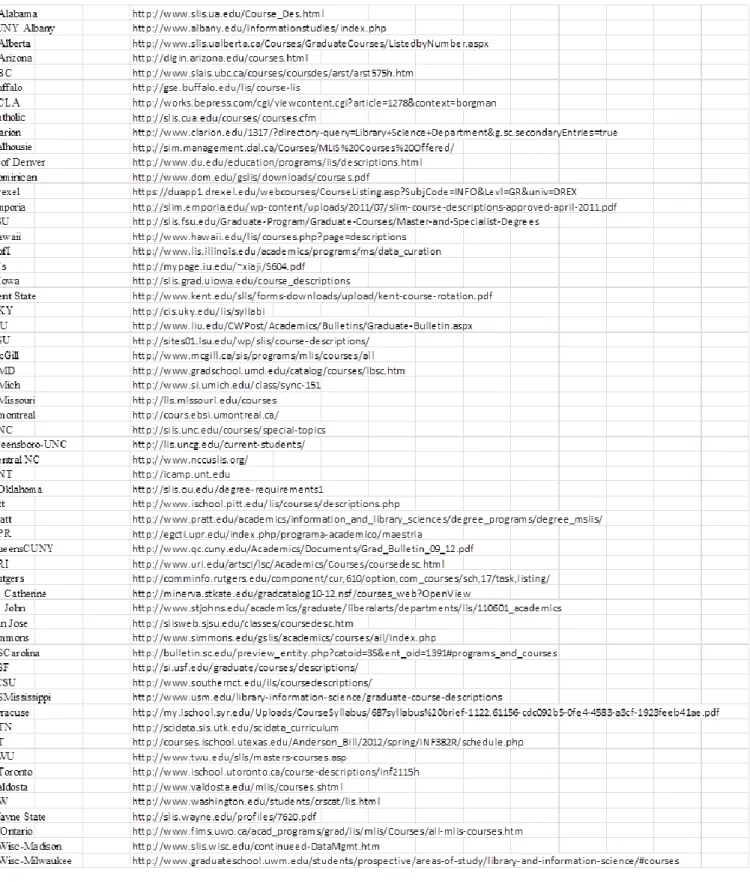
A content analysis of course curricula, de-scriptions, and syllabi related to research data management offered to students at 58 ALA accredited LIS programs in North Amer-ica was performed. The sample (N=58) in-cluded institutions in the United States, Can-ada, and Puerto Rico. The researchers searched the course catalogues, syllabi, and course descriptions available on the web-
91
sites of each institution (see Table 1). Simi-lar to Varvel et al. (2012) and an analysis of biomedical and health informatics programs by Kampov-Polevoi and Hemminger (2010), the researchers complemented the analysis with a keyword search on each program’s website. These keywords were: data cura-tion, data management, data science, data
sets, data librarianship, eScience, research data, and scientific data. The research team compiled the data over the fall semester of 2011 and the spring and summer semesters of 2012.
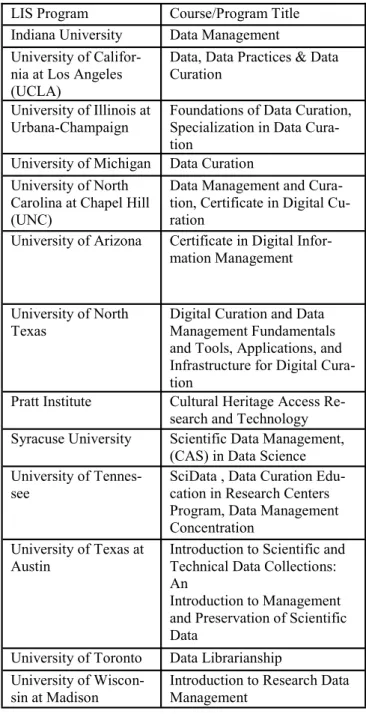
Courses that were singularly and specifically focused on an overview of the lifecycle of LIS Program Course/Program Title
Indiana University Data Management University of
Califor-nia at Los Angeles (UCLA)
Data, Data Practices & Data Curation
University of Illinois at Urbana-Champaign
Foundations of Data Curation, Specialization in Data Cura-tion
University of Michigan Data Curation University of North
Carolina at Chapel Hill (UNC)
Data Management and Cura-tion, Certificate in Digital Cu-ration
University of Arizona Certificate in Digital Infor-mation Management University of North
Texas Digital Curation and Data Management Fundamentals and Tools, Applications, and Infrastructure for Digital Cura-tion
Pratt Institute Cultural Heritage Access Re-search and Technology Syracuse University Scientific Data Management,
(CAS) in Data Science University of
Tennes-see SciData , Data Curation Edu-cation in Research Centers Program, Data Management Concentration
University of Texas at
Austin Introduction to Scientific and Technical Data Collections: An
Introduction to Management and Preservation of Scientific Data
University of Toronto Data Librarianship University of
Wiscon-sin at Madison Introduction to Research Data Management
management and curation of research data were included; thus, excluding courses in metadata, data mining and structures, digital collections, database concepts, data visuali-zation and analysis, digital libraries, and courses on data networks and information systems. The team analyzed the text of the course listings, syllabi, and descriptions and entered the results into a spreadsheet. The researchers reviewed the final sample of courses using Creamer et al.’s (2011) data management competencies as a framework to identify courses that included assignments and lessons that required students to prac-tice these identified competencies: evaluat-ing data formats and provenance, citevaluat-ing data sets, using metadata to describe data sets, preserving and storing data sets, and per-forming data interviews and developing a data management plan.
Results
Thirteen (22%) institutions teaching courses on data management and curation that met the competencies identified above (see Ta-ble 2) were identified. The programs at UIUC and Syracuse University have speciali-zations in data sciences in addition to their courses on research data management. The University of Michigan, the University of North Carolina at Chapel Hill, and the Uni-versity of Tennessee at Knoxville offer courses and grant-funded fellowships in re-search data management. The University of Arizona offers a graduate certificate in digital information management. The University of California at Los Angeles (UCLA), Indiana University, the University of Texas at Austin, and the University of Toronto and University of Wisconsin at Madison offer courses on research data curation and management courses. According to Keralis (2012), the Pratt Institute and the University of North Texas have developed programs. The Pratt Institute is rolling out a Cultural Heritage Ac-cess Research and Technology (CHART) certificate program and the University of North Texas and its iCURATE program of-fers courses on Digital Curation and Data
Management Fundamentals and Tools, Ap-plications, and Infrastructure for Digital Cura-tion.
The UIUC iSchool offers a LIS degree that specializes in data curation. Similarly, Syra-cuse University’s iSchool offers a CAS in Data Science, formerly eScience, and an eScience Fellows program. These schools can offer a comprehensive selection of data-related courses. In addition, the University of Michigan, which joins Indiana University as a Council on Library and Information Re-sources and Digital Library Federation Data Curation Fellowship Postdoctoral Program site, offers a course on the curation of scien-tific data and supports an Open Data Re-search Fellows program. The school has also offered graduate training for Data Shar-ing and Reuse in eScience, and workshops on Data Management and Data Visualization Needs and Priorities for 21st Century Cyber-infrastructure. The University of North Caro-lina at Chapel Hill is one of a handful of LIS institutions offering a certificate in digital cu-ration that has a course on the cucu-ration of research data. It is also the site of the DigCCurr project. This project sponsors multiple LIS initiatives concerning scientific data curation education including the Caroli-na Digital Curation Doctoral Fellowship Pro-gram. The University of Tennessee at Knox-ville has created two programs, SciData and Data Curation Education in Research Cen-ters, to teach research data management and curation to its LIS masters-level stu-dents concentrating in data management. UCLA, Indiana University, the University of Texas at Austin, and University of Wisconsin at Madison serve as examples of how an iSchool or LIS program without a data sci-ence-related specialization or concentration can still offer a comprehensive research data management course. In Canada, the Uni-versity of Toronto offers a course on data librarianship that focuses on the curation of research data and is a partner with the Uni-versity of North Carolina at Chapel Hill on the DigCCur II project.
Discussion
The objective of this content analysis was to gather a sample of courses among the data-related options available at LIS schools that practicing librarians could choose to gain competencies managing and curating re-search data. Similar to Varvel et al. (2012), the above sample shows that there are a limited number of iSchool and LIS programs teaching data science. The team found about half of data-related courses at iSchools and LIS programs were exclusively offered online, and a quarter was available with an online option. Our data suggests that online courses will be very important in educating future data librarians because of the low number of LIS programs teaching data management and the uneven geo-graphic distribution of these courses.
One of the limits of this sample is that some LIS schools may only have temporary grant funding to sponsor these programs or cours-es. In addition, some LIS programs may of-fer multiple courses that cover some aspect of the research data lifecycle. As Helen Tib-bo (2007) noted, “there are several LIS pro-grams offering relevant coursework through multiple courses; however, most LIS pro-grams with a concentration in archives offer relevant, but not fully articulated programs.” As shown by Varvel et al. (2012), not every data course covers the same or same num-ber of competencies; however, students ma-triculating at LIS programs without a data curriculum may be able to take multiple courses within their programs to gain the data-related skills needed to work as data librarians upon graduation. As a result, we would like to extend an invitation to this jour-nal’s readership to keep us informed of the continuing research data management-related course offerings for future and prac-ticing librarians.
Conclusion
LIS programs have not sufficiently embraced research data management as a key
compo-nent of their curricula. However, this trend may be changing. After Simmons College assistant dean Terry Plum presented at the 2012 Science Boot Camp, a recent Sim-mons library school graduate seated in the audience asked him why Simmons- at that time- had yet to create a course focused solely on research data management. He invited the attendees to describe to him what they think this course would look like. He made notes of their suggestions. That sum-mer he began collaborating with the Univer-sity of Massachusetts Medical School Lamar Soutter Library to create a research data management course for Simmons. LIS schools want to evolve in order to better meet the needs of the profession, and we should continue this dialogue and coopera-tion between practicing librarians and LIS programs to identify and teach the data skills that current library roles demand. Hopefully this paper will provide other LIS administra-tors interested in developing such courses with a useful sample of the types of research data management courses available today. LIS schools are just one of several options for librarians interested in data curation. In-deed, there are an increasing number of open access curricula and tutorials online. The University of North Carolina at Chapel Hill and the U.S. National Archives and Rec-ords Administration started the DigCCurr project to create “an international digital cu-ration curriculum composed of openly acces-sible, graduate-level curricular framework, course modules, and experiential and en-richment components and exemplars neces-sary to prepare students to work in the 21st century environment of trusted digital and data repositories” (DigCCurr). Other options for data curation education are through col-laborations with library partners such as Johns Hopkins Data Conservancy initiative or Purdue University Libraries and the Uni-versity of Illinois at Urbana-Champaign’s Da-ta Curation Profiles Toolkit community. This community, for example, describes itself as “an environment where academic librarians of all kinds, special librarians at research
cilities, archivists involved in the preservation of digital data, and those who support digital repositories can find help, support and ca-maraderie in exploring avenues to learn more about working with research data and the use of the Data Curation Profiles Tool” (Data Curation Profiles).
Lastly, regional library organizations will be of significant importance because they can offer a range of continuing and professional development opportunities. For example, the National Network of Libraries of Medicine New England Region collaborated with its regional partners and brought Jian Qin and Diane Hillmann from Syracuse University to New England to host Scientific Data Man-agement and Metadata Professional Devel-opment Days (Professional DevelDevel-opment Day for New England Librarians), as well as Christine Borgman from UCLA to present the keynote address at the 2012 New England E-Science Symposium. In addition, it worked with its partners at WPI to create a data management curriculum framework that is available online (Frameworks for a Data Management Curriculum). At the local level these types of professional development op-portunities will be essential to help support practicing librarians interested in adopting new roles managing and curating research data.
References
Accredited Library Science Programs. Amer-ican Library Association. Accessed Septem-ber 11, 2011.http://www.ala.org/ala/
accreditedprograms/directory/alphalist/ index.cfm
Carolina Digital Curation Doctoral Fellows.
University of North Carolina. Accessed Sep-tember 20, 2011. http://www.ils.unc.edu/ digccurr/aboutII.html#cdcdf
Cheek Fern M., Pamela S. Bradigan. 2010. “Academic Health Sciences Library Re-search Support.” Journal of the Medical Li-brary Association 98, no. 2 (2010):167–171.
doi: 10.3163/1536-5050.98.2.011. Accessed September 2, 2012. http://
www.ncbi.nlm.nih.gov/pmc/articles/ PMC2859272/
Creamer, Andrew, Myrna Morales, Donna Kafel, Javier Crespo, and Elaine Martin. “Data Curation and Management Competen-cies of New England Region Health Scienc-es and Science and Technology Librarians.” Poster presented at the University of Massa-chusetts and New England Area Librarian e-Science Symposium, Worcester, MA, April 2011. http://escholarship.umassmed.edu/ escience_symposium/2011/posters/8/ Creamer, Andrew, Myrna Morales, Donna Kafel, Javier Crespo, and Elaine Martin. “An Assessment of Needed Competencies to Promote the Data Curation and Manage-ment Librarianship of Health Sciences and Science and Technology Librarians in New England.” Journal of eScience Librarianship
1, no. 1 (2012): 18-26. doi:10.7191/ jeslib.2012.1006.
http://escholarship.umassmed.edu/jeslib/ vol1/iss1/4/
Data Curation Profiles Toolkit. Purdue Uni-versity. Accessed September 21, 2011. http://www4.lib.purdue.edu/dcp/
DigCCurr. University of North Carolina. Ac-cessed September 20, 2011. http://
www.ils.unc.edu/digccurr/
Digital Curation Centre. “What is Digital Cu-ration?” Digital Curation Centre. Accessed September 9, 2011. http://www.dcc.ac.uk/ digital-curation/what-digital-curation Digital Curation Education Program. Ac-cessed September 15, 2011. http:// cirss.lis.illinois.edu/CollMeta/dcep.html Escience Fellows Program. Syracuse Uni-versity. Accessed September 15, 2011. http://eslib.ischool.syr.edu
Librari-95
ans. University of Massachusetts. http:// esciencelibrary.umassmed.edu
Frameworks for a Data Management Curric-ulum. University of Massachusetts. http:// library.umassmed.edu/
data_management_frameworks.pdf Gold, Anna. 2010. “Data Curation and Li-braries: Short-Term Developments, Long-Term Prospects.” California Polytechnic State University Digital Commons. Accessed October 1 2011. http://
digitalcommons.calpoly.edu/cgi/ viewcontent.cgi?
article=1027&context=lib_dean
Heidorn, P. Bryan. “The Emerging Role of Libraries in Data Curation and e-science.”
Journal of Library Administration 51, no. 7/8 (2011):662-672. doi:
10.1080/01930826.2011.601269.
Kampov-Polevoi, Julia and Bradley M. Hem-minger. “Survey of Biomedical and Health Care Informatics Programs in the United States.” Journal of the Medical Library Asso-ciation 98, no. 2 (2010):178–181. doi: 10.3163/1536-5050.98.2.014. http:// www.ncbi.nlm.nih.gov/pmc/articles/ PMC2859255/
Keralis, Spencer D.C. 2012.“Data Curation Education: A Snapshot.” In “The Problem With Data.” CLIR Report. http://www.clir.org/ pubs/reports/pub154
Kim, Youngseek, Benjamin K. Addom, and Jeffrey M. Stanton. “Education for eScience Professionals: Integrating Data Curation and Cyberinfrastructure.” The International Jour-nal of Digital Curation 6, no. 1 (2011):125-138. Accessed August 2, 2012. http:// www.ijdc.net/index.php/ijdc/article/ viewFile/168/236
Moen, William E. “iCAMP Curate, Archive, Manage, Preserve.” University of North Tex-as. Accessed May 20, 2012. http://
digital.library.unt.edu/ark:/67531/
metadc83318/m2/1/
high_res_d/20120402_CNI_S2012_iCAMP_ Overview.pdf
Open Data: Graduate Training for Data Sharing and Reuse in E-Science. University of Michigan. Accessed September 16, 2011. http://www.igert.org/projects/228
Open Data Research Fellows. University of Michigan. Accessed September 16, 2011. http://opendata.si.umich.edu/
Perry Gerald J., Nancy K. Roderer, and So-raya Assar. “A Current Perspective on Medi-cal Informatics and Health Sciences Librari-anship.” Journal of the Medical Library Asso-ciation 93, no. 2 (2005):199–205. Accessed September 1, 2011. http://
www.ncbi.nlm.nih.gov/pmc/articles/ PMC1082936/
Plum, Terry. 2012 Science Bootcamp Cap-stone Address. Presented at the Science Bootcamp, Tufts University, June 2012. http://esciencelibrary.umassmed.edu/ science_bootcamp
Professional Development Day for New Eng-land Librarians. University of Massachusetts. Accessed September 21, 2011. http://
libraryguides.umassmed.edu/2011PDD Professional Development Day for New Eng-land Librarians. University of Massachusetts. Cited May 20, 2012. http://tinyurl.com/
bv2kbq4
Rambo, Neil. “E-science and Biomedical Li-braries.” Journal of the Medical Library Asso-ciation 97, no. 3 (2009):159–61. doi:
10.3163/1536-5050.97.3.001. Accessed September 1, 2011. http://
www.ncbi.nlm.nih.gov/pmc/articles/ PMC2706433/
SciData. University of Tennessee. Accessed May 20, 2012. http://www.sis.utk.edu/
Tibbo, Helen R. “DigCCurr: Building a Digital Curriculum.” DigCcurr. Accessed September 21, 2011. http://www.ils.unc.edu/digccurr/ digccurr2007_tibbo.pdf
Varvel, Virgil E., Elin J. Bammerlin, and Carole L. Palmer. “Education for Data Pro-fessionals: A Study of Current Courses and Programs.” Poster presented at the iConfer-ence, Toronto, ON, Canada, February 2012. http://cirssweb.lis.illinois.edu/
DCCourseScan1/Images/ iSchoolPoster2012Final.pdf Funding Statement
This project has been funded by the National Library of Medicine, National Institutes of Health, Department of Health and Human Services, under contract no. N01-LM-6-3508 with the University of Massachusetts Medical School
Disclosure: The authors report no conflicts of interest.
All content in Journal of eScience Librarian-ship, unless otherwise noted,
is licensed under a Creative Commons Attribution-Noncommercial-Share Alike Li-cense
http://creativecommons.org/licenses/by-nc-sa/3.0/