ORIGINAL ARTICLE
How to Survive in a Declining Industry? A study of the clothing
industry in Southern Italy
Nunzia Carbonara
Department of Mechanic, Mathematic and Management Politecnico di Bari, Viale Japigia 182–70126 Bari, Italy;
Abstract:The aim of this paper is to identify possible competitive strategies that guarantee the survival of a declining industry. To reach this aim an explorative empirical research based on a multiple case study design has been developed. The research focuses on the textile and clothing industry and studies seven target companies operating in different textile and clothing subsectors. Empirical results allow to define a strategic business framework consisting of three competitive strategies each one characterized by a strategic goal and implemented by three macro-strategic actions: deindustrialization, internationalization, and leverage networking.
Keywords:Declining industry; competitive advantage; business strategies; textile and clothing sector
1. Introduction
Globalization, intense competition, the information technology revolution, and the increasing customer demand sophistication have radically modified the competitive scenario, the environmental conditions, and the critical factors of success. In the present decade, many mature sectors have tried to meet the challenges posed by the new competitive context, even though in several cases we witness the failing of such attempts and the collapse of many industries. Indeed, in many European regions, due to the strong international competition, mainly from low-cost countries, as well as the structure of the business, such a situation has an even greater painful impact upon local industry and employment levels[1–3].
Among the declining sectors, the textile and clothing industry has experienced a profound crisis. Since 1996, the TCL lost one third of its jobs within ten years. Compared to overall manufacturing, the textile and clothing industry decline was at a significantly higher speed and seems to be continuing indefensibly. For example, in the European Union, between 2000 and 2005, employment in the clothing industry decreased by 19.7% and textile employment by 22.9%[4]. The main factors behind this crisis at the international level are the acceleration of trade liberalization in this sector, the phasing out and definitive end of the Multi-Fibre Agreement, and the success of China and a few other Asian countries on the international markets.
Yet, there are important differences across countries and regions regarding the extent of the declining process and the productivity performance of this industry. Some countries, such as US and the UK, have lost more than half of their textile and clothing employment since the mid-1990s, whereas losses have been more moderate in other countries such as Italy (Table 1).
In the light of this evidence, the paper focuses on issues concerning the competitive strategies and the survival of a declining industry such as the textile and clothing industry. The main questions addressed by the present study are:
Copyright © 2018 Nunzia Carbonara. doi: 10.18686/fm.v3i2.1074
This is an open-access article distributed under the terms of the Creative Commons Attribution Unported License
(http://creativecommons.org/licenses/by-nc/4.0/), which permits unrestricted use, distribution, and reproduction in any medium, provided the original work is properly cited.
Can the textile and clothing industry overcome the crisis?
How can the textile and clothing industry face the challenges due to the globalization and environmental changes? Why some textile and clothing firms are successful and others are failing?
To address these questions an explorative empirical research based on a multiple case study design[5] has been developed. In particular, seven successfully Apulian companies operating in different clothing subsectors have been selected as case study and, for each case study, the business model has been investigated so as deriving potential business strategies that can guarantee a sustainable competitive advantage. Drawing on the empirical analysis a strategic business framework has been defined consisting of three competitive strategies each one characterized by a strategic goal and implemented by three macro-strategic actions: deindustrialization, internationalization, and leverage networking.
Employees Year Employee s
Year Employee s
Year
Variations Approx. 1995-2000
Approx. 2000-05
Approx. 1995-2005
Germany 256.600 1995 215.000 2000 161.000 2004 -16,2 -25,1 -37,3
Italy 580.128 1995 503.000 2000 434.100 2004 -13,3 -13,7 -25,2
UK 330.345 1995 266.300 2000 139.000 2004 19,4 -47,8 -57,9
US 1.338.136 1995 1.087.000 2000 637.000 2004 18,8 -41,4 -52,4
Source:[3].
Table 1.Employment in the textile and clothing industries since the mid-1990s
2. Methodology: Research Design and Data Collection
This paper applies a multiple case study design[5]. A case study approach was selected to provide a ‘thick description’ of the business models adopted by firms under investigation. The main advantage of this methodological approach is local groundedness which helps uncover latent and underlying issues within each single setting. In order to derive a framework of potential business strategies that can guarantee sustainable competitive advantage for declining industries, the study focuses on the textile and clothing industry that has been experienced a profound crisis by suffering the global competitive pressures[6]. In this industry, seven target companies operating in different clothing subsectors have been identified.
In each setting, the fieldwork was conducted over a period of three months using several data collection techniques.
The research integrates qualitative and quantitative data collection methods and consists in two stages. At the first stage, an explorative study addressed to mapping the textile and clothing sector in the Apulia region has been carried out. This stage involved: i) the collection of documents, data, and information extracted from the annual reports and the relations of Associations, Chambers of Commerce, and Research Institutes; ii) in-depth semi-structured open-ended interviews with key informants and local institutional actors. The outcomes of this study have been the characterization of the sector in the Region and the selection of the target companies for the case study.
At the second stage, the multiple case study has been carried out through face-to-face in-depth interviews. The interviews followed a semi-structured questionnaire intended to reveal the company profile, the business models, as well as the characteristics of both production processes and inter-firm networks. In particular, the questionnaire covers the following areas of investigation: (1) company background and internal organization; (2) innovative activity and sources of knowledge; (3) linkages with local and external subcontractors/client firms; (4) horizontal linkages with district firms and institutions; (5) internationalization.
3. The Textile and Clothing Sector in the Apulia Region
and ranks among the six Italian regions for importance of the textile and clothing industry, both for number of firms (about 7,000) and the number of employees (about 38,000). The specialization is mainly the production of clothing and knitwear, whereas textile production (yarns and fabrics) was significantly reduced compared to the past. In the years 2000-2003 the productivity of Apulia showed a stagnation. Tables in the follow show some relevant data, classified by production specialization and geographic area, which give concise indications about of the size and the trend of the sector in Apulia, in terms of employment and number of firms.
Years
Total firms
Active New Registered Closed
1996 6.724 454 503
1997 6.764 704 735
1998 6.812 599 614
1999 6.886 515 521
2000 6.933 408 508
2001 6.993 513 537
2002 7.009 500 607
2003 6.903 355 534
2004 6.600 317 720
2005 6.332 273 619
2006 5.996 263 678
2007 5.713 252 674
2008 5.686 279 769
2009 5.225 236 792
2010 4.945 218 643
Source: Infocamere.
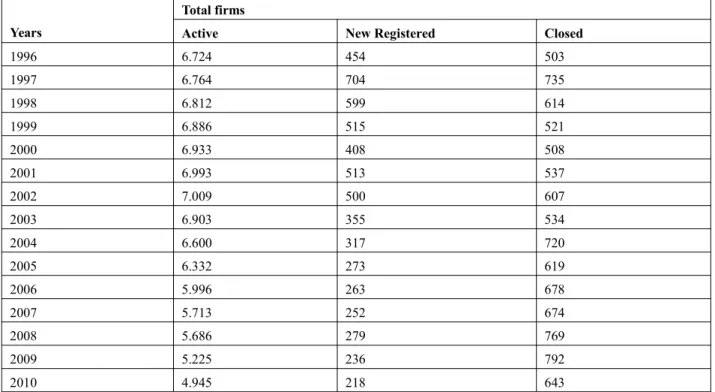
Table 2.Number of textile and clothing firms in Apulia Region: active, new registered and closed (19962010)
Figure 1shows that the number of active firms raises from 1996 to 2002 by 4,2% whereas decreases from 2002 to 2010 by 29%. The closed and new registered firms have the same trend up to 2002, then the number of closed firms increases by 6% and the number of new registered firms decreases by 56%. Table 2 compares years 2001, 2005, and 2009 in terms of number of active firms and number of employees. It is interesting to note that a reduction of the number of firms (of 17% from 2005 to 2009) did not cause a drop in the number of employees, which increases of 4% in the same period. This is probably due to the fact that the companies that cease their activities are micro-firms and the companies that are still active increase their size.
Figure 2 shows that the industry is spread in all the 5 provinces of the region. Even if there is a strong concentration in the province of Bari that accounts the 56% of firms and a strong polarization in terms of industry specialization. In fact, the industry is almost entirely specialized in the clothing sector with about 80% of the total firms.
Figure 1.Trend of textile-clothing sector in Apulia region: active, new registered, closed, 19962010.
Source: Infocamere. 2001 2005 2009
Number of Firms 6.988 6.332 5.225
Number of Employees 37.373 28.322 29.405
Source: Movimprese.
Table 3.Number of active firms and employees in the textile-clothing sector
Figure 2.Number of firms for provinces and industry specialization (2011) Source: Infocamere.
Data reportedFigure 3confirm that the sector is mainly characterized by the presence of small firms.
Source: Istat (2001).
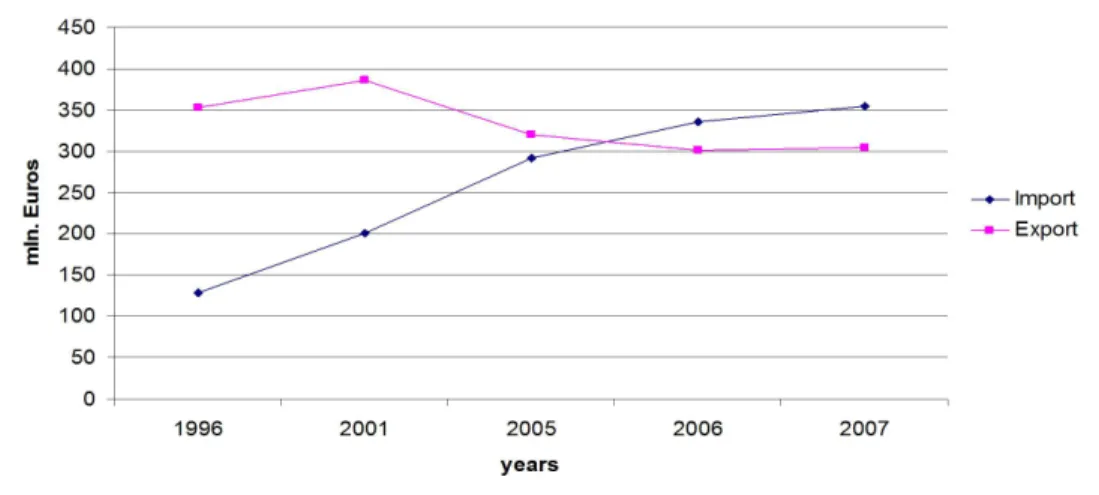
To complete the analysis of the textile and clothing industry in Apulia it is interesting to analyze the data on imports and exports in the last years. Data reveal a raising trend of imports and a decreasing of exports, which caused a negative balance for 2006 and 2007 (Figure 4). This can be explained as an effect of the delocalization process, which implies that domestic companies purchase products made abroad and then commercialize them with their brand.
Finally, to remark the strong vocation of the region in the clothing sector rather than in the textile, data of import and export detailed for the two sectors are reported in Table 4.
Figure 4.Import and export of the Apulian textile and clothing sector (1996-2007) Source: Istat-Coeweb.
Specialization
Import Export
1996 2001 2007 1996 2001 2007
Textile 92.180.979 125.981.903 164.125.625 91.197.853 111.746.950 77.416.931 Clothing 36.527.555 74.956.783 189.684.120 260.971.066 273.685.283 226.889.072
Source: Istat-Coeweb.
Table 4. Import and export for product specialization (1996, 2001, 2007)
4. Case Study Analysis
Case studies involved the following seven Apulian leading firms, each specialized in one textile and clothing subsector: Mafrat S.p.A. (children’s clothing), ITN S.p.A. and PRIAMO Ltd (outerwear and men’s clothing), Nocese Manifatture Ltd (Shirts); PSV Ltd (knitwear), Andra Lingerie Ltd (Underwear and Lingerie), Govanna Sbiroli Ltd (Wedding and party clothes).
The information gathered through the empirical study are reported in the follow according to the relevant areas of investigation, such as: (1) company profile and subsector main characteristics; (2) products; (3) innovative activity; (4) the production model, (5) the supply chain; (6) the marketing strategies; (7) horizontal linkages.
4.1 The company profile and subsector characteristics
The general data on the textiles and clothing sector in Puglia show that the region is mainly populated by small and medium-sized firms still far below the national average, but also by leading companies in related markets.
In particular, as for the baby and kids wear subsector, mainly localized in the municipality of Putignano, Mafrat SpA can be considered a leading firm with a turnover exceeding 20 million Euros and 150 employees. The company has a long tradition in the baby and kids wear production, it started in the 1944 the production of knitwear for babies and in the '70s Mafrat SpA counted about 300 employees and a significant quota of exports. Since 2000, thanks to the licensing of leading brands, there is a turning point: a significant business growth, in terms of turnover, and a
competitive success on the high market segments.
In the same area of Putignano, a few number of medium-sized firms (Gimel, Vuemme, Lavis, Loredana), 25 small firms and more than 50 micro firms were also surveyed.
Martina Franca is the municipality with a greater concentration of firms specialized in the production of men’s outerwear. Here is localized ITN SpA, leader firm in the menswear subsector with a turnover of over 20 million Euros and 230 employees. In the last five years, the company has undertaken a profound change in its strategy by focusing on the brand affirmation and strengthening. Currently, the ITN SpA is targeting a mid-high market segment, selling a total look menswear with the Angelo Nardelli brand. Also important is the quota of export (40% of the total turnover).
The changing process has also involved the company organizational structure. In fact ITN SpA is part of an industrial group formed by two other companies:
The 3 Enne Ltd, that produces and sales products for a mid-market segment, with a turnover of about 6.5 million Euros;
The NAF Ltd, that manages the network of franchised stores, with a turnover of approximately 4 million Euros. Not less important is the presence of few competitive firms in the municipalities of Bitonto and Noci, such as PRIAMO Ltd and Effedue Manifatture. However, the size of the men’s outerwear subsector is quite difficult to quantify (approximately 200 companies with 3.000 employees are estimated), while is not very relevant the production of women’s outerwear.
As far as the wedding party clothes, the subsector counts more than 1.000 employees. Overall, the production of wedding party clothes carried out in Puglia (Putignano, Lecce, Spinazzola, and San Severo are the municipalities with a greater concentration of firms) covers about the 80% of Italian production. It is worth noting that over 50% of Apulian firms acts as subcontractors of leader firms located in the Northern Italy. In the municipality of Putignano, one of the most important wedding dresses district in Italy, there is a few number of small but well-structured companies including Govanna Sbiroli Ltd, Valentini, Val & Max Sposa, and about 100 micro-firms.
Regarding the production of shirts, the sector registers about 700 employees. In the municipality of Noci, is located the Nocese Manifatture Ltd, better known by the brand Harry & Sons: a leader company in this subsector and among the largest in the province, whose production is more than 800.000 shirts a year. In the same area are located about 200 micro-firms, which are suppliers and subcontractors of the leader firms.
Regarding the production of underwear and lingerie, mainly localized in the municipalities of Canosa and Andria, the data show the presence of about 10 well-structured firms with turnovers between 5 and 15 million Euros, among these Andra Lingerie Ltd, and about 500 micro-firms.
The knitwear industry is mainly located in the municipality of Barletta. This subsector more than the others has suffered the international competition. Nevertheless, there are some successful firms, such as PSV Ltd, Gordon Confezioni (both located in the municipality of Cassano) and New Linea Elle (located in Barletta), that have undertaken a profound organizational and strategic changing process, by repositioning their brands on the high-middle market segments.
In particular, in the last six years PSV Ltd, specialized in the production of knitwear for women, has carried out three main changing processes:
registration of a brand, with the consequent repositioning on the medium-high market segment; outsourcing of the entire manufacturing process to local subcontractors;
focusing on two functional areas: the new product development and the marketing. 4.2 Products
The production of children’s clothing is targeted for mid-high, premium, and luxury market segments. Products range from outerwear (pants, skirts, shirts, jackets) to specific items, such as caps, track suits for babies, up to the production of total look.
Regarding the production of outerwear, there are some firms positioned on the mid-high and high market segments together with a large number of firms targeting to the mid-market. The former are also organizing their own sale and distribution networks. As for the production of wedding party dresses, firms place their products in medium-high or high market segments. Firms specialized in the shirt production target their products to medium and medium-high market segments. Regarding the production of underwear and lingerie, only few firms have repositioned on a medium-high market segment, while most companies target their products in the mid and cheap market segments.
A similar scenario characterizes the knitwear subsector, where some companies target the high-middle market segment, while most companies place their products in the mid and cheap market.
4.3 Innovative activity
Innovations carried out by the Apulian textile and clothing firms are essentially product innovations, and basically consist in the development of new models and collections. It seems rather scarce the attention of local companies to innovate products by adopting innovative materials or by searching for new functionalities of the textile materials.
Among the interviewed companies, PSV Ltd (knitting industry), Andra Lingerie Ltd (underwear and lingerie), and ITN SpA (men’s clothing industry) rely on one or more external designers as well as a style internal office. For the new collections development, Mafrat SpA (children’s clothing industry) and PRIAMO Ltd (man’s outerwear) rely exclusively on internal design functions consisting of different professions, such as fashion designers, model makers, and prototypists.
In all cases, the new model development process consists in the following main steps: market analysis, sales analysis, analysis of competitors, materials research, stylistic research and development of new models, fitting, pricing, production of the samples.
Referring to the process innovation, is well established and widespread the adoption of automation technologies (such as NC, CNC) to increase the efficiency of the manufacturing processes; automation technologies to support the design (CAD), and information technologies to support the management processes and information processing. Information and Communication Technologies for the organizational and inter-organizational coordination are mainly adopted by leading companies.
Real R&D projects have been developed by ITN SpA, Nocese Manifatture Ltd, and Giovanna Sbiroli Ltd. The former has developed an innovative system based on the RFID (Radiofrequency identification) technology that allows the control the entire production process from the fabric cutting phase up to the completion of the end product. Nocese Manifatture has launched a project aimed at optimizing the production of custom-tailored shirts in order to personalize not only the fitting but also the tissue composition. A further project concerns the treatment of fabrics and it is aimed at increasing the product performance when subjected to specific conditions of washing, perspiration, etc.
Giovanna Sbiroli together with the University of Bari has been involved in a R&D project aimed at developing an instrument for measuring the human body that uses photogrammetry. Such a tool would be a real fitting automated station for the retailers that would allow the following advantages:
the reduction of the fitting time and of the data transfer from the retailers to the producer;
a higher precision in the fitting and in the measurement data transfer. The latter will be directly transferred to the CAM system of the producer;
solving the problem of the lack of the retailers’ tailoring skills.
4.4 The production model
The analysis of the textile and clothing sector in the region reveals that most of the companies located in Puglia is specialized in the production of clothing or knitwear items and/or in specific phases of the production process, namely cutting, sewing, ironing, etc.. This is confirmed by the fact that the presence of firms in the upstream supply chain is very limited, only 2% of the Apulian firms dealing with spinning and weaving.
final firms that sell their products both with their own brand name and/or with licensed brands; and specialized subcontractors, including workshops and specialized embroiderers. The latter hold handicraft skills and know-how and operate in the most labor-intensive phases of the production process characterized by poor economies of scale.
As for the production of outerwear, we find companies that produce and sell with their own brand name and in the meanwhile are subcontractors of other domestic and foreign companies. We find also a great specialization of the subcontracting companies on the production of a few types of items that are carried out on a large scale with the consequent reduction of the unit costs.
As regards the production of wedding dresses, the different phases of the production process are decentralized to local small sized companies. The production process is highly labor intensive and requires a specialized skills (70% of the production is "handmade") and handicraft know-how.
The production of shirts is characterized by a capital-intensive production process and focuses on a few types of items, carried out on a large scale. Firms in this subsector mainly produce internally their products; subcontractors are mainly involved in the cutting and sewing phases.
The production of underwear and lingerie is characterized by a higher level of automation, but also in this case there is an extensive use of local subcontracting firms. As for the knitting subsector, we find wide networks of local suppliers and subcontractors, mainly specialized in small-batch productions.
All the interviewed firms are interested by processes of decentralization and recur to local suppliers and subcontractors for carrying out specific production phases, parts of the product, or for the production of the finished product.
In particular PSV Ltd and Mafrat SpA have outsourced all phases of the production process except the production of the samples. PSV Ltd employs a network of about 15 local subcontractors. Mafrat SpA uses nearly 700 indirect employees in Italy and about 1000 indirect employees in the Southeast Asia. ITN SpA for the high-quality products recurs to about 500 indirect employees located in the region and throughout the country. It produces internally only the jackets while the complementary products that form the "total look" (trousers, shirts, coats, accessories) are made by external companies. As for the lower-priced products trade with a different brand, ITN SpA has decentralized the great part of the production to Chinese partners.
PRIAMO Ltd has partly decentralized in East Europe the production of the more standardized products.
4.5 The supply chain
Figure 5shows a scheme of the SC of the interviewed firms. The supply network consists mainly of: third parties, which are assembling firms; subcontractors, which are suppliers of semi-finished product, raw material suppliers, and components suppliers (others).
The distribution network is formed by two stages: the first-tier stage is made up of wholesalers and agents, the second-tier stage is made up of independent shops, retailers, distributors, and franchisers.
Figure 5also shows the types of links used in the supply and distribution networks. As to the supply network, the final firms have managed relationships with third parties, local subcontractors, and components suppliers located in Italy. All other links are not-managed.
As to the distribution network, the links are both managed and monitored.
The degree of internationalization of the supply chain varies from firm to firm and from sub-sector to sub-sector. The degree of internationalization of the supply market changes from firm to firm as well as from product to product. A strong degree of globalization characterizes the largest companies that are able to manage the logistic activities more efficiently. As an example, Mafrat supply chain: the 60% of the suppliers are localized abroad mainly in South-Eastern Asia and Eastern Europe and over 30% of its total turnover is exported. However, for products that require handcraft skills or products target to premium market segments, companies still rely on the local supply network.
Figure 5.The SC of the interviewed firms
4.6 The marketing strategies
In the recent years, companies are setting up new marketing strategies with the aims of increasing their export share, differentiating respect competitors, and improving the relationships with customers. Such marketing strategies can be summarized in:
Strengthening of company brand: ITN SpA promotes the trademark Angelo Nardelli and PRIAMO Ltd uses the trademark Park House. The leading company in the shirts production sells its product with its own brand (Harry & Sons).
Opening to international markets: PRIAMO Ltd has been engaged in the last years in an international project aimed at opening a retail chain in China;
Developing vertical market systems (e.g. Franchising): Nocese Manifatture Ltd has set up a network of 80 franchises that cover the entire national market and part of the European market. Recently, ITN SpA distributes through a network of franchised stores;
Licensing of prominent trademark: Companies that produce children’s clothing mostly have their own brands but are also licensee of very prominent trademark, such as Ferrè, Laura Biagiotti, Mariella Burani, Byblos, Versace, Roberto Cavalli.
4.7 Horizontal linkages
The analysis aimed at identifying the presence of cooperative agreements or strategies among similar companies. Spontaneous associationism and cooperative attitude have led to establish strong connections among firms and the creation of consortia in almost all the subsectors.
In particular, we find three main specialized consortia: one of 45 companies specialized in the production of children’s clothing, accounting for more than 600 employees with a total turnover of about 70 million Euros; another formed by 10 companies specialized in the production of wedding clothes, with 200 employees and a turnover of about 15 million Euros; and a third one grouping five companies of the outerwear subsector.
Finally, we find the consortium Texitalia, formed by complementary companies specialized in different subsectors: PRIAMO, Matesma, PSV, Andra Lingerie, and Gordon.
Consortia are mainly created to overcome the limitations due to the small size of the firms. They essentially aim at launching joint marketing strategies, supporting the promotion of a local brand, and promoting internationalization program.
Third
Final firms
Not-Managed links
Distribut Subcontractor
Raw material suppliers (fabric)
Other suppliers
Managed links
Shops Retailers Distributors Franchisers Wholesal
5. Cases Analysis
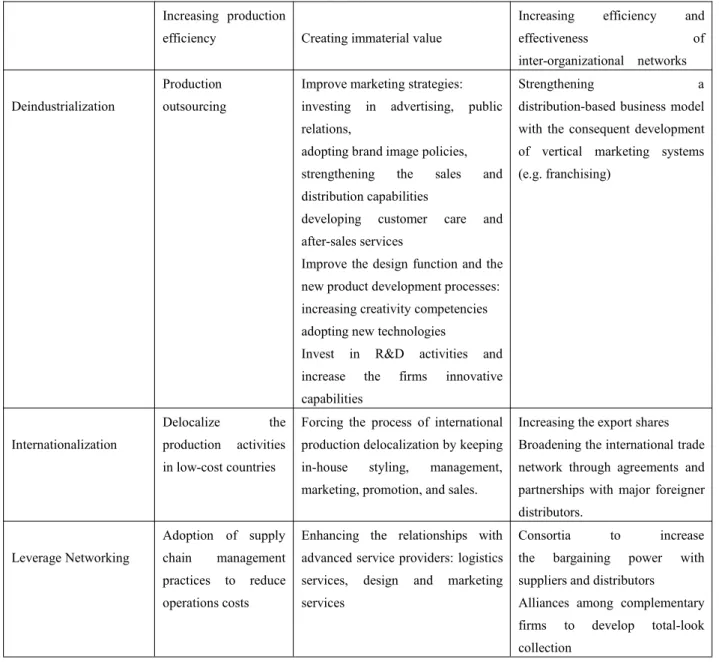
The cases presented in this study allow possible evolutionary patterns for a declining industry to be identified. In particular, drawing on the analysis of the leading companies’ business models and organizational policies and practices, it is possible to define a strategic business framework consisting of three competitive strategies each one characterized by a strategic goal and implemented by three macro-strategic actions: deindustrialization, internationalization, and leverage networking.
In the follow the three strategic goals are listed:
Goal 1: Increasing production efficiency, through technical change, exploitation of scale economies, and cost reduction.
Goal 2: Increasing profits by creating more immaterial value;
Goal 3: Increasing efficiency and effectiveness of the inter-organizational relationships, by improving the relationships with distributor/supplier, by expanding the distribution/supply channels, by developing partnerships.
In Table 4 the organizational policies and practices adopted by the interviewed firms to implement the three competitive strategies are summarized.
Increasing production
efficiency Creating immaterial value
Increasing efficiency and
effectiveness of
inter-organizational networks Deindustrialization
Production outsourcing
Improve marketing strategies: investing in advertising, public relations,
adopting brand image policies, strengthening the sales and distribution capabilities
developing customer care and after-sales services
Improve the design function and the new product development processes: increasing creativity competencies adopting new technologies
Invest in R&D activities and increase the firms innovative capabilities
Strengthening a
distribution-based business model with the consequent development of vertical marketing systems (e.g. franchising)
Internationalization
Delocalize the production activities in low-cost countries
Forcing the process of international production delocalization by keeping in-house styling, management, marketing, promotion, and sales.
Increasing the export shares Broadening the international trade network through agreements and partnerships with major foreigner distributors.
Leverage Networking
Adoption of supply chain management practices to reduce operations costs
Enhancing the relationships with advanced service providers: logistics services, design and marketing services
Consortia to increase the bargaining power with suppliers and distributors
Alliances among complementary firms to develop total-look collection
6. Conclusions
This paper presents the results of an explorative empirical research based on a multiple case study design. Seven successfully Apulian companies operating in different clothing industry subsectors have been selected as case study and, for each case study, the business model has been investigated so as deriving potential business strategies that can guarantee a sustainable competitive advantage. Drawing on the empirical analysis a strategic business framework has then been developed, which characterizes possible competitive strategies for a declining industry. The framework distinguishes three competitive strategies each one characterized by a strategic goal, namely: i) increasing production efficiency, through technical change, exploitation of scale economies, and cost reduction; ii) increasing profits by creating more immaterial value; iii) increasing efficiency and effectiveness of the inter-organizational relationships, by improving the relationships with distributor/supplier, by expanding the distribution/supply channels, by developing partnerships.
Each strategic goal is pursued by implementing three macro-strategic actions: deindustrialization, internationalization, and leverage networking.
The proposed theoretical framework is a premise to derive managerial guidelines for firms operating in declining industries.
Additional research could further validate the framework generality through new case studies.
References
1. Djelic M, Ainamo A. The Coevolution of new organizational forms in the fashion industry: A historical and comparative study of France, Italy, and the United States. Organization Science, 1999, 10 (5): 622–637. 2. Filatotchev I, Toms S. Corporate governance, strategy and survival in a declining industry: A study of UK cotton
textile companies. Journal of Management Studies2003, 40(4): 895–920.
3. Reinecke G. Upgrading or decline? Globalization, retail structure, and labour in the chilean textile and clothing industry, competition and change. Competition & Change 2010, 14(1): 23–47.
4. Institute Français de la Mode, Study on the competitiveness, economic situation and location of production in the textiles and clothing, footwear, leather and furniture industries. final report, Vol. 1. Report for the European Commission, Enterprise and Industry Directorate-General, Paris,2007.
5. Yin R K. Case study research, design and methods (Beverly Hills, CA: Sage), 1989.
6. Schiattarella R. La delocalizzzione internazionale: problemi di definizione e delimitazione. Un’analisi per il settore del Made in Italy (in Italian). International delocalization: problems of definition and delimitation. An analysis for the Made in Italy sector. Economia e Politica Industriale, 1999, 103.